QIP, IPO, Bubble. Why Swiggy, Zepto, and Blinkit see quick commerce differently
from Two by Two
70m 51s
This episode of 2x2 discusses the escalating quick commerce battle among Swiggy, Zepto, and Blinkit. Swiggy, despite its recent IPO, is raising another ₹10,000 crore to fund its competition, while Zepto’s fee-dropping strategy forces Swiggy to copy its moves. Blinkit, the market leader, remains confident, with its CEO predicting a bubble burst. Ambit Capital’s Ashwin Mehta provides a bearish perspective, arguing that quick commerce is a restricted market limited to 100-200 cities, with dark store penetration already high. He estimates India can support only about 12,000 dark stores, and current expansion plans from all players already reach 8,500-9,000, limiting growth potential. He also questions the bull case of high advertising revenue and unlimited market size, noting India’s low urbanization and online grocery penetration. Anand Kalyanraman adds that Swiggy’s need for fresh funds signals desperation, and its reliance on “adjusted EBITDA”—a fictional metric excluding key costs—masks poor operational performance. The discussion underscores the unsustainable nature of the current discount war, with Swiggy falling behind in market share and stock performance, while Blinkit and Zepto push aggressive expansion. The episode concludes that the quick commerce race remains unsettled, with analysts divided on its long-term viability.
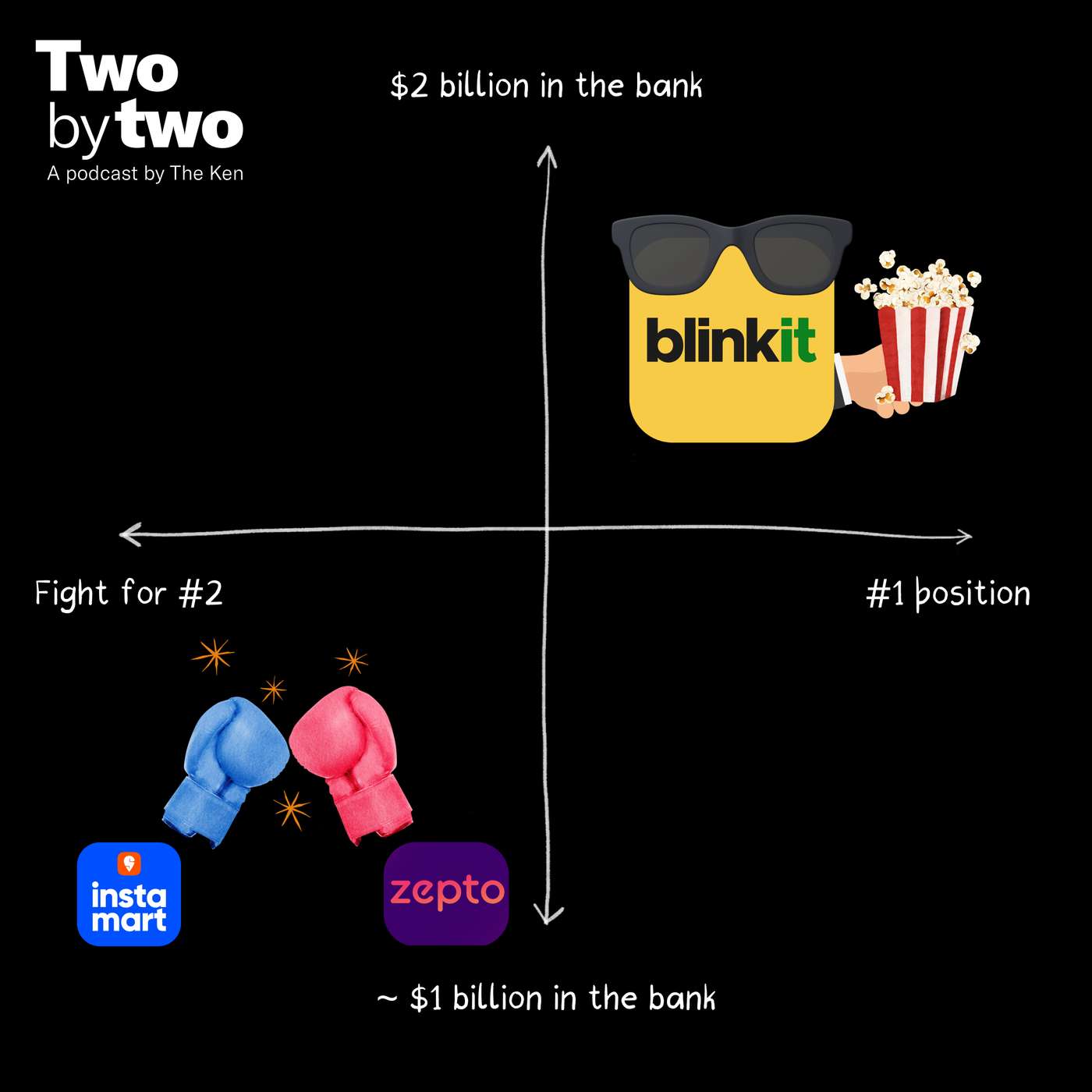
Welcome back to another episode of 2x2 and this week's episode is on quick commerce and swiggy and zepto and eternal and the future of what we thought was a battle which was somewhat settled but it doesn't look anywhere from settled. I have two wonderful guests. I'll introduce my first guest. My first guest is Ashwin Mehta who is the head of research at Ambit Capital who is joining us from Mumbai. I was briefly looking up Ashwin's LinkedIn before the episode and he has over two decades of experience just in stock research and analysis. Right? So I'm excluding the experience that he had before that because I think Ashwin you didn't have experience on the technology side on the engineering side as well but over two decades of experience analyzing and understanding Indian stocks in the Indian stock market is not a joke. Yeah. And I'll come back to why Ashwin and his opinions are so important. Ashwin, are you more right or more wrong in your two decades of doing stock analysis? Ashwin, it's been a mixed bag. I think the biggest learnings have been when I've been wrong. So that's nice. That's usually that's great right? Because I think it's like when we're wrong where the feedback loops are strongest on ourselves because when you're right you sort of tend to overlook it and move on to the next thing right? It's like when you're wrong then you kind of go back and like revaluate your priors as they say. Which brings me to my second guest who's actually in Bangalore and was scheduled to be recording with us at the Ken Studios. But Alas is not because he's come down with a flu is my colleague Anand Kalyanraman who's the finance editor at the Ken. Welcome Anand from your heightened flu inspired situation. Hey guys, thank you. Yeah. It's great to have you, Anand. I'll just say that I'm also happy. I mean, I'm not that happy to that. Anand is not in this today, but I'm also happy because I don't want to get a viral infection. So for listeners, I mean, come to office today. Yeah, yeah. This is not some AI filter we have put on Anand's voice. So his voice is going to be a little bit what, creaky squeaky today we'll find out. Thank you. And that of course was Praveen Gopal, Krishna and my co-host and I'm Rohind Dharmakumar. And with that, let's dive into this episode. When we schedule this episode actually, some of the news items still hadn't played out completely. So it looks like news is coming at this episode faster than I can keep track. So I didn't interrupt you, but some news was published and also deleted. That's a different story. We'll talk about that. That's right. Since you mentioned it, Praveen, I'll actually mention what was published and deleted around two weeks ago. There was this news report which came out on money control, which reference and HSBC study if I'm not mistaken. Yeah, it was a combination of HSBC and Redsia. So it was I think an HSBC report that kind of reference a Redsia report or something like that. I didn't write the story for you. Yes. And what was the story? The story was that Swiggy has fallen further behind in its market share in the quick commerce space with of course number one being blanket, number two being Zepto, which had apparently overtaken it even more and Swiggy being at number three. Strangely, I think over a day or two later, there was this press release that Swiggy sent out to the exchanges where it said that, you know, was it Swiggy or was it? It was Swiggy. So Swiggy sent out this press. Yeah, it was a notice to the exchanges and I believe what they said was they had a copy of a letter from Redsia saying that we did not commission any such report or something like that. Right. No, no, no, no, no, the so I understand these press releases are at dance in themselves. So the press release set, Redsia set, we have not shared this information for this purpose. Right, I can already tell my head imagine lawyers typing out saying, please mention the specific context so that you are only denying a specific context and not overall. But anyway, what essentially happened is it looks like Swiggy objected to that news report and suspiciously a day later if you went to the money control site, that article was deleted. There was no note about what happened. It was as if that article had never existed at all. But that in some senses was the trigger for us to do this episode saying because now let me talk about the three things which are sort of intersecting today and we'll dive in right after that. First point, Swiggy shareholders approved a qualified institutional placement for it to raise another 10,000 crores. Just last year Swiggy had done its IPO and just over a year later it is raising another 10,000 crores primarily to compete in the quick commerce space. Of course, Zepto raised $450 million in October just less than a couple of months back and it is using it to rapidly and aggressively expand its market share. And third, which is very important is just today there was this like the third player in all of this is Blinkit because in some senses the fight seems to have moved towards Swiggy slash Insta Mart versus Zepto and the number one player is sort of sitting pretty, saying no one's questioning me. I am Blinkit. I am a Zomato. And it also gives them the luxury of being very zen and sage like sage like you sort of imagine that sage like people are like look this will all settle down don't worry. Instead sage like Blinkit and it's CEO Albin the Dinsize actually pouring ghee onto the fire by saying India's quick commerce bubble may be close to bursting. It is an interview that he did with Bloomberg. That's right. Yeah, but I think the most interesting part about that interview was right at the very end. He says that the bubble will burst. It may take a few weeks, it may take a few months but it will burst. We're not worried. We're far ahead of everyone else. Which you could say about anything but okay sure good right. That's right. So the three way race in some senses all the things that sort of came together is Swiggy needs to raise another 10,000 crores to compete in quick commerce. Zepto raised $450 million and Zepto once again is forcing everyone to blink because after it raised that it said you know what we are dropping fees on everything no fees charge at all and every day low prices and surprise surprise if you open up this Swiggy in Stamart app now every time you place an order it places this banner right in front of you saying that zero charges we will mess. So in some senses Swiggy is once again copying what Zepto is doing and of course Blinkit is there saying that look all of this not sustainable is coming down. I believe it's called Max Saver and I think it's mentioned in the report we talked about. I don't know because Swiggy actually has so many products and so many means that it's hard to keep track of after a while they keep spinning up things and shutting down things. Now with that context and background of all of this chaos that is happening and of course unsaid thing and all of this is that both Swiggy and Blinkit's parent eternal are listed and Zepto is desperate to get listed it's mostly it says that it wants to get listed in 2026. Now this is the context right. We thought that this was sort of settled as we come at three haas race. People are okay Indians are okay paying fees to order quick commerce. Suddenly you have two of the players saying we are not charging fees and once again the battle seems to have shifted back towards discounts and subsidies and expansion and beggaring the in the middle of all of this. You have to sort of wonder how our analysts treating this how are they watching this because this does not seem sustainable right. So in some senses quick commerce is India's version of the AI bubble. Globally we have this is not sustainable this cannot be sustainable we don't have that in India thankfully yet. So the parallels continue because just like how Sam Alpens says yes yes the bubble will burst I can imagine Alvinder Rinsar saying something very similar yes yes the bubble is good to buy. The leader can always say the bubble will burst because I'll be the one left standing. Exactly. There is one analyst firm that has almost consistently been holding a bearish view and I'll explain I'll ask of course Ashwin to kind of explain that on this overall space and especially on Swiggy which is Ambit. I was referring to multiple Ambit reports over time there was a report from April this year where it said look this is non-sustainable we have a sell on Swiggy and most recently in October and in November as well Ambit has put out reports saying that this 10,000 crores that they're raising is not enough to kind of achieve any kind of leadership it is not enough to get sustainable. In fact they've gone out of their way everyone in India right now if you meet them they think that quick commerce is going to eat everything therefore the opportunity so vast that it makes sense to kind of go all in and Ambit is so
of saying that look this market is limited to about 100 to 100 cities and even in those 100 to 100 cities if you really look at it we've already achieved close to 70% of possible dark store penetration. So the upside is sort of limited and right now Amit has a cell on Swiggy and with this larger and longer than usual context I'm going to ask Ashwin. Ashwin why are you and why is Amit in some senses the contrarian when it comes to quick commerce and Swiggy and the long term prospects or not even long term less next 12 to 24 months. So I think three reasons for our watch stands in terms of quick commerce. So there are say three bull cases in quick commerce if you were to look at it. The first one is that it's an unrestricted opportunity almost everything with will get sold on quick commerce. The second is that the profitability will be driven by substantial bump up in terms of advertising as a percentage of GOV which can touch as high as 78% of GOV over a period of time. I think the third thing which we think the market appreciates unless is the fact that competitive intensity is here to stay. It's a large enough space for nobody to throw in a toggle at this point in time. So I'll maybe elaborate in terms of in terms of these three aspects. The first is quick covers in our view is a restricted market to the top 50 hundred cities where there is density. Even if you were to assume and what you mentioned in terms of in terms of how many stores or dark stores can India support if we take a optimistic estimate of say 200 cities India has around 32 crore population in these 200 cities which is around 8 crore households. Even if you assume for simplicity say 60% of those can actually afford something like quick commerce that's closer to 5 crore households. Current frequency of either blanket or swing in stomach is somewhere in that range of 2.8 to 3.5 times. So even if you assume a 10 time frequency so you're ordering once in 3 days on the platform and typically most of these companies would open up a new dark store when there are say 2000 orders per day. So if you do that back calculation around 12000 stores is what India can kind of support. And if you look at the outlooks that have been given by all the players over the next year which is say by March 27. Some of like a blanket is touching say 3000 dark stores. Swingy and Zepto should be at least 1500 or dark stores there. Add to that what Amazon is adding what Flipkart minutes is adding where big basket is right now. And then you have also a reliance retail which is there. So in total you have visibility of between 8520 to 9000 dark stores. So one is this factor that limits the growth because you reduce the orders per dark store. It hurts the economics. It's a utilization based business wherein someone like a Swiggy requires 1800 plus orders per day per dark store to break even and someone like a blanket requires 1300 30 almost 1400 plus orders because their average order values are higher. So yeah the multiple factors why the breakeven is lower for say blanket versus Swiggy. One is of course there on an order value basis both are similar or in a no v basis. So my store is still higher. That would be the net order value. Yeah net order value which is discount across platforms manufacturers brands etc. On a take rate basis in some art is lower compared to a blanket from a fixed cost perspective. Blink it is somewhere closer to 4.5% of GOV Swiggy is at almost 9.5% of GOV. So effectively currently the economics are such that you have a minus 1% adjusted a bit up for say blanket versus a 12% negative a bit up for a Swiggy. So which is which is where the breakevens are higher till Swiggy gets their fixed cost. Got it. And let you go into the other two points but just specifically on the dark store point. You're basically saying that at a fundamental level you're saying look india can support whatever somewhere around 12000 doxos based on the calculations that you've made and I'll take the calculations at face value and you're basically saying that right now we are somewhere at the 8500 so we have almost hit there. So that is one reason reason number one why you believe that yeah there is probably this thing is not there is certain like you know I won't want to say pessimistic but you're basically like you're looking and being taken in your words a cautious view of this. Someone who's taking the bull case and saying that no no there is actually like immense growth possibility will probably argue and say that look I understand that you have gotten like 70% of dark stores in terms of this number but all these dark stores are very poorly run they're very inefficiently run so you shouldn't just go by number of dark stores so even though they will increase or they will stay where they are the additional throughput that all of these dark stores will generate. Sorry how what does that mean like let's let's take the unit of a dark store once it's up and running what you I mean what's in some senses it's like what are the number of orders that come into it. Sure. And what is the number of orders that it fulfills and how efficiently does it fulfill those orders. Sure. So through this are people implying that it can be done more efficiently the cost of running a dark store can be optimized. I think the the biggest call here is is where does the online grocery penetration reach in India. Now if you just were to compare say globally the other countries out there say South Korea would be the highest at almost a 24% online grocery penetration comparable countries would be somewhere around at 10% online grocery penetration. But the difference between India and those countries is that the median urbanization levels of these countries is almost 80%. India is around 36% as per World Bank forecast. This over the next 15 years will possibly touch what P6 or percent. Now even if you assume that the online grocery penetration is largely urban for all these countries the median urban grocery penetration would be somewhere around 1330 and a half percent. If India reaches those levels what you are looking at is a 6 to 7% online grocery penetration. You assume 75% of that comes to quick commerce. That in our view purely from a grocery perspective is somewhere closer to say on a quick commerce perspective grocery perspective somewhere around 80 or a billion dollars in terms of this market over the next 15 years. And even if you add to that the remaining part which is the non grocery portion what you are looking at is say 120 billion market over a period of time. Now what some of these stocks seem to be building in is that a substantial market share will be one by them over this period. So the first question always is and which is where the bullish guys would be differing from us in terms of the size of where the quick commerce grocery market can reach over a 15 year duration. The second is how big is the time from a user perspective how many cities can quick commerce reach. And the third is how do you build efficiencies in terms of these dark stores so that this 2000 orders per dark store number can actually go much higher and that builds up profitability in terms of this business. Interesting. I'm going to come back to this thread Ashwin but for a minute I want to shift this to a slightly more meta view on what's going on and bring it on. Annanth how does one look at a company that just IPO'd last year and a fairly significant size IPO. A significant part of the proceeds for which were to be used for quick commerce right which is Swiggy. And then just over a year later saying that we need much more money and this time they're saying this should be it for you know for a while. I mean in their notes they're saying that we're sorted. But how does one view this in terms of you know how you look at the company from a financial point of view or from a stock point of view. If you were a investor or a potential investor in Swiggy and Swiggy said
we know we are IPO'd last year but we need another 10,000 crores can you please help us and their stock hasn't significantly appreciated from the time that they IPO'd. How do you view it? The way I look at it indicates a cash crunch and cash low from operations are obviously negative and the company seems to desperate to raise funds to be able to compete against the likes of septal not to mention somato we will link it. Interestingly for all its virtues signaling, eternal actually uses a concept called adjusted abeta which as we had written about adjusted abeta is fiction like others will actually say that abeta itself is fiction adjusted abeta is worse. So both both somato and swiggy they use adjusted abeta we don't have the numbers. Sorry and for our listeners if you can just very quickly touch up on adjust it abeta and why it is fiction like what's what's the deal here? Adjusted abeta so abeta excludes all these non cash expenses like you know deposition and it also excludes the interest interest cost that you pay on the loans that you take. So abeta itself is actually problematic if you listen to one of them of it. On that adjusted abeta will exclude other things. It will exclude your esophage expenses. It will add interestments which can be completely random. So the number that these players actually project to show that they're doing well is it's a problematic. Profit of somato. It actually gets a boost because of something called other income. It's not because of its operational efficiencies or performance. We had written about it at a story called Dushra where there's an income which is the second second source of income. It's not operational. So swiggy it is obviously a crisis now. That's how I see it. And it actually somehow wants to raise money to defend itself from the competition. And it is reflecting the stock also while when somato eternal has appreciated significantly swiggy as it stands has been declining and it's almost only at its IPO price now. So the market is also also taking a bleak view of it. So I agree with Ashwin on that. Interesting. At Ashwin and maybe PG also you can comment right because we've discussed on earlier episodes about swiggy which is in many ways swiggy sort of is the category creator for both of these things. Food delivery where it's significantly like it has a market share which is much less than somato and revenue share it's even less. And of course the quick delivery format where it actually pioneered it but then it took zepto and blanket to essentially take it to that 10 minute thing and it was late to react to it. So it's again seems canching up. Do either of you have a view on what this says at a strategic level because it's not always I mean you can't blame swiggy at some level be saying look these folks were innovative they came up with these things but time and time again they end up seemingly seeding market share to others who are nimble and faster and more aggressive at the right times and swiggy in some senses is caught in this loop of playing defense. And that defense seems to be a downward spiral because they continue to play defense and their market share continues to dip on both the food delivery side as well as the quick comment said why is this happening. Before I'll get to my point of view but before that I think I'd love to get Ashwin in because in the ambit report there are actually four or five charts that specifically compares swiggy with somato we'll talk about somato first and I think you can cover that I should but I feel like that is very great context for what's going on. So I think if you look at it as you rightly said swiggy was a pan year in terms of food ordering when somato was largely a classified site or a discovery website at that point in time and similar is the case from a quick commerce perspective where they started it in terms of having their own delivery in terms of having these dark stores but blink it and zepto caught up with them or blink it is now larger material larger almost twice the size of swiggy on it. Now the key reasons in our view where the business was architected in a different manner. So swiggy started with the worldview that 30 minute delivery is what will suffice. Zepto came in with that 10 minute delivery blink it followed with that 10 minute delivery and swiggy had to then re-architect their business to be able to deliver in 10 minutes. The second area where Zepto blink it took lead was in terms of assortment wherein swiggy went in that with that view that it'll be grocery that sells on this platform blink it when it went in and kind of expanded that assortment which was then followed up by zepto and swiggy in terms of closing that gap in terms of assortment. And now swiggy talks about the fact that that gap is is completely closed in some locations they might be more or bigger in terms of assortment compared to the two. Zepto or blink it also got the benefit of daily NCR which is a cheaper market both from a rental perspective from people availability perspective any place which has higher migration tends to be cheaper from a people perspective that's not necessarily the case with Zepang law where that migration is much lower compared to a Bombay by itself or Mumbai by itself is a more expensive market because real estate is expensive living costs are expensive. So when blink it once reported their numbers they talked about 40% of their GOV in food ordering coming in from daily NCR and a material proportion of their GOV in even the blink it side of things would have been coming in from daily NCR. So clearly that was the third area where the geography mix had an impact in terms of in terms of expansion and then currently if you look at it over the last two quarters which is decided to work on economics wherein they've not necessarily been adding dark stores over the last two quarters they would have added say 80 dark stores blink it has added almost 500 or dark stores. So so blink it took a lot of time in terms of getting that model right and then started expanding in terms of dark stores we did not have that benefit they had to play catch up in terms of dark store expansion even when the economics were not necessarily right and then it took the lead in terms of customer acquisition so you had to spend much more in terms of customer acquisition to kind of catch up with the with the blink it. So so clearly there were say they're the first view in terms of how they wanted to think about this business was kind of completely changed after Zepto and blink it came in with that 10 minute delivery and in the process there's another factor that we started with dark stores which were 2510 to 3000 square feet dark stores the coal chain was in there in some of these dark stores over a period of time they had to kind of switch to 4000 to 4 and a half thousand square feet kind of dark stores as well so they were continuing to change their business while growing and which is where possibly some of these inefficiencies have have built in and in some of the cases you have had to follow because say Swiggy came with Swiggy one wherein they were discounting on odd deliveries blink it never did a loyalty program for the quick commerce part of the business so you were to some extent separated into one guy attracting convenience customers the other guy actually going after the value conscious customers and in third value conscious customer base you have both Swiggy and Zepto playing. This is very interesting so this I'm assuming this this point that you made about the size of the dark stores changing from a 2000 to 2500 to 4000 is related to the assortment mix as well because if you start with a lower assortment than when you plan for it you assume that you don't need coal chains you don't need as big stores but later on as you change your plans you have to then re-value it the size of the stores right yeah I'm going to be even more brutal to be honest I feel like there are two things here like what
part that Ashwin is saying is, oh, you've been extremely reactive if you're Swiggy, the moves that other people have made, which is true. And there are tons of examples around that. I feel the second thing is that, Swiggy had made a lot of fundamental assumptions for the quick commerce business. And I think every one of those assumptions have been wrong. And I'll give examples. One is, of course, what Ashwin said. They started off, even though they were pioneers, they started off by saying, we think 25 minutes is going to be the sweet spot. They were wrong. They said that even when they opened the app, they said that, okay, we are going to have grocery first. And if you remember, they had this other section called Swiggy Mall, where you basically had all of these other things with very high assortment. They were wrong. People are not going to have two places where they go to. They also said that we are going to be the only one who's going to have a single app and a single destination. They actually had a great PowerPoint during the IPO roadshow where they compared all the other apps and said, we are a super app. We're going to put everything together. They were wrong. It didn't matter. They started off by saying that, okay, we're going to continue to do this. And then immediately after that, when these other 10 minute companies started coming, like Swiss and everybody else, immediately they spun out and started creating other snacks and something. I mean, I lost count of the number of things that I found this. Yeah, I have lost track of the number of things that Swiggy had set out as priors. And they had to very quickly realize that, oh, they were wrong about this. They had to circle back and all of that, you lose time. There is one thing which I think, you know, I mean, we all rightly gave a lot of grief to Swiggy for all these seemingly random bets that it made which it got wrong. One thing which hasn't been discussed as much as one of the bets which Zepto seems to have got wrong, which was the Zepto Cafe bet. Like at one point, everyone said that, oh, my God, this is the future. And like, you know, I know they were saying we're going to sell espressos from it, snacks from it. They were buying this really expensive Italian espressos machines to put up in those stores and deliver this thing. A lot of those seems to have been shut quietly. There isn't much talk about Zepto Cafe. Ashwin and Anand, how do you view that? Because I mean, I see that in some senses as an assortment category expansion bet that if people are willing to buy groceries, why won't they buy coffee and tea and samosas, which we can fulfill from the same store because we can put a barista there or someone to heat these things there as well. It didn't work out. So, I think in terms of Zepto Cafe, what they started off with was possibly a thinking that if I can club a grocery order with a Zepto Cafe order, the complete order becomes profitable because in a Vietnamese coffee, I can make possibly a 50 percent margin. Now that is where this bundling did not work out for these guys and which is possibly where they are pulling back based on use flow in terms of Zepto Cafe. So while some others like Swiggy have over the last two quarters kind of moved orders to a max saver to get that A O V higher and that way the commission higher, the higher the commission you are, the better the chances are in terms of you becoming profitable at some point in time. In case of Zepto, they did their first experiment with cafe and then they moved to their super saver where their view was that first I will attract customers and then move them to a higher A O V kind of an order by pushing them into the super saver. So I think they have tried to do that to kind of improve their profitability but both these initiatives having to work. So I have a small follow up question before I come to you Anand from Ashwin. Actually it does look like from the outside that Swiggy and Zepto are the ones that are sort of trying all these combinations of can we have a subscription, can we also sell food, can we offer a plan that incentivizes people to move up. Whereas Blinkit seems to be largely a transactional, like you know they don't seem to be doing so many, how do I put it like you know hypothesis driven that if they do this then they just looks like it's an optimization. Exactly. You come to Blinkit, here is the assortment, add it, pay for it, you are done. Which in some sense seems to be a cleaner and leaner hypothesis which I think Ashwin also referred to that you know I mean they are essentially saying that we will be able to do which keeps them focused on efficiencies and cost of delivery and you know A O V etc. A R R rather than all these other complexities and I suspect the strategy overhead of each of these experiments. You learn something, it cannibalizes something else, it takes you six months to understand what was its impact by the time you wind it down, something else is eating into it etc. So the management people have left. Exactly. The management overhead and bandwidth to do all of these bets cannot be non trivial is my sense. And is that how you see the difference between Swiggy, Zepto versus Blinkit as well Ashwin and Anand? So I think in terms of the three players Zomato or Blinkit seems to have gone with that convenience user. Wherein people are willing to pay their view has been that people are willing to pay a little higher for convenience in which is why when you do a price comparisons across these platforms you will always find say Blinkit a little bit more expensive compared to the other platforms. In case of both Swiggy as well as Zepto you will find that they are essentially trying to target that value customer and over a period of time once they've done that customer acquisition want to move them to IRAOV order and that's something that they found it difficult in terms of moving because they started off with that delivery discounting in terms of Swiggy, one or Zepto pass. What you're saying seems to me sort of counter intuitive right? One would assume that the bulk of the market is the value conscious customer and not the one who's and yet what you're saying is that Zomato is going after the convenience customer who's willing to pay a premium yet their market share is the highest and continues to grow. Whereas the rest of the players are focusing on the value conscious customer and they're fighting among each other. Doesn't this invert the entire logic of how we think about Indian consumers where we sort of assume that most people are value conscious and you know so. Which is where our concern in terms of the sector is that we are kind of pulling forward demand in the sector and which is where that exhaustion after a particular point in time in terms of that convenience customer happens. Our viewers that India's probably going the same way as they instac out went in the US where until 2020 they touched the 35 billion dollars you. Their scale up was very similar to ours but after that their order growth as well as you we growth is kind of altered because whoever could pay for that convenience is more or less exhausted and which is where our view comes in that in India if you were to look at the top 100 cities or top 200 cities the number of users that are possible will at some point in time get exhausted in terms of even dark stores what we are saying is that the number of dark stores that the country so there are different triangulations possible and on all those triangulations what is appearing is that in some ways after a particular point in time the growth starts to falter or slow down it's exactly how things have played out in food out ring as well when we started the viewers 30% growth then 20% growth now it's more like mid teens kind of growth rates and we are kind of plateauing out at that 20 million plus customers in quick covers blanket is at that 20 million odd customer base maybe the peel is a little higher than food ordering so our sense is that over a period of time that when we can possibly become 50 55 but beyond that it is difficult for this model to to sustain in the current format you might possibly see after say they have exhausted the top 50 hundred cities they go to a slotted delivery beyond that and at some point in time who knows everything is a cycle everything repeats this is something that actually PGK has has written about a long time back that e-commerce companies in India all these new age companies essentially the cater to the to the rich customer the premium kind of customer and for them that extra cost wouldn't matter but for them what matters is the personalized experience so and and they have they are willing to pay some extra for transactions just fine with them they are not willing to pay extra on coffee which they want as a more personalized experience and I think just to just to add if you just look at say simply in Kate or is some art numbers of link it as a three and a half times monthly free
frequency, 700 odd bugs in terms of orders. So a typical person is spending at 29,000 rupees on a per annum basis. Now, even if you assume 1 1/2 app per household, that effectively means somewhere closer to 45,000 rupees per household is getting spent on the platform. If you assume 30% of your spends also are going on a blanket, then you can arrive at a number into what is the household income that is needed for you to be able to order on something like a blanket or an insumort for that matter. Fair. And you point this out. Sorry. I was just saying, listening to Ashwin feels like a Rosham on me. Every angle-- like he's right. It's not triangulation. triangulation implies three. I think from every angle he's looking at it, he's saying, OK, if you look at it from income standpoint, if you look at it from city standpoint-- sort of Rasham on. Rasham on is every angle looks different. Oh, it looks a different person. Here, it is like everything is-- Ashwin is every angle looks-- it triangulates to the same reality, no matter how you look at it. But his larger point seems to be that whichever way you come at it, you at some point hit the hard economic reality of how many households are there at what income levels. And even if you project that out 10 years or so, that number is undeniable. Like, you can take different growth rates and estimate it. But you can't suddenly expect that number of households with X income will explode. I mean, it just doesn't happen like that. Like Anand mentioned, I think there's something that I've written about before. But I think that, I mean, finally, five years back with in the context of e-commerce. But two things sort of changed. If you look back with the benefit of hindsight for e-commerce, not change, but the trajectory sort of got influenced by two things. Number one, it got influenced by e-commerce, at least. Got influenced by taking share away from offline. Like when I talk to senior e-commerce people, they basically say, yeah, all this is fine. But at the end of the day, it's all about people are buying offline. Can we just move them online? That's the real battle. No one cares about us fighting with each other. It's OK. And people are buying offline. We just have to get them online. That's the battle. So that's one dimension across which all the e-commerce players went out. The second, of course, is completely this dark horse that came out of nowhere, which was me show, which-- I mean, we did an episode on me show a couple of episodes back, which threw a combination of a really innovative business model combined with zero commissions combined with data science and logistics. And it just created this-- it seems to have created at least the beginnings of this new model that goes down into tie-to-end tie-to-3 cities. Markets-- But once again, it's hyper-focused on efficiency and costs. Absolutely. Because no commissions, extremely low costs. Absolutely. I mean, markets that even though senior, Amazon, and Flipkart people have admitted to you in privately that they had given up long back and thought it was not possible to get. So I guess if you are looking at the future of quick-comers, it sort of comes down to one of these two dimensions or both. OK. Ashwin Anand, PGK also-- I want to ask all three of these questions saying that-- we're looking-- I mean, Ashwin Ambitz reports and most other reports mentioned just to share a number of companies that are targeting the quick-comers sector. Other than, of course, these three-- there is Big Basket now, there is Amazon Flipkart, there will be reliance. And as you've rightly said, right now, the battle teller has been primarily grocery-based. But as these companies expand into other categories, you can absolutely expect the other incumbents to retaliate using their own services, discounts, opportunities, et cetera. So it's not a settle raised by far. Now, therefore, at some level, I'm trying to answer the-- understand the question of what is this fight for? Is this going to be a two-horse race? Is everyone fighting-- is everyone hoping that most sectors in India-- this will become an oligopolistic sector where there'll be two key players, like just like Swiggy and Zomato Control Food delivery. Or-- well, I was about to say Uber and Ola. But yeah, let's take Uber and Ola Control, right-sharing, or let's take Indigo and Air India controlling airlines, or like Airtel and Geo-Controlling Telecom. Is this that game that if you're not one of the top two, then it's not going to be easy to be profitable and sustainable over the long run. Is this a race for being the top two Ashwin and Anand? No, I would think slightly differently here. Now, say, if a blanket in Stamat or as Epto are getting into non-growsery, then effectively, they are getting into the space of e-commerce. And e-commerce growth in India is, say, over the last two, three years. These guys have grown at between-- if you just look at the marketplace growth, it's around 11% to 17% kind of a keger across these two areas. Now, for them, it is a question of survival. So maybe they're not who the e-commerce players are. Or the e-commerce gamers-- For the e-commerce guys, because for them, advertising business is what is driving whatever is the profitability for them. And if you start losing the eyeballs to quick commerce players on the e-commerce side, then start advertising revenue also at some point in time content or under threat. So which is where you look at the strategies of say, an Amazon or a Flipkart. They are not going to the 120-odd cities that Swiggy is in or 190 cities that are blinked as in. An Amazon is touching or talking about touching 300 dark stores in three cities. A Flipkart is talking about 700, 800 dark stores in 19 cities. So they're trying to play in markets where the current GOV share of these companies is almost 70%, 75%. So you need not hurt them because they also have to walk a tight rope. They can't be burning too much money. So if you have to reduce burn and still retaliate, you will have to hit where it hurts the hardest. And very interesting, which is where you'll expand in markets. And this is not about whether the competition is efficient and efficient. They might still burn. They might not be as efficient as, say, a blanket. But a few pullaway, a few hundred orders. That pushes the other guy into losses. So that's what they're doing. So this is like fascinating game theory level. This thing's really saying that this is-- I'm going to do it to hurt that other person. If I hurt them here, then I will prevent their expansion into other markets. And I will hold. So it's almost like a battlefield planning, whether the different battlefields and there are micro battles getting played, et cetera. Ashwin, could I ask you to elaborate on the advertising part? Because I remember distinctly in the Ambrit report, you spoke about the advertising as a percentage of GOV. And I'm quoting from the report, advertising let Take It Expansion hopes are exaggerated. Strong statement. Increase in Take It has not materialized. And we see risk to the companies in this case. We have views of 6% to 8% of GOV coming from advertising. We believe 4% of GOV is a more sustainable level, looking at global comparable, FMCG advertising, time assessment. Yes. So I think what we are essentially saying is that for these businesses to become much more profitable, and that's been the case with online businesses, that where the core margin on your underlying business is low advertising pushes you over in terms of profitability. And the view has been on the street. That's 6% to 8% of GOV is what's possible over a period of time, because these are places where there is intent. So if you show an ad and because of that intent, the conversion is higher. It effectively translates faster. But our view is that if you look at both those scenarios, that what's happened globally among the people who have been above 3% of GOV, there is largely Amazon globally. And Amazon is both a search and a transaction destination. Typically, the quick commerce platforms are largely transaction destinations. So Amazon is attracting advertising dollars for even product searches away from people like Google. Exactly. Exactly. That's what's going on. Second thing to look at is how much does FMCG advertising happen in India? You have close to 34,000 crores of FMCG advertising that happens in India. You assume 55% of that happens online. The number is actually lower than that. That's around 18,000 crores that happens. If you look at formats, social and video is 75% of it. Those are not amenable categories to come on to quick commerce. So you have only 25%, which is classified, paid search, banners, which can come on to quick commerce. Assume that 25% goes to 40%. That social loses out over a period of time. It's not happening by the way right now. That effectively means that 18,000 crores goes to 7,000 odd crores. Take 2/3 out for the rural market. That's around 5,000 crores. Asumes 75% of it comes to these two players.
that is 4% or less than 4% of GOV. And over a period of time our view is that transaction growth will be faster than advertising growth. So this number over a period of time should come off. So which is where it might further interim period where every brand is trying out can actually go higher than that 4%. But over a period of time it should come down. Is what our view is? You see that in an icon terms of advertising is a percentage of GOV. Yes, the category shift happened. It was a high. It was somewhat 6.8%, which is 6.3%, which has fallen now to 4.8%. Yes, so that's because you moved from beauty which is a highly advertised category to fashion, which is less advertised as an advertising. In some sense, the second order effects of category expansion, because the categories that you expand into become less desirable for advertising. So that's where we think this is what gets kept. So and from a from a profitability perspective, you need either take rates to be higher, AOV to be higher or efficiencies to be higher. And if you that's the other part that we've written, wherein if you look at the economics on a per order basis economics seem to be improving. But when you look at it on a per dark store basis, the fixed cost is kind of stable across both these companies at different levels. Despite the fact that 3 to 5 times the addition in terms of dark stores has happened over a period of time. So because as soon as you open up a dark store, possibly there is the customer acquisition that has to kick in for that particular micro market. And which goes into the fixed cost side. I want to just bring back this discussion to Swiggy's QIP and ask both of you, can you think of any other examples of companies that have had to raise such significant amounts of funds in such successive order like IPO, billion plus dollar IPO in one year, and then billion plus dollar QIP primarily to compete. It's not even if it's not that Swiggy saying that we're raising this 10,000 crores because we spot this massive opportunity and we're going to go and capture it. They're primarily saying we need it to fight against two players who are bigger than us. That's a very interesting question and I have an example in my head. Yes, we do. What you should go first out of it. Maybe it's the same example you and I have it go. So, Ola Electric made the market while the big boys were waiting on the sidelines. Ola Electric is a deep trouble and it has to continuously raise funds. A lot of thought of it is actually, it's not even equity is debt which is a millstone. It's a problem for it. So, the likes of a Bajaj and a TVS are on the offensive now. This is something I think could also play out in quick commerce and e-commerce for that matter, a combination of the two, where these big boys, the relimes, the tartars, the flip cards who don't have a problem for cash, who will get funded. All they have to do is to approach up their parent companies. They get the money for that. So, these guys are waiting out and hence the cat fight between Septu and Swiggy now. Because they probably realize that one of them will sink and they want to be the survivor there. Which was your example? My example was not this at all. Here is an example of a company that raised $1 billion in a QIP after its IPO. And you know what that company's name is? That company's name is Zomato. And Zomato did this in November 2024, where it raised exactly $1 billion in QIP. But the difference is the context. The context is that Zomato raised that $1 billion and it didn't need to raise that $1 billion. It had a significant watch just at that time. Do you have any guesses why it raised that $1 billion in QIP? Go ahead, tell us. Arun Ashwin, I'll tell you the reason. The reason why they raised it was, they announced the $1 billion QIP coincidentally just a couple of weeks before Swiggy was supposed to go public. So, what they tried to do was they tried to suck some funds out of the market because they knew that these guys were going public. So, they launched this QIP. So, I think it comes back to my original point today when Swiggy is trying its best to do its $1 billion QIP. You have people like Zepto doing or basically trying to or money control doing stories about all Zepto's actually getting market share, et cetera. And Swiggy forced to defend and clarify. You have Albin there going and saying that well, we think that a fall is imminent. So, you can see the difference already with what Ashwin had said earlier, which is operating from a place of offense versus a place of defense. Yeah, very interesting. I must like, you know, the important factoid is Zomato is sitting on close to $2 billion of cash. Swiggy post QIP will have a billion plus $1.2 billion. And I think Zepto is sitting close to about $900 million or order of cash. This is their, so Zepto and Swiggy are sort of similar and Zomato's at 2x. That's one. Second, I think there is a sense you mentioned that Zomato did this QIP when it didn't need to. There are these famous things which keep coming up in the context of money, which is, you know, the best time to get that is if you don't need that, right? Or the easiest people who get that at the best rates are those who don't need it. Or it also comes up in the context of when M&A has happened. It's like you'll get the best valuation if you're not looking to sell your company. So, in some senses, if Zomato didn't really need to, it's possibly like, you know, viewed as a plus. But when you have your back to the wall and you're fighting and you're like, I need this cash to defend myself. It's a different thing. But sorry, Ashwin, you're the only one who has an answer that what comes to mind? Are there any other examples and how do you view this? Just like wherever there have been high contitvents in ten city periods. So, when say, make my trip was fighting against a goi bibo and at that point in time, Naspers was funding goi bibo or the process was effectively funding goi bibo. And make my trip was a listed company had to raise equity at the price that was available at that point in time. And their numbers were known goi biv numbers were not known. So, so you've seen those those periods, but those have been periods of say intermittent competitive intensity in travel when you had goi bibo, then you had ptm oo, which competed at different points in time. And once that competitive intensity settled, you started to see the profitability kick in in terms of this sector. Here, our view is that over the next two, three years at least, nobody is kind of going out of business. So, everybody has a large buy to play and everybody will want to give it a shot before they call it quits or maybe there is some consolidation that happens post to that. Do you have a view on Zepto? Because it is the company, which is in some senses still private. And I would argue that has most at stake because it has raised what about two and a half billion plus or close two and a half billion 2.3 2.5 billion dollars of venture funding so far, valued at about seven billion dollars, needs to IPO in 2026. Therefore, in some senses, I see Zepto as you got to have that posturing and burning to scare your opponent enough. You're walking that fine line between, you know what? It's like those two cars coming at each other on the road at high speed. And are you going to swarth first? Am I going to swarth first? Yeah, I think Zepto sort of reminds me. I said blinks first. I'll let us go. But I think that Zepto sort of reminds me of there is this story they used to say about Richard Nixon back then where they said that with China, they said that the reason why the China as a country feared Richard Nixon was because he was just completely unpredictable and nobody could tell what he's up to. And he wanted to keep that thing going. He wanted to keep that illusion going of him being a completely unpredictable guy. And I feel like Zepto is a bit like that because if you see sometime back, they were very aggressive. They said we're going for an IPO for sure. This is happening. Then after that they said, oh, actually we are scaling things down profitability. And they started going that far. Then they said culture matters. We're taking care of our people now suddenly no fees. No fees. No, suddenly overnight. They're like all right. We're back to war again. Cut all fees. So it's this unpredictability of this. And that's interesting because in all of this, if you really see Blink it seems to be sort of on this linear path that we know what we are doing. We'll keep tweaking this. We'll keep expanding. Right. So in some sense, they're doing their own thing. And you have Zepto, which is sort of the joker in the pack, which is sort of getting Swiggy to react. Correct. So Swig, so if you really look at these three players, it looks like Blink it knows what it's doing, where it's going and it's doing it. Zepto sometimes does, sometimes doesn't. Swiggy is actually watching Zepto to decide what to do. Swiggy doesn't have a view or long term path of it. But the last reason for that is again, what I
which is in a sense both Zepto and Sviggy for better or for worse seems to have cornered the same kind of customers. So someone doing something necessitates you reacting. You can't afford not to react. When was the last time you saw Zepto reacting to something that Sviggy did? It's not happened in the wild. Ashwin, please. Yes, so I think in terms of Zepto, obviously both Sviggy and Zomato have their food ordering business, which is profitable, which is driving cash flows for them. Zepto is a pure quick commerce player and which is where they have to show one that they are not necessarily losing out on market share or possibly gaining on market share and still show a road map to profitability. So I think there's is a is a tighter rope to to walk in comparison to the to the others. And I think just as you mentioned, it's the it's game theory out there seems to be that they want to first attract the customers and then move them to a to a profitability bucket over a period of time. The problem is that in these businesses, if you cut down on delivery charges and platform fees. It's it's it's very difficult to to get to that that profitability because those are places where you can kind of tweak and and get additional money for convenience out there. So so that's where the the challenges and just an anecdote if you just look at food ordering. Despite so many years of food ordering, the delivery charges have come down from say a peak of 27 rupees to closer to 16 17 rupees. Despite all the platform fee increases that we have seen. So effectively the customer is still not paying. It's either the platform. So so choice is between either the platform paying or the manufacturer paying or the customer paying. Who pays across these three decides how the profitability of the sector evolves. Interesting. So I'm going to ask all three of you slightly forward looking question about the next 12 months. We're in December 2025 right now. Say we go back to this go forward to December 2026. Do you any of you have any predictions? It's an open ended. You could talk about this is what market share will look like. This is what overall market size will look like. This could be you know what Zepto will be public or this is how Swiggy's stock price may be anything. I'm not essentially pushing it down any this thing, but because we're also trying to understand all of this is fine. Swiggy will now raise 10,000 crores. Two of them have a billion dollars each third one has two billion dollars each. There are other people who want to kind of play this game as well. What happens or what is likely to happen over the next 12 months? Any sort of predictions or even projections if not predictions. I know especially Ashwen I mean being in the research space you'd be very very of making predictions. So I'll walk back that predictions and just talk about trends or projections in that sense if it's often. So I think I think from a trend perspective we think as you get into the next year you'll possibly see more expansion from players like an Amazon or a flip card minutes. I think our view is that they will not be too aggressive in terms of customer attraction till they have the network in place. And once they have the network in place they'll also focus in terms of more customer attraction. So what do you mean by having the network in place? What does that mean? Like say if you were to look at places like Bombay Flipkart minutes is not available everywhere. Now you start advertising that come order on Flipkart minutes and the customer doesn't goes there and doesn't find his location. Essentially it'll be much more difficult to attract those customers back. So so our view is that you might see baby above these players some reduction in terms of competitive intensity over the year. What you will possibly have you are people coming in. I have a feeling and I agree with Ashwin that these really big boys who are sitting on a lot of cash. Thanks to the parent companies. They'll go aggressive. They're just just waiting and watching for now and it won't play out immediately maybe over the next couple of years. This is how I look at it and that make me cause a shakeout that shake out word being used by Albin. There's so much in this interview recently. One other thing that which is ironic and interesting is that there's a two which isn't listed is going ahead and making unsubstantiated allegations against a listed swiggy. Since swiggy has to respond. So like in a year or two those tables will turn. When Zepto will have to also publishes his financial results. If it manages to IPO and that's when the real numbers are for everyone to see that. So that will be interesting times. As of now it's like I say and you say and those numbers I don't think at least what Zepto is actually putting out is ethical and even accurate. I'm from in. Yeah, I think on and stole a bit of what I was going to say my prediction because I'm not in equity research. So I can make really bold predictions and nobody can hold me accountable for it. So why bold prediction is that I think that Zepto going public is the day that the tide turns against wiki that is the time when swiggy is bad time ends and probably it's good time begins because I think that Zepto for even though it wants to go public. I'm pretty sure a large part or large people in said swiggy are praying desperately and hoping that it goes public because the day it goes public. Suddenly now it's held to the same standards as Zomato and swiggy numbers start to become much more clear and I feel like in that kind of a situation where this information asymmetry does not exist between a listed and unlisted company. I think swiggy will be in a slightly better position and I that's what I believe again it comes down to execution etc. Why do you say swiggy will be in a better position because now they don't have to now deal with this right now they're fighting two kinds of battles right one is of course the above the line and bigger and this Zepto which is like you know is making some insinuations insinuation let's call them insinuations for now and this thing and I'm sure that I feel like swiggy is at least saying one of you like just fight on the same plane as us. And so then at least we can like at least talk about this we can have some point of view. I don't know I just feel like it will probably be better for swiggy but I'm not sure it also comes down to execution etc they can still get out executed doesn't matter. Yeah I mean I don't have any predictions of my own I'm just I just hope some of that 10,000 crores goes to some really original bets where they have some vision of the market and swiggy stops merely responding to what Zepto or blanket does and instead goes back to this is something that we said earlier podcast as well I would love to see a swiggy that says enough of just like you know creating markets and innovating and only to find out what's going to happen. And so we're just waiting and only to find above the line or below the line players come and steal them from us. We are going back to finding I would love to see that but yeah the sound I'm going to yeah the striking part about swiggy is that these are all criticisms not just as a lot of people have had about swiggy even before it went public. And the striking part is that even after going public nothing much seems to have fundamentally changed I think the only thing you can say at best is and again I think this is covered in the ambit report they were losing market share in food delivery and I think the best you can say that they have stopped losing market share in the last few quarters they're not started gaining and primarily because it's a two players and prime and it's a two play market right even relative to Zomato I think they're definitely losing market share for even if you forget Zepto keep them out of the side I feel like Zomato. Zomato is starting to win. Swiggy has not fundamentally like what is Swiggy fundamentally built in the last let's say one year or what kind of actions have they taken in the last one year as a public company that makes you think that okay some new fresh start has happened not really clear start maybe the 10,000 grows will change it sure I mean if you have to take funding in order to like start to try to turn over a new leaf I don't know I'm not so sure but let's see. All right thank you so much gentlemen for this wonderful chat I think I don't think we've come to a conclusion I don't think it was the intent for any of us to come to any kind of conclusion but to hope that we could discuss this really interesting space and this sort of like you know stab each other in the back with a dagger game of quick commerce play out thank you Ashwin thank you Anand thank you Praveen thank you thanks for having. Thank you guys thank you so much. Thank you for listening to this episode of 2x2 this episode was produced by Odantika Kashyap and mixed by a resident sound engineer Rajeev CN. If you feel there's something we've missed out in this discussion all.
feel some numbers or facts don't add up, you can write to us at 2x2 at thecane.com. And if you're listening to this episode on Apple Podcasts, please sure some love by leaving us a rating. Lastly, if you love the episode, share it with people, your friends, family or colleagues who might find it insightful as well. We'll be back next week with an exciting discussion and a 2x2 for you to think about. [Music]
Podcast Summary
Key Points:
Swiggy is raising an additional ₹10,000 crore via a QIP just over a year after its IPO, primarily to compete in quick commerce, signaling a cash crunch.
Zepto raised $450 million in October and is aggressively dropping fees, forcing Swiggy to match its zero-fee strategy, intensifying the price war.
Blinkit (Zomato) leads the market, with its CEO suggesting the quick commerce bubble may burst, but claims the company is far ahead and unconcerned.
Ambit Capital holds a contrarian bearish view, arguing quick commerce is limited to 100-200 cities, with dark store penetration already near 70% of potential, limiting upside.
The episode highlights the unsustainable nature of the current discount-driven competition, with analysts questioning long-term profitability and market size.
Summary:
This episode of 2x2 discusses the escalating quick commerce battle among Swiggy, Zepto, and Blinkit. Swiggy, despite its recent IPO, is raising another ₹10,000 crore to fund its competition, while Zepto’s fee-dropping strategy forces Swiggy to copy its moves. Blinkit, the market leader, remains confident, with its CEO predicting a bubble burst.
Ambit Capital’s Ashwin Mehta provides a bearish perspective, arguing that quick commerce is a restricted market limited to 100-200 cities, with dark store penetration already high. He estimates India can support only about 12,000 dark stores, and current expansion plans from all players already reach 8,500-9,000, limiting growth potential. He also questions the bull case of high advertising revenue and unlimited market size, noting India’s low urbanization and online grocery penetration.
Anand Kalyanraman adds that Swiggy’s need for fresh funds signals desperation, and its reliance on “adjusted EBITDA”—a fictional metric excluding key costs—masks poor operational performance. The discussion underscores the unsustainable nature of the current discount war, with Swiggy falling behind in market share and stock performance, while Blinkit and Zepto push aggressive expansion. The episode concludes that the quick commerce race remains unsettled, with analysts divided on its long-term viability.
FAQs
The discussion was triggered by a news report that Swiggy had fallen behind in quick commerce market share, a subsequent denial from Swiggy, and its plan to raise ₹10,000 crore via QIP to compete with Zepto and Blinkit.
Ambit believes the market is limited to 50-100 cities with about 12,000 dark stores maximum, and current expansions already target 8,500-9,000 stores, limiting growth. They also see high competitive intensity and unsustainable economics for players like Swiggy.
The three bull cases are: 1) It's an unrestricted opportunity where everything will be sold on quick commerce, 2) Profitability will be driven by high advertising revenue (7-8% of GOV), and 3) Competitive intensity will ease. Ambit disputes all three.
Swiggy's stock has not appreciated significantly since its IPO, and its need to raise ₹10,000 crore just a year later indicates a cash crunch and negative cash flow from operations, reflecting desperation to compete.
Adjusted EBITDA excludes non-cash expenses like depreciation and interest, but also arbitrarily excludes ESOP costs and adds other items, making it a fictional measure that inflates profitability. Both Swiggy and Zomato use it.
Blinkit's CEO claims the bubble will burst in weeks or months, but they are not worried because they are far ahead of competitors, implying they will survive while others fail.
Chat with AI
Loading...
Pro features
Go deeper with this episode
Unlock creator-grade tools that turn any transcript into show notes and subtitle files.
 PodcastTranscript AI