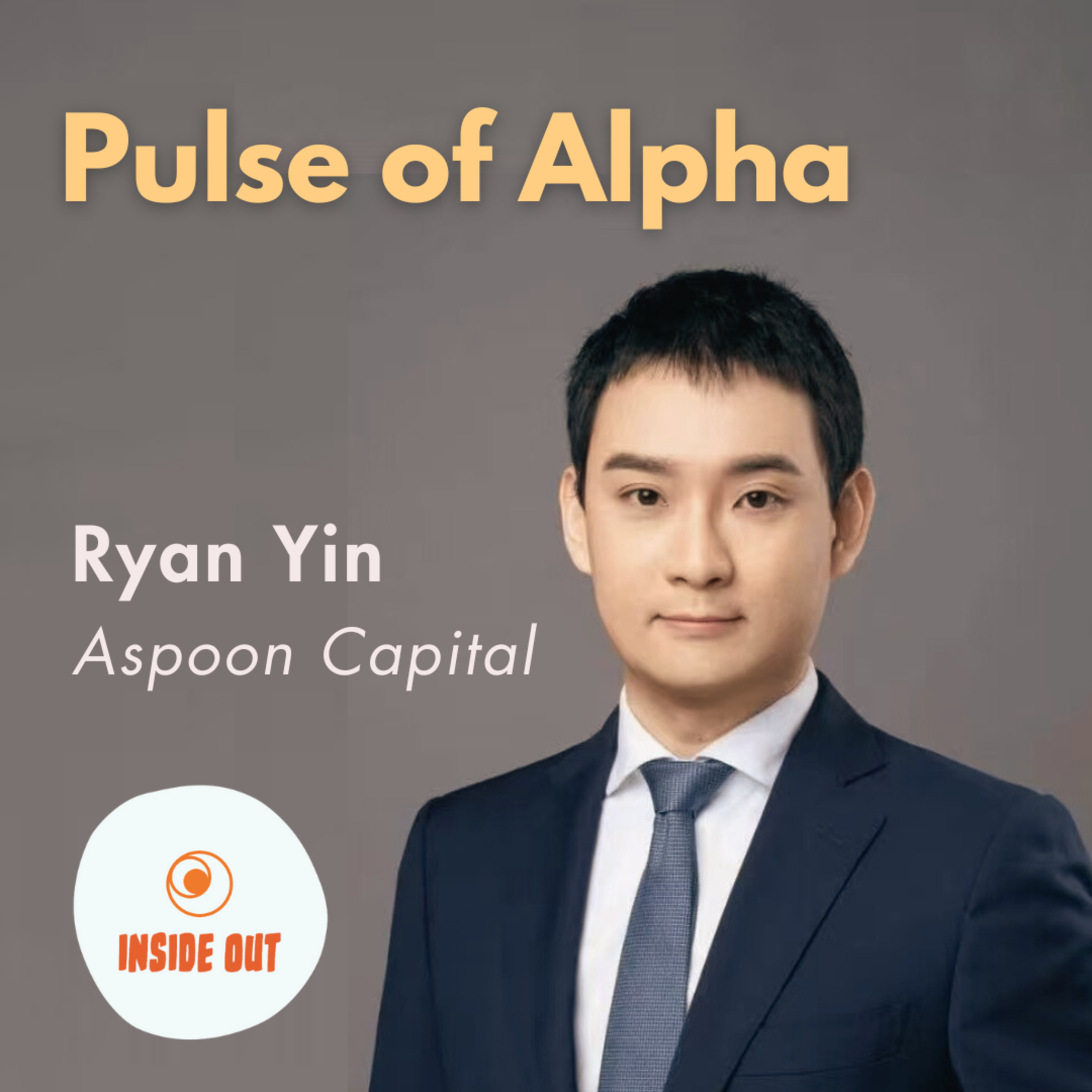
Pulse of Alpha | Policy Shifts, AI, and the Long/Short Game with Ryan Yin
from Inside Out: Tell a Better Story of Investing in China
60m 32s
Ryan Ying of Aisbun Capital shares how his long-short equity fund evolved to navigate China’s volatile market environment. Starting in 2021, the fund shifted from relying on market beta to focusing on companies with strong, macro-uncorrelated fundamentals—such as high dividend yields and sustainable earnings—providing resilience during periods of macro uncertainty. The team emphasized macro awareness not as a bet, but as a risk management framework, using early signals like late-night Beijing operations to anticipate policy changes. In 2024, this approach led to a significant performance turnaround, with a 58% return driven by prudent positioning and alpha discovery. The fund challenges prevailing narratives on China’s AI progress, arguing that while Western media overstates the gap, China’s unique use cases and domestic talent create real opportunities. Consumer trends show a shift away from luxury toward value-driven, emotionally resonant products. Geopolitical risks, including tariffs and ADR delisting, were managed through hedging and diversification. Aisbun believes the current Chinese market, though uncertain, offers abundant alpha opportunities, especially for nimble, fundamentally grounded investors. The fund highlights that China’s capital markets are now more stable and supported by the government, with domestic listings becoming a preferred path for global companies. Ultimately, the strategy emphasizes patience, alpha discovery, and disciplined risk management over macro forecasting, positioning China as a resilient and evolving investment landscape.
We thought it was just an industry policy, but it turns out to a disaster that all the
foreign investors lost confidence today in the entire market, I think.
Understand all they forgot how the country is operated.
It's not like a hatchback dynamic that your analyst pitched to you today, and you put
the trigger and put the trading tomorrow, right?
I think it came to a stage that we start to feel the consensus about the China AI to some
extent so wrong, versus in a way we observe on the ground.
Hi everyone, welcome to Inside Out, the one podcast for everything about investing in China.
Co-hosted by Dantuan and Qinghao, we bring you exclusive insights from top investors
and visionary founders.
From venture capital to the public markets, we uncover insider stories and next-gen opportunities.
The content of this episode is intended for informational purposes only, and should
not be considered financial or investment advice.
Our guest for today is Ryan Ying, founder and chief investment officer at Aisbun Capital,
a long short equity hedge fund that focuses on greater China and invest across TNT, consumer
and industrial sectors.
Born in racing Shanghai, Ryan began his career at UBS as a prop trader.
Before founding Aisbun in 2021, Ryan spent 7 years as a partner at Tiger Pacific Capital,
where he led the research team, built out the Shanghai office and played a key role in
expanding China Asia coverage.
Hi Ryan, thank you so much for joining the show today.
Aisbun Capital has recently getting a lot of attention for its performance and approach
to China's market, and we're really excited to have you on.
To kick things off, can you share a bit about your own background and what has led you
to greater China focused long short equity hedge funds?
I will have high attention and it's my pleasure to be here and thank you for having me.
A little bit back to the early stage of my career, so I was born in the racing China and
I went to United States for college and after I graduated from college, I started my career
on the trading floor of UBS as a proprietary trader.
That's where I got exposure to a various of different strategies, and then eventually
I realized my expertise is still about knowing China better, and I was known for being
in the China dialogue floor, and I enjoyed the most, and that's where I want to foresee
my career, so that I joined a Tiger Cup in 2013 as one of the early members of the team
to be a dedicated China investor.
And then you actually found it Aisbun in 2021, so in just a couple of sentences, how would
you describe the funds evolution since then, especially now the market environment in
China is evolving so fast?
I think that's a great question, given the fact that we launched in 2022, 2021, by nature
that was a very challenging time, if you look at the cycle of China markets.
The first 12 months into the launch, all of a sudden we realized everything we got so
used to money in the past decade, they just simply stopped working, so it was a very
challenging time, so that we decided we need to make changes to survive.
When we take a step back and think about what were greater success in the past and what
were greater challenge at that point right now, it was really the expectation for the market
beta.
In the decade, from 2010 to 2020, China market had a great run, people made a lot of success,
made a lot of money there.
Eventually, I think it was an implicit beta that people were writing on, and these beta
just disappeared if you look at 2021, 2022, or 2023.
But on the other side, we still believe the alpha-pitting in China is still very, very
abundant, so the first change we made was we know we specifically break down a lot more
about earning qualities of the company, right?
We tried to find a company that delivered their 10, 15, 20% earning gross, or it's unco-related
to China macro.
A counter example would be, say, Alibaba.
If Alibaba wants to grow earning 5% for the year, how much of that needs to be dependent
on China macro?
The answer is a lot, right?
So that means you don't know for sure how Alibaba can deliver earning gross if you cannot
make the right call of the macro.
And to us, that's too complicated and that's too beta-related.
So we want to find exactly the opposite of that story.
That's the first evolution we made.
On the trading side, we also became more nimble.
I think coming from the Tiger background, it was always buy the hold.
But when you don't have the expectation of the market beta buying the whole thing for
it doesn't work.
And they used start to be more nimble on your trading pattern.
And also, I think coming from the trader background, it's not hard for us to pick up the knowledge
to use more derivatives to fetch our children's scope of portfolio to smooth out the volatility.
The last but not least part is actually the macro awareness of China coming from the bottom
of our approach.
You know, macro was not a priority in my early career.
But it is very important now in the framework.
We don't necessarily use the map for knowledge to fully office in the portfolio to try to
make more returns, because that's actually hard and I don't think that's the core competence
of the strategy.
But we actually use that more as a risk management framework from a portfolio top-down sanity
chat perspective to make sure we don't step on the bombs.
So I think with these three changes, the fundamental alpha quality with the macro awareness,
with the more nimble trading style with utilization of the derivatives, I think these three combine
to our evolution.
And we really did that step by step, right?
We started from trying to climb out of the hole in 2022, 12 months after our launch.
We tried to do the risk management first, and then we tried to catch up on the macro understanding.
And then with the fundamental alpha discovery, obviously, you know, there are a period of time
we're doing this all together, and then we do this step by step, where we realize that
direction was right, so that we took bigger step to further go through that.
And if you look at our performance, you know, it was a stabilization in '22, a turning
around in '23, and then it's accelerating in '24.
Great.
Yeah.
I mean, year '24 was indeed an acceleration, it's actually a really fantastic year.
And your phone was up by 58%, and you successfully made some big calls, including some call on macro.
And let's revisit a couple of this turning points.
We noticed that in your newsletter for August, last year already, you wrote, we might have
some signs of policy inflection on the way.
It's a big if, and we'll find out soon.
And just one month after the Chinese government and the Bank of China, our central bank announced
really aggressive, economic stimulus, sending the markets up by 20%.
So could you walk out through what you saw at the time?
Looking back at our time, you know, as I come from a mass major, so to us, the market
is always about the odds and the probability.
So it's about the chance you weigh and how much you can weigh.
Standing in late August of 2024, the market was very depressed, everything was so cheap.
If you look around the sentiment of the market, the morale was super, super low.
And the people were basically doing the ABC strategy, anything but China.
At that time, we already noticed the early sign, that a lot of company fundamentals start
to reflect on the sheer price.
And that was very different to versus years of 2022 and 2023.
It was just a systematic meltdown on valuation and has nothing to do with the fundamental.
That was the early observation we had in the market.
And then obviously that has something to do with, I call this the supply side reform of
the China investment management industry, in a sense of, we do a lot of like analyze industries
that we want to invest all day long.
But if you take a look at our own industry and also have these own cycles, I'm obviously
for China markets, you know, 2019, 2020 was a good years.
And that's where people add a capacity, meaning a lot of new funds launch, a lot of money
raised, a lot of analysts were hired.
And when the market turned to the downside code, I think a lot of supplies in the market
actually went away, right?
Some funds closed down, some funds turned to family office.
And also a lot of appears, you know, just expand their mandate to say 10 Asia.
That's why there's a lot of, you know, interest in rushing to Japan and also turning into
the global tech strategies.
So this is where you see a lot of supply was I'll notice it actually went away.
was the fundamental of the college because that provides very, very, very good odds for us to bet.
In terms of the macro inflation point, after we realized an importance of the macro understanding
of China, we actually did a lot of catch-up work in the past three, four years. And thank you to some
historical accumulation of the network and of the brand we'll make so that we managed to have
that access to some of the decisions and the way even fortunately were invited to give our
devices, to give an interest to some of the decisions so that we understand how Beijing sees things,
probably ahead of the curve versus a lot of our peers. So one of the anecdotes I can share was
when I visited Beijing in late August, I noticed the lives of a lot of the government buildings were
on late night. That was abnormal because that means like people were work overtime in the system
and this actually was not a case in the past two years before 2024. So I think that there was
an obvious reasonable gas there on the table. But I think the core fundamental is still more about
we think the probability was very good and it was almost a scenario where your downside is
variable limited and you have the free option to pass for the upside and in terms of the instruments,
the assets we choose to express that view, it was also very prudent. We selected companies where
can easily give us five, six, seven percent of them in a year so that even nothing happens we don't
think we can lose much on those things. But earning thought of it, the business directions
is very correlated to the macro. So this is how we approach it and that was the the whole
roll map of what we were through. So after you saw those government buildings running on still late
and then how did you adjust or set up your position specifically to the anticipation of the big
if of the macro shift, we push up the net exposure of the portfolio for sure but also we select
stocks where we think even if nothing happens, even if we were wrong, I call we wouldn't lose
much money because they were supported by the dividend yield. It was not even PE because everything
was like four or five, six times PE that back then but it was a company that pays real dividend
that gives you a lot of the cushion on the downside. And while we push up an net exposure,
we also bought some what's to give us the extra insurers combined with the with the higher net
exposure in the portfolio. We got a lot of debate especially when it comes to policy risk
in China and some Western educators argue that the government policies can be very unpredictable
and have the potential to hit the entire industry like what happened to the education sector.
And others believe that government actually provides very clear long-term guidance
with the opportunities for investors to benefit from this targeted policy support. How do you see
these two perspectives? And what's your own approach to navigating Chinese policy risk and
also capture the opportunity as an investor? Yeah, I'm not sure if I agree with the word unpredictable.
To some extent, I think China has been going through a paradigm shift. So it was, you know,
economy development goes for the first and then you know, people compromise for everything else.
But now obviously, you know, there are other important agendas like in terms of the domestic
replacement, you know, security, safety, I think there's a lot of focus on that and also the social
welfare, right? And also during the decades when, you know, the property was booming, obviously,
both the balance sheet of the government as well as the balance sheet of the househood,
the leverage was going up significantly. I think they basically step on the break and try to
lower the leverage of both balance sheet, which they made it. It's more about the market and
the market participants and including us in 2021 did not pay attention enough to the message they
tried to deliver. And before I go, okay, we're still going for the same, same methodology versus
previously. And it took time for people to realize this is not true. I think a lot of things that
government did, if you go read the book that the president wrote, it was all there like 10 years ago.
He told everybody very clearly how he wanted to change the country. People didn't pay attention.
People learned in a hard way. But also, I think they are paying much more attention to the capital
markets. The importance of the capital markets, obviously getting higher, I would say in the past 12
months also. So the way the government communicates the capital markets is also more sophisticated
and smarter nowadays. So initially it was just a pain period for everybody. And some of the pain
actually came unintentionally. But I think that's what happened there. In terms of what the
government supports, that's always very clear as well as you follow the policy. Like I said,
probably showed up in Beijing every one or two months. We're basically phone call by the way.
Another thing I wanted to say is when people comment on the government policies in the markets,
especially when they comment it from overseas. Sometimes they don't understand all they forgot.
How the country is operated. It's not like a hedge fund dynamic that your analyst pitched you
today and you put the trigger and put the trading tomorrow, right? So even if you have a policy change,
it takes month for people to earn all the details and to execute it out. That's natural, especially
for a big country like China. Let me share the story that I heard from my Beijing source.
So last year there was this meeting that a group of economists from the intelligence bank reported
their findings of how other countries handle their macro cycles to the senior management,
including the big boss. The economists talked about a single case for 20-20 minutes and then
the big boss commented, "Isn't this just the size of shaman city?" And then after the career report,
he asked, "Isn't this just the size of hometown province?" Obviously we cannot verify the
choose of this story, but what he meant is we are too large a country for a lot of things to
be carried out. You can now use the same expectation on that and that reflects to the market the
country basically had a policy inflection in September. That was loud and clear and people excited.
And then if you look at how the market trades include for last year, it was basically
people like, "Okay, you've been very slower than expectation to deliver what you said,
but like I said, you know, you need the patience for those things to be carried out." That's another
point I'm trying to make. But eventually with all this above being said, our strategy is more about
alpha discovery, so that we don't bet on the macros, we don't bet on the policies and the
historical in the at least in the past 34 years. That was not a successful strategy. I think a lot
people tried. It didn't work that way. Before that, it was easy because every time when the economy
was bad, they just buy property because that's always going to be what the government wants to
save. But people learned it in the hard way. It's no longer the methodology anymore. So we just
try to focus on the alpha names, which are the bad all things uncorrelated to macro. But meanwhile,
we use our macro understanding to make sure we avoid the bomb, we dodge the bullets. For example,
I think in 2021, after school tutoring business was a shock to a lot of people.
We actually knew that was a direction of the regulation goals, so that we knew it was not a bite
dip for any of the names. As a matter of fact, we were shorting these names. But I guess the mistake
we made back there was we thought it was just an industry policy, but it turns out to a disaster
that all the foreign investors lost confidence today in the entire market. I think that was the
mistake we made. So talking about defensive measures, are there any sectors that you are paying
special attention to, which might suffer from policy headwinds in the next 12 months? That's actually
a good question. I think in a big direction, I wouldn't say no, not much. After the policy
inflection seems September overall, they are really encouraging. If any change, I think it's all
about the incremental negative, but it's not like the directional negative. For example, I think
there's subsidy for home appliances, devices. That's been running for almost like three quarters now.
And basically, the government pays about $80 billion afford to subsidize that. I won't be surprised
that going forward that extent can get a bit weaker. And also, I think the structure might shift
a little bit away from the cities to the cars.
and to the Y goods because I've called these are lower frequency products and they probably
stimulate already enough in the past three quarters for people who wants to buy it.
So I can be shifted more away to the devices, to the equipments, etc.
So but these are all like incremental. It's those are all like marginal negatives,
but not the rational and negative. In terms of the headway, the biggest thing I can think of
is actually this is actually a year where the competition for a lot of the industries are actually
coming back. Because in the past several years, I think a lot of companies were in a defensive mode
so that they were not investing for future growth. They were cutting costs, cutting expenses.
They tried to save the profit and then be more shield holder return to do the buyback to do the
dividend. But I think this is the year from quite a few industries that we we observe we follow
each track on regular basis, you know, for example, logistics, business, express delivery,
the food delivery business, all the business, so also force. I think the biggest theme in
common is the competition is back. The companies are eventually decided to invest for the future so
that they are willing to spend more. So that, you know, we do have renovations on the margin
predictions for a lot of company for this year. But if you look at the bright side of this, I think
this is also a sign that the cooperates who are a part of the economy start to stance the
stabilization of the macro. So that would be more open up, there are more willing to invest.
And if we jump into a more specific topic, which is AI right now, has been a headline, I guess,
Q4 2024. Many of the Westing method call it as a game changer for China. When it comes to AI,
what was on your radar in the past 12 months? We have been followed AI trend very closely,
because this is genetically what we care about. How many problems have I got background? You know,
we start to cover, you know, consumer technology sectors, you know, in the very beginning,
and these are the, so what we call the growth sector was a great business model to start with.
So that we always spend a lot of time on that. And also, I think personally, I am a lot more
interested in those new things, new technology, new consumer brand exaggeration. The conclusion is
we spend a lot of time there. We started by following the progress in the US. And then, obviously,
given the experience and the connections, you know, we collect from early Korea,
so that, you know, we do happen to know a lot of founders of the new AI company,
because a lot of these people are exactly the same group of people who were involved in the last
roundup internet wave in 2015, 2016. There's a high overlap in terms of that group of people,
so that we naturally know them, we follow them, we see what's new that they are trying to do.
Obviously, I think that they were very excited about the US AI progress as well. And I think
that combined with AI is actually a national wide strategy from the country. Speaking of the
support from the government, AI is definitely one of them. So that, you know, we spend a lot of
the time on, with the companies, despite, you know, they are not listed, a lot of them are private
companies, but we spend a lot of time on there. And then, in the second half of last year,
I think it came to a stage that we start to fill the consensus about the China AI to some extent
so wrong versus, you know, what we observed on the ground. Back then, the consensus was, you know,
one, China doesn't have the chips. And two, everything started in the US. And the models in China
were like, you know, several generations behind. People were basically calling China
were two years behind on the models. But what we observed was, well, there is always a lack of
the chips. There is always a generation gap on the models. But I think there are very unique
use case for China AI. Yeah, global models cannot breaking. And two, I think China still enjoy
the benefit of the engineers that we have work very diligently and at the reasonably low price.
The more we talk to people in the industry, the more we confirm the thoughts there. So when
there was a group of investors, the winners last November, we organized a AI trip for them
to meet the companies there that we know and let them to use the product to experience the China AI
by themselves. And in the end, we told them, look, you know, we think that gap reflected by the
car cap on the markets in terms of understanding China AI versus US AI, it was too huge. So that,
you know, we wanted to take the other side of the trade. And then obviously, we did not expect
it was deep seek that came to the headline in January. It was not our guess. But to us, even if it was
not deep seek, it would be other companies like Biden's, like Mini Max, Alibaba. It was not
necessarily has to be deep seek, but it will happen with some other companies at a different time,
for sure. Let's touch face a little bit of what you mentioned of the radar AI opportunities.
Can we give us a favor of what type of companies that you find interesting?
Sure. I think terms of AI, we were involved in the whole ecosystem, right? From China's own
GPU to the data center to the applications. And then obviously, market got excited about them,
you know, in January, February to March. And in the past several months, I think fundamentally,
the gap between US AI versus China AI was actually gone bigger, right? You can think about that,
you know, the gap was significant narrower in January, February, you know, when all the Chinese
companies launching models. But I think, you know, in the past couple months, when we followed
the specific development of the industry, the gap was actually bigger again. Look at the, you know,
open AI user number. Oh, these were all ramping up very rapidly. And progress on China was,
it was still progressing, but it was not as fast, you know, as US. But we believe eventually,
it's more like two teams playing terms, right? So one runs out, the other catch up. So I think there's
a specific pace for that. So we think it is very likely in the second half of the year, we'll see
the China catch up game again. So that's where we see the pace of the game. And in terms of like
the specific opportunities, I think now, given a lot of companies were no longer off the radar,
as we look at the last few four. So now I think for us, you know, the best opportunities are the
companies were previously not labeled as the AI play. And some of them are even not labeled as
as the AI play now that we think it will get labeled as the AI play. I think these are actually
that that's opportunities. For example, we all know that in terms of the AI application,
that financial industry is actually a huge user case in the US that has not been fully
appreciating the China markets. We do see like a consumer netting companies, we use the AI,
use deep seek for them to help them to do the risk management to help them to do the collection
process and to do the further analysis. And also, there are companies, you know, use the AI to help
them sell insurance, because that can help you to accurately find the user case and customize,
you know, the insurance premium, given all the historical data, do a quick attack duration,
and then use the right, the right agent to sell the products. We try some of them, they are very
smart, you know, they can't even, with, you know, five seconds into the conversation, they can
identify the accident and dialect, and then try to communicate with you with a dialect,
particularly from a specific origin in China. So we think that these companies are actually
the hidden gem in the AI play. And but how do you assess the recent reward in China's AI
value trend now, especially estimation, advanced trip supply constraint?
First of all, I think the chip constraints, well, ease from here, although from a video,
X20 is banning China, I think the new generation of the Black 126 series, which I think for now,
it's called B30, that will not have HBM in it, but that is very likely to be allowed to sell
to China. So this is one and two, either domestic GPUs that are progressing well, eventually,
chip would not be a hurdle for this. And two, the way we ban on this, it's very similar on how we
add on the China inflection point. We always want to be there early, and we want to be there
at a reasonable cost, if it's not free, meaning we're always very prudent to go for the assets
that has downside protection, either they pay dividend, they have very low B, multiple
there, low cash. So that we know on, we will have the holding power on these assets so that,
you know, you will not be leading with the clockway hold of positions. And two, even if we end up
being wrong, we will not lose too much on it. So that's always our approach into the early trend
we observe, so that we can get ourselves covered. It's very similar for this one as well. Like I said,
you know, the sum of the consumer ending companies we invest into, they are trading at like three,
four times the year, two times the next year, 30% payout ratio. So you get like,
15% dividend yield right away as your protection and that there is no understanding of the AI angle of it.
So these are our way to bad on those trends and we're excited about it because this is not a market consensus yet.
And compared to the AI specific area, are there any areas that you feel are overheated in the current market now?
Not particularly. I think overall, the AI names in China, I think after the January, February rally, they are in a relatively lower point at this point.
And I don't think the market are super excited about them right now.
I do think some of the AI names in China assets, particularly the companies who are suppliers to the US AI play, especially on the hot tech side, they are in the process of getting from a fair valuation to a relatively full valuation.
But I won't call that a bubble just yet. Also, you need to have a call on the US AI, which is not our core competence to make the call right now.
But I think overall, if you answer your question, I don't think there's much overheated bubble in the China AI plays right now.
And if any, the valuation of the US AI suppliers in China assets are relatively more expensive than the China own play.
I just want to slide in some questions before we move away from AI. Just curious, what's your prediction on Tesla and it's robot taxi launched this month.
I mean autonomous driving is one of the largest cases of AI.
Well, I think obviously everybody has their eyes on it. But for now, I don't know how they can surprise the market.
One, because you know, it's very well studied and well, well analyzed for now, right? It's going to, I think in a musk set by himself, it's going to be somewhere between 10 to 20 model Y runs as a robot taxi.
We'll see, you know, how much surprise will they find on the event soon to it's not about the event itself. It's more about how these role taxi runs after the event, the experience people get in operational metrics, people get out of their thing, we can make a clear conclusion on those things.
Obviously, it would be for long that as well. So what about the domestic markets? So are you following the broader autonomous driving sector in China?
Like AI trans operators, etc.
Yeah, I think you know, the quick conclusion is we are overall bullish about autonomous driving sector in China, but we are not sold bullish about the robot taxi scene particularly.
We do agree that the autonomous driver sector in China is expanding significantly and I think there is a lot of attention and this is triggered by the effective cost cutting on the hardware side.
We've seen hardware like a lidar, the price basically came down to 2000 RMB from previously like 50,000 and that gives the OEMs significant incentive to put them on versus you know, three years ago, when you try to sell the autonomous driving as additional setting point to the car owners and if you want to charge stay, it came more people were like, no, we don't need it.
So now if it's two came more and they tell people this is almost like the safe out you need for a car, I think the people accepted this in a much wider extent, right?
So this is actually where we believe I think the trend is there in terms of the robot taxi. The story is a little bit different. Obviously, I think as a technology of advancement and from the direction perspective, I think the government is always supported to it.
If you compare to the robot taxi model versus stay way more in the US when you comes down to the unique calculation, it can be more challenging for the China robot axis because a driver cost in the unique calculation in China is much cheaper.
That means it's much more challenging for the robot axis to beat the current to over model.
So I think it's impossible, but I'm just saying it is a little bit harder and then obviously you need to stand.
You need to stand in the shoes, put yourself in the shoes from the government perspective, and that asks yourself, you know, are they going to worry about the employment rate, if robot taxi gets massively pushed out, right?
And you know, labor costs inflation, these are the problems you are trying to save are trying to solve when it's about the robot taxi, but these two things, at least from now, they are not a problem for China.
So that the incentive to push out robot taxi wouldn't be slightly weaker. They don't let you do it, but meanwhile, probably don't want you to do this too aggressively.
And I'll switch and get to a totally different sector, the consumer sector. It's very interesting. You actually have maintained quite a short exposure in this sector.
What has been driving your conviction on the short side in those stocks and are there particular trends, data points or like special tips you're getting?
So first of all, you know, to make a clarification, you know, we are not bearish about the entire consumer sector. We are more like being bearish about the high end, the luxury and the consumption.
And I think the trend was driven by saving is in the DNA of this country or so that you know, when the expectation of say the property market, which is a big percentage of every house cost net wealth, when that was in a down screen, and now relatively stabilized when people don't have expectation of that.
And this to span on the luxuries and off the discretionary consumer sector is still very limited. And of course, with the data extract from all areas from the shopping malls, from the stores, from the experts in the people in the industry, we talk to.
And also, there is a weaker willingness for people to show off the brand within this study in the past several years, the best performing clothing brand in the shopping malls are actually brands like Brooks Brothers.
They are almost like a downgrade from the luxury, but also doesn't make you look bad.
So it's a combination of these things, make us believe the trend is still going on. Obviously, no, we will closely monitor on these things. One of the fun anecdotes I guess here is our Shanghai office is actually in the same building with one of the two hosts, a China headquarters.
And you can clearly see their rental space getting smaller and smaller in the past several years and eventually they just completely got rid of it.
Yes, maybe part of the reasons the competition from the local EV players or that also true that's another short end of course, but overall the willingness to spend on luxuries is smaller.
And obviously structurally, this is what people call the new consumer fan in China that people are willing to spend more on the toys, on the puppets, on the IPs, where that provides the emotional value to the young generation, you know, that's on the rising trend.
But when you see through the fundamentals of this, this is also something you don't need to pay that much, but get a lot of happiness.
So I think that this is the new trend that we observe.
Well, I would not necessarily say it's a self-adjacent concept in Hungary. It's more like people look for better priceful value. I think that that's what people are doing, right? They might spend up if they think that they get a lot more out of it.
So it's not necessarily downgraded, but priceful value is the word. And there are definitely some names we should hear are the victims of that.
And another trend is I think the new generation just for the consumer brand, it's harder to have a single SKU that sells like billions of RMB in the dollars nowadays, just because I think the younger generation that tastes are much more diversified.
And to some extent, you know, the young people, they particularly try to avoid the consensus spread, the consensus SKU. That's a challenge to a lot of consumer companies that the product cycle of every new product is getting shorter and shorter so that you will have to keep innovating.
And like the it's like the game studio model, like you don't know every time you're new launch will be successful. So that definitely creates the volatility, you know, where people projects and revenue projects in the margin.
So, yeah, that's I think that's the overall trend and a challenge to a lot of traditional consumption companies in China and technically with that increasing volatility, they should a derate from the multiple perspectives.
The elevate our talk to a level uncertainty now, and this year we already see a lot of volatility, we mentioned the China U.S. tariffs before, and maybe less on track how you navigate those events.
It's very good to see that your phone has a delivers very strong return in 2025 and reporting 14% of the return in the first two months, and you have been using their China tech index options to hatch against the potential tariff shocks.
Maybe would you like to elaborate on how you size and turn your head in such an uncertain geopolitical environment?
Yeah, so I think the first of all, it's still I think our macro awareness, right, so we were very bullish, you know.
January, February, going to end of the March, you know, with the tariff event in early April,
ahead of us. We looked at the market positioning from the TV reports and from everybody around us,
we talked to. We definitely had a stance. The market was too complacent to go into the event.
Everybody straightforward thought, you know, we were a U.S. China, we're going to have a deal.
So it's not there's not much to worry about. We always have this stance that, you know, we try to
understand what the market consensus is. And in particular, the biggest market consensus
usually was always wrong. That's why we always try to avoid the crowded positions and we try to
avoid the crowded positioning of the portfolio. So that we significantly decrease our net exposure
of the portfolio going to end of the March. So that, you know, we smooth out the April in a very
low volatility manner. And I mean, while, you know, we utilize, you know, some of the derivatives to
help us to protect the portfolio, particularly for some of the loans, you know, we feel
they should be really uncorrelated to the tariff, to the macro, but from beta perspective,
we still need some hedge there. How has this strategy raised exposure changed,
following this back and forth or tweets and terms of the tariff talks? Because we have some of the
index puts in the portfolio. So when the market, I think it was April's balance correcting it
on wrong, you know, when the entire market was down 10%, and when you have the index puts in
a portfolio and the way you're positioning was relatively light as we mentioned with decrease
exposure, we were down 1% for that day. The index puts helped us very well. And I think given
the nature of the doubt of these posts, you know, when the market tanked, even if we don't do anything,
your net exposure will automatically win down because we're not the gamma nature of the options.
And then when the market rallied the back, because of the same nature, your portfolio exposure
would have went back on the net exposure perspective so that from that perspective, given we already
positioned ourselves in that way, in March, so we didn't do much in April. But what we did was when
the market rallied the back a little bit, we shift to more from the consensus large cap names to
relatively idiosyncratic alpha ideas, right? So some of these ideas would be like very deep in the value
dividends stock below cash, there will be companies at its own turnaround story before completely
early breaking the market comeback story. We basically had some shuffling the portfolio, moving
more into the alpha opportunities as well. So that's how we positioned ourselves. Because we do
think, you know, with US China get the 90 days pause, I almost feel like it comes again to the
period of time that people all think the US China terrified behind us, especially when we talk to
our peers in the US. In China, I think relatively similar people think we're going to have a deal.
We don't know what will happen. And like I said, I think the market pricing in a high probability
that everything is going to be fine. And that's actually where we on the other side usually have
the most concerns. We're prudentially optimistic about the market situation right now. We're
prudential because we don't know about the macro, we don't know what happened in China because no one
knows Donald Trump. He can flip out the next second, right? But we were optimistic because the alpha
opportunity we see is on the ground are very sufficient. And if you're willing to make a full
bet, what would be a long-term view of this? I think the longer-term view is US China decoupling
is inevitable. What would be the right expectation of the new norm that we can discuss about?
This is the first thing. And two, what is almost certain is the uncertainty. I think it's going
to be a very bumpy road towards the end of the game. Just we don't know when the volatility will
come out to hit us. And very likely it'll happen when the positioning was so unsided and when the
consensus is so strong. So that's where we always want to pay the extra attention to. Obviously,
that kind of like thinking methodology, you know, it helps us sometimes efforts sometimes, but it's
important to understand the consensus and always be careful about it. And the last thing is if I
have to guess, if you look at the US-China deal talks so far, China has been very strong
in terms of where they stand. Because they came out of the misunderstanding in Trump's first term.
They thought they hosted the Trump in China for his first visit and he was very happy. And nobody
expected, you know, he went back to the US and then started the whole thing very dramatically.
So China has been very strong standing where they are. And if we look at the deal progress in the
past month also, it's almost single-sided US compromising. And obviously, no Donald Trump can always
claim his wing in one way or the other, but if you look at the facts, this is what's happening.
This is because Donald Trump is running on a time clock that he still has other
items in his agenda that he wants to move to. He's in a rush to
lip over the page of the tariffs because he has the tax cutting deal ahead of him.
He wants to do the deregulation. And obviously, now the Israel-Iran War is something new to him.
And also, if we look at the next year, he needs to prepare for the midterm election.
So he has a lot of things in his agenda that makes him not being able to stick on one item,
a stick on one page for too long. That's why he just wants to chart everybody 10%
and maybe like 25% 30% on China for the tariff and then claims a way to move forward.
That's why he's being single-sided compromising. We'll see. And obviously, a week ago,
when he realized the railors' inventory level for the US was only six weeks.
And that that was almost the earlier level they were running at. He was pissed off. He
started to yell at the people on his backs and then he'll request a talk to President Xi.
I think that these things will keep coming back because that's just who he is.
But overall, a huge replay this whole thing. I think that's what we'll observe so far
and that we'll see what happens next. And especially right now with the break-up
with Elon Musk. That is the greatest teacher's thing there.
That's also something very hard to bet. You can get back together tomorrow.
Doesn't matter how ugly it looks like right now. So we just tried to not to guess these things.
That's the only thing we learned. You have described 2025 as "Market with True Tales,"
AI in the first half, and macro recovery in the second. We have already talked about AI.
Can you talk more about what you are seeing on the macro side? What would be a true macro driven
recovery look like for you? So I think there are two ways we get there. Obviously, now
we are actually in a status where we seem to have a deal with the US,
but it's not a final deal. It's just on an ID day pause. So you don't know if the whole drama
in April will happen again in a different format. But on the other side, because it's not a final deal,
so that the government cannot express the stimulus button just yet. Because there's not a final deal,
no one can have accurate guess or accurate calculation of the damage of that to the economy.
So that you don't know how big a stimulus package is. So we are sort of in an awkward period
for the next few months, which is also why we are relatively cautious about the broader market
at this point. But I think for a mid to longer term, we are still bullish, and the stimulus will
come in two paths, one or the other. One is we finally have a deal with the US, then we run
through all the numbers. We know the drag to the GDP numbers, and then we will release the
stimulus package. And two, it'll be another 90 day delay after 90 days, because really,
not much can be done in the 90 days. And then I think the Trump administration has been spending
so much time to try to get a deal with other countries, which is progressing for probably not
as fast as he would think. So I would not be surprised if there is another 90 day.
And then I think eventually it gets to the point that the government will realize,
we cannot just always wait for the outcome for this. So this can last for much longer,
then why don't we just stimulate first? So eventually, I think the stimulus package will come
in one way or the other. But what you do not need to question is the stimulus package there is
ready. There's a lot more than what I can share here, but in terms of the detailed stimulus policy,
the size of it, how to execute it, that is very thoroughly discussed internally,
and they are all ready. They are all on the shelf, are ready to use any time. And then it comes down
to the government's breed of the situation and when they want to release it. And if we can switch
to one of the very interesting topics that most of our European peers care about, which is the
Chinese capital market, we call it ADR Delisting. And it has been so much talk about this topic
lately, and the sector seems to take a strong hit. What's the tech on the situations right now,
or do you see more risk here, or maybe some more opportunity? Totally. This is a question
where we spend a lot of time on in this year. Not just because we are the ADR experts for
very long period of time, but also because we really deep dive into the rules, into the policies,
and where I feel the giving importance to Beijing, to such
just them how to fight against this.
Basically, if reading to all the SDC rules in the US,
there are only two ways.
In the, I forgot to exact the name of it.
I think it's called the foreign company management rule
or whatever that is called.
There are only two ways you can revoke
the registered status of a foreign listed company.
One is you can question the audit reports,
which was what the US used in Trump's first term.
And I think the agreement was reached three years ago.
That's the first card they can use.
And that was already used.
I don't think they can go back and use that card again.
The second card they can use is called
undisclosed relationship with government.
That's why you keep hearing the word golden shares
that the Chinese government has in the companies.
I don't think that they have an evidence on it,
but that's what the conspiracy theory keeps mentioning about.
And I think what is bad about this one is,
eventually what is the evidence
and what counts as the evidence,
I think it's all defined by SDC investigation.
Even in the beginning of the year,
when we were giving votes to Beijing,
we think study this very clearly.
And if you look at the first round of tariffs for
in Trump term one, ADO at the listing
was exactly the card he used.
And the two of them was a very effective weapon
because it almost came at a zero cost
and it does hurt Chinese company a lot.
But the situation now is actually much better for China.
In a sense of starting last round,
a lot of like a large cap ADRs
already do a listing each year.
So that definitely diversified the risk.
And also this time,
my Beijing is much better prepared as well
so that per our suggestion, there's gonna be a fast pass
for the ADRs who wants to all listed themselves to each year.
In a perfect game theory environment,
if US knows China has the plan to fight against it,
you should not make the move
because you know it's already defended.
And that's also in the background
of US is cutting government budgets.
And if you set up an investigation group in SEC
to go through the whole process,
which will take at least six months,
it can be as long as two years,
that's gonna be a lot of like a government expenses as well.
Though I'm not sure if that's what they want to get into.
Look at the interview back then with Scott Bassant.
It wasn't for the words in his mouth.
The question was, is ADR the listing a method
you would consider?
And that was a question from the reporter.
And I think from his perspective, he can also know.
There's a definite answer for him.
He always say everything is on the table.
Do they really consider that
as a viable, actionable, effective tool to use?
I'm not sure.
So I think my conclusion here is one in a perfect game theory
environment because China is much better prepared right now.
And because the damage that is going to do
to the China capital markets is much smaller
and given the expense, the cost,
the US will need to put in this move.
They probably should not do this.
But they can be irrational.
They can still pull the trigger just
because they want the votes from the voters.
Even from this perspective, China is better prepared.
And I think in six to 12 months,
I think for the ADRs who are not back to age here yet,
and who are too willing to come back to the age here.
And three who are qualified to come back to the age here,
will be back.
So we've go through a lot of process
to in the discussion of who can be back,
who cannot be back, who is willing to be back,
who might not be willing to be back.
So that we have a very clear list
of who are safely who's not.
'Cause the rationale behind that is
that government will provide a fast pass
so that all in PCRC and SFC in Hong Kong,
they will all work very closely
to push the process forward.
But for China slash Hong Kong IPOs,
you will still need a approval from the corresponding
department who regulates you.
This stat cannot be skipped,
which means if you are a company
that you previously couldn't get a approval
from a specific department who regulates you
so that I decided to get this in the ADRs,
probably this time you still cannot do it.
That is the story we have.
We do think that there's a misunderstanding of the ADR space,
but we're only investing in the names.
We know for sure we'll be back to age here.
And as a matter of fact,
we actually use our resource and network to help some companies
to get in touch with the regulators
so that we know they're in safe hands.
- So what would be the implication
for global investors?
- The government puts more attention
on the capital markets than ever before.
And no, they actually elevate this to a more finance level.
Once it gets to that level,
you know, they won't defend it and they won't defend it hard.
And they will give whatever it takes to defend it.
And given the fact that going forward,
like I said, the US trying to decoupling,
there will be fewer and fewer companies
going to the US for less things
so that you will see more companies
getting this in an age here and age here for sure.
And at this point,
they're giving the cues in the IPO pipeline,
probably age here as a preferred choice at this point.
So that will provide the most apparent demand
to the age here market.
- How might this affect the valuation gap
between age share, Hong Kong and US listed shares?
- They won't narrow.
The previous situation was because
age here was in a very unique place
because it's unsure, there's a capital control.
There's a lot of things the regulators can do
but they cannot to protect the market
versus what they can do in age share.
The story collecting there is always an age to age premium.
But what we significantly noticed this year
is that the premium is actually narrowly
and to be more specific,
I think the four companies like ATL,
actually the age share is trading at the premium right now.
The trend is also happening.
- We are reaching the longest recording time
in the history of our podcast.
- Yeah, thank you so much for the great inputs
and it's quite insightful.
Just to wrap up, last cup of quick hits.
So for audience, for allocators new to China,
what are the common pitfalls or misconceptions
that you see, what advice would you give
to those looking to build a first exposure
to the Chinese public equities?
- Sure, we do have like the increasing inquiry
from investors around the world included.
The most common questions we get
is one, China macro uncertain,
we don't know when we can pull the trigger,
we agree everything is very cheap
but we don't know where we can pull the trigger.
And two, is there are still concerns about the geopolitical risk.
Particularly, I think Taiwan gets asked a lot,
which by the way, I personally don't think
it's a risk in it, Hans, too.
And there are still a group of people worried
that they're invested in assets
in China will get confiscated.
That I think is also a big misunderstanding.
Without too much noticing,
and I think that the government is trying
to put a bigger influence on this,
is actually there's a agenda for them
to try to bring back the foreign capital.
And particularly, I think in a capital
from Europe, capital from Middle East
are actually very welcomed.
And this task was dedicated to Shanghai
who was the financial center of China.
So we were actually invited to give inputs, et cetera.
And my answer is always,
you need to let people make money first
and then everything else is much easier, right?
So I think that contributes to,
you know, they're supporting the capital markets nowadays.
And my advice, it's just my two cents,
I'm not sure if that's our advice.
To your fellow audience, I just want going forward for China.
If you want to invest in China,
Macro is important,
but you don't have to have a perfect macro situation
to decide to put a triggering China.
Because it's such a broad and deep market.
The alpha opportunities are very, very sufficient,
as long as the macro is stable,
then it's enough to put a trigger.
And then you need to calm down the manager's capability
to sell through the turbulence in the market
instead of trying to call the macro by itself.
So this is the one and two.
I'm a firm believer that it was the worst time
for China market and now probably
is the best time for China market for more new emergent managers
to show up.
The stage is large enough for the emergent managers
because as I mentioned in the beginning of this episode,
there's a lot of paradigm shift to the playground
so that you need to be able to eat both together
with the paradigm shift to be more nimble,
to be more alpha driven, to be more macro where to invest
in this country to capture the abundant alpha opportunities.
It's the good time to look at the emergent managers.
And also last question a bit more private.
So what's your own way to online after a tough market day?
I think you need to have a fair expectation.
The first lesson I learned all the trading floor
is tomorrow is another day.
So doesn't matter how bad today is tomorrow is another day.
Doesn't matter how bad a PNL is, knock on wood.
We wake up tomorrow, it starts from zero again.
That's where you need to fight.
It's one for me to finish a day.
And particularly when you see the market is better.
obviously you think about what you can do about it and sometimes the more you
experience it the more you realize sometimes the best solution is not to do
anything about it. There are definitely times I close out my room, but I don't
look at the screens and I start to play games and I'm a big fan of football
manager. So nice. Yeah, I hope so for that's what I do. Great. Thank you so
much for your time and sharing such a wonderful episode we have so far. Yeah,
thank you very much for having me. I truly enjoy that.
Podcast Summary
Key Points:
Ryan Ying’s Aisbun Capital evolved from a traditional long-short strategy to a more nimble, alpha-driven approach focused on fundamental earnings quality uncorrelated to macroeconomic shifts.
The fund shifted emphasis from market beta to deep fundamental analysis, avoiding companies like Alibaba that are heavily dependent on China’s macro environment.
A key change was integrating macro awareness as a risk management tool rather than a bet, enabling early identification of policy inflections and avoiding systemic shocks.
The fund successfully anticipated a policy turnaround in late 2024 through early signs of government activity, such as late-night operations in Beijing, and positioned with defensive, high-dividend companies for downside protection.
Despite market consensus, the fund remains skeptical of AI hype, noting that China’s AI progress is more grounded in unique use cases and domestic talent than media narratives suggest.
Consumer sector short exposure targets luxury and discretionary spending, driven by structural shifts toward value, emotional value, and diversified youth preferences.
Geopolitical risks, including U.S.-China tariffs, were managed through reduced net exposure and the use of index puts, which limited losses during market downturns.
ADR delisting risks are now diminished due to improved Chinese preparedness, regulatory fast-tracking, and a strategic shift toward domestic listings, signaling long-term strength in China’s capital markets.
Summary:
Ryan Ying of Aisbun Capital shares how his long-short equity fund evolved to navigate China’s volatile market environment. Starting in 2021, the fund shifted from relying on market beta to focusing on companies with strong, macro-uncorrelated fundamentals—such as high dividend yields and sustainable earnings—providing resilience during periods of macro uncertainty. The team emphasized macro awareness not as a bet, but as a risk management framework, using early signals like late-night Beijing operations to anticipate policy changes.
In 2024, this approach led to a significant performance turnaround, with a 58% return driven by prudent positioning and alpha discovery. The fund challenges prevailing narratives on China’s AI progress, arguing that while Western media overstates the gap, China’s unique use cases and domestic talent create real opportunities. Consumer trends show a shift away from luxury toward value-driven, emotionally resonant products.
Geopolitical risks, including tariffs and ADR delisting, were managed through hedging and diversification. Aisbun believes the current Chinese market, though uncertain, offers abundant alpha opportunities, especially for nimble, fundamentally grounded investors. The fund highlights that China’s capital markets are now more stable and supported by the government, with domestic listings becoming a preferred path for global companies.
Ultimately, the strategy emphasizes patience, alpha discovery, and disciplined risk management over macro forecasting, positioning China as a resilient and evolving investment landscape.
FAQs
Aisbun Capital focuses on fundamental alpha by identifying companies with strong, macro-unrelated earnings. They emphasize nimble trading, use derivatives for volatility management, and incorporate macro awareness as a risk management tool rather than a bet.
The fund shifted from relying on market beta to focusing on alpha-driven investing. It improved macro awareness, adopted more nimble trading strategies, and used derivatives to smooth portfolio volatility, leading to stabilization in 2022, a turnaround in 2023, and acceleration in 2024.
A clear signal of policy change was observed when government buildings in Beijing were seen operating late, indicating active policy work. This signaled a shift in macroeconomic direction, prompting Aisbun to adjust positions with a focus on downside protection.
They avoid betting on macro or policy changes and instead focus on alpha from companies uncorrelated to macro trends. They use macro understanding to avoid risky sectors, such as shorting companies affected by prior policy shifts like the tutoring sector.
Yes, but only marginal ones. For example, subsidies for home appliances may weaken, and consumption in cities might shift toward rural areas. These are incremental changes, not directional headwinds.
They believe China's AI is not behind the U.S. in real-world use cases, especially in domestic applications. They see significant opportunity in AI adoption in finance, insurance, and consumer services, with companies leveraging local language and cultural understanding.
Chat with AI
Loading...
Pro features
Go deeper with this episode
Unlock creator-grade tools that turn any transcript into show notes and subtitle files.
 PodcastTranscript AI