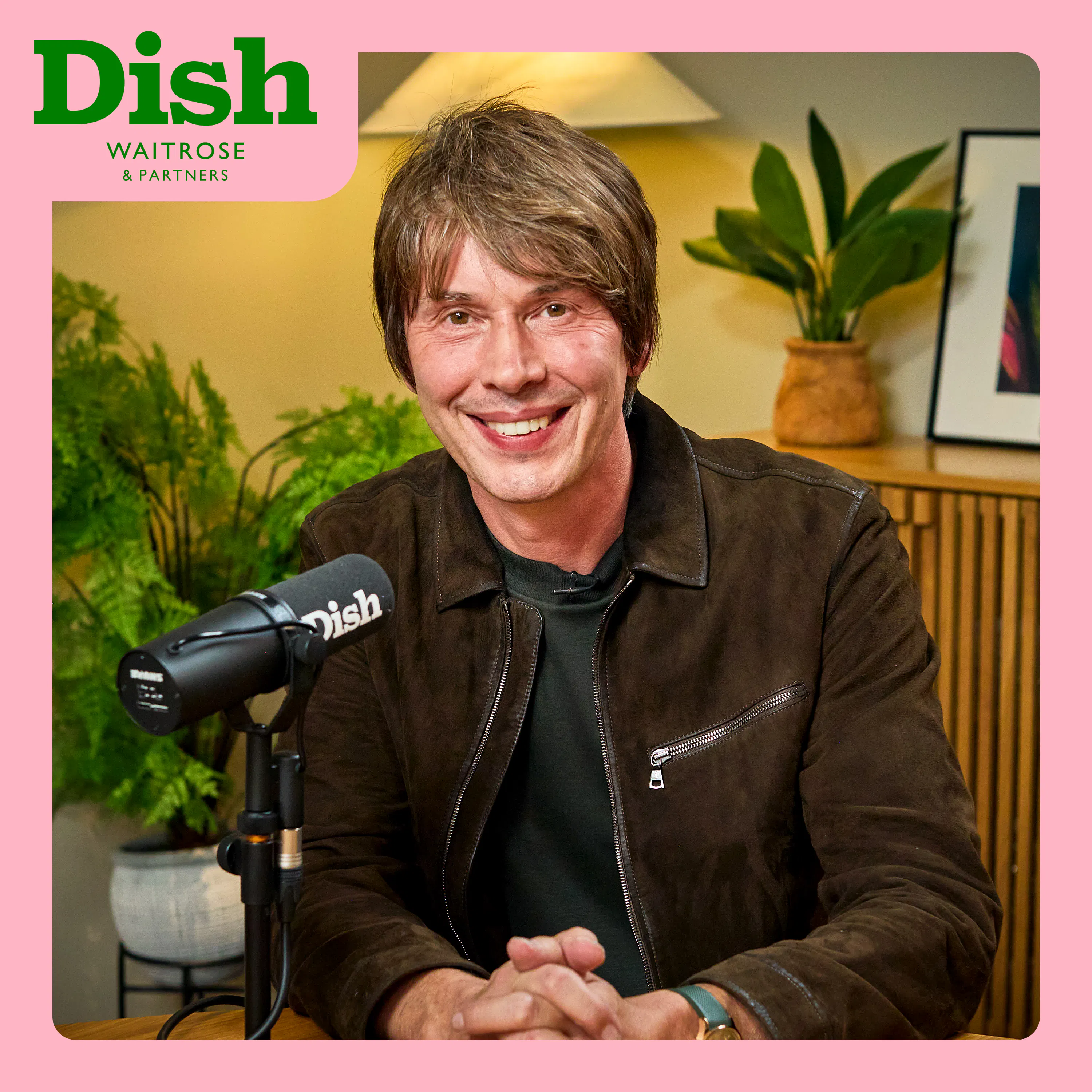
Kick of the gear with healthy habits and great flavour. We've added two new stars to our Wichro's Food to Go range. A vegan roasted button at squash and fruit chutney sandwich with fresh basil pesto and our super plant mix grain and bean salad packed with grains, beans, beetroot crush and spice button at. Perfect for a quick, feel good lunch. And the best part? Both are in the Wichro's £5 meal deal. So let's install the subject to availability. Dish from Wichro's is a cold glass production. This podcast and may contain some strong language and adult themes. Hello, welcome to Dish from Wichro's, I'm Nick Grimshaw. And I'm Angela Hartnett. That's right. That's right. How are you, Ange? I'm good, thank you. How are you? I'm good. I'm all right. It's a little bit snoozy if I'm on this. Snoozy, you're trying to have a little snoozy. Yeah, do you start early? What are you? 5 a.m. up? Yeah. Yeah, sir. Do you do a nap ever? You stay, don't anymore. Do you think it's good for your battery? I think it's good for you. Yeah, definitely. Yeah, but not a long one. You don't need a two hour, you need power nap. Yeah, like power nap, like 10 minutes? Yeah, 10 minutes max. Do you ever do one for now? For now. No, because then you sort of feel. Afternoon, I've been known to do it in the afternoon, go home and have a power nap. Oh, yeah. Hey, Professor Brian Cox. I know, very exciting. I know, I'll first Professor. I'll first Professor. Yes. Have you ever met him? No, never. Do you? - I have, I've made my few times. - Well, you've made everyone. - He's been on the radio a few times. And I've always had a really great time. - I'm old, am I? - Yes, I'm old, am I. - Yeah, it's a very brainy town. - Very brainy town. - Very brainy town. - Make Grimshaw. - Yeah, yeah. So he's going to be here soon. And of course, we know him as someone that speaks about space and time and science. Before we get an expert, what are your thoughts on space? Would you travel? - I think, yeah, I'd love to know if there's other planets with other people on, you know? - I think there is. - I'd honestly don't know. And how do any of us know? - Yeah. - And there are other planets going, "Oh, there are other planets," we'll go, "You know, how do we know, you know?" - There are other people doing a podcast like us in another universe. - Oh my God, that's frightening. - That's right. - Alien, alien heartless. - Yeah. - Another one. - No, it's fascinating, it's the unknown, isn't it? That's it. - I love the way I was the alien. - Yeah, yeah, yeah, yeah, yeah, yeah, yeah, yeah. - Which planet would you most like to go to? - Jupiter. - Why? - To know? - I mean, I've never sort of analysed it once, just the one I thought about. It's a nice sounding name, Jupiter. - It's a nice name. - What about Uranus? - Oh, boom, boom, boom. - There we go. - Trusty to low regard. You don't pretend you're not trying to be fun though, you're based human. - Grinshaw. - And does this mean that you're about, isn't it? - It's dark. - Right, moving on. - I've got a challenge for you, I've got a challenge for you. You have to mention Uranus to Brian. - No, I'm not doing that. - And no one's gonna- - No, I'm not doing that. - No, you can mention it and see if it's pretty right or wrong. - Go on, go on, please. - No. - I wonder how that goes down with it, because it's probably like- - How many times have people said it exactly, yeah? - I hate that, I've found it funny. - What is it called, but- - Cause it's something else. - Cause it's something else. Let's tell him, he can change it. - He can change it. - He was saying, he thinks will be, Mars will be soon, not maybe moving there. Not opening a way, Tros, or anything. - But we might be using it to, like, mine, do you know what I mean? - For an assand, something like that. - Yeah, more stars. - Brian, as well as talking about space and time, we're gonna talk, you know the big wine fan. - Big wine fan. - Big wine fan. - Love his burgundy, white burgundy, yeah. - He's got a, we stalked apparently his house with wine. - Salos everywhere. - Wine everywhere. - And he's also gonna be, he's also quite passionate about gin. - Oh, yeah. - So someone to tell us about gin as well today. And, but we always like to do a bit of a seasonal moment. And we thought because Brian is such a wine fan, we could do the seasonality of wine. And I guess you think about it seasonally in a broader sense, like in the winter you might have red wine, in the summer, you might have white wine. In August exclusively, you might, for go, water, for rosé. But is there specific seasons of. - No, no, no, no. - No, I think next week. - Well, no, the season of white now is, well, yeah, end of October. So sort of September, October's harvest time. So that's, so wine will all start to be put in barrels come October time. So the end of this month or even before everyone will be picking their grapes, you know, fermenting, adding their sugar, et cetera. So then, and then it's age. So there's the seasonality of years, really. There's young wine, older wine and all the rest of it. But then you have Bogele New Voday, which is where wine from the region of France is made from the gamma grape. And it's bottled very early. It's a young harvest, and they put it out for release. And then they just have these mad days, where everyone just basically gets pissed up on Bogele New Voday. - Yeah, what is that about? - It is slightly bottled from France. - Viva La France, you know. - Viva La France. So when is it this year? So it's the third Thursday of every November. - Right. - It's the date. So it's the 20th issue. - The 20th, okay. - Yeah. Well, I look forward to celebrating with you, Ange. - Perfect. You come as my guest. - At the end of the month, yeah. Apologies to Neil. And, all right, well, we should go our guest in and remind you that we're going to do listener questions at the end. So let's get Brian in. We are ready to go on a journey that takes us through the great curiosities of life. We're going to talk about time, space, the universe, and most importantly, what wine goes nice with the dover soul. - Around the applause for our guest, Brian Cox, everybody. - Welcome. - Hi. - Welcome. - How are you? - Very well, thank you. Thanks for coming to see us. - Yeah. - Nice to pleasure. I'm going to learn something. I like learning. - You do. We know. - We know. - I feel like we may learn more. - Yes, I think. I think that's probably-- - Before you join us, we gave our thoughts on space. - Yeah, we're kind of up for it. - Is that, is that you? - Yeah, we're up for it. - We go. - We go. - We go. - Yeah, big time. - Is that the sum total of your thoughts? - Yeah, we go all out. - We're up for it. - We're a bit basic. - Claire, who used to work with, who would say to people, "How's life?" And I don't know, I didn't notice that. - I didn't notice that. - Me neither. But everyone was saying, "When I ask you," that's kind of a, feels like a deeper question. It's a "how is life?" Not for us all. But how is life for you right now? - So you're expecting me to say, "I am part of an unbroken chain." Then began with the last universal common ancestor, two which we are all related, around 3.8 billion years ago. And actually, until around six or 700 million years ago, all there existed on the earth with single-celled organisms. So it's only in the less, I don't know, 700 million years or so, that complex multicellular life has appeared on the earth. And I am part of that unbroken chain, which is a remarkable thing. That's what you. - That's exactly what I was asking. - Yeah, that's the right answer. Thank you. - Therefore, it's very good. - That's really good. - Because it's remarkably unlikely. - Yeah. - Or welcome. And thank you for coming. I mean, don't you're gin and tonic, because you recently went to Iceland? Is that right? - Yeah, so gin, I've got. I mean, I've always liked gin and tonic. But recently, I've noticed that they all taste different types. - Right. - And yeah, in Iceland, they're really big on gin. There are loads of little distilleries around that make really interesting gin. - Now, we've gone for this. - This is beautiful. - A Cambridge Dry Gin, great bottle. - Yeah. - That square. And we couldn't get the Icelandic gin flung. So, we gave Brian a choice and we got the guys at Waitrose sort of picked their favourites, essentially. So, we've gone for this one, but it's great gin. - It is beautiful. - It's made in Cambridge, is it? - Yeah, blended and made in Cambridge, yeah. - Well, you gin facts there, aren't you? - Well, gin facts are. So, it has a traditional juniper combined with fresh basil, rosemary, rose petal, angelic acid, black-current leaf, and the effervescent citrus fruits of lemon verbina. - Wow. And so, Brian, you are our first professor, as we were saying, on dish. You're our second Brian Cox because Brian Cox is the atron, of course. - And you guys must have crossed paths. When did you guys first. - We have. I think the first time I met him, it was at some awards so many. I was giving an award. So, I was on stage and he jumped on and ran on in front of me and kind of made a joke of it because he's funny, you know. And so, I met him. And then we had mutual friends, actually. So, we'd been out for dinner as well. - OK. - And that it was funny because I walked into the restaurant and said, like, I'd save all of Brian Cox and then something there. And then he walked in and said, "I'd save all of Brian Cox." And they just went, "Why?" Because they thought I'd go and get one sale. I know the two of them. And they were like, "I know we've been together, don't we?" - Either of Brian Cox or either of Brian Cox. - So, since then we've been distracted. But we did earn. We were asked to do one of those pieces for a newspaper and they wanted to do your Brian Cox and each Brian Cox. And he did say to me, "This is absurd, really." Because it's just the same name. We've got nothing in common or anything. You know, why do people think it's interesting to put these people together? Because it's just random. - Well, I have a name saying Nicholas Grimshaw, who's an architect. He passed recently, actually, he was 85, Nicholas Grimshaw. So, I always grew up knowing his name because it was my name. - Yeah. - And he was an architect. He did, like, the Edon project. He did the Berlin Sparky Change. - Right. - Incredibly excellent architects, and really, you know, truly so respected and celebrated. And when it was like 2013 or something, I got a letter to my house. And then the letter was like, just nonsensical. I was like, "The him." I was like, "This is nothing to do with me." Like, "House, a letter about architecture to Nicholas Grimshaw arrived at my house." I was like, "That's quite weird. Lived on the same street." And I went to his office and met everyone and showed me around. It's got that giant office on. It's in Clark and Well. You might have seen it. It's like a huge Buddha says Grimshaw beside of it. So, I went around and he showed me his office and how it all works and met everyone. And he was the most interesting guy, obviously. And then he was like, "Why don't you show me something from your world, what's going on in pop music this week?" Because that's a radio one at the time. And that day, Rihanna released "Bitch Bear" that I have my money. So, I said, "Well, the big thing at the moment is Rihanna. It's just released this really great, quite expletive pop song called "Bitch Bear" I have my money." And he was like, "I don't know her." And he watched the video totally got her. He went, "Oh, yeah, she's good." He was like, "She's a bit punk." She says, "She's quite real, isn't she?" I said, "She is quite really well." "Yeah, really like her." He just was like, "Yeah, get it." And Angela Hartnett felt that. "I don't think so." There must be, please, come on. You're on Angela Hartnett, let's find one. I'll cry, please. Let's find one. And Brian, before we get into the chat, we always like to do our guests' food, lights and dislikes. First up, you really enjoyed "Deal for Sale," which we're going to be having today. One of my favourites. I'm so excited about this. You also love parsley from your garden. For reasons that don't need explaining, we weren't able to source the parsley from your garden. And you said, "I love it when I'm filming somewhere, like India and I can get a dial for breakfast." Yes. I find that there's, you know, because breakfast is a funny meal, isn't it? Because you think that the only thing you could possibly for breakfast is eggs or something like that. But of course, it's regionally. And yeah, I think dial works tremendously well for breakfast. So I'd always go for it. I went away at my mum at the beginning of the year and we went to Morocco. And on the breakfast, they did like a really great. It was actually, it was in Morocco, but it was called an Egyptian stew. So it was kind of dial-like. It was like lentils, but it also had chickpeas in it and onions. I think it was so good at breakfast and they'd serve it with that fresh red onion and that fresh herbs and a bit of lemon. You have that with an egg on them. But I always think breakfast, like when we went to Indonesia, we had the rice with fried egg on top. Yeah, I love that. Now, you go to Tokyo. You have the Japanese breakfast. Yeah, that's fantastic. So whenever I go, I'm like, "You, whenever I go abroad, I'll always have whatever the local." You know, even if you get Iceland and all, you have just the cheese, the salami. It's just it's even more interesting than just, yeah, exactly. I never have, like, some cheese in front of breakfast, but when I'm on holiday, I eat that every day. That's what it was, wasn't it? Continental breakfast. But on holiday, you're like, "Absolutely delicious." But yeah, it's weird that you sort of, like, yeah, when you like everything else. Slave to cereal forever, yeah. We also asked for your guilty pleasures and you told us that you're never guilty about pleasures. This correct, isn't it? Yeah, absolutely correct. As I said, I'm part of an umbrokin chain of white people. (laughter) It's remarkable that I'm here at all. It was like, it was only one thing, but it was pitched perfectly. And it was porridge tastes like cardboard. It does, I don't understand, porridge. I don't get it. It's just, it does, it looks and tastes like cardboard. I don't know why people eat it. It does have to be disguised to be enjoyed. I mean, you have to put, like, a tablespoon of sugar on it. Yeah, brown sugar, honey. I can't like a bowl of porridge. Plain porridge. Well, no, I make it with half milk, half water, and then I put some chopped nuts on top and then honey on top. Because I don't like, so rice pudding is another thing I don't know. I don't like the hot milk. I don't think milk should be hot. Ah. (laughter) I don't eat this. Yeah. I mean, it doesn't come out of the cow hot. Yeah, maybe it does actually. Maybe it comes out of the body temperature, yeah. Well, yeah, I suppose. You never know it's a cow hot milk. No, today's your day. Yeah. And so that's food likes and dislikes. We need to talk about wine. And because we know you're a big wine family, we know that you host an episode of your podcast that Infinite Monkey Cage called. Why does wine taste so good? It was really fascinating. It was at the Australian wine research institute. So they have an academic centennial adelaide where they research wine. It's a whole thing from growing the grapes all the way through. One of the things we did was try different tastes so that they give you little pieces of, so it's like a little paper with little chemicals on it. And it's the different components of wine. Yeah. And there was one of them that they gave everybody. Everyone. And I went, that was awful. It was like an old shoe that someone had set on fire. Or something. And nobody else reacted to it. And they said, yes, so it's one of those things. So they call the super tasteers, the particular sort of compounds that you find in wine. And this one, there's something that happens sometimes. In my favourite wine is white burgundy. So I noticed you've got a centobaan here, which is, I think, the best value in burgundy, because it's not like Muncher Shane. So everybody knows it. And so I love it. And there's something that occasionally happens, which eye tasteers really sort of hazelnutsy, a real sort of nuttiness to them. And I don't like it at all. And it was associated with this chemical, when they oxidize a bit, apparently. So I learned why sometimes, particularly with white burgundy, I get this nut taste that people don't, other people don't get. And I don't like it. And you have a home in Provence, right? How is life in Provence as a fan of wine? Are you a big collector of wine? It's, I mean, that region is famous for rosé, but actually, I'm not a big fan of rosé, to be honest, but they do make beautiful white wine. It's a great call roll. It's called, I think it's called the Mantineau in Italy, but it's rolling in that region. We should be white, great, but you don't see very much. And I like that a lot. We just don't come out of that region. You can really mainly stays in there. So I like that. I mean, Neil, my husband's uncle's a lot. And he worked in France for about six, seven years. And sometimes when we go over there, it will pick some roots, because he'll have gone to that vineyard to taste that wine. So he sort of, you know, you're the burgundy side of it. You know, he likes all the Pino-Wars and all the sort of red grapes and stuff like that. So it's fantastic from what you've ever been. It's worth going to trips and just trying all the different. Yeah, it's good. We visited one in Australia, it's Canberra. And the wine maker said the wine and the grapes, so it's just the medium through which the land and the seasons speaks to you. I thought that's beautiful, isn't it? I love that. That's what it is. So usually around this stage, Andrew will, you know, finish making our meal. We'd have a chat, but I heard you wanted to find out about how to make a good dover soul. I really do, because I love fish. You were probably my go-to thing in a restaurant. Yeah, I tend to choose fish. And I'm really bad at cooking the fish. OK. I think I panic and usually overcook it. Yeah. So I'm paranoid about it, I think. Yeah. So that's my-- Well, you should go and help. You can come and help. Go and have an Angela Hartnett, let's. I will. Yeah, go and have a-- yeah, go on your professor for now, Ange. Right, OK. So we're going to do pan-fried dover soul, but we're going to cook it with some clams, some samfire, as Brian likes parsley. We'll add a bit of parsley in there as well. And then cider as well. So we'll cook in the cider more than the butter. Just to get your pan hot, a little bit of butter in there. So why would you go for this cider, what's the-- Well, normally-- If you do it in the air style, which is butter and flour, and then you do the capers and the lemon. But we're going with the cider, because we've got the clams. And normally with clams, you'd probably put wine. But for a different sort of flavor profile, we're going to use cider. So it'll have slightly sweeter. And season your dover soul into there. Oh, and not skin down first, the other way. No, you put it, because the dover soul has the dark skin. But that's like tough to eat. So I've peeled all that off. Oh. And that's the basically the top of the fish. And we're going to do the skin cider after. So I'm just going to let that cook slightly in there like this. And it's not going to cook the whole way through, because cooking it in this will keep it nice and moist. And it will help cook with clams as well. So just like so. What temperature is really low, isn't it? It's, yeah, it's not too, because I want it quite. I don't want it too high, because I don't want the butter to burn. And then if I feel it's getting a bit too dark, I'll just add a little bit more butter. But it's a cut at the moment. So you're going to just flip the fish, like so. So it's got a nice color on that side. That immediately looks right. Yeah. And then we're going to put our clams in. And what did you do to the clams before, Ang? Well, I did ask before only because I can't do three at once now. But for this recipe, you put the clams in. Then a little bit of cider. So you've already cooked those? I know. These aren't cooked. These are raw. Oh, so you've not done anything to those clams. They're just going in now. Yeah, they're just going in now. And they're going to basically cook in the cider with the butter. And we're going to put a cartouche on which forms as a lid to keep all that steaming. And then that's going to sort of steam open the clams and cook the dover sole at the same time. I always like using a cartouche, because you can just lift it slightly and see what's going on. I mean, you can do that with the lid as well, by quite like a cartouche. I like cartouche. I like cartouche, I see. But then if you were doing it mungier style, which is when you flour it, straighten your butter, you turn it over, then you add your cakers, your parsley, your lemon juice, and then you'd cook extra on the stove like that. But then that is when it's really buttery sauce. This is going to be a lot looser and less butter. So we're going to turn that heat up slightly like that. We've got our parsley ready, which I'm just going to finish shocking. We're going to add a little bit of some fire as well, just around the edges. Yeah, you don't need to cook that for long, do you? No. And I'm so old-school that I do things like just the back of a spoon, but I just feel how the fish feels. No, I would do that about having an oldie jaw skill. So because I have that, you sort of feel that now. It feels like if you sort of press in the thick bit, like the thick, which the middle part where the bone is, you can feel there's still pressure there, tension. And once it's cooked, it will go through quite easily. So there's still a little few more minutes to cook. So now you see the clams are open in a few more minutes, I think, while the clams open. And then the clams before range? Because I remember when we've had clams before, you do sort of make the kitchen a bit like a water feature for a bit. Do I? Because what happens with you got to rinse them first? So basically, you sort of rinse your clams about three or four times under cold running water. So I think that's going to just sit in there now for a few minutes. So you just clean in the shell basically? Yeah, basically you clean in the shells any grit that's coming out of there because you don't want any grist in the sauce. And then basically take them out, drain them, and then cut them, you know, hot. And you just do under a running tap? Yeah, under running tap, yeah, for about three or four minutes. You just keep changing the water so they're nice and clean. So all I'm going to do now is finish that with a bit of parsley. I'm going to put lemon on the side. And then I'm going to remove the fish onto your plate. And then I'm just going to add some creme fresh and just reduce the sauce. Right, so you can sit down now. You're going to take those to the table for me. That's it, everyone, nothing is a free lunch. So do you like to cook at home, Brian? Yeah, I do. But as I said, it's kind of limited things that I feel that I can cook well. Yeah. What would you do if Angela Hartner, HRH, was going around? Dove a soul now. I would ask you to take advice. I suppose it is experience, isn't it? I know you just say, well, you feel it when it's ready. Oh, and listen, as you say, it's years of experience. I know I've put stuff up. I mean, the other day I sent a dish out with no fish on. I totally forgot to put it on the plate. And I was like, well, what's the way to come back? I said, you're missing the fish, you know? You know, you're cut into a piece of meat and you'll go, I took that a bit longer and stuff like that. So that's why you're training people all the time. But, yeah, it's experience. Food is here. Food is here. So it is side esteemed dove a soul with clams. Oh, delicious. Yeah. And serve with a side of new potatoes. Mm-hmm. Wow. This is our first dove a soul. No, it's a dove a soul. It's a big guy, the dove a soul, isn't he? It's a meaty fish. It's a meaty fish, yeah. It's a meaty guy, for sure. Yeah. Absolutely. Perfect for me. And you happen to see this, is that? Because it's about the texture, isn't it? Yeah, it's quite meaty. It shouldn't, you know, you can sort of pierce it to check it's cooked, you know? I know that sounds terrible. Yeah, it's meaty brown, you ruin it. You ruined it, yeah. The other thing is I didn't know, when you said cider, I thought, well, that'd be a really strong taste, because you imagine cider is rich, right? But it isn't, it's very delicate. No, it's quite delicate. And I think, and also, because you put it into a hot pan, the alcohol steams off it, so you just get that, sort of the mineraly taste of the cider. And then you've got the creme fresh, so you know, like dilutes it down, smooths it out. So it doesn't feel too acidic. Yeah. But yeah, I don't know, we shouldn't be scared of clams. You should have been scared of clams, yeah. No, you should have. No, I'm not scared of them when you've selected them. No, exactly. I'm scared of them when I've selected them. The key thing is, when you cook them, don't cook them for too long, because they get a bit rubbery. So as soon as they're open, pull them off the heat. And then any shells that are unopened, just get rid of them. That's key. And even if when you rinse them in the water beforehand, if there's any that are chipped or slightly broken, don't bother cooking them, just get rid of them. OK. They've got to be really closed before you cook them, and then fully open once they're cooked. So that's quite easy to cook. Then you just wait until you see that they're open. Yeah, once they start to open, then you off the heat now. Yeah, and they're the wine as well. What's the wine pair? Well, I'm going to ask you to pronounce this, Mr. Burgundy. Oh, yeah, Mr. Burgundy. Come on. Santoban Premier Crude. Domen, Jihad, Tomas. Fabulous. Well, that is the main Gerard Thomas. The main Gerard Thomas. Gerard Thomas. That is delicious wine. Oh, it's absolutely absolutely beautiful. And if you want to try this recipe with the clams, as half done by Ange, half done by Professor Frank Hartz, wait tros.com, four slash dish recipes. You can get the wine pairing on there as well, if you want to try it. You've got a brand new show called Emergence, which your touring now is a sort of working progress across the UK, and then he kicks off properly in March, is it? Yeah, in Europe, yeah, around Europe in March, and then Australian New Zealand, Singapore in just before the summer. And then here in October and November for the really big shows, which are really the things I enjoy them all, but the thing about arenas. I mean, first of all, doing cosmology are astronomy. Indian arena is just fun and funny. Yeah, and also, we can put the screens in now. In someone like the O2, for example, you can put a screen in that basically fills the O2. I think there's something like 30 meters wide by 14 meters high at LED. But the images we've got now from things like the new, the James Webb Space Telescope, for example, are such high resolution that you can put them on screens like that, and they look absolutely beautiful. And they've had astronomers come who are involved in the research, and they've only seen those images on their computer screen, because most people do. Wow, yeah. In fact, nobody's ever seen them. 30 meters wide, I think it's wonderful to see. Oh, I bet. And the tour is running from right through to 2027. I love the things from me, actually, really well. I love that there's hunger for it. Don't you think the people that you can instill such curiosity in people? Yeah, well, I mean, I don't think it's instilling curiosity. I think people are curious about the particularly about the questions raised by cosmology. So cosmology is the study of the universe as a whole, and also concerning the origin of the universe. So questions about our existence are intimately entwined with that. And everybody has those questions. Everybody wants to know, are we alone in the Milky Way galaxy, or the universe? How did life begin? How did the universe begin? Did it ever begin? You've all those things. I think people think that the answer might be completely incomprehensible and too complicated. And it isn't-- I mean, some of the-- we don't know a lot about those questions. In fact, we probably don't know the answer to any of those questions that I just listed, which is interesting in itself. But we know, for example, one of the things I talk about is from the origin of the universe, from the Big Bang. The emergence is about how this happened. So how did we go from just some hydrogen and helium 30.8 billion years ago to dover soul? And people talking about it and thinking about the universe, that's a very good question. Because we have a photograph of the universe as it was 380,000 years after the Big Bang. And it's just got hydrogen and helium in it, and a tiny bit of lithium. That's it. There's no carbon or oxygen or any of those things. So first of all, how did the helium get there? So then we know that, say, if you have a balloon, you know, a party balloon, and you make your voice squeaky, the helium, that stuff, mainly-- most of it was made in the first three minutes in the life of the universe. So the universe was too cold to make it three minutes after the Big Bang. So that's where most of it comes from. Some of it gets made in stars. Most of it from the Big Bang. So suddenly, those are interesting stories that you can tell about our origin. There's a galaxy at the moment, which was seen by the James Webb Space Telescope, which is so far away that the light has taken 13.5 billion years to reach us. Now, the universe is 13.8 billion years old. So you can't get your head rolling. The photo. There's a photograph of this thing. It's called JZ-14, I think it's not really boring. And you can kind of see it. It's a galaxy. But it's the light. So 13.5 billion years, just some context for that. So the Earth is 4.5 billion years old. So that means this light is traveling across the universe, across the universe. And when it's about 2/3 of the way here, then the Earth forms. It's kind of nearly here. No, it's two. And then it's Paris. And the telescope is so sensitive that there was a paper that a couple of-- about a week ago, actually, that said, we've seen that there's carbon in it. There's carbon-- we've seen detected carbon atoms in this thing, which means there were some stars that Libden died in there. It's just remarkable. And how do you feel about doing these huge shows? Yeah, you say it's huge places like the old two. How does it feel to step out and have to deliver this information to a nightly basis? I have to deliver it. I love it because it's kind of a pleasure. It's almost an honor to do it. I think when it's a big show, you said like 15,000 people, there's something about it in an arena. If I say something that people really latch onto, it might be that galaxy. I don't know what it'll be in this show. But it might be the image of that galaxy. You say it's very close to the origin of time. And you pause, and there's complete silence. And you kind of go, oh shit, they're listening. They're listening to what I'm going to say next. And there's a very particular silence with a really big audience. There's different to the silence in the theater. So that's where I love it. And you just have-- you could if you weren't careful about a little wobble then. Because everyone's like-- waiting for it. Yeah, waiting. They got what I'm going to say next. What you have given people is the ability to ask-- and it sounds a little bit silly questions-- and not feel silly. You haven't made it easy because it's very complicated. But I think you've made it approachable for people to question and want to come and see and understand. A bit more-- I know we were really important. Yeah, it is. About that confidence-- and it's kind of a skill in a way-- to ask questions about things. Which I said was hard to come by. I don't think we were-- probably the 32nd explanation of why we're not on Mars now is because the Romans and Greeks didn't figure that out, so asking questions and trying to do experiments and things. But it's central to life, isn't it? Because we live in a world, of course, where we bomb badly by information. We don't know what's reliable and what's not. So learning had to ask questions about information, but also trust information. Maybe you've asked a few questions. You're OK. I'm not going to build some massive conspiracy theory about this. I trust this. That is important. Yeah, of course. It's more important just in a certain sense. Even than science. Yeah. We're glad to go ask the news. Yeah, we're glad to go ask the news. You can get tickets for emergency right now. Yeah, let's get asked. I'm going to get some right after this. No, we're joking. Should we do some food questions? Because normally we do food questions. There'll be questions like what should go to Roast, or what did we get at school? Or we thought we could do science food questions right now. Because we really want brain to eat for also just quickly. Can you explain a nutshell how taste works? Is there anything going on there scientifically, or is it not really a scientific subject as to how we taste things differently? It's very scientific subject. That's awesome. So actually, I was one of the places I work to find this quick institute in London, which does lots of research, well, I've cancer research, but basically lots of biological research. And in that, that I met someone who's doing a project, trying to work out, I was going to say, how am I smell? But you'll go off. But I mean, the signs of how they smell there. And so they've got these images with brain scanning of the brain, and how it's triggered by different scents, which is essentially taste, isn't it, a base of taste. And they found that there are little regions of the brain, which are like little co-processors, which take in the data and kind of compress it and work it out. And then they send some to the bit of the mass brain that deals with the spatial sort of building our model of the world. So where is this thing? Where's it coming from? And then some might be danger, or that bit of the brain. And some might say, so different-- we just begin to understand how the brain takes these signals. Because they're the same signals that are coming from our eyes, or our ears, but it's just neuron. It's just firing our signals in nerves. So the brain sorts it all out, and says, this is smell, this is taste, this is spatial stuff, this is sight. And so we just begin to understand. Wow. So there you go. So you thought it was a death question, but it's really good. Are there any scientific principles that are relevant in terms of cooking a meal? I, how about getting poached eggs just right? Oh, definitely. Have you read that book, McGee? I know Patrick McGee, yeah. You know that book, yeah. So we know that the answer-- Yeah, for this, no, it's a book about this big, which is all about the signs of cooking. The chest, and there's a lot of, and the why things. Yeah, I love that book. So it is true that the temperature at which water boils varies with altitude. And that's basically because the pressure is lower as you go high up. So the water molecules are less scaped from the water at lower temperatures. So I suppose that you should correct the altitude when you're cooking the meal. And you probably do if you're cooking at 5,000 meters on a volcano in Hawaii or something like that. And so it's cooking times will increase because you'll be cooking at a lower temperature. So you don't assume that boiling is at 100 degrees. Because we have a restaurant out in the French Alps. And we have a machine. People would just go and boil our eggs. But we have a little message that says, whatever you cook in the UK-- I think we say add a couple of minutes, because it won't be the same. We'll cook a five-minute timer. We need the answers to that. Well, you know, but it's also-- That's not a viral list. Everything we have to do, like anything that is rising, so a cake is very different making it in the Alps. And it is making-- Wow, that is. And there's so many times we make it. And then we'll go, it's not working. And I go, la, la, la, la. Yeah, we have to consider all these things. So a lot of things you make with yoghurt, and sort of like that sort of rate-raising element, rather than actually baking powder and eggs and stuff. Because it reacts differently, yeah? Wow, yeah. Big differences. Yeah, you say so. So someone could be trying your recipe somewhere, saying, she's sh*tter. And actually, it's altitude. It's altitude. It's altitude, yeah. Now, we were speaking before about life on on Mars. And you spoken before about this, of course. And you've talked about before about having a permanent presence on Mars in the next 20 years. Yes. Do you think that's still the case? We're still on track. We. We, yes. And Nick and I, yeah. I think I was, guess, not on Mars. It's not out of the question. On the moon, yes. I would think it's much easier to go to the moon and much easier to build bases there. And I think we will within 20 years. Mars is, if we really wanted to go there, we could go there, I think, on that time scale. But it's actually the journey time. It's really about eight months or so there. And about eight months back. So it's really close to a two-year mission. So I would say that we don't know how to do that yet. Right. Just for the humans in nothing else. We don't have to send spacecraft to Mars, because we've done it. But sending them and have those humans in there in a very small space for so long, so far away from Earth. I don't think we understand how to do it. So I'd be surprised. I'd be delighted if someone fancied it. And when it'd be really fascinating to see, there's a very famous Robert Zubrin, who's one of the people who's wrote books decades ago now about the case for space and the case for Mars. And I've met Zubrin, and he's quite forceful. He's a real character. And he said to me once, he said, ideas have consequences. And the worst idea with the worst consequences in human history is that there are limited resources, because it causes war and competition. And there are limited resources on Earth. And it is clear that by chasing after them, we fight wars over the world. And we also, of course, damage the climate and so on. But he said it's wrong this idea. It's false, because that way infinite resources. And so he's a real kind of idealist. So he said, if we just start to access that stuff, actually more than that, we just understand that it's there. So we relax a bit. Then we'll be fine. Anything's that are conflict. We'll see some, we'll operate as one world. And actually, it is true that if you have the capability to go outwards, then you reduce the pressure. You could imagine a time where heavy industry and those things are moved off, where the resources and the power are. And then you protect this world, which is unique in the universe, it is the best planet in the universe for us. And then you start to say, how do we protect it then? And some people that we can argue about it, if people have listened to this and arguing, but it's an interesting argument. One way to protect it would be to go and access the resources that are infinite that way. Wow. Bloody hell, Anne. Yes. I'll tell you what, next week's dish guest, that would be good. Exactly. Because my mind has been blown. Now it's all I want to talk about, all I want to think. Yeah, oh my god. Luckily, we've got the past three quicks. Yeah. Oh no, that's the dirt tier. No. Do you know Stargazing Life that we used to do? Yeah. And we wanted to see it with Darra. He's been on, hasn't he? Yeah, Darra without Darra. And we were in Spain, Buzz Aldrin. Wow. He's Buzz Aldrin. And he got to the point and he was going, and then I walked out of the lunar lander and saw Neil, and I was walking down the ladder. I mean, I hear it was going, times up, times up, go to the quiz about the dog. No, I mean, down like, no. He's Buzz Aldrin. No way. And in the end, it's the earpiece out. Oh, that's a lot. Yeah. Going to the quiz about the dog. No way. [MUSIC PLAYING] It is time for your fast food quiz. Tell us, please, your favorite way to eat eggs scrambled. Correct. What's your favorite sandwich filling? I like from way back. I think I like corn beef. Oh, yeah. And I think it's one of those childhood things of corn beef sandwiches. And when he's right, when he's right, it's good. With pickles and things like that. Yeah, pickles. I don't know. I feel too traumatized from childhood, yeah. What's your favorite crisp? Do you eat crisps, I think? Yeah. Yeah, I do. I tell you what, roast chicken. Roast chicken. Oh, we haven't had roast chicken. I don't think we've had a roast chicken flavor. Oh, I forgot about that. Do you have a favorite pasta? It depends what's on it, doesn't it? Yeah. But I like the, um, I think at the moment, because it changes. Yeah. What are the little chew ones called? The Rigatoni. Rigatoni. Yeah. Rigatoni. Or penne. Or penne. Or penne. Or penne. But I like it to be just, again, talking about timing of cooking. Yeah. I only like it if it's just cooked, right? Yeah. What about your favorite roast? Do you do Sunday roast? Yeah. I like chicken. I love roast chicken. Yeah. I think. You go upgraded. You go upgraded. My ancestry is olden. Right. Yes, that's what it goes on. You like the dimest day, both of something. They're fascinating. No one means they just say that. Goody Baguijoles, Brian Cox. Well done. And, well done. Congratulations. Thanks for bearing with us. And, around in the blocs, with a brilliant Brian Cox. Thank you. Brian, thank you. Massive thank you to Professor Brian Cox for joining us. We thought we would do a listener question to round off the episode. Let's see what has been coming through the inbox. If you ever want to email us by the way, WaitTross.co.uk is the way to do it. And this is from Ali from Argyle. And Ali says, "I absolutely love your podcast after only recently discovering it whilst being on maternity leave. It has been a welcome companion." Oh, thanks, silly. And congratulations. I have a question for Angela regarding venison. Our neighbour is a stalker. You know. Oh, right. She shoots the venison. And very kindly gives us cuts of venison for the freezer. I always stick to stews to slow cook the meat as I roasted a haunch a few years ago. And it really dried out. What's a haunch? So it's basically the big shoulder of the venison. Right. Yeah, it's a big cut. Have you any tips for roasting venison or for other nice ways to cook it? So venison is a very lean meat. So you do need some-- She's a skinny legend. Yeah, she's skinny legend. And I would do-- I think-- I mean, she does it the right way. She's stews, I think. You can make a bolognese. You can make a venison regu. And do a nice bolognese. You can do venison sausages. But I think with both of those things adding some minced pork or something to give some nice fatiness to it. But venison sausage rolls are very good. Venison sausages could do, like I said, bolognese and stews. That's probably the best way to do it. Unless she's got the lawyne. Which then you just roast in a loads of butter, some juniper, some rosemary. And that will keep it nice and moist. But Neil always-- Pizika is probably more venisonary. When we serve it, we always put a nice strip of lardo, which is like pork fat on top. So it gives that nice extra satiness to it. Oh, yeah. Having some braised cabbage, Ailey. Oh, yeah. We'll come soon. All right, we'll see you then, Ailey. Well, that brings us to the end of dish for this week. Thank you so much. And we will see you next week. Thank you. If you want to make any of the meals I cook on dish, head to weightrose.com/ditchrecipes for all the ingredients and the recipes. If you do want to get in touch, please do. Email your questions, thoughts and suggestions to
[email protected]. Dish from weightrose is a cold glass production. Weightrose, the home of food lovers.
 PodcastTranscript AI