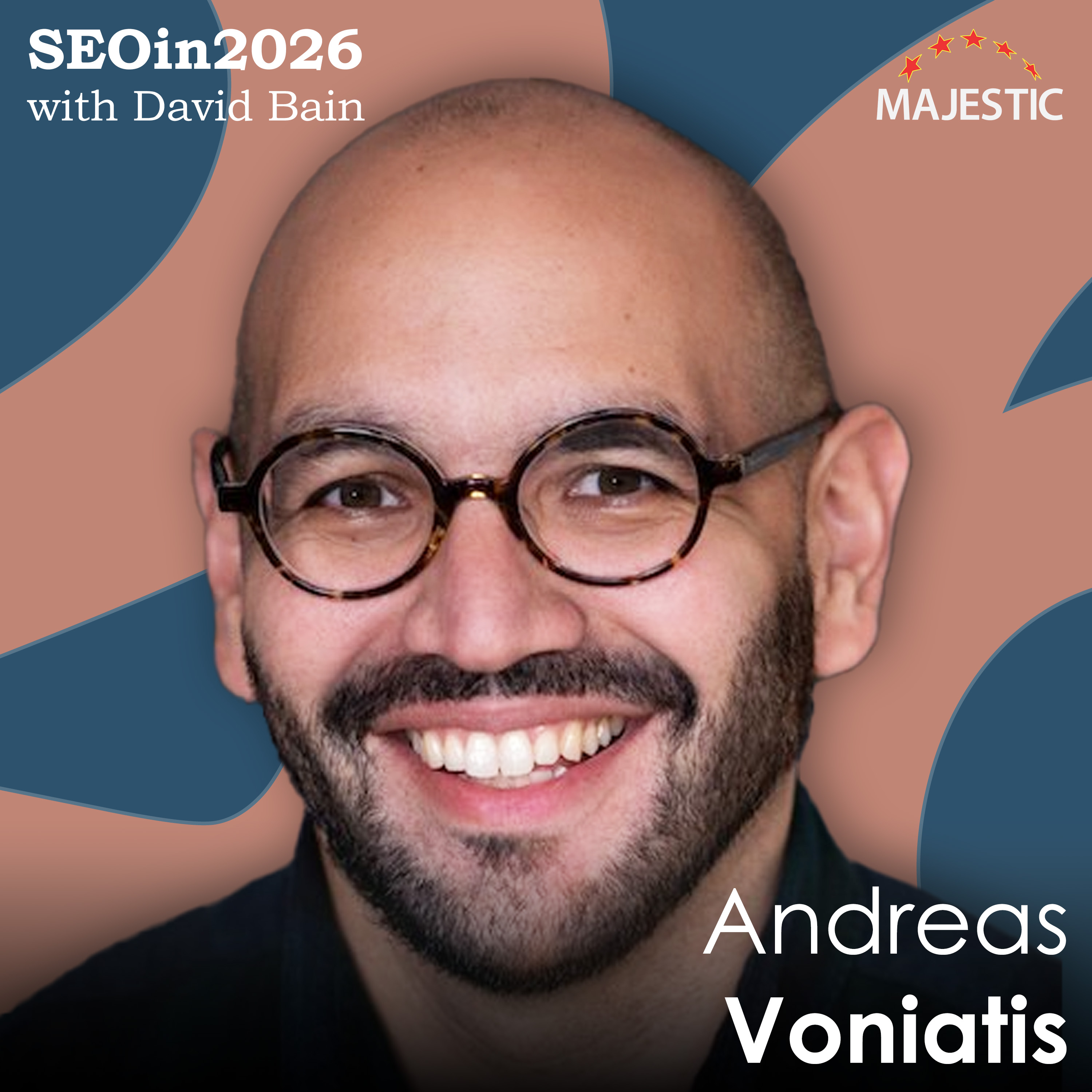
Produce meaningful research to stand out in AI search – with Andreas Voniatis
15m 21s
In this interview, Andreas Vignatus shares his number one SEO tip for 2026: producing "scaled insights" to get content AI-recommended. He clarifies that this does not mean scaling content production, but rather conducting research of significant size that offers unique, fresh data AI does not already possess. Using AI to generate research or write content for AI results is ineffective because AI already knows that information; the content must add value to AI's existing models by providing something truly new. While traditional SEO basics remain important, E-A-T must now be enhanced by large-scale, data-driven research. Andreas warns against using AI outputs to fake authority, as AI can hallucinate, and derivative content fails to contribute value. Instead, he recommends producing reports based on original data collection, cross-validation, and high-confidence studies that target specific buyer interests. This approach not only appeals to AI search but also works across social media. He notes that while each piece of content is evaluated on its own, consistent publication builds cumulative domain confidence, making your brand more authoritative over time. The key takeaway is to research what your target buyers are discussing and create data-backed insights that AI can learn from.
You want to be conducting research on what your target buyers are discussing. And if you can do that, then you've got the raw ingredients for getting your content featured by AI. I'm Andreas Vignatus and this is SEO in 2026. Andreas, what's your number one SEO tip for in 2026? My SEO tip is to produce scaled insights in your content to get your website AI recommended. Scaled insights. So is that same as scaling content production? No, no. Scaled insights is about producing research that has achieved a significant size. That means that your insights contained within your content has significance. And that's really important for AI because it means that it's likely to generalize well or describe the world or whatever it is describing. It's likely to apply in the real world. You see it's more linked to authority than enhancing your own personal and brand authority. Yeah, I guess so. Yeah, it's a very succinct way of putting it. Okay, so how do you go about doing this then? Can we discuss how you don't go about it first? Sounds good. Yeah, so the first thing is that if you're all using AI to produce research for your content in the hope that it will get featured or surfaced in AI results, that's not going to work. Even if you use AI on deep mode or pay the $200-$400 option, that's still not going to work. Because the first issue is that AI already knows about it. So trying to tell AI something it already knows is not going to, it's not going to work. It's not going to cut it. Okay. So you need to produce something fresh and unique, is that the way to do it? Yeah, you need to produce something that provides that favorite phrase information game. It has to be something AI doesn't already know about. It has to add value. It has to be something that AI deems as something that will help it become smarter as a result of using your content. It must be something that adds value to its existing models. That is what's going to position your company or your brand or nonprofit as an authority on the given subjects that you wouldn't be featured or cited as a source in AI. So how does AI determine that your content does add value to what exists out there already? Well, the first thing is that AI is already modeling conversations that are happening online. Okay. So the way AI works currently is it's synthesizing memory. Okay. So if it compares what you're producing to what it has in its modeled memory, then it'll be quickly able to check whether it correlates or how likely what you're producing is to be true and how likely it generalizes. And on that basis alone, it can tell whether you're providing something truly game changing or you're just another also ran trying to get into AI. I mean, stepping back, how do we actually get AI to start considering your content to begin with? Is it simply a manner of actually trying to rank within the first couple of pages of traditional search? Oh, yeah. I mean, there's been plenty documented online that if you're in the top 20 and being more recently Google that you're in the running for AI results, well, SEO is not what it was. The SEO basics absolutely matter. Your content still needs to be discoverable and passable, etc. But that's something everybody can do pretty easily, right? After all is optimized, technically, the real game changing feature here is whether your content tells us what something is. And so this is where scaled research insights comes in. So over the last couple of years, we've heard a lot about experience, expertise, the thirdediveness and trust. Aren't quite so essential now and what we need to do now is simply get our content to a stage where it's being discovered in the first couple of pages of a search engine and from there on in, it's simply a matter of actually publishing relatively unique content that hasn't been featured elsewhere. I think it's more of a case of EAT, very much matters, but it needs to now be enhanced by a scale. Okay, so it's more of a case of back it with it needs to be more data driven and it needs to be data driven at scale. So it's not that EAT isn't important anymore. It's more important than I never. It just needs to have scaled data research behind it and that's what's going to get you into AI. I also talk about the fact that LLM outputs want Cusset even on deep mode, what would you mean by that? Well, what I mean is if you're attempting to fake EAT or scaled EAT to get into AI, it's not going to work because AI generally hallucinates. It's just that 80 to 90% of the time assuming that we're asking it about something it would know or is known to the internet, then 90% of the time the hallucinations happen to be useful and correct. But if you're using those hallucinations or the outputs of AI to try and make it EAT, it's not going to work because those outputs are derivative, they're diluted, they're summarized and there's something that AI already knows about. So you're not really adding value to AI by telling it something it already knows. So are you saying that if you use AI in any form to enhance the structure of your content and enhance your content in some way, then AI search engines are less likely to want to feature that content? I would say so, yeah. So I want to make a distinction here, you can absolutely use AI to like a former machine learning to help you make sense of the data that you collect from your research. That's one legitimate use of AI, but using LLAMs like your AI platforms like ChatGPT to do the research for you to make your content authoritative and expert, etc. That's the latter that is not going to work. Got you okay. So you can produce original content and perhaps use AI to write it a little bit more effectively, but if you're using the AI to determine what to write to begin with, then that's where the problem comes. Yes, exactly. By write it, sorry if I'm being a bit of a sticker. No, that's okay. I like doing that as well. Yes, if you're using AI to help you produce rigorous statistical conclusions that then get used when it's written up by human in your content reports or your insight feature, article, then that's fine. But for me, using AI to write content is a matter of no. So what type of content in general, what structure of content have you had a lot of success with in terms of getting it featured within the AI search engines? Yes, so the kind of content that I find has worked really well and got clients for recommended within 90 days is the type of content where you produce reports that the target buyer, their target buyer or your target buyer can learn from. Because the internet has seen more than its fair share of what is target topic, which you know, your target buyers will already know what that target topic is. So it looks like it's aimed at, you know, every single country in the world, every single person or type, you know, students, retired people, etc. Whereas AI search has raised the quality bar and the threshold. So producing reports that your target buyers can learn from, that's a big one, where did you get the data? Well, we're data scraping the internet on a daily basis, and we're able to subset those conversations, you know, for the target buyers and then do some data enrichment to maximize the confidence interval. And that is what AI seems to really like. And it's pretty reliable. I've never seen it, seen it fail. And that comes out of fraction of the cost.
of, you know, if you as a go to Gallup, for example, you go and take out surveys, that can become very expensive very quickly. But that will work. Do you just produce content for target buyers by doing your extensive research and discovering opportunities in terms of content that doesn't exist already and what's likely to resonate with your target buyer or do you also try and produce content for LLMs or if you produce content for your target buyers will that naturally be appealing to LLMs? Yeah, that's a really great question actually, David, because I think what we've seen with what is topic SEO style guides is that it was primarily driven for search, whereas if you're producing reports for target buyers, not only does it have value for AI search and traditional search engines, it also has value in social media because you're really discussing things that you're talking buyers are truly interested in. You can even make videos of individual sections within the content reports that you're producing. So it can go on not just linked in, assuming your B2B, but you know, it can go on YouTube and start TikTok, wherever your target buyers hang out. Got you, okay. And you also talk about producing high confidence, lower error margins, survey studies, etc. I assume that what you're trying to do here is just give LLMs as much confidence as possible that the content that you're offering is likely to be as better than anything else that exists out there. Yeah, 100%. So the weekly contrast contrast that for a second with using LLMs as a content research tool or an insights tool, you would never get the raw data or nothing meaningful and scaled from an LLM output, it's designed to give you a summary as opposed to the template links. Whereas if you're like a carce getting your own data, then it's not just enough to have the data, you have to do something with it. So this is where we do a lot of cross validation to make sure whatever we collect is likely to land in the real world. And when AI can see that, it passes those fact checking LLMs and therefore it's seen as something that is value-adding and therefore is worthy of being cited in response to a prompt by a target buyer. Does AI build confidence in your domain that it's likely to be authoritative in a particular sector or does it take each piece of content on its own merit? I think it builds confidence actually. I mean, I built my own LLM five years ago and what I learned is that AI search is really a synthesis of memory. So the more you feed it, the more of a memory it has and the more it would score your domain or brand as knowing more about certain areas. So there will be greater weights placed on your domain when it comes to certain domain of knowledge expertise. Yes, each content is taken into its own entirety but obviously there's a compounding and cumulative effect. I guess you could equate it if we're going to talk in SEO terms. It's a bit like domain authority and page level authority. Obviously the page has to stand out on its own merit but the more of those you have, the more the overall domain benefits, even for pages that have a lot of intrinsic authority at page level. But you're okay. So in the age of AI, staying in your lane, staying in your box of your perceived authority is the way to probably maintain that authority and grow it further. I would say staying the target bias lane, that's where he want to be. So whatever your target bias are interested in, that is the lane to go in because if they're discussing it, then it's relevant and you want to be covering it. And Dres was the key takeaway from the tip you shared today? The key takeaway is you want to be conducting research on what your target bias are discussing. Andreas Furniatis is the CEO at Arteas. Find out more at arteas.io. Andreas, thanks so much for being part of SEO in 2026. Thank you David for having me. It was a good fun as always. I've been your host David Bane. Get your copy of SEO in 2026, the book over at SEO in 2026.com. you
Podcast Summary
Key Points:
The top SEO tip for 2026 is to produce "scaled insights"—research of significant size that provides new, unique data AI doesn't already know.
Using AI to generate or research content for AI recommendations is ineffective because AI already knows that information; content must add genuine value to AI's models.
Traditional SEO basics (discoverability, technical optimization) still matter, but E-A-T must now be enhanced with large-scale, data-driven research to gain AI authority.
AI can hallucinate, so using its outputs to fake authority fails; original data collection, cross-validation, and high-confidence studies are essential.
Content should target specific buyer interests (not broad topics) to resonate with both AI search and social media, and success builds cumulative domain confidence over time.
Summary:
In this interview, Andreas Vignatus shares his number one SEO tip for 2026: producing "scaled insights" to get content AI-recommended. He clarifies that this does not mean scaling content production, but rather conducting research of significant size that offers unique, fresh data AI does not already possess. Using AI to generate research or write content for AI results is ineffective because AI already knows that information; the content must add value to AI's existing models by providing something truly new.
While traditional SEO basics remain important, E-A-T must now be enhanced by large-scale, data-driven research. Andreas warns against using AI outputs to fake authority, as AI can hallucinate, and derivative content fails to contribute value. Instead, he recommends producing reports based on original data collection, cross-validation, and high-confidence studies that target specific buyer interests.
This approach not only appeals to AI search but also works across social media. He notes that while each piece of content is evaluated on its own, consistent publication builds cumulative domain confidence, making your brand more authoritative over time. The key takeaway is to research what your target buyers are discussing and create data-backed insights that AI can learn from.
FAQs
Produce scaled insights in your content to get your website AI recommended, meaning research that has achieved a significant size and provides value AI doesn't already know.
Scaled insights involve producing research with a significant size that generalizes well and adds authority, unlike simply scaling content production which doesn't add unique value.
AI already knows about AI-generated outputs, so telling it something it already knows won't work. You need fresh, unique content that adds value and helps AI become smarter.
AI models conversations online and checks if your content correlates with its memory, how likely it is to be true, and how well it generalizes, ensuring it provides game-changing insights.
Yes, SEO basics like discoverability and passability still matter, but the real game-changer is having scaled research insights that tell AI what something is.
Reports that target buyers can learn from, based on data scraped from online conversations and enriched for high confidence, perform well and get AI recommended within 90 days.
Chat with AI
Loading...
Pro features
Go deeper with this episode
Unlock creator-grade tools that turn any transcript into show notes and subtitle files.
 PodcastTranscript AI