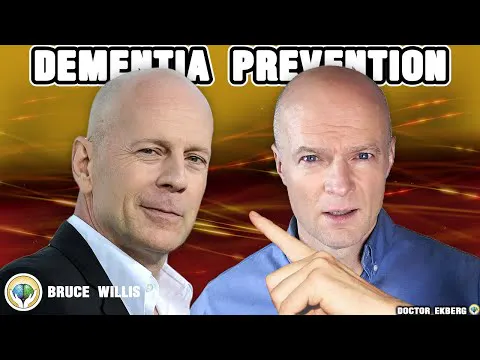
Frontotemporal dementia (FTD) is a degenerative brain disease affecting the frontal and temporal lobes, leading to problems with executive function, speech, and motor control, rather than primarily memory loss as in Alzheimer's. It gained public attention after Bruce Willis's diagnosis. While genetics play a role, lifestyle factors are critical for prevention and delay. Brain cells require three essentials: fuel, oxygen, and stimulation. Fuel comes from glucose or ketones; chronically high glucose causes insulin resistance, starving the brain, whereas ketones offer a stable, anti-inflammatory alternative. Oxygen delivery depends on circulation and lung function. Stimulation, 90% of which comes from movement, is vital—without it, brain cells degenerate. Physical exercise strengthens cells, while cognitive activities like learning languages, puzzles, and social interaction increase neural connections. Stress reduces blood flow to the frontal lobe, worsening degeneration. By optimizing these factors, individuals can potentially delay FTD onset by decades, improving odds even with genetic predisposition. The key is proactive lifestyle changes: regular exercise, low glucose levels (via diet or fasting), and rich mental and social engagement.
Hello Health Champions! Today we're going to talk about Frento Temporal dementia. What it is, what you can do to prevent it, and also if there's anything that you can do if you already have it. Frento Temporal dementia, or FTD, became a hot topic very recently when the family of the famous actor Bruce Willis, came forward and announced that he did have FTD. Earlier, they had believed that he had simply had aphasia, which means lack of speech, but then the disease had progressed, and now he'd gotten the diagnosis of FTD. So the family came forward in the hopes of bringing some attention to this devastating condition, and maybe the hopes of bringing some light to it and some progress. My heart goes out to the family, and I applaud them in this effort, and not only is Bruce Willis one of my favorite actors of all time, but I even happen to look like him some people say. So unfortunately though, whenever something like this happens, when a celebrity gets a diagnosis or there's attention around a celebrity, we get a few days or a few weeks of attention on the topic. But by the time this happens, very often it's too late to really do something about it. We're going to talk about the different things, and there's still some things that may be able to help, but we really want to understand that we want to understand the principles, and then do something about our lifestyle to reduce the chances. We want to work much, much harder at preventing these things, because they're not all that different. Most degeneration has things in common. So, frontal temporal dementia refers to the area in the brain that is being affected. So, if we have the brain here, then the frontal lobe is the front half of it. We put a little F here for frontal lobe. Then we have the parietal lobe, which is up here. We have the occipital lobe, which is in the back, and we have the temporal lobe down here. So, with Alzheimer's, with the most common types of degeneration, it affects mostly the temporal lobe and the occipital lobe. So, it's further back in the brain. It does have some influence on the parietal and frontal, but not so much. It's mostly in the lower and back portion of the brain. But with frontal temporal, now it affects the frontal and the temporal. So, with Alzheimer's, the frontal lobe is spared longer, but with frontal temporal, it's one of the earliest areas that are being affected. So, Alzheimer's affects mostly the temporal lobe, the lower and the posterior aspects, and those areas are mostly concerned with memory. So, when you have Alzheimer's, then it's the memory that's slipping. But with the frontal temporal, now it affects both, and the frontal lobe has a little bit more to do. The frontal lobe is our executive center. It's our thinking. It's our abstract thought, problem solving. It is also the area that controls impulses. It is also the area that controls motivation. And it is also known as the motor center. The front of the brain is more about the motor output. The area that makes things happen. So, when you speak, for example, that's the frontal lobe, when you listen and understand speech, that's more of the temporal. And typically, the frontal temporal hits people a little bit earlier in life. For people under the age of 60, it is the most common form of dementia. And part of that might be that because the frontal lobe is affected, we notice it sooner, because it's not just a little bit of memory loss. It's not just a little forgetfulness. We have major deterioration in motor function and speech and so forth. So, what we really talking about is improving the odds. And we want to understand that there is a genetic component, a strong genetic component to most diseases. And there's also a lifestyle component to most diseases. So, in the case of something congenital, that means you're born with it. Let's say that you're born blind, you're born with too many fingers, you have a cleft palate, you're missing a kidney, that's congenital. You're born with it. It could be a genetic defect or it could be a developmental defect. But either way, it is 100% there. There's nothing you can do with a lifestyle to prevent it. However, there are things that you can do within a wide range to improve the quality of life. And then there are other conditions like type 2 diabetes that while it has a very strong genetic component to it. Like some people could be 10, 20 times more likely to develop type 2 diabetes than someone else. They have a predisposition. The genetic link is very, very weak. Because the lifestyle can convert, can reverse up to 90% of these conditions. There's virtually no one that is doomed to get type 2 diabetes. And then there's these other conditions like dementia and cancer, for example, where the percentages fall somewhere in between. Maybe it's 50/50, maybe it's something else. I'm not trying to pick a number. I'm just trying to show you a concept that you might have a very strong genetic predisposition. But it doesn't necessarily mean that everyone with that genetic makeup gets it because there are still a lot of lifestyle decisions, lifestyle choices that you can make. So what we're hoping for here is to create a delay. And that delay might be 10, maybe 20, maybe 30 years of a delay. And hopefully then you might get to the end of the life and you've delayed it long enough that you actually never get it. But we don't know these. All we're trying to do is to improve the odds. And if we understand the variables, if we understand a little bit more about how the brain works and what it needs, then we can figure out what speeds up the degeneration, what slows it down. And now we have a way of influencing and improving the odds. The main characteristic of dementia is that it is a degenerative disease. What does that mean? It simply means that some things that used to work don't work anymore or don't work to the same degree anymore. So in the body, we have about 40 trillion cells. And out of those, we have 100 billion brain cells. But brain cells are unique in that they make connections to other cells. So each brain cell has about five to 10,000 different connections called synapses. So those are like little wires that connect. And that is how the brain cells talk to each other. That's how we create patterns. That's how we learn things. That's how we develop skills is by creating these neural networks. So let's make it really basic. If something used to work and it's not working, let's try to answer the question of what is it that normally makes them work for as long as they do? And the second question would be what is it that makes them stop working? What is it that interferes with their function and makes them degenerate? Brain cells are designed to live forever. But in order to do that, they need three things. They need fuel. They need something to make energy out of. They need oxygen to burn that fuel and they need stimulation. And we're going to talk about all these separately. And then just for completeness, we're not going to talk much about that today. They also need some nutrients, some building materials and some catalysts. So one would be DHA. That's the longest most complex type of fish oil. That is a structural component of the brain. We also need some minerals as a catalyst. And we need cholesterol as a building material and insulation. But for this discussion, we're going to focus on the top here just so that we understand the mechanisms and why the brain degenerates. So the first two here, that's the energy source. And the second is the stimulation, which is the reason for that brain cell to stick around. So first of all, the brain needs fuel. And contrary to popular belief, glucose is one of the fuels, but not the only fuel. The other fuel the brain can use is ketones. And when glucose is plentiful, when we have lots of food and the glucose stays high for a long time, then up to 100% of the fuel is provided by glucose. The energy is provided by glucose. However, when there's a scarcity of glucose, when we don't have food every day or every three hours, when we go a little bit longer without food, called food.
Now the brain makes do with ketones. We can break down fats, we can have ketones as a byproduct of that, and up to 75% of the fuel for the brain can come from ketones. Now this is really, really important because for most of human history we've had a mix of these two fuels. Sometimes we have plenty of food and sometimes we had not so much. But in the last 100 years we've had so much food that glucose has never been scarce. However, historically ketones are more stable. It's a more stable fuel source. It is also anti-inflammatory. It has anti-inflammatory signaling properties. And glucose of course is the opposite. It's pro-inflammatory when glucose goes high. But most importantly, which we'll get to a little bit later, is that ketones do not require insulin to get into the cell. So ketones flow freely. They're not affected by insulin resistance, which we'll come back to. The oxygen part is really simple. We need to oxidize the fuel just like you're burning fire, you're burning gas in your car, you're burning wood on the fire. You need oxygen. If you choke off the oxygen, then the fire goes out. Same thing in the body. Without enough oxygen, we can't make energy. We've got plenty of oxygen. We can make energy. But the stimulation is the least understood of all of this. We tend to think in nutrition and biochemistry and so forth. But stimulation is the key. Stimulation is the purpose and the reason for that cell to exist. Use it or lose it. So muscles need tension. If you use muscles on a regular basis, if you work out, if you put the muscles to use, the body will make new muscles. Some fibers break down, but then the body makes new ones. But only if you use the muscles, otherwise, they will atrophy and go away. Same thing with bones. Bones have the purpose of resisting gravity. Without gravity, if we don't do weight-bearing exercise, if we don't live in a field of gravity, then there's no need for bones. That's the biggest problem for astronauts. You can maintain most of the cells and the organs in the body, but without gravity, the bones disappear. And by the same token, brain needs signals. That's the purpose of the brain is to process signals. It has an incoming amount of billions of bits of information every second, and every one of those bits of information is processed and responded to. So if we don't get as many signals anymore, then there's less reason for the brain to stick around. So we need to understand where do most of those signals come from? What's involved with most of those signals? And the thing that makes the brain stop working, the thing that gets in the way is called interference. And we'll talk about these, but real quick, if these are the thing, if fuel and oxygen and stimulation is what makes the brain work, if those are the needs, then anything that causes a decrease in fuel delivery, oxygen availability, or in the amount of stimulation is going to make the brain degenerate and deteriorate. And there's also some huge metabolic factors that we want to include, and that's inflammation, oxidative stress, and toxicity. Now what will decrease the availability of fuel? And this is a shocker and surprised to most people, because we're told that glucose is so important for the brain that it's the primary fuel source, and yet high levels of glucose is the number one reason that the brain cannot get enough fuel. So let's explain that part. When glucose is low, when there's starvation, famine, fasting, now the glucose is low and the body burns more fat, and ketones are available as a byproduct of the fat. So when glucose is low, the body has a backup fuel source. So it's not a problem. And this is how humans survive with the biggest brains in proportion to body size of any animal in history. However, when glucose is high, when it's chronically high, when we have a lot of things to eat all the time, now we develop insulin resistance. And it used to be thought, even just a few years ago, a couple of decades ago, we used to think that glucose could get into the brain without insulin, and then they found out that even the brain needed insulin to get the fuel into the cell. And the brain can also become insulin resistance. So even though glucose is a fuel source for the brain, the brain is more likely to be starving when glucose is high than when it's low. Because when it's low, we get this backup fuel source. And the reason for low fuel could be poor circulation, because the fuel is in the bloodstream. And if we're not circulating enough, if we have placking in the carotid arteries, or if the heart is unable to pump enough blood on a consistent basis up to the brain, now that could also be a problem. And the reason I talk about stress related to every topic is that stress relates to every topic. And whenever we are stressed, we shift the blood flow, the body reprioritizes. So our front to low is our cognitive center, it's our creative center. But when you're stressed, you're not very creative. If you're being chased by a tiger, that's not the time to be creative. It's the time to use your instincts and just get out of there. So whenever we have stress, when we're in fight flight mode, the brain shifts the blood from the front and further down into the brainstem. So we're starving the front to low for blood to some degree when we are stressed. If we're low on oxygen, that could again be poor circulation, because just like the fuel it needs to follow the bloodstream. And again, of course, that could be stress for the same reasons. But here we have a few more reasons. It could also be a lung disease. If we're not oxygenating the blood properly, then there's no oxygen to carry. And also if the heart itself has a problem, like congestive heart failure, now for whatever reason, the heart cannot pump enough blood. It doesn't pump effectively enough to circulate the blood and get a consistent supply to the brain. We can also have something called anemia, which means lack of blood. If we just don't have enough of the red blood cells or red blood cells containing enough hemoglobin, now we don't have the oxygen carrying capacity. So now again, we're not getting enough oxygen to the end organ. And number three is stimulation. So let's first understand what stimulation is and what it does to the brain. So we have receptors and the receptor is anything that takes one type of stimulus and converts it into a signal. So we have our five senses for starters. We have vision, hearing, smell, taste and touch. So when you look at something, you have photo receptors that take photons and they being stimulated and then they turn that into an electrical signal. The hearing, we have a membrane that picks up vibrations in the air. They turn that into an electric signal. Same thing, we taste and smell. Whenever you touch something, the reason you can feel it is that there's a receptor that takes that deformation of the skin of the tissue creates an electric signal. So receptors are different, but they convert a stimulus into a signal. So even though we usually just talk about touch as one of the five senses, it's a kind of deformation if you want to call it and that would include then pressure and vibration and temperature, the ability to sense hot and cold with just different receptors and depending on where they end up, we perceive all these different senses. And also part of this deformation of the change in shape is stretch receptors and mechanoreceptors. So when you move a body part, you have muscles that get stretched and that shorten. You have muscle spindle cells that send electrical signals to the brain. You have tendons that stretch a little bit, that get certain tension on it and you have joints with mechanoreceptors that sense a change in position. And here's why I'm making a big deal out of that because this movement, these receptors, these sensors that translate movement account for 90% of all the stimulation that the brain receives. And remember, muscles need tension, bones need gravity and the brain needs signals. So without these signals, the brain degenerates. It's the juice that keeps the brain alive. And 90% of the body is in the brain.
of them come from movement. And then there's also thought and thought very often translates to emotion and we have different neurotransmitters and these neurotransmitters in turn fit into receptors and create different signals. So we create signals with our senses, with our movements, with our thoughts and our emotions. So here are the things that can account for a lower degree of stimulation. So obviously a sedentary lifestyle would reduce the amount of signals, but also skills. Whenever you learn a new skill, then you have to create additional wiring in your brain and this additional wiring, the complexity of that wiring creates more stability and these brain cells are going to have an increased probability of stimulating each other if they are more interconnected. If you are mono-lingual, meaning you speak one language rather than two or three or four, then you're going to have a lesser complexity of your neural network. So picking up an extra language or two can dramatically improve the complexity in your wiring and the stability and health of your brain. But it could also be a lack of joy. If we don't feel good, if we don't have a purpose, if we don't get a lot of stimulation, emotional stimulation, like if we have a lack of a social network, if we don't interact with people, if we don't have very many hobbies, if we just work and come home sit in the sofa, there is less variety in life. If we don't feel like we have a purpose, that reflects on our level of joy. So here's where we need to understand the difference between a brain cells' strength and its interconnectedness. Because so often, we hear that you should stay active. You should go out with friends. You should do crossword puzzles and all of those things are good. But here's how you want to think about it. That if you have a brain cell, then it has all these different spikes where it can make connections and then it has a cell, a nucleus. So a brain cell, just like a muscle, it can be big and strong. It can have a high metabolic threshold. It can have a large work capacity, just like a muscle. If it's healthy, if it's gotten the fuel and the oxygen and the stimulation consistently, we have a nice big fat, strong brain cell. But if the brain has been suffering in those regards, and it has not been stimulated, now we have a little wimpy brain cell, just like we have a big muscle versus a small muscle. So this weaker brain cell would have a lower threshold, a lower work capacity. So if we want to improve on that, we want to juice up the brain cell. We want to pump some life into it. And what's the way to do that is exercise. We want to get the hormones going. We want to get some intense exercise, large volumes of exercise and movement, because that's going to pump it up. But the other aspect is called interconnectedness. So now we're talking about how many connections, how many synapses is this brain cell making? So on average, they have five to 10,000. So brain cell with 10,000 synapses and connections, it is more well connected. It has a greater interconnectedness. It's going to be stimulated more by other brain cells because it has more connections. Whereas something with only a few connections is not going to be as strong and stable a brain cell. So you use the exercise, the large volume of signals to pump it up. But then you use all the other things like cross-broad puzzles and bridge and hobbies and skills to increase the number of connections and the complexity. So please don't miss that piece. Usually when they tell you to stay active, they're usually just talking about cognitive activities, which will increase the number of synapses. But that doesn't help much if you have a skinny and weak and depleted brain cell. And then we have the metabolic factors, which are inflammation, oxidative stress and toxicity. And as I always bring it up, stress is involved with everything and stress does cause inflammation as well. And beyond that, the two most important factors are sugar and insulin resistance because they're strongly involved with all three of these factors. Something most people don't pay enough attention to are the processed plant oils. These are the so-called healthy vegetable oils that were told to eat because we have this phobia of saturated fat. Resaturated fat is very safe because it's stable. It doesn't oxidize very much. Whereas these plant oils are poorly unsaturated. And in the processing of these oils, they are subjected to incredible oxidative stress. There's some of the worst foods on the planet. So just because they tell us that their plant based and healthy doesn't make it so. And then we have, in the aspect of toxicity, we have pesticides and metals and chemical exposures. So there's dozens and dozens of common metals and there's thousands of different chemicals that can be involved. And here's how you want to think about that. But think of it as your breaker box at home, your electric panel. But instead of just a few dozen circuit breakers, you have a hundred billion circuit breakers and they're connected to 10,000 other. Each one is connected to 10,000 other circuit breakers. And every time that you get a short circuit, then the body has to reroute. The body has to create a workaround. And the brain is much better at that because your electric box won't do that by itself, but your brain will make the attempt. However, everywhere that you have these foreign chemicals, especially when it comes to brain, especially metals, then they can create one of these short circuits. And I'm never seen a neurological problem that didn't have a metal involvement. And it doesn't have to mean that on a blood test or a hair sample or urine test that your levels are higher than anybody else's, it just means that for you, those short circuits are affecting something critical. So what are some things that you can do about this? Well, first of all, I really, really urge you that when it comes to the brain, you want to change before you have the symptoms or very, very early when you have the symptoms. Because in a lot of conditions, you can go quite far and still reverse it. That's not true about the brain. The brain cells, even though we have some capacity to rewire and regenerate, it's not nearly as capable of regeneration as other organs. So diabetes, for example, type 2 diabetes, you can be quite far gone in your 70s and still reverse it. That is not true for dementia. So you want to make these changes before there is a problem. And that's why we talk about these principles in these videos. And what you'll find if you watch 100 videos is that the solutions are remarkably similar because there are certain things the body needs and there's certain things that interfere. So the first thing I would cut out is sugar. Eliminate it completely. All added sugar should be gone. And if you're insulin resistant, then don't just cut out the added sugar, cut out all natural sugars and you also want to minimize your carbohydrates. If this was me or someone that I know, then I would tell them first thing you want to do is keto, a ketogenic diet, and intermittent fasting. And why is that? Because a ketogenic diet will provide ketones, which is an alternative fuel for the brain. So if your brain is starving because your glucose is high, all your feeding it is carbohydrate, but you can't get into the brain, if you can develop some ketones, they can go straight in and start fueling that brain. And even in some cases of mild to moderate dementia, that can make a huge difference. The other part is intermittent fasting, which is as powerful or even more powerful, because intermittent fasting will generate ketones, but intermittent fasting also will generate growth hormone and something called BDNF, brain derived
neurotrophic factor. And these are the two hormones that promote neuroplasticity. So your ability to rewire the brain depends on these hormones. Your ability to make new synapses and circumvent a problem depends on those two hormones. And one of the most powerful ways to generate that is intermittent fasting. Now here's the problem when we start talking about keto is that everyone out there knows someone who knows someone who heard someone say or read a scientific paper that high fat is bad and that high fat creates causes insulin resistance. Now here's the truth of the matter. So insulin resistance is caused by what's called a fuel overload. And there are two types of fuel. There is fat and there is carbohydrate. So the average person in America they have learned to eat less fat. So they're down to about 35% fat. Most of it is horrible quality fat, processed plant oils oxidized, fried oils, etc. And they're eating about 45% of their calories from carbohydrate. Almost half of that is added sugar, about 22% in the average diet. So they realize that's not a great diet. So they tell people to eat even less fat and even more carbs, but a higher quality. But then when they do research on what they call a high fat diet, here's what they do. They raise the fat to 45% and they lower the carbs to 35%. And we're assuming here the protein is about 20%. So it could be 15, could be 20%. But just to keep the number simple. So what they've done now is they've raised the fat and they call this a high fat diet. But what they don't realize is this still is a high carb diet. And the absolute worst thing that you can do to create a fuel overload is to have high fat and high carb at the same time. There is a small percentage of people who have success with high carb and really, really low fat because they can reduce the fuel overload. But it's because they don't do both of them high at the same time. But it's much, much easier to reduce the fuel overload if you increase the fat dramatically and lower the carbs dramatically. So this is high fat high carb. If you want to do a true high fat diet, you want to go to at least 70% fat and 10% carbohydrates, none of which should be added sugar. So at this level, now what's happening is you're reducing the carbs low enough that you're going to reverse insulin resistance. You're going to dramatically reduce the amount of insulin released and secreted to handle the carb load. So probably 80% of people will get a dramatic improvement on that level. And if you don't, then you take it a little bit further and you go ketogenic, which is about 75% fat, 5% carbohydrate. So realize what they call a high fat diet is not a high fat diet. It is a high fat high carb diet. It is one of the absolute worst things that you can do. If you get the carbs low enough, it's going to work beautifully. And if you don't believe me, get some blood work and try it, measure your triglycerides and your glucose and your insulin and you'll find that this is what's going to reverse the condition. You also want to eliminate all processed plant oils and you want to replace them with natural fats. And those are fats that are naturally occurring in meat, nuts, fish, cheese, etc. And if you add fat, you want to make them as natural as possible, which means things like butter and olive oil and coconut oil. Those are saturated or mono unsaturated and they're very stable and undamaged. And then you want to include some exercise. You want to do as much as you can without exhausting your body. So things like walking are great because you can do them for hours every day. You can do things like high intensity interval training because that is the thing next to fasting, intimate and fasting that produces the highest amount of these hormones that help neuroplasticity that helps you make new brain tissue and new brain connections. You could do things like yoga or pilates, you can lift weights, all of those are fantastic. You can take on or you can add various hobbies, you can read books and books are vastly different than watching a video. When you're reading a book, you're involving different areas of the brain, much more precisely, much more actively than when you're watching a movie. You can learn a different language that would increase the complexity as well or you can join a club, you can volunteer in an organization, just start doing more things. Another thing to help organize your brain and promote brain plasticity is called meditation and because meditation is a little challenging if you don't have the patience or skill for it, there is a tool that we use in the office called Brain Tap. I'll put some information down below if you want to check that out as well. It's like a guided assisted meditation that requires no skill and even if you fall asleep during a session, it still works. Now here's the problem. Depending on how far progressed the disease is, there are some things on here that you could do and others that would be a challenge. In the case of Bruce Willis, for example, they said that he had aphasia to the point where he stopped his acting career a little under a year ago and now the disease has progressed. I don't know anything about him other than those statements that they made, but obviously it wouldn't be possible for him to change before the symptoms because they're already there. It would be rather difficult to make high intensity interval training or things like yoga because they require a lot of motivation and focus things that go missing when the frontal lobe degenerates. Same thing with pilates and weights to the degree that you can't do that, it would be great, but there may be a limit in how much you can perform. Also with hobbies, books and languages, there may be some hobbies that are easier than others, some that you can still perform, whereas books and picking up a language might be more difficult. But again, everyone is different, so we have to look at these things and maybe add to the list and figure out things that we can do. And I would think that meditation would be very difficult because meditation requires very very strict focus. It's about sitting down and controlling your thoughts, so that's very very much involvement of the frontal lobe. But the things that you could do that would be still very powerful. There's no way of telling if it could create an improvement, but there's a very good chance that it might or at the very least that it could slow down the progression. And these would be things like decreasing the sugar, like starting keto and intermittent fasting to cut out all processed plant oils and to promote more brain plasticity and kind of give the brain a little bit of fitness workout. I believe that the brain tap would be a fantastic tool. And if you have something that you really like to get done in the face of overwhelming odds, maybe that's just the time that you want to go "Yippie Kaie" and if you want to dig a little deeper and really understand some of the markers that I talked about in this video, I've created a blood work course. It has over 15 hours of recorded materials. It's divided into nine modules with various different topics. And while not everything can be explained in blood work, it will give you a lot of information to understand what's really going on, especially metabolically, and help you really take charge and make some changes in your lifestyle. If you enjoyed this video, you're going to love that one. And if you truly want to master health by understanding how your body really works, make sure you subscribe, hit that bell and turn on all the notifications so you never miss a life-saving video.
Podcast Summary
Key Points:
Frontotemporal dementia (FTD) affects the frontal and temporal lobes of the brain, impacting executive function, speech, and motor control, unlike Alzheimer's which primarily affects memory.
FTD is the most common dementia in people under 60, with lifestyle factors playing a significant role alongside genetics in prevention and delay.
Brain cells need fuel (glucose and ketones), oxygen, and stimulation to survive; high glucose levels can cause insulin resistance and starve the brain, while ketones provide a stable, anti-inflammatory fuel.
Movement accounts for 90% of brain stimulation, making physical activity crucial for brain health; a sedentary lifestyle, lack of social interaction, and low joy reduce neural stimulation.
Brain health depends on both cell strength (via exercise) and interconnectedness (via learning skills, languages, and social engagement), which together improve resilience against degeneration.
Summary:
Frontotemporal dementia (FTD) is a degenerative brain disease affecting the frontal and temporal lobes, leading to problems with executive function, speech, and motor control, rather than primarily memory loss as in Alzheimer's. It gained public attention after Bruce Willis's diagnosis. While genetics play a role, lifestyle factors are critical for prevention and delay.
Brain cells require three essentials: fuel, oxygen, and stimulation. Fuel comes from glucose or ketones; chronically high glucose causes insulin resistance, starving the brain, whereas ketones offer a stable, anti-inflammatory alternative. Oxygen delivery depends on circulation and lung function.
Stimulation, 90% of which comes from movement, is vital—without it, brain cells degenerate. Physical exercise strengthens cells, while cognitive activities like learning languages, puzzles, and social interaction increase neural connections. Stress reduces blood flow to the frontal lobe, worsening degeneration.
By optimizing these factors, individuals can potentially delay FTD onset by decades, improving odds even with genetic predisposition. The key is proactive lifestyle changes: regular exercise, low glucose levels (via diet or fasting), and rich mental and social engagement.
FAQs
Frontotemporal dementia (FTD) is a degenerative brain condition that affects the frontal and temporal lobes. It impacts the executive center, motor function, speech, and impulse control, and is the most common form of dementia in people under 60.
Bruce Willis's family announced his FTD diagnosis to raise awareness about the condition, hoping to bring attention and progress to understanding this devastating disease.
Brain cells need fuel (glucose or ketones), oxygen to burn that fuel, and stimulation to maintain their connections and purpose.
High glucose can lead to insulin resistance in the brain, reducing fuel delivery. In contrast, low glucose allows ketones to serve as a stable, anti-inflammatory backup fuel.
Movement accounts for 90% of the stimulation the brain receives, as signals from stretch receptors and mechanoreceptors keep brain cells active and prevent degeneration.
Lifestyle choices like exercise, learning new skills, maintaining social connections, and managing stress can delay or reduce the risk of FTD by improving fuel delivery, oxygen, and brain stimulation.
Chat with AI
Loading...
Pro features
Go deeper with this episode
Unlock creator-grade tools that turn any transcript into show notes and subtitle files.
 PodcastTranscript AI