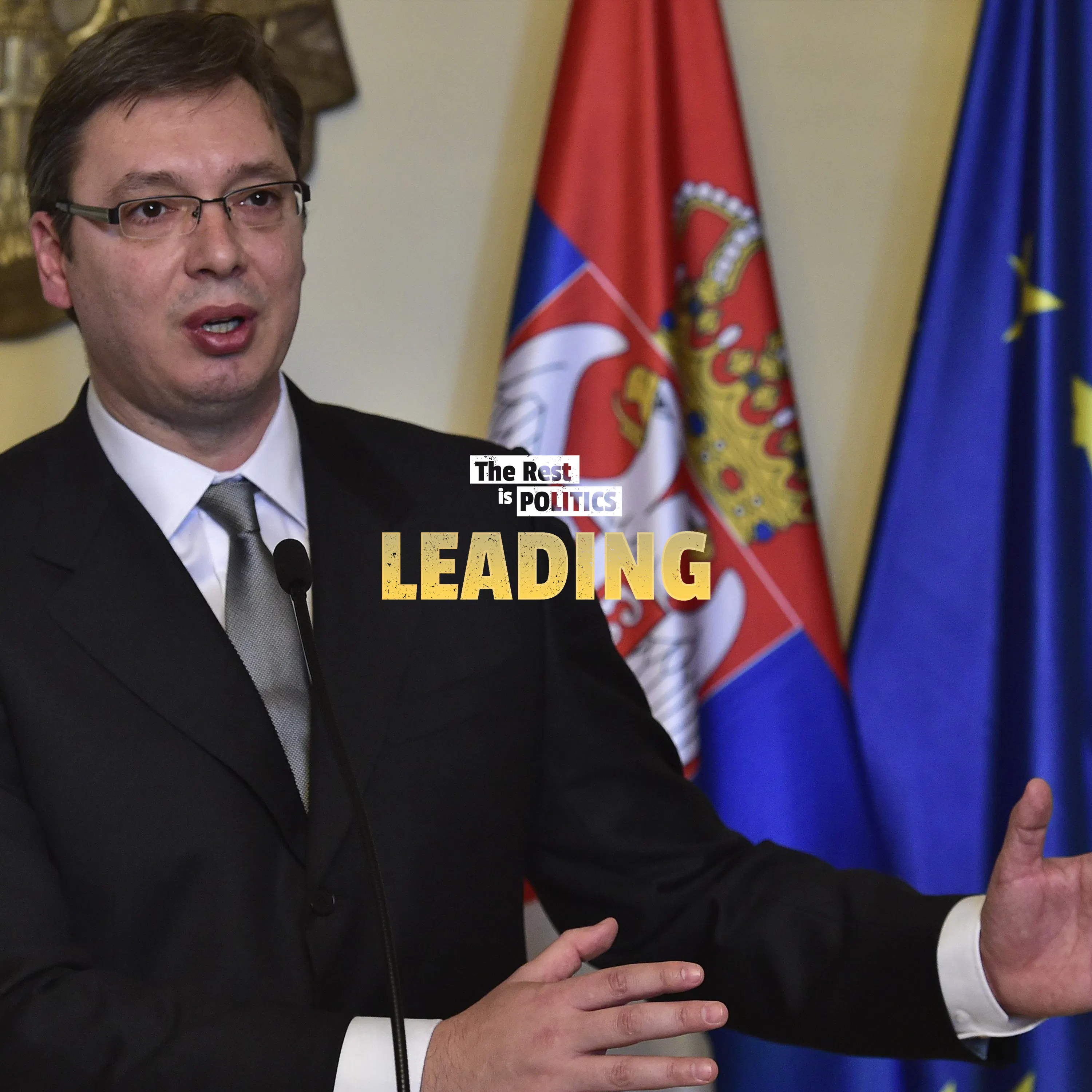
President Aleksandar Vučić: Russia, China, and How Serbia Could Join the EU
from The Rest Is Politics: Leading
64m 38s
In this interview, President Aleksandar Vučić of Serbia discusses his country's complex history, regional tensions, and geopolitical balancing act. He strongly defends Serbia's stance on Kosovo, arguing that NATO's 1999 bombing campaign violated international law and set a dangerous precedent for border changes worldwide. Vučić acknowledges past Serbian war crimes but insists that Western powers were not innocent either, and that the conflict opened a "Pandora's box" of instability. He promotes the Open Balkan initiative as a practical solution to regional disputes, allowing free movement and economic integration without requiring formal recognition of Kosovo's independence. On EU accession, Vučić criticizes double standards, noting that Ukraine receives faster consideration while Serbia is blocked over Kosovo, despite five EU members still not recognizing it. He defends his domestic record, claiming media freedom is robust with more opposition outlets than in neighboring countries, and rejects comparisons to authoritarian leaders. Vučić also praises his friendship with Viktor Orbán, crediting him with transforming historically tense Hungarian-Serbian relations into close cooperation. Throughout, he emphasizes Serbia's desire for peace and economic development, while maintaining pride and resentment over past Western intervention. The interview reveals Vučić's efforts to navigate between EU integration and strong ties with Russia and China, as well as his handling of ongoing student protests and corruption allegations.
Thanks for listening to the Restisted Politics. Sign up to the Restisted Politics plus to enjoy Adfree Listening and receive a weekly newsletter. Join our members' chat room again early access to live show tickets. Just go to therestistpolities.com. That's therestistpolities.com. Help us understand your position in relation to Russia. You're representing yourself as a beacon of democracy. Russia was a beacon of evil, which is not true. Broadly speaking, we are more democratic than Russia, right? I mean, the Grey and Nuaces, but there are different cultures. There are different cultures. There are different traditions. You were always speaking about Serbia that was a Russian puppet. We knew that. Okay, or never said that. What does it feel like looking back to the fact that we were enemies and we're now sitting around a table together? Many people in the world started doing something against sovereign nations and changing borders because they saw that you were able to change our borders. We have principles, unlike you, other start from time to time. This episode is brought to you by IG. If you're listening to this podcast, the chances are you're someone who thinks seriously about politics, economics and your own financial future. You probably also understand that volatility can also mean opportunity. So rather than waiting for things to settle down, you're wondering how to invest. And that's where IG comes in. They've been trusted by British investors for over 50 years through every kind of market condition you can think of. IG offers zero commission on your investments, zero count fees, and they were just voted best low-cost iser at the 2026 boring money awards. If you've been thinking about investing or you want a new investment platform that gives you better value, search IG.com today and find out about their latest welcome offers for new customers. IG trade invest progress. Your capital is at risk. Other fees may apply. Welcome to the dresses policies leading with me, Alice Campbell. And with me, Rory Stewart. And we are in the presidential palace in Belgrade, capital of Serbia with Alexander Ruchich. Now when I first came across Mr. Ruchich, he was in charge of the government information machine under Slomadan Molosevic. I had a similar role in the UK and then when we were at War over Kosovo at NATO, he rose through politics first to become prime minister and now for the last nine years has been president. I, on the other hand, present a podcast with Rory Stewart. So we won the war, I would argue, but maybe he has won the battle for long-term power and relevance. Like all presidents, he's got a lot on his plate. He has a lot of supporters and he has a lot of critics. His supporters say with some justification that he's done a good job on the economy. His critics say that he has authoritarian tendencies in the model of Mr. Viktor Orban recently defeated in Hungary. His supporters say he's committed to driving Serbia towards the European Union. His critics say sometimes the deeds don't always match the words. This is a European country, but it's one with very close ties to Russia, which with China, people may be surprised to know Paul as the two most popular foreign powers here. So he's trying to balance the European path with all these other complicated relationships and a very complicated history, not least Kosovo, which continues to be tricky. And Ukraine, where Serbia's indirect provision of munitions is perhaps led to some rough conversations with Russia and even the Russian intelligence services saying that President Vuchis has blood on his hands. The China relationship came into very close focus around the world when a train station canopy collapsed in 2024, getting 16 people with allegations of corruption in the deals with China. And the birth of a student protest moment, which has become quite a force in Serbia. And of course, like all world leaders is having to adapt to the world of Trump term too and think about his own future as he's only got one year left of his presidency. So we have got a lot to get through. Mr. President, thank you very much for doing the interview. Can we start in Kosovo? I mean, it's a strange connection for us. I was a British diplomat based with the military and Montenegro and Kosovo during the war. And of course, as he's pointed out, he was also working on Kosovo. So what does it feel like looking back over 26, 27 years to the fact that we were enemies and we're now sitting around a table together? Today, if you ask ordinary Serbian people what they feel about 1999 and how they felt, they feel even bigger resentment, they feel bigger disappointment with the behavior of 19 countries that launched aggression against the sovereign state. And people are absolutely certain, which is even confirmed by almost everybody that was done not in accordance with you and charter, not in accordance with your resolution 1244. That was done not because of preventing humanitarian disaster as it was said by Alistair and some other smart guys, but it was actually something West did in order to separate 14% of Serbia's territory, which was at least attempted to be done eight, nine years later, 2008 when they did this self-proclamation of their independence. And as a young man, you were very much on the nationalist side of the political debate. Looking back, do you draw a distinction between the wars in Bosnia and the war in Kosovo? Do you have a different attitude towards what? It's a different legal situation. The routes are you can find a common denominator speaking about the routes or the cause of the clashes in Croatia, Bosnia and Serbian Southern province. But at the end, it was a different legal situation. And you went through a transition? I believe initially you had been supportive and there were moments where it seemed as though you were earlier defensive of figures like Miladic, but later you supported the movement for Trans. First of all, I believe I have changed my views not only recently. It's a process, but it has nothing in common with the bombardment of Serbia or that aggression that was launched in 1999. But whether I am more pragmatic, more rational, whether I see the future of Serbia not in new wars, but in opening borders in an entire Balkans, opening borders with Europe. This is what I see and I'm not ashamed. I'm not ashamed to say this. Even that with marriage was exaggerated because you saw those labels with his name that I was sticking somewhere, but it was not about that. It was about legal rights of some people to protest that were arrested about it. But you know, you cannot explain everything to everybody. But anyway, I just wanted to tell you that what is the real issue today in the Balkan that people don't want to understand because for you, as Alistair has just said, it's all over the world. You were stronger. 19 strongest countries in the world were stronger than one small Serbia. And it was not the case that Serbia attacked any of your countries. It was the case that you attacked Serbia. But people here are proud, dignified, and they don't forget it. And I like the fact that we are more rational, that we are future oriented, but if you ask the people about their souls, about their opinions, you're going to hear a 90% of the same what I have just told you. But is that part of the reason why you as the leader of the country also have to say it? Can you not look back and think actually at the conduct of Milozović and the attempted ethnic cleansing of Kosovar Albanians and some of the massacres that took place? That the 19 countries would actually have been doing a disservice to humanity if we hadn't stepped in. I really disagree with you on this and I'm not going to I'll discuss part of your sentence, which is don't look back to the past. Because would you say the same to Ukrainians with Crimea? Why do you look back to the past? In 2014 you lost that Crimea. Why do you still claim that it's your territory? You would never do so. I think I would. You would? I didn't hear it from any Western official. Well, I think part of the reason my peach and has gone on to do what he thinks he can do in the whole of Ukraine is because the world didn't stand up enough. But my point is I can tell you many people in the world started doing something against sovereign nations and changing borders because they saw that you were able to change our borders. Or at least you will saw that you finished your job. Okay, 1999 and 2008. Yeah. That was the way that Pandora's Box was opened, actually. When you say, if you ask all European officials today, if you ask all of them, tell me, how can you not be on your Ukrainian side? We supported the territorial integrity of Ukraine. We act in accordance with you and charter your resolutions and everything else. But my question to you is, why are you still, we have 1244 resolution in effect? It has not been dismantled or abolished. No, it's in effect.
I don't you observe that resolution. Okay, and it's not okay, Alistair. There are no responses to that. Whenever I say this, I hear the same sentence. Don't look back to the past. And then I say, I don't look back to the past. You asked me the question. You wanted me to say this to you. Otherwise, what have spoken about, I don't know, Expo, growth rates, GDP, public depth to GDP ratio and everything else. Yeah, and we've got 45 minutes and I want to cover lots of that. And just, and I do want to look forward. But the truth is, regardless of the history, and we're you and I can go backwards and forwards on that. One of your strategic goals, I mentioned at the outset, is for Serbia to become a member of the European Union. Yes, right. It's never going to happen unless this issue gets somehow resolved. It's never going to happen. If you remember, and I know that you remember, you two are very smart guys, not going to flatter you furthermore. But you know something, you remember, when you, how you emphasized that one door, it's a different type of victories we had, although I have never said that we won. We didn't, but I don't think that you won. Sorry, just unpack that. What do you mean, bother? You opened that Pandora's box, and we'll all have a big pain in the future because of opening that Pandora's box. And it was not related to today. Even with Iran. Yes, it's related to everything that was happening after that. And you know, all these politicians were saying the first attack in Europe, the first violation of territorial integrity happened in Ukraine. No, it's not true. It happened here. It happened here. You were guaranteeing, Alistair, you were guaranteeing us, territorial integrity of Serbia, if we accept territorial integrity and independence of Slovenia, Croatia, Bosnia, Kertzegovina, and Macedonia, you don't accept. And we did accept that. No, you don't accept the Slovak Damalovian, the Milosevic did anything, which just if you like, yes. No, I don't say that we were angels. I don't say that we were like people without any falls without any guilt. No. But we were not the only culprit, no doubt, for everything that was happening here. And I'm scared speaking about the observance of international public law, which is very clear. And you cannot provide any kind of responses even as a very smart man and not any other guy can do that. The real issue is. What we're going to say about that, it will take another five minutes or so. No, it can take you even ten. Speaking about massacres and everything else, it was happening on both sides. It was exaggerated from your side about their destiny. It was also from our side. We were pretending that there were no war crimes on our side. But there were. But at the same time, there were many war crimes that not only Albanians, but foreign troops were committing against us as well. But okay, put that aside. Now the question is, Pandora's Box is opened. Now no one will stop it. No one will stop it till some new world order is produced. And that's it. And it was all about Yugoslavia or Serbia, if you like it. Mr. President, you did a very interesting op-ed with Prostal D. Rama from Albania, suggesting a new possibility for resolving this problem. And basically our listeners looking at Serbia and looking at a map will think this is crazy. Why is Serbia not in the European Union? It's like this big hole, Bulgaria, Romania, which are further east or in the European Union, why is Serbia not great? I was interested in it because maybe this also resolves the Kosovo situation. If you join the single market, join Schengen, maybe even if Kosovo did the same, then the borders don't matter and Northern Mietrovica is more integrated, it's easier for people to move back and forth. Can you explain a bit about this idea? I can. Yeah. And it's very easy. That was my idea with an open Balkan as well. That's what we wanted. And then it was interrupted because some European big powers were not having the steering wheel in their hands and. But tell us more about that. I'll tell you what is your overall idea. You know Serbs lost 29% of its overall population in the First World War. We started First World War two months before you started. And we were the country with speaking about proportional numbers, of course, with the biggest losses in the First World War. Us then French them all the others. Second World War. Only Serbs were at the beginning of the war and the Nazis oriented. Only Belgrade was bombed. As you know, all the others were receiving German tanks and German troops with flowers and greetings. Belgrade has never done it. And we paid a big price for that as well. And we were fed up with wars. My idea was that I wanted to finish, and I still want to finish my mandate, my tenure, without having any wars. And we were accused by your press, by everybody, in Great Britain thousands of times. In last four and a half years, since the war in Ukraine started, that small Serbia, those Russian puppets, will launch a war against someone in the Balkans in order to distract our attention from Russia and blah, blah, blah. And I was listening to that for more than four years. And I have never heard a word of apology or whatever. Never ever. We want to keep peace. And we invested into that peace. And my idea is, and our idea was, our common idea was, okay, open the Balkan area. For all of us, doesn't matter entities, states, countries, whatever you call it, everybody's free to move. Can you imagine how much easier would be for Bosnia, from Novipazar, to go to Sarajevo, particularly when we finish this highway towards Bosnian border? Much easier. Two hours, two and a half hours. Easy for them. No borders. For Bosniaks from Sarajevo to go to Novipazar. For Serb, from Bania Luka, to come to Belgrade, for Serb from Bielinak, to come to Belgrade and vice versa. For Serbs in Kosovo's Camitrovica, they will always say, "We live in Serbia." Pristina will always say, "They live in Kosovo." But they will easily go to Pristina. They will easily go to Belgrade. They will easily go to Herzegnovi, wherever they want. That was an idea and to connect us economically. And you know, you have to work with the governments, with the local, regional countries, entities, authorities, that's it. And no will never ever put in jeopardy that kind of peace. And he was mentioning, "If you don't recognize Kosovo's independence, you are not going to be a part of European Union." Now, European Union is discussing full-fledged membership status for Ukraine. I have nothing against it to be very frank, very open. But what would be the territory that will join Europe? But they also say, Does it mean that Europe will fight for that territory? Or there are still five non-recognizers within European Union of Kosovo? What you're going to do with those countries because you will never, ever be able to force Spain, never, ever to recognize Kosovo's independence, because of their own interests. We had President Zelensky on the podcast recently and he's very frustrated with Europe as well, because he thinks he's making reform, he's making progress, but he still has to go through a process. You have to go through processes. Now, I think Mark Tukosti Commissioner is interested in this idea of getting everybody in and then sort of making the process part of the accession, as it were. But at the same time, you have been. We just share the same views about the process. I know that, but the reason is because you've been criticized. But it's not the one in with you. If we criticize the backsliding on media, rule of law, you just should know this though. I agree with you. Just tell me, what is the backsliding with judiciary? I do understand. Now we are revoking something and we'll do our job. And I accept it. I cannot accept all the arguments, but okay, I accept it. Our fault. Tell me about media. What did I do and what did we do regarding media? You have more media against me here than against any other leader in the region. No. Yes. Really? Okay. Let us analyze it. No, let's look at you a little bit. Okay. Okay. Okay. I know what you're doing. Okay. You're bringing this up. This is a list of. I think my understanding, the nature of this argument, is that you would say that social media is free and quite agressive against you. You're creating a lot of. You're creating a lot of social media. in propaganda and lies against me.
And that's it. And you know, how can you, can you understand the argument where someone is casting spells against you, even adding that your father actually is not your father because your mother was a whore and your she was cheating your alleged father with one Albanian and that's why are you so much pro Albanian. I think people are and it was not said on social media. I agree that that's terrible. And I agree that is terrible. Do you think people were unfair to Victor Orban? Do you think the West misunderstood him? I believe that people are always right. That's what I believe. I'm a friend of Victor Orban. I was and I will always be. And why be a friend? What did you like about him? I like his, I liked his openness. We disagreed on many things. Let's say when he was bringing decisions against Central European University and something else. I was asking them to come to Belgrade. Because I wanted to have a diversity of universities and faculties. But no problems with that. And I asked him. I was very open with him. He became a big world known leader. He started taking care about global south fighting against big guys in Europe and all over the world against American Biden administration, Kamala and all the others, which was not easy. He was courageous enough. But what was the real reason that we made a friendship was something that we did both. And he deserves everything to be praised. It's Hungarian Serbian friendship. You both know. You both know how difficult that relationship used to be throughout a history. And the half million Hungarians in Serbia. And beyond. But that's 300,000, 300,000 Hungarians in Serbia. But anyway, big number of people. Now we're brothers. We used to have, we used to have why I appreciate Victor Orban's role 15 years ago. We had almost 1,000 incidents speaking about big brawl, clashes, physical clashes between Hungarians and Serbs. And we used to have a lot of problems in Serbia. I'll define my response in an easy way. There is no man in the world that can have that kind of relationship with Alvin Korti for stock. So this thing is not a single one because you cannot even find that kind of relationship with Karen Pers. With Karen Pers. Okay. Okay. Mr. President, can I bring you back to this idea of the single market as a way of solving the opinion of this? I was always more interested in resolving internal issues, more focused on growth rate of Serbia, more focused on re-industrialization of Serbia, digitization of Serbia. This was my topic. He became a big world leader. And then people in Hungary missed him. They missed his presence. No. No, they missed his presence. Oh, because he went away. Yeah. Because he was tackling the other issues. And I was saying that to him. And he said to me, Alexander, I'm experienced. I said, I believe you. You know better than I do. Did he think he was going to win? Did I think? Did he think? I believe that he trusted in his bolsters. In a way, although he was saying to me that it was neck to neck, but two days after it was not an easy conversation between two of us because it was emotional one. And we were speaking. It was a relatively long telephone conversation, open line. But he said to me, whatever you were saying to me, you were right. There was something else. It was a lousy chess player. I was always more prudent and more cautious and less optimistic than he was. This is my nature. I'm always more prudent and more cautious. That's why I'm avoiding any kind of clashes, even with the small guys, even if it's take care of your things, a few a job then go somewhere else. Mr. President, we are more, as you know, on the on the Kamala Harris side of politics. But maybe you can explain to us, what is it? Do you think that liberals like us don't understand about what Victor Orban was trying to say or what Donald Trump is trying to do? What is the case for the more right wing style? I'll be very honest. I cannot justify every single move of Donald Trump. But if you ask me whether I do understand American people that voted for Donald Trump, yes. If I were American, I would have voted for Donald Trump. You are now in a country where he used to have, by far, the highest level of popularity in an entire world apart from the United States. It was 74-75% of popularity. Now it's lower. Now it's lower. But many other world leaders. Why do they like him? What do they like about that politics? The Hear and Orban representative? First of all, people in Serbia, as I told you, they hate Clinton administration because of 1999 and 2008, Democrats. These are historical reasons. Then people here are more conservative. If you see my two older kids, my son and my daughter, they are totally different. One would always belong as a conservative, as a religious guy to Trump people. My daughter, although she is not lesbian, she supports all LGBT rights, all these all edge, though real liberal values and everything else. But people in Serbia are mainly conservative, traditional people. Many of them religious people, not only Orthodox people, but Muslim people. Do you think Trump is religious? No, but he was speaking about family values. He was speaking something against transgender or whatever else. And people here like that. These were the main reasons at the end. They expected to get people who were droop-belund to see changes in the United States to find a friend in Washington after so many years. And they were cravingly trying to find a sufficient reason to say, "Okay, it's not America that we are fighting against. It was that administration. We have nothing against American people. The United States of America will love that country." That was the reason why Trump got such a huge popularity here. Maybe to come back to this. I mean, we feel strongly that because of what America is now demonstrating to the world, trying to take Greenland, this operation in Iran, trying to get Kosovo together with them. We didn't try to take Kosovo as our territory. The United States was trying to take Greenland as their territory. But you tried to do it eight years after. We were not trying to annex territory to our own country. We're not trying to use this banner. That's the society's separate question, right? I think that's the general question. It's pretty much the same. You think the United States take Greenland as their territory? I'm not even defending, I'm not even defending violation of international public law on Iran. Although I believe that I'm a big friend of Israel, I believe so. The only flag that was hosted here in front of this presidency, apart from Serbian flags, and once European Union flag was Jewish flag, I cannot justify absolutely everything. But whether I'm still a friend of Israel, yes I am. The use of recognized the Palestinian state. Yes, but also I cannot say that it's not a violation of international public law when you start attacking a sovereign country like Iran. To develop this, we assume that we have principles unlike you, Alistair, from time to time. As the world reconfigures, our instinct is that the future of European countries is a deeper integration with Europe and the European Union. Yes. As opposed to the United States, we cannot rely on the United States in the way that we have for the last seven years. I believe that we reached the point of no return. What I believe that Americans will do in the future. This is my guess. And they are smart and diligent people, as you know. And they will try to build their structures in Europe. Now they trump reasonably, will try to escape from further conflicts in Iran. That will end one important era, but will bring us to very complicated and very complex relationship all over the world. And I believe that tonight is
States and their politicians doesn't matter. You're going to see that. It's not going to be totally changed even when Democrats come to power if they come to power because there are still two and a half years. But what I believe that will happen, I believe that American will build its own structure, taking five to ten countries in Europe, mainly in East Europe, under, not their control, but with the predominant influence of the United States of America, creating issues for the European Union. And that's why I don't understand European Union. Why do those guys not bring so far strategic decisions based even on that letter that was signed by Edirama and myself? I don't get it to tell you the truth because all the other decisions were politically in the past and we were not asking for veto right. We were not asking for commissioners. We were not asking even for bigger findings. Nothing. Simistrason to Summers, your idea is that by pushing ahead with Serbia, Albania and presumably others joining the single market. Joining the single market. Because without all the others, it has no sense. And you're bringing, I don't know, Montenegro and Moldova to Europe without Serbia. What's the sense? Yeah. Bring them all into the single market. And one of the reasons strategically to do this is that if it doesn't happen, it provides an opportunity for the US to try to pull off the Eastern European countries away from the Western Europe. Yes, not only some countries here, but if I were them would have done the same. Smart people would have done it. And then they can speak to one structure in Poland. They are deeply divided. And other structure in Romania. Another structure in Bulgaria. It's not that easy for Europeans to keep control if Americans would like to make it differently. Do you think one of the worries in Europe and the European Union is that what you and Eddie put forward was the way of saying we can get in without doing all the things that Europe is asking us to do? No. You don't think that's the especially? No. I don't want to be rude. I am arrogant and impudent from time to time. As you know, the Rolester and the Rory, but I don't think so. When it was 2004, I believe in Romania and Bulgaria, I joined the European Union, where they're fulfilling all requirements, all demands, even today. It's not easy. Do you think any of the big powers in Europe actually want enlargement to continue? If they don't, they're making a big strategic mistake. Do you think they do want it to continue? I hope so. I hope that there are some understandings for the first time after many years in Italy, France and Germany. That's what I believe, but I'm not sure about it. Because in Vigil, Rory, quick break back for more. Hi everybody, it's Dominic Samerak here from The Rest Is History. Now, some of you may have heard me on your show, The Rest Is Politics, when Rory was away, and I was filling in and enjoying Alistair Campbell's tremendous banter. And I'm back to tell you about our new series on The Rest Is History, which is all about Britain in the 1970s, appeared with a lot of uncanny resemblances to our own. So right now, we're living through a moment when oil shocks generated by war in the Middle East are reppling through the world economy. When Britain feels like it's sunk in a bit of a malaise, people are arguing about Europe. The government has got a few issues with the trade unions, and we have a kind of, I suppose you'd say governing elite, a kind of political class that is really struggling to come to terms with all of these issues. And people are asking if Britain is governable, at all. So there are a lot of parallels between that Britain that I'm describing, which is our Britain, and the Britain of the mid 1970s. So in this series that's coming out on The Rest Is History, we're looking at these and other issues, we'll be talking about the rise of Margaret Fatcher, obviously a colossal figure in our political life, even now, whether you love her or loathur. And we'll be talking about the very first Brexit referendum of 1975, a subject that I'm sure Rory and Alistair will have strong opinions about. We'll be talking about the fall of the Labour Prime Minister Harold Wilson. And we'll be talking about one of the grimest moments in Britain's economic history, the moment in 1976 when we had to go cap in hand, as people said at the time, to the International Monetary Fund, the IMF for a then record bailout. Now if that sounds good to you, how could it not sound good to you? Of course it sounds good to you. We have a clip for you to listen to at the end of this episode. And if you want to hear more, just search for The Rest Is History wherever you get your podcasts. How should Europe think about Russia? How should the United States think about Russia? What is the strategic vision for the West? You were always presenting yourself as a beacon of democracy. Russia was a beacon of evil. And that's it, you know, which is not true. Explain that. Which is not true. There are no asses. There are many grain asses. It's not everything that is black and white. But put that aside. What I was saying to everybody. But before these speaking, we are more democratic than Russia, right? I mean, the gray and nuances, but there are different cultures. There are different worlds at the end. The Russia is not a part of European Union. At least you used to be a part of European Union. But you were not satisfied in your left, as you know, and you are still forced to ring us to go there. And we listen to you and we are on that path. We would also like to rejoin the European Union. We will join. We can be part of your project. Yeah, but it's late to remorse on something that you have already done. Anyway, you were always speaking about Serbia. That was a Russian puppet with me, said that, okay, or never said that. And also you, I would argue, as it was interesting, in my introduction, I pointed out, you've actually provided a lot of munitions to Ukraine. The dissonance need I would talk about. No, I did not. I was doing my job selling our ammunition to different countries because we need to earn money and we need to feed our workers. And then we discussed that with Russians. They attacked me face to face. They said to me this and that. And I said to them what I thought and what I had to say. And I said it in a very open transparent and transparent way. I'm not going to do. I'm not going to discuss it. No, no, I'm not going to discuss it because what was said on a closed meetings, I'm not going to expose it. But I had an answer for them. But let me tell you this. You didn't see those backing Ukraine. No, we were backing all humanitarian efforts in Ukraine. We were sending money. We were sending humanitarian support and everything else. Armament and ordinance we didn't sell to anybody, to any of war infections. This is our official stance and that's it. Speaking about speaking Americans on the war infection. No, we had we had long thermal agreements with Americans for 25 years. Okay. But we partisan you know they were selling ammunition for 25 years to the United States of America for 25 years. Let's say. But we were selling let's say to some African countries that were re-exporting that to Ukraine. We were selling to Russians were very angry because we sold many things to Bulgaria, then to Bosnia and Herzegovina. And I was but that was my decision to sell it to Bosnia. So we've never said your petions puppet. But we're still okay. We're still fine. But it's what we're in relation to. Of all of us. Our relationship is we are traditional friends. We have good relationship with them. But we are a sovereign nation and we are an independent country and we are Serbs. We are not small Russians. We are not small Ukrainians. We are just Serbs. And when you go to the May the 9th, this year? Serb me this year. I haven't decided yet, but I was there last year. And just let me tell you this, Deer Rory. It's and people were always exaggerating about it. About Russia's influence, everything is okay. We have good relationship. They can always give me a call. I can give them a call. And I believe that's helpful always. But the real issue is when I became the prime minister, Russia was part of number two. Italy was number one. Bosnia and Herzegovina was number three. Now, economic part of number one by far is Germany. Number two is China. Russia is number 11. Serbia has changed. It's not about political approaches. It's about economy. It's about economy. It's about industrialization of the country. It's about country that progressed so much that now we have more than two billion of trade exchange with Poland, Czech Republic, Slovak Republic, Hungary, Romania and all those in a way surrounding EU countries. Which is a big, big, big change. It has never been the
case before. China, where do you think strategically Europe, Serbia should position itself in relation to China? How should we think about the Chinese relationship? China is, I know that you were listening to liquor chunks pitch from 2015 or 2016 in Munich conference. He was saying in a relatively naive way, but very smart way. You were saying, you know, China just want to renew and to revive something that was regular to become number one power of the world. And then Angela Merkel replied to that saying, "Who told you so that it was a regular situation?" And she got a bigger pause. But China showed itself as a very serious state, very responsible state on a world political stage, a country that brings stability and that country they're so successful they're overtaking everybody, including the United States of America. Even combining software as in hardware as they're ahead, AI and software as they're neck to neck with Americans. Whether you're going to buy Chinese hybrid or electric vehicle or European, most of the people just in five years in Europe will pick Chinese hybrid and electric vehicles. I get the feeling watching some of the things you said about China and the number times you visit China that you got. I'm a big admirer of this generation. Yes. And I don't hide it. They already changed it. Okay. Put that to one side. They have different systems. You're not to impose your values and your thoughts to everybody else in the world. I'm not sure if you respect that. No, you have to observe, you have to respect someone else's customs, tradition. You know they have to do that. I was making a different point. Let's say I was going to say, put that to one side. What is it? I'm not going to put that on it. I'll get it. Don't mention it. Okay. What is it that they do that you admire so much? I tell you, I admire their diligence, their devotion. I admire something they have and we lost. We Europeans, we lost. It's an Iowa Tiger. They're cravingly trying to overtake the United States of America. We are lagging behind. Take the best European car companies. They are at least we know that. People ordinary people they don't know it because they cannot find that information in any of our papers. We are lagging behind Chinese on technological level regarding hybrid machines, not combustion engine. It's three to four years at least and you believe that we are going to close that gap in a year to come. No, the gap will become bigger because they have an Iowa Tiger. They are ready to work. Not only eight hours, but 10 or 12 hours. They have long-term targets, long-term aims. What we do, how does it look? How we're working day, we work for two or three hours, everything, everything else belongs to digital laziness and complaining against our bosses, against our world. We lost our will to win. Do you think it would be good if the China did overtake the United States? I cannot discuss that. I'm not that smart. I'm just saying what I see today. I'm not a profit, not a visionary person, but what I'm doing, like interests, like in sports, I can put pieces together, I can analyze the situation. You definitely made an early big bet on China, that's for sure. And it's helped. It helps a little bit. I know you don't like taking these compliments. Let me let me ask you this. Your constitution, you can only serve two terms and you're heading to the 10 years in your papers. Your papers were saying that I was on my papers. I don't even read our papers. I still understand a bit of English. That's how I read it. What did they say? They were saying tens of times that which was preparing himself and preparing the ground for changing the constitution because he'll never leave this position. I'm not saying that. I haven't read this. Let me ask the question. The question is whether you might do a Putin-medvedev situation where you actually go back to being Prime Minister again, something like Anna Bartonbitch becomes the president and you stay part of the scene. You're still very young. You're a lot younger than I am. It's not about some old age. I still have more energy and bigger enthusiasm than most of my opponents and even most of people that are surrounding me. But I'll be very honest with you. Now we are doing polls. All the polls, all different surveys, all focus groups, all crisis groups, everything. In order to see whether there are other candidates able to beat the candidates that are coming from the opposition. Other people, other than you? Yes. The president and Prime Minister. I cannot candidate myself for the president. No, it's a problem because I'm not going to violate our constitutional regulations. I'm now scrutinizing possibility for candidateing someone else on parliamentarian lists in order to be the new Prime Minister. We'll see whether there is possibility to secure our legacy in that way or not. If the reason would you stand? I'll do that. But the problem that I have today is that and I cannot hide it and it's not fair towards my people. If I won't be able to find that energy, I say to my people, not fit for the job because you know what I passed in last 14 years. You know how difficult that was for you in other an easy time. A bit smaller period of time. And you just put yourself into my shoes in last 12, 13, 14 months. What I passed through. It's something that no other leaders have been going through. You took me out, Novi Sad, you took me out. Yeah, I took a few things about everything. I'm talking about all the attempts to overthrow me, mainly finance from outside. Also, it was partly genuine, no doubt. But you're still the most powerful person in Serbia by mile and the most popular. Yeah, exactly. Yeah, but this is back to the difference between you and Orban that you're just looking on the dark side. Maybe you're right, but the real issue is that I want to see Vutric from with the same level of energy which I had in 2017, 2019, even 2020. But you wouldn't 20 years younger than the old Trump. I think I'm almost 10 years younger than that young candidate of the students, you know. So what? I'm telling you, it's not about some on the ages. If I will feel fit, then I might go. If not, I'll be very honest and very sincere with my people. Because at the end, all the other guys from the opposition would be drool balance, would be drool balance just not to see my name. My final question, let's say you remain in politics, you become prime minister or you remain in flat. What is your vision that you would drive through in terms of Europe? And what is your vision in terms of what you would drive through inside Serbia? And in particular, what is the long term post-Vutrician vision? What is the kind of democracy that you imagine Serbia becoming? You asked me a question that goes in depth of our society. I'll tell you something else before that. I believe that spending a few hours in Belgrade, you were able to rather start to see totally different city. From last year in Australia, yes, definitely. Totally different city. Absolutely everything has changed. We changed the face of this country. Everything's different. This country is 61% of overall Western Balkan FDI attraction. This country is 50% of overall Western Balkans GDP. This country is 55% of overall Western Balkans export. This country when I became the prime minister used to have public depth to GDP ratio 79% today is 41% just for you to know. Every seller used to be 329 euros today is 1057. I believe significant change. We built more highways, more motorways than it was built in last 60 years. This will remain my legacy. What I believe speaking about structural reforms, democracy, Europe, I think that we can become a part of Europe in a way that we proposed. Everything else European countries will never agree upon. And this is the only rational and I believe the only possible way being a part of Europe, which we want to be. If you ask me whether I would like to be a full flood member, yeah, that is not going to happen that easy because of all these preterns that we have discussed. Yes.
Let us do this, let us do this, and then at the end, even if I become the Prime Minister, even if I go for that, which is not certain yet, otherwise we would have already announced that, even if it happens, that would be my last tenure. I will say that in advance, why can't Angela Merkel used to say that? Because you have to understand that people become fed up with you. There is a matter whether you did something wrong or not. Nobody cares about it. You have fed up with it. They just want to change something in their life. They have fed up with the same face, staring at it for 14 years. And you're on the TV, you're on the TV, a lot. It's a party job, it's no criticism. No, no, no, but you know, I was thinking about it thousands of times, and Edirama is always making a joke about it. He prefers social networks. Now, Wutrich has to refer to his Serbian citizens. He didn't do it twice today. He now needs to do it, and that's it, you know. But if I was not doing that, then you would say you're an arrogant bastard that didn't want to show any kind of care for your focus on people. You don't explain anything to your people. You don't justify your position, your stances, and everything else. It's always easy to criticize and to spit on someone. If that was not done that way, you would criticize this from the other side. There isn't. Susanna's giving me the evil eye, and you've got to go on a visit. My very final question, we normally talk a lot about with our guests, about their childhood and their upbringing. How serious a footballer here can wear you? I was a big football fan. Yeah, I'm a big football fan. But you also, I was a part of a football holy gun, you know. Partly a hooligan. Yes. Was arrested in different parts of for me. I was never arrested. No, I was not. I was watching football when there's a lot of violence around football. It was impossible not to get involved in it, but you went looking for it. And you got arrested many times. Yes. You're more of a hooligan than him. Yeah. Much more. Much more. Much more. Yes. But you know, it's football still a peaceful here, as it was. Is it still as beautiful as we are? We are a person that people, we are ardent people here. We have two big teams or red star and partisan, as you know. It's a big rivalry like you're not hidden and it's it. Oh, even bigger like Chelsea Rangers. Like Oliver Pullover, Tony. No, that's not the kind of. Chelsea Rangers. It's a very nice. I think it's probably very black. Very black. Very black. Yes. Yes. He's serious. He knows. Of course, I know it was like Litz Milvall before you know. He's a big family fan. He knows a lot about me. And there is a lot of you to see you again. It's good to see you always and please come more often to Serbia. Okay. Thank you, Erišan. Thank you. Thank you. Thank you. Thank you. Thanks a lot. Thank you. Bye. So, Rory, we've met President Vucic, me for the, I don't know, how many time? And me for the first time. And what do you make of it? Well, it's extraordinary. I mean, first thing I think to explain to the viewers and listeners is we're in the presidential palace, which is of course much, much, grander than Downey Street. It's so much grander than Downey Street. And we walk past all those glass cabinets, which were full of what? They were full of mainly weapons that have been given to him by other leaders, swords and there were a couple of guns from Vladimir Putin. Quite interesting. So the Russians are great ones for giving semi-automatic weapons, 19th century rifles, cutlery, but interestingly, the Azerbaijanis, the Czechs give little handguns. There's a lot of that stuff. There's a beautiful icon down there. Beautiful icons as well. So that long sense, the martial history, Serbian Orthodox history. Yeah. And we're in the library with a table, which is a chess board, because he is actually a very serious chess player. Well, people say he's a very, very good chess player. He was saying he was very average, but yeah. Well, what he actually said is that he won the Belgrade parish level and never quite made it to the master's level. So it'd be interesting to play rich reefs because very serious chess player. Yeah. Listen, I think more seriously, he is a figure who is very popular with some Serbs and very, very unpopular with other Serbs. So when people are listening, I hope they will feel that we gave him opportunities to talk, that it was a generous interview. There will be service from the opposition who will be very angry. They will feel that we should have been much tougher on authoritarianism, on all the allegations around the judiciary, the media. And of course, if you are a friend of Albin Kordtty listening, you'll be very cross that we didn't challenge more strongly on cost. How do you think about this question of what happens when you interview somebody who's a genuinely controversial figure with a very, very difficult past? Well, put it this way, all political leaders have some people who love them and some people hate them. He is, I said at the end, by some distance, the most popular politician in Serbia. My hunch is, for all that, you know, I think genuine sort of. He's basically saying he's going to run to be prime minister. I think he's going to run to be prime minister, and that means that he stays basically very, very powerful. Because of course, as I understand the Serbian constitution, the prime minister used to be the most powerful position in the country when he had it. He's become the president. I wonder if it won't go back. You're right. There's some people maybe think we didn't push him hard, nothing this and that, but what he's very, very good at. We could have we could have spent the whole 50 minutes, whatever it was, just revisiting arguments that we had during the Kosovo war. And I think a lot of our listeners and viewers would have got very fed up. He's not going to give ground on that. I'm not going to give ground in terms of us thinking that it was legal. We're doing the right thing. But that's that is for the past. I thought I he was much more aggressive on Europe than I thought he would be. I wondered whether part of the reason for him wanting to do the interview or green to do the interview was actually to say, you know, I'm going to be a nice throughout Europe. I know he was very, you know, we've given you an idea. It's a good idea. If you don't take it, you're making the big mistake. In a way, we need to develop it more because for those of us who believe, certainly you and I do, that Europe now needs to be the other corner of the global square. This whole question of how you get these countries, which are right in the heart of Europe, which are sort of holding the doughnut of Europe now. Yes. In a Serbia, Montenegro, Bosnia, Kosovo, etc. into the European Union is completely vital. And so he's come up with this very interesting proposal, which I think I'm fully in favor of, which is let's push for a single market solution. And that will give them access to the European markets, free movement to people, no borders. So what he was describing was essentially something that felt a little bit like the Good Friday Agreement in relation to Kosovo. Once the border disappears, as he points out, the Kosovo-Rovanian population can very much feel there in Kosovo. The Serbian population, North-Mid-Tributsen, Northern Kosovo can feel there part of Serbia, but it doesn't matter. Not a border, right? And the fact that he did it with Eddie Röhm at the Prime Minister of Albania was a big disappointment. But the big disagreement, I guess, in that is presumably with Mata Kosovo and others in the European Union, who actually imagine the other way around. They would rather have full European membership and then catch up on the conditions rather than single market membership delaying the EU membership. Although, when I went to Ukraine with Mata Kosovo, I got the feeling that she does feel something has to give, but she feels to get the member states to allow something to give. She has to have more sense of a buy-in for the processes. And she was clear with that with Zelenski as well. But listen, I think what he was saying as well about, you know, I guess if you take out all our spat over Kosovo, what he was talking about there, I think, is a small country, small, medium-sized country like Serbia, working out its place in the world at a time of monumental geopolitical change. And he was basically saying America is always going to be important, but we've got our doubts. He was saying, Russia, you guys have got a very, very narrow lens through which you look, we're trying to broaden that lens. And he was basically saying about China, if you don't recognize that this is where the future is coming from, you're in trouble. You know, it's least the vision of your place in the world. Yeah, and actually it's a very interesting vision because certainly from the US point of view, they would be very uncomfortable with their talk about China. I mean, the one thing that most of the Democrats and Republicans agree on is that China is a threat and a peer competitor. The one thing that the British write agrees on, you see this in Boris Johnson's opets and things that if you have to choose, you have to choose the US against China because China is seen as a dictatorial regime that's destroying. And he just wanted to push that in one side. I also thought that even though it will irritate some people, I thought it was good actually to hear him give the national narrative, remind people that this is actually genuinely what a nationalist politician and to speak positive about all about which is in the Balkans things. Never been done on the right to politics. Possibly. That all man, relatively positive about Russia, challenging ideas of liberal democracy, challenging liberal interventions, standing up. Was it what you're speaking to in a conservative? No, I mean, I didn't think it was being my own conservative, but I think it's really useful whenever we feel we're in a bubble to be reminded that there is a whole world out there of people who he was relatively gently actually explaining how a completely radically different worldview that we maybe don't have space to do. I had an irony though that on his desk, he had the place of Alexander Popovitch, which I thought was an extraordinary thing to do. Alexander Popovitch is basically you could argue as a sort of satirist of the current Serbian regime. He actually writes about the Communist period, but he's writing about wily politicians who change their political views. He writes about bureaucrats, propagandists, the use of language. He's basically a satirist of a you could argue of the contemporary political scene. And yet it was sitting on his desk. I don't know whether he reads Alexander Popovitch, but it would be a bit like, I don't know, you know, Nigel Farage having George Orwell on his desk. It's a very sort of discordant thing. Is it, is he doing
it ironically? Is he doing it without being conscious of the criticisms? Might it be, or rather, this is a room that they use for interviews and they've just put a few books on the bench? I don't know. I don't know. I don't know. But it was interesting at the end. You wouldn't let me ask him about it. So we wouldn't let him make it. No, you wouldn't. That's what if you won't, but I think if we go, I'd rather have took about China and Russia than the books on his desk. Interesting though it is. But it was interesting at the end, after we'd stopped filming, when he started then to give us a long reading list about books about Serbian history in the Middle East. In the 19th century, which again is very striking. It's something that the British basically suffer from historical amnesia. We have no real memory of what happened in 1997, let alone in 1897. I remember like the late 17th. What is vividly? Yeah. You know, really does want to think about what the British did in relation to the Ottomans in the mid-19th century, which really doesn't feature in our book. But I'm always, it's not that I'm impressed by meeting politicians who read lots of books, but I'm always unimpressed by politicians who don't. I know how busy politics is, but if you don't broaden your mind by reading particularly about history of politics, then I think you're missing a big trick. Now, the biggest thing that you achieve for which congratulations is that at the end, he said that he would agree to do an infuse with the two of us and Albin Corti. Which would be, I think would be only their second would be, would be unbelievable. So let's try to make that happen. We definitely try to, if Albin Corti's listening or his people are listening, we said at the end, listen, this cost of everything, you've got to at least make an effort. We've talked to Albin Corti on the podcast, we found him fairly reasonable. Why can't we come back and get the two of you together and he said, I'd be happy with that. So Albin, you're listening, let's try it. Let's try and disagree agreeably. Do you think we disagreed agreeably on cost of things? Yeah. Yeah, we did agree. He got it. And there's a whole series of bits of background, which probably is worth explaining. So he is essentially saying that Britain, in particular, you know, David Cameron did a lot of this, British intelligence did a lot of this was saying that Serbia was trying to destabilize Northern Kosovo and he said it didn't happen. Actually, there were some very disturbing movements around police stations, weapons, paramilitaries. It's a very tense, difficult situation, but he is correct so far, peace is held. And we've got to lean into the optimistic reading and the optimistic reading would be that he's been on a huge journey. He's changed his political positions a number of times. And if we can push it in a pro-European position, that would be great. Final one for me, though. He had this very interesting narrative that we've heard less about, which was the sort of implicit threat to Europe, which is if you don't push ahead with enlargement, in the middle of Eastern Europe, we'll start playing footsie with the more right wing version of the United States. So the idea would be the law and justice party in Poland. Or Russia. The more populists. But particularly he said the US are really going to be able to play with the populists in Romania, Bulgaria. That is part of the US strategy. The reason they were so investing in Orban's election, I don't know whether they're the same here, but Bulgaria as well. Germany, France, some of these obvious UK is kind of obvious what they're trying to do. Anyway, look, I thought it was really interesting. I think a lot of, I think you write some people would have expected to sort of want to just come and beat him up. I think that was pretty pointless. I thought he, I thought you made some really interesting observations about the state of the world and the Serbia's place within it, which ultimately is kind of his job. Yeah. And interesting. I always feel when we interview presence of Serbia, Kosovo, Greece, Cyprus, even Spain, how actually much more confident they are speaking about the geopolitical frame in the world order than somebody like Kosomer's. Now that maybe that a smaller country feels freer to think big thoughts. Or maybe that just you can't get through a whole episode without actually criticizing Kosovo. That might be that too. Could that do you. Without doing my famous impression of Kosovo. No, don't do it again. No, you can't if you want, but anyway, thank you very much. See you soon. Bye-bye.
Podcast Summary
Key Points:
President Vučić defends Serbia's position on Kosovo, arguing that NATO's 1999 intervention violated international law and opened a "Pandora's box" that encouraged other nations to change borders.
He emphasizes Serbia's commitment to peace and economic integration through initiatives like the Open Balkan single market, aiming to resolve regional disputes without formal recognition of Kosovo.
Vučić acknowledges Serbia's EU accession path but criticizes double standards, noting that Ukraine is fast-tracked while Serbia faces obstacles over Kosovo recognition.
He defends his record on media freedom, claiming more opposition media exist in Serbia than in other regional countries, and rejects accusations of authoritarianism.
Vučić highlights his friendship with Viktor Orbán, praising his courage and the improved Hungarian-Serbian relations under their leadership.
Summary:
In this interview, President Aleksandar Vučić of Serbia discusses his country's complex history, regional tensions, and geopolitical balancing act. He strongly defends Serbia's stance on Kosovo, arguing that NATO's 1999 bombing campaign violated international law and set a dangerous precedent for border changes worldwide. Vučić acknowledges past Serbian war crimes but insists that Western powers were not innocent either, and that the conflict opened a "Pandora's box" of instability.
He promotes the Open Balkan initiative as a practical solution to regional disputes, allowing free movement and economic integration without requiring formal recognition of Kosovo's independence. On EU accession, Vučić criticizes double standards, noting that Ukraine receives faster consideration while Serbia is blocked over Kosovo, despite five EU members still not recognizing it. He defends his domestic record, claiming media freedom is robust with more opposition outlets than in neighboring countries, and rejects comparisons to authoritarian leaders.
Vučić also praises his friendship with Viktor Orbán, crediting him with transforming historically tense Hungarian-Serbian relations into close cooperation. Throughout, he emphasizes Serbia's desire for peace and economic development, while maintaining pride and resentment over past Western intervention. The interview reveals Vučić's efforts to navigate between EU integration and strong ties with Russia and China, as well as his handling of ongoing student protests and corruption allegations.
FAQs
It features discussions on political topics, hosted by Alice Campbell and Rory Stewart, often with world leaders like Serbian President Aleksandar Vučić.
He sees it as an aggression against a sovereign state, not in accordance with the UN Charter, and believes it opened a 'Pandora's box' for future territorial violations.
Serbia does not recognize Kosovo's independence, citing UN Resolution 1244, and Vučić argues that Western countries violated international law by supporting it.
It's a plan to create a single market and free movement in the Balkans, aiming to boost economic ties and peace without requiring recognition of Kosovo.
Membership is stalled due to unresolved issues like Kosovo and concerns over media freedom and rule of law, though Vučić argues EU processes are inconsistent.
He claims there is more media opposition against him than other leaders in the region and points to aggressive social media attacks as evidence of freedom.
Chat with AI
Loading...
Pro features
Go deeper with this episode
Unlock creator-grade tools that turn any transcript into show notes and subtitle files.
 PodcastTranscript AI