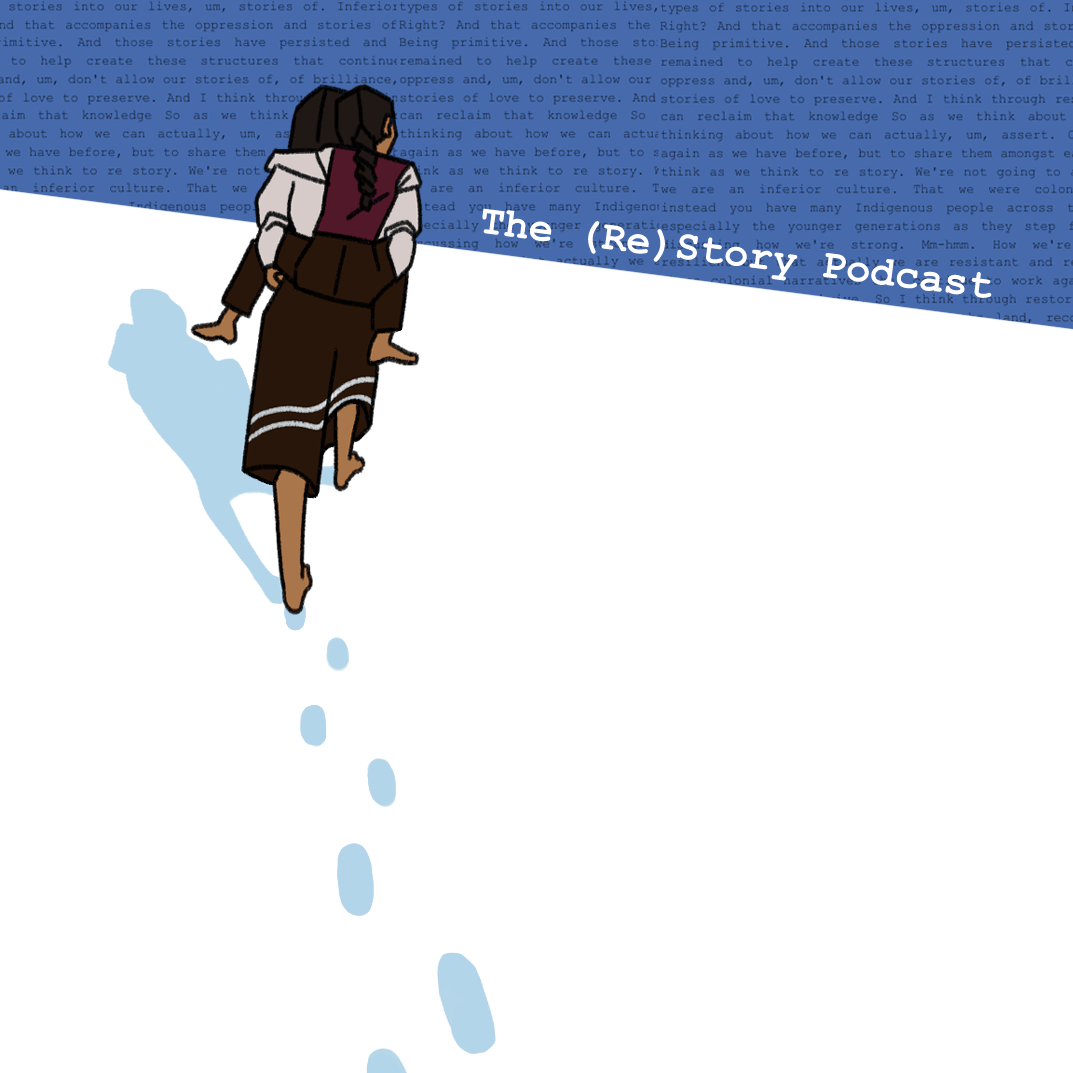
The Restorey Podcast, hosted by Carly and Danielle, introduces the concept of "restorying"—reclaiming narratives to resist colonial trauma and highlight Indigenous thrivance, love, and resistance. Inspired by Dr. Michelle Johnson-Jennings, a Choctaw scholar, the podcast shares a poignant story from the Trail of Tears: a 9-year-old girl carrying her brother, sustained by love for seven future generations. This story exemplifies how shifting focus from trauma to love can heal and empower. Restorying involves questioning colonial narratives, reconnecting with land and community, and amplifying Indigenous truths. The hosts, though new to podcasting, aim to create a space for Indigenous celebration and for all listeners to reflect on love, resilience, and becoming "good ancestors." The first season explores restoring during the pandemic through connections to land, community, and self.
Welcome to the Restorey Podcast. We believe that the stories we tell about the world past, present, and future matter. When we restore, we resist, we connect, and we heal, through returning to the land to each other and to ourselves. When we restore, we become good ancestors, creating a world today that reminds those seven generations from now, that they were always loved. Damn, Carly, who made that vibe? That song was by Kino Benale, Denna DJ, producer, and musician. He is our future artist for the season. Tensei, hello, everyone. I am Carly Marso, and I am a Cree in Métis Descent from Treaty 2 territory on the Prairies of Turtle Island. I'm a digital artist, I use my art to revitalize the Cree language, and to work to create representation of indigenous peoples and popular media. In their spare time, Carly is an aspiring comic book author and collector of French art books. This is true, and thank you for including those very specific details. Anytime. I'm here for you. Anytime. Anytime. Yeah, thank you. And this is my co-host, Danielle. Hey everyone, I'm Danielle Ray. My ancestors are Scottish and Norwegian. I was born and raised as an uninvited and grateful guest on the unseated and sexual territories of the Musqueam, Squamish, and Slay with Truth First Nations, on the Pacific Northwest of Turtle Island. I'm a university student and a creative. Through my work, I hope I can elevate stories based in love, because I think they have the power to heal this world. And in her spare time, Danielle can be found appreciating marine mammals or trying to keep her host plants alive. This sadly is also true. I cannot keep any plants alive. I have a problem. Anyways, at Carly and I, we stumbles. I would say tripped, maybe like fell into podcasting. And despite the fancy microphones and the polished theme song, we are total noobs. And we wanted to say that right off the bat, because we read a bunch of research articles about podcasting while we were planning the show, and it said that if we were vulnerable with you, you would find us approachable, and you might even like us. I think it's working. I do do. Okay, so now you might be thinking, how on earth did a crematy digital artist and a white university student from opposite ends of the country end up making a podcast together? Well, we literally got an email, so. Okay, that part is true. This is fact checks is true, but there is actually a bit more of that story. You know, me and Danielle, we worked for an indigenous lead, woman lead research group called Cedar, and Cedar creates spaces through our research, our social media community, and now through this podcast, amplifying indigenous knowledge, resistance, and thrivance to the world. Matt, when we say that word, thrivance, actually also fun fact, neither of us knew what on earth thrivance was until like a solid few months into working for cedar, there's a humbling moment. But anyways, so that you are not lost, when we say thrivance, we mean when indigenous communities, you guessed it thrive. It's a type of well-being that grows in communities from indigenous knowledge, resistance, and love. I'm currently Cedar's social media and communications coordinator, and I'm a research assistant. About a year ago, our boss, Dr. Michelle Johnson Jennings, who you'll hear from later, assigned us to a new project. You guessed it. A podcast that amplifies indigenous stories of thrivance. And initially, I remember thinking cool, but, you know, we were also like, what? What? No, we never done anything like this before, and yet now 10 months later, here we are. After the initial shock faded, we did the smartest thing we thought we could do. We cried, okay, yes, but then we were in denial. That's also true. But then, we heard a story that changed everything. It began in the frostbitten footsteps of a nine-year-old Choctaw girl. Today, we tell you the story behind this podcast. It begins with Michelle. So, hello, I'm Michelle Johnson Jennings. I help from the Choctaw Nation of Oklahoma. My ancestors come from the place of Alba Oma, a place where you gather the sacred medicines to date referred to as Alabama, but we were forced to remove to Oklahoma. Dr. Michelle Johnson Jennings is a mother of four whose ancestors hail from the Choctaw, Anishinaabe Sok, and Fox, Miami and Dehiga, Su, Kwa Pa, Nations. She is based out of the University of Washington with her husband, and she is a renowned scholar, professor, and leader in land-based healing for indigenous peoples around the world. So I like to say, I come from a long line of storytellers, but my family have been extremely important to me, especially in terms of their intelligence and their depth and their ability to teach and to pass on knowledge as through stories, right? And so, storytelling has always been a big part of our lives. And with story, we have power, right? So as my elders, as my grandparents, as my parents, aunties, uncles, others have told me stories within these stories have been tales of love, tales of trauma, tales of grief, but also tales of resistance, right? And so those stories, even our animal stories, I was told as a child, have these beautiful stories and instructions for living a good life. And those stories are extremely powerful. Michelle has spent much of her career helping communities re-story. She takes people out onto lands where historical trauma has taken place. Restoring implies that stories are shifting, changing, being re-spirited. For Michelle, restoring involves questioning the story as colonialism tells about indigenous peoples, cultures, and land. Restoring involves challenging colonial narratives that were embedded in the colonial settler state that persist implicitly and explicitly as oppression and systematic erasure of indigenous peoples. Restoring is the process of changing the narratives we believe, returning to indigenous knowledges and narratives regarding our connection to land, others, and self. One afternoon, before this podcast had a name, or a guest list, or even a topic, Carly and I were doing a practice interview with Michelle so we could test out our newly purchased equipment. In that interview, I remember going off script and asking her a question that had been na-ing at me since the moment I started working for a cedar. Where did it all start? What was that moment when she first started restoring for herself? When Dingell asked her this, I remember Michelle paused. We were silent, but held by this sort of stillness that could always come before something sacred is shared. The story she told us next became the inspiration for this podcast. It's a story that has sustained Michelle's family for generations. We're grateful that we get to share the gift of this story with you today. A trigger warning, this story includes mention of colonial violence. Growing up, I often heard about the trelloteers. The trelloteers happened in the 1830s after the passing of the Indian Removal Act. The Choctaw were the first of a approximately 100,000 indigenous peoples that were violently relocated from their ancestral lands, between Michigan, Louisiana, and Florida, to land west of the Mississippi, including Oklahoma. Just in our funeral clothing, as we marched, we put sacks of seeds around the children's neck because we didn't believe the government will provide food when we got there. We knew this was to be at the march, so there was no indication or belief that this is going to be a wonderful walk across to Oklahoma. An estimated 15,000 people perished on that march. The Trail of Tears references their collective suffering. So I grew up with these entails of the starvation of the food never arriving. When a braille did come, it was ranted meat at one point, the military officers even begging. The US government to send more food because none of the settlers would sell food to us. They would just watch us starve and refuse. And then we had cholera, and we had a noctoberous no storm, freaks no storm coming in. You can only take with you what you could carry on this walk, and the moccasins would wear out, of course, and you weren't allowed to go hunting, right, to replenish those. So you just had to walk barefoot in the snow, which is what even the children did. Michelle grew up learning about these tragedies early in her academic career. She began to research first-hand historical accounts of the Trail of Tears, what she found surprised her. It's not stories of, this is so horrible, I'm so angry with the US government, how could they do this to us? Though there is some of that there, it's more about, "I did this so that my children and their children and some generations out could be well." And she searched those archives. She came across a story that has changed the course of her life. And one of these stories that I've traced back to one of our grandmothers, she was walking at nine years old in the snow, and she had worn out her moccasins, her feet were bloodied, they were frostbitten, and her five-year-old brother was walking alongside with her. And she didn't want him to be killed, which he would be immediately if he fell behind. So she put them on her back, and she carried him on her back, even though she was starving frostbitten feet. And as she walked with each step, she thought about the love, not just for him, but for seven generations forward. And that's what she wrote about the love of seven generations forward. And when I read that, I stopped and counted out, wait, what generation are we on? Who was she thinking of? But how much does she love them? And as I counted it out, it really says, "My children." Wow. Yeah, so I'm the sixth and they're the seventh. And I was just, "Wow, this is the amount of love that they carried for us when they made this walk." And not just my feeling, but all the families, right? We wouldn't be here if not all of our community did this for us at once. And then they moved with this love. And it's that love that for me really switched how I viewed the walk. So instead of viewing it as a source of trauma and a source of almost fear and going out and re-walking the actual footsteps that they stepped in, I then saw it as a place of love. And when you go out onto the land, I can really feel that love. So you went to some places that I knew where they can't for sure. There's a place where the grounds fallen from those who walked on the trilleteers and it's still in that state today. And so as I stand in the spot even today, if I go out there, you can just feel the love and feel like the focus. And that amount of love is what's carried them. And so as a indigenous person, I rarely see myself center stage. We're regulated to the sidelines as if we're an afterthought and we're treated sometimes as if we don't exist. And if I'm ever afforded this luxury of being able to see myself in popular culture, contemporary spears or educational institutions, I'm always immediately placed in this box and it's a box full of assumptions and preconceived notions of what it means to be native. And it's one that shares like a very painful history that is shaped by residential schools and intergenerational trauma and stolen land. And you know, despite how difficult it may be, there is power, strength and resilience and exploring these parts of ourselves. And there is power in remembering the love that has sustained our ancestors. And that love is the same love that carries me now. And I wanted to create a podcast that celebrates that we're still here. I want to help create spaces where the truth is amplified. The love of civic generations has carried us, we are still here. The love that Michelle shared with us was tangible. As Michelle told us this story, that love was as present as the microphones and headsets we were wearing. If we could do anything with this show, we wanted this to be a space where more indigenous folks could experience that love. What's important to Michelle's concept of restoring is the shift from trauma to love. And the shift has informed her work as a psychologist and a land-based healer. As a psychologist, as a scientist, we're often encouraged to look at trauma, right? We're encouraged to see how it's devastated our communities, how it has been passed even through generations, right? There's very much a focus on historical trauma, which is needed to understand why do we have these health disparities today? We've had things happen to us. We didn't just lose our language, right? It was stolen. So we've had all this taken from us. Because like I said, Western science really is okay with you talking about trauma. That's fine. You can talk about the epigenetic effects of trauma. You can talk about how childhood trauma influences and puts you at risk for substance use and cardiovascular diseases, etc. But when you start talking about love, so I say, I think, okay, what does it mean? Why are we not talking more about love in our research and our science? Because love is just as powerful as trauma. It can actually heal and turn off the switches that put us at risk. And our ancestors knew this. Free story is a healing journey. When we restore, we heal from colonization. It constructed these stories that dehumanized, devastated, and destroyed indigenous communities. Colonial narratives were woven into every aspect of colonial settler society and provided the ammunition for oppression. These stories they persist today through systemic racism. And as we think about how colonization has woven different types of stories into our lives, stories of inferiority, right, and that accompany the oppression and stories of being primitive. Those stories have persisted and have remained to help create these structures that continue to oppress. And don't allow our stories of brilliance, our stories of love to persevere. And I think the re-restoring, we can reclaim that knowledge, right? So as we think about restoring, thinking about how we can actually assert our stories, again, as we have before, but to share them amongst each other. So that's the critical component, I think, as we think to re-story. And we're not going to accept that we are an inferior culture, that we were colonized. But instead you have many indigenous people across the nation, especially the younger generations as they step forward, are discussing about how we're strong, how we're not just resilient, because those stories of resilience also imply that we're going to pop back up again as soon as we get back down. But that actually, we are resistant, and we're resistant to those colonial narratives that continue to work against us as we move forward to thrive. So I think through re-storying, we can take a tale of trauma, go out on the land, reconnect with Mother Earth, but really focus on those ancestral footsteps. When we re-story, we are storytellers. We control narratives, we choose what's important, and we overcome colonial narratives with indigenous love, thriveance, and resistance. Re-storying, yeah, it's not just for ourselves. We ask Michelle why it's important to share what we're re-storying. I mean, as we share, we story, right, and we're re-storying. So instead of us sitting back and letting others tell a tale about our numbers or our disparities or what happened to us, if we share those stories of love, we can have others read that, and they can feel that love, right? And then share their stories of love as well, I feel compelled to. I think it's also putting love out there, I mean, I think as we share stories, our ancestors have always told me, my elders have always said, "Be careful what you say." Because our words are powerful, and what we say puts things into motion in the world. And so that's a Choctaw viewpoint that I think others might share as well, but as I think about it personally, if I can put more stories of love out there, I think it's literally putting love out into our environment, which we all need, right? And as we're able to provide that space, we're able to further love for others. And hopefully that will inspire others, like I said, to tell their own tales, but also just to feel nourished from that love. I mean, this was our first episode ever, and honestly, we had like no idea how to do this, but we're choosing to become storytellers, and we're choosing to reconsider and reclaim the stories that we believe about the land and each other and ourselves. So wherever you're at, and whoever you are, dear listener, we would love for you to join us on a journey of figuring out how to do this, how to restore, how to become a good ancestor. And also how to live in ways that remind people seven generations from now that they were always loved. Packing up our equipment that afternoon, I remember we looked at each other and we were like, yeah, let's do this. Let's create a podcast about restoring. Because when we restore, we question colonial narratives, stories that persist implicitly and explicitly as a pression, dehumanization, sidelighting and silencing of indigenous peoples. When we restore, we amplify the truth that indigenous peoples are still here. And when we restore, we follow in the footsteps of a nine-year-old Choctaw girl whose love has sustained and nourished generations. When we restore, we become good ancestors. We are all invited to be good ancestors. This season, we're restoring the pandemic. And we want to elevate the work and stories about indigenous drive-ins, resistance and love that has happened over the past three years. We came across so many indigenous communities from Turtle Island to Atteroa that have been restoring during the pandemic. In a time marked by isolation, those we interviewed shared how they've been restoring the pandemic through three types of connection, connection to land, to community and to self. So that's the story that brought a cremate digital artist and a white university student to awkward and very unqualified broadcasters to make a podcast. It started on the trail of tears in the courageous love of a nine-year-old Choctaw girl who invited us to walk with her to become a good ancestor and to live out stories of love that will sustain the next seven generations. After months, so many months of scripting, meetings, laughter, editing, tears, mainly my eyes, tears, and then more editing and more more tears, here we are, the journey continues. Welcome once again to the Restorey podcast. If you're indigenous, welcome. We hope this can be a safe place for you to reflect, re-script and reconnect to your story and the stories of your ancestors and the wisdom and love that carried them, but we also hope that this can be a space for you to celebrate, resist and create. We created this space first and foremost for you. If you're not indigenous, you're welcome here too. I hope that you'll join me as an active listener in this space. As you listen to these stories and re-stories, may the wisdom, resistance, thrive and love, they carry sink deep, uprooting your assumptions, cultivating truth and guiding you on your own restoring journey. At the end of each episode, we want to create a space for you to re-story. To stop wherever you're listening in from today and to be still. Take a moment to breathe. Take a moment to think about the love that you have experienced during the COVID-19 pandemic. What did that love look like? Take a moment to be held by those images and stories of love that come to your mind? What did those stories mean to you? How did love sustain you over the past three years? Stories are powerful. Is there a story you want to share? We would love to hear your story. Share your story with us on social media. Special thanks to our boss, Dr. Michelle Johnson Jennings for sharing her voice on this episode. This podcast is grounded in her teachings of restoring and the decades of work she has done in the field. We wouldn't be here without her. This season, all our music is by our featured artist, Kino Banale, Adena DJ producer and musician. His latest album, you can find and purchase on Bandcamp. It's called "The Human Hashtag Son." The re-story podcast is a production by Cedar, co-vernets Indigenous Engagement Development and Research Pillars 7. Cedar is an Indigenous and women-led research team. Our mission is to use community engagement, knowledge sharing and research to ensure that Indigenous stories are heard. Our guests represent themselves and their views may not reflect those of Cedar. We are dedicated to honoring our guests, their honest perspectives and lived experiences. If you enjoyed this episode, please subscribe to the podcast on your favorite platform. Leave us a review and share the re-story podcast with your mom, your dog and your pod. We love hearing from our listeners and you can reach us at Instagram @Cedar_7. You can also learn about the re-story podcast on Cedar's website, link in the bio. This episode was produced by me, Danielle Ray, edited by Philippe Contreras and Tamara Chavez, mixed by Philippe Contreras. Our executive producers are Tamara Chavez, Michelle Johnson Jennings, Kimberly Heiser and Katie Collins. Our senior producer is Philippe Contreras. Our producers are Danielle Ray, Jordan Durksen, Sterling McGregor and Jonathan Lynn. It was hosted by Danielle Ray and myself, Carly Marso. See you next time with more restoring episodes. Hey, hey, hey, hey, hey, hey, hey, hey, hey, hey, hey, hey, hey, hey. Hey, hey, hey, hey, hey, hey, hey, hey, you can reach us at Instagram @Cedar_7. [Music]
Podcast Summary
Key Points:
The podcast "Restorey" is co-hosted by Carly (Cree-Métis digital artist) and Danielle (white university student), focusing on Indigenous stories of thrivance, resistance, and love.
The concept of "restorying" involves reclaiming and reshaping narratives to challenge colonial trauma, emphasizing Indigenous knowledge, connection to land, and intergenerational love.
The inspiration comes from Dr. Michelle Johnson-Jennings' story of a 9-year-old Choctaw girl on the Trail of Tears, whose love for future generations symbolizes resilience and healing.
Restorying shifts focus from historical trauma to love as a powerful force for healing, community well-being, and creating a legacy as "good ancestors."
The podcast aims to amplify Indigenous voices, celebrate survival, and invite all listeners to engage in restoring through personal and collective storytelling.
Summary:
The Restorey Podcast, hosted by Carly and Danielle, introduces the concept of "restorying"—reclaiming narratives to resist colonial trauma and highlight Indigenous thrivance, love, and resistance. Inspired by Dr. Michelle Johnson-Jennings, a Choctaw scholar, the podcast shares a poignant story from the Trail of Tears: a 9-year-old girl carrying her brother, sustained by love for seven future generations.
This story exemplifies how shifting focus from trauma to love can heal and empower. Restorying involves questioning colonial narratives, reconnecting with land and community, and amplifying Indigenous truths. " The first season explores restoring during the pandemic through connections to land, community, and self.
FAQs
The Restorey Podcast focuses on storytelling to restore, resist, connect, and heal by amplifying Indigenous knowledge, resistance, and thrivance, shifting narratives from trauma to love.
The hosts are Carly Marso, a Cree and Métis digital artist, and Danielle Ray, a university student of Scottish and Norwegian descent, both working with an Indigenous-led research group called Cedar.
Restorying involves challenging colonial narratives, reclaiming Indigenous stories of love and resistance, and shifting focus from trauma to healing through connection to land, community, and self.
It started from an assignment by Dr. Michelle Johnson-Jennings to create a podcast amplifying Indigenous stories of thrivance, inspired by a story of love from the Trail of Tears.
It refers to the ancestral love and foresight that sustained Indigenous communities through hardships, like the Trail of Tears, with actions taken today to benefit future generations.
She is a Choctaw scholar and psychologist who leads land-based healing work, provided the foundational teachings on restorying, and shared the story that inspired the podcast.
Chat with AI
Loading...
Pro features
Go deeper with this episode
Unlock creator-grade tools that turn any transcript into show notes and subtitle files.
 PodcastTranscript AI