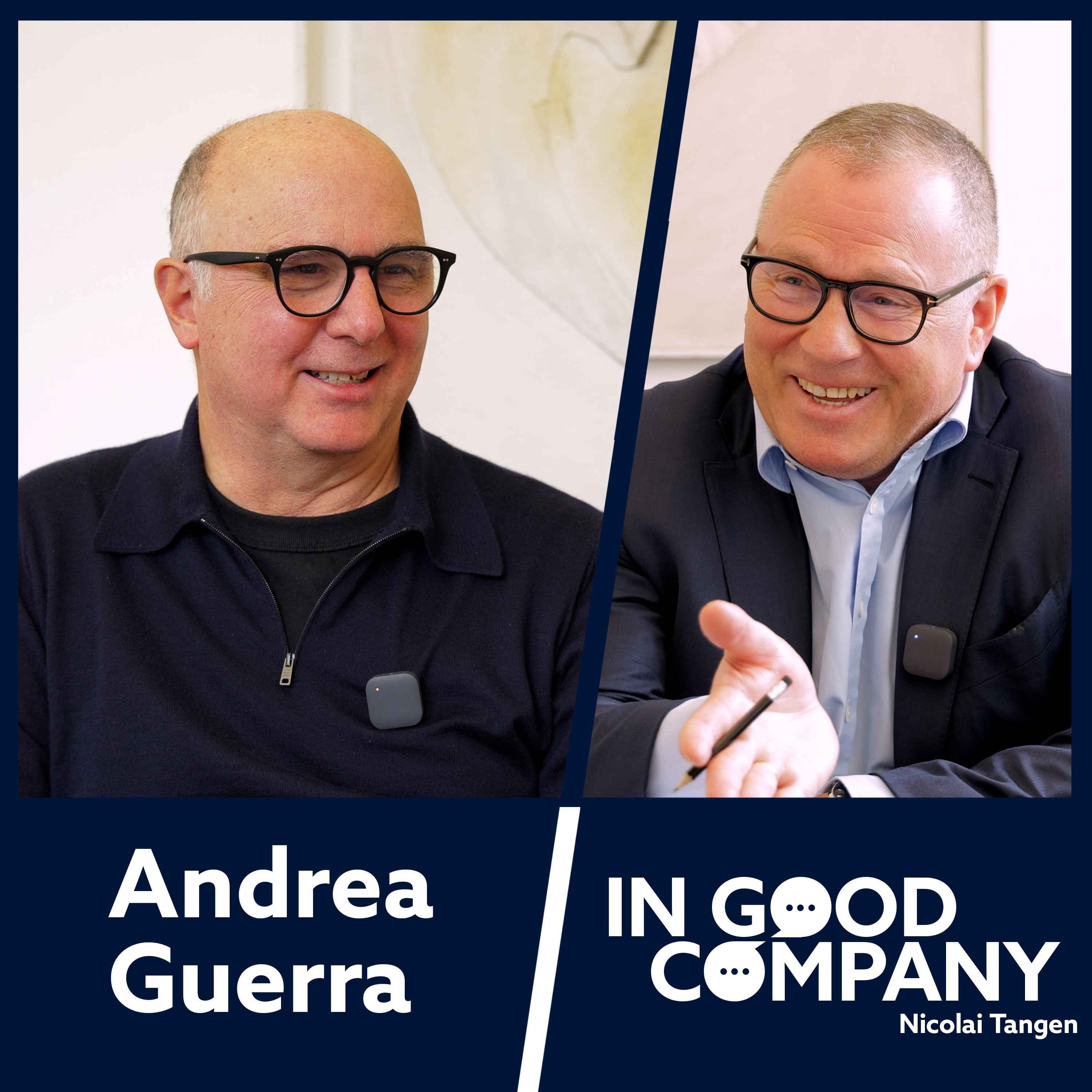
Prada Group CEO: The Old Normal of Luxury, the Bet on Versace and Why Patience Beats Trends
from In Good Company with Nicolai Tangen
41m 46s
The discussion centers on the core philosophy and strategic direction of the Prada Group. Prada is described not merely as a fashion brand but as a cultural viewpoint, deeply intertwined with art and society, where every detail is deliberate. The luxury industry is seen as transitioning into a phase of "normalization" after years of explosive growth, shifting focus back to exclusivity, value, and enduring brand identity over fleeting trends. Critical to success is maintaining a patient, long-term creative tension within brands, as seen in Prada's stable creative leadership and the strategic acquisition of Versace, which will be nurtured with respect for its cultural roots.
Engaging consumers requires compelling storytelling that evokes emotion, a process now enhanced by artificial intelligence for personalized customer relationship management. Sustainability remains a key focus, particularly for attracting younger audiences, as demonstrated by Prada's Re-Nylon initiative. Leadership is characterized as resonant, fostering a clear mission while managing the group's generational evolution. Ultimately, the philosophy asserts that true luxury transcends price; it is about creating such compelling desire and experience that cost becomes an afterthought for the consumer.
Hi everyone, today I'm in Milan, the heart of the Italian fashion and I'm in extremely good company with Adria and Greta, CEO of the product group. Now Andrea took over three years ago, stepped into the product shoes and at that time the group has grown quarter by quarter. Mio Mio is arguably now the oldest brand in luxury and you just bought Vasace, so well welcome. Welcome and happy you're here. Now Prada is more than a hundred years old. What's the DNA of Prada? In short, you know Prada is a unique brand. It's a. Prada is a point of view. Prada is an opinion. Prada is culture. Prada is totally winded in certain cultural pillars such as art, architecture, literature and has always an opinion and how do you see that in the brand? You can see that in the brand, you can see that in a brand in any aspect, in any location, in anything we do. There is nothing which is not thought. There is nothing which you can spot details which are out of place. There is nothing that we do by chance and not linked to a thought and to an opinion about what's going on in the society. So what's constant and what is changing in the realm? Nothing is changing. Nothing is changing. Obviously the world is changing. The trends are changing. Fashion is changing but the brand is always that same thing. How is fashion changing now? How is the luxury? It gives you. You know I think this industry is upside down. What does that mean? This industry has gone through a couple of decades of constant growth. Let's go to any textbook. That's not possible. That's not feasible. And I think we were all happy and this industry has grown by three times, four times, five times in the last only 10, 15 years. So I think that now we have to go through a period of normalization. We have to go through a period where maybe we've been a little bit spoiled. So we have to go back through certain aspects of the business. So what's normalization? What's the new normal? I think it's the all-normal. This is what we have to look for. It's not the new normal, it's the all-normal. Luxury is exclusivity, selectivity is value, is dreams, its experience, its hospitality. This is what we have to do and this is what it has always been. So how are you adapting to the new old? I can tell you that there are certain things which are very visible. We have gone through a refurbishing of a huge store in Hong Kong where we would have followed our usual logic of one floor for man, one floor for women, one floor for accessories. Instead we have decided to allow one entire floor to be an apartment. To be a place which is totally addressed by our creative directors. So it's a unique spot where you can spend time. Where I you can you can have friends for dinner, for lunch, spend time for your birthday and we're happy about that and we're happy to offer you very special exclusive products and this is the all-normal. You talk about change at the same time I hear you talk about the ports of patients just how does patient play in? You know I think that the winning brands are those brands where there is a constant positive tension between brand management and creative direction and this means patience this means listening to each other this means debating this means taking the proper time to take decisions on how and where the brand is going and where creativity is going and this is long term cannot be short term in which brands in the world are you seeing that creative tension. I can talk about my brands and we have it we have it we have long-term solutions we don't have a creative director coming in and going out we have long term commitments and that's the only thing that the consumer will pay in the long term then you can have a success here, a success there but that's short term. Talking of creativity you started me from scratch right in 93 and it's an extraordinary brand growing very very fast why is it so successful. You know Miu Miu has I always say Miu Miu is an inclusive brand. Miu Miu is as women only it's imprinted in a young lady but it's inclusive. You don't feel wrong in wearing Miu Miu on a Monday morning or on a Saturday night. You don't feel wrong being 25 years old and 50 years old. You don't feel wrong with with Miu Miu and you say that it's rebellious. How it's out of the schemes it's out of the fashion logic. How large can a brand and still be rebellious and out of the fashion. You know I think it's if we look to ladies only brands that are brands which are four or five times bigger than us. So I'm not alluding that we have to be there but there is space to grow. But what is important is that we have somehow attracted a lot of brands in our field. We don't have to move from our field. Typically you see these three cycles. Do you think we'll see that? You know this is a five-year cycle which has lasted longer than what we expected and we need to be ready for normalization. We need to be ready for normal growth and you know you're never ready for that but we have to be ready for that. We don't have to be complacent. It's a tough we have to be pretty masochistic. What are the what are the truths you use to be a masochistic? You know it's no. My usual answer is no. We're offering you another store. No. We're offering you this upper to no. So this is what we do. We had 170 stores three years ago. I think we got 176 today with the kind of growth we had. So I prefer to enlarge certain stores but I don't want new stores. In five years time maybe we will have 180 stores, 185 stores but that's it and that gives you the idea that we have not opened the gates to success. We have not gone in in new categories. We're not open to men. It's us. This is what we are. This is who we are and these are the who we want to talk to. Tell me about emotions and dreams. It's all about emotions and dreams. If I'm you know I'm always and this is this is happening since I was selling white goods. Can you imagine? Because I have known you for 20 years. And you have talked about this all the time. And you're saying it. If if I'm able to tell you a story that makes sense. If I'm able to get your emotions going it's much easier to have your hand going to the pocket and getting the wallet out. But I need to be absolutely credible and I have to be into the brand and I have to engage you. And this is everything we're trying to do. What did you learn storytelling? You know I think it's I think that
In Managed, why did you have a grandfather who was telling you a very nice when you went? If I take my father, my father probably was saying five words in a day. So it was not a story teller. I can tell you that there are two things in management which I particularly trust. One thing is that people and emotions are the vehicle to everything. The second is when you are able to manage the mix, your profit and loss is solid. And these two things go much together because when you are telling a story, you need to understand if you are going towards an enterprise or if you want to dream of 100,000 euros. And it's not anymore how you are dressed, how you are entering a store, who you are because I mean tech has totally revolutionized society and how people are coming into stores. And sometimes you can be really misinterpretating what's happening in the store right now. Now the world is changing and the media picture is changing and we got social media and we got attention spans like ants. How does the storytelling art change? You know, I think there are two things. First of all, when people are asking me how are we using artificial intelligence, the main part we are using artificial intelligence is in our CRM. So customer relationship management. Yes, we are working like hell, hours and hours to really understand which message to which people and how to personalize that message to that person in that moment. And the more you are able to do that, the more business becomes hot. Okay, so I'm coming into your store, you know my background, you know what I bought with you. But even before you're coming to my store. Okay, that's where everything starts. We'll see you sell me, we'll dream you, sell me. So, you know, I think artificial intelligence today allows you to go into your data and really what I always say look alike. So you bought those distinctions to me. I'm coming out with this new drop, this new package, these new ideas. And I think these new ideas have these characteristics. How can I match these things? And how can I match how hot you are in that moment to come into my brand and buy? And when I'm able to connect this, wow, I have conversion rates which I've never seen in my life. Well, I intend to buy a shirt in Milan. So let's see whether it's correct to be a product shirt or not. Nice to do. Where does this fit in with quiet luxury? You know, I don't know where, where if it is, what is quite, what is quite large? You know, I'm not able to answer to this question. I don't think, I mean, there is brands which are, the real thing is how clear your body is a brand. I mean, we're seeing brands going up, brands going up, what is that? Take for a brand to be credible over time. You know, it's what I was saying at the beginning. It's that respect of the brand with a creative job which makes sense at that moment. How do you get young people attracted to the brands? I think that this is the biggest concern, the biggest opportunity, and it's a great amount of our job. We're out today, exactly today, with a re-Nylon period, which is this. So as you know, Prada has been known for its nylon product since 80s. Then Sustainability comes and we have recreated a nylon, which is a, which we call re-Nylon, which is totally be sustainable. And anything you look at, you can read something about that fiber. We're out with a communication today, which is around the education, around pollution in oceans, nylon in plastics, and we are in our stores with a completely and unique collection of re-Nylon, which we have linked to a communication to the younger generations. So using those media, attracting those kind of, let's call influencers, but also having certain price points is, and it's working really well. Is sustainability dropping down on people's preference lists? Not on Yauk. No. Not on Yauk people. Not at all. For young people is, you are, you don't have to think about that. You are in that sustainable world. You are in digital. You don't have to think about it. Then if we go in government and politics, maybe yes. Moving on, Vasakshay. Econik has been owned by Americans for seven years now, and you are buying it back to Italy. Why, why did you buy it? It's an opportunity. We were not out for acquisitions. We feel that the two engines we had can take us somewhere close to 10 billion euros as an ambition. What's the DNA of Vasakshay? The research is something we like because again, it was born in culture. It was born in this mania, Grecia. Has this Greek ancient Greek influence on Italian culture? And it's winded in pop. There's such invented glamour. There's such invented pop. There's such invented great models. There's such invented music in the shows. So it's this spin which is very different from our portfolio. But it's in our DNA that we love that everything goes and starts from culture. When you have these things with glamour and the things you mentioned and you take Donatella Vasakshay out of it. Does the brands still contain it? I think that this Donatella research is not out. It's part of our team in giving an image and networking which we love. This is the first. Second, I think that Versace has incredible long roots that you need to respect, that you need to keep as a cent with that kind of tension and being proper in 2026. I just read an African proverb with this morning that if you go to long roots you can take more wind. Now what did you see in Versace that other people didn't see? I think that many people have seen what we have seen. But we're ready to take the tackle. We're ready to take the challenge. It's not an easy job. It has been a little bit mismanaged as a brand, not as a business. And where it's to go. And we feel that we know how to do a brand business. We are patient. We don't think that we have to be successful tomorrow morning. But we need to plan seats. We need to nurture. We need to have the right people in place and the team is ready to go. So that is something that we have done pretty quickly. And you have a new creative officer, Peter Mollier. Yeah, and this is a game. This has to be a really long-dirt relationship. How do you think he will change the expression of the brand? We will see. Around creativity, there is never anything that is already designed or written down. Is there like a uniform creative process across the brands? How does it create process work? No. I think that there is people who are working
and taking a lot of times to prepare. There are people who are impetuous last minute. There is people who are doing things and crashing them, they're redoing things and then crashing them, they're redoing things and crashing them. And finally, the last day, they have what they want. - So our Italian is more creative than other people. - I wouldn't say so. But if we go statistically for sure, since 1500, I think we have been pretty creative. - Yeah, both in art and music. You mentioned 10 billion. Why is it important for you to grow the size of the total group? - You know, we haven't even, you had a stint at the LVMH group. Are you trying to recreate the B-combromerates? - Absolutely no. And the way we work, the way we are organized, it's pretty different. But we're not in a niche business. So we need some scale. And we think that on one side being very distinctive with our brands and having a certain kind of scale allows us to protect ourselves. This is what we think. How do you think about pricing when something is hot and it's tempting to price it up? Just how do you think about it? Because I'm seeing some brands and I'm just amazed by the price points. - My first answer would be, I don't care. - Yeah. - That is, am I able to get you your heart, your passion, your dreams, your emotions somewhere? If I'm able to do that, full stop. Each one of us is spending, I don't want to say money, could be money, could be time in so many different things we love. On a bottle of wine, I mean, let's discuss it, or on an incredible room in front of the ocean, there are many different ways we can spend our money. And if the issue is, once you talk about price, it's evident I made a mistake in whatever I'm doing in luxury. - What do you mean? - I mean that you should never talk about pricing because you should be so happy that you give me your credit card without even asking what is the price. This is what we have to do. - Yeah, it happens with some people, but it doesn't happen with everybody, right? - Sure, and maybe, maybe this is why I'm saying, "Oh, normal, maybe this industry has gone "and it'll be too far out." This industry has lost one consumer out of five in the last four years. Three years. It's a lot, eh? - Mm-hmm. - How is the dynamics, I mean how are the dynamics in China changing? I don't know if they are changing. For sure, we have gone through this unbelievable evolution. Then North America stopped, consumer digested, and then we have seen a kind of new dynamics, new positive dynamics. Same thing is happening in China today. So maybe we have gone a little bit too far out. Two years of digestions, and now we are seeing a kind of plateau and slightly positive dynamic. And I would say that even because of the wars, Europe today is the animal or is the region that is digesting the Great Road had. Europe is by definition a touristic market. And today, I mean, America's are coming because they think the war is in Europe. Asians cannot come because, I mean, it's so difficult today to fly over East-West. So Europe, I think, will have a little bit of normalization. Any reflections on the future of Europe? Complicated. I mean, today, today Europe is in the middle of. It's in the middle of. It's the weak in between big powers. I mean, it's unbelievable to see that our economics, our macros, it's probably the slowest, but we have the heaviest currency today. I mean, it's complicated. I don't think I am the person that can tell you what will happen macro to Europe. But for sure, what I can tell you from our point of view that I hope that we are still able to demonstrate to the world that coming to Europe makes sense in a touristic manner. But today, Asians are really, I mean, compared to 2019, probably we are 50% of what it was. Compared to 2022, 23, Americans are probably -20. -25 compared to that. So, I think that we need to rethink. Moving on to leadership. How would people define your leadership style? Mine? Yeah. Ah. You know, one day I read a book. I don't usually read business books at all. But there was a lady that was giving us a kind of session in the United States and I read her book. And she was talking about a resonant leadership, which I love. What is it? Which is convincing your mind and convincing your heart that we are all in our journey with the very clear mission and allowing everyone to express to their best? This is what I think I'm doing every day. Are you as immersed in Prada as you were in Laxodica in Italy? You know, I think more, maybe a major. Why? Because we are in a long generation evolution phase. So, we have a very solid founders mindset. Very strong. And on the other side, we also need to prepare the company for the long term. And what is fantastic by this Italian founders and family in Italy that they have said, this is the root. Never seen in Italy. This is the root. It's very clear. Loreso will be the leader in the long term. Andrea is helping this journey and everyone knows it. And this is what we're trying to do. And how is it to be a leader than when people know that you are kind of the bridge between generations? I don't care. Either you are or you're not. And I don't think I have any issues with that. Why will you use a key to take this job? You know, I know the family since 20 plus years. We have built the Prada brand in Iwear from scratch to over a billion. It's a big number for Iwear. And I love the way Mr. Bertelli was working on the products and collections. I love the way the spin on certain image events and coming into these places and looking on how Mrs. Mewcha was working. So I always love them. And so you go to know them through the Iwear. Iha, it looks like. Yeah. And we know each other very well. And we had other opportunities to come to work together earlier. But somehow I always said that I was not ready for that kind of cultural landscape that Prada Group was. Then Lorenzo joined in 2017-18. And we had this conversation again in 2022 and a lot of things started to change, such as the way the brands wear much more clearly positioned, a completely new,
mission, sustainability, a completely new mission on the consumer and cultural behaviors in the group. So we were really evolving in that way of working and way of relationship between people in the company and I have seen it and I said I'm ready to help when the control relationships what was changing there. Prada group as you know and it's very well known in the industry has been quite a hard group which is fine which I like. But then I love to allow people to express themselves and I didn't think that at that time that was feasible. When I joined I thought it was feasible and I was right. So how are decisions made? It's fine. If you participate to certain meetings you say these guys are crazy. The debate is strong but I love it. It's real expression and can we last 10 days of you need to be strong in this in this group. And once you understand the logics it's really nothing personal, not as the American safely quickly, nothing personal and then they kill you. But it's more a it's really a kind of opinion debate. Does that kind of decision making lead to better results? I think so. Why? Because it takes the best. It's not a lower compromise. It's a napper compromise. It's one of the most fantastic behaviors of human beings but it has to be in the upper side. How are you a different deal now compared to a new younger? You're 60. You're in your prime. You know, it's I've been lucky. It's 25 years I've been a CEO of public companies and today I'm quicker. Unfortunately in so many meetings I already know what people are going to tell me. But this is part of the age. Just listen to them. I think I am very good in listening to what they're not telling me. The other day I finished up a conversation with one person and we stayed together for half an hour and I was saying, I see you strange these days and he started talking. At the end of the meeting I say, thank you especially for the things you have not told me now. What are the kind of things that people don't tell you? Sometimes people are not always ready to confront on tensions or problems or issues. While it's so easy to say, okay, we have a problem. I don't care where it comes from but we have a problem. Let's face it, let's understand and let's be quick. Let's debate as much as we want but then let's be quick. I hate that formal slide management. I cannot stand it anymore. So I introduced certain in this last year's certain rules so you cannot come with a budget with more than 10 pages. I laughed at the guy, very funny, he came with 10 A3 pages so he could like more things. But this is what I laughed at now. Do you not have overhead slides? Like presentations. We have, but short, please. We can cut at least the first 15 minutes. I don't need to go to Adam and Eve again every time. In what other ways have you developed as a leader, you think? You know, I think that I still think that energy beats experience. And I want to prove it every day. So these things, that if you don't have an experience, you cannot hold that position. I don't believe it. But on the other side, I have that experience today. I mean, being 25 years as a CEO, where every bloody day you're seeing your result of the day before, you learn so many things. And I try to use it as much as I can. Where does energy come from, you think? I think I'm pretty mesochistic. So, you know, we're having a great sale yesterday. And I say, "Oh, shit. How do we come next year?" So I'm a little bit mesochistic, but I do my best to celebrate. That's one of my issues. Somebody introduced me to the concept of high agency people, so people who figure out where they go, and they are forceful and they use technology to get there. And it's just struck me lately how big difference is between people who actually do things and the rest. You know, I think that, I think that technology is there. I think that there is more technology than what we are able to use today. So, my constant mission is to make the culture of the company evolve. The more we're able to evolve, the more we become executors, and able to use all the technology available. How are you changing the corporate culture, a problem? You know, my desire is that one day I ask to people, and what has changed, and they say everything, and then I say, "Well, I don't know." So, it's what I was saying before. It's a self-expression. This is what I'm trying to do every day. What is need to be done? Allow people to have real power on things. Allow people to do things. Allow people to make some mistakes. Allow people to give their opinions. I love when people debate. Then I say, "Let's take a decision. If you're not able to take a decision, I will take a decision." This is what I love. What should we wear this summer? Prada or Mewbio? Or a volcano style? Prada is one thing, and Mewmew is a different thing. With Prada, we have decided to go. We have taken a decision to go with a color. So, we have decided that for us this summer is white. And we have gone all in. And this will be very visible. And why is this summer white? You can ask this question to Mrs. Mewch, not to me. And how risky is it for a firm to be all white? I don't care. It's not risky. This is our life. We have a point of view. It's never risky. It's risky to follow the trends. That's risky. I guess it's less risky to be white than pink. I think it's. You need to always, in your brand, in your position, in your identity, I need to surprise you, I need to comfort you, and we need to do something new to enter. Well, you're not very white yet. So, we'll see this summer. What do you read? I read, basically, novels. And I go back, re-reading things, frequently, such as. I'm re-reading the Metamorphosio of Kafka today. And I have just finished to re-read the castle. I think that these guys had understood our contemporary world very well. And it's fantastic to read them again. Me waking up as a cockroach in the bed. Yeah, but I mean. This is what is happening to the society. Yeah. So easy.
This is my very real talent. As soon as I'm out of here and out of this, black and white. And what do you do then? I swim, I eat, I travel, and I use to spend a lot of time with my family, but my three kids are grown. So I try to organize things so that they accept to do that with us. Jekuk, in my next life, I will be a great chef. And what are the other things you will do in your next life? You know, I think that. I think that. Life has become much longer than before. So I think that my next life is behind the corner. So I would love to continue to work heavily, fewer days. And my dream would love to be to mentor young, fantastic CEOs. And what will be your advice to these young people? Be patient. Be patient. This generation is not patient. I love them, but they're not patient. - Well, thank you. - Thank you.
Podcast Summary
Key Points:
Prada's DNA is defined as a cultural viewpoint rooted in art, architecture, and literature, with every detail intentionally linked to societal commentary.
The luxury industry is entering a period of "normalization" after rapid growth, emphasizing exclusivity, experience, and long-term brand integrity over short-term trends.
Success relies on a positive, patient tension between brand management and creative direction, fostering long-term commitments rather than frequent creative changes.
Storytelling and emotional engagement are crucial for connecting with consumers, supported by using AI in CRM for personalized marketing and high conversion rates.
Sustainability and engaging younger generations are priorities, exemplified by initiatives like Prada's Re-Nylon collection linked to environmental education.
The acquisition of Versace is seen as an opportunity to nurture a culturally rooted brand with strong heritage, focusing on patient, strategic brand management.
Leadership at Prada emphasizes resonant leadership, bridging generational evolution within the company while maintaining a clear, founder-driven vision.
Pricing in luxury should be secondary to creating emotional value; discussing price indicates a failure in crafting desire and brand experience.
Summary:
The discussion centers on the core philosophy and strategic direction of the Prada Group. Prada is described not merely as a fashion brand but as a cultural viewpoint, deeply intertwined with art and society, where every detail is deliberate. The luxury industry is seen as transitioning into a phase of "normalization" after years of explosive growth, shifting focus back to exclusivity, value, and enduring brand identity over fleeting trends. Critical to success is maintaining a patient, long-term creative tension within brands, as seen in Prada's stable creative leadership and the strategic acquisition of Versace, which will be nurtured with respect for its cultural roots.
Engaging consumers requires compelling storytelling that evokes emotion, a process now enhanced by artificial intelligence for personalized customer relationship management. Sustainability remains a key focus, particularly for attracting younger audiences, as demonstrated by Prada's Re-Nylon initiative. Leadership is characterized as resonant, fostering a clear mission while managing the group's generational evolution. Ultimately, the philosophy asserts that true luxury transcends price; it is about creating such compelling desire and experience that cost becomes an afterthought for the consumer.
FAQs
Prada is a unique brand that represents a point of view, an opinion, and culture. It is deeply rooted in cultural pillars like art, architecture, and literature, with every detail thoughtfully linked to societal perspectives.
The industry is undergoing a period of normalization after decades of rapid growth. 'All-normal' refers to returning to luxury's core values: exclusivity, selectivity, value, dreams, experience, and hospitality, rather than chasing constant expansion.
Prada adapts by creating unique, experiential spaces like redesigned stores that function as apartments for events, while staying true to its cultural roots and avoiding over-expansion into new categories or markets.
Patience involves fostering a positive tension between brand management and creativity, allowing for debate and thoughtful decision-making. Long-term commitments, rather than short-term successes, build lasting consumer trust.
Prada engages younger audiences through initiatives like re-Nylon, which combines sustainability with education on ocean pollution, using influencers, targeted media, and accessible price points to resonate with their values.
Versace was acquired as a strategic opportunity, with a DNA rooted in culture, Greek influences, and pop glamour. The brand's long heritage and creative potential align with Prada Group's focus on cultural depth and patient brand-building.
Chat with AI
Loading...
Pro features
Go deeper with this episode
Unlock creator-grade tools that turn any transcript into show notes and subtitle files.
 PodcastTranscript AI