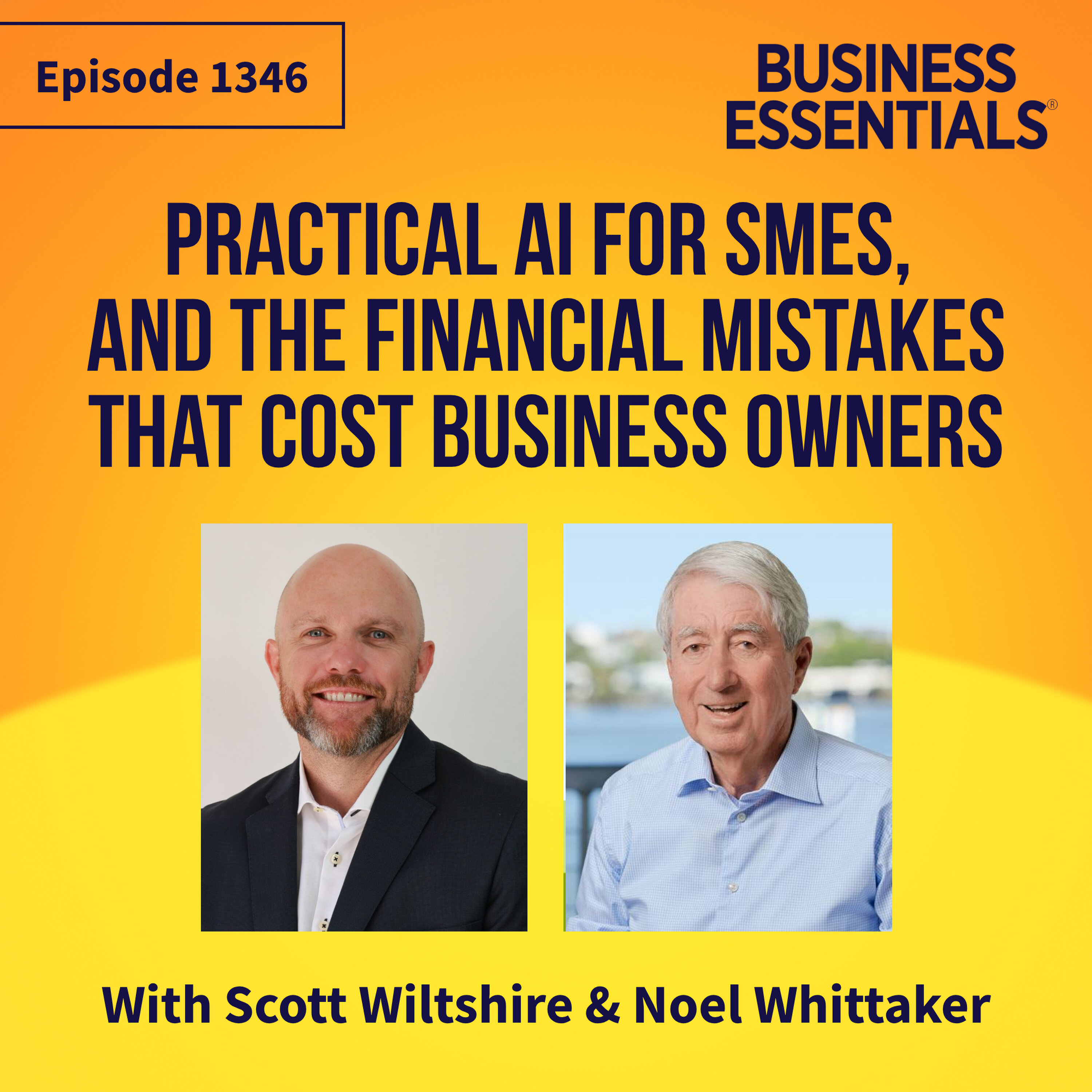
Speaker 1Is your business embracing AI wisely and are your financial habits building wealth or holding you back? This episode explores two practical areas every leader of a small or medium-sized business should master. First up, AI strategist Scott Wiltshire explains how small businesses can safely adopt artificial intelligence to improve productivity without creating unnecessary risk. Then, Australia's finance guru Noel Whittaker shares the most common financial mistakes business owners make, from neglecting investing in super to confusing good debt with bad. And he shares the simple habits that can build lasting wealth. From Sound Cartel, I'm Grace Jennings-Edquist, and this is Business Essentials. We all know AI is transferable. But how can SMEs move from experimentation to practical, secure adoption of these tools? Scott Wiltshire is vice president and general manager of Oracle NetSuite ANZ, and he joins us to explain where to start with AI, why clean data and strong governance matter, and how AI can streamline processes and give employees more time for higher value work. Nicole Goodman starts by asking Scott, why do you think so many businesses have struggled to move from curiosity to real-world adoption of AI tools?
Speaker 2Scott Wiltshire: Well, I believe it's a timing thing, most of all. I mean, the pace of change. I mean, how rapidly this technology is evolving is one of the major reasons why I think Australian customers are a little bit more conservative than many of our international counterparts, and rightly so, are looking at it and saying, "Okay, before I just dive in head first and throw caution to the wind, let's make sure that I know that this is going to provide the right value to me, and I'm going to do it in a way that's not going to disrupt my business, that's going to be safe and repeatable and secure." Australian businesses really do punch above their weight, and it's not just because we swing more punches, but we're more thoughtful in our approach to things that looks like simplified processes where you can help hire and train your staff on, and they've got to be repetitive. And you've got to provide clear visibility to your operations so those employees really understand the business and the environment they're working in, and they can make great decisions on the fly. We're seeing a lot of customers now that really are making that shift from, "Let's have a look, let's test a couple of things." There's still some challenges, but we do have to make significant strides into embedding AI across our operations. Speaker 1: For a business owner listening today who's thinking, "Oh, I'm going to do
Speaker 3this, I'm going to do that," I think that's a good thing. I think that's a good thing. Scott Wiltshire: Yeah. That's a good thing. where do I actually start? What's one practical use of AI that can deliver genuine value without requiring huge investment or a huge level of technical expertise?
Speaker 2That's something that we're all facing today. So, and my advice is just look at one part of your business. Look at something that's taking a long time that you're hearing the noise from your employees to say, hey, look, you know, this takes forever. Month-end close comes to mind. I know, and I've worked with customers like Accusensus in Australia, that was taking the better part of the month to close the books and you go back into month-end close again. You know, there's an obvious choice. They had a very rapidly growing business. It was only founded in 2018 and they've grown to 320 people and almost $100 million in revenue. But you might drive past and see those cameras hanging over and looking for people who are doing a good job. And you might see people who are doing a good job. on their mobile phones. And now you probably understand why they're in such hot demand. You want to be safe when you're driving down the road. But on the financial side, we help them reduce their month-end close by 60%. So you can see sorting this out will also alleviate some pain and give employees back time in their day so they can reinvest that in your business and do kind of higher value tasks. This is something we do all the time for our customers.
Speaker 3Scott, you've spent much of your career in sales and helping businesses grow. AI is changing the way businesses engage with customers. But sales is still about trust and relationships. And it's interesting that you mentioned trust now because that extends through. Where do you see AI making the biggest difference? And where is the human touch still irreplaceable?
Speaker 2I think the human touch is absolutely irreplaceable. I mean, we're dealing with businesses another one that comes to mind, True Protein. I was lucky enough to share the stage with Lockie Cornwell, their CFO and COO at a recent customer event called Sweet Connect in Sydney and Melbourne. And Lockie describes this streamlining of processes, these amazing businesses founded in 2014, growing to over 100 staff. One of the fastest, if not the fastest protein business in the world. It's one of the fastest, if not the fastest protein in the world. And it's not just their livelihood. This is many people's livelihood. But this is a fantastic business. We don't want to just hand over the reins to a system that's a couple of years old, that's doing some amazing things. But we need to keep the people in the loop. And I know that the CFOs that we work with, the number crunchers, the stewards of these businesses, they don't want to necessarily just work with automation or AI, exclusively. They're looking for a trusted partnership. They're looking for advice, experience, expertise. And that's the thing that builds trust. It's not necessarily how quickly can I make 300 phone calls or the levels of automation that are available today. Without that relationship, there's no trust. And bringing that expertise to the table, it's absolutely irreplaceable. So I think keeping the humans in the loop will always be a thing, particularly in sales. The humans are here to stay, for sure.
Speaker 3You work with growing businesses every day. Beyond AI, what are the common traits you see that successfully scale? Are they leadership habits or ways of thinking that consistently set them apart?
Speaker 2Yeah, definitely. The common trait that I see that help people scale, particularly from Australia, is they have a clear understanding of their business, what it takes to be successful. They have their finger on the pulse. They have an eye for the numbers. They know exactly what their business is trying to achieve and how it's going to do it. They're also thinking about how do I simplify things? How do I make sure that I don't need to be an absolute superhuman? And it's critical for your business, if you want to scale it, that you do have simplified, documented, clear processes that you can train your staff on, that they can execute. And then you give them visibility to the information, that they need. Underlying that, you need good quality data in your system and you need to push that data. You need to push the insights to the edges of your business. So those employees on the front line, so they can make critical decisions based on good quality information very quickly. And then they can get back to work, use their time to really add value to your business and look to innovate. When you've got the platform to do that, it makes it that much easier.
Speaker 3And lastly, Scott, what is one action that every small and medium business should take over the next six months and one mistake that they should avoid?
Speaker 2Definitely clean up your data. AI is an absolute revolution. It is changing the way every business operates. Even the ones that say they're not, you know, the plumbers are telling me, no, we're not getting involved in this. This is fine. Well, actually they are. I've got plenty of friends in the trades that are doing this. They're doing this. They're doing this. They're doing this. They're using AI solutions already. And that's only going to expand. But across every business, AI is changing the landscape. And what's critical there is to have fantastic quality data. AI is only as good as the data that it's being trained on. And so for a business owner looking to get the most out of their AI solutions, we don't want to take that data and put it into an LLM online and just hand away the keys to your business. Don't do that. We want to get the most out of your business. So we work with the MCP protocol so we can connect to any of the AI LLMs that you choose. Going back to Lockie from True Protein, a great example of how they use AI. He's using that MCP to connect Claude and he's turning their monthly financial pack into a podcast. So everyone can listen to it. It's all automated, gets sent to them and they can listen to it on the way home, on the train or in the car, which is really cool. So clean up your data. It really starts there. I recommend avoiding. If you haven't got your security and your data governance in place, make sure you get that foundation in place first. One of the big challenges of not having that in place, if you go and put AI over the top, that could break access and permissions that could allow people to get access to the wrong data, which is fraught with danger.
Speaker 1That was Vice President and General Manager of Oracle NetSuite ANZ, Scott Wiltshire.
Speaker 3can help build trust at scale and turn your expertise into authority. Sound Cartel's new Thought Leader package is designed for business owners who want impact without the overwhelm. So we handle the strategy, production and launch while you can stay focused on what you do best. You can book your free 20-minute strategy call at soundcartel.com.au.
Speaker 1Now to common financial mistakes SME owners often make. Building a successful business is one thing, but building lasting personal wealth is another. Noel Whittaker is an international best-selling author, radio broadcaster, newspaper columnist and public speaker and is one of the world's foremost authorities on personal finance. The finance guru joins me today to talk through some practical advice for SME founders and leaders. In this interview, he explains why so many business owners miss opportunities. to secure their financial future. And he offers practical strategies to help them make better money decisions. I kicked off the interview by asking Noel what the single biggest wealth-building mistake is that he sees small business owners make.
Speaker 4I think the biggest mistake is they always intend to start the investment program, but they never get around to doing it. It's exactly the same with human beings. You don't miss what's taken from you, but you never get around to investing. That's why I say the most important thing is to make investing a commitment. That's why, if appropriate, get your business premises and pay them off. Get a nice home and pay it off. Make sure that you put at least $2,500 into superannuation every month as a tax deduction. Back in 1988, long before you were born, I was quite famous by telling people to pay their mortgage. I don't think that's a good thing to do, but I do think it's a good thing to do. If you're paying $1,000 a month, you're paying $12,000 a year. If you dropped out the $500 a fortnight, you're paying $13,000 a year. So we don't miss what we don't get. The great thing about super, it's a tax deduction, just like wages. Because people work so hard, they always mean to start and they don't. That's the big one. So speaking of, so small business owners don't get paid as much as they used to. I don't think that's the case. I don't think that's the case at all. So speaking of, so small business owners trying to
Speaker 1make good financial decisions, I do see a lot of business owners who plow every spare dollar back into the business instead of paying themselves properly or building super. Is that ever the right call or is that a bit of a trap?
Speaker 4I think it's good to do both, but the sad fact of life is 80% of small business owners fail after five years. And the one thing they can't touch is your super. And that's why if you're a small business, I don't like you owning shares in your business in super unless it's very good business. And also there's a wonderful book. It's called The Gift of Pain. Now it's a funny sort of title, but pain is a warning signal. If you've got leprosy, you can't feel pain and you could lose an arm as we say in our small business, that your business is always talking to you. You must listen. Are you having cashflow problems? Are you having staff complaints? Treat these as warning signals as a gift to straighten up what you're doing wrong. This is so important because customer focus is the biggest thing in business. I rang a business this morning. I sent them an email last week. They haven't answered. I rang them at 9:45. I got the message. I rang outside opening hours, which is nine o'clock. That's just terrible stuff. That's frightening. People have to understand the value of a customer and also they need to know the books. They need to know how the bottom line works. There's an old business thing that we teach. If you can increase your sales by 10% and cost your costs by 10%, you increase your bottom line by about 35%. That's why discounting for sales is normally a very bad policy because then you're in a slippery slope. Once you start to drop your prices, other people drop their prices. You've got to have your unique selling proposition. What makes people. What are their business with you?
Speaker 1There's so many good concepts here to dive into, but I'm going to move on and ask about good debt versus bad debt. I've heard that you've said, I believe, good debt can work for you and bad debt can work against you. What does that distinction look like in practice for someone running a small business?
Speaker 4Well, bad debt is debt for which you can't get a tax deduction, which means you're paying a much higher effective interest rate and you're buying things that depreciate in value. Typically furniture, holidays, all these kinds of things. Good debt is like investing in property and shares or your business. If it's appropriate, because the interest is tax deductible, which virtually halves the cost of it, and secondly, you're creating wealth because what good debt does is let you buy good assets now, which hopefully will increase over time. You don't want bad debt. What I see so often, people start a business, it goes well, and first thing's a flash car. Then there's a holiday in Spain, they can't help themselves. That business is precious. You can't afford to buy those kinds of things until you're long established. There's a great saying, you either feed your ego or you feed your family.
Speaker 1I'm going to move on to my last question for you, Noel. Say you had to leave SME owners with one rule of thumb to run their business finances by maybe something they can remember without a spreadsheet, something memorable. What would it be? One rule of thumb.
Speaker 4I would say think of the gift of payment. Think of the fact your business is always talking to you. Listen to what it's saying and take action.
Speaker 1That was finance guru, Noel Whittaker. Thanks for joining us for this week's episode. Follow Business Essentials Podcast across social media and head to businessessentialspodcast.au for more. Business Essentials is a Sound Cartel Podcast. Producers are Nick Schildberger, Nicole Goodman, and myself. Technical production is by Pete Letts. I'm Grace Jennings-Edquist. Thanks for listening. We'll bring you more Business Essentials next week.
 PodcastTranscript AI