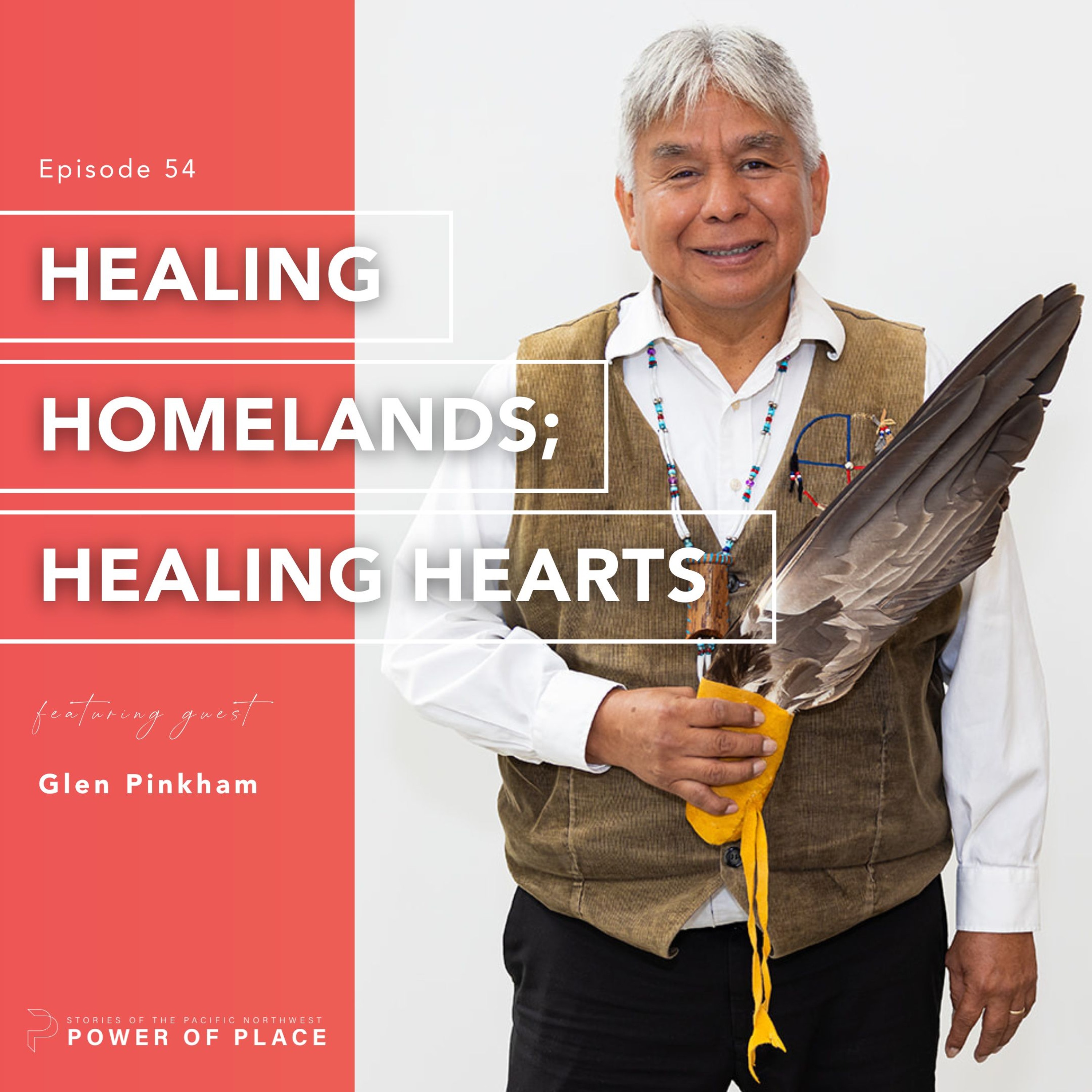
🎧 Power of Place Episode # 54 | Healing Homelands; Healing Hearts – Glen Pinkham
57m 26s
Glenn Pinkham, a Yakima Nation member, has dedicated over four decades to working with native-led organizations in Seattle, promoting indigenous practices and spiritual connections. Through his role as a cultural mentor and storyteller, Glenn shares sacred traditions that inspire healing and resilience among communities. He emphasizes the importance of sharing personal trauma and pain as a means of healing for both individuals and communities. Glenn's work extends to aiding military veterans through conversations and sweat lodge ceremonies, offering a space for healing and reflection. Additionally, he assists individuals in coping with grief and loss, recognizing the universal struggle of dealing with trauma. Glenn's profound experiences and teachings reflect a deep commitment to cultural preservation, community healing, and spiritual guidance.
Transcription
8904 Words, 46717 Characters
When we say you share your personal trauma, your pain, with another person, your sadness, with another person, it turns it upside down and it turns into medicine, it helps them to heal. In our last episode we explored the intersections of place and perspective with David Albright, whose stories invited us to cross bridges, both real and metaphorical. Today we continue crossing bridges, this time between the material and the spiritual, guided by a cultural mentor and storyteller who brings both wisdom and a lighthearted touch to his work. Our guest and enrolled member of the Yakima Nation has spent over 40 years working with native-led organizations in Seattle, including Chief Seattle Club, Mother Nation, and United Indians of all tribes. His role span hospital chaplaincy, sweat lodges, prayer services, and community events, all infused with a spirit that's as comforting as it is compelling. As a homeless outreach representative for Mother Nation, alongside his wifey vet, and an elder at Chief Seattle Club, our guest, Bridges Past, and Present, sharing sacred practices that inspire and sustain. His vivid stories of buffalo harvesting on ancestral lands connect us to indigenous food sovereignty, and the ties between people, land, and spirit. And so in today's episode we'll explore traditional Yakima approaches to healing, the transformative power of sweat lodges, and how the boundaries between humans and animals can sometimes blur. And stick around at the end of today's episode, our guest will share a first-hand encounter with a presence as real as the mountains themselves, Bigfoot, ever-watchful in the wilderness. Glenn's encounter will bring him to life, adding depth of the stories that shape Bigfoot's connection to the land. So let's welcome our guest today, Glenn Pinkham. Hey Glenn. It's good to be here with you. It's so great, and I'll just actually say that you're also my uncle, but for the purpose of today's conversation, I'll call you Glenn. Either way works. Good. So for all of us, our community and family of origin really shapes our lives. Can you please describe the place that you grew up, Glenn, during your earlier years? And what was a landscape like there? Well, I grew up in Yakima, a reservation, which is about two and a half hours at South Central Washington. And when I grew up, there were still salmon runs in the lower Yakima Valley. And I remember swimming in the Yakima River and seeing them when they turned into reds when they were spawning. And not just the salmon, but I would say, I used this expression that you could see the air move. And what I mean by that is there's thousands and hundreds of thousands of dragonflies, different colors. You can walk in a certain area, and they all moved together and it made the air move. And at that time too, it might seem kind of really old-fashioned, or maybe some people would never have heard of this. But when the migratory ducks and the geese flew across the sky, they really did darken the sky. It was an amazing thing to see. And I first came here in the mid '80s with my wife to pursue school at University of Washington. We stayed here approximately 11 years. Then we moved back to Yakima again. We did work in the community for about 10 years. And then we moved back and we've been here now going on 15 years. And I always share this with people who come to the sweat lodge, is that there are prayers, there are words, there are thoughts of feelings. They might be just a little bit different than the prayers I've heard in Yakima. But the Creator still lives there in their hearts, and that's one thing that I like to share is that the Creator lives there, and he lives here. Glenn, can you share memories of somebody who had a great deal of influence upon you when you were growing up in Yakima prior to your move to Seattle? I would say my dad, my dad was, he was like the enforcer, but you know what? We grew up really traditionally old-style in Yakima, in that parents, they and touch their kids with their hand, they had this thing called a boss, it's a stick. And when we got in trouble, my mom says, "Go get the boss, it's right over the TV." And we go, you know, we get a spank in, but my mom and my dad, they told me what I referred this phrase before later, but it's what they said is, "These are the rules. We're going to enforce the rules, and this is how we're going to enforce them." You know, they just told us what they were and who was going to enforce them, and they did. So I really appreciate that, whether it's getting up at 6 o'clock in the morning to go feed the horses on Sunday, we got to go to the long house or there were special times, we went to shake her church, or we went to medicine dances, or we went to go hunt for people. My dad got me involved with hunting for the funerals, and our way when a person passes away, we give the medicine for their table, and the main table that we have men and would do for the table, like 300 or 400 people, would be elk and deer and salmon. Did you meet Yvett in Yakima, or did you meet well in college? Well, I met her in Yakima, it's funny, but she would say we met at a powwow, and I would say we met at a disco back in the seventies. Which is true? Well, I believe her now, because you know what happened, it is back during my sister's memorial service. She shared this story of how she met me, it's such an eloquent and hard-pelt way, you know, I had a hard time keeping from crying, and just remembering it, it almost puts it to her mind. So I believe I go with that, her point of view. And so it was the powwow, okay. And our listeners, they haven't been to a powwow yet, maybe share a little bit about what happens. Today's powwows are for people who come and they bring people from different tribes and different cultures, different ways of dancing. There are dancers who are like jingle dressers, that's kind of the primary from the southwest. There are grass dancers who are like from the Midwest and Southwest. The traditional circle dances, the thing what I would call dancing for when you get to no people, the way I grew up was very different. See, when I was young, only men danced on the floor, and they would call it war dancing, men and boys could dance. And women would dance when you had a circle dance, when you danced with couples. And these were dances so that you could be together and get to know each other. And I'll explain how this happened with my mom and dad. A circle dance a long time ago when my mom and dad finally made it known that they were going to be married. It started like this. There was a circle of my mom's relatives, and in its circle was my mom and her dad. And then on the outside of the circle was my dad and his mom. And he brought over to them, he says I have five horses and her dad says no. And so he goes back outside and he brought in ten more horses, and he says, well, what else? And so they said of fifteen horses, I believe it was fifteen. And then they, all of his family members brought in items to give to the family members of her family. And what they did is they brought it into the, as they walked in the circle, they put it in front of her. And every other person was his family and everybody person was her family. And they joined the circle and they did a circle dance. And that was the join of families in front of the people at award dance. And that's how they were recognized. So can you explain the function of the long house, especially during life events and through the seasons? Well, when I was growing up, it went from the main emphasis that it did, it explained traditional laws and what, like for instance here's a traditional law that I can share that I bet with a lot of my friends who are not native, that hunt. They say, "Clan, how is it that you say you don't hunt on Sundays?" I said, no, we don't hunt on Sundays. Like, well, that's our best day to go hunting. And you know, that's a traditional law, we don't hunt on Sundays. So it's a, they explained in the long houses, explain what our sacred foods are and when we could take them, another traditional law, that's very basic. Similar to a lot of other long houses is that before you gather the sacred roots, you send the women to gather the roots of berries and men would gather the salmon and the alken deer. And then once they gather and you eat at a feast, then you could go gather it for your own family. So we gather for the people first and then we gather for ourselves. Much of the work that you have done throughout your long life has been as a cultural mentor and kind of a group facilitator, focused on healing other people and helping people through trauma. Can you share more about this, how this work began for you in Seattle? Well, you know, in order for me to do it first, I had to learn it. And what happened is that when I was a young man, my dad would say, "You got to come with this." And we'd go to the local hospital over Yakima. And I'd watch him and my, his uncles, we were like my grand uncles. And they would pray for a family because someone was about to pass and then they prayed for the family, that was left behind, they'd sing songs for them and talk to them. They would take him to the sweat or they would take him, they would do things for them like they would go bless their home, they'd clean their home. And that's what I do here in Seattle, with Mother Nation and even before Mother Nation, I was doing this with Chief Seattle Club in the United Indians. And the Seattle Health Board would also give me references, "Hey, can you go see this person at Children's Hospital?" Or Chief Seattle Club would say, "We have persons about to pass at Harborview, could you go see them?" And so I would go there and sometimes I'd be the older one there. And then sometimes I'd be, they'd be family, they would be coming from Montana. I would give them a service, a prayer service right there in their room. And how has that been for you when you have folks from other tribes that maybe have slightly different traditions? Well, a lot of tribal members didn't have any traditions, didn't grow up with the traditions. So the way I grew up is also, I grew up with Methodist Church, McKinley Mission, over in Topish on the Reservation, and then I grew up with the LDS Church. My mom was because of her background being raised and boarding school, I was familiar with Catholic services. And so I could do a prayer for service for them, I would call a Christian prayer. And then I would do a, I would explain to them, "Would you like a Yakima prayer service?" And they would say, "Okay, sure." Because what I would explain to them is I would give them an example of a point of view about what God looks like. And so they would tell us. So I'd say, "Okay, you for the circle, I'd be pointing out their mom and dad and two two kids." I'd say, "God stand in the middle of your circle and you're going to say that people look and directly at God." You could say, "God has two eyes, two legs in the face and two ears." And the people on the side of God would say, "Wait, he only has one eye, one ear, one arm, one leg." And then the people on the back would say, "Well, he's got two arms, two legs, but he has no face." And that's the point of view. And so what I would suggest to these people were left behind, that what you can do in your life, because of trauma that happens, we change our point of view. And so right now you're going to listen to me. You came from Montana and you know, this guy talked for the Aqbal and he's talking about your nephew. And I would say, "This is what I knew about your nephew." And I would talk to them about their nephew, how I knew them, what they may have worked with. And I would say, "You are a resident of a chief cell club or United Indians." And when we say you share your personal trauma and your pain with another person, your sadness, with another person, it helps people, it turns it upside down and it turns into medicine, it helps them to heal. So you brought an object in today, can you tell us about that? This is an eagle fan that was gifted to me by my dad. And I use this in a brushing off ceremony with people who are in need of prayer. And what I explain to people is that eagles and I say, "All people live in the air, all people live in the water, all people live in the ground, the four-legged ones, all these people, they have different ways of touching Mother Earth and touching the Creator's breath, which is the air." And these eagles, they go places where even a lot of other birds can't go and that medicine goes through their bodies and their fans. And those feathers stay there. And when you touch a person with it, it takes the trauma of a person and we say, "I would sing a wash-it song at the same time." And the song, we say the songs are here, we're given to our people by the Creator from time and memorial. They've been here since the beginning of time. And the Creator gave us these songs for ceremony, they gave them for what they call Sunday service now. We did them for a blessing of our foods. We did it for time when we were healing, especially for our veterans. Can you please share more about how you came to work with military veterans? A while back, it was about 16 years ago, now going on at 16 years ago. I was telling my dad, I just, "Hey, dad, this group, they're not profit. They want me to do a talking circle with veterans." And he looks at me and he goes, "My dad was a master gunner sergeant in the Korean War. So he's pretty direct." He goes, "What is a talking circle?" And so I told them, "These guys come in and they're going to talk about what happened to them in war and their pain." And he looks at me and he goes, "Okay, this is what you got to do, son." And he told me to approach how to talk to them. He said, "First, as soon as they walk in, this is what they're going to tell you." And everything he told me, "I'm going to tell you, it happens with veterans." They said, "So you're the guy in charge, right?" And he went, "Yeah. So you're a combat veteran." And I would say, "No, I'm not a combat veteran." And they'd say, "Well, you're a veteran anyway, right?" And I'd say, "No, I'm not a veteran either." They'd look at me kind of puzzled or mad and said, "Well, why should I blank listen to you?" And my dad said, "That's what they would say." They'd call it for language. And then my dad would say, "This is what you tell him." He'd say, "Well, you joined the service. They taught you how to kill people. They gave you a ceremony. You went overseas and you killed people. They came home, they gave you a ceremony, but they didn't teach you how to live with people." They'd say, "Well, okay, let's talk." And so my dad and my uncle, my dad's uncles from Korea and World War II, they told me these stories, what they did. And so I would share a story of what happened in Korea or World War II. And then these guys are from Vietnam and some of the other guys were from Afghanistan. And they'd say, "Hey, that sounds like what they would share what happened to them." And after talking for, you know, you're listening to them talk and they share, then they're crying, and they're happy, and they're talking again. You know, they released that medicine, that veteran shared from World War II or Korea. And they had that same background, that same medicine, that harshness that they'd lived through. So when we were preparing for this conversation, you mentioned that a lot of the ways in which you helped heal veterans apart from having these conversations was through sweats. And for our listeners that may not know what a sweat is, can you share a little bit about that and then specifically, how are you able to help veterans? And then other cohorts, other people that came to you for healing. Well, a sweat lodge, I would call it a sweat house. From Yakima and the tribes just run over the mountains, we call it a sweat house. The other tribes, east of us in the Midwest, planes, they call them sweat lodges. And what a sweat house says to us, it's basically a half circle, and if you were to put a half circle onto the ground, that's connected, that's built with a cow willow. And then we have willow and it goes around this way, all around it, help hold it together. And because where I'm at, I'm in the city of Seattle, our sweats, we use blankets and we have to take them apart every day when we use them. We have a pit in there that has rocks, we call them grandfather stones, and they're heated by fire. And wood, a tree, it has its rings, it's how long it's lived, good years, bad years. Well good years are bad years, that's medicine. The air went into that tree, the ground, mother earth went into that tree, and that medicine stays in that tree, but when it talks to grandfather stones, what that means is it burns. So you start the fire so that it can make the rocks wake up, the grandfather stones, which means turn of red. We then, with a pitchwork, take the grandfather stones out of the and put them inside the sweat, and people are in there. And I have people that are from all the communities, not just native, but I have people that are Caucasian, Black people who are from different countries, from Africa, Europe, China, Colombia, Central America, it's amazing, because what I tell them is that you come here to pray to the creator, and you come here to listen to other people pray to the creator in their own way. And when you do that, because the air all around us, we say that's the creator's breath. It gives life to everything. And because it's like similar to the air, you can't live very long without air. And then the sweat, with the grandfather stones, we add water to it. We add a little bit of sacred medicines to the rocks too, and that purifies the air and makes it hot. And so the analogy that I could use, that some people can relate to, is when Moses stood in front of God, and that's, it's all hot, you know, it changed him. And when they come in, what I do is I ask them, okay, we're going to go around, and each of you are going to address the creator in your own way, and then you're going to let him know who you're praying for. And then you're going to tell me how many splashes you're going to be throwing the rocks. And we do that with five people or twenty people in there. And the more people in there, the hotter it gets, you know. So it's a very challenging, if there's ten or twenty people in there. And in between round after we're done with that, we leave the sweat lodge, get some water, you can hydrate it, they go back in, and then we bring in more rocks, more grandfather stones. And in between each round, we bring in grandfathers, and so each round gets more and more intense, it's more heat. And what I let them know is that you're going to be like the first part of the second round, I call it Old Style Yakima round. Old Style Yakima round is you don't talk, you just sit there and be still, and I tell them it's like a meditating round. And after that, I let them start singing songs, sharing traditional teachings from their people, sharing stories, and people will sing songs, because the creator talked to their people in a sacred way, and they're sharing that with us, and we get to witness that. Another one of the traumatic experiences I know you have helped people with over your lifetime is grief and loss. You mentioned veterans having to go through that, but also just everyone else. Can you share a little bit about how you do that? Well what I do is I explain to them that veterans, it's pretty straightforward, they just came from a war and come back, that's a war. So when they come home, they end up finding out that everybody else is in a war. Some people, they lost their brother, they lost their mom. There's some kind of trauma that happened. And so they're just the most basic things they're having a hard time doing is just breathing. They don't breathe right. And I explain to them that you have to almost do the basic things all over again. And when it comes to the wars that we face every day, the trauma we face every day, breathing as one, the other one is, if you can, I encourage them to drink more water. I also take other teachings from other groups of people, by the way, and I've incorporated them with people because it helps. What's an example of that? Well I learned about this tradition that they do in Japan. They have this group, a larger group of people who live over a hundred years old. And they do one thing that they all do in common. Every morning, they address water, they have a short ceremony, they think the water and they drink it. And they've done that all their lives. And what I share with people is that when you address the water, the thing that gives life to everything, you know, and the air that sustains life. And then there's the water that like grows life helps heal. And so they put them together. And I explain to them that then you have something that you do everything, that everybody else goes, that they can go a little bit longer without, which is food. So I tell them, now you got to look at your food more in a sacred way. In one way, then I encourage them to do that with the water and the food. They've learned to address the water with the food. I tell them, the most basic thing, do you ever say thank you for your food? And they look at me and says, no, I've never said thank you. I go, well, that's the most basic thing in the world because you know what, I don't mean to cover across, like being hard on you or anything, but there's a lot of people starving. And there's certain places in the world that you can't grow food no more. So you know, say thank you for that food. And then I tell them, wherever you come from, we have sacred foods. There are roots and berries and elk and salmon. But you could come from, I'd say, where are you from? Because I'm from Finland. I go, just go use that phone in front of you, Google it and Google your people's names and just say sacred foods are special foods. And even though you can't eat that food, maybe you can't get to it, but address it. Just like the people who do when they address water, say, greater, I'm grateful for this food that my people had since time immemorial. Just address it. So when you spoke earlier, you talked about how these animals and even just non-animate objects from a Yakima perspective traditionally are really like relatives. Which is something I love and connect with, even though it's hard to understand that sort of connection, familial connection to the land and to the place that you're from. But yet also, when you're taking a life of a relative, it seems like that's not an easy thing to do. Can you help us understand that? Okay. There's a song that we have. And the song, Washington says, what it means in general is that God called the old people up. The birds, the fish, the plants, he says, "Hey, we've got some people coming, they're going to call them two-legged and they're going to need your medicine, they're going to need your body." And they said, "Okay," and so they volunteered their bodies so that they could help because we were weaker than they are, so that we could grow and heal and live. And so the creator said, "By you volunteering in your body to give strength and medicine to the two-legged ones, now you'll live forever with them." And since we give them the time, the salmon people, all the plants that we deal with, they're still here. And the creator says, "Okay, when you do these, this is a song that you have to sing when you gather them. This is a song that you have to sing when you bring them into the longhouse. This is a song that you sing during services and to respect them." And you can only do those songs at that time. So we're following traditional teachings, traditional laws. And the buffalo, the elk and deer, the salmon, talked to the creator like how we're talking, and says, "This is what I'm going to do for time of memorial." And then the creator told us, "These people are going to take care of you." And so you take care of them. So I ask all our guests to share a place that matters to them somewhere in the Pacific Northwest. What comes to mind for you, Glenn? When my wife and I, we would go to the ocean, go to a beach, and there's these true sounds that heal people all the time, and they don't know it's healing them. People say, "Oh, yeah, I walk along the beach and that, you know, that sound of the water hitting the beach, you know, it feels good." And that's a true sacred sound that's touching you, and it's pushing out the noise. And you can have noise in your life, but you got to have a balanced out. And you have too much noise, you can't hear that wave against the beach. You can't hear that sound of walking in the woods where the winds mix that sound with trees. So you mentioned the ocean as having this really sacred sound. Is there a place, an oceanic place in the Northwest that you and you've left to go? She heard I like to go to deception pass. Why? It makes this movement, and the water moves different. It sounds different, and it's coming right into the, right into the sound. It's that new water, and there's little trails you can hike on. And it talks to, you know, like my heart or spirit, somehow in a different way. Earlier, we were talking about a first kill ceremony. Can you share with our listeners what that is? What I'm going to explain to you, too, I explain this to some of my hunting buddies who are not, who are not yak or non-dative, and they say it's crazy. Sounds like a good story. Yeah. See, for instance, I can share the, what we did is for about a year before my, my boys got their first elk or deer. We saved up items that reflected their life, their boys, and they were in the sports. So we saved baseball gloves and bats and things like that, footballs. And we saved these things to give away, at a giveaway, because as soon as they shoot their first elk, their first deer, they give that to an elder, and to feed them out of respect for them being alive. So both my boys did that. And then at the giveaway ceremony, when we brought away all these items, giveaway, we have a dinner. We call a hunter up, an experienced hunter, and my boys each had a rifle, and they gave these rifles to two experienced hunters. And the hunters would say, thank you, they say, this is what you can do, what's what I learned about hunting, and they share medicine of how to take care of people with hunting. And then, so I tell people, when we give one of my boys gave away their rifles for their first kill, they say, that's crazy. I would never give my rifle away, they're holding onto it, and I go, okay, that's okay. And I'm not saying mine's better, I'm just saying, that's what we do for a sacred truth. And we give our first came away, and they, their mouths, wow, you know, that's cool. Thinking back, Glen, to a story you shared with me earlier about the giant bull elk, how does your experience as a hunter reveal animals as individuals with stories of their own? Yeah, my buddy was, and I were coming around the corner, we're up in the mountains, and there's a reason why he's so cute, he must have been like a ten, a ten by ten. His racks were longer than my friend's truck. And there was like a, maybe a 20 to 30 yard embankment, he was, he came down, he saw us, and like three steps, four steps, and like two, three seconds, he was gone. I mean, it was so amazing, he was so beautiful, and I tell people, when you get to see those guys, it's a blessing. You get blessed to see their lives, because they've dodged a lot of bullets. They probably got a couple bullets inside them, you know, they let they live through, and their strength that they do for their herds, that they pass on are good for future hunting for people. And another point of view about hunting for us, for a funeral, for memorial, we don't hunt for trophies. We just hunt for first or anything under a two-year-old, because they're more tender meat for, because you have elders and children. But it's also just a matter of respect, because you need the older bullets to pass on the strength to lead a herd. Because I've seen different kinds of animals, when they lose their groups of them, like wolves, what happens to wolves is that there's the two that lead it. But there are the uncles and aunties and uncles that are part of that pack, and they have something special that they learned. And when people poach, they legally shoot wolves, and not only shooting a wolf, but they're shooting the medicine, the knowledge that that wolf's supposed to pass on to those young guys. And if you shoot the leader, or shoot two or three, the other ones, that knowledge is not passed on to them. And back about, must have been 2018 or 17, I can't remember what year it was. This wolf pack, young wolf pack, they're young, killed about, I don't know how many, 18, 19 elk. And people say, "Why did they do that?" I go, because they don't have a leader, both leaders are probably gone, and sure enough, the owl was gone. And they were young, so they weren't taught how to treat elk the correct way, their game, their food. And I'll compare it to people, a young person who's drunk, and a young person who's got a gun. And they don't know any better, and they say it's guns or people, but in that case, it turns it's the person that misuses. So when it comes to game, it comes to take care of life. When you respect the life that you're taking, and you're respecting the people that you're giving it to, to me, there's a lower chance of things being done in the wrong way. You want shared a story, Glenn, about a night in the woods, when your flashlight did more than just light your way. Oh, yeah, my friend and I were out hunting for funeral. And he was right before, maybe we had like two or three hours for dark, or put the cascades, you know, up in the mountains. And I got off and I shot these two elk, climbed up there, and he says, "Hey, Glenn, I'll pack them and you just clean them." So I started taking the hide off, and he'd carry them down back and forth. Then it started getting dark. I went and got dark. He'd come up with a flashlight and I heard him, and he goes, "Hey, Glenn, my flashlight's not working too good, because I can hear him talking to me." And he goes, "He hit his flashlight together, so it's light to come back on." He was bang, bang, like that. I said, "Oh, okay, well, it walks up to me," and he goes, "But anyway, that's me." And then he goes, "By the way, you can't scare me." I go, "Oh, what do you mean, try to scare you?" I go, "I can walk it up here," and I heard you go, "Oh," like that, and I go, "That wasn't me." And he goes, "Ah, sure, sure." So he walks away, carries on, and I'm keep on working. And then he's coming up, and also, and I can hear him, and he comes up to me, and I go, "Hey, what's going on? You can't scare me. I'm the one that's got the rifle. I'm not scared." And I think we both started laughing, and all of a sudden, we heard it together. And he goes, "Oh, man, we've got to get out of here, so we took the rest of the alken, hustle down the truck. We threw it down the truck." And all of a sudden, we heard this big smash crash across the road from us from the truck, and this guy comes running out, and he's dragging his leg, he can barely walk, he's sweating, he's dirty, and he's a hiker, he goes, "Hey, hey, don't leave me, don't leave me, please don't leave me." And we looked at him, he goes, "I was up there, see you up there. I was way up there. I've been lost for a couple days, and I was going to die. I was going to give up. I was getting dark, and I go, "I'm not going to make it to the night. I'm hungry." And I looked, and I saw that, your flashlight, I started to go bleep, bleep, bleep. And so I yelled to you, "I realize you couldn't hear me." So I hurried down farther, and I'd yell, "You still couldn't hear me." So I went down farther, and then when I yelled, the flashlight stopped. And I go, "They hear me, they hear me." You gave me hope, your flashlight stopped moving. So I hurried down farther, and I yelled again, and the flashlight stopped moving whenever I yelled. And so your light saved my life. And what I tell people is that we were just doing a regular day, and your light. It's not as extreme as this, a flashlight, but the light that you have in your eyes, your spirit, that love that you have for your kids, your people that you love. By being yourself, you're going to save somebody. Because you can see a person walk through the door, and they're trying to go out another door, and there are crutches, so you walk over there and you open the door for them. You're helping them. But a person who's hurting inside their heart, inside their mind, mental anguish, they're sad, always open the door for somebody. And listen to them, talk to them, because you have that light that you have, those little words that a little bit of light will help them to live for the rest of the day. So I always share your light. So Glenn, you've had a direct encounter with Bigfoot. Yes I have. And so I would love for you to share that with us, but before you do, can you share a bit more about the traditional role of Bigfoot, for Yakima people? Okay, part of it is in the mountains, there are good things out there, and there are things that are not good. And that's what Bigfoot is. He's a good guy, and he keeps those negative things from getting out of control. And just like predators keep the food down from getting out of control, that's that circle. They keep the negative things from getting out of control. And that stuff gets clamorized to the movies, so I don't really talk about that too much, but only if I'm out there. And the way to protect yourself that I share with people is that whenever you go in a mountain, as soon as you go in that area, pull off the road, take some tobacco out, and set it down and say, "Creator, I'm not worshiping this land, I'm not worshiping the animals or anything here. So there's other people that live here, I just acknowledge them in their land, and I'm going to be respectful." And then I'm going to put this tobacco, and if you're hunting, acknowledge the game, acknowledge the game that you see. If you're hiking, acknowledge all those beautiful things, you see out there. Say, "Hey, creator, look, thank you for letting me see this waterfall or see this cliff I climbed. Thanks for giving me strength to climb it." Or I hike this trail for 10 miles, never thought I could do that before, I saw a lot of amazing things. I always give gratitude to where you're at. And when you do that, it balances things out out there. And the way you balance things out in the city is you pull up the light and it says, "Red, you stop." And it's green, you can go. That's how you acknowledge things well in the city. You'll be the lost, you know? And you help other people by paying the loss and you pay, you help yourself. And that's what he does, he basically enforces the loss. And it's funny, do you guys have ever been standing around and you look around and feel like something is looking at you and you go, "God, what is that?" And then you look up and there's a spider looking right at you. And you know what that spider is thinking? He goes, "Boy, I really like to drink your blood." You know? That's what he's thinking. So, take a big foot and he's like 10,000, 100,000 times bigger than a spider. What they could do is, and I'll share this in a nice way without trying to offend anybody, they could see you and they could tell what you want by looking at you. And they'll see these guys hiking and they say, "Hey, those guys, the only way they want me, they can see me as, as bigfoot, is they want me to yell at them." It's like, "Okay, I'll yell at them, so he yells at you." Well, other people, you know, someone like myself, he'll say, "Hey, that guy just put down tobacco, only certain people do that. So, I wonder if he wants some game, so he wants some elk or deer. So I'll follow him." And I've had him do things, amazing things for me when I was hunting because he don't proclaim to be a great hunter. I'll tell you the story. Me and my buddy were out and there's a really high cliff, about 50 yards up or so. And our friend goes, "Hey, Glenn, you can hit him." I go, "Well, how are we supposed to get him, how are we supposed to get that bucket?" So I'll climb up there. I go, "Are you sure?" And he goes, "Well, okay, so I shot him." And he goes, "Oh, looks like you missed Glenn. How could you miss him? They were so close." Well, so we drove off, then we came back and just as we came back, we came back that same place, like two, three hours later, that buck that I shot out was laying on the road. And we pulled up to it and we picked it up and my friend goes, "Hey, there's no slide marks on its fur. When they slide down, fall down, you could see where the fur gets rubbed off." And I thought he knew what we were seeing. I thought he was seeing what I was seeing. And he was standing like 20 yards off the road, 15 yards off the road. And I go, "Well, you know, that guy over there helped us out. And my friend turns around real quick, where? Where?" And I go, "Okay, well, you've got something that you should tell him, thank you." And he goes, "How do I do that?" I go, "Well, you know, he doesn't get that what you got right there. He likes your tuna sandwich." He wants your tuna. And by the way, he wants your apple too. So just walk over there and set it down, right? See that bush right there? And it was, "Yeah, walk right up to that bush and set your tuna sandwich down and put your apple down and just walk towards me but don't turn around." So he walks towards me, he turns around real quick and he goes, "Hey, where'd my tuna sandwich go? Where'd my apple go?" I go, "Well, it's not here anymore, you gave it to him." And so back to the spider and the way they are, people can see them the way they've been taught in their mind and their experience. And my friend, he was one of those guys who liked to be like a, what they call a bigfoot hunter, you know? So he always wants to be bigfoot, but he's right there. And so he goes, "Hey, I got to give him some, what did you call it, Glenn?" I said, "Oh, you gave him, you gave him lunch, I guess, for dinner." You had a great story when we were talking earlier about when you went in to help somebody at the hospital and you wound up being many more people. Oh, yeah. Can you share that story? Okay, I've met this young man. He was hooked up to a machine and he says, "Hey, it's going to be perfect, they're pretty soon, and I got some special to share with you." That's okay, and I never thought of anything of it. Then he called me like two, three o'clock in the morning and he says, "You've got to come over here. I'm going to tell grandpa, I'm going to go see grandma now." I said, "Okay, that's cool. I thought he was being released." So I go there, walked in there, "Hey, how's it going?" And his grandpa was crying really hard. And I go, "Well, you know, two hours ago, I turned 17. I can decide for myself now what I want." I go, "Oh, yeah, what's that?" He goes, "I can't do this no more." I asked him, "Take me off the machine." I told grandpa, "I'm going to go home. I'm going to go see Grandma now." So that visit taught me about what I call end of life visits. I call them that now, about how to talk to the people that are left behind, talk to the people that are already passed, because sometimes I visit people, they're unconscious, but I still talk to them. I talk to their family, and families just go ahead, take off the machine, or they're going to die any day, and they die, but we want you to do a prayer service. And so this was the beginning of that. And this one time I was doing this prayer service, I was singing the song, and I come walking out and I was done. And the nurse, a couple of us down, she says, "Hey, we have a young man in this family. They're wondering who you are and what you do." I go, "Oh, I told my name until I went to Robert Westman," because these guys are out of remember what tribal was, they said, "Can you come do the same thing for them?" I said, "Sure." So I went in there, and we talked, I explained what I do. So I did a prayer service for them. I was done, and I walked down the elevator, and as we're going down, come out of the elevator, this guy goes, "Hey, what are you doing here?" And he was another ending guy, and I go, "Oh, I just finished doing a prayer service for this family." He goes, "Hey, can you do one for me?" I said, "Oh, well, okay, I got time, so we went up to their room to the prayer service for this family, and then I walked out, and the nurse said, "Hey, we have one more family." I met five families that day, all because they heard the song, they were touched by it, they appreciated something praying for them. And I tell them, they always say, "Oh, you do such a great job when they give me a compliment." And I tell them, "No, that's the creator talking to you." I just show up, and I'm very honored to be here with you, I'm thankful that you're here with your loved one. The Thunderbird Treatment Center, once operated by the Seattle Indian Health Board and now moving to Bainbridge Island, supported those recovering from substance abuse. Lynn, can you share how you approached your work there, especially in integrating traditional practices and connecting with those in recovery? Well, my thing was to the sweats, I did that, and at the one that I was working with before closed down, the Thunderbird, I would talk to them individually, one-on-one, and I wasn't a counselor, I just talked to them about behavior. And because it was a open to the general public, the other counselor says, "Hey, can you talk to this guy?" So I talked to them, and they says, "Hey, can you talk to these other guys and turn our group?" Are they called a big gathering? So they all come together to begin day. So I walk in there, and they were always thrown off by hearing me sing this song, and then I explain how you guys have traditional songs, just go find them, and they'll help you. I'd ask them, "The words you just heard, your grandparents have those words. Your elders have those words. Go find them." And when you do, it'll help you deal with the drugs in alcohol. And I tell them that, continue using what you're learning here. There's the AA, there's the Eleanor, there's Will Bridey, and then we have the sweats here. And I tell them, "This is what you can do. They are two different worlds." And I tell them, "What I was top of my grandma, when she died, she was 103 years old." She said, "Klant, what's she called me, son, sunny boy?" She said, "There's that door right there, and it's a non-Yakkama world. There's no Yakkama wasn't there. Go through that world, and you share the best part of Yakkama with those people out there. And then from those people, learn the best part of the non-Yakkama world, and bring it back to the door of the Yakkamas and share it with your Yakkama people." And that's what you're doing here. You're coming into the treatment, and you're learning the best part of your people's world, AA, Eleanor, and Will Bridey. And now you're going to take it with you when you leave treatment, and you're going to share it with your people, they got to rediscover you. See, this is who you really are, and then you can learn the best part of where you come from, where you come from, down from Southwest, or you're learning your people from North Dakota. You guys all have sacred medicine that will help you stay sober, along with the AA and Eleanor. Put them together. When many people, myself included, have noticed something special about the way that you speak. There's a depth and resonance that itself seems to be healing. Can you please share what shapes your approach to speaking? I'd like to explain things that are from the heart and from your spirit. There's an expression that I learned in the Yakkama that goes like this. You can see things far away with your eyes, and you can see things farther more with your heart, but you can see even farther more than that with the creative in your heart. And when you just see things with your eyes, that's as far as you're going to go. So when I speak with my heart, I'm talking about things that are true from beginning to time. And so when you do that, it sounds different. Well, thank you for being our guest today, Glenn. It's a privilege to hear how you connect us to the land, to Yakkama tradition, and to the heart. I'm glad to have been here. Thank you. You're here today, I've told you my story. Join us next time on Power of Place for a Conversation with Visual Artist, Jane Orleman, whose journey took her from upstate New York during World War II to Ellensburg, Washington. There she met Dick Elliott, who became known for bold public artworks, including the iconic reflector installation around Yakkama Valley's Sondom. For 38 years, Jane and Dick pursued their own creative paths while building Dick and Jane's spot, a vibrant outdoor art space filled with sculptures and works by 40 artist friends. Though Dick passed away in 2008, Jane continues to expand her studio paintings and the evolving arts environment around their home. Jane is joined by our studio assistant and curator, Carl Schwischau, an emerging artist from Homer, Alaska, who also runs an art gallery in Ellensburg. Carl offers fresh insight into the town's evolving art scene, as well as its stunning landscapes. Through Jane's stories of creativity, resilience, and love, she brings to life the radiant energy of her art and her surroundings. Join us for the next episode of Power of Place, it's sure to brighten your day. Thank you for joining us today, audio engineering and sound designed by Daniel Gunther, with photography by Travis Lotton, administrative support from Mary Munsor, and the music written by Toma Nakayama and performed by Grand Hallway, with additional music by Arks Duo, Andrew Weathers, and Ryan Love. And for this episode, a special thanks goes out to Black Belt Eagle Scout. We record on Coast Salish Land at the Jack Straw Cultural Center in Seattle's University District. I'm Edward Kricksman and you've been listening to Power of Place, Stories of the Pacific Northwest. If you've enjoyed today's episode, please leave us a review or subscribe to us. And if you know of a place in the Pacific Northwest that matters to you, please tell us about it. We'd love to share your stories. [Music]
Podcast Summary
Key Points:
Glenn Pinkham, a member of the Yakima Nation, has spent over 40 years working with native-led organizations in Seattle.
He shares sacred practices that inspire and sustain, focusing on indigenous food sovereignty and spiritual connections.
Glenn has worked as a cultural mentor, storyteller, and healer, aiding individuals through trauma, grief, and loss.
Summary:
Glenn Pinkham, a Yakima Nation member, has dedicated over four decades to working with native-led organizations in Seattle, promoting indigenous practices and spiritual connections. Through his role as a cultural mentor and storyteller, Glenn shares sacred traditions that inspire healing and resilience among communities. He emphasizes the importance of sharing personal trauma and pain as a means of healing for both individuals and communities.
Glenn's work extends to aiding military veterans through conversations and sweat lodge ceremonies, offering a space for healing and reflection. Additionally, he assists individuals in coping with grief and loss, recognizing the universal struggle of dealing with trauma. Glenn's profound experiences and teachings reflect a deep commitment to cultural preservation, community healing, and spiritual guidance.
FAQs
It turns into medicine that helps them heal.
It involves practices like sweat lodges and connecting people, land, and spirit.
He learned from his father and uncles to offer prayers, ceremonies, and services for healing.
He shared stories and ceremonies to help veterans heal from their war experiences.
A sweat house is used for purification and prayer, involving hot stones, water, and sacred medicines for healing.
He helps individuals, including veterans, by acknowledging their trauma and guiding them through ceremonies and traditions.
Chat with AI
Loading...
Pro features
Go deeper with this episode
Unlock creator-grade tools that turn any transcript into show notes and subtitle files.
 PodcastTranscript AI