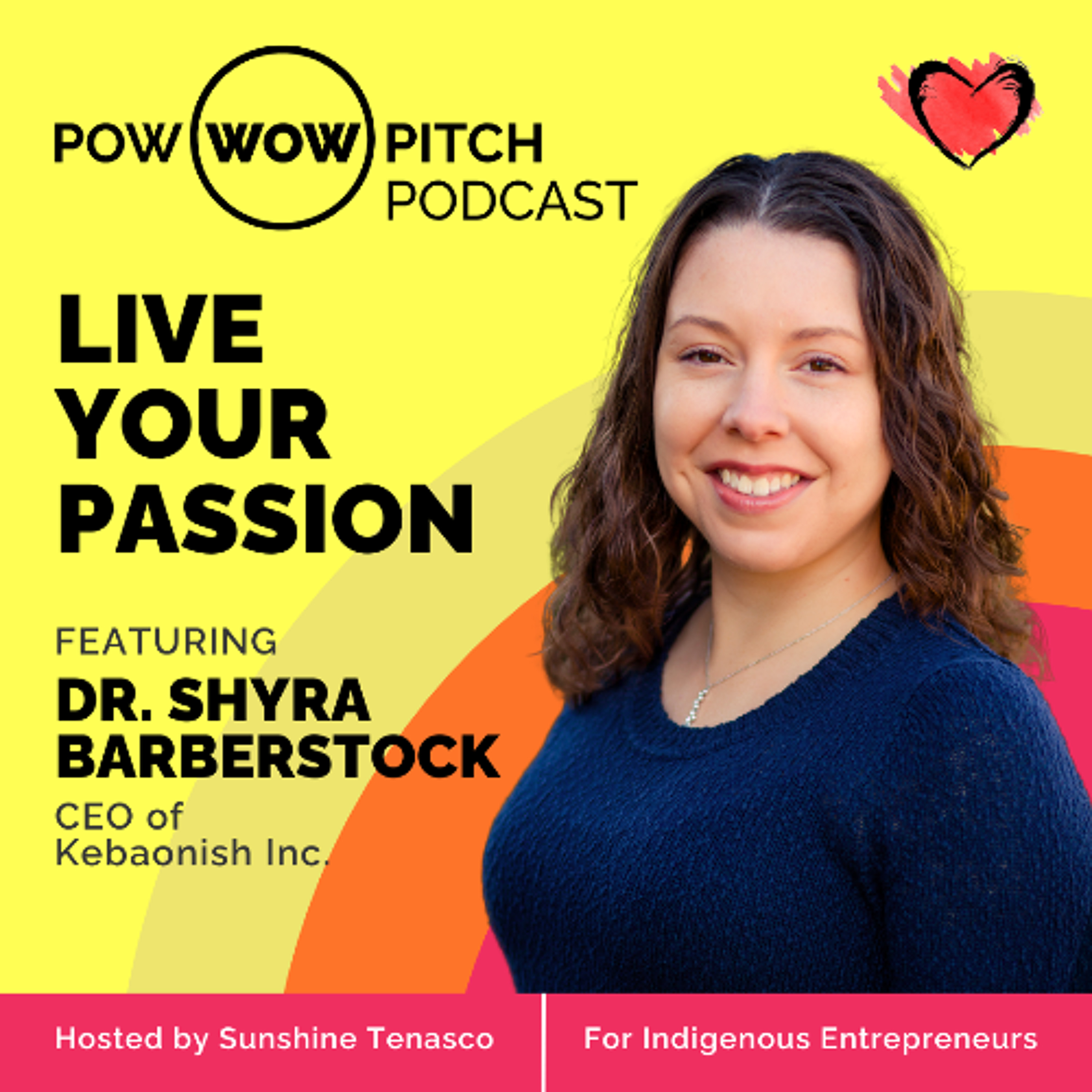
Pow Wow Pitch Podcast E48 - Live your passion with Dr. Shyra Barberstock
29m 19s
The transcription highlights the spirit of Indigenous tradition through Cabaniche's premium coffee and tea, rooted in values like Meenobemotsuin and Gana Gorio. It emphasizes Indigenous entrepreneurship and innovation, with support from RBC and Mastercard for sustainable solutions. The PowwowPitch podcast, hosted by Sunshine Quem-Tanasko, uplifts Indigenous entrepreneurs by sharing their stories and providing a platform for inspiration. Dr. Syrah Barberstok, a trailblazing Anishinaabe entrepreneur, co-founded Kibonish Inc. and Aguajo Equal Source Inc., blending academic expertise with entrepreneurship. Through initiatives like the Indigenous Climate Hub and Kwebiz program, Syrah champions social innovation and economic development. Cabaniche incorporates Anishinaabemowin and Haudenosaunee languages on its packaging, promoting cultural preservation. Indigenous philosophies like Mino-Modswin and Ghana-Gurio guide Kebunish, fostering reconciliation and promoting universal values. Syrah's vision includes expanding Kebunish globally to share Indigenous teachings and values with a wider audience.
Transcription
4631 Words, 26993 Characters
Discover the rich spirit of Indigenous tradition with Cabaniche, Coffee and Tea.
I'm Dr. Shira Barber-Stock, Anishinaabe Kwey and proud member of Cabawick First
Nation. At Cabaniche we bring you premium coffee and tea inspired by
Indigenous values like Meenobemotsuin, Living the Good Life, and Gana Gorio, the
Good Mind. Every sip connects you to the stories, cultures, and traditions of
Indigenous communities. Our beautifully designed packaging features art from
Indigenous creators celebrating their heritage while supporting cultural
preservation and economic reconciliation. Order now at ProudlyIndigenous.com or
find us at Select Retailers across Canada.
Entrepreneurship and innovation have always been an integral part of
Indigenous ways of life and today this is inspiring sustainable and
transformational solutions. To learn more about how RBC supports Indigenous
communities and businesses visit rbc.com/indigenous.
Small businesses are the foundation of our communities. That's why Mastercard
has invested in tools to support small business owners as they grow their
business. With Mastercard tools and resources you can increase sales by
shortening checkout time, broadening your customer base, and tapping into new
opportunities to increase customer loyalty. So get started. Discover all the
ways Mastercard can help guide, grow, and protect your business at mastercard.ca/smallbusiness.
Kwe Kakinah, welcome to the PowwowPitch podcast, a show empowering Indigenous
entrepreneurs. I'm your host Sunshine Quem-Tanasko from Kitagan Zibi Anishinaabeg,
an entrepreneur at heart and the founder and chair of PowwowPitch. I got my
entrepreneurial start on Dragon's Den selling baby moccasins and today I'm
the creator of Herbrades, an author, a water protector, a mom of four beautiful
children, and an advocate of Indigenous entrepreneurs. Each year PowwowPitch
supports hundreds of Indigenous entrepreneurs in sharing their stories.
I launched this podcast to expand the reach of our entrepreneurial community,
creating a space to uplift voices, exchange ideas, and inspire others to
pursue their entrepreneurial dreams while embracing the richness of their
cultures and honoring their Indigenous roots. On this podcast I interview some
of the most successful Indigenous entrepreneurs, experts, changemakers,
creators, and shakers of our time. Together we'll dive into their stories
and gain insight, knowledge, and valuable lessons to inspire us and uplift our
entire PowwowPitch community. The PowwowPitch podcast is a production of
PowwowPitch. Every month we drop a new episode so be sure to subscribe to the
PowwowPitch podcast on Spotify, Apple Podcasts, SoundCloud, and anywhere else
you listen to the podcast. Also be sure to visit us at powwowpitch.org to sign
up for our e-newsletter to get in the loop about supports, resources, funding,
and opportunities for Indigenous entrepreneurs. We're so glad you're here,
welcome to our show!
Today we are thrilled to welcome a very special guest, Dr. Syrah Barberstok,
the 2024 PowwowPitch first-place winner and a trailblazing Anishinaabe
entrepreneur from Kibowak, First Nations, near Kibowak, Quebec. Syrah is the co-
founder of both Kibonish Inc. and Aguajo Equal Source Inc. where she blends her
academic expertise and entrepreneurial vision to champion Indigenous social
innovation and economic development. With over a decade of experience as a
professional Indigenous researcher and business leader, Syrah has spearheaded
impactful initiatives like the Indigenous Climate Hub and the Kwebiz
program for Indigenous women entrepreneurs. At Kibonish, she combines
Anishinaabe and Haudenosaunee teachings and Indigenous storytelling to craft
coffee and tea products that honor culture and community. Today, Syrah is
here to share her journey of creating an Indigenous and woman-led business, the
importance of reconciliation and cultural teachings, and her vision for
taking Kibonish global. So let's get started. Kwe Syrah, welcome! We're
excited to have you here today. Thanks so much for having me. Yeah, so Syrah, you
have been like the ultimate long-time powwow pitcher. You were at, I believe it
was the first ever powwow pitch competition in 2015 at the Ottawa
Summer Solstice Festival. So can you sort of tell us about how you got from
that first pitch competition to now being the national winner, then the first
place winner of 2024? Sure, thank you so much. I definitely was at the first pitch
and there was another one as well. I pitched a couple times. I was, I believe,
top 10 both times, but it was never the winner. So this is the first time I won.
But I always think that good things come to people who wait and I think this was
the right year with the right business and the right project. So I've been an
entrepreneur for over a decade. I've come from the consulting world from a
service-based business. I still have the consultancy and it's meaningful, but
Kibonish is really special for me. I started to work on Kibonish back in
2022. That's when I incorporated it. I went after trademarks and I really wanted
to, I wanted to have a new challenge and I have never had a product-based
business before and I am so hugely passionate about coffee and tea. I
drink coffee and tea on a daily basis. I love the power of coffee and tea to
bring people together. We always tell our best stories over coffee and tea and I
really loved the opportunity to be able to work with Indigenous artists and
really showcase the talent that we have and bring it to a larger audience. First
in Canada, but all across Turtle Island and then eventually global.
And what inspired you to start this, to start Kibonish specifically? Because
you were, this is your first product-based business. Yeah, there's a whole
bunch of things that culminated at once. I mean, during 2022, we are still going
through the COVID-19 pandemic and I've actually found it really, I found it
very isolating like a lot of people. I really missed having those connections
with other people. So I think I started thinking about something that
would, that would bring, that would bring people together and have that sense of
community. I was also I think becoming a lot more reflective on my life and what
sort of legacy do I want to leave? What sort of give-back do I want to have? I do
have a really good give-back on the consultancy side. There's a lot of work
we've done that I'm really proud of, but what's really exciting about product-
based businesses is that, especially as an Indigenous social enterprise, I have a,
I have a bigger opportunity to be able to do bigger give-backs because as we
start to, to generate profits as a company, then we can actually use that to be
able to support things like cultural revitalization, language, education in
First Nation communities. So that's a big part of what inspired me, but I'm also a
person as well that always loves to be challenged. And you know what I love
about coffee and tea? It allows me to have incredible conversations with so
many people. Probably, you know, over 90, 95% of the planet drinks coffee and tea.
So it just opens up so many opportunities to have incredible conversations
with people that I might not have had conversations with.
Mm-hmm. Totally. So you founded Kebunish with your husband, Rai, which is wild.
First of all, I, a long time ago used to work with Ryan many, many moons ago. And
second of all, you know, they kind of always say, like, don't start a business
with your friend because blah, blah, blah. And you were, you just decided to take
it a step further and, and start a business with someone who you share a
bedroom with. That is wild. So what's it like? Like, can you give us a, give us a
story about how that, how that works out and all that good stuff?
Yeah, you know, that's, that's funny. I get that a lot. I have a lot of people say,
wow, you work with your, your partner. How could you do that? I'd be divorced if
I worked with my partner. I have had that comment so many times. Rai and I, I think
we're a strange anomaly. I think even if we weren't a married couple, I do think
we'd make incredible business partners, even if we weren't a married couple. All
of our, we have so many complimentary skills that are so, that are so different.
I'm really social. I love to connect with people. I love to build connections. I
enjoy public speaking. I like facilitation. I enjoy sales. And then Rai, he, he loves
administration. He's also in a very intriguing public speaker, but he's
quite happy to be working hard in the background. And he's got a very strong
operation side. So he's really, he's really helpful. But I think for Rai and I,
where we're unusual is we, we absolutely love working together. To us, it gives us
a real sense of meaning purpose. We just feel like we're on this incredible
journey together. We're like each other's rock. I mean, you know, the sunshine,
there's so many ups and downs and businesses. I mean, sometimes you feel
like you're on top of the world. It's the best thing you've ever done. Yeah. And
there's some weeks where it's really tough where you're like, I'm not coming
out of my comforter. Yeah. What am I doing? Why did I do this? Yeah. And every
entrepreneur goes through that. That's part of the entrepreneurial experience,
but it's, it's really about our, our persistence and keeping our eye on that
longer term vision, right? And where we're headed. So you have, you co-founded
Cabanich, but this isn't your only venture. You're also co-founders of
Aguajo Equal Source. So maybe if you can tell us a little bit about that and how
did the two intersect or do they intersect and how does that collaboration look
like? They're actually two very different, two different businesses, but I do
think that what we've learned through Aguajo has definitely helped to inform
Cabanich. So Aguajo Equal Source is an indigenous consultancy. We're headquartered
in Tyandinega Mohawk territory. So it's Cabanich because it's the same two, two
co-founders working together. So we've got a nice, a nice office and community.
For Aguajo Equal Source, Rai and I really wanted to find ways to be able to, to
contribute back to community through doing meaningful projects. We've done a lot
of really exciting work through Aguajo. We ended up being able to launch, not
national, national platform for climate change called the Indigenous Climate
Hub. That's been really, really exciting. That started in 2018 when our company was
asked to put together a national gathering for indigenous communities and
organizations that had received climate change funding from the, from the
federal government. When the, when the federal government was doing modernization
of indigenous procurement, we were a big part of that. We helped to lead several
of the facilitation sessions. We did roundtable discussions because of our
PhDs. We did some very influential research papers that helped to
contribute. And we worked really closely with, with, with NIOs like, like CCAB
and NACA. So that was really exciting. We've, we've been in First Nation
communities helping them with economic development plans. And we also led the
Quabus Program for Indigenous Women Entrepreneurs for three years in
partnership with Queens University and worked and supported with over 90
indigenous women entrepreneurs through, through an accelerator, mentorship,
workshop series. And that's just a sampling of some of the projects that
we've done. We've done indigenous relations training as well. And so I
think on the Cabanich side, that's a very different, it's a very different
business model because it's coffee, it's tea, it's product based, the way it's
set up is different. But I really do believe that in the consulting world,
I've met so many incredible people and continue to meet incredible people. And
it's definitely helped to inform how we've set up the philosophy of Cabanich.
And then the other thing that, that I think is a big part of it, and it goes
back to your first question too, is I was also part of the 60 scoop and I was
adopted. And so I've been going through a lifelong journey on what does it mean
to be an Anishinaabekway. And so on the Cabanich side,
Cabanich is a word that I made up. It's actually inspired by two words,
Cablewick, that's the name of my community, which means River Narrows or the
place where you disembark in the niche in Anishinaabe, original peoples.
And so Cabanich has such a deep meaning to me. It's that feeling you get when you
come home. And it goes way deeper than a place because I think we can be anywhere
on the entire planet having good coffee or tea with somebody that we love,
and we can get that feeling of being home anywhere.
What the heck, Shira, I didn't know that. That's so cool. I love that.
Thank you for sharing that. Yeah, that kind of just blew my mind and put me,
put me on a different track than the question I was going to ask.
But the first question I wanted to, that I'm just sort of curious about is,
you have a service-based business and a product-based business. Which one,
number one, do you enjoy more of doing the work if you had to choose?
That's a really tough one. It depends on what the work is. I can't say that I prefer one business
over the other. But I can tell you that when I'm working in Cabanich or Guajo, I'm happiest
when I'm with people and developing relationships. And I love that business,
whether it's a Guajo or Cabanich, I love that it gives me a platform.
And it gives me the opportunity to be able to promote the things that mean a lot to me.
Over the years, I've had the opportunity to do a lot of public speaking.
I've advocated for everything for more support for Indigenous procurement,
to Indigenous entrepreneurs, to supporting First Nation communities, to women in tech.
And I am most passionate when I feel like I'm making a difference.
Totally. Do you think that one takes more work than the other?
At the moment, I would say probably Cabanich because it's still in the startup phase. We've
been selling for just over a year now because we started doing sales back in November 2023.
So there's a lot of moving parts. But the good thing with Cabanich is as it grows,
I'm having the opportunity to be able to contract people to help offset some of the tasks. So I do
have a team with me. But it really depends on the time of year. Consulting can be very busy
if we're juggling several projects. But I could say the same thing about Cabanich. So it ebbs and
flows. Right. Right. Okay. So Cabanich incorporates both Anishinaabemowin and Haudenosaunee, which is
Ryan's nation, right? The language is into your packaging. So why is it important for you to
highlight these languages and how has the response been in communities and in
Canadians' perspective? We've had a lot of really good support. And a lot of people have
been very excited about Cabanich on the Indigenous side and the non-Indigenous side. I really feel
like I've had people rooting for us. I've had my First Nation community promote what we're doing
and also Thai and Denega rice community has also promoted what we're doing. We've had a lot of really
nice messages through social media and people saying congratulations and buying the product and
sharing it and recommending it. And to answer your question about language, I think language is so
important. We need to keep our languages alive. And the only way to keep them alive is to be able
to use them. So I think one of the exciting things with Cabanich is having the actual language
on the package. It brings it to people's attention, whether they're Indigenous or non-Indigenous
and just reminds people that that's right. There is Anishinaabemowin. There is the Ganyakgeha as
well, right? The Mohawk language. And for me, again, it's also really meaningful because as I have
this lifelong journey on what it is to be on Anishinaabekwe, it's so incredibly meaningful for
me to have the, for example, like our teas, which are inspired by the seven grandfather teachings
of the Anishinaabe and then having the language right on the packaging. There's a lot of pride in
that. And it's also exciting for me because now I'm thinking, these are my products. I better
know how to pronounce all of this. So it's a good motivation to learn the language, right?
Right. Like just as soon as you were talking, I was like, got the hashtag in my mind still here.
Like it's a visual representation of that daily, you know? So that's like super impactful. How do
you see Indigenous philosophies like Mino-Modswin helping to create a better world? The world that
we live in is kind of wild right now. And how do you see Kebunish playing and fostering reconciliation
through that? That's a really good question. Yeah, there's actually two philosophies that were
a huge inspiration for Kebunish. And one of them is, of course, Mino-Modswin on the Anishinaabe side,
which means living a good life. And then on the Haudenosaunee side, a very complimentary philosophy
is Ghana-Gurio, which is having a good mind. And so I do think that those philosophies are incredibly
important. And I love that we've weaved it throughout Kebunish so that Indigenous,
even a non-Indigenous people can really think deeply about that. What is it to have a good life?
What is it to have a good mind? What does that look like in terms of my actions? What does that
look like in terms of my heart? What does that look like in terms of my relationships and how
I see the world and present myself? So I do think it can contribute to reconciliation because you
think about this. Well, how do I follow Mino-Modswin? Well, one of the things I can do is I can follow
the Seven Grandfather teachings and what are those, right? People can learn about that through
Kebunish. You know, it's things like trust, respect, you know, bravery. What do you love?
What do all these things really mean? I also love that they're all universal concepts. That's one
of the reasons why we had that as an inspiration because it started with the inspiration of the
Seven Grandfather teachings. But anyone all over the world, those words have a meaning to them.
There's stories behind them. I could go all over the world and say, tell me, I can ask them,
tell me about love, tell me about bravery, tell me about truth, tell me about respect,
tell me a story about that. And they'll be able to tell me an incredible story.
Totally. We had one of our mentors for the powwow in Manitwabi in Winnipeg. He is Indian, Indian. And
he came and he was like, oh my gosh, like this dance is exactly like our dance. And then the next
dancers came out and he was like, this dance is exactly like this dance in our culture. And then
we sort of got deeper and deeper into conversation. And obviously the, you know, some people call them
the Seven Sacred teachings. Some people call them the Seven Grandfather teachings. Obviously,
they came up and they had similar beliefs too. And it was just like, you know, the more we have
these conversations, the more we realize how similar we are to so many people and that we
all just want to be connected and seen and cared for and loved and all of that stuff. So I think,
you know, us sharing our stories just sort of gives ourselves the, we're giving ourselves
permission to be seen and celebrated too. And, you know, being able to see a product like, oh my
god, Shira, I would love to see your product on all of the grocery stores and, you know,
be represented in such a positive and good way. And I know that you have dreams of going global
as well. And I'd love to hear some of your, you know, the steps that you're taking to
expand internationally. And how do you hope to share these Indigenous teachings with a global
audience? Yeah, thank you so much for the question. Well, I think it's important to
to sort of prove products first in a local market. So we're mostly focused on Canada right now.
We are currently shipping into the United States. That is happening. We have had people order on
the website and we have shipped to the US. There's actually been a couple of universities that have
ordered our gift boxes, which has been really nice. And so I'm going to start also reaching out
just to get to learn more about what we need to do to be able to expand globally, because I do
think there's going to be some really good interest from other countries, especially countries that
are really intrigued by Indigenous products. So I think it'll definitely be a very special
product that could be introduced into other countries. So we're starting with Canada first,
but I definitely have my sights on global. I want to be able to prove to Turtle Island and the
world that Indigenous companies can compete with the larger brands. But we just definitely have to
build sustainably as a company and just make sure that when we do launch globally, we're ready for
it. Totally. Yeah. Growing too fast is a lesson I learned the hard way. And so you're very smart
for thinking that way already. So what advice would you give other Indigenous women and
business partners looking to start their own business, especially when it comes to balancing
your cultural values and entrepreneurship? That's a really good question.
Well, I have a lot of advice. But I would say to really take the time to really look at whatever
industry that somebody's looking at getting into and just make sure to do their homework
before they get into it, I think that's incredibly important. Knowledge is power. And so being a
founder or a co-founder, I do think it's important to make sure to understand that. I have seen people
be incredibly successful going into industries that they were unfamiliar with, but they took
the time to be able to do that research. So start with that. Number two, make sure that what someone
is looking at for a business is feasible and that there's a market for it. I've seen a lot of people
come out with some really novel and exciting ideas, but it's not necessarily what the market needs
and what the market wants. So that's incredibly important. The other one too, I think it's really
common for new entrepreneurs to have imposter syndrome. So I have to speak to that. If there's
anybody that's listening, that's been thinking of starting a business, but they've been nervous
and they think, "I can't do this." I want anybody listening to know that they absolutely can. And
I can say that as people build with experience over time and develop that support network,
and they learn and they grow, that sense of imposter syndrome starts to disappear and it
starts to be replaced with confidence. And so I just think that we always need to up our game,
educate ourselves, take workshops, have mentors. Mentorship is incredibly important. I've had mentors
the entire way through my entrepreneurship journey and mentors change over time. The perfect mentor
for you at the beginning of your startup might be different than when you're 10 years in and you
think, "Well, maybe you don't need a mentor 10 years in," but it just gets more high level.
And so mentors are always really helpful and there's so many supports out there. I think
sometimes new entrepreneurs aren't aware of them, but always look out and look online. There's tons
of supports for entrepreneurs out there, but just go for it is my main message. You can be shy,
you can be nervous. I believe anybody can do it, but it does take a lot of work, perseverance,
not giving up and making sure that you're passionate about what you do because on those
hard days or there's hard weeks or hard months, if you're passionate about what you do and it
gives you deeper meaning in your life, you're more likely to continue. So always lead with passion.
I love that. That is great advice. Where can we find you?
I can be found in several different places for cabanishproudlyindigenous.com. I'm active on
social media. People can also follow me on LinkedIn. I'm quite active there. And if people are
interested in learning more about a Guajo equal source, that one's at aguajo.com. That's O-K-W-A-H.
Oh, I just got lost there. O-K-W-A-H-O.com.
There we go. Thank you. And any last words, anything else you'd like to share?
I think I've shared a lot. Actually, I do have something I would love to share. I would love
to see more Indigenous entrepreneurs. I think there are so many incredible opportunities out
there for Indigenous entrepreneurs right now. There's funding that can help to support Indigenous
entrepreneurs, but I also want to see our stories get out there more. We can use the profits from
our companies to be able to give back to community and to the causes that are important. And as I
mentioned earlier, when you're an entrepreneur, you also, in a sense, become your own platform.
And so if there are things that people are really, really passionate about, this will give you that
platform to be able to do that. I want to hear more Indigenous voices. I think that is so powerful
and it's so needed right now for so many different reasons, whether it's climate change or supporting
our communities or being able to contribute to the world's Mino Bematsoin. We need those voices.
I love that. Shaira, you're such, you're just so amazing. You're such an inspiration. You
have follow through and you create all of these amazing things and doing it in a good way.
I'm so happy that you are a 2024 winner. And just to see you come back again and again,
that's sort of like my favorite, you know, is the people who just keep showing up and
maybe it changes, maybe it's, you know, maybe it's the same, but it's, it's actually beautiful
to watch. And I've been cheering for you for a very long time. And I think you have amazing advice.
So Miigwech for joining us today.
Shima Gwech, thank you so much for having me.
Miigwech, thank you for joining us today on the Powowpitch podcast, dedicated to empowering Indigenous
entrepreneurs. The Powowpitch podcast is recorded at Powowpitch Headquarters on Anishinaabe, Algonquin
Territory in the Adalue Indigenous Business Hub Studio, powered by NACA. Thank you to our
partners, to our team, Keely Thompson Cook and Naomi Sarazen, to our creative producer,
a Cyprian Shallen Kavech, and to everyone who makes Powowpitch possible. Be sure to visit us
at powowpitch.org to explore how we can support you to start your business and sign up to our
newsletter to learn more about the Powowpitch competition, the Indigenous Entrepreneur Award,
the Indigenous Startup Program, the Powowpitch Box, the Powow Market, and other opportunities
from our community. Until next time, I'm your host, Sunshine Tinasco. Miigwech.
(upbeat music)
Podcast Summary
Key Points:
Cabaniche offers premium coffee and tea inspired by Indigenous values.
Entrepreneurship and innovation are vital in Indigenous communities, supported by organizations like RBC and Mastercard.
The PowwowPitch podcast empowers Indigenous entrepreneurs and shares success stories.
Summary:
The transcription highlights the spirit of Indigenous tradition through Cabaniche's premium coffee and tea, rooted in values like Meenobemotsuin and Gana Gorio. It emphasizes Indigenous entrepreneurship and innovation, with support from RBC and Mastercard for sustainable solutions. The PowwowPitch podcast, hosted by Sunshine Quem-Tanasko, uplifts Indigenous entrepreneurs by sharing their stories and providing a platform for inspiration.
Dr. Syrah Barberstok, a trailblazing Anishinaabe entrepreneur, co-founded Kibonish Inc. , blending academic expertise with entrepreneurship.
Through initiatives like the Indigenous Climate Hub and Kwebiz program, Syrah champions social innovation and economic development. Cabaniche incorporates Anishinaabemowin and Haudenosaunee languages on its packaging, promoting cultural preservation. Indigenous philosophies like Mino-Modswin and Ghana-Gurio guide Kebunish, fostering reconciliation and promoting universal values.
Syrah's vision includes expanding Kebunish globally to share Indigenous teachings and values with a wider audience.
FAQs
Kibonish was inspired by a desire to work on a product-based business, particularly in coffee and tea, to showcase Indigenous artists and reach a larger audience. It honors culture and community by incorporating Anishinaabe and Haudenosaunee teachings and Indigenous storytelling.
Dr. Syrah Barberstok describes working with her husband as a unique and fulfilling partnership due to their complementary skills, shared vision, and sense of purpose. They feel like they are on an incredible journey together, supporting each other through the ups and downs of entrepreneurship.
Incorporating Anishinaabemowin and Haudenosaunee languages into Cabanich's packaging is important for highlighting and preserving Indigenous languages, promoting cultural pride, and reminding both Indigenous and non-Indigenous people of the richness of these languages and cultures.
Indigenous philosophies like Mino-Modswin (Living the Good Life) and Ghana-Gurio (the Good Mind) are woven into Kibonish to encourage reflection on values, actions, and relationships. By promoting universal concepts of trust, respect, bravery, and love, Kibonish aims to foster reconciliation and inspire positive change in the world.
Dr. Syrah Barberstok is taking steps to expand Kibonish globally by aiming to have the products available not only in Canada but across Turtle Island and eventually worldwide. Through Kibonish, she hopes to share Indigenous teachings, stories, and cultural richness with a global audience.
Chat with AI
Loading...
Pro features
Go deeper with this episode
Unlock creator-grade tools that turn any transcript into show notes and subtitle files.
 PodcastTranscript AI