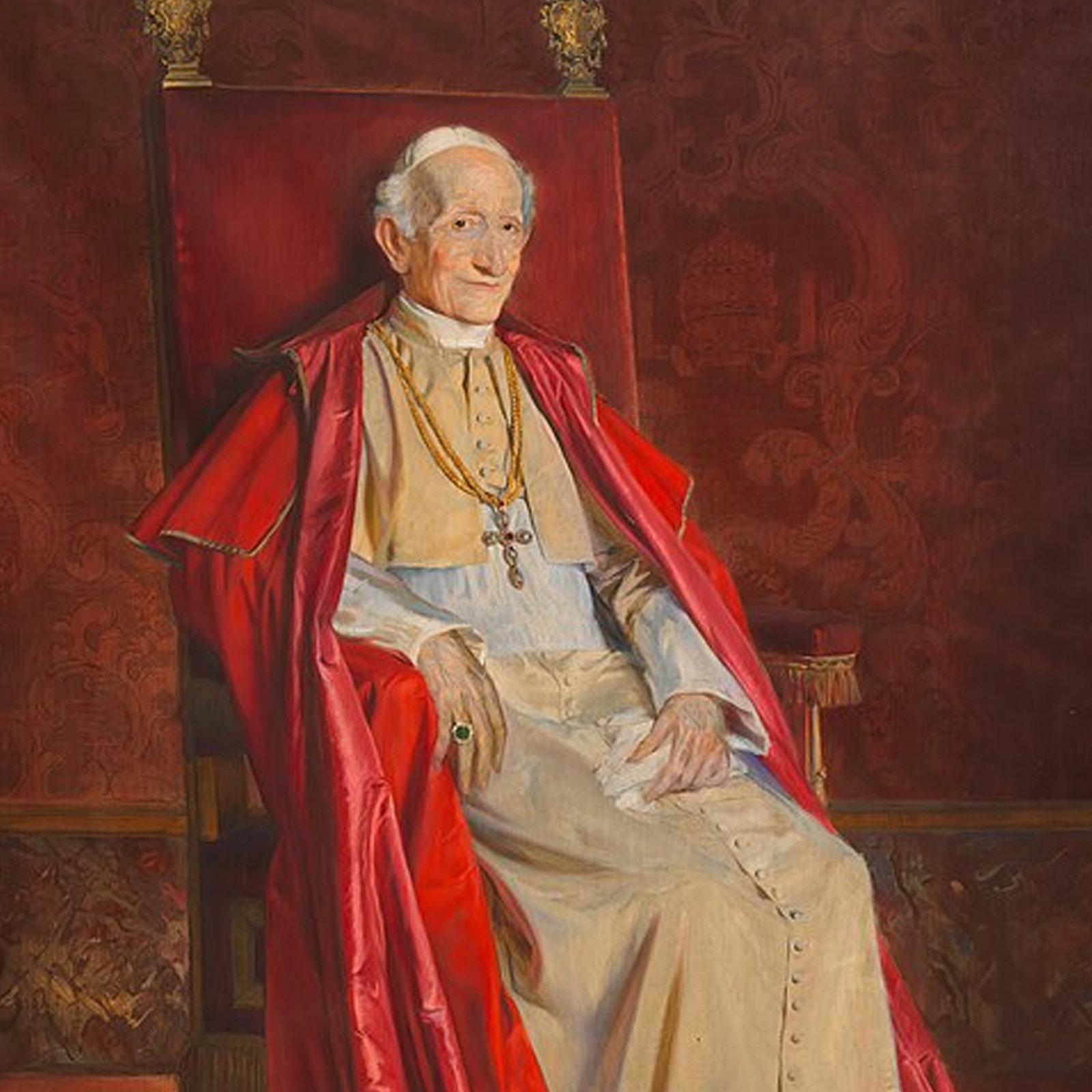
Pope Leo XIII and Communism – Fr. Brad Elliott, O.P.
from The Thomistic Institute
41m 46s
The lecture, presented by Father Ambrose Little, explores Pope Leo XIII's encyclical *Rerum Novarum* and its response to 19th-century communism. It begins by noting that contemporary readers often find it odd that the encyclical starts with a defense of private property, but this is explained by the Marxian threat as Leo understood it. Marx and Engels' dialectical materialism posits all history as class conflict driven by economic forces, where private property is an alienating epiphenomenon of class struggle. Their system denies property as rooted in human nature, viewing it instead as a temporary social fabrication that must be abolished to achieve a utopian, propertyless state. More fundamentally, Engels' *The Origin of the Family, Private Property and the State* argues that the patriarchal family is the primordial source of private property and class distinction, emerging from a social convention to ensure male certainty of paternity. This family structure, he claims, introduced the first power differential and commoditization of women and children, laying the groundwork for all subsequent oppression. Thus, the Marxian attack on property was part of a broader war on the family, Christian anthropology, and the hierarchical order of Christendom. Leo XIII's defense of property in *Rerum Novarum* is therefore nested within a defense of the family and paternal rights, countering the Marxian system that saw these institutions as the root of all social evil.
Hello, I'm Father Ambrose Little, the Director of the Timmist Against Institute. Before we begin the next great TI lecture, a quick word with you. Thanks to donors like you, our content is cutting through the digital noise with the truth of the Catholic intellectual tradition. But we can't keep it coming without your help. If you enjoy programs like the TI Podcasts in Aquinas 101, please consider a small contribution of $25 or more. You can use the link in the description or visit our website to donate. Your generosity ensures that these important programs will continue to lead souls to the truth all over the world. So please enjoy this episode and may God bless you and keep you in His grace. Welcome to the Timmistic Institute Podcast. Our mission is to promote the Catholic intellectual tradition in the University, the Church, and the wider public square. The lectures on this podcast are organized by university students at Timmistic Institute chapters around the world. To learn more and to attend these events, visit us at TimmisticInstitute.org. Going into more detail with some of the themes that I talked about this morning and what Professor talked about last night, this is simply called Pope Leo the 13th and Communism. Because that's been what we've been talking about. Because largely, Catholics, social teaching, emerged as a direct reaction to this 19th century threat. This was the reaction. So we're going to go a bit deeper. And because we're going to go get deeper, this is going to be very theoretical, speculative, and so I actually wrote out everything, so I'll be in the reading. Sorry, you guys. So it's my text. When Cardinal Robert Frantz's Privost was elected Pope on 8th of May 2025, he chose the name Leo the 14th. This sparked questions, why the name Leo? Does he wish to continue the work of his predecessor of the same name? Or is the new Pope suggesting that the challenges of our own day echo those faced by the former Leo a century ago? Well, not surprisingly, these questions would not resonate long in the minds of Catholics before generating a renewed interest in the work of Pope Leo the 13th, his times and his writings, particularly interest in his great encyclical Rarum Navarum, long hailed as the inauguration of the body of church reflection known as Catholic social teaching. As a result, many contemporary Catholics felt compelled to do what very few in the modern world ever think to do, just pick up a century old papal document and read it for current insight. But when readers first turn to the first few pages of Rarum Navarum, they find something they might not expect. They find something very odd. Aware that they're reading the first in a series of social encyclicals, they might expect to encounter prescriptions for state action or a preferential option for the poor, or a reflection on man's social obligations. But no, this is not what they first defined. Instead, in the first 15 paragraphs, they read an elaborate defense of the right to private property. Certainly, this strikes many readers as very odd. That's very odd. And it's not hard to understand why. The reader is certain to ask why would a work advertised as a social encyclical begin with a defense of what seems to be a private right? That's weird. Or why would the Pope see in the right to private property a right that seems to exalt man's individuality? A principal central to his social nature in call to life and society. So these are undoubtedly difficult questions and they point to a fundamental tension in Catholic social teaching. But I would insist that this cognitive dissonance emerges in our minds because we oftentimes fail to properly appreciate the real Marxian threat as Leo understood it. Leo understood that the Marxian attack on property was more than a simple attack on individual rights. Far from it. Rather, the Marxian attack on property was one battle in a much larger war on all that was left of the old culture of Christendom. Thus, as we will see, Leo's defense of the right to private property is nested within a defense of the family. That's the context. It's a type of society. And in particular, within a defense of the paternal rights in the family. Thus, to understand Leo's words and in fact, to understand the entire encyclical, we must understand the real Marxian threat that it addressed. So one would be hard pressed to overestimate or exaggerate the influence of Marx and Ingalls on the modern west's notion of property. More than being simply an attack on the right to private property, the Marxian system provides a fundamental metaphysics of class conflict, an explanation of history's trajectory based upon this conflict, and an eschatological vision of man-freed from this conflict. The Marxian system not only denied the right to private property completely, but shook the foundations of the Catholic worldview, a Christian anthropology, the central role of the family, and the hierarchical order upon which traditional Christian society was built. As a result, no defense of property could stand without at least a summary acknowledgement of the Marxian attack on it. Thus, I will outline the Marxian system itself, its understanding of class conflict, its proposed theory of the rise of property in the family within society, and then Leo's response to it. The Marxian system, one. Karl Marx and Friedrich Ingalls constructed their philosophy not upon a metaphysics of substance and order as did Aristotle, St. Thomas, and the Christian West, but rather upon a dialectical metaphysics of emerging self-contradictions. Whereinathesis and antithesis battle towards a new thesis that in turn gives birth to a new contradiction. This dialectical metaphysics was the direct descendent of the German philosopher, GWF Hegel. But instead of adopting hegelianism whole and entire, Marx and Ingalls transposed their system into a historical, empirically materialistic key, a historical dialectical materialism, what they called it. For them, all history consists of a series of dialectical conflicts between emerging and opposing social and economic classes. Wherein the class struggle, emerging from these oppositions, becomes the very driving force behind histories unfolding. In a word, all history is the story of these clashing social forces, propelling its movement forward along necessary and predictable paths. With dialectical materialism in hand, Marx and Ingalls stood convinced that history moved with a systematic or to use a more fitting word for Marx, a scientific necessity. For Marx, the paths along which this class conflict propelled history were scientifically determined and most importantly, scientifically discoverable. The Marxy in historian then is more like a historical scientist. A technician applying the dialectical method to history by uncovering the conflicting forces at the heart of history's necessary flow. It is no exaggeration to say that their method gave Marx and Ingalls a bloated confidence in their own ability to explain all history through purely economic forces. So this leads to the question, if all history moved through the influence of economic forces, then where did private property as an economic reality fit into this system? This is an important question. The answer to this question will be twofold. First, we must understand the Marxian economics of class conflict and how it affected the conception of private property. Second, we must examine how Marx believed this notion of private property originally emerged in human history. It's very important. And this final query will allow us to appreciate how great the Marxian threat was to the church and exactly how Catholic social teaching responded to it. Part two, class conflict. We love talking about class conflict. For Marx and Ingalls, private property was not a reality rooted in human nature at all, but was instead an epiphenomenon that emerged from clashing economic classes. They saw in the ever widening gap between property owners and labor brought on by the Industrial Revolution, one of history's great synthetics.
antithesis contradictions. That is, the increased production of each worker caused by technology slowly alienated that worker, both from the product of his labor and from the emerging class of property owners who held exclusive possession of the technology, the means of production that made the workers increase production possible. Private ownership of the means of production conditioned this class alienation. And since Marx held to a strict labor theory of value, the alienated workers increased productivity, the surplus value of his labor, was simply expropriated by the owner of the production increasing technology with which the laborer toiled. Therefore, property, that is, the private ownership of the technical and industrial means of production, was merely a concretized form of alienated labor. An incarnation of the surplus value stolen from the worker. For this reason, the French anarchist P.J. Proudon, inspired by Marx, famously asserted that property is theft, insisting that the very notion of property is a fiction or an ephemeral social fabrication. Quote, "I contend," Proudon wrote, "that neither labor nor occupation nor law can create property that property is in effect without a cause." In the same vein, the Aristotelian distinction between ownership and use, so essential to the classical understanding of property, even adopted by St. Thomas Aquinas, was also explicitly rejected. It's a semantic trick, they call it. Yet we must keep in mind that for Marx history moved with certainty. If Marx is correct, the class conflict generated by the institution of private property must be by its nature propelled history forward to some more perfect state. So what was this more perfect state? Marx insisted that the notion of private property, as understood in capitalist society, must give way to its own certain contradiction, and as a result, its own destruction. The historical anomaly of private property, what Marx would call a bourgeois property, and its alienation from labor must progress to a new society without private property, a new property less state of perfect nature. And this instantiation of private property then was merely a sad but necessary chapter in the narrative of humanity's inevitable march towards a more perfect natural state. This natural state, the future of this utopia, would be one in which all private property distinctions would cease, in which the clash between property and labor would end, and in which the sheer force of that clash would usher in the use of all goods that everyone would finally enjoy in common. So for Marx, the existing social order of the West with its cold alienation and fictitious property rights would pass not merely to a new arrangement of property, but to a whole new understanding of property itself. A communitarianism free from properties alienating effects. Thus, in the description of Marx, he says himself, quote, "The distinguishing feature of communism is not the abolition of property generally, but the abolition of bourgeois property." But modern bourgeois private property is the final and most complete expression of the system of production and appropriating products that is based on class and antagonism, on the exploitation of the many by the few. In this sense, the theory of the Communists may be summed up in one single sentence, he says, in one single sentence, this is the theory, the abolition of private property." Since the abolition of private property was his stated goal, it is not hard to see how Marx's views of history and social progress were at odds with traditional Christianities understanding of the social order. Their understanding of authority, hierarchy, and the harmony that ought to exist between social classes. But the true Marxian threat lay not in its utopian economics. No, that's not true. But more fundamentally in its dark suspicion of how the concept of private property first emerged in human history to begin with. Part number three, the family and the rise of property. As mentioned, for Marx, the modern notion of private property was merely a bourgeois property. A fiction emerging from a class relation, one that would fall away as soon as the social class from which its prong disappeared. So once this had occurred, the notion of private property would simply pass over into the ideal egalitarian common property in a society without class distinction. But how can the notion of private property itself fall away? How will that happen? What are the epistemological conditions that would allow for such a change of consciousness? To answer, we must first understand that for a true Marxian, for a true Marxian of the strict observance, ideas themselves are not derived from eternal and changeless truths as they are for the Western tradition. But instead they emerge from social relations and are therefore subject to change along with those relations. Ideas like property itself are epiphenomena of social and economic conditions, conditions by society and determined by economic necessity. Thus ideas for the Marxian are not true or false as we typically think of. They're simply useful or helpful for the cause. What is true is simply useful for the party. In other words, what the Christian West would call true, the Marxian would call productive for the cause. That is an aid in histories inevitable you fall towards its utopian state. So private property then is but one more of these passing ideas that will emerge from and change with social relations. But from all that we have said so far, the astute observer, and I can tell you, you're all very smart, is sure to have spotted a circular logic at the heart of this reasoning. There's a circular logic here. The circle flows as follows. For the Marxian private property is the necessary condition for the owning class to expropriate the surplus value of the working class, thus establishing an alienation between these two classes. Yet the concept of private property itself is nothing but an epiphenomena of that very class system that was supposedly created by private property in the first place. The circle is hard to miss. So Marx would posit private property as both a cause of class distinction and its attendant alienation and the product of that class distinction at the same time. So we must ask then which came first the class distinction that generates the idea or the idea that generates the distinction. Well, Marx was indeed a keen enough thinker to recognize such a conundrum. And his system is not without an answer. Although it is true that in Marx's world a feedback loop exists between social relations and private property that loop does indeed finally reach a logical ground. This end is not one in which the social alienation between an owning class and a laboring class rests upon a legal institution of private property at all. Instead, it is one in which the existing class distinctions within society, so owner, laborer, manager, worker, rich poor, priest, layman, freeman, servant. These themselves rest upon a more fundamental and pre-existing social institution. For the true Marxian, there is one primordial social institution rooted in biology itself that first conditioned the minds of our early parents to take their first steps out of a pristine state of a calitarian nature and enter into history's drama of class conflict, power struggle, and alienation. This social institution is the fact.
family, the primordial evil for Marx. This is the sys, and he says this, they say this explicitly and we're going to get there. This is the primordial evil. In his book, The Origin of the Family, Private Property in the State, written in 1884, Friedrich Ingalls confesses that for both Marx and himself, quote, "The first division of labor is that of man and wife in breeding children." That's the first division of labor. This division of labor, as they termed it, rooted in the obvious procreative roles dividing the two sexes, placed within human society its very first power differential. That is, the original power inequality enabling one individual to exert control over another. One individual to need another, and one individual to point to another and claim that is mine. And their logic flows thus, and this is in Ingalls book, I highly recommend that you read it. The prehistoric family was matriarchal rather than patriarchal. Actually, this is not uncommon amongst 19th century German sociologists. The assumption was that the early family was matriarchal. We think that's a new idea now in woke universities. No, it's 150 years old. It's already been disproven. We think that all of these ideas we have now are new. It's nothing new. So, the prehistoric family was matriarchal rather than patriarchal. And this was due to the obvious privilege role of the female in procreation. Since human gestation in birth fell to the female, there was no room to question which child belonged to which woman. Duh! Each mother obviously knew which child was hers. Yet, Marx and Ingalls argued, since the male procreative role terminated at the initial stage of conception, they remained constant doubt on the part of the primitive male as to which child in the tribe belonged to him. Any certainty had by the male as to which child might belong to him remained entirely dependent on the reliability and loyalty of the female. If the male then were to solidify any certainty of his offspring in any way, as many early males were sure to desire, it could only be my means of some extrinsic code of conduct imposed from outside the biological relation itself. Some communal certification tying each female to each male, a type of social construct, equally obeyed by all in the community and equally enforced by all in the community, that binds each female to only one male. So at some crucial point in history went there thinking, just such a social convention was established, and alas, the patriarchal family was born. That is, an unnatural fiction that gave each male at least the pretense of a right to point to each female and say that is mine. Within this new patriarchal system, the female, along with her children, become useful for the male's social status. The woman in child then assume a quasi-economic, almost commoditized role in relation to the man. This is why Ingalls claims that quote, "monogamy was the first form of the family not founded on natural but on economic conditions." That is, the victory of private property over primitive and natural collectivism. That's English. It's the family. The family, he connects the family as the first victory of property. So in a logical leap, Lingalls connects the patriarchal family with the victory of private property. For Ingalls, the social convention of tethering a woman to one man, that is one man in his words owning a woman, born of the patriarchal family, became the seed from which the very notion of private property, class distinction, slavery, and oppression would grow. Ingalls states this without ambiguity. "The modern monogamous family is founded on the open or disguised domestic slavery of women, and modern society is a mass composed of molecules in the form of monogamous families." In the great majority of cases, the man has to earn a living and to support his family, at least among the possessing classes. He thereby obtains a superior position that has no need of any legal special privilege. In the family, he is the bourgeois, the woman is the proletariat. Or he states again, "Monogamy was a great historical progress, but by the side of slavery and private property it marks at the same time the epic which reaching down to our days takes with all progress also a step backwards." Relatively speaking, and develops the welfare and advancement of one by the woe and submission of another. It is the cellular form of civilized society which enables us to study the nature of its now fully developed contrasts and contradictions. And quote, "That's all the families, where he says the family is." From the above it is clear that for Marx and Ingalls the patriarchal and monogamous family not only propelled all social structures of property and slavery, but was the very no-sional font from which all forms of property and slavery would flow. The patriarchal monogamous family was itself the genetic common ancestor to all forms of class distinction, inequality, alienation, slavery, rights to use or abuse at will, and then finally private property. However, one might assess his conclusions, one must confess that the logic of the Marxian worldview is at least very consistent. The logic is consistent. And if the world is to pass to a more perfect state of peace, egalitarianism, and common ownership of all goods, that is if private property is to be eliminated, as Marx says was the goal of his common system, then first must be eliminated the patriarchal monogamous family. Both the institution of private property and the institution of the family are so conceptually connected that they must either rise or fall in unison. There can be no abolition of private property and at the same time the preservation of the family. Nor can any trace of the monogamous family remain once private property is abolished. And Angles wrote this precisely. This is another quote. "With the transformation of the means of production into collective property, the monogamous family ceases to be the economic unit of society." The complete triumph of the individual over the family. The private household changes into a social industry. The care and education for children becomes a public matter. Society cares equally for all children, legal or illegal. That's with the transformation of the means of production to the state. The family dissolves. So in the Communist Manifesto, Marx also says this is Karl Marx, "The bourgeois family will vanish as a matter of course when its complement vanishes, as private property. And both will vanish with the vanishing of capital." Property and the family go together. They go together. And so many people in the modern world don't see this. They don't see the connection. This is why Marx and Angles are so brilliant. They were brilliant because they understood these relations. They understood these social relations and the origin of these social relations. I believe Marx and Angles were one of the most brilliant two of the most brilliant minds of the 19th century, but they were just completely wrong. That's why they erect this perfect system that is so perfect and consistent. It understands these relations. It's just entirely wrong. Whereas Catholic social teaching would recognize the value of private property and the family and put these two together. Marx and Angles just wanted to destroy both. It's like a clock that isn't right even twice a day. If a clock is right twice a day, it's broken. But if a clock is wrong every time of the day, it means it's deliberately set to the wrong time. But it's actually working. I think Marx and Angles were actually brilliant thinkers that were working. They understood these social relations.
It's just completely wrong. It's not just that we all want the same end. We just have different means to get there. Oh, stop it. That's not true. No, they wanted a different end. They wanted the abolition of Christian, anything that resembled Christian society. Mark's and Ingalls didn't just want the same end just to get there by a different means. Oh, so now, no, they wanted the destruction of everything that was Christian in society. And I can't stress this enough. It wasn't a good philosophy. It was mistaken a little bit. No. Okay. And since in Mark's own words, communism may be summed up as abolition of property, the Marxian cause was not a single front war alone. But the cause was a war on two fronts in which one battle was waged against private property and the second battle equally strategic was waged against the family. And both had to go, both had to go. And only when this battle had finally been won and the monogamous family dismantled from within could the inequality of men and women be leveled. And once this primal inequality between men and women vanished, then only then would also vanish all other social inequalities. For Marx and Ingalls, the woman, the first proletariat must be freed from the family. The family is her slavery. And here I'll quote Ingalls again, quote, "Given the peculiar character of man's rule of a woman in the modern family, the necessity in the manner of accomplishing the real social equality of the two will appear in broad daylight only then when both of them will enjoy complete legal equality. It will then be seen that the emancipation of women is primarily dependent on the reintroduction of the whole female sex into the public industries. To accomplish this, the monogamous family must cease to be the industrial unit of society. This was born, the Marxian crusade to emancipate the woman from the man and to a tone for humanity's original sin." Patriarchy. Does it sound familiar? Should sound familiar, especially if you've been on any college campus recently. This is like the official theology. Hello. The church's response. This is the final section. Little doubt remained that by the end of the 19th century, the Marxian attack on the right to private property in the family posed a threat to Christendom that demanded a bold response and a response indeed received. Pope Leo XIII was in no way naive. Nor was he blind to the gravity of this too pronged threat to property and the family. Thus in Rarim de Varam, he boldly connects the question of private property rights to the question of family rights. And he keenly defends them both together because he was smart. He understood what Marx and Angles also understood. What even 99 out of 100 professors of Catholic social teaching don't seem to understand. That both family rights and property rights must go together. Without property we're just utopian. We have no place. We're not connected to a place. And Pope Leo XIII says this. This is a quote from Leo XIII. This is from what paragraph. Rarim de Varam, I have it here. This is paragraph 13 in Rarim de Varam. This is a long, this is a long paragraph, whatever. Let me read it because keeping in mind this Marxian system, let me read this paragraph. That right to property therefore which has been proved to belong naturally to individual persons must likewise belong to a man in his capacity of head of a family. This is essential. That right is all the stronger in proportion as the human person receives a wider extension in the family group. We all about society, society. It is a most sacred law of nature that a father should provide food and all necessaries for those whom he has begotten. And similarly it is natural that he should wish that his children who carry on so to speak and continue his personality should be by him provided with all that is needful to enable them to keep themselves decently from want and misery amid the uncertainties of this mortal life. Now in no other way can a father affect this except by the ownership of productive property which can be transmitted to his children by inheritance. As a mic drop. A family no less than a state is as we have said a true society. This is Leo even 150 years ago is a true society governed by an authority peculiar to itself, an authority that is to say by the authority of the father. So Leo doubles down on this. He's doubling down. He's provided therefore the limits which are prescribed by the very purpose for which it exists, not be transgressed. The family has at least equal rights with the state. Listen to this. The family has equal rights with the state in the choice and pursuit of the things needful to its preservation and its just liberty. Wherein as much as the domestic household is antecedent as well in idea as in fact to the gathering of men into community, the family must necessarily have rights and duties which are prior to those of the state and founded more immediately in nature. Mic drop. As Leo the Pope's insights are profound and there is little doubt that the Marxian two front war on property in the family animated his concerns as he wrote these words. His couching of the defense of property within the larger defense of the natural family, patriarchy and the supreme role of the father leaves us no room to conclude anything else. So into this toxic air of intellectual atheism and materialist collectivism Pope Leo sounded a bold defense of the right to private property. Against the Marxian and socialistic attack on the right to private property, he states in the opening of a room that every man has by nature a right to possess things as his own. And against the Marxian logic that property was a mere construct of class oppression, he writes, "The common opinion of mankind has found in a careful study of nature and of the laws of nature, the foundations of the division of property and the practice of all ages has consecrated the principle of private ownership as being preeminently and in conformity with human nature." And he says again against the encroaching collectivism and centralization of social planning that was consuming all of Europe at the time, the end of the 19th century. He says this, "This is paragraph 15. It is clear that the main tenet of socialism, which is the community of goods, must be utterly rejected. Since it only injures those who it would seem meant to benefit, is directly contrary to the natural rights of mankind and would introduce confusion and disorder into the commonwealth. The first and most fundamental principle, therefore, if one would undertake to alleviate the conditions of the poor, must be the inviolability of private property." It's another mic drop. So what can we learn from all of this? Although Leo's defense of private property rights might seem confusing at first sight, this confusion is just that. It's a confusion. It doesn't understand what's going on. Leo's defense of property and the family is not an exultation of individual rights in isolation from the community. Instead, it is an exultation of the family's social function. It is the work of social justice. For Leo, in the Christian tradition, property is not an abstract principle of capital. Property, labor, these are not just abstractions. They're not just abstract economic principles. Nor is property a mere economic reality. It's far more. is a concrete principle that
that tethers each family to a place, a topos, a society, and grounds the society of the family within the larger community. When a family has a real place that it calls its own, only then can the family and the individual be freed from the bondage of being a utopian, having no place. And only then are the family and the individual freed from the vice of cosmopolitanism, freed to be his social creatures they're supposed to be. Thus for Leo, property in the family are not mere economic realities. They are moral realities. It's a moral reality. They are principles of social justice. And if social justice is to be defended at all, so must Catholic social teaching defend the inviolable rights of the family and the family's property. Just like Leo did. Amen. In the fall of the sun in the Holy Spirit. Perfect time. Perfect time. Perfect timer. [Applause] Thanks for listening to this lecture on the Tumistic Institute podcast. The generosity of people like you makes this podcast possible. If you enjoy these talks, please consider showing your support at www.tumisticinstitute.org/donate. Your donation of even a dollar helps us reach more college students and many others with the powerful truths of the faith. And it ensures that we can keep publishing top notch lectures on this podcast. Thanks a lot.
Podcast Summary
Key Points:
Pope Leo XIII's defense of private property in *Rerum Novarum* is misunderstood; it was a response to the Marxian attack on property, family, and Christendom.
Marx and Engels' dialectical materialism views history as class conflict driven by economic forces, with private property as an alienating epiphenomenon of class struggle.
Marx's goal was the abolition of bourgeois private property, leading to a classless, propertyless utopia.
Engels traced the origin of private property to the patriarchal family, which he saw as the first form of economic domination and the seed of all class distinctions.
The Marxian system challenges Christian anthropology, the family, and social hierarchy, prompting Leo XIII to defend property within the context of family and paternal rights.
Summary:
The lecture, presented by Father Ambrose Little, explores Pope Leo XIII's encyclical *Rerum Novarum* and its response to 19th-century communism. It begins by noting that contemporary readers often find it odd that the encyclical starts with a defense of private property, but this is explained by the Marxian threat as Leo understood it. Marx and Engels' dialectical materialism posits all history as class conflict driven by economic forces, where private property is an alienating epiphenomenon of class struggle.
Their system denies property as rooted in human nature, viewing it instead as a temporary social fabrication that must be abolished to achieve a utopian, propertyless state. More fundamentally, Engels' *The Origin of the Family, Private Property and the State* argues that the patriarchal family is the primordial source of private property and class distinction, emerging from a social convention to ensure male certainty of paternity. This family structure, he claims, introduced the first power differential and commoditization of women and children, laying the groundwork for all subsequent oppression.
Thus, the Marxian attack on property was part of a broader war on the family, Christian anthropology, and the hierarchical order of Christendom. Leo XIII's defense of property in *Rerum Novarum* is therefore nested within a defense of the family and paternal rights, countering the Marxian system that saw these institutions as the root of all social evil.
FAQs
The mission of the Timmistic Institute is to promote the Catholic intellectual tradition in the University, the Church, and the wider public square.
It begins with a defense of private property because Pope Leo XIII understood the Marxian attack on property as part of a larger war on Christendom, and he nested this defense within a defense of the family and paternal rights.
They viewed private property as an epiphenomenon of class conflict, not rooted in human nature, but as a fiction that would be abolished in a communist utopia free from class distinctions.
They identified the first division of labor as that of man and wife in breeding children, which they believed placed the first power differential in human society.
Engels argued it originated from a social convention imposed to give males certainty of offspring, tethering each female to one male, which he saw as the victory of private property over natural collectivism.
He saw it as a fundamental attack on Christian anthropology, the family, and the hierarchical order of traditional Christian society, shaking the foundations of the Catholic worldview.
Chat with AI
Loading...
Pro features
Go deeper with this episode
Unlock creator-grade tools that turn any transcript into show notes and subtitle files.
 PodcastTranscript AI