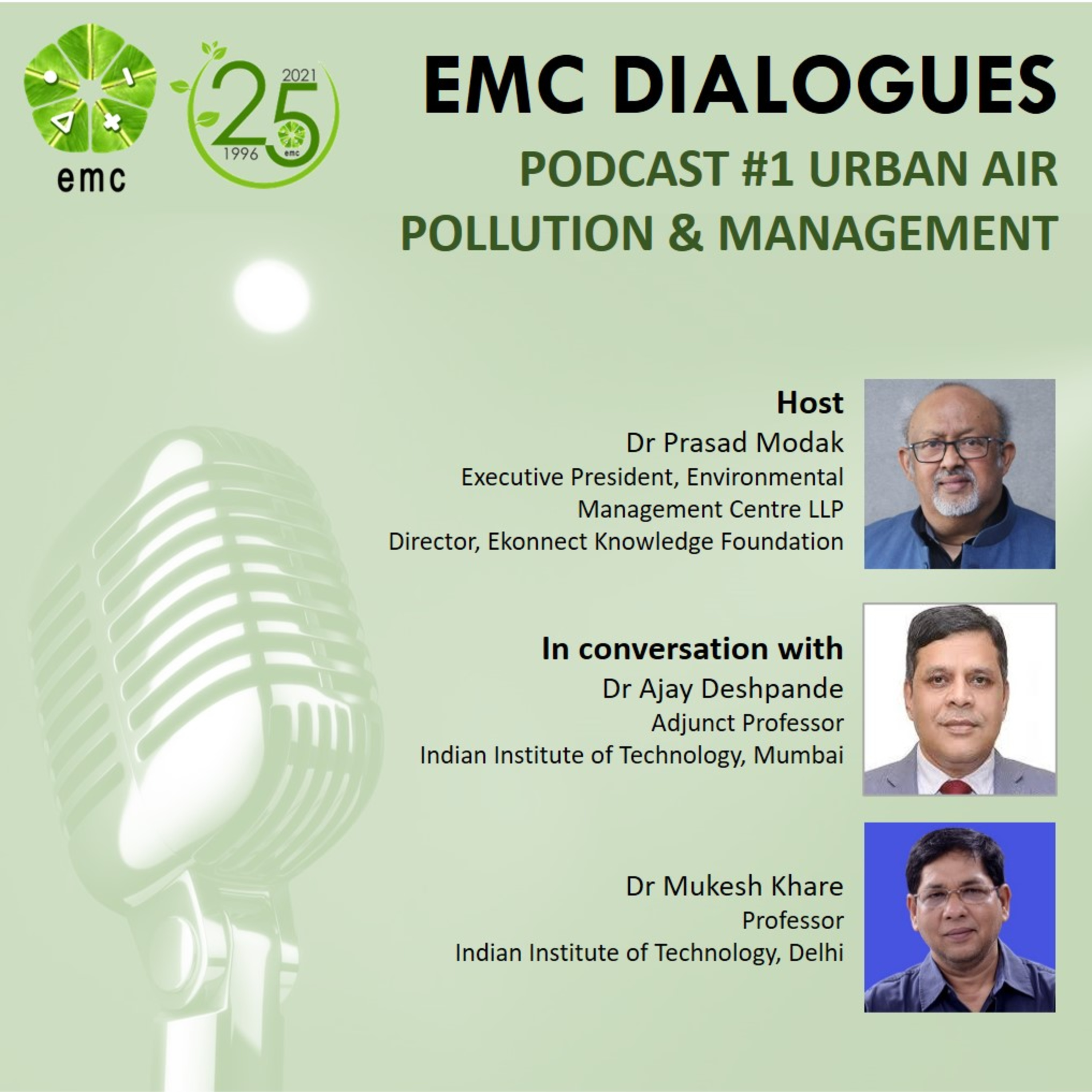
This dialogue introduces a podcast series on environmental sustainability, focusing on urban air pollution in India. Experts Dr. Mukesh Curry and Dr. Ajay Desh Pande discuss the severe and worsening air quality in cities like Delhi and Mumbai. Dr. Curry identifies key pollution sources: vehicular emissions, construction, open burning of solid waste, poor traffic discipline, and unplanned urban growth. Dr. Desh Pande emphasizes the shared responsibility under India's legal framework, involving regulators, multiple agencies, and citizens, though coordination remains difficult.
Both experts highlight a critical gap: the lack of integrated studies on the social, economic, and health impacts of air pollution, including indoor air quality. They critique past interventions in Delhi (e.g., CNG, odd-even rules) as largely ineffective due to their ad-hoc nature and lack of systemic public inclusion. The conversation concludes with an analysis of the National Clean Air Program (NCAP), praised as a comprehensive, funded, and participatory strategy. However, its success depends on targeted action against major pollution sources, robust technical execution, and sustained mission-mode implementation to achieve tangible air quality improvements.
Environmental Management Centre proudly presents the EMC Dialogue Series. We will be bringing to you informative and engaging conversations in the form of monthly podcasts with experts in the field of environmental sustainability. This series is an initiative to celebrate 25 years of EMC of practicing sustainability to the Advantage of all. We are pleased to introduce the host for today's dialogue, Dr. Prasad Mohdukh. Dr. Mohdukh is a renowned environmental expert and the founder of Environmental Management Centre and E-Connect Knowledge Foundation. We warmly welcome you listeners to the very first dialogue from the series addressing the problem of urban air pollution in India. Joining us for today's conversation we have with us Dr. Mukesh Curry, a chartered engineer and a professor at the Indian Institute of Technology Delhi. Dr. Curry obtained his PhD in the Faculty of Engineering from Newcastle University, UK and has worked in a wide range of environmental projects throughout his professional career. With a specialisation in air quality modeling, Professor Curry's experience has covered research and development studies, teaching, consulting, modeling and editor-relative dreams. We are pleased to have you with us today, Dr. Curry. Joining Dr. Curry we have Dr. Ajay Desh Mandi, a senior environmental professional with more than 27 years of experience in environmental governance, environmental policy and planning and urban and industrial environmental management. Presently Dr. Desh Pande is working with the Asian Development Bank as a part-time member of its compliance review panel. Dr. Desh Pande is a former expert member of the National Green Tribunal and has worked with the Maharashtra Pollution Control Board. Currently he is also an adjunct professor at the Indian Institute of Technology Mumbai. Thank you for joining us today, Dr. Desh Pande. I would now invite our host Dr. Motha to please take forward the conversation. Welcome to this podcast session. Today we have the theme of urban air pollution and its management in India. Thank you Professor Mukesh and Professor Ajay to join with me today on this interesting topic of urban air pollution. I am going to come to you Mukesh first and the first question I would like to ask you is that today urban air pollution has become a serious problem in India. Especially over the last 10 years we all know that the city like Delhi has been undergoing very severe air pollution especially in the winter times. And today for example we also know that city like Mumbai is also equally polluted. Something with poor air quality values as close to what we often see in New Delhi. What are the major reasons Mukesh or such a steep increase in air pollution in the cities of India? Good afternoon everybody. The question of the major reasons for urban air pollution increase in last two decades concentrated to expanding cities are four or five sources which are exponentially increased in these decades. Most of them is the emissions from regular exhaust which are causing a heavy pollution of particulate matter of 2.5 size and nitrogen dioxide. Second reason which I felt is one of the major contributor to the urban air pollution in cities is the construction activity because India is expanding fast. This growth is really exponential. As a result the cities are expanding so therefore a lot of construction activities not only of the residential complexes but also commercial complexes, the city roads, the flyers, the initial highways you know so all these construction activities became one of the major contributors to the urban air pollution. The third reason which I feel is one of the major contributor to the city's air quality deterioration in last decade is the solid waste management. You know that due to the climate change the winters are getting very harsh which are we are experiencing for last six to seven years and that is the reason that many poor people have started using the solid waste as one of the fuels to keep themselves warm. So if you just go in the nights of the winters in the city you find a lot of people especially in periphery of the city, any periphery of the city burning these solid waste comprising of not only leaves but also the hazardous materials like plastics, tires etc which makes you know the air bad. It's not 20 or 100 or 200 it's just thousands within a city and the last reason which I feel is the traffic laws. It's also related to the vehicular exhaust. People are not following the traffic laws properly they are not their behaviour of driving is very bad. We have heterogeneous traffic comprising of not only four wheelers but two wheelers, three wheelers, cycle all together, no lane systems, lot of maneuvering. So that is making the emissions exhaust you know in nitrogen dioxide gas into the you know atmosphere. And the last you know factor which I can add it over here is unplanned and unbalanced land use planning. This is a very important cause which is making the urban air quality bad and increase in the exposure to the human being that land use planning is not proper and you know unplanned growth is taking place which becomes you know a threat to the air environment in urban areas. So that's what I feel. Yeah thank you Mukesh I mean this is just telling us that there are so many diverse sources of air emissions and also I'm sure this would mean that one has to involve multiple agencies if we want to tackle to this complex issue of urban air pollution. So let me come to you on that basis Ajay that then who has that responsibility to address this challenge and who is accountable? Yeah in fact the reasons which just now Dr Mukesh mentioned they are covering all spectrum of the development act. And if you see the legislative framework putting the constitutional provision we must realize we have a fundamental right to have a clean environment no doubt about that but at the same time all of us have a fundamental duty also to protect it. And yet as we try to over emphasize our rights then the duties per se. So what Dr Mukesh lastly mentioned about the civic disciplines and all other things I think they fall squarely in the ambit of our duties to maintain the clean environment. But structurally if you see India is one of the first countries which had the legislation specifically on the air act that came in 1981. And it formulated two specific goals at one at the central level and second at the state levels, individual at the state levels. And they have been even the press responsibility to maintain and to ensure that the air quality is within the prescribed norms. Nonetheless certain safeguards are also referred in in those legislations where individual person who is carrying out any activity or a process or industry he has to follow the rules. So basically what I would like to say here that practically every stakeholder has a response in it. But over and above this particular law gives provision to prepare a air quality action plan. In such cases where the air quality is deteriorated then the action plan has to be prepared and it has to be executed. And that's why these goals have been given very important and special powers to ensure that those action plans are properly executed. So it's a you will call this as a responsibility of the regulator that has the pollution controlled boards. When I'm sure that in order that these action plans become implementable, there will be a need for a support or cooperation or a coordinated approach between different departments who are involved including transport for example, all the solid base management department of the civic authority as another example. So it is really a challenge in terms of coordinating implementing of the action plan, implementation of the action plan. I think that is something which makes this challenge little more complex. But then that the air pollution like Professor Mukesh, we talked about it that over the last 2 3 d k's.
it has been growing. There must be certainly health impacts that all of us are facing. People following sick especially respiratory diseases and then again that may be causing outage in terms of working expenditures, increasing in terms of attending to you know the doctors and getting medicines. In some cases even requiring hospitalization especially those people who have asthmatic related disorders. So my question to you, Mukesh is that all this must be translated into some kind of an economic implication. Have we carried out any such assessment of the economic and social impacts of urban pollution in India? Very good questions actually. My experience for last 30 years in air quality has that very limited studies were carried out to assist the social and economic impact of air pollution. We can count our fingers. In adequate data and limited number of collaborations between social scientists, economists and air quality experts is the main reason for the save. What happened in the last you know two decades or so there is no systematic study carried out in India to see the social and economic impacts of urban air pollution because air quality studies have been considered as only the environmental concern. That is why if you see any study, good studies have been done by many institutions and organizations and national laboratories in the country. But there is a lack of collaboration or coordination with any social scientist or medical specialist or epidemiologist. Because of this reason only that air quality has been considered as only environmental concern. Health implications are not created defined in that. Right. Neither understood. Right. Now Mukesh on this one quick another question that when we talk about the health impacts, isn't it the case that most of us are today indoors and there is certainly going to be a role of indoor air quality while we assess the health implications of air pollution. So whether we on that subject today Mukesh on indoor air quality. Yes I was going to say that because when we talk of the health implications of air, indoor dominated the outdoor air quality health impacts because indoor air quality health impacts become a very limited area where the occupants are exposed. Though the pollution level or concentration may be not as high as you find outside, some time it increases. I'm not saying that some pollutants like 2.5 or nox maybe more than that as outdoor. But because we spent a lot of time indoors whether in office or in house or in school for the children, I think indoor air quality health implications become a sort of integrated study when we talk of air pollution and health. It should be included in that and unfortunately we have not yet so far that a systematic study as you are asking coordination between the epidemiologist and doctors and air quality experts neither indoor nor the outdoor. So that's the lack or gap in our air quality research. No I think this is a very significant observation issue of making and it just tells us that we have to certainly at the national level make an effort to get social and economic aspects along with the like you said the environmental considerations and it comes to air quality. But then Ajay since you have been also in India's national green tribunal, whose responsibility it is to compensate the affected people and even not just the people but the urban ecosystems like we all know the long term impacts of air pollution on health, the materials and vegetation. What can be the role here of a national green tribunal when people complain? So firstly I would like to continue with the concern raised by both of you but if you really see the provisions of the air act again and the real definition of the air pollution. The definition is directly linked to the health impacts as well as economical. In fact our legislation is fantastic but somehow as time has gone there is certain gap or certain sort of other confusion or I don't know some some something like a silo approach which has been taken between different specialists and also there is a term which has been used is a comprehensive air pollution control action plan. So it covers practically all the aspects including the social and economical as well as the health aspect but here's there is a gap. But earlier the only opportunity for the people to address or to raise their concern was through the public interest litigation because now having a clean environment is a fundamental right. But with the introduction of the national green tribunal there is a specific provision in the act, section 15 actually which talks about the such eventualities where people can approach the code for compensation in terms of environmental damages including the air pollution. So if there is any incident of maybe gas we are now reading also in the news vehicle for last one year or one year's wherever there is an accident or gas release or some sort of gas leakages then the webinar is intervening and ensuring that the people who are affected by that type of incidents are adequately compensated. I think time is not far where in fact even the urban air pollution can reach to the doors of the NGT and for seeking certain economic and other reliefs in the matter but there are sufficient legal provisions in the national green tribunal. Thank you thank you Ajay for this but then you know to respond to this challenge particularly I would like to ask you there is several measures seem to have been taken of course stricter enforcement or asking for the use of cleaner fuels or also ensuring that the open burning of solid waste doesn't happen and actions are taken but we hear particularly in Delhi several you know measures which are like using of the CNG the compressed natural gas restricting vehicles in certain areas on the odd even number basis of the plates and also phasing out of the old vehicles we hear about these measures quite a lot especially in Delhi. So what has been the ground level experience have these interventions worked and whether such interventions should be for example tried also in other cities. The experience in Delhi for these three main interventions which you had just mentioned that is first is the CNG and then some stop gap interventions like odd even and the third is the phasing away of the 10 years old diesel and 15 years old petrol vehicle. These interventions it's it's good and the regulators and the policy makers thought that it will have some effect on the ambient air quality however what I would say that for example the odd even was a stop gap type of solutions you know they are not a very systematic approach which has been taken by the the government. The enforcement of which is an obstacle to achieving the set objectives because this is the intervention which has been taken just in a 24 hour period time by the politicians. So setting up of a more stable systems with a strong institutional capacity instead of these temporary superficial solutions is the need of the day. It's the utmost requisite to combat urban air pollution that's what I feel. Stop gap solutions doesn't work for the country like in your area else. As far as CNG is concerned it is a good it's a clean fuel however you see that there is exponential increase in the vehicle count. So adding the benefit of the CNG is gone because of the increase in the number of vehicles in the city. So what I feel in the end I should say that the intervention should be designed in a way that the public in some way is included in the decision making process. That's a big gap which we are having at the moment that decision making process is not including any stakeholders and citizens should be involved in that before any such decisions are taken because air pollution control and management affects not only the environment but also it affects the citizens which you have just asked in the last question the social impacts and also as well as the economic impacts. Right. So because of these reasons the interventions were not proved to be much beneficial as far as air quality is concerned. That's what I feel. Yes I think the very important point Mukeshu made that we cannot go by ad hoc approaches and we do need a systems thinking to come up with something which can be synergistic, effective and the same time sustained for a period of time. So in response to that I want to ask you Ajay that India launched the National Clean Air Program the NCAP and I think the idea of the NCAP fundamentally was to come up with such a kind of a
systematic approach, looking at everything including the institutional capacities, the research needs, you know the financing of such plans and also I believe central pollution control board came up with a template for all the non-attentiment cities to come up with an action plan. Now, where do you see NCAP in terms of the kinds of challenges we mentioned and some of the observations both of you made and where do you see are the implementation related challenges especially to meet the targets which NCAP has set and what should be done then to address these challenges. Ajay please. NCAP program actually envisage a different local of public participation in fact that's actually one of the important features. It is a complete document in itself. It has three different actions first is mitigation, second is the knowledge development and third is the actual implementation involved. So unlike the initiatives which are taken in the past it is basically a bottom set that is one one change I'm seeing it. The urban local bodies are involved in that the another important aspect we must consider is today we are talking about more than 130 cities which are not meeting the node and this number is bound to increase with increased monitoring and also one side we are thinking about strengthening or rather tightening our an Monday or quality standards at par with the development because we are ambitious country. So the point today is NCAP is a very ambitious project. It requires not see any interventions we talk about like if we want to change the fuel you require a lot of infrastructure to choose to require if we want to provide mass or upward transit system or mass transport systems you require a lot of infrastructure like metro and other city takes time also it's not a overnight eco-packtool. So there is a funding line which has been provided center government has assured funds and they have also put some sort of KRAs actually the performance will be evaluated for each of the local bodies every year and then only the funds will be released and they will be ranked also there so there can be a competition something like a switchabara and all other missions has. But the biggest challenge is a technical challenge. Technical when I say it includes social, economy, health and also the most important is the source of post-termine because we have to target the important sources in the first two we can't do everything in first year. So if we can catch certain low-ing new fruits I think we will see a perceptible change and once that confidence is developed in the people that okay something is improving something is happening then it will get a complete motion in itself. NCAP is a really wonderful idea at the same time. Implementing is has to be in the mission mode you can't really have it a conventional programs what we used to have like SAP and something other earlier also we had linear action plans but there was no funding line available to know there is a funding line available that has made significant changes in. Thank you thank you Ajay for talking about NCAP it gives a kind of a feeling to me that a lot while we say has been done lot also still needs to be done that we can see ground level results on air quality improvement in the cities. I don't think both of you tell me that I don't think we have a example which we can showcase that a city which was heavily air polluted has now improved its air quality and I think we don't have therefore many success stories to share that the air pollution in our urban areas can actually be tackled. Maybe during the journey of NCAP we may come across such examples and we will also understand how such improvements were made possible by looking at a mix of policy instruments regulatory enforcements maybe somewhere some incentivization maybe in some cases introducing innovation we are not touched upon in our discussion just now on electric vehicles but that also has been looked at as another strategy to tackle the local urban air pollution. So I think time will tell us how our urban air quality management experience in our country will improve and we mature so that we in especially the newly urbanizing towns we start taking few measures on a proactive basis so that situations of the grave urban air pollution do not arise. So I must thank both of you today for throwing light on some of these key questions I'm sure most of these questions are on everybody's mind on what's happening today as far as urban air pollution is concerned and what can be done and what is being planned by our government on a national level plan basis and I think the key message which I am taking out out of all this discussion especially when Mukesh you also talked and Ajayu emphasized it's a participatory approach which is probably the need and also expanding the canvas from environment although there are provisions but to also explicitly look at the social their health related perspectives and the economic implications becomes extremely important. I think that is an area apart from what you highlighted Mukesh on giving due importance to indoor air quality I think are important takeaways from this conversation with you. So let me thank you once again and I hope that our audience if they have any questions we will give you contact details of both the speakers you may like to write to them and connect with them if you are looking for more information. Thank you. Thank you thank you very much. Thank you very much Dr. Curry and Dr. Deshpande for joining us today for our very first podcast of the EMC dialogue series. It has been a pleasure hearing you both and thank you once again for sharing your invaluable insights and experiences with us. To our listeners thank you for tuning in. We hope you enjoyed this podcast. We will be back again next month with an equally interesting topic. To learn more about the topic for the next month and the work we do at EMC follow us on our social media handles and our website www.emcenter.com. We look forward to your feedback and questions. You can also drop us a line if you would like us to have a dialogue on the topic of your choice. Contact details and social media handles will be made available in the description to this podcast. Thank you once again for joining us. Until next month stay safe stay healthy. you
Podcast Summary
Key Points:
Urban air pollution in India has intensified due to multiple factors
Responsibility for addressing air pollution is shared among regulators (like pollution control boards), various government departments, and citizens, but coordinated action is challenging. Legal frameworks like the Air Act and the National Green Tribunal provide avenues for enforcement and compensation.
There is a significant lack of comprehensive studies assessing the social, economic, and health impacts of air pollution, partly due to insufficient collaboration between environmental, social science, and medical experts. Indoor air quality is also a critical but understudied component.
Past interventions in cities like Delhi (e.g., CNG promotion, odd-even schemes, vehicle phasing) have had limited success due to ad-hoc implementation, lack of systemic planning, and insufficient public involvement in decision-making.
The National Clean Air Program (NCAP) represents a more systematic, funded, and participatory approach, focusing on mitigation, knowledge development, and implementation at the city level. However, its success hinges on overcoming technical challenges, prioritizing key pollution sources, and maintaining mission-mode execution.
Summary:
This dialogue introduces a podcast series on environmental sustainability, focusing on urban air pollution in India. Experts Dr. Mukesh Curry and Dr. Ajay Desh Pande discuss the severe and worsening air quality in cities like Delhi and Mumbai. Dr. Curry identifies key pollution sources: vehicular emissions, construction, open burning of solid waste, poor traffic discipline, and unplanned urban growth. Dr. Desh Pande emphasizes the shared responsibility under India's legal framework, involving regulators, multiple agencies, and citizens, though coordination remains difficult.
Both experts highlight a critical gap: the lack of integrated studies on the social, economic, and health impacts of air pollution, including indoor air quality. They critique past interventions in Delhi (e.g., CNG, odd-even rules) as largely ineffective due to their ad-hoc nature and lack of systemic public inclusion. The conversation concludes with an analysis of the National Clean Air Program (NCAP), praised as a comprehensive, funded, and participatory strategy. However, its success depends on targeted action against major pollution sources, robust technical execution, and sustained mission-mode implementation to achieve tangible air quality improvements.
FAQs
Major reasons include vehicular exhaust emissions, extensive construction activities, poor solid waste management leading to open burning, lack of traffic law compliance, and unplanned land use.
Multiple stakeholders share responsibility, including pollution control boards, government agencies, and citizens. The Air Act of 1981 mandates central and state bodies to ensure air quality standards, while individuals have a duty to follow regulations.
Air pollution leads to health costs like medical expenses and lost productivity, especially from respiratory diseases. However, systematic studies on these impacts are limited due to inadequate collaboration between environmental, social, and economic experts.
Indoor air quality significantly affects health because people spend most of their time indoors. Pollutants like PM2.5 can accumulate, but integrated studies linking indoor air quality to health outcomes are lacking in India.
The National Green Tribunal provides a legal avenue for affected individuals to seek compensation for environmental damages, including from air pollution incidents, under Section 15 of its act.
Interventions like CNG, odd-even schemes, and phasing out old vehicles have had limited success due to poor enforcement, rising vehicle numbers, and lack of public involvement in decision-making.
Chat with AI
Loading...
Pro features
Go deeper with this episode
Unlock creator-grade tools that turn any transcript into show notes and subtitle files.
 PodcastTranscript AI