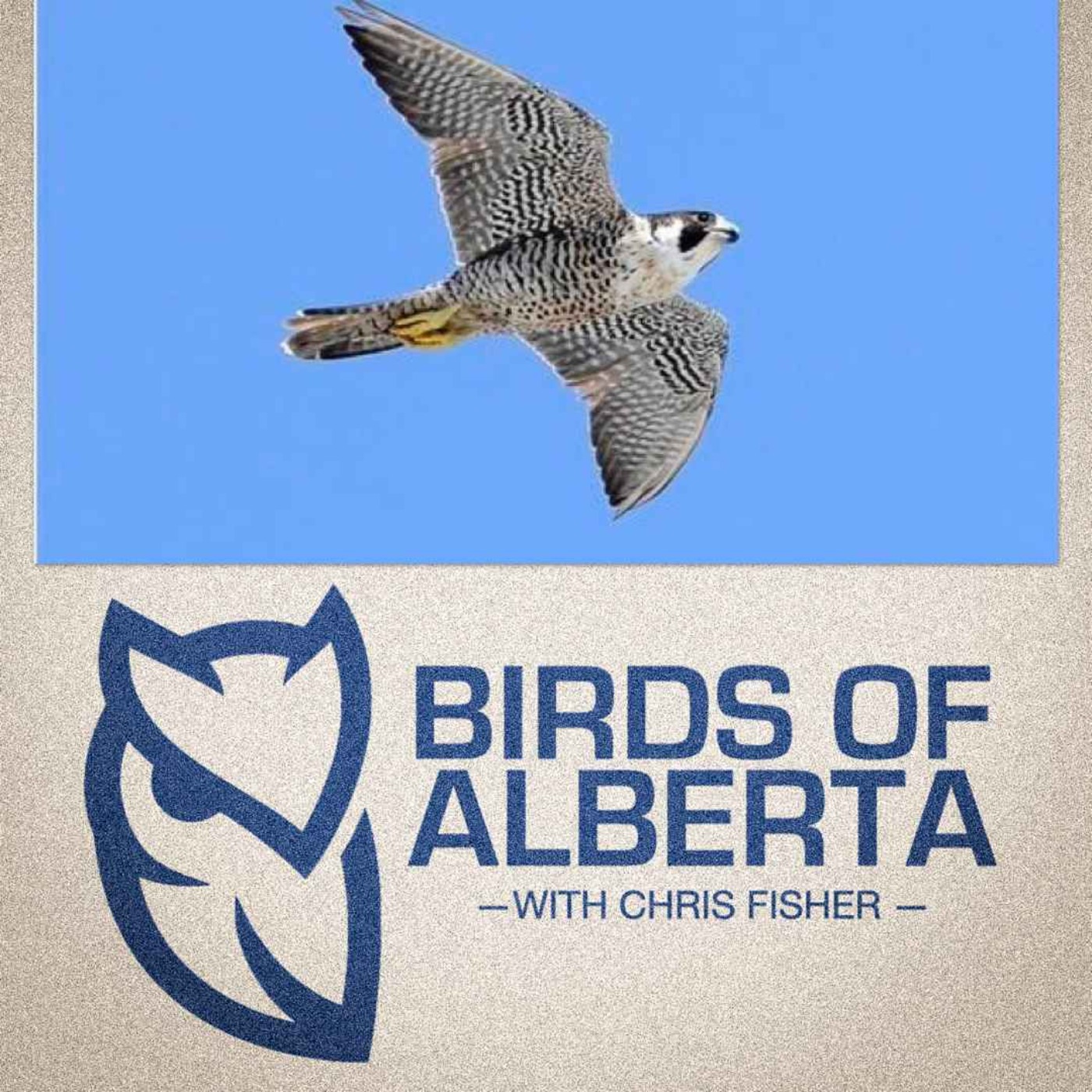
The podcast details the dramatic decline and remarkable recovery of peregrine falcons in Alberta. By the mid-1970s, the species had virtually disappeared from the province's river valleys, primarily due to the pesticide DDT, which caused fatal eggshell thinning, and illegal falconry trade. In response, a conservation program led by Richard Fife of the Canadian Wildlife Service established a captive breeding facility at CFB Wainwright. Through dedicated effort, the team successfully bred falcons and used a "hacking" technique to soft-release young birds into the wild. This effort was bolstered by public interest and key figures like researcher Dick Dekker and a young enthusiast, Gord Court, who later documented the first urban nestings on skyscrapers. The program is a landmark success; from near extinction, Alberta now hosts about 70 wild nesting pairs. However, the recovery is not fully complete, as historic sites like the Bow River cliffs remain unoccupied, leaving hope for the falcons' eventual return to all their ancestral territories.
Welcome to the Birds of Alberta podcast. I'm Chris Fisher, co-author of the best selling field guide birds of Alberta. There once was a yearly tradition here in Alberta but one that was filled with more despair than celebration. You see just as the last snows were sublimating from the deepest crevices of Alberta's southern Newtah valleys, Richard Vife and Harry Arnbruster went out to conduct their springtime duty. And at least here just upstream of the otherwise insignificant hamleta of Bo City there was something to see. In 1970 there was stud as he was known a master of the air capable of snagging and supersonic flight songbirds ducks and delivering the meals to his nesting mate. He was the skip the dishes of his time. Stud with his distinctive jet black head and pugnacious disposition would also be on guard and drive away all intruders whether they arrived on wings or on foot. So Richard and Harry they would return to this overlook again in 1971 and '72 to watch stud in his family. But when they returned in April of 1973 there was stud but no female arrived. He was alone again in '74 and '75 after which stud was no longer seen. And so by 1975 the historic cliff nests used since the year they were formed were now unoccupied along Alberta's milk, Old Man, South Saskatchewan, Norse Saskatchewan, Pembena, Maclaude, Red Deer, and Athabasca rivers and with the loss of stud they were now also gone from the Bo River. This was a loss of a bird that seized our collective imagination and interest more so than any of our other birds of Alberta because because we feared that one of our most famous might never be seen again the Paragrand Falcon. Paragrand Falcons were a great symbol of the conservation movement of the 1970s. First off it was an odd day shes bird that had muscle and speed and the specks quite frankly that appealed to some and and the sympathy that appealed to others. And no bird shows as much confidence as it seems to know of its own physical dominance as if it can outdo all comers with a mastery of the air. Paragrands have often been referred to as as our top gun and the analogy holds. It really does seem cocky and self-assured, engineered for life elevated above our merely mortal birds. Paragrands even choose to nest on the biggest real estate around, be it a high cliff ledge or nowadays on skyscrapers and industrial smokestacks. Everything for Paragrands line up to be the biggest and the best. So by the mid 1970s the plate of one of our most charismatic birds required attention right when the world started to take notice of all environmental causes. This came the heels of the work that was done by people like Rachel Carson, writer of Silent Spring and person who brought to light the concerns of DDT and other organo clorings. It was also not long after the very first Earth Day in 1970 a passage of the endangered species act and other environmental legislation and even Woods-Yawell who asked us all to give a hoot and don't pollute. So it was in this environment that the declines of Paragrands became noteworthy. The declines were thought primarily to be driven by the increase in DDT, which in their eggshells, which made the parents unfortunately crush the eggs unintentionally when they were incubating them. That led to great declines throughout most of their range in North America and around the world in Alberta. There were some concerns that some of the very last nests in the early 1970s were rated by wildlife smugglers and the illegal trade in falconry birds. So during this very critical time frame Richard Vife who was working for the Canadian wildlife service, you'll remember them from the Hinterlands Who's Who Series? Well, he came up with a plan to reverse the trends of Paragrand Falcons by securing some of the very last eggs of wild Paragrand Falcons bringing them into captivity to start a captive breeding program. The federal government would fund a captive breeding facility on the grounds of Canadian forces-based Wainwright and Richard Vife and team of CWS members had to figure out a plan how to not only raise Paragrands that were brought in from the wild but to eventually breed pairs in order for them to produce viable young of their own. They hired an excellent team of committed technicians to figure out exactly the right conditions that would lead to these captive Paragrands in order for them to couple up and produce young. While this program took quite a number of years to fine-tune the details required to entice Paragrands to breed successfully it eventually did work quite effectively as the birds in Wainwright not only began to produce offspring within a few years but love was also in the air for some of the technicians as the primary ones, Phil and Helen Treffrey would eventually marry and be a power couple for Paragrand Falcons for decades to come. And so by the late 1970s the team at Wainwright under the leadership of Richard V acquired quite a bit of success at producing a significant amount of young every year and the goal of the entire program was to eventually see the release of these young birds into the wild. So Boroughine a technique that had been developed over centuries by falconers throughout the world the Wainwright team decided to release these young birds by hacking them. Now in 1979 hacking was not a term that referred to any digital malfeants it really was a technique to soft release soon to be fledged young Paragrand Falcons. And so the next critical phase in this recovery was soon unfolding throughout the province these hack boxes which are essentially open air cages were erected on River Valley's and other Paragrand friendly locations so that the soon to be fledged Falcons would be contained within the hack box and fed for a period of time. There were of course be technicians monitoring the young birds and once it appeared that they were ready to take their first flight well the side of the hack box would be open and the young birds on their own will would take those first practice flights and continue returning to the hack box where they would be fed and eventually was hope that they would at these hack site locations acquire the rudimentary skills required to hunt all on their own and then make the other great leap to migrate away from these hack boxes in Alberta to some distant migratory location where they would spend the winter and hopefully return to these same areas. There was of course no guarantee that any of this plan would work out as it had really never been done before but but the team was audacious and waited for the results to unfold. And while most of the hack boxes were in relatively remote areas of Alberta along our major rivers there were a few in urban settings one particular was erected on the Longman building which is very close to present day South campus of the University of Alberta. The hacking program led by Richard five had gained some traction some media intention and one summer day a curious teenager decided to ride his bicycle all the way from Sherwood Park to the OS Longman building to see Paragrens for himself. That day a young Gord Court met Richard five and they struck up a friendship with Richard offering Gord opportunities to actually help him out in the field the following year. Young Gord Court was hooked on paragrens from the first moment that he saw them at the Longman building in later years while a university student he was the first to document Paragren Fulkins nesting in downtown Edmonton. These were not birds nesting and a hack box or another purpose built structure.
but nesting in an Alcove in an office building. The AGT building, the Alberta government telephones building now called the Tellus building just to the side of Sir Winston Churchill's square. These were the very first wild pyragons in Canada to nest on high rise office buildings, just on the AGT tower in Edmonton and then its twin structure in Calgary and some of us are not only old enough to remember AGT but phone books as well as by the mid 1980s. That's exactly what they put on the covers of their Alberta phone books, pictures of their nesting pyragran falcons showing off the pride they had and their little piece of the conservation puzzle leading to the recovery of this species here in Alberta. Pyragran falcons, really benefited by having an unmatched interest and devotion, members of the public and no individual probably in Alberta has spent more time watching pyragran falcons than Dick Decker. Dick Decker is an independent researcher of incredible note here in the province began observing wild pyragran falcons when he first arrived from his native Holland in the 1960s and continued up noticing the declines through that decade and the 1970s his ability to record and observe pyragran falcons during that period of time was unmatched. In the Edmonton area Dick's favorite place to watch migrating pyragran falcons would be in the Beaver Hills Lake area he drives station wagon oftentimes getting stuck in the muddy roads and then having to walk 5 or 10 kilometers to his favorite viewpoint along the shoreline. You know I spent a single day doing this years ago and saw four pyragran falcons simultaneously hunting migrant ducks and sandpipers it really wasn't an incredible day but also one that left me with a little bit of heatstroke so I couldn't hold the candle to the efforts that Dick did over years and years and decades of watching pyragran's and other wildlife. Dick Decker's contribution to wild pyragran's was really unsurpassed during this period of time his data and his observations really contributed to a great understanding and awareness of pyragran's particularly migrant pyragran's most of the pyragran's that he observed in an around Beaver Hills Lake were destined to nest in the high Arctic where they hadn't declined nearly as much as the ones that nested in the prairie provinces. Over a period of about four years from the late 70s to the early 80s he documented over 300 birds and observed dozens and dozens of hunting opportunities and documenting their kill rate of only 9.4 percent. Dick was very very good at publishing the results of his scientific inquiry and academic journals but he also wrote numerous natural history books intended for the general public in order for them to gain the appreciation of these birds through his data points but also by reading his words readers got a great sense of the passions someone can have for these particular birds. Pyragran falcons are really a bird that anyone can feel a sense of connection to and I certainly do can't help but but think that when I was born in 1970 here was a bird that was pretty much gone from the southern part of Alberta and very much in danger. By the time my children were born pyragran falcons in Canada were listed as not at risk. It is a remarkable achievement and quite frankly an achievement in conservation that has not been equaled by many species at all. And well today there are over 70 cities in North America. Most at least one pair of nesting pyragran falcons in their downtown cork. Certainly in Edmonton there has been as many as eight pairs. Calgary is only seen three. Of course there are pairs nesting on industrial sites throughout the province. Red deer has even boasted two pairs in the past number of years. In total Alberta has about 70 wild pairs nesting where just 50 years ago there was hardly any at all. And nowadays even catching a fleeting glimpse of a pyragran while always very special is not as hard obviously as it once was. You can see some of these naturally engineered rockets at pretty much any location during migration that they're preferred prey gathered. So stop on any good waterfile water hole in the spring or fall and scan the trees and power lines and power poles surrounding them and you just might see the diagnostic teardrop shape form of a pyragran looking over the waters for their next meal opportunity. Now I've certainly seen them and delighted in them in those opportunities but I've also seen them certainly in our downtown cores many many times always a thrill to see them flying among our skyscrapers. I've seen them on roadside fence posts and one of the greatest elights that I've had is I've seen one of our prairie pyragran falcons while I was sailing south from Florida to Columbia. Well on that trip we were several consecutive days at sea and the first day at sea I noticed a pyragran flying around the ship which is a little bit strange but it was during the fall migration and then I noticed that it started to perch on the foremast the tallest structure in the front of the ship. As the day went on it spent more time with the pyragran and noticed that it was occasionally flying off and catching flying fish that were being scared by the wake of the ship and returned with its most unusual prey. Two perch once again on the foremast to consume the fish. Day after day it continued to enjoy its free ride south till the final morning I noticed it as I was eating my breakfast and as we pulled into Cartagena well there was the pyragran circling the ship and then disappearing off into the wilds of South America after enjoying a leisurely and effortless cruise across the Gulf of Mexico. Well pyragran good to see you again now you're back for another attack though you were gone or much too long you did win my pyragran long time ago in a clear blue sky that flew up earth man could it fly straight like a jet and chase the fastest game then eight their heads can you guess its name well pyragran good to see you again now you're back for another attack though you were gone for much too long you did win my pyragran then along came DDT which made their eggs all crumbly their numbers fell till we could not see anymore falcons near this city for many years the sky was dry no pyragran was seen to fly over clean things up made a moral turn and then pyragran they did return well pyragran good to see you again now you're back for another attack though you were gone or much too long you did win my pyragran so here today they fly around they tie a nest in this year town they're even back to where they've never been these smiling birds with a pyragran well pyragran good to see you again
Now you're back, oh another attack, but you were gone, oh much too long, but you did win my pairing. That was Old Peregrin from my television show from 20 years ago while Files TV and it was written by me and the fabulous Michael Becker. And so the Peregrin is back, impressively, a study of the lineage of Albert's wild Peregrin Falkens show that approximately 95% of the genetic diversity once archived at CWS Wainwright now exists in the wild population, stud may have been considered the last Peregrin by some, but happily that condition was temporary. His descendants are alive and well and flying in Alberta today. These are the words of Dr. Gordon Court, that same teenager who wrote his bike all the way from Sherwood Park to observe young Peregrin Falkens on the OS Longman building board has become our Peregrin Falken historian and we couldn't have asked for a more charismatic or better wrong-going tour, but he was also very much responsible for nominating his mentor Richard Fife into the order of Canada, tremendous on and not only to Richard Fife, but to all those responsible for helping bring Peregrin's back to the skies of Alberta. There is no doubt that the accomplishments and recovery of Alberta's Peregrin's is incomparably impressive, but it is not yet complete as Peregrin's have not fully returned to all the nest sites in our southern Alberta rivers. And to this day, whenever I have the chance to drive by Bo City during the summer months, I do. And I pull over and scan the cliffs and skies to the west to see if a Falken family has returned to these ancestral cliffs, not yet. But perhaps one day we can see them back here on stud's old territory high above the Bo River and that will further cement the Peregrin Falken as one of the most legendary and inspiring birds of Alberta.
Podcast Summary
Key Points:
The peregrine falcon population in Alberta drastically declined by the mid-1970s, primarily due to DDT-induced eggshell thinning and illegal wildlife trade.
A captive breeding and release program, led by Richard Fife at CFB Wainwright, successfully revived the species through techniques like hacking.
Public engagement and key individuals, like Dick Dekker and Gord Court, played vital roles in monitoring, research, and raising awareness.
The recovery is a major conservation success, with populations rebounding from near zero to about 70 wild nesting pairs in Alberta today.
Despite progress, peregrines have not fully recolonized all historic nesting sites, such as along the Bow River.
Summary:
The podcast details the dramatic decline and remarkable recovery of peregrine falcons in Alberta. By the mid-1970s, the species had virtually disappeared from the province's river valleys, primarily due to the pesticide DDT, which caused fatal eggshell thinning, and illegal falconry trade. In response, a conservation program led by Richard Fife of the Canadian Wildlife Service established a captive breeding facility at CFB Wainwright.
Through dedicated effort, the team successfully bred falcons and used a "hacking" technique to soft-release young birds into the wild. This effort was bolstered by public interest and key figures like researcher Dick Dekker and a young enthusiast, Gord Court, who later documented the first urban nestings on skyscrapers. The program is a landmark success; from near extinction, Alberta now hosts about 70 wild nesting pairs.
However, the recovery is not fully complete, as historic sites like the Bow River cliffs remain unoccupied, leaving hope for the falcons' eventual return to all their ancestral territories.
FAQs
The decline was primarily driven by DDT, which thinned eggshells, causing parents to crush them during incubation. Additionally, some nests were raided by wildlife smugglers for the illegal falconry trade.
A captive breeding program was established at CFB Wainwright, where eggs from wild falcons were raised. The young birds were later released using hacking, a soft-release technique from hack boxes in river valleys and urban areas.
Hacking is a technique to soft-release young falcons by placing them in open-air cages (hack boxes) where they are fed until ready to fly. Once fledged, they learn to hunt and eventually migrate independently.
Richard Fife of the Canadian Wildlife Service led the program, with technicians like Phil and Helen Treffrey. Gord Court, a teenager inspired by the project, later became a historian and documented urban nesting falcons.
The recovery is highly successful, with about 70 wild pairs nesting in Alberta today, compared to almost none 50 years ago. Genetic diversity from the captive program is now 95% present in the wild population.
They nest in urban areas like Edmonton and Calgary on skyscrapers, as well as on industrial sites and along river valleys. During migration, they can be spotted near water bodies where prey gathers.
Chat with AI
Loading...
Pro features
Go deeper with this episode
Unlock creator-grade tools that turn any transcript into show notes and subtitle files.
 PodcastTranscript AI