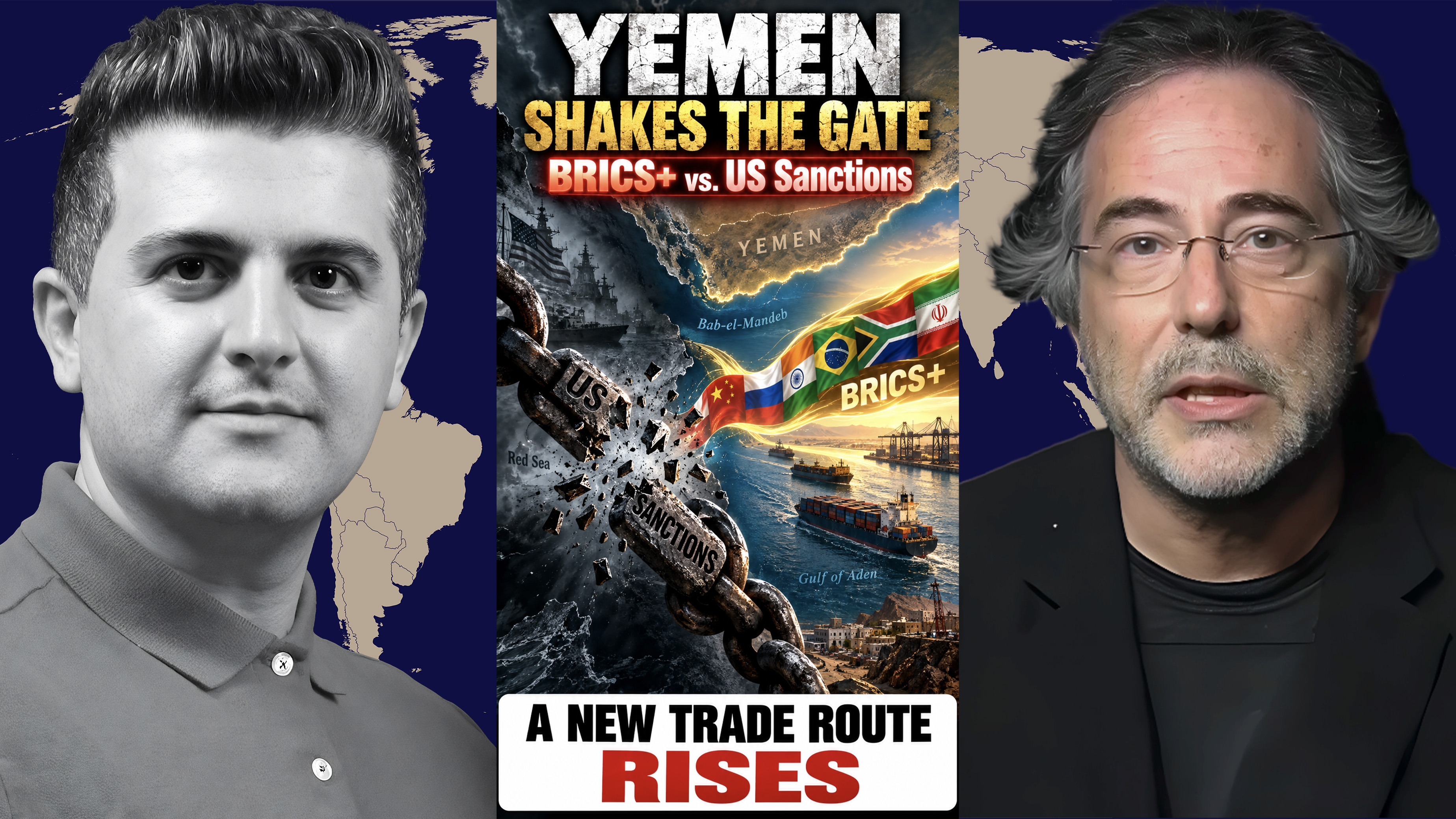
Pepe Escobar: Yemen Shakes the Gate of Tears — BRICS+ Blows Up Trump’s Sanctions
53m 12s
A decisive and pre-planned offensive by Ansarallah forces in Yemen has reshaped the regional balance of power, resulting in the capture of key western territories from the Red Sea coast to the Bab al-Mandeb. This move, executed with indigenous weapons and strategic foresight, marks a historic reversal of Saudi-led aggression and exposes the weakening of Saudi military and economic infrastructure, including the destruction of major oil pipelines. The operation, which was a preemptive strike against a planned Saudi offensive, demonstrates the power of local resistance and grassroots mobilization, particularly in the face of decades of Western and Arab-backed interference. Saudi Arabia now faces severe internal and external pressures, including tribal fragmentation, isolation, and a loss of diplomatic allies, with Turkey, Pakistan, and India urging a return to diplomacy. Meanwhile, BRICS nations, especially China, India, and Russia, are deepening coordination through diplomatic initiatives and alternative financial systems like Bricks Pay, which aims to bypass Western financial controls. These developments signal a broader realignment in global power dynamics, where regional actors are increasingly asserting sovereignty, and the U.S. is seen as unreliable and destabilizing. The outcome underscores a growing trend of resistance to hegemonic orders, with Yemen’s victory symbolizing a broader historical narrative of moral resilience and self-determination in the Islamic world.
I already today Saturday September 12th, 2026 and our dear friend, Episobar, is here with us from. from. I have no bloody clue because I am a ghost, so I could be anywhere in the back.
Hi everybody, greetings from Moscow from my mini-constructivist studio, where I arrived 10 minutes ago to talk to Nima.
Because otherwise I would be either. I would be probably in bed because I'm dead after the absolutely crazy week that I had.
But Nima, every sacrifice brings you closer to Nima, so that's how you got to do it.
Happy! Let's start with your friends in Yemen. What are they doing here?
Oh man, these are the original bad ass motherfuckers, really.
I was so happy for them, and they are very discreet because the last time I exchanged some messages with them was a few weeks ago.
When I asked them a direct question about the blockade against the Saudi blockade, and they never told before,
instance that they were preparing an offensive, and this is exactly what happened in a matter of 72 hours, maximum.
An absolutely lightning strike offensive, where they conquer everything a south of Sana on the western coast of Yemen bordering the Red Sea all the way to the Bab Al-Mandeb,
including the island in the middle of the Bab, the real name of the island is Mayum. It's not Perim, it's Mayum.
And the island, it's a rocky volcano outcrop in the middle of the Bab Al-Mandeb.
So all that now is Ansarallah Yemeni Armed Forces territory.
I'm stunning, stunning. So it was prepared in advance.
You talk about here, Pepe.
Yes, you're showing, with the arrows, you're showing all the areas that they, for instance,
I would say larger than life in terms of mythical port of Mokka, which have been giving us Mokka coffee for centuries.
Do Bab to the south, and Perim Island, which is in this map, which is the island of Mayum.
All that they conquered during this week, until yesterday.
And they can continue to go south east because they are already besieging Ta'iz.
Ta'iz is a very, very important southern city in Yemen.
And of course, they can go all the way to Marib, which is more or less in the center of Yemen.
Marib is essential because it's where the oil and gas fields are.
So this is something that probably is going to be escalated for a longer offensive to take over Marib.
But it's now inevitable.
They now control the whole of Western Yemen, as you can see in the map.
Ta'iz is a, it's a mirror of a few days probably.
They are not interested in conquering the port of Adam, because this would be an enormously complicated and costly.
And lots of possible casualties to the people who are in Adam.
In fact, most of them are not, they are of course supporting the Saudis, but a lot of people are also being bought and supported UAE.
So this will be left for later, but the parts of Yemen that really matter, which are probably 90% of the population.
Now everything is under the command of Ansarallah and the Yemeni armed forces.
And once again, this was planned, the general plan that operation, this is something that's been going on for several months.
They had of course IRGC visitors, who were some like advisors, but this was not an IRGC operation.
No, this was absolutely indigenous, 100% made in Yemen operation.
And the weapons that they used once again, and this was confirmed by one of the guys of the political council, 100% Yemeni weapons.
And not to mention what they captured from the Saudi paid mercenaries.
Wow, amazing stuff.
They captured the capture state of the art armaments, obviously sold by bought by the Saudis from the Americans and then transferred to their gangs and mercenaries in different parts of Yemen.
All of that has been captured.
So it's in terms of a stunning lightning flash success is this is another one for the books.
And only the Yemenis could do that.
And in silence and discretion, nobody knew that this would happen and Nima.
And the great thing is, when I talked to my friends a few weeks ago, they said, "Look, we decided to install our partial blockade of the Bab,
among them only for Saudi petrol tankers and Israeli bound or Americans, et cetera."
Because we knew that the Americans were planned with the Saudis, they were planning a major offensive against us.
So this was their preemptive attack at the time.
But the real preemptive attack was this operation this week.
So this means that they already had planned their own offensive.
And obviously they were using a diversionist tactics to say, "No, we are studying the situation."
And then when nobody expects, "Pah!" that's the Yemen style.
Wow, fascinating.
And I was immensely pleased and humbled because one of my friends, he sent me an email.
The column that I published yesterday night in Russia, the title of the column is, "Yemen rocks the Gate of Tears."
Gate of Tears is the literal translation of Bab Al-Mandab.
He said that he was going to distribute my column to all the political leaders, including the guys at the political council.
So I am, wow, it's an enormous honor for a foreigner to have a column extolling there.
Once again, their vision, their pride, their moral values, and their military prowess.
And they're going to read that.
And he said, "Oh, it's going to the whole political council."
So this is, wow, it's wonderful.
It's a source of happiness.
Of course, because once you visit Yemen and Imam, it gets personal.
Same thing as once you visit Afghanistan.
You incorporate the power of the land, the history, their purity, their moral values, their rectitude, their steadfastness, everything.
You incorporate that, and you will live with that, and obviously you want the best for all of them.
Not okay.
They have been harassed, bombed, evade, especially by the bloody Saudis, for over 11 years, almost two hours.
Since 2015, 11 years, in fact.
And they paid a heavy, heavy price for it.
People there, they show you all the places, some of the places that were bombed by Saudis, including schools, universities.
And when we were there last year, the Americas bombed a cancer hospital in progress in Sada.
So this is what the abstinence syndicate does, you know.
And still, and of course, they are the purest Islam.
Everybody knows that, the real Islam, the pure form of Islam is in Yemen.
And they defend the real pure values of original Islam.
So, you know, for them to actually reconquer part of their land, and they will reconquer the rest, of course.
And the rest includes, among other places, three southern provinces of Saudi Arabia, which were basically stolen from them.
So, sooner or later, they were going to reconquer, exactly. Asif Jizan and Najran are Yemeni lands.
for the moment they are in Saudi Arabia, but they are not Saudi places. They are Yemeni places.
And when I was in Saddam, you can show on the map. If you show Saddam in the map,
Saddam borders, Jizun and Najran. And people in Saddam explain to me that look across the border,
we are all family. Here is Saddam. Saddam is the birthplace of Ansarallah,
for all of you who still don't know about it. It's very, very important because Ansarallah was born
in Saddam. It's surrounded by mountains, the landscape is absolutely extraordinary. To get there
from Sana, you drive to a sort of canyon among the most beautiful canyons you can see anywhere.
So it's high up in the mountains, it's very well protected, and it's very, very close to the
so-called Saudi border, which will be the border with the province of Najran currently with Saudi Arabia,
but in the near future we'll be back to Yemen because these are Yemeni lands essentially.
Actually, it has borders with Najran with Asir and Jizun.
Exactly. The three provinces, you're absolutely right. It has borders with a small border with Asir
as well. You're right. But this is the long term. For the moment, they want to solidify what they
recapture. They have to analyze what they capture in terms of weapons, which is enormous and how
they're going to use it, and they are focusing for the next few days and weeks in Conquering Thais
at the south as you get to the right of Mocha. And of course, Marib, more to the, let's say,
the center west because of the oil and gas. And it's practically, we can say that
not perhaps not short term, but mid term, it's going to be a done deal.
And of course, from a Saudi point of view, wow, the humiliation is absolutely stratospheric.
And what we saw this week, which is it's the 9/11 saying, of course, it's very much in my mind
because I was deep into it for years. So five years ago, a few days before 9/11, we had the American
humiliation in Afghanistan where we saw the whole planet saw how it took 20 years for the Americans
to replace the Taliban with the Taliban. And now, five years later, very close to 9/11,
once again, in the same week 9/11 was yesterday. We see an extra humiliation not only of the
empires, but of their main vessel in the GCC in West Asia, Saudi Arabia with this lightning
flash in Yemen offensive, which is completely destroyed the mercenaries working for Saudi Arabia.
And at another parallel with Afghanistan, because at the time when the Taliban
basically overrun everything all the way to Kabul in a matter of 10 days or so,
the people who they were overrunning were paid mercenaries by the Americans. They were being paid
essentially by the Americans to work for a sort of a puppet government in Kabul. So it's
you know, the parallels are there so many, of course. And of course, two warrior nations.
Afghanistan, you can say that in many aspects, is a civilization state. In history linked
to different empires in central Asia, but with the distinct characteristic and cultural code,
any Yemen is a civilization state. Absolutely. It's the oldest Arabian civilization,
let's put it this way, what the Roman Empire called Arabia-Felix,
happy Arabia. Yes, happy Arabia, absolutely. And they gave us so much stuff, not to mention coffee,
of course, but many other things. And of course, this overall vision that they are very, very
special within the Islamic universe. So it's a sort of a historical history. Sometimes it has ways of
patching things up and things happen the way they should be. And they are historically correct.
And history pays homage to truth, to roots. And this is what's happening with Yemen recapturing
essentially Yemeni lands. It's a beautiful story. And I'm sure it's resonating all across the
the Muslim Ummah everywhere, everywhere, absolutely. And when they compare especially,
what the Yemenis do, even being impoverished, not only by Western powers, but also by Arab powers,
mostly Saudi Arabia and the Emirates, which are essentially artificial constructions.
And they compare this with the Yemenis and they compare this to the rulers. They compare this to
MBS with the MBS, with the rulers of Bahrain, with the rulers of Kuwait. And obviously, one second,
they draw their own conclusions, you know. Grass roots wins in the end against brute force,
raw power, and essentially fifth columnists. Because these people are not defending interests of Arabs.
They are their own interests and they are basically working for a hegemonic power, a foreign hegemonic power.
Happy, how do you see the way that Pakistan and Turkey reacted to the Yemeni attack on Saudi Arabia?
And the way that Saudi Arabia is losing a lot in Yemen.
Well, we have inside information, Nima, we got this yesterday and there was extra confirmation today.
I'll probably going to be talking about this in a special show tomorrow night in our channel,
Transition Protocol. Both Ankara and Islamabad told the Saudis, "Look, this is not our war.
This is your war." And we cannot invoke the now famous or infamous Mecca alliance, Mecca defense alliance,
that's the official name, because this is a pre-existing situation. What they're basically saying is,
"Look, your war against Yemen started years ago. It has nothing to do with our pact.
Our pact is if you are attacked in a new situation, then we will defend you." And that's not the case.
And once again, Ansar al-Arabi said that they are not interested in attacking Saudi Arabia per se.
They want Saudi Arabia to come to a table and respect the memorandum of understanding that existed
already between Riyadh and Sanaa. And of course, and they're blocked against Yemen.
Then it's okay. They end their own blockade of Saudi oil exports.
Until then, nothing. Well, as we know, MBS with his hebristic arrogance is not going to go for diplomacy.
So he's going to pay a much stiffer price than he is already paying. And at the moment,
the situation for Saudi Arabia is absolutely dire in every possible aspect.
They're going broke. They're going to have to get money out of their sovereign fund to pay their bills.
They cannot export their oil. It's de facto blocked. The bombing of the east-west pipe line
to Yambu now is shut down at least for a while. And this could be a long while.
So they are not pumping oil at the moment. So they are in the worst possible situation.
The worst possible. Which they brought on themselves. This is the pipeline, Pepe.
This is the pipeline. Absolutely. And apparently, the pipeline was
drowned, let's put it this way, in several different stretches. So it's not only one or two bombings.
It's fine. Remember, well, at least seven different points of the pipeline were bombed.
So this could be a while to restore, you know,
know, the normal flow of things. And it wasn't warning. Once again, another warning to
the Saudis. Are you sure you don't want to go for diplomacy? Are you sure you don't want
to end the blockade against us? So you're going to suffer. And of course, there is the,
it's a very, very complex situation to me because we don't know exactly who bombed the
pipeline. The Iraqi militia said, no, it was not us. It's an official statement. Say, look,
we have nothing to do with this. And of course, from the point of view of Ansarallah, they have
been relatively quiet about it. So nobody really knows who bombed the pipeline. What, what
matters is the result catastrophic for Saudi Arabia. Absolutely catastrophic. So what are
going to have on Monday is something very, very important. There's going to be a meeting
in Muskat between Iran and the GCC. They are going to theoretically agree on a system
of navigation across the street of our moves. But let's say relatively temporary. Let's
say for the next few weeks or perhaps one or two months. And then they will discuss the
final arrangement. There is a problem. Until today, as we speak Saturday, nobody knows if
the UAE is going to be at the table. But at the same time, what happened today in New
Delhi during the breaks? Pazashkin, sat down on the same table with the crown prince of
the UAE. This is a really good sign. Quite unexpected. We can assume, of course, we still
don't have it. This is the son of MbZ. Caled, the son of MbZ.
They are absolutely right. And there's got to have been Chinese pressure, especially on
the UAE. After all, this is BRICS. The bilaterals are the most important thing at BRICS. BRICS,
what really matters in BRICS. Apart from the top, top BRICS summit, which was the one in
Kazan here in Russia two years ago. Most BRICS summit, what really matters are the bilaterals.
And today, we, between yesterday and today, we had some serious bilaterals. This one was
particularly significant, because it proves that at least they are talking, which is already
enormous considering the situation. And, of course, we can assume that there was Chinese
pressure in the background, perhaps even Russia as well, because Russia and UAE, very,
very close relationship, look, sit down and talk. First of all, very, very important. First
of all, in our declaration, which was a consensual declaration, the new Delhi Declaration, approved
by everybody, and the Indians managed to pull that off. That is a small miracle in itself.
Apparently, the debate went on until four or five in the morning to finally get the final
reduction. They unanimously condemned the war again, just like the SEO a little over a
week ago in Kyrgyzstan, in New Delhi, the BRICS also condemned the war, and very, very important.
There is a paragraph when they say that sanctions, unilateral and secondary sanctions, are illegal.
So this is the BRICS position for the whole planet to, you know, take into consideration.
So these, you know, these little nuggets, even though I'm not betting that there's going
to be a big, big, big announcement tomorrow at the end of the summit. But these bilaterals,
what's written inside the New Delhi Declaration, and, you know, this movement directly related
to the war against Iran, these are positive aspects. Very, very positive. Much more positive
than we could imagine only a few days ago. They said that the meeting in Moscow, in
Oman, is all about the straight-off almost, but I think it's all, it's going to, you know,
they're going to talk a lot about many issues there. You're right, Nima. It's much, much
broader than just almost, of course, almost is a larger than life issue. But they're going
to be discussing basically, okay, what happens next here as a whole? How are we going to reorganize
our bilateral and multilateral relations? So another point, why this BRICS summit this weekend
is also important, because, you know, what was discussed in New Delhi will be passed over
to the discussion in Moscow? Very, it's the concourse of circumstances in this case is positive.
And of course, because of Russian China, we're there, Russian China, we're telling, especially
UAE and Iran, look, this is how we can support you, where you have to follow a certain pattern.
And obviously if there is no understanding between you, you know who the winner is, the Americans,
which is what nobody inside BRICS at least wants. And the UAE, we know, it's a much more
complicated situation, because they are essentially allied with designers. And it's a completely
artificial construct, but they have to think about their survival. And there's only way for
them to survive, which is to find an accommodation within Iran, it's more than obvious. And apparently
ambizad is already, you know, listening to the wind. It's what our friends, the Pakistani
mediators, were telling us a little over a month ago, look, the UAE will sit on the table.
Give it some time. Perhaps now it's the right time.
Happy, do you think, are they going to be able to resolve the issue between Saudi Arabia
and Yemen? No, what we heard once again, I just told you, and we're going to have more
confirmation throughout this weekend, that Turkey and Pakistan are directly telling ambizad,
look, get your act together and go for diplomacy, because you have everything, if you continue
like this, you have everything to lose. And we are not going to defend you. We're not
going to launch air strikes against Yemen. It's completely absurd. The last thing both want
now is a new war front in West Asia. It's more than obvious, right? And the Pakistani
USA can be very persuasive, because they have weapons, they have troops already stationed
in Saudi bases, at least, if I'm not mistaken, at least 8,000 Pakistani soldiers, which
is a lot state of the art of Chinese fighters, you name it. But no. And of course, they know
that, if they do that, they sacrifice everything that they built in terms of building trust
to the Iran. Forget it. And Turkey, wow, Turkey is even further away from everything. It's
not even a theater that matters particularly significant for Turkey. No. Turkey, their
preoccupation is Syria. It's a completely different story. They're focused on, okay, what
are we going to do with Syria? What are we going to do against Israel in Syria? This is
their priority. So the Saudis are essentially on their own. And once again, that it's always
the same story, isn't it? The MBS calls Trump twice desperate. Please strike Ansar ala
and Yemen. And Trump says, no, you're on your own, literally. There are many ways to interpret
that. One of them, which is, it's a solid interpretation. Nobody's saying that this is
what's going to happen, but this is a very solid scenario. Is that the Americans are
essentially, okay, he's going to go down. MBS. Assuming MBS would go down, guess who would
come to power? The American man, Prince Naif, CIA asset. So the Americans would only gain
from MBS.
being thrown to the dogs.
So this is something to consider.
And another thing is that a few forces
among the Zionist international axis,
they are betting on a total collapse of Saudi Arabia,
which is a good thing as well.
And they can pick up some pieces for themselves.
A total collapse of Saudi Arabia in practical terms,
meaning those tribes, they are not part of the South.
Almost 100 different tribes, which are apart from governing,
are marginalized from governing.
They're going to start fighting among themselves
to pick up the pieces and see who's going to govern next.
So it's going to be a mess.
Saudi Arabia is going to be an enormous mess, essentially.
And once again, don't forget that we are dealing what
with the empire of chaos, which is always
installing masses everywhere, and divide and rule.
Divide and rule inside Saudi Arabia is perfect for them.
As long as they have their men to control things
when things have come down a little bit,
and they already haven't.
So it's NBS is not sleeping very well these days, Nima.
That's for sure.
But the problem, Pepe, they're dealing with, in my opinion,
is the two main choke points if we can put it this way.
Here, in the straight-of-her-mose and in Bobo Mandat, here,
they're basically-- they have the Shia Muslim--
they're controlling--
Yes, absolutely.
Controlled by Saidi Shias in the case of Yemen,
and Shiites in the case of the straight-of-her-mose.
Absolutely.
Not to mention, don't forget that the Eastern provinces
of Saudi Arabia, where most of the oil is,
the absolute majority population is Shiite.
The Eastern part, the Eastern part.
Here, you're talking about this area.
I'm talking about here.
In those cities of Yemen, that you said,
they were part of Yemen, here, Abha.
Yeah, but this is on the Western part.
These are Shiites as well.
No, of course.
What you are pointing to, these three provinces, which
are in southern Saudi Arabia and the area of Yemeni lands,
they are Shiite majority as well.
And in the Eastern province of Saudi Arabia
bordering the Persian Gulf, they are majority Shiites as well.
Same thing.
So the Wahhabis are squeezed in the middle.
Absolutely.
Not to mention all the other tribes are all across the--
as they are described by--
including Shiite intellectuals--
Bedouin camel herders, which is what they are essentially.
And of course, if they see a chance
of, OK, let's grab some power of fabulous, you know.
So the prospects for the House of Saud
are dire, to say the least, dire.
And they brought this on themselves.
So how stupid, geopolitically can you be?
And of course, there's the matter of Saudi Emirati rivalry
as well.
They were fighting themselves.
They were fighting each other on the-- in Yemen, for instance,
once again, they were pitted against each other in Yemen,
controlling pockets, different pockets in Yemen.
The island of Sokotra, for instance,
is totally controlled by the UAE.
So from the point-- from the Saudi point of view,
everywhere you look, you only see hell.
You don't see a way out.
And no friends whatsoever.
Nobody is going to help you.
When you figure out-- when you are in a geopolitical position
and you figure that out, you know that you're toast.
Nobody you can trust.
And nobody who's going to trust you and help you.
I think this is the outcome of decades
of fantasizing about making alliance outside of the region.
Basically, I'm talking about the United States coming
to the region, helping them or providing them
with some sort of security umbrella.
That didn't happen.
And it will not happen.
That's not going to be the case for them anymore.
Because the model itself, Nima, it has exhausted itself.
And it's a completely artificial model.
The whole petrodollar thing to start with, you know.
This is the famous American security umbrella.
You export your oil in dollars.
You put all your money in our stock exchanges or in London.
And we protect you.
Yeah, but the Americans are not protecting the Saudis anymore.
I guess anything.
And nobody wants petrodollars anymore.
And the future for most of the Gulf is the petrodollion one.
Everybody knows that.
So this process of the whole single app,
the whole House of Cards collapsing, has already started.
And the first major victim may be the House of Saudis.
Not Saudi Arabia, absolutely.
Arabia will always be there.
But this chapter, Saudi Arabia, this may be the beginning of the end.
Well, where do you see the Trump administration and Washington
in what, you know, in reacting to what has happened at the break summit?
They're basically mentioning we have the population.
We have the numbers.
We have the GDP 40% of the GDP, 50% of the population.
We have everything.
We have the energy, you know, they have technology.
They have altogether everything.
There's just, you know, putting all these pieces together.
It takes time for them to do that.
But they're heading toward that point that they want to get.
And where do you see Washington?
And the way that Washington sees bricks today?
Well, we don't know because first of all,
they don't even understand what bricks is all about, Lima.
You know that and power all of it.
I remember Dolph Trump, sorry.
He hasn't dropped anything but bricks is all about the exact--
Dolph when he was elected in first days in one of his--
he said, do you know he asked the reporters?
Do you know what's bricks?
You don't know.
You have no clue what's bricks.
Spain is part of bricks.
Here's that, Spain is part of bricks.
Go ahead, baby, sorry for interrupting.
Yes.
No, there was something I was thinking about that happened
during this-- ah, did you see?
There was one particular meeting and a series of photos
that is obviously provoking serial heart attacks
in War, Alago, Washington, New York, et cetera.
Putin, Xi, and Modi, smiling, holding hands, super relaxed.
And this is the culmination of a process
that has been going on for years.
Because the man, the mediator between Modi and Xi
is always Putin.
In every important summit, Putin brings both of them.
OK, let's go here, let's go to a room and all of that.
Guys, sit down together, talk to each other, et cetera.
So thanks to, I would say, the Putin strategy
this past few years, now Xi and Modi
they're starting to trust each other.
They're starting to perhaps build a relationship.
This is immense, because this is essential for bricks
to work properly.
You cannot have India sitting on top of the fence
all the time, hedging their bats.
Are we going to have a privileged relationship
with the US, in Europe, and the West?
And at the same time, be a member of bricks
and building up Eurasia?
No, you're going to have to make a bet.
And you're going to have to choose your side.
So once again, Modi in the beginning of the summit,
he was talking once again, he was hedging on multi polarity.
Perhaps in the interval of one day, a little over a day,
before the end of the summit, he will
see that if he increases his bat on Eurasia integration
and on very good relations with the top members,
they already have an accent relations to Russia.
And they have all the energy that they need,
that they can buy from Russia.
And they admire puts in--
They want Indian companies to invest in Russian vice versa, etc.
Now the thing is China.
They need China. They need China technology.
So it will be very, very good for India.
We still don't know if this is what's going to happen.
But the signs during the summit were very positive.
Much more positive than we imagine.
Peppy, today she said that she's willing to help the situation
to help Iran and the United States to come together
to reach some sort of agreement.
And who's able other than Xi Jinping to do that?
Or if she is the right person to do that,
do you see that happening with the United States?
No.
The ego of Donald Trump, because he wants to be the author of everything.
You're right, Anima. No, it's impossible.
What's the best thing that China does is what they are already doing.
They are helping this axis.
In fact, they are part of this axis, China, Pakistan, Iran.
They were deep behind the negotiations by the Pakistani mediators
to get the US and Iran back on the table with the memorandum of understanding.
This was fully supported by China in detail.
They will continue to do the same thing.
They know at the same time that there won't be a diplomatic solution
because of who's on the other side.
So it's un-Chinese to claim for them a different role of protagonist in the story.
No, they are in the background.
And their national interests lie in both Pakistan and Iran.
They have a strategic partnership with Iran
and they have a very strong relationship with Pakistan,
included in the Niosal Groves, the Belt and Road Initiative.
They want this to continue.
And they want Pakistan and Iran to be very, very close, closer and closer.
So this is the Chinese position.
At the same time, they want a solution for the straight of our moves.
Because this concerns them directly.
It's the oil that they are not getting for a gigantic number of reasons.
And they need it.
They cannot rely on using their reserves for months on end.
They can do this for one month, two months, three months, that's it.
So, of course, they are interested in a peaceful solution for the straight of our moves.
And at the same time, they know who they are dealing with.
Well, Xi Jinping is going to visit Donald Trump, as we know.
This is something that they might discuss face to face.
The Xi Jinping said, "Look, do you want me to help you find a solution out of the mess that you provoked?"
This is something that Xi Jinping could offer, Trump, face to face, Asian style.
In Asia, everything is face to face.
Or at the same time, Xi Jinping is going to do nothing.
And let especially the Trump administration drown in their own filth.
Which is actually what the absolute majority of the planet wants.
Not only Iran and China, but everyone wants that.
And the Iranian plan is actually to let the Trump administration flounder collapse within the next two months or so.
So, the Chinese, they usually have a menu of options.
And they play goal.
Playing goal, you are circling and containing the enemy, which is what they do with the US all the time.
From a distance, a closer, but basically they are preventing the enemy to make significant moves.
Which is exactly what's happening now.
When you look at the situation in the straight of our moves and the Baba Al-Mandab compounded,
what are the options for the Americans except Bombi.
And Bombi, what? And with what objective?
That's it. Nothing.
They are only of ramp would be once again a diplomatic of ramp.
But as we know, they killed diplomacy.
The Trump administration killed diplomacy completely.
And they are not going to resurrect diplomacy.
They were offered an off ramp via the memorandum of understand.
They blew it at least to us.
That's it.
So the Chinese, once again, that's one of the best metaphors ever.
They are on the band of the river just watching the corpse of the enemy float by.
There you go.
They are so close to Iran, Papi, China today.
I would say it's not even comparable to what it was two years ago.
And here is the new photo of the, again, the two here.
The Iranian Foreign Minister is talking with the Chinese Foreign Minister.
And you see how close they are.
And how they are discussing very serious stuff.
Absolutely.
I think these are signs that the whole bricks, I would say China, Russia, and Iran,
they're preparing themselves on one hand to talk with the empire to talk,
try to talk as much as possible at the same time,
at the same time preparing themselves for the repercussions or for the reactions from the United States.
Because no one knows what Donald Trump wants in the West Asia.
Look at Donald Trump today.
It's so much, everything is so vague.
When it comes to Ukraine, Russia doesn't know what Donald Trump is seeking for.
When it comes to the West Asia, nobody knows.
That's why you see the confusion in the West Asia, Iran, and GCC countries all together.
They don't know what's going on with Washington, under Donald Trump.
This is the confusion.
And today, with the bricks, you see that confusion is somehow appearing in the meetings there.
Because they don't know what to do with Washington.
And the thing is, Nima, it changed a little bit.
They don't care about Washington.
They don't care because they're dealing with a psycho killer with the mentality of a four-year-old.
How can you trust anything he writes or says?
So forget it.
So you start organizing a system without even thinking about them.
First of all, because you know that there are only two signs being emitted from Washington about anything.
They either sanction or bombing you.
That's it.
That's it.
They don't do anything else.
So, you know, you have to build a system that is relatively strong to withstand all that,
this kind of out-of-control pressure. It's what the bricks part of the discussions.
For instance, this is another complicated sign.
Bricks pay.
Bricks pay was basically a card that you can use in different bricks countries linked by banks of these member countries a little bit everywhere.
This was proposed in the summit here in Kazan two years ago.
That was a long time ago.
And they are still testing it.
And I confirmed this.
I went to RT today to give an interview about bricks.
And while I was there, I was asking everybody, look, you're watching everything on all the channels.
And did you see anybody, apart from Kiril Dimitriak, saying that bricks is going to approve a brick's pay?
They said, no, we looked everywhere in the other Indian channels.
No, the only one who actually said that was him.
So he's trying to push something that the governments of the nations, bricks members have not approved yet,
because there's an absolutely key problem.
If you're going to have a card, then you can use, for instance, in Iran.
Simple example. Let's say you're a Brazilian.
And then you want to go to Iran and you want to use bricks pay.
This is the application they use.
Yeah, you're right. This is the application.
How does it work? What's your pay with your bricks, with your bricks pay?
Comes from your Brazilian bank account.
How will this money transfer to your Iranian company?
Because if you are Brazilian and you have a bank account, you are linked to Swift.
If you are Iranian as you know very well, you are not.
You have been expelled from Swift.
Same thing with Russia.
In the case of Russia is even crazier.
They go to Kazakhstan, their neighbors here or Uzbekistan, their neighbors here.
They cannot use their Russian Mir cards because they are outside of the Swift system.
So this means that all the top 10 bricks, full members, plus the partners, they have to
organize an architecture where banks from all these nations can talk to each other.
And then when you have a brick space, you are sure that you can use your card in any
bricks member.
They still haven't got to this point, that's why they cannot announce it.
So yes, we are only scratching the surface, Nima, because this is the key angle, alternative
payment systems.
So even if we don't have brick space this year, maybe next, we'll have it next year or
then we'll have it other forms of a payment like Bricks Bridge, which is a copy of M Bridge
for inter-business payments.
The unit, my friends here in Russia who conceptualize the unit based on gold and a basket of currencies.
This will happen, but it's a long-term process, especially because the bricks member nations
and their banks, they have to get their act together and say, "How are we going to dribble
the Americans?"
That's it.
If you still don't have that, you don't have anything.
Exactly.
Thank you very much, Pepi, Grange President, as always.
Thank you very much for giving me because I'm very tired, but for you, of course, I open
an exception.
It's a pleasure to talk to you.
Now I'm going to crash and sleep for 24 hours.
Oh, it's going to be me.
It's going to be me.
It's going to be me.
Just a little bit.
You need to get up.
Okay, my dear.
All right, and let's see the final day of the summit tomorrow.
Maybe we could have a few good surprises for the last day.
And meanwhile, all of you, don't forget to drink your iced mocha, liberated iced mocha.
Yeah.
Cheers.
Look at that, Pep.
Ciao.
Ciao.
[MUSIC PLAYING]
Podcast Summary
Key Points:
Ansarallah forces launched a rapid, pre-planned offensive in Yemen, capturing key areas from the Red Sea coast to the Bab al-Mandeb, including the island of Mayum, and now control most of western Yemen.
The operation was entirely indigenous, using only Yemeni weapons and capturing Saudi-backed mercenaries’ advanced armaments, marking a decisive strategic and symbolic victory.
The offensive was a preemptive strike against Saudi-led aggression, exposing Saudi Arabia’s military and logistical collapse, including the destruction of key oil pipelines and the near-complete blockade of oil exports.
Pakistan and Turkey are urging Saudi Arabia to pursue diplomacy, emphasizing that continued warfare risks regional instability and loss of support from key allies.
BRICS nations, especially India, China, and Russia, are strengthening coordination through diplomatic declarations and bilateral meetings, signaling a shift away from Western influence and a rise in alternative systems like Bricks Pay.
Saudi Arabia is now isolated geographically and politically, facing internal tribal fragmentation, a loss of external alliances, and growing economic and strategic vulnerability.
The region is witnessing a historical shift in power, with Yemeni resistance and grassroots movements demonstrating that local sovereignty and moral values can overcome imperial aggression.
The rise of Eurasian cooperation—especially between Iran, China, and Russia—suggests a long-term realignment of global power, with the U.S. and its allies increasingly seen as unreliable and destabilizing.
Summary:
A decisive and pre-planned offensive by Ansarallah forces in Yemen has reshaped the regional balance of power, resulting in the capture of key western territories from the Red Sea coast to the Bab al-Mandeb. This move, executed with indigenous weapons and strategic foresight, marks a historic reversal of Saudi-led aggression and exposes the weakening of Saudi military and economic infrastructure, including the destruction of major oil pipelines. The operation, which was a preemptive strike against a planned Saudi offensive, demonstrates the power of local resistance and grassroots mobilization, particularly in the face of decades of Western and Arab-backed interference.
Saudi Arabia now faces severe internal and external pressures, including tribal fragmentation, isolation, and a loss of diplomatic allies, with Turkey, Pakistan, and India urging a return to diplomacy. Meanwhile, BRICS nations, especially China, India, and Russia, are deepening coordination through diplomatic initiatives and alternative financial systems like Bricks Pay, which aims to bypass Western financial controls. S.
is seen as unreliable and destabilizing. The outcome underscores a growing trend of resistance to hegemonic orders, with Yemen’s victory symbolizing a broader historical narrative of moral resilience and self-determination in the Islamic world.
FAQs
Yemeni forces, including Ansarallah, launched a rapid offensive this week, capturing territory from the western coast to the Bab Al-Mandeb, including the island of Mayum. This has brought them under full control of southern Yemen and threatens to expand toward Marib, a key oil and gas hub. The operation was carefully planned and executed using only Yemeni weapons, with captured Saudi-supplied arms, marking a significant military and strategic victory.
The operation was entirely indigenous and planned over several months, with no involvement from foreign forces like the IRGC. Yemeni military leaders confirmed the use of only locally made weapons. The offensive was a preemptive strike against Saudi-led aggression, executed with stealth and precision, demonstrating deep strategic foresight and operational capability.
Mayum is a rocky volcanic island in the middle of the Bab Al-Mandeb Strait, strategically located between Yemen and Saudi Arabia. Its capture by Yemeni forces signifies a major territorial and symbolic gain, closing a key chokepoint and solidifying control over vital maritime routes in the Red Sea.
Saudi Arabia is facing severe economic and military setbacks, including a shutdown of its east-west oil pipeline due to bombings and a blocked oil export route. The situation has led to a loss of credibility, financial strain, and a lack of support from allies like Turkey and Pakistan, who are urging diplomatic engagement instead of further conflict.
Yes, both Pakistan and Turkey have directly advised Saudi Arabia to end the blockade of Yemen and enter negotiations. They emphasize that continued hostility will only deepen the crisis and invite further regional instability, with Pakistan noting that the UAE may soon join diplomatic discussions to resolve the conflict.
China is actively supporting diplomatic solutions, including behind-the-scenes negotiations between Iran and the U.S., and is promoting cooperation among BRICS nations. It supports the idea of a peaceful resolution in the Strait of Hormuz and the Bab Al-Mandeb, and is helping build alternative financial systems to reduce reliance on Western-controlled payment networks.
Chat with AI
Loading...
Pro features
Go deeper with this episode
Unlock creator-grade tools that turn any transcript into show notes and subtitle files.
 PodcastTranscript AI