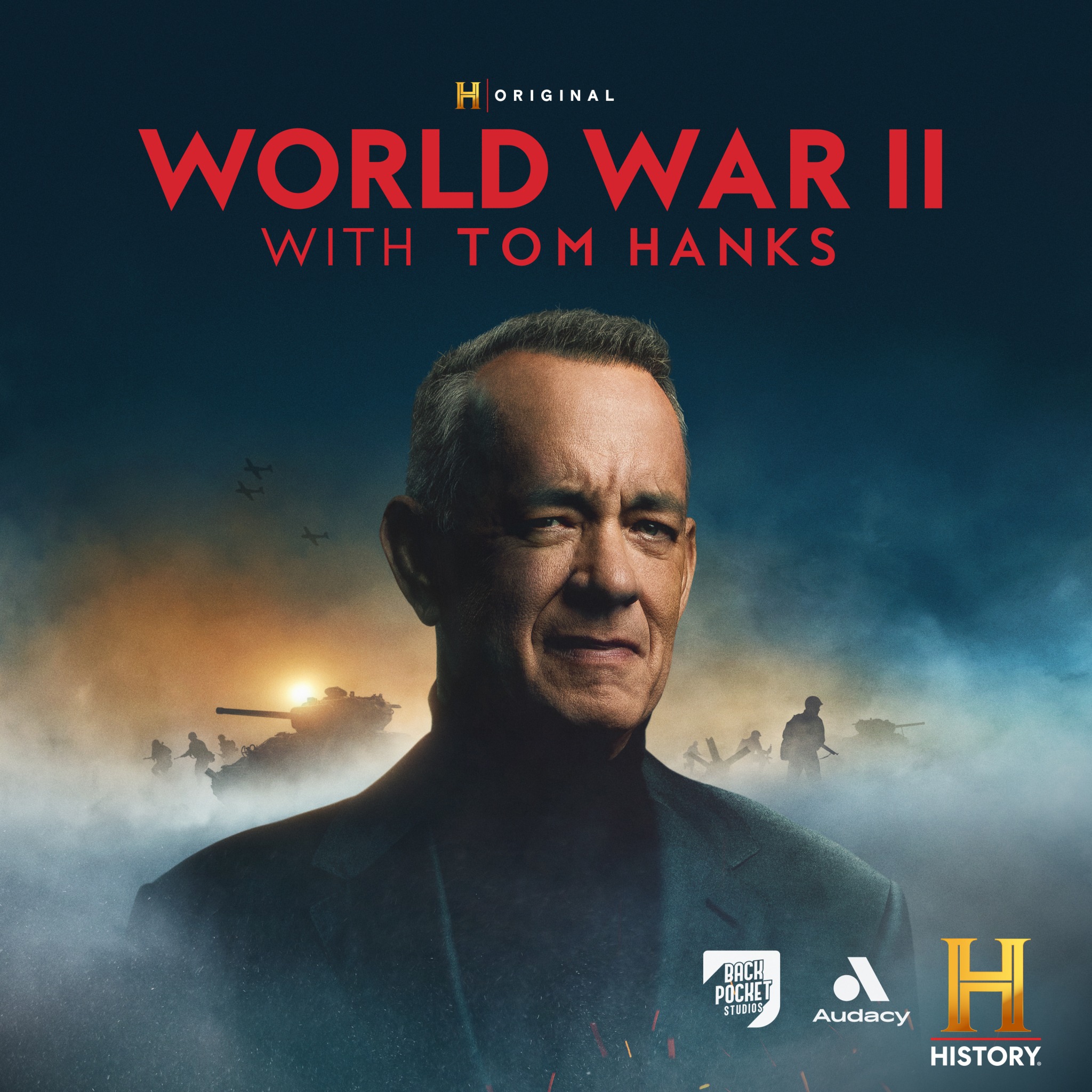
The transcript blends personal product reviews with a detailed historical narrative of World War II’s early stages. It begins with a promotional segment on D-Mobile’s fast 5G network and Rosetta Stone’s new language-learning app, Sapphire, which uses immersive, game-based learning to help users speak naturally. The core of the content is a historical account of Japan’s expansion in Asia during the 1930s, driven by military ambition and resource needs, culminating in the attack on Pearl Harbor in December 1941. This event triggers the U.S. entry into World War II, with President Roosevelt declaring war on Japan and later, through diplomatic and military developments, on Germany. The episode also features promotional messages for a range of products, including skincare (Primely Peer), mental health support (Alma), education (IXL), and hair care (K-18), all tied to personal well-being and daily life. Through a mix of storytelling and marketing, the narrative connects global history with individual choices, emphasizing how technology, education, and personal health shape modern experiences. The structure reflects a podcast-style format, blending entertainment with informative and promotional content.
Hey, all right, almost here. Are you ready?
Just grabbing my shoes.
That's what you said 10 minutes ago.
I just wrapped the video call, uploading this giant file on my tablet,
looking at my watch group and Nana's with the group chat,
and of course, still lining up tonight's playlist on my phone.
All at once?
Yep, story of my life.
That's why I switched to D-Mobile. They have the fastest 5G network.
Okay, multi-tasker. I see you.
Honestly, I never imagined I could do all this at once.
It's awesome.
Say no more. I'm totally switching.
My post is taking way too long to upload.
That's a sign you've got to get D-Mobile.
So many reasons to join D-Mobile. Find yours at T-Mobile.com.
Fastest based on analysis by Uglow Speed Test Intelligence
data of national speed score results incorporating 5G download
and upload speeds for the first half of 2026.
I've always dreamed of being able to order my coffee in Italian
like a local instead of just pointing at the menu and hoping for the best.
There's something about speaking another language with real confidence
that opens up a whole new world of experiences.
That's why I'm so excited about Rosetta Stone's Sapphire.
It's their biggest launch in over a decade.
It takes that research-backed method we all know in trust
and adds fresh cutting-edge features that make it easier
than ever to go from knowing a few phrases to speaking naturally
about the topics you actually care about.
What I love is that you aren't just memorizing vocabulary lists.
You learn entirely in your new language through visuals and audio,
just like you did as a kid.
One of my favorite new features is chat missions.
It turns conversation practice into a game,
putting you in real-world scenarios,
like ordering at a restaurant or asking for directions
and giving you missions to complete.
You get real-time feedback along the way,
so you build that confidence before you ever have to use your skills in the real world.
If you want to take your language skills to the next level,
don't wait to try Rosetta Stone's Sapphire.
Listeners of this podcast can get 20% off their Rosetta Stone Sapphire subscription
when they sign up today.
This gets you access to Rosetta Stone Sapphire in 25 languages.
Visit rosettastone.com/rs10 to redeem your 20% off.
That's rosettastone.com/rs10.
The History Channel, Original Podcast.
The 1930s is a decade of aggression.
Italy attacks Ethiopia, dreaming of a modern Roman Empire.
Hitler's 1000 year rike calls for his seizure of Austria, Czechoslovakia, and Poland.
The Japanese Empire expands with the invasion of Manchuria and China,
but intends to dominate all of Asia.
To accomplish that, the military in Japan know they must first eliminate
the United States as a seaborn power.
They act accordingly.
This is World War II with Tom Hanks, Episode 4, Pearl Harbor.
In late 1937, the Japanese escalate their military campaign in China.
They already occupy Manchuria.
After three months of fighting, they take Shanghai,
and move to the ancient Chinese capital of Man King.
The Japanese brutality that follows will shock the world.
They enter the city, and instead of just occupying it,
they let the Japanese troops off the leash.
They rape, they pillage, they burn, they steal.
The Japanese commanders ordered their soldiers not to take any prisoners,
which meant executions.
This was Japanese soldiers looking down on the Chinese as an inferior people
and as being non-humans.
Japanese soldier who committed atrocities himself,
he described it as killing pigs.
Japanese officers had a competition to see who could be the first
to kill a hundred civilians with a sword.
This was printed in Japanese news paper.
To show pictures of swordsmen, decapitating bound prisoners in the 20th century,
made the people doing the killing seem almost like they were barbarians from another era.
And it struck Americans and people in the Western world in a different way
than had they shown people being lined up against a wall and shot.
Hundreds of thousands of people raped and murdered by the Japanese,
it was called the rape of Nun King.
In just six weeks, the Japanese army killed 200,000 Chinese and Nun King.
Most are civilians.
The Japanese invasion does identify the Japanese as an aggressive power
in the Pacific that they are brutal in the way that they've treated the population.
And this starts to change people's perceptions with regards to the Japanese.
By the end of 1939, Japan controls vast areas of north and central China,
as well as the southern port cities.
The Japanese are driven by the desire for raw materials.
The luck of the historical draw has put the Japanese people on a series of beautiful islands
which are unfortunately resource poor.
Take iron ore.
The Japanese have almost no indigenous sources of iron ore.
Their steel industry is based on US scrap iron.
They need the raw materials and almost limitless manpower of China.
Japan is a modern and complex nation.
At the pinnacle of society is the Emperor Hero Hito,
the 124th Emperor of Japan.
The Constitution made the Emperor of Japan a divine figure,
literally a living god.
Taken literally he's a god on earth,
or a mystical figure who people aren't really supposed to have much direct contact with.
Emperor Hero Hito is not really a policy maker in Japan.
He's not the wartime planner.
He doesn't go through details of tax policy in the way you would think a president or prime minister does.
He's a guarantor and a protector of Japanese tradition.
Emperor Hero Hito approves government policy,
but real power lies with the Japanese army in navy and its political allies.
They wanted period Japan to control Asia.
For the last couple of decades it has been a major industrial power, powerful economy.
Its armed forces have been built up.
It's in a really strong position.
The Japanese resent the Western colonial empires that dominate Southeast Asia and control resources.
The British rule over Hong Kong, Burma, Malaya and Singapore.
There's French Indochina and the Dutch East Indies.
Even the United States has territories called Protectorates in Guam and the Philippines.
Japan intends to create what they term the greater East Asia co-prosperity sphere under their leadership.
By this point Japan is Asia's preeminent power by a long way.
I think because of that the Japanese have a sense that they are destined to bring the rest of Asia with them.
Japan had an interest in becoming the supreme power of not only continental China but also Asia.
Asia for the Asians was one of the propaganda.
slogans one of the key slogans of the Japanese empire. Asia for the Asians was understood by
some Japanese politicians at the time as an honest interest in liberating Asia from the Western
colonizers, but there were some voices in the Japanese military who had a different understanding
of phrase "Asia for the Asians" saying, "Okay, Asia for the Asians means actually Asia for Japan."
You get people in the Japanese government who are militarists, who have a very constrained view
of the world. Their attitudes are somewhat disdainful of Western comfort and softness and all
these sorts of things. The Japanese believe their soldiers are the toughest in the world.
They combine modern weapons with the traditional training and values of the Samurai warrior,
known as the Code of Bushido. Bushido was an older tradition that had now been inculcated into
the manpower of the Japanese army. The Japanese didn't choose this aspect of their history randomly.
They don't have the aircraft to compete with the West. They don't have the heavier tanks
and artillery. There needs to be an equalizer and they believe they found that equalizer in the
superior fighting spirit of the Japanese soldier. By 1940, Japan controls most of China.
In Washington, President Franklin D. Roosevelt is alarmed and fears further Japanese aggression
could threaten the entire Asian Pacific region.
Japan is the authoritarian power organized and driven by a theory of racial superiority
and a margin of aggressive conquest. That was what Japan was doing. Now, the only problem there
is that the United States has traditionally seen the Pacific as its own area of operations.
Roosevelt is determined to dislodge Japan from China and the Japanese are determined to stay.
To counter continued Japanese aggression in China, Roosevelt orders the U.S. fleet to move
from San Diego to Pearl Harbor, a naval base on Hawaii, 2000 miles closer to the Japanese mainland.
This is a land that is an extension of the United States. It is the United States.
Roosevelt is sending a clear signal. He hopes will deter Japan. The Pacific is America's
sphere of influence. He wants the fleet to be positioned far enough forward
that the Japanese will take it seriously, but at the same time not to be overtly
provocative by moving it to a place like the Philippines or maybe Singapore.
Pearl Harbor is now the front line of American naval power in the Pacific.
The Pearl Harbor naval base is perfect because it's got a narrow channel into a wide harbor
with an island right in the middle, so it looks like a fortress.
Outside the naval base is the thriving city of Honolulu.
The Hawaiian Islands to America looks like a paradise. Beautiful beaches, relaxed culture,
amazing weather, but there are security concerns among top naval and army commanders.
Because now they are surrounded by a population that is disproportionately Asian,
and a population that also includes a very large percentage of Japanese Americans.
30% of the population of the Hawaiian Islands has Japanese heritage.
One of the major fears is sabotage from local Japanese Americans.
General Short, who is in charge of the army at Hawaii, is much more afraid of sabotage
than air attack. So he takes the fighter planes out of their protective bunkers, lines about
on the airfield where he thinks his soldiers can protect them from sabotage.
Unfortunately, he's presented a line of sitting ducks.
The U.S. expands its profile in the Pacific. At the same time as Germany's forces,
sweep through Europe in concernation after nation.
Hitler doesn't realize what he's done, but in Topping France he's set in motion a kind of ripple
effect of aggression that is going to move far and wide. Going back to the First World War,
there's a sense in Japan, but when things happen in Europe, there's an opportunity for Japan
in Asia. If they can get their hands on something while the big powers are busy in Europe,
then they will. That's exactly what happens in June 1940.
Germany's conquest present Japan with an opportunity. Germany now occupies the Netherlands,
colonial ruler of the oil-rich Dutch East Indies. Great Britain, still at war with Germany,
controls the resources of Malaya, Singapore, Burma, and Hong Kong.
And the French who rule Indochina have surrendered to the Nazis.
The Japanese now realize that an opportunity is beckoning. The Dutch can't defend the Dutch East
Indies any longer. The British are going to have a heck of a time trying to defend
Singapore and aren't on the French in Indochina. The resources await and it seems to the Japanese
that a once-in-a-century opportunity has arisen to seize those colonies. Who's going to defend them?
So the French are overrun by the Nazis. You have a Vichy regime being set up. The Japanese really
have their eyes on Indochina because of the resources there. The sense that actually it won't
put up much of a fight, giving that the French are busy elsewhere.
Japan's first target is French Indochina. In September 1940, it pressures the French Vichy
government to see to them the northern region. That same month, Japan's leaders signed a formal
alliance with Germany and Italy called the Tripartite Pact. The three nations become known as
the Axis Powers. One of the characteristics of the Axis, of course, is that they were three
hyper-aggressive militant powers, eager for war.
There's strange bedfills. There seems to be no overlap between German interests, which are
focused on Eurasia, Italian interests, focused on the Mediterranean and North and East Africa.
Japanese interests are in East Asia and so there's no obvious overlap between the three.
They come together because they're all kind of outcasts. The Tripartite Pact is a marriage of
convenience to try and put the Americans off from entering any kind of conflict with Japan.
There isn't a great deal of ideology there. It's simply a case of how do we keep the Americans
at bay for now, so that we can do what we need to do in Asia.
And the summer of 1941, the American Japanese relationship reaches crisis level when Japan
takes control over all of French Indochina. The French yield and the Japanese come down and they
start helping themselves to the resources they need to keep the war going. And then eventually they
just outright take it over. It's a great source of resources. It's also a great staging post
for whatever else you might want to do in Southeast Asia. Japan now has access to even more raw
materials. The thinking in Tokyo is we need to get 10 and box side from Malaya. We need to get oil
from the Dutch East Indies. We need to get rice from the Philippines and everything you need is
there. It's a no-brainer. The United States has one major weapon to force Japan out of China and
Southeast Asia. And President Roosevelt is about to use it.
Today's episode is brought to you by Alma. What if the small things actually felt small
like getting out of bed when you said you would? Or replying to a text right when it came in?
Therapy can help you bridge the gap between where you are and where you want to be.
And Alma can help you find a great therapist. The search can be the hardest part of getting started,
right? Well, Alma has simplified it. Alma has a directory of over 26,000 quality therapists
with different specialties, life experiences and identities and 98% of them take insurance.
Answer a few quick questions and they'll help you find a match. And most people find their
match on their first try. Clients with insurance pay $20 on average and most people find their
their match on their first try. If you're hoping to improve your men's
mental health, try searching for a provider through Alma.
Get started now at helloalma.com.
That's helloalma.com.
G'day, I'm Justin Wolfas, host of the Platypus Economics Podcast.
If there's one thing I've learned from a career teaching economics, it's that your life
is shaped by economic currents you'll never see.
A single price tag can explain things a thousand experts can't.
People who understand economics, they make better decisions in their careers, their finances,
their relationships, and their communities, and I want that for you.
Listen to and follow Platypus Economics, available now wherever you get your podcasts.
In the summer of 1941, the United States takes its strongest stand yet.
Against Japan's territorial ambitions.
The United States has been concerned about Japanese expansion and aggression in Asia for some
time.
Roosevelt has stopped short of a military response, but there's been a series of embargoes.
Embargo on weapons and embargo on scrap iron.
Japan is almost entirely dependent on oil imported from the US, so FDR imposes an embargo
on the Japanese.
In the summer of 1941, America essentially turns off the tap.
The embargo becomes a disaster for the Japanese economy and military.
By installing an oil embargo, we have basically said we are going to control your future.
The Japanese have to find a way out, and there's oil nearby, the Dutch, for example, control
huge amounts of oil in that region, so it becomes almost a temptation.
Why wouldn't you take it?
Especially when you feel like the United States had no right to cut you off from oil in
the first place.
I mean, would a European power stand for that?
The moment Roosevelt turns off the tap, the clock is ticking.
In Tokyo, the Japanese make plans to strike back.
Japan thinks about how do we get out of this straight jacket?
Well, we have to replace those things by seizing the raw materials of Southeast Asia.
And the first step will be to knock out the American Pacific fleet.
The Japanese finalize plans to attack American interests in the Pacific.
There's a sense amongst the Japanese that the Americans are merchants rather than warriors,
and that if you do give them a really bloody nose, they'll think, "Actually, this isn't
for us."
So if you really show them some proper steel, then they might back away.
But not everyone in Japan is committed to conflict with the United States.
Prime Minister Funomaro Kanoe wants to find a peaceful solution.
Very much of a noble background, he is an internationalist.
He has great relationships with diplomats in the West.
His big concern, I think, is how you reach some kind of a settlement with the United States
and manage to bring the Japanese military along with you.
But war minister Hedike Tojo is determined to go to war against America.
Hedike Tojo does have a very aggressive sense of what Japan is going to have to do.
The destiny of Japan is to be the preeminent power in Asia, is to push the Americans out,
to push the British out, to push the Dutch out.
Look at what's happening in Europe.
Look at the success of the Nazis.
That is the way a great power is going to run itself in the future.
Emperor Hirohedo is caught between the war and peace factions in Tokyo.
He gathers his political and military leaders for an imperial conference, where he resides
a poem written by his grandfather, the Emperor Meiji.
Across the four seas, all men are brothers.
In such a world wide do the waves rage, the winds roar.
The Japanese try to interpret Hirohedo's feelings about the war from the poem.
But he never states his views explicitly.
Prime Minister Kenoe still wants to find a diplomatic solution.
There's no harm done in keeping open channels of communication.
There are ambassador and a special envoy in Washington talking to the U.S. State Department.
The Americans still demand that Japan withdraw from China.
I don't think they see any possibility that this problem can be negotiated away.
I think the Japanese have made a pretty firm decision to go to war.
In mid-October 1941, a frustrated Prime Minister Kenoe resigns.
He tells his government secretary, "His imperial majesty is a pacifist.
I told him that war was a mistake. He agreed.
But the next time I met him, he leaned more to war.
I felt the Emperor was absorbing more and more the view of the army and navy high commands."
Hirohedo heard plans being discussed in detail constantly.
He never really said yes.
But the crucial factor is that he never said no.
War Minister Tojo becomes the new Prime Minister.
Japan's destiny is now in the hands of the military.
In Honolulu, there's a new employee at the Japanese consulate, Dekeo Yoshikawa.
Dekeo Yoshikawa was a member of the Japanese Navy and was sent to Hawaii as a spy.
Yoshikawa is hoping that he's going to find some sympathizers within the Japanese population
that'll give him additional information.
What he quickly discovers is that the vast majority of the Japanese Americans on Awahu
are loyal to the United States.
So he's renting planes to take sightseeing tours around the harbor.
He's driving around town. He's taking pictures. I'm a tourist.
He's renting boats to go around and actually measure the depth of the harbor and so forth.
So he gathers a lot of intelligence about the daily activities of the Pacific fleet.
Yoshikawa is the one who comes up with the insight that Sunday morning really is the best
time to launch an attack against the Americans.
Although meant to deter Japan, FDR is ordered to move the Pacific fleet base from California
to Pearl Harbor. Means it's now within striking distance.
Roosevelt doesn't really understand that by moving the fleet as far forward, it now becomes a
potential target for the Japanese because the Americans in general don't understand the sophistication
and level of capability that the Japanese now have.
On a cold Wednesday morning, the fleet of the Japanese Imperial Navy heads out into the Pacific.
An overall command is Grand Admiral Isoroku Yamamoto. It was his plan to launch a surprise attack
against the US fleet at Pearl Harbor. Yamamoto is a really good appreciation for just how powerful
the United States is. He's lived in the US. He was a naval attaché. He speaks some English.
And so he understands that any war with the United States is going to have to be a very fast
affair that they've got to get this thing over as rapidly as possible. Hit them hard at the outset
and try to go after American morale. The way he thinks he can do that is by sinking as many of our
battleships as possible. Maybe then the Americans will come to the bargaining table and we can get
this war over within six months or something like that. Key to the operation is grouping six modern
aircraft carriers together for the attack. Yamamoto is an air power advocate. He has been
consistently pushing to beef up Japan's aircraft carriers. When they create this organization,
Kido Boutai, the mobile force. Aircraft carriers are usually deployed one at a time and their
aircraft are tasked with defending heavy battleships. The Japanese are like, "We're going to take
all of our carriers. We're going to put them into a carrier fleet of six big flight decks."
The can now bring 350 aircraft across the ocean.
That is going to allow the Japanese to deliver these enormous pulses of firepower over the battlefield,
which has never been seen before.
for in naval warfare.
The Japanese have another challenge.
How do you get this enormous armada across three and a half thousand miles of ocean without
being detected?
First, they shut down all radio communications and travel in silence.
Then, eight oil tankers sail alongside the fleet.
The ability to refuel at sea is one of the master strokes of Pearl Harbor, because your fleet
didn't have to stop at any basis.
This is how the Japanese fleet could stay radio silent, refueling at sea literally allowed
the Japanese fleet to vanish like a ghost.
As the Japanese fleet steams towards Hawaii, in Washington, D.C., the Japanese and the Americans
continue to negotiate.
From December 6th, President Roosevelt writes to Emperor Hirohito directly, "It is clear
that a continuance of such a situation is unthinkable.
We have a sacred duty to restore traditional amity and prevent further death and destruction
in the world."
Roosevelt's saying that war would be a horror; it's a war that none of us want.
But at this point, Hirohito is embarked on war.
The Japanese fleet has reached the point of no return.
December 7th, 1941.
Just before 4 a.m. a patrol ship, the USS Ward receives a message.
A small submarine has been spotted in the area near Pearl Harbor.
At 6.40 a.m., the ward drops depth charges on the submarine.
They send a sighting report upstairs.
The people at Pearl Harbor look at it and they're like, "This is a brand new captain.
He's only been on duty for a day at this point.
He probably doesn't know what he's doing and don't worry about it."
Even though the ward has successfully fired the first shot in this war, her report is completely
ignored.
20 minutes later, two young radar operators spot a huge formation of planes approaching
the area.
They report it to their senior officer.
He knows that there's a group of American B-17s that are due in this morning that should
be coming from roughly that direction and the result is that he tells those two radar
operators don't worry about it.
183 Japanese planes descend on Pearl Harbor in the first wave of the attack.
Their target.
The airfields.
The result is going to be this concentrated bombing attack to try to put as many American
planes out of business at the outset of the attack.
At 7.55 a.m., the first bombs hit.
When you hear the airplanes overhead, you're like, "Oh boy, it's sure I'm doing training
early today."
And then when all of a sudden things start to explode, you're like, "Oh man, somebody's
really going to get in trouble because this training event's way out of hand."
At 8 a.m. on Honolulu, the Japanese spy, Takedo Yoshikawa, tunes his radio into a Japanese
weather forecast.
The announcer uses the phrase, "Higashi no Kazeame, East Wind, Rain, its Code.
The attack on America is underway."
Another formation of Japanese aircraft dive on the ship's anchored along Battleship
Road, torpedo planes at low level and overhead bombers.
It's not until ships actually start exploding, bullets start ripping through the decks that
they realize, "Oh my God, this is really real."
So attacks are very, very successful.
The Oklahoma and the West Virginia are very heavily hit.
Oklahoma ends up capsizing, trapping hundreds of men in this overturned ship.
Over 400 sailors and marines die on the USS Oklahoma.
At the same time, the level bombers are coming in overhead and dropping their bombs.
And one of them lands a devastating hit on the Battleship Arizona.
And destroys the blink of an eye.
The explosion on the USS Arizona kills 1,117 men.
So if you think about every soldier sailor marine, they cannot connect the idea of what
is happening.
There are bombs exploding, there are ships sinking, there are men on fire, there are body parts
flying around.
And you can imagine just trying to wrap your mind around all that.
After two waves of attack, the Japanese withdrawal.
188 U.S. aircraft are destroyed, 1,178 servicemen and civilians are wounded, 2,403 are dead.
But the United States Navy's aircraft carriers are at sea and escape the devastation.
If we want to talk about the Grand Inflexion Point in World War II, it's December 7, 1941.
At 755, it's the world as we've always known it.
15 minutes later at 810, the world is different.
We are now at war.
Now that the school year is officially underway, families are getting a clearer picture of
where students are thriving and where they might need a little extra support.
It's the perfect time to reinforce what they're learning in class and build confidence
along the way.
That's where IXL comes in.
IXL is an award-winning online learning platform that helps kids truly understand their
schoolwork, whether they're building math confidence, strengthening reading and writing
skills, or reviewing science concepts. From pre-K through 12th grade, IXL offers personalized
interactive learning that adapts to each child's unique level and pace.
IXL supports classroom learning by providing personalized practice that aligns with what
students are already studying.
It's proven to improve achievement, with results seen in all 50 states.
Plus, one subscription covers everything for all the kids in your home, making it a time-saving
and cost-effective choice.
It's a resource-trusted nationwide, and IXL is used in 96 of the top 100 school districts
in the U.S.
Make an impact on your child's learning.
Get IXL now.
Listeners of this podcast can get an exclusive 20% off IXL membership when they sign up today
at IXLLearning.com/audio.
Visit IXLLearning.com/audio to get the most effective learning program out there at the
best price.
I've realized lately that the products I use every single morning genuinely affect how
I feel for the rest of the day, if something feels heavy, greasy, overly make-up-y or complicated,
I just stop reaching for it.
That's why I've been loving Primely Peer's new Sun Serum Tinted SPF.
It gives mineral SPF-30 protection, and enough coverage to make my skin look even and
healthy, but it still looks like my skin.
It has this really fresh, lived and glow, and their lip and cheek tint has become one
of those products I keep throwing on throughout the day because it makes me look instantly
more away.
and put together in like 10 seconds.
The whole vibe just feels very effortless.
Skin first, clean girl beauty,
products that enhance your skin.
If you've been wanting your routine to feel lighter,
simpler, and more natural this summer,
definitely check out Primely Peer's Sun Serum
and Lip and Cheek Tints.
[MUSIC PLAYING]
[MUSIC PLAYING]
The America that wakes up on December 8, 1941
is a different country.
The country's being tested.
Are we up to this?
Can we meet this challenge?
We are being put in the balance.
And would we be found wanting or not?
[NON-ENGLISH SPEECH]
Prime Minister Tojo tells the Japanese people
about the victory of its navy at Pearl Harbor.
He also tells them that Japan has attacked Singapore, Hong
Kong, Malaya, Wake Island, Guam, and the Philippines.
While American attention is focused
on the surprise attack, the Japanese
are bombing and launching invasions all around.
They're bombing Malaya.
They're bombing the Philippines.
At 12.30 p.m., Congress assembles.
Yesterday, December 7, 1941, a date which
will live in infamy.
The United States of America was suddenly
and deliberately attacked by naval and air forces
of the Empire of Japan.
He dictated a good part of the speech
to his secretary, Grace Tully.
And the initial formulation was yesterday, December 7, 1941,
a date which will live in world history.
And at some point, before he gets to Capitol Hill,
he writes in a wonderful handwriting of his date
which will live in infamy.
So it was his edit of his own dictation
that created an indelible phrase.
I ask that the Congress declare that since the unprovoked
and dastardly attacked by Japan on Sunday, December 7, 1941,
a state of war has existed between the United
States and the Japanese Empire.
Looked very carefully at what Franklin Roosevelt said
on the 8th of December, we are declaring war
against the Empire of Japan.
He does not mention Germany.
The 8th goes by, the 9th goes by, the 10th goes by.
And not until the 11th, when Hitler decides
to declare war on the United States,
did the United States then in turn declare war on Germany.
America now faces a global war on two fronts.
We were dragged into this.
Let's be very clear.
The United States of America did not wake up
in the middle of the 20th century
and decided it was going to defeat tyranny.
Tyranny had to force us into a struggle
that we now recognize to be the great existential struggle,
arguably of the last millennium.
But it was not a quick or easy date with destiny.
We are now in this war.
We're all in it, all the way.
Every single man, woman and child
is a partner in the most tremendous undertaking
of our American history.
It will not only be a long war, to be a hard war.
We are going to win the war.
And we are going to win the peace that follows.
America is now at war, the most devastating in world history.
Germany reigns from the Atlantic to the outskirts of Moscow.
Imperial Japan has swept across the Pacific,
forcing America into an armed struggle.
It is not yet ready to fight, not on land, not in the air,
not at sea.
World War II with Tom Hanks is produced by Nytopia Limited,
A&E Factual Studios, Play Tone Productions,
and Backpocket Studios in association with motion entertainment
for the History Channel.
This episode was narrated by Tom Hanks and mixed by John Lloyd,
additional voicing provided by me, Jeremy Reagan.
From the History Channel, our executive producers are Eli Lara
and Liv Fiddler.
For Play Tone, executive producers are Tom Hanks and Gary Getzman.
For Backpocket Studios, our executive producer is Ben Dixting.
This is Jill Slesinger from JillOnMoney.
Managing your small business finances shouldn't feel overwhelming.
Zero brings your accounting, payroll, payments, and analytics
into one simple platform with automated features that clear away
the daily busy work.
You get a quick detailed look at what's coming in and what's going out.
Over 5 million customers worldwide rely on zero
and 91% of customers across the US, UK, and Australia agree.
It's easy to use based on a 2024 survey.
Get the clarity and confidence you need
to make smart decisions for your business.
Learn more at XERO.com.
Have you noticed your hair changing before you expected it to?
Maybe you're seeing those first grays, more shedding in the shower
or your scalp and hair just don't feel as healthy as they used to.
It can make you wonder, is my hair aging faster than I feel?
Meet K-18's new future IQ Biomomatic Longevity Hair Serum.
It's clinically proven to give you 19,000 more hairs,
fewer grays, and improved scalp barrier.
Future IQ is powered by proprietary multivital technology.
The first synergistic multi-path approach
designed to address the signs of premature hair aging.
It's hair science that sees you.
Start reversing hair age in three months
to reduce shedding, graying, and scalp aging.
Shop at Sephora or get 10% off your first purchase
at k18hair.com with code Aspire.
That's code Aspire at k18hair.com.
Podcast Summary
Key Points:
The host promotes D-Mobile as offering the fastest 5G network, enabling seamless multitasking and faster content uploads.
Rosetta Stone’s Sapphire language learning app is highlighted for its immersive, game-based approach using visuals and real-world scenarios to build natural language confidence.
A detailed historical narrative explains Japan’s aggressive expansion in Asia during the 1930s, driven by resource needs and the belief in a "Greater East Asia Co-Prosperity Sphere."
The U.S. response to Japan’s actions includes an oil embargo and the strategic relocation of the Pacific fleet to Pearl Harbor, which inadvertently makes it a target.
The surprise attack on Pearl Harbor on December 7, 1941, marks a turning point in World War II, leading to the U.S. declaration of war against Japan and eventually involving Germany.
The episode underscores how personal choices—like skincare and mental health—can significantly impact daily well-being, promoting products and services like Primely Peer and Alma.
IXL is presented as a personalized educational platform that supports students from pre-K through 12th grade, with a 20% discount for podcast listeners.
The historical context emphasizes the global impact of geopolitical tensions, showing how decisions in one region (Asia) rapidly shift the course of world events.
Summary:
The transcript blends personal product reviews with a detailed historical narrative of World War II’s early stages. It begins with a promotional segment on D-Mobile’s fast 5G network and Rosetta Stone’s new language-learning app, Sapphire, which uses immersive, game-based learning to help users speak naturally. The core of the content is a historical account of Japan’s expansion in Asia during the 1930s, driven by military ambition and resource needs, culminating in the attack on Pearl Harbor in December 1941.
S. entry into World War II, with President Roosevelt declaring war on Japan and later, through diplomatic and military developments, on Germany. The episode also features promotional messages for a range of products, including skincare (Primely Peer), mental health support (Alma), education (IXL), and hair care (K-18), all tied to personal well-being and daily life.
Through a mix of storytelling and marketing, the narrative connects global history with individual choices, emphasizing how technology, education, and personal health shape modern experiences. The structure reflects a podcast-style format, blending entertainment with informative and promotional content.
FAQs
D-Mobile offers the fastest 5G network, enabling faster downloads and uploads, which is ideal for multitasking like video calls, streaming, and managing group chats on the go.
Sapphire uses a research-backed method with visuals and audio to help users learn naturally. It includes chat missions that simulate real-life conversations, such as ordering food or asking for directions, with real-time feedback.
Listeners can get 20% off their subscription by visiting rosettastone.com/rs10 and redeeming the code during sign-up.
The episode details the surprise Japanese attack on Pearl Harbor on December 7, 1941, which led the United States to declare war on Japan and eventually enter World War II.
Japan sought to eliminate U.S. naval power in the Pacific by attacking Pearl Harbor, believing a strong showing of force would pressure the U.S. to negotiate and end its territorial ambitions in Asia.
The U.S. oil embargo severely impacted Japan's military and economy, pushing it to seek raw materials in Southeast Asia, which ultimately led to its decision to launch a military attack.
Chat with AI
Loading...
Pro features
Go deeper with this episode
Unlock creator-grade tools that turn any transcript into show notes and subtitle files.
 PodcastTranscript AI