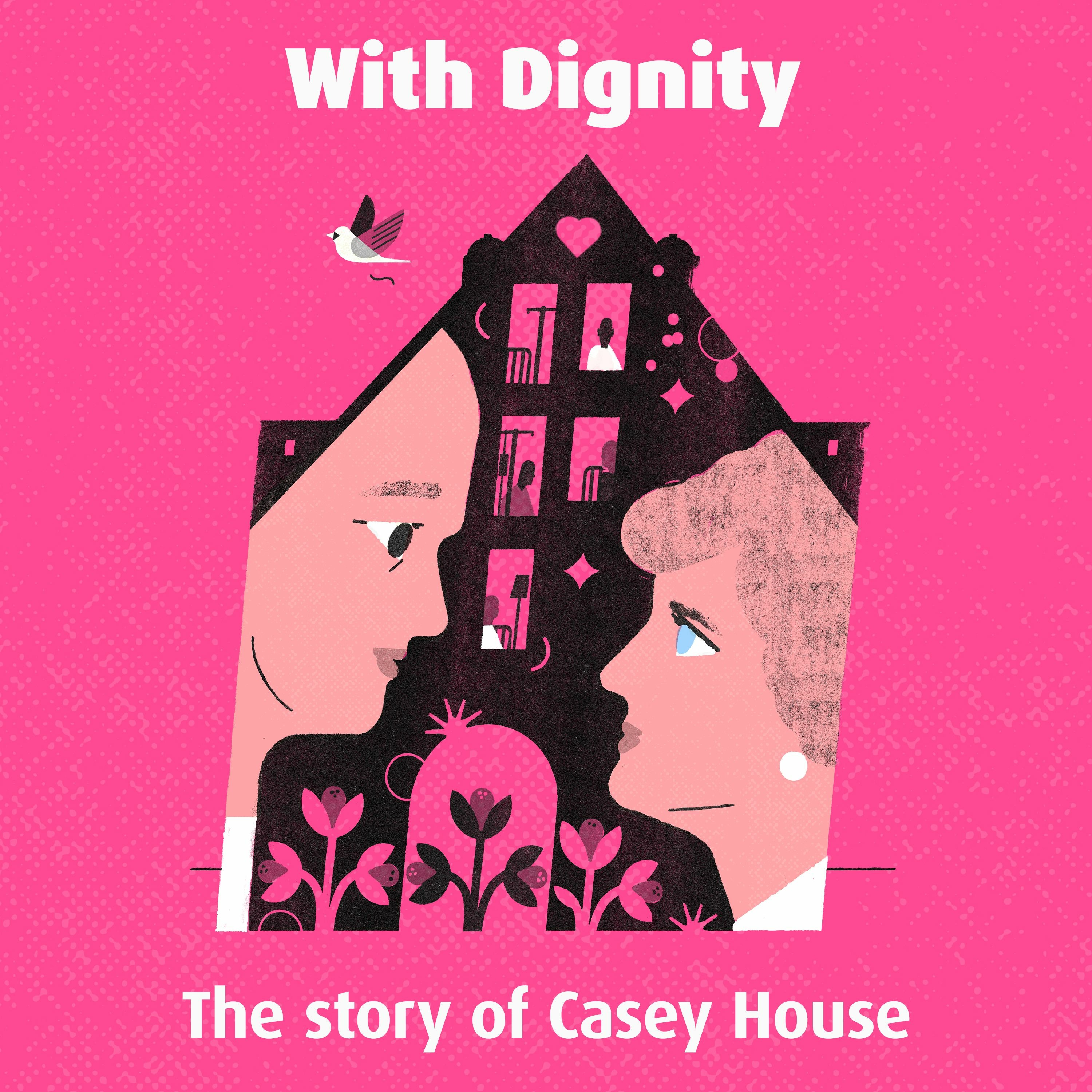
At the height of the AIDS crisis, journalist, activist, and mother June Callwood saw that something had to be done. She took her immense energy and impressive network, and pulled together a team of volunteers. The result? A home where people with AIDS could die with dignity: Casey House.
Hosted by Nick Green. Written and produced by Pippa Johnstone. Original music by Nathan Howe. In this episode, we hear from Bree Fitzgerald, Nancy Roe-Lucier, Guy Bethell, Linda Rapson, Jim Donovan, Michael Oscars, and the cast of DQ ’87.
Transcription
4344 Words, 23209 Characters
Aside from the urgency of it at the time and the fact that they were literally like me just trying to open up a space where people could go to die with dignity. What I also remember is this joyous energy around that beginning. That building has meant something for the community for so long at a critical time and it has always been a beacon of hope and a place of acceptance and understanding. And unconditional love. We both said, "We'll never forget this moment in our lives. This was one of the best feelings you could ever have that we accomplished what we did." This is with dignity, the story of Casey House, an oral history of Canada's first AIDS hospice. My name is Nick Green. I wrote a play called "Casey and Diana" about this amazing moment when Princess Diana came and visited Casey House in 1991. It was an incredible time, but it's only one of many inspiring stories about how Casey House came to be and the incredible contribution it continues to make. My play premiered at the Stratford Festival and as I'm making this podcast it's having a second run at Soulpepper Theatre in Toronto. So I wanted to bring a few more stories to you to contextualize that moment in history. This is a story about a group of volunteers who saw a crisis and said, "Something has to be done and we are the ones who are going to do it." It's a story about the power of kindness and compassion. And maybe it's also a story about how we today can harness some of that power for the changes that we want to see in our cities. We're going to hear from nurses, caregivers, Casey House founders and staff. They were all there in the 1980s watching this crisis emerge. It was not an easy time. There was a lot of stigma, a lot of prejudice. The life expectancy of someone who had gotten diagnosed with AIDS was nine months. It was really scary. We didn't understand it at all. Everyone was afraid. And then of course when it became obvious that it was primarily in gay men, then there was prejudice to deal with. It was a pretty marginalized community in Apristia. This is virus that is overwhelmingly affecting just your community. The stigma at the height of the AIDS crisis was a struggle. It's just all that a struggle. Hospitals were treating people very badly. We heard stories of people who were brought their meal and the food is left outside the door and they had to crawl out of their bed and get it themselves. I would see lunch trays still on the hallway at 2/3 in the afternoon. I would walk in with them and the person would be surprised that they had been brought a meal at all. And of course, you know, when they discovered they were positive, it was the world tumbling apart. How many people had to be comforted or they would go on terrible drunken binges and in some cases didn't wait. First hand, I think you know what I mean. Extra, the newspaper you'd open up and there'd be proud lives which, you know, there was just photo after photo people that had passed that you knew. And if you lived in the church, where I was named neighborhood, when you'd meet people on the street, you gave me a hug but you gave them an extra big hug and you said, you genuinely said it's so great to see you and that was code for God you're not dead. It's really hard to imagine this time. I was a little kid and all I have is stories of the loss and pain that people were going through. The sheer number of funerals is hard to imagine. The fear that would have rippled through everyone in the community, the sense of being completely abandoned to die painful and undignified and often lonely deaths to this mysterious new virus. Today, HIV is a vastly different landscape. We know more about the virus. We have drugs to treat it and make it indransmissible. KC House is evolved too. It's now a hospital, not a hospice. HIV AIDS is thankfully no longer a death sentence. But in 1985, AIDS had become the leading cause of death for people 35 to 44 in Toronto. And in the midst of that crisis, journalist June Calwood, also known as St. June, citizen June, the secular saint and sometimes Canada's conscience, no big deal, decided to do something. She had that good, strong clarity that was able to dissect through all the bullshit and just say, okay, so what are we really doing here? What's really going on? It was just like June called upon you to do your best. You knew you were part of something with her in the room and she had a way of just making you feel like we're all in this together. She inspired everybody to want to do their best. She was unquestionably one of the most amazing Canadians we've ever had. We ended up calling her St. June because in many respects she was and she could be very valuable and she could infect you with energy and you want to do this for June. But no, she was one of the grand ladies over time. Oh, she was so sunny, completely full of energy. She was driven by her passions in a grand, grand way. Obviously she was kind. I mean, that's the thing that everybody knows about her. And funny, like extremely funny. She was, she was a force of nature. That last voice was June's granddaughter, briefest Gerald. June call would grew up in poverty in Chatham, Ontario. She said that as a child she once went three days without food. Here's Bri again. Well, you know, she came from nothing. She had a rough, rough start. And I think she always had a memory of that. And then a sense that there can be something better. She was hungry and she transferred that into the work that she was hungry for information. She was hungry for a family she wanted to put together a life that was comforting to her. From this difficult start, June launched herself into a pretty killer career as a writer and a journalist. She married another journalist, Trent Frayne, but kept her own last name. Namely, and all shade intended because the Globe and Mail didn't employ married women. Together, they had four kids and built a middle class life in Toronto. But it wasn't until she was like 40 years old that she started trying to fix things outside her own life. The story goes she was called one day by her son, Brent, in 1968. He had friends that were living on the street in Yorkville. And June went down there and saw the situation and thought like, this could be happening. Like, why are these kids on the street? There should be some place for them to stay at least. In typical June fashion, she saw a problem and began to organize an effort to solve it. One day in 1968, June joined these young people in a protest against the imprisonment of an American doctor who was helping draft dodgers. There, June found herself in trouble for the first time. And then she was arrested, which I think that she thought that a woman like her couldn't get arrested. She was blown away by the fact that a mother of three kids and housewife could just get thrown in the back of a patty wagon. I think she thought she was protected. And once she realized that she wasn't and really nobody is, she got really, really busy after that. And she was really, really super busy. Like, there might need to be a different word invented for how busy she got. June is credited with founding 50 organizations, five zero. She started Digger House, a hostile for young people, Nellie's a home for women experiencing violence and poverty. Jessie's place for pregnant teenagers and many, many, many others, not to mention her many awards, including the highest honors in the order of Canada. What have you done lately? June was a legend before Casey House even began. She would see a problem and get to work solving it. The AIDS crisis was no different except that it found June after two life-changing tragic events. First, her son, Casey Frane, was killed. Here's Brie describing her uncle Casey who was only 10 years older. He used to play airplane with me and like lift me up on his feet for hours and hours and just, you know, play with me as I sailed through the air. He was a beautiful, soft man. And I think, you know, there's no way that you can lose somebody young and not just be completely destroyed. But he was very special. So I think we were all really shocked, kind of our angel. In April of 1982, Casey had dinner with his parents, June and Trent in Toronto, then set off to ride his motorcycle back to Queen's University in Kingston.
It was wet and dark out, and an impaired driver took a wrong turn onto the off ramp of the 401 and crashed into Casey's bike. He died on impact. He was 20 years old. "It's like a curtain fell. We were a different family before he died. It gave us sadness. We didn't have that before. I don't think we had sadness. And then we had nothing but for years." During this period of grieving, June was met with another significant event. Her friend Margaret Fraser got really, really sick. And June, of course, began to get organized. This is Dr. Linda Rapsen, an eventual co-founder of Casey House. I met Margaret Fraser when I was on the board of Nallys. And she was just such a character and lovely person. Who ever had anything to do with her loved her. And she became ill with an operable pancreatic cancer. And so I went to see Margaret right away to talk to her and offered to be of some help. And I ended up taking the job of being her physician during her three months before she died. Margaret wanted to die at home, but she lived alone. And the hospital wouldn't discharge her without knowing that she had the support that she needed there. So June and Linda set to work, putting together a group of volunteers to create a palliative care plan for Margaret. While she lived alone, Margaret was super involved in her community and also a really good friend. So it wasn't hard for June and Linda to put together a huge list of volunteers from her church community, the team at Nallys, Linda and of course, St. June herself. We had three shifts a day and there was somebody slept there every night. And that went on until she died in June of 86. Through that work, June and Linda learned about caring for the dying and what it meant to have a good death. June went on to write a book about this time called 12 Weeks in Spring. She donated half the proceeds of that book to her next project, a house for compassion in the face of HIV and AIDS, named in the honor of her son, Casey House. People sometimes try and we obviously try and put a connection together between Casey, the son and Casey, the house. And I don't think that there's anything to it other than the terrible loss of someone who should still be here. And she, you know, out of her grief, it just was this kind of perfect storm that she was a deeply grieving woman that she happened to start working in hospice care through Margaret. And then, you know, looked around her and saw the impact that this was having on particularly young men. So first, June lost her son in this pointless and tragic way. And then through Margaret Fraser, June learned what it meant to have a good death. At the same time, she was working on a book with Jim St. James, an artist and activist who had been diagnosed with AIDS. You know, and it was through Jim that she attached more to the gay community and then started really looking at what was happening with HIV AIDS. And it's not a leap for me to see how she just got terribly, terribly busy on that problem. June's eyes were opened. And all around her, she could see so many young men dying senselessly, sometimes at home where they had no support or were ostracized from their family. Other times in hospital where they were faced with stigma and fear and not receiving the treatment that they needed and deserved, she saw the pain and loneliness being experienced by people with AIDS, otherwise known as PWAs. They were dying lonely, uncomfortable, undignified deaths. People were afraid to touch them. These weren't the good deaths that she had learned to provide for Margaret Fraser. At the same time with the AIDS crisis going on, June announced, you know, the thing we really need is we need a hospice. A place where people could feel like they were at home where they had agency, dignity and compassion in their last days. I remember laughing out loud because well, here we go. Once June makes up her mind that something's going to get done, it gets done. Something got to work. Her first move was recruiting people to help. Imagine this part like the beginning of a heist movie. She pulled in people with different skill sets, people in politics, in medicine, fundraisers, donors, it was very Oceans 11. One of the things that she was amazing at doing was putting the right people in the room. Right? This is what she always said about how to get anything done is to really clearly target the people that you think can do something and then bring them all together and then say, "Okay, so here it is. This is the problem. You all could do this in your sleep and then sort of charm them into doing the work. I think that once you're all there looking at each other, it's really hard not to say, well, I was planning on going to Italy. Whatever it is that's looking like, what are you going to do? You're going to cancel your trip." So basically she would like warmly, forcefully press people into service. Rebecca Bragg was conscripted into leading fundraising. Linda Rapson was recruited to chair the Health Services Advisory Committee. I mean, I tried to put off joining this committee, but I had to give in after a while. And after that it was full bore ahead. She decided that I should be the chair of the Health Services Advisory Committee. And I said, "I can't do that." That's like the Medical Advisory Committee in a hospital. You have to know what you're doing. She said, "It's okay. You'll figure it out." And of course, I figured it out. They started with meetings in the building of the AIDS Committee of Toronto. And she has a sort of technique. What she did was she pulled together a committee. She grabbed everybody she knew who was going to be useful to be on a committee. And then what she would do, she herself would write minutes of the meeting. And she would send the minutes to the Ministry of Health. And she said, "When you do that, they have to open a file." And when they open a file, then they keep adding to it and they get used. And of course, because it's her, she was known. I mean, I know so many times when I said, "Well, you can phone the Prime Minister and they will speak to you." And she would always try to be humble about it and say, "Well, they'll take my first call." Because after that, then they find out what I'm after. And they might not want to support me. Through her charm and sheer will, June got a team together. So there was the very serious nature of the job at hand on one side. But what I also remember is this joyous energy around that beginning. As they were planning out, you know, what the rooms should look like, what the best colors would be. It's got to be many things because everybody's going to want something different. It was so centered around the individual. You know, you're not going to come in and take a number and feel like you have to do it in a certain way. You know, your death is your own experience. And so it needs to be comfortable. My biggest memory is the idea of building something that functioned as a hospital, but really was more like your living room. At the time, there was no hospice like this for people with AIDS, certainly not in Canada. June and her team were dreaming up something completely new. But anyway, once we got going with this idea that we were going to have a hospice for AIDS, we had to raise some money. Lots of people wanted to help fundraise and there were so many ideas, which was a good thing because putting together a hospice was going to cost a lot of money. Here's Michael Oscars. So apparently at the time there was a line out of people pitching ideas to Casey Houses fundraisers and June oversaw all these pitches. Now I knew June, but I wasn't able to pitch this. What Michael Oscars wasn't going to pitch was a drag show, a friend of mine called Eric Turner who was a drag queen under the name of Sasha. He got all fired up and he said, "Wow, we've got to do more. We've got to do more." So he said, "We have to put on a show." I said, "Okay, Mickey." "We'll put on a show, open the bar now." But he was serious and he said, "Look, if I arrange drag queens from all over to volunteer to do a big show, when you write it and direct it." So yes, I said, "Okay, fine." They went and pitched it and poor June kept thinking, "What's Derek Rene doing?" Because they kept saying it's a show called DQ. Anyway, after the end of the meeting, once they had said, "No, no, it's not Derek Rene's drag queens." She asked me, "Yes," and said, "Oh, okay."
Fine. And that was that. And they got to work. I said, "But you know what, I'm too exhausted. Just bring everybody." And we rented the Winchester Street dance theatre, and he brought about 40 drag queens for me to look over. But at the end of it, we had a cast. A giant cast of drag performers from all over Toronto. Putting it all together was fun, to be honest. But it was a lot of work. Dealing with drag queens is like hurrying cats to be in with. Very fashionable cats. And we had rules. I made the rules. And we used to have a sign, "Check your ego at the door." And then on my chair was the buck stops here. It just made sense. You know, somebody had to be. And I wasn't going in this for a popularity contest. So the rules were, it had to be fun. It had to be funny. Silly, lovely to look at. The word AIDS. HIV never crossed the lips of anybody on stage. The only time that there was any sentimentality or modeling, if you like, would be the closing number. And we decided to do five performances. A dress rehearsal on the Wednesday, Thursday, one show. One show, Friday, two shows Saturday. And if we did well, we would do the Sunday matinee. At the dress rehearsal, we invited all the PWAs and men airsiers and whoever was around. But the result was astonishing. We had no idea what we had. Suddenly there was this amazing buzz, opening night, sold out. And then we went clean after the Thursday night. And everybody came and then we were able to put the Sunday in the show. I am here to tell you what DQ means. But I don't know. Does it mean dairy queen, Don Quixote? Dumpy queen. We are not amused. But we do know what DQ means. However, our delicate sensibilities would be offended to say the words out loud. Perhaps, though, we could spell it for you with a little help from this lovely audience. So much better than Wednesday nights, don't you think? We didn't have one Wednesday night. That's what I mean. They're better than nothing. So, are you all in good voice? Yes! Oh, lovely baritone in the balcony. Very nice frog, dear. So, altogether now, will you give me a D? D! Give me an R. R! Give me an A. A! Give me a G. D! Tricky bit coming up. Give me a Q-U-E-E-N. We do it! Put it all together. And what have you got? DRAG WE! There's your answer, Miss Davis. DRAG WE! You mean those people that are always doing me badly? The first Q-U was a huge success. They raised $38,000 that March. And at the same time, June and the team were out searching for the building that would become Casey House. Many spots were to run down, some were too far away from the downtown core, some were not welcoming. They were told by one local alderman, "We have children here." Sounds like a sweet guy. But eventually, they found their spot, a beautiful Victorian house at Huntley and Isabella. It was going for $1.5 million. They needed to raise $500,000 macaroon, and then the government would chip in their remaining $1 million. But they weren't at their goal, and the closing date was coming up. I don't know if you know, but it's the legend of Casey House. They had seen the building on Isabella, the original building, and they were closing on the Friday of that week. And they were faced with not being able to close on the building for lack of $30,000. And it was Jay, who was our producer and heard to handle all the finances and everything. Once we had figured out everything and we had the net result, $38,000, he put the check in the mail to Casey House. And they were freaking trying to find that money. And the check arrived on the Thursday. So June told me, and she said, "We were completely aghast because they didn't know how much we'd raise. We didn't know how much we'd raise till literally well, closed on the Sunday, and they were closing the house on that following week." So the checker arrived like the cavalry, and they were able to do the house. In a wild and totally dramatic scramble, they pulled together funds from the government, donors, the George Sedrick Meckhaft Charitable Foundation, the Holy Trinity Church, and DQ. They partnered with St. Mike's Hospital for support, and finally, they got the house. Nine Huntly. Here's Linda Rapson again, one of the co-founders of Casey House. And the first time I went there, I stopped at the liquor store on the way over from my building. I walked over and got some probably pseudo-shampaign, I would think. And so there were three of us were there to have a look at this place. What would this place be like? And we walked around everywhere, and we went on the elevator. And we said, "Wow, gee, this looks pretty good." And I would look at the baseboards, they were pretty scruffy. And I said, "Well, I think we're going to have to fix those." But little did we know it was going to be virtually gutted, and it was going to be turned into a really great place. They took possession in 1987, and there was a lot of work to do. And while they did that work, they needed someone to live in the house over the summer. Rebecca Bragg, the fundraiser, had just lost her apartment, so she offered to move in. But she needed security with her to live in the giant drafty house alone. So, she recruited a security guard to keep her safe. A German shepherd named Chelsea. How iconic is that? Chelsea kept Rebecca safe all summer long. They were originally wanting to open in September of 1987, but they still needed some time to get it ready. So, they delayed until January, then delayed again, and finally, in March of 1988, they were ready to open. That was the most amazing experience. I remember, because we took turns taking people on tours. It was open. We wanted the public to come in and see. We wanted to reduce the fear that people had about AIDS and so on. And I can remember, Rod Austin and I were working together on taking people on tours. And I remember standing there with him looking outside the door. The door was left wide open, and I said, you know, we both said, "We'll never forget this moment in our lives. This was one of the best feelings you could ever have that we accomplished what we did." June said the same thing, and she had done so many other wonderful things, but this was really an accomplishment to get this place. So they had the house. They had the team. And now, all they had was the super tiny, simple task of starting an AIDS hospice, something that had never existed before. That's next time. [Music]
Podcast Summary
Key Points:
Summary:
Chat with AI
Loading...
Pro features
Go deeper with this episode
Unlock creator-grade tools that turn any transcript into show notes and subtitle files.
 PodcastTranscript AI