Do the finest examples of American antiques make your heart beat a little faster? Have you ever longed for an authentic Windsor chair, a folk painting, or a shaker desk? If so, you should get to know David Shorsh and Eileen Smiles. Among the nation's leading dealers, they are dedicated to advancing the eye and knowledge of collectors from Gen Z to baby boomers. Learn more at their website, AmericanAntiqueArt.com. Hello, and welcome to Curious Objects, brought to you by the magazine antiques, I'm Ben Miller. This is the podcast about art decorative arts and antiques, the stories behind them, and what they can reveal to us about ourselves and the people who came before us. Now when you think about Renaissance art, what comes to mind is probably the master painters, your Raphaels, your Donatellos, your Leonardo's, the whole Teenage Ninja Turtles gig. But there is another medium that has attracted collectors with incredible luminescence and timelessness. This is the world of Renaissance, limoge, and mammals, effectively painted glass, which is an incredibly challenging, but rewarding medium for festitious artists of the Middle Ages and Renaissance. Now a new exhibition at Gallery Cougal in Paris shows a fantastic group of 17th century pieces, dishes, plaques, tereens, medallions, and more decorated with these stunningly vivid images. So, today I'm excited to welcome back to the podcast Laura Cougal, the sixth generation of Gallery Cougal, to tell us about In March Cessable, limoge, Renaissance, and animals, and their collectors, an exhibition which is on view at their Paris Gallery from October 22nd to December 20th. We will find out what In March Cessable means, and of course Laura will tell us the story of today's curious object, a double-sided enamel medallion from around 1530, which depicts a moment of profound religious devotion, St. Francis receiving the stigmata, and also an old testament figure of regal and poetic power, King David. Laura, thanks for joining me. Thank you. Thank you for having me back. Second time. Last time we talked about 17th century amber, how did that exhibition turn out? That was two years ago. It was an amazing success, I think by the end of it people couldn't stand me talking about amber anymore, so I'm ready to start bugging them with a new rabbit hole. Exactly. Well, 17th century amber to 16th century enamel, I look forward to 15th century, I don't know, tapestry, as you know, as what's coming down the pike, you'll tell us about it again on curious objects, I'm sure. But for now, it's time for your favorite part, the rapid fire questions. Are you ready? I'm ready. Laura, what is the weirdest use of an antique that you've ever seen? Well, just today, it may not be the weirdest, but I was giving a tour to a sculpture curator from a prominent American museum, and I wanted to show him a porcelain representation of a famous bronze sculpture where my colleague had put our exhibition label in the hand of the little porcelain character being held that way, which was fairly embarrassing, who played this man found it charming enough, maybe not the weirdest, but the most recent moment of weird that I've encountered. What artist or crafts person or movement or style do you think is overrated? NFTs, obviously. Yes. Yes. Okay. Well, I think the craze for that is maybe over by now, blessedly. Yes. But we can all agree somehow. Yes. Not as controversial of a statement as it would have been two years ago. What's the one object that you regret not buying when you had the chance? The one object that I regret not buying was a fantastic vase in the shape of a corn by Taxiildoat, which came up for sale in the US a little recently. He's a French person and maker from the 1900s, but I discovered his work in America where he traveled and worked extensively. And I just was obsessed with this piece that ended up being purchased by a museum that's going to organize a big exhibition about him, so fair enough. So at least you'll be able to see it. What's the most unexpected place where you've found something extraordinary? Anywhere. Everywhere has extraordinary things and no specialty is overrated. I mean, some pieces are overrated within each specialty. Same goes with places. Everywhere has magic. This summer I was in Savoy in the French Alps for a few weeks of nature hikes and what I expected to be no interaction with museum or art whatsoever, but I discovered the wonderful world of Baroque Savoy churches, which have their own little style with makers that cross the Alps from Italy and I was completely flabbergasted. Any new video games to recommend? Last time you told us about Assassin's Creed. That's true, I did. No new video game recently, I feel like perhaps it's now my time to start reading some books again, but I did pre-order. I believe a new Assassin's Creed, which will be set in feudal Japan, so I can tell you about that one later. Excellent. Maybe the next exhibition will be Japanese decorative arts. That would be exciting to me. What's the best bargain that you've ever scored on an antique? You personally, not necessarily the gallery. At Teyfef in Maastricht, a few years ago, I discovered an English Staffordshire puzzle pipe, which I encourage all your listeners to Google. They look basically like a spaghetti, very, very long spaghetti that's kind of swirled around the concept of the puzzle pipe, also called the philosopher pipe, is that if you have a problem and you start smoking it by the end of your tobacco, you'll have solved anything. Anyway, it was extremely weird. I bought it and I don't think anyone really cared and then all of a sudden, someone wanted to buy it from me. So since then, I've been buying all of them that I can find and I think I've solely created the 21st century market for puzzle pipes. If you had a puzzle pipe, call me. Fantastic. I think we're going to have to do an episode on that sometime. Do you know about them? I'll send them to you. I've seen them, but I can't say I've ever done a deep dive. Fantastic things. What's the strangest thing that somebody has offered to you thinking that it was valuable? Well, I get offered a fair amount of Michelangelo's and Leonardo's beer. That's for sure. I get offered, I mean, I will not tell you the story of an art dealer by mistake showing me a very, very renaissance miniature in a wonderful frame. And when I looked at it more closely, I realized it was just a printed piece of paper. Oh, no. What's the one question about an object that you've never been able to answer, but which that you could? Did people use this in relation to a lot of objects, in relation to the emotion animals? I mean, a lot of people in the world have silver asked me if people used what we call nefs, which are those boat-shaped silver vessels from the 1600. And I think the whole literature can still not agree on whether or not they were filled with wine and used to pour at big banquets or simply pretending and just sitting on a shelf. That's so frustrating to me. I mean, it's a question relevant to so many forms, so many types of objects that unfortunately nobody was snapping Instagram pictures at those parties. So we just don't really know how or if they were being used. What's the ugliest object you've ever seen that you secretly love? Every object that I thought at first was ugly, I learned to love. So we sold to a museum concerned with the works in glass, a fantastic Venetian chair made with glass beads that was the pinnacle of Rococo and when I saw it appear, I thought it looked like something out of a beauty in the beast cutscene and it really shocked my eye for a second. But then on second glance, I just, the ugly vanished and the fantastic was born. I love that moment that transition from not understanding something to understanding it. Okay, well, we'll be right back with Flora Cugal. As soon as I say, thank you for listening. This podcast is a passion project and I couldn't do without you listeners. If you're enjoying these deep dives into the stories behind the world's most fascinating objects, there are a couple of things you can do to help. First, you can subscribe to the show on your favorite podcast app. That is the easiest best way to make sure you never miss a new episode. And second, if you have a moment, please leave us a rating and a review that really helps new listeners to discover the show and tells me what you love about it or maybe don't love about it. Either way is fine. But if you know of a curious object that you'd like us to feature, please get in touch. You can reach me via email at
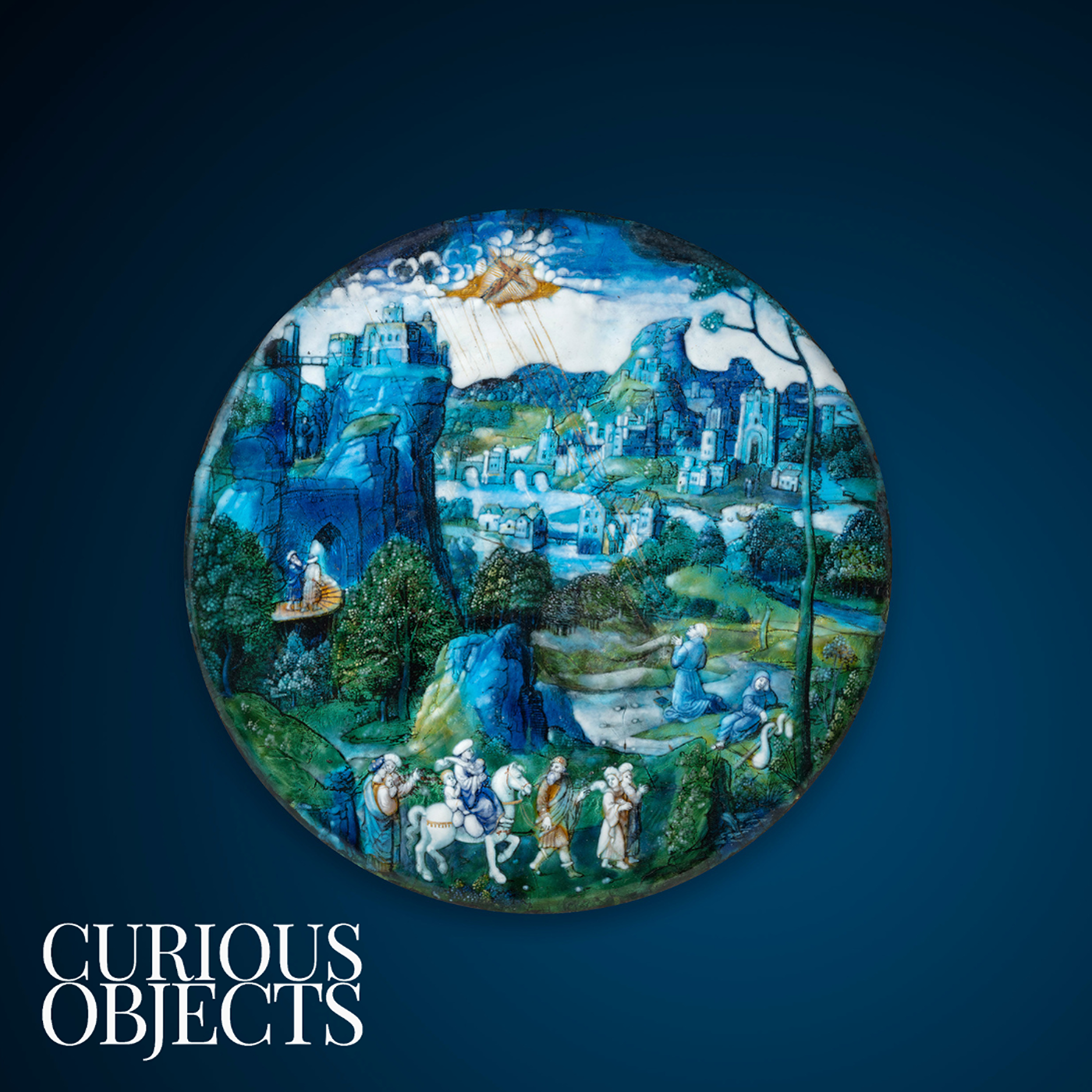
[email protected] or on Instagram @ObjectOfInterest. I'm always on the lookout for our next story. Okay, now Laura, could you just start by describing our Curious Object for listeners? It's a fantastic work of art and I really hope folks will take a look at images at the magazine antiques.com/podcast. But either way, just paint a picture for us with your words. Yeah, absolutely, Ben. So the Curious Object of the Day was very difficult to pick amongst the kind of amazing group of limo genemles from the Renaissance that we've gathered. We're talking about over 70 pieces, some of which include pair or, you know, a series, so nearly a hundred individual objects. But I picked what did you rightly describe as this double-sided medallion, which incidentally will be the cover of the book that we're publishing, the MSD exhibition, because it speaks to all the different layers that we wanted to convey in this show. It's a double-sided medallion of about 13 centimeters, so that's a little bit smaller than the size of my hand. It's extremely detailed and has a lot of very vibrant colors. Several pieces that we'll be showing are in this technique called Grisaille, which is almost a monochrome of different shades of from black to white, to gray, with a little pink and gold highlights. This one is not the case, it's very vibrant, it has green, blue, oranges, and as I'm sure we'll discuss the technique of enameling is very complicated when you want to add all these layers of colors, which are made out of different mixes of pigment. They cook at different temperatures. This is kind of an alchemy feat to be able to realize something like this. It's from the early 16th century, around 1530s, and it's attributed to a master that we are focusing a lot of our exhibition on called the Master MP, a mysterious figure whose name we haven't been able to find, but we think the piece stands for pinnico, which is one of the main families of enamelers in the emote. We have managed to gather a corpus of a handful of works that we can attribute to this master in this exhibition, others that we have sold in the past, based on a small amount of work that are signed in the Louvre, in the Victorian Albert Museum, and so on. Because our exhibition is really about the object, but also about the market for these objects, I thought it was fun to show you something that displays very interestingly how the literature and what we know about those works is constantly evolving, and so we are, in fact, able to bring back to the light new works by new artists, rediscover reemerging artists, if you will. It's enamel on both sides, which I'm sure you'll feature on your Instagram page and on your various media, and that's one of the specificities of this artist. Typically, limo genamelers would either, if they made a plaque enamel, but not decorate the reverse or decorate it in a way where it was obviously the reverse, so with maybe less vivid scenes, maybe less expressive iconography. In this case, they're both very mysterious. One is in all these crazy colors that I described. The back is in just a very strange milky white mix with gold. It's a beautiful object that completely illustrates why this technique was so sought after. It's almost like you're holding a magnified jewel in your hand. You want to have a magnifying glass and just examine it for hours and hours and hours. Yeah, so I mean, it's beautiful. It's captivating. It's, as you mentioned, incredibly difficult to produce, and we'll get into that in a minute. But given the sophistication, given the challenges of producing it, can you tell us why enamel was such an appealing medium for decoration in this period? It's always a little bit hard to understand those reasons at first, and they are, of course, always a mix of a variety of sociological geographic, historic factors. But I would say that for sure what has seemed to attract collectors through the ages, from the medieval production to the Renaissance to long after, in history, to our time, to those works is their rich colors, shiny polish, and I think originally, even though they were quite costly, they were still less costly than gold, and yet they were shimmering like gold, they were precious like gold. So I believe this may have been one of the reasons. And then the image emerged very early on as a big center, so much so that these works still bear the name of the city attached to it, which is fairly rare in our world, and of course the enameling technique is vast and has been applied to all kinds of objects. But the limo genamel is something very specific, and limo gen its region was a very pious monastic region crossed by a big river in kind of the middle of France, so a perfectly placed location for trade routes, and they started producing those at first liturgical objects for a lot of different courts of Europe. And it's only a little bit later in the Renaissance that the subject matters that we cover in our show started developing, let's say, mythological subjects, or much more profane, and painted limo genn. It's interesting. I mean, I think listeners, many listeners will be familiar with some of the older coffers and reliquaries with limo genamel decoration that you might see in museums around the world, but this later material that the exhibition features. I mean, in a lot of ways it's much more refined, it's much more sort of painterly and illustrative and artistic, but it's still associated with the same region. How did Limoges sort of emerge as this specialized location for the production of these things? Why was it that other places didn't start to copy their work and distribute it more widely? It's kind of a story about know-how. So what you're describing and what you're right, the listeners might know the very medieval limo, which are often golden copper against blue, typically blue grounds, and in the shape of cascets, or so on. These were in a technique called cloisoné, where within a copper plaque, they would carve little shapes. It's almost like paint with numbers, and then they would fill its shape with a different color, and it would make a figure appear. Then in the mid-14th century, for various reasons, including the black plague, there's a stop and kind of a freeze in this whole production that re-emerges in the early Renaissance. And of course, the Renaissance is all about focusing on beauty, the beauty of nature, but also humanistic typologies of iconographies. So the production stays partly religious, but moves away from solely religious. You have portraiture that emerges, mythological scenes, as we said, and all kinds of references to the ancient world and to classics. And indeed, as you mentioned, this ability to now paint with the enamel instead of filling it. And this know-how also emerged at that specific time, almost, I would say, as an answer to other types of works. So it's quite close to Italian maelica. It's quite close to Murano Glass. In fact, some of the objects share very, very close shapes. And you could see that there must have been some influences, same goes with the world of silver. You can see little wings from one technique to another, but the finish that they were able to obtain in Limog, because even though there was a little gap, there were already centuries-long experience in this technique was considered so amazing that at one point in the French Renaissance, it would cost you even more to get your portrait done in Limog enamel than to get your portrait done by the court painter. So come back now to our curious objects. So we've described this as a medallion. But what does that mean? I mean, what really is that? And what's it for? So these medallions that are kind of small in sizes with religious objects were usually for private devotion, if not ordered by some churches. And these apparently were known to be inserted and adorned types of objects called Agnus Dei. Agnus Dei, if you may know, which also contained little depictions of the Pascal Lamb. So they did have this kind of religious function or religious intention, even though they are also, I would say, not austere, right? They are glossy. They are fun to look at. It's not a very overwhelming and overpowering depiction. Of religion. But these objects were often dismantled as history went on, sometimes different parts were sold as independent parts. So we don't always exactly know what the original purposes was. It's obviously more logical that they were inserted on an object than frame, because it's really meant to be admired on both sides, because as I said, both sides are of incredible and equivalent quality. And in terms of the physical process for creating it, I mean, you alluded earlier to how difficult these pieces were to make. What did that process look like? So from what I understand, and it's still not completely clear to me, I imagine this process involved a very big furnace, that's for sure, limoge imported a lot of copper, again, because it was situated on this river in between trade routes. It was quite easy for them to supply themselves with those kinds of raw material. And copper was chosen because of its low cost compared to other metals, and it's rather easy to deal with. And also, it burns at a much higher temperature than the variety of limoge paste, glass paste. So you would completely coat the copper plaque that would be molded either as a dish, as a cup, as whatever objects you wanted the shape to be. And then each color, each pigment would cook at a different temperature. So it's almost like a lacquer work in the kind of a mental description you might describe to it, a very patiently understanding the process of what is the first coat you put, what is the first color. Then you have colors that for the sake of adding a translucent aspect, they would add a little sheet of silver, or a little sheet of gold, or a little sheet of shiny metal. And when you look at the object and you kind of move it around to the light, you really see that there's depth to each of the colors and the coats, and you start understanding that they are, in fact, layered on top of each other. Then at the end, with a much more fine brush, little gold highlights were applied, either to write inscriptions, or to add little details like jewels or things like this. They were cooked, I think, at a much, much lower temperature. So they are almost like an after-clays, and some of them were above quite easily. But apart from that, those objects and the magic of those objects is that when they are correctly handled, they look the same if they're in good condition today as they did the day that they left the kiln, which I think is not the case with many antiques objects. And you and I, and a lot of your listeners, will know what we mean when we say something has patina, and we like it. But some people maybe really ascribe this kind of older-looking surface to, you know, a displeasing characteristic. In the case of those objects, it's not like that at all, they are fantastic, they look brand new, which is a very odd thing to say for an antiques dealer when describing our own stock, but it's actually true. Yeah, it's interesting. I mean, it reminds me a little bit of a gold object, gold jewelry, which similarly doesn't really change very much over time. So you pull in a trusskin gold necklace out of a tomb, and you're looking at basically the same object that somebody in the third century BC was looking at. It can really act as a time capsule in that way. But it was interesting, you know, you referred to the fact that in these enamel works, each color had to be applied separately, which means that really there was a great deal of planning. And this is not the Bob Ross style sort of, oh, I'll see how this thing comes together and add a little bit here, and add a little bit there. I mean, presumably these artists really had to know from the very start, exactly what the finished product was supposed to look like, right? Yes, and when you study the emotion, you start to understand very quickly that we're talking at the top level about a handful of family dynasties. So obviously, this knowledge was really centralized within a very few amount of workshops taught from father to son to nephew sometime to daughter, because we know of at least one female enameler who signed works. Maybe they were more. I don't know exactly. Susan, the course, she will be the topic of an upcoming exhibition at the Frick Collection in the next couple years, she's definitely being very studied right now. So you also are able to recognize the same style generation after generation within the same family workshops. But those objects were so sought after in the 16th century, all the way through, you know, the first quarter of the 17th century when that was really like a craze that they were probably very wealthy makers. And so they definitely led sophisticated ateliers with a lot of people with different jobs to deal with the metal, to deal with the pigments, mixing the pigments, cooking the pieces and so on. Can we talk about iconography for a second, because the scenes depicted on this medallion are really quite fascinating. What can you tell me about the choice of subject? One specificity of the limo workshops of that time, as it is the case with a lot of different workshops of decorative arts in the Renaissance, is they clearly had to their availability different engraved sources. So this is really the moment where you have a mini globalization of iconography within you. Learn more at their website, americananticaart.com. And the way that he composes his scenes on those very small size objects are very inventive and not just a copy and paste of one engraving. Maybe little inspirations are taken here and there, but it's not just something that you can completely match to one source. The main side is San Francisco receiving the stigmata, but to me this is almost anecdotal because it's actually a landscape scene and Francis is very small as your listeners will see when they look at the picture in the grand scheme of how much is going on on such a small format. Yeah, I mean it's extremely busy and it reminds me a little bit of the broigel picture of the fall of Echoris where the titular subject of the painting is actually almost an afterthought. I find it completely captivating, you know, there's a little town, maybe a church, maybe a castle, there are sort of travelers and crafts people and swaddled infants. And then in the midst of all of that, you have Francis with these rays of sunlight penetrating through the atmosphere. I mean, it's quite, I think it would be at home in a, I don't know, in a children's book or something where it just draws your attention from one thing to the next thing to the next thing. I think that's one of the aspects of those works that are easiest to understand today. You've said the right word. There is something quite comical about it. Almost like a comic book because they are really illustrations. You see the line. They are sometimes filled with humor. There are scenes of banquets. The mythological scenes can be quite, quite boisterous and very expressive. So definitely, you're right on this one. So the exhibition is, of course, in part, it's a display of these fantastic works of art. But in part, it's also, there's a meta level to it, right? Because this is an exhibition about the history of the collecting of these pieces, as well as just being about the pieces themselves. So I want to talk a little bit about provenance and then the sort of heritage of the collecting of lmogenamels. And maybe you can start with our curious object and tell us what you know about where it's been. Yes, the curious object of a day does have a good provenance that dates back to the 19th century. Mostly French aristocratic provenance of the two families, one called Darambar and then the counts of Merod. They are known in America, in American museums because they are works at the cloister, for example, that belong to this family. They are not by any means the most prominent collectors that we are discussing in our, in our catalog. But it does illustrate quite well that these were often collected by people who really cared for them, great collecting families. And this is kind of the sub-team of this whole exhibition. When we focused on Ember and we chatted with you last, at least for the French audience, it was a complete discovery. Those objects were not very well known and no exhibition had ever focused on it in France at least. The emotion animals of the Renaissance are a little different. They are permanently featured in French museums, in American museums, even in Italian museums, because all European courts widely collected them at one point or another. And even though there hasn't been, I guess, recently a big show about them, we felt like visually people are much more aware of what they are. What will be impressive in our exhibition is the mere volume and variety of what will be presented in terms of iconography, typology, rediscoveries from private collections or discoveries at auction of pieces that hadn't been seen for 50 or 70 years. And also the simple fact that when you see when you see a wide variety of the same type of object in one place, you can really get it instead of just looking individually, at one work, one at a time in a hyper-curated manner. So you've told me about the role that the famous dealer, Duvine played in bringing the most Renaissance animals to the eye of the collector, and specifically of Frec. And then, you know, that sort of lineage travels up and down and up and down. There are periods of interest, periods of disinterest. The exhibition press release notes the relationship between Gallery Cougal and Givenchy and how that relationship revolved around a collection of animals. So there's really quite a complicated, as I said, meta-history around this. Tell me a little bit about this sort of the emergence in the modern era of collecting interest. Yeah, it's the this theme to me is very interesting because I think for people like you and I who try to give audiences the desire to pay interest to antiques and decorative arts, sometimes a lot of the public doesn't understand that there's a market for those works. A lot of our colleagues use the words museum quality objects, I think a little bit too much, in a sense that now some people who might follow the art market really just think it's about contemporary and modern works, when really it's not the fact at all. So in focusing on limoge animals, collectors, basically since their creation to now, we wanted to show that you can in fact study an art market over the course of 500 years, and not just a few years, and you find patterns that repeat that are very very close to what happens today. So I'll give you a brief overview of in a very rough sense how the trend evolved, the limoge mammals at their creation for about a century were the craze. And then at some point, in the 17th century, their fashion started fading. I think partly due to the increased fashion in oriental porcelain that started arriving in Europe, Chinese, Japanese porcelain, which have a similar feel, a similar look, you know, a glaze also, they are also the art of fire. And this kind of is the moment where limoge popularity goes down, you have a few collectors who are just very very cultivated, aware, you know, men mostly who continue to collect them like Mazara, like the famous Jean-Baptiste Avernier, who is this great figure, this diamond dealer who traveled the world. But other than that, it's kind of a low moment. And then in the late 18th century, the story starts shifting elsewhere. So you have people like Horos Walpole in England, but mostly you have the French revolution. And after the French revolution, as soon as the early 1800, a lot of collections in France get nationalized, you have the King's collection and museums open. And when museums open, the public starts noticing new things. And limoge gets displayed. And I think that's a moment where there's a new interest in it, because simply collectors hadn't seen that kind of material for decades, if not centuries. And this gets coupled with the great exhibitions of the mid-19th century, where families that did have some, and that had some in store for a long time, start showing them, you know, to illustrate all the know-hows of France in this instance. And there you have the Rothschild, who show all their limoge, and all of them are showing all their collection next to each other, almost rivaling. And a lot of people flock to those events and see them. But of course, there's a whole American story to this. We're very grateful to Ian Wardropper, who just retired from the Frick Collection as director, and who oversaw a lot of fantastic exhibitions and the whole refurbishment. He wrote the preface of our catalogue, because limoge namels of the Renaissance are, in fact, his first love, I suppose, as a creator before he became a director. And he does talk at some point about Frick's relationship to the 40 or so pieces that are on show at the Frick Collection. Indeed, Joseph Duvin encouraged Frick to buy JP Morgan's collection of limoge namels. Of course, Morgan donated a lot to some of the museums, but Frick does buy this ensemble, and we found the number that he spent, which is almost $1.2 million at a time where for the Bellini, he spent just above $150,000. That gives you a scale, even at that time, of value, and of what those works represented. And it's not just about Morgan and Frick, you have other people in America like Walters. The Walters Art Gallery in Baltimore has a fantastic collection. So, it was very appreciated by American collectors. Of course, it is meta for us in a much more recent capacity, because, again, I would say, in the 60s, 70s and 80s, these were not the most sought-after artworks, even of fans of decorative arts, silver, or other things were much more actively collected. But one man who took advantage of this lack of attention at that point was Givenchy, who patiently cherry-picked absolutely fantastic pieces, all in Grisaille, so all in this kind of monochrome, and made a collection of 35 pieces or so, that at some point in the mid-90s, he asked my father and uncle if they would buy it from him. They were young dealers at the time, and it was a big task, but they did purchase the whole collection, and not only did they do that, they thought that he did such an amazing job creating this ensemble, that it would have been a shame to sell them piece by piece, and so they offered for sale at a Biennale in 1994, I believe, to Givenchy Renaissance Limoge and our collection, to the dismay of many of their peers or of creators who said it's stupid to sell something as a set. It's obviously so much harder, but in fact, it did succeed, because, again, the effect of all of these works together on one wall was apparently so striking, that immediately it got purchased by Salohan Pierre Berger, whose renown as collectors was already more than established, and just this sale created enough rumor and discussion for my father and uncle to get requests by other collectors, some Americans, some Europeans, to create similar ensembles with the same works. So for them, it's a very personal story, and today, the emotion mammals are a very strong market, filled with passionate people who collect the top top pieces, you know, the multi-million pieces, and collectors that are very generalist who have a variety of interests, who just want one or two or three pieces because they just find it so appealing, and maybe they won't necessarily need a whole set, but it's a very dynamic market, it attracts a lot of younger collectors, I think because of this Givenchy Salohan connection, because we've seen a lot of pictures of those works installed in what were honestly some of the most beautiful houses, at least in Paris of the 20th century, so they have this kind of iconic feel for people who also love beautiful interiors and interior design. The title of the exhibition is 'emarcessible', and I always love learning a new word. I'm not above admitting this isn't anyone for me, and might be for some of my listeners too, so tell me what is that word and why is it titled the show? Well, I hope that 'emarcessible' will be the new word of the year 2025-06. We found this word in an 1866 poem by Tophil Gautier, where he praises an enameler, and he uses the word 'emarcessible', which means that never fades, or that's eternal, in discussing exactly the work of enameling, so it's not related to the Renaissance enamel specifically, but it does work, and I think it's exactly this feature of those objects that make them stand the test of time, that make them very attractive today, 100 years ago, hopefully 100 years from now, and it brings them up to this almost poetic surface. There is something in this shimmer, in this translucent, in this superposition of layers that you kind of dive into, like you wouldn't oppose them, so yeah, we thought this had a little mysterious cache, that would make a few people curious enough to come see the show just to kind of guess what the word means. I think that's a beautiful note to end on. Once again, the exhibition is 'emarcessible', 'emarge Renaissance enameles' in their collectors, October 22nd, to December 20th, at Gallery Cugaland, Paris. Thank you, Laura. Thank you, Ben. Today's episode was edited by Julian Minerva, support from the Maxine Antique's editorial team includes senior advertiser, Sarah Stover Turner, managing editor Christine Hildebrand, and editorial assistant, Grovesche Leile.
 PodcastTranscript AI