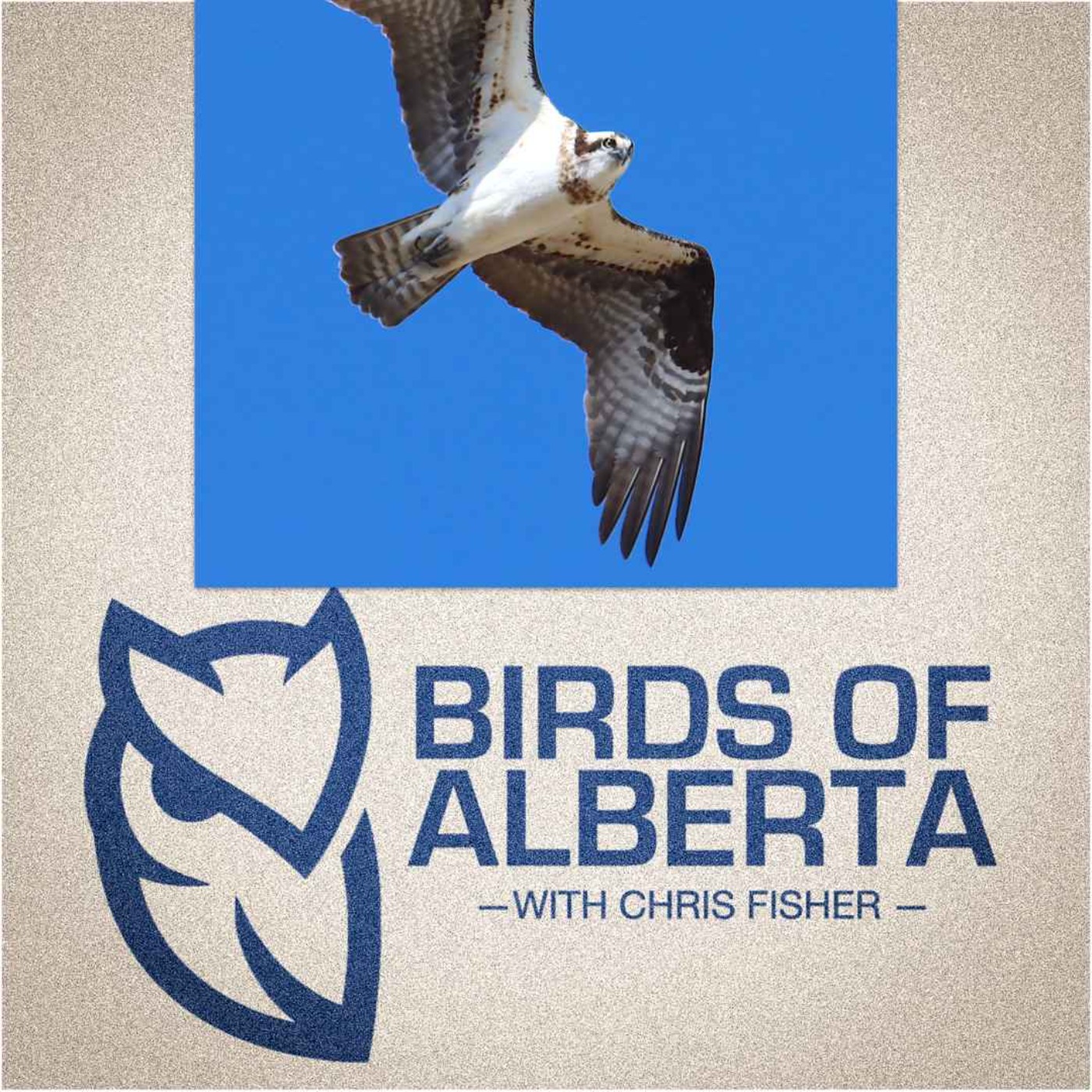
The podcast discusses the Osprey, a bird that symbolizes resilience and conservation success in Alberta. Unlike fleeting spring migrants, Ospreys are "marathon" birds with a broad global range. They faced severe decline due to DDT contamination, which weakened their eggshells, but have rebounded remarkably. A key factor in their recovery is the widespread installation of tall nesting platforms near water bodies, initiated by efforts like Brian Keating's 1994 platform at the Calgary Zoo. These structures, often erected by power companies and conservation groups, provide safe nesting sites away from hazardous power lines. Ospreys now thrive across the province, including urban Calgary, where they fish in clear rivers and have become a common summer sight. Their extended breeding season allows for detailed observation of their life cycle, from nesting to feeding on fish like suckers and invasive carp. The Osprey's integration into cityscapes, even nesting on public art like the "Bloom" sculpture, highlights a successful coexistence between urban development and wildlife conservation, reshaping how Albertans connect with nature in their communities.
Welcome to the Birds of Alberta podcast. I'm Chris Fisher, co-author of the best-selling field guide, Birds of Alberta. While I, like so many of us love the spring, but coming with that love is a bit of angst. You see, like so many of our spring experiences are painfully brief, blink, and you'll miss them. I suppose this, this heightens the importance of getting out to see all those blooming wildflowers since the flowers will only be out for a week. Or spending time with that neotropical wardler, who seems to be nesting the moment after they arrive from the south, and then hatching, fledging, and vanishing over and done within one hectic June, not only for the wardler, but for you and me. It sure seems that most of our wild things sprint through the spring, but it should be nice to have another June to enjoy, wouldn't it? But then again, not all our birds are sprinters, some prefer the long game, running the marathon. And I suppose it's fitting that one of our marathon birds is representative of this and in more ways than one, as it's not only a marathon-long distant migrant, but it also has an amazing distribution throughout the world, nesting alongside the reservoir near Marathon Grease, seaside in Marathon, Florida, or lakeside in Marathon, Ontario, and even here in Alberta. It can be seen from the parking lots of Marathon Mechanical, Marathon Compression, and Marathon Hardware. So clearly, this is quite the bird, one with ancient connections to all of our past, presence and to our future, and it may well be the most Hellenistic of the birds of Alberta, it is the Osprey. Well today, the Osprey is really one of our best known birds throughout the province of Alberta. That wasn't always the case. In fact, it wasn't too long ago, the Osprey wasn't all that common, not only in Alberta, but throughout much of the world. You see, the declines that we're seeing most famously in predatory birds like bald eagles and most famously the Paragraph Falcon also fell the Osprey. As a predatory bird, DDT and other organoclorines bio-accumulated in the prey species, fish, principally for the Ospreys, that these birds ate and accumulated more and more in the bodies of the birds so that the egg shells that were laid back in the times of these contaminants were very thin and brittle. So that in 1976, when salt and milk were writing the birds of Alberta, they wrote today, as a breeding bird, it occurs in small numbers from lesser slave lake north to Lake Athabasca and in the Rocky Mountains region. Salt and milk make absolutely no mention of Osprey being found in the prairie region of Alberta or even in our major cities where today it is rather common. Now of course, that is not the case. The trends of a good population of Osprey has shifted, so they're quite commonly seen, certainly throughout the lake districts of the boreal forest in northern Alberta, when they're always where, but also in lakes and large water bodies throughout central Alberta and even on the prairies, they're commonly seen. Lake Wobbenen, just west of Edmonton. Down in the southern part of the province, St. Mary's Reservoir always has a pair or two. We don't see them as much in Edmonton or Medicine Hat and that may have to do with the fact that the rivers flowing through those cities are rather murky and not at all transparent and that makes life difficult for a bird looking to catch fish that they spot underneath the waters. In comparison, of course, well, Calgary has nice clear waters of the bow river that flows through town, which makes the city of Calgary possibly the best place in all of Alberta to spot the enigmatic Osprey. I was reminded recently by tuning into one of Brian Keating's afternoon chats on CBC Radio where he recounted the tale of his involvement in the construction of the very first Osprey platform in Calgary. Who is of course one of Alberta's best-known wildlife enthusiasts and storytellers and a good friend to all things wild while he was working at the Calgary Zoo. And notice that Osprey had arrived in early April and was looking for a place to nest and rather than choosing a nesting site in a fairly high risk area like some of the transmission towers that are in and around the zoo area, well he cobbled together a plan very, very quickly to erect a nesting platform for them. So in 1994 that's exactly what happened in his backyard. He put together a crude nesting platform and listed the help of Enmax, a power provider in the city. And they put his platform a top and 80-foot pole and put it right in the zoo where it has been standing and occupied by Osprey for nearly 30 years. Well I'm not going to try to tell the whole story here when Brian himself did a perfectly wonderful version of it on his recent interview. So I will allow the great rock home tour to Tell us on story and I'll put a link to that recent interview on the CBC. Down in the showments of the podcast. Well it's not just in Calgary of course where we've seen a surprising increase in nesting platforms for Osprey but really nesting platforms have become a conspicuous part of Alberta's conservation commitments over the last 30 or 40 years. And really there's two conspicuous raptor nesting platforms that we see here in Alberta. The Osprey ones typically are very very high, at least 60 to 80 feet high. So that's in excess of 20 meters high and they're typically located pretty close to major rivers, reservoirs or large lakes. But if you do come across other nesting platforms that are much lower to the ground, typically only 15 to 20 feet off the ground. Well those aren't for Osprey at all. Rather they're typically intended for another endangered bird in Alberta. That's called the Frujaness Hawk. They're never located anywhere close to any water bodies or river course for a Frujaness Hawk is a grassland specialist. So if you do see a short stumpy nesting platform out in the middle of the grasslands or prairies, that is not for Osprey. That in fact is for a Frujaness Hawk. So it's a bit of a chicken and egg or I guess I should say osprey and egg situation on to whether nesting platforms help the recovery of the osprey or the recovery of the osprey was well underway and nesting platforms are a response to it only to the fact that we didn't necessarily want Osprey to be nesting in potentially volatile and dangerous settings like these transmission towers or on the distribution towers and poles of power lines owing to the fact that they could cause fire and shorts. Not only that, of course, deaths to the birds themselves if they should reach out and touch two live wires. So as a result of this, we've seen a lot of the power companies and distribution companies in Alberta erect a lot of these nesting platforms throughout much of the province. Oh, we can see them famously throughout Calgary, of course. Jasper, not far from the town site. There's a famous one, Waterton. Even Haswen, not far from the Parkgate, Lethbridge, Glenifer Lake, Lesser Slave Lake, Cold Lake. You don't have to travel too far across this province and you see those large nesting platforms for Osprey. Just about everywhere. That's not only here in Alberta where these nesting platforms for Osprey have been erected. You certainly travel to British Columbia's. Many of us do during our summer vacations. You see nesting platforms occupied by Ospreys. So just about everywhere along those major interior lakes, go down to Florida or Texas in the winter time. You see more and more there. So we've got a pretty good idea of what a successful nesting platform for an Osprey needs. And it's several things. They need to be located, of course, close to high value wetlands and water body that do contain abundant fish. So we always see them around lakes or rivers or reservoirs here in Alberta. They also have to be quite high, typically. Like the one over at the Calgary Zoo that started it all off, they need to be around 15 to 20 meters.
above the ground. I really like to have a big look around and this protects them from rivals but also potential predators as well. And while the early platforms that were erected here in the province were kind of thrown together a little half-hazardly, the structure really has been nicely defined there now. In fact, manufactured by certain individuals to a certain standard and you often see a little perch with two boards, two little perches coming off to the side of them on all the new ones that are being put in place. You don't typically have to put too much nesting material on the platform to start them off but oftentimes some starter sticks and other materials are placed when these platforms are first erected. And it must be said certainly that these platforms just didn't spring up on cells. Of course, groups of concerned citizens partnering with quite frankly the power companies, the Inverge's Atco's Fortis's Alta Links. Here in Alberta, combining with other partners like the Albert Conservation Association, Fish and Game, and other nature and conservation organizations that have come together to really not only benefit the Osprey themselves but many keen Alberta naturalists who just love spending their summers watching the Osprey go through their life cycles. And I think that is what I enjoy most about Ospreys unlike most of the other birds that I mentioned previously there seem to be in such a great rush to get in and out of Alberta. Well, you know, the Ospreys don't rush things so we really get to watch their lives unfold throughout the entire summer. We certainly have a great opportunity to see them hunting and feeding on fish. We see them hovering above our lakes and rivers and plunging feet first into these water bodies going after fish, grabbing them with their talons and shaking themselves free of the water and flying off to a perch where they start eviscerating there, preusing the grappling hook-like talons and the meat hook-like beaks that they have to fillet those catches of fish and eat them from up top the perches overlooking these waterways that we have. And in these areas we can peek in on what the type of fish that they're feeding upon you, a lot of fly fishermen, other fishers really are concerned sometimes that they may be eating a lot of gamefish like the highly prized trout that we have in places like the bull river and other trout streams. Man, it's true they do catch a few trout but boy, do they ever catch a lot of other fish that are not as highly regarded as gamefish. So we do see them feeding and catching a lot of suckers in our rivers and lakes. Also things like whitefish are pretty frequently chosen as well. So they're not really all that in discriminate. In fact, we see them increasingly feeding on some of the undesirable invasive carp that have taken over many of the waterways and water bodies throughout the province. So I guess in their own little ways, Osprey could be argued that they're doing their very best to rid Albert of those invasive carp species that have made it into the waterways and water bodies in the province. And while watching them fish and consuming fish may be the most exciting aspect of spending time with Osprey throughout the long summer months, it's really their nesting chronology that is very interesting and because it's a large bird, boy, it takes a little time for all the action to unfold. They typically arrive in Alberta mid to late April and they get going right away and choosing a nest site and starting to place new nesting materials on old platforms or new nesting material on brand new nesting platforms. And by the first week of May, usually you are observing both male and female defending these nesting sites and shortly thereafter eggs will be laid and nesting duties which are primarily done by the female are well underway. And about a month after the eggs are laid, they hatch and that's when the real business of parenting gets underway as the chicks grow larger and larger. They stay in the nest for about two months. So that first month they are very hungry and then that second month leading into July, the chicks are very, very hungry, nearly the size of the adults, eventually the size of the adults and with an appetite to match. So the food deliveries intensify as we get to the end of July with the begging screeching calls of young hungry nestlings intensifying as July unfolds first from the nest site. And then as they are able to flap a short distance away to safe purchase, the adults will be delivering fish to those young out there and then eventually the young will be flapping around and begging from the air. So their screechy begging calls are pretty common sound throughout our region in mid to late summer. You know the skyline of Calgary may be the most conspicuous thing to have radically changed it in the whole entire province in the 1970s. Back then a decious madman architects would they would never have believed that their space age Calgary Tower Husky Tower is known then would one day be dwarfed by the glass and LED techno towers that we see today. And and in that same time a similar change slightly less conspicuous is also happened here over Calgary's River Valley with the proliferation of osprey and the nesting platforms that they occupy. Today we see almost 20 of these things dotting not only the bow but also the elbow and fish creek right here in Calgary. And it is I guess kind of ironic that a bird so strongly associated with water has has made such a strong connection to a city. It seems that's perpetually at the edge of a drought but it is cool that we're able to live alongside a bird like this. In many ways osprey have added their own flavor to the diverse dish that Calgary serves up to the world. Take for instance the bloom sculpture on St. Patrick's Island just east of the downtown core. This now monumental sculpture is composed of street light blossoms and filaments and petals. The artists conceive these as devices of attractions, flowers and lights. They create points of encounter and interaction. The artist was Michel Dubroin and he was inspired by the natural landscapes of the park and the urban cityscapes nearby so that the bloom would be kind of a seed of the city that sprouted among the trees. And that's all perfectly good and lovely but here's the thing. Within a year of it being up a local osprey pair decided to enhance the bloom by building its large nest atop the structure. And the funny thing is that no one that I know thinks that the nest desecrates this uh "oove dog" but rather it enhances its intended message. Reminding us that the Calgary is a modern city and it is blending the contemporary with conservation and that our osprey bloom family is a perfect though unintentional symbol of the connection between nature and city life. You know decades ago we had to search out osprey in Alberta's northern lakes. Nowadays they are a daily summer sights in Calgary but also throughout waterways of all of Alberta. Their presence and conservation have informed the way we see our hometowns and how our lives can be shaped by the birds of Alberta.
Podcast Summary
Key Points:
The Osprey is a resilient bird species in Alberta that has recovered from population declines caused by pesticides like DDT, which thinned eggshells.
Conservation efforts, especially the erection of artificial nesting platforms by power companies and community groups, have significantly aided the Osprey's comeback and expansion into urban areas like Calgary.
Ospreys have a slow, observable life cycle throughout the summer, feeding primarily on fish and adapting to urban environments, symbolizing a blend of nature and city life.
Summary:
The podcast discusses the Osprey, a bird that symbolizes resilience and conservation success in Alberta. Unlike fleeting spring migrants, Ospreys are "marathon" birds with a broad global range. They faced severe decline due to DDT contamination, which weakened their eggshells, but have rebounded remarkably.
A key factor in their recovery is the widespread installation of tall nesting platforms near water bodies, initiated by efforts like Brian Keating's 1994 platform at the Calgary Zoo. These structures, often erected by power companies and conservation groups, provide safe nesting sites away from hazardous power lines. Ospreys now thrive across the province, including urban Calgary, where they fish in clear rivers and have become a common summer sight.
Their extended breeding season allows for detailed observation of their life cycle, from nesting to feeding on fish like suckers and invasive carp. The Osprey's integration into cityscapes, even nesting on public art like the "Bloom" sculpture, highlights a successful coexistence between urban development and wildlife conservation, reshaping how Albertans connect with nature in their communities.
FAQs
The Osprey is a large predatory bird known for its long-distance migration and widespread distribution, including in Alberta. It has become a symbol of conservation success and is now commonly seen across the province, especially near water bodies.
Osprey populations declined due to contaminants like DDT, which thinned eggshells. Recovery was aided by conservation efforts, including the erection of nesting platforms by power companies and organizations, leading to their resurgence in Alberta.
Osprey are commonly seen in lake districts of the boreal forest, central Alberta lakes, and on the prairies, such as at Lake Wabamun and St. Mary's Reservoir. Calgary is a prime spot due to the clear waters of the Bow River.
Nesting platforms are tall structures (60-80 feet high) placed near water bodies to provide safe nesting sites for Osprey. They prevent birds from nesting on dangerous power lines and support population recovery.
Osprey platforms are very high (over 20 meters) and located near water, while platforms for the Ferruginous Hawk are lower (15-20 feet) and found in grasslands, as they are a grassland specialist.
Osprey primarily eat fish, hunting by hovering over water and plunging feet-first to catch prey with their talons. They often consume suckers, whitefish, and invasive carp, not just prized gamefish like trout.
Chat with AI
Loading...
Pro features
Go deeper with this episode
Unlock creator-grade tools that turn any transcript into show notes and subtitle files.
 PodcastTranscript AI