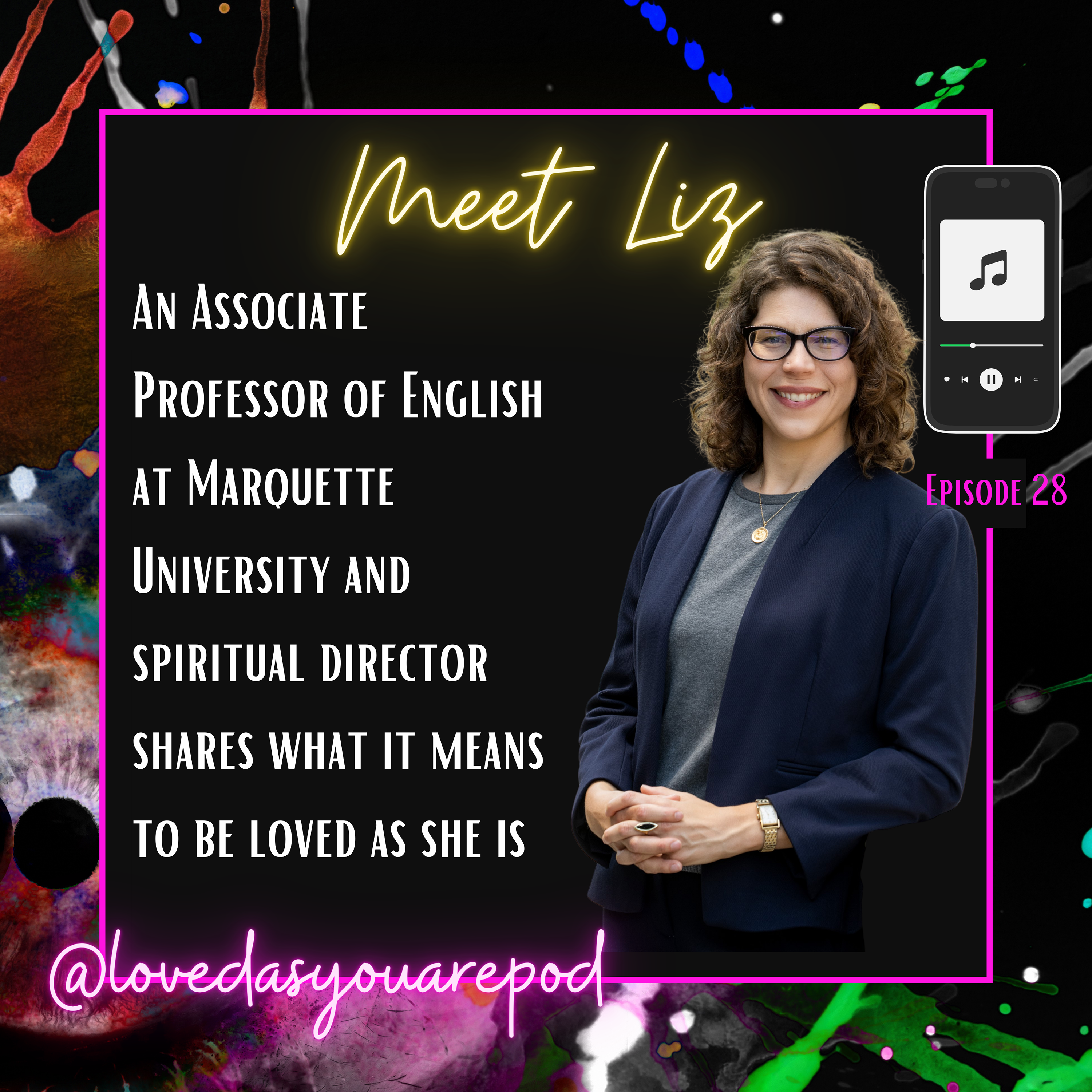
Hello, and welcome back to Loved as You Are, an Ignatian podcast with me, Gresham Crowder. I am so glad you are here. Well, it's been a minute. I think it's true for many of us that January was a full month, not only full of obligations, but also full of sickness as well. For the first time since I was a child, I got taken down with strep throat, and it lasted way longer than it should. Once I got better, I was playing catch-up like crazy. I'm sure many of you can relate, but I'm back and ready to bring you my latest conversation with Liz Angelie. Liz is a college professor, writer, spiritual director, and retreat leader. An associate professor of English at Marquette University, Liz is a company of young adults through personal and professional transitions. At Marquette, she teaches a range of professional and technical writing classes and integrates elements of Ignatian discernment into them all. Her research interests include the overlap of Ignatian discernment, humanity, education, and career readiness. In her spiritual direction practice, she feels especially called to work with LGBTQIA+ seekers and those who are in the discernment process. Liz holds a PhD from Purdue University and a certificate in spiritual guidance from the Sienna Retreat Center. And she is currently pursuing her MA in counseling for ministry at Loyola University, Chicago's Institute of Pastoral Studies. You can learn more about her work at our website linked in the show notes. Liz and I met this past summer as we journey through an online course together, and she enthusiastically accepted my invitation to come on the podcast and discuss being loved as you are. This conversation covers a range of topics and her passion for exploring her spirituality and God's role in her life comes through an every experience she shares. This conversation reminded me why I started this podcast. Because I knew that I could come to know and share who God is and how God loves us. If I was first willing to listen to the diversity of stories and experiences of real human beings, just trying to figure it all out. I think you're going to enjoy this conversation as much as I did. So here we go. [MUSIC PLAYING] [MUSIC PLAYING] Welcome, Liz. I just finished introducing my listeners. And in my introduction, I told them that you and I met just this semester in an online course, and you are currently enrolled in an MA in the Counseling for Ministry at Loyola Chicago. Can I start by asking you what inspired you to go back to grad school after receiving a terminal degree? Yes. Let's say fantastic question. One that I get frequently from people. When I went to undergrad at Merkett, fabulous Ignaisia or Jesuit institution where I currently teach, I was a psychology major. And I wanted to be a clinical psychologist, but I knew after graduation I was not ready to pursue being a clinical psychologist. And now I'm really glad that I didn't, because living life and having experiences, makes me a better spiritual director. It's going to make me a better counselor in the ministry context. But I followed all the yeses and the directions that I was feeling when I was in my 20s. I've got my masters in rhetoric and writing with a focus on teaching English as a second language. And I got my PhD in rhetoric and technical communication with a focus on health care. And a couple years after that, I say graduated in 2012 from Purdue. And then I went to spiritual guidance training in 2018. And I fell in love with spiritual direction. I mean, it just felt like, oh, this is what I have been longing for. Like, I honestly think my whole life. I mean, when I felt called a clinical psychologist, that was the only framework I had in my 10-year-old, 12-year-old mind of this is the field you go into to support people through the journey that is life. And after I graduated from my spiritual direction training program, which was a two-year program, it was a certificate. It wasn't a graduate degree, which at that time was perfect. Because I was like, I don't need another degree. I'm done. I schools grade, I love school. But this is good for now. I really was kind of delightfully surprised how much I loved my spiritual direction practice. And then I was getting invited to do discernment-based workshops and do integrate that into my teaching that I do at Marquette. And it's being invited to talk about LGBTQIA+ spirituality and all these things. And I was coming up against growing edges where I thought, OK, I want to do something about this. And I discern going back to get another PhD in clinical psychology. I looked at society programs. I looked at MDIVs. I got accepted to a seminary and realized, theology is not where I'm feeling called. I think theology is great. It's really important. That's not what really makes me feel alive and free. And then when I found the program at Loyola through the Institute of Pastoral Studies, where we both are, but oh, this is a spiritually informed counseling degree, which is what I have been longing for for 21 years since I started college. And as much as I love Marquette and I love my psychology degree, we had no spirituality in any of our coursework, which I think is a real disservice to psychology students at Ignatian, just what I should say, universities. And I've been only in the program for one semester. And it has been invigorating and life affirming. And doors are already starting to open that I didn't know existed. And I've kind of-- I mean, I'm joking when I say this. But there's part of me that feels like I have three degrees, and they're all wrong. I have three-- I have a terminal degree that took a lot of time and a lot of work. And it's the wrong degree. It's like, no, it's not the wrong degree. This is discernment. My friend, it's beginning to myself. And I'm glad for the journey that I've had, because it's put me exactly where I am today, which is a really, really great place. Well, and I appreciate what you said about having a bunch of wrong degrees to lead you to the right one, because I started off I majored in math and undergraduate. So-- and I taught math for a decade. And the first years of college, I majored in aerospace engineering. And I always go back to those two years. And I say, look, I didn't finish it. But those two years helped form me. I was never meant to be an engineer. But everything I learned in those two years about fortitude and asking for help, all sorts of things, really made me capable of doing other things later on. The other thing I appreciate about what you're doing is, as a high school educator, I think we can always do a better job of making sure that all Catholic educators, all Jesuit educators, have experience in ministry, experience in prayer, spiritual conversation, because those things come up. But also, it's a through line that you can have, no matter what your academic subject is. And so to hear you say that also about universities, I went to Notre Dame, and I know that my aerospace engineering teachers and my math teachers did not talk about spirituality. But I think it would have enhanced their interactions with the students, enhanced kind of the conversation and the ability of relating with the students and things that are often more technical and more distant than other subject areas. Yeah. Yeah. And that's spot on. And you know, we're at-- you mark-- I was one of the leading engineering institutions in the United States, and I taught a discernment class a couple of years ago. And I'm an English department. So all my classes are writing intensive. And I see writing as a way to discern. And I had an engineering student in that class. And he was a fifth year engineer. I had took extra classes and stuff, and part worker. And it was one of those, well, this fills my writing intensive requirements. So this will be fine. And I just-- I always trust who shows up into my classes like that. It's like, you're going to teach me. I'm going to teach you. We're going to teach each other. At the end of that semester, and I actually had to take an unexpected leave of absence halfway through that class because my dad died. And I had a graduate student from the previous semester that I taught the grad version of the class stepped in to go over the class. And I let my students know right after spring break, I said, I'm taking a leave of absence. I'm not checking my email until May 16. I wish you all the best, take good care. And on May 16, when I opened up my email, there was an email from that engineering student who said, I did not think this class was going to be anything. That was relevant or important. But he said, this class changed who I am. I am a different person now than I was in January. And I could not-- I mean, that was a moment where I just kind of stopped in my tracks and just. Savored the moment of, you know, how this is, this is, you know, the universe of work, the divine at work. And, and that's why we need spirituality in all areas of education, not just theology or the humanities. I mean, it needs to be everywhere. Well, you make me think if freshman year in college, besides the other freshman requirements, I could have taken a class under discernment, what I have spent two years in aerospace engineering, you know, what I've gone into math. What would have been different if I had already started knowing what those tools were, and especially at a Jesuit university, like you teach at to have a class like that freshman year, you know, that might be really life changing for students as they go through their experience. Because, you know, you can always go seek out the Jesuits and go seek out retreats, but it's not necessarily something that's a required part of everyone's experience. Yeah. And we do have the theology classes that, you know, the professors teach the spiritual exercises and they do all that stuff. And I know students who are in those classes and they say they're life changing, but, you know, they're not required, they're not, you know, it's hard, it's hard to know what you don't know in any, at any age, but I think really, at college, it's, and that's really where I see myself coming in now. I'm teaching the classes that I needed to have and I wanted to have, but I didn't know. I knew on some level that I was longing for them, but I didn't have the language. I didn't have the framework. I didn't, you know, have the training to know what I was missing. And so it's been, it's just been, it's been great. And I'm really grateful for Loyola to just sort of add to what I'm able to do for our students and for, you know, my own, my own, um, direct ease and my spiritual direction practice too. Yeah. And I'm so grateful that they offer online courses because as you know, we meet a lot of people, we would not normally meet if we weren't in these courses online from a distance. I mean, I'm in Texas and you are, it, you live by market, right? Because you're teaching. Yes. I'm in a lot. I'm in a lot. Yes. So I'm not that far from Chicago. So it's doable to do the first program, but I just thought, I am not spending an hour and a half on the train one way, you know, to sit in class for, you know, 90 minutes to two hours. It's like that's, I'm, I'm, I'm really grateful that they have the online option. It's been, it's been a game changer. Well, and especially since so many people seek out spiritual direction and retreats and that kind of conversation online these days to be able to experience that way, it, that way helps us to be able to do that with other people in the future. Yeah, that's true. It's funny. All my directees and I meet online, even the ones who are in Milwaukee with me. Yeah. It's, I mean, they just, it's easier and it's funny because in my training program, you know, pre 2020, it was, you will not meet your directees on Zoom. You will not talk to them over the phone. This is an in-person practice. You have to learn how to pay attention to the body. You have to learn how to pay attention to energy and you can do all that stuff virtually. It turns out so. Yeah, it's been, it's been a wonderful tool. And for some people, it's more comfortable to do it with that distance, right? Yeah, I think so. Well, I appreciate you saying that you get that question a lot. I too get that question a lot because I keep going back to grad school as well. We must be in love with academics as well as with our subject matters. So, but for purposes of this podcast, I usually do start with the question, because I think it's really important for people to hear all the different ways that people answer this question from all different stories, for all different locations, all different walks of life. So, who is God to you and how did you come to that understanding? That, that's a question I've been wrestling with for the past few years and I, it's, and it's always evolving for me. You know, who God is, is evolving. For me, God is energy, God is connection, God is all forms of life on this planet. You, me, the water that is in my water bottle, my dog who is right there, the fish that live in my aquarium, the trees, it's, it's about connection and compassion and engaging with all the life force that's around us. And I, you know, I grew up Catholic. So, my idea of God, you know, it's funny. I was, I was reflecting on this question before we, we hopped on to record. And I remember the church that I went to, here actually in Milwaukee, and the, the back of the altar is a statue of the risen Jesus. It's all gold. It's beautiful. And around Jesus' body is eternity. So, it's a triangle. And that, I can, I can remember as a kid looking at that triangle saying, that's God. God is not a person. God is not nothing. God is all encompassing. And, you know, and that, and just trying, you know, when you're 10 trying to understand the Trinity, it's like, what is this? This doesn't make sense. But that always resonated with me. And, and I, you know, as I'm, you know, lesbian, I'm queer. I really could not use the word God for a long time. You know, God and the Bible and religion were used as tools by people. I really loved and cared about to tell me that I was less than human and that I was going to hell. And that, you know, my, my quote unquote lifestyle was a choice and not, you know, something that was part of who I am. I worked a lot with my spiritual director to heal and to be able to use the word God. And my spiritual direction training program, which I completed through the Sienna retreat center and Racine Wisconsin, it's ecumenical. It's that the retreat centers run by the Dominican sisters, but the program itself is grounded in the universe story. So it's very much based in cosmology and science and spirituality. And that resonated. That resonated, you know, thinking that, you know, we are all made of stardust. We are all made of stars to quote Moby. I thought, yeah, this is, this is bigger than Catholicism, like this feels like spirituality and what God is. And that, that gave me the, the spiritual guidance training program gave me the way kind of back in to feeling safe using the word God to really kind of claim God as my own, not as something that I was talked and tested on in Catholic school. And then, you know, I really feel like I developed a personal relationship with, you know, I called God loving energy for a long time. And then I just, I feel like I, I found my way back to loving energy because loving energy never left. Even though I was like, I'm going to go over here for a while because I don't know about you. And I just, there's something that doesn't feel right. It's like, okay, now I've got things sorted out and I'm healing and then, you know, learning. So, yeah. Yeah. Yeah. I like, first of all, you said it's hard when you're 10 or 11 to try to understand the Trinity. I think it's hard when you're 42 to understand the Trinity, you know, to try to be able, not only understand it, but explain it to someone else. The thing that always resonated with me is that God is relationship, right? So that triangle that you described because it has three sides that are all connected, that this relationship just kind of flows from one person to the Trinity to the other person to the other person. And so when we think about the relationship of the Trinity, we think about as human beings, we have healthy and we have unhealthy relationships, we have relationships that are broken and then relationships that are repaired and healed. I always see the Trinity as God showing us what relationship should be and what we should be striving for. What a healthy relationship is, what a relationship is that loves us as we are, no matter what. And so what I appreciate specifically about Ignatian spiritual alienation discernment is that you can meet God where you're at and then try to figure out through all the steps of discernment who God is to you and then reunite with who God is to you and community with other people, right? And the other thing is we have in flow our whole life with our understanding of God, our closeness to God. But I think the other thing that the Trinity relationship gives us is that God's relationship with us is never broken, right? It's always us trying to repair and to develop that relationship back to God. I don't know if that makes sense to your experience. Oh yeah. Because it's co-created. And as you were talking about Ignatius, it just reminded me, finding God in all things. And it's one reason I love Ignatian spirituality is because of we find God in all things. And one of my colleagues in theology, his name is Connor Kelly, he's brilliant educator, brilliant theologian. We were working on a chapter of technical communication ethics. And I was invited to write the spirituality chapter. And the editor said, I want you to write about divine command and universal ethics. And I said, I don't know anything about that. I said, you need a theologian to write this. I said, but this kind of sounds like discernment. I can write about that. So Connor and I were talking and preparing to write this chapter. And we got to the free, finding God in all things. And he said, the way I explain this to my students is we find God in all things because we recognize God in items that remind us and bring us back to God. So he said, that it's like, you're like, "I'm gonna go to the bathroom."
of a relationship with them. And you have to know God first, right? So like, you know, I mean, I'm just talking about, you know, my dad, I see things that remind me of him. I hear songs that remind me of him. I smell things that remind me of him. And they remind me of him because I've already had that previous relationship. And so I love that concept of, okay, well, you see a squirrel and that reminds you of God, okay, well, what is it about that squirrel? That connects you back to this relationship, to this co-creation, you know, co-creation. And I just always thought that was such a beautiful explanation of, you know, that phrase. And why, you know, it's, I know sometimes people are like, "Oh, isn't that pagan?" Finding God and all things like, it's like, well, if it is, okay, you know, I don't have problems with that, but, you know, it's some, but it's like, no, it's God's everywhere. - Yeah, well, and God created everything, right? So when you create something, a piece of you is left behind. Just like when one of my sons loves art and every time that he does something artistic, I'm like, I feel like you just left a piece of yourself behind in that painting or in that whatever you made out of cardboard that I don't understand, but you think it's beautiful. So I feel like that's the same with God. Like God created all of us, created all of creation. And by doing that, God left a piece of God behind in all of that. So of course, we're going to find God everywhere. And sometimes it's helpful when human relationships have been fractured, that we can find God in other things that can lead us back to figuring out what human relationship should look like, what healthy relationship should look like and how we can reform those. - Yes, yeah, I think that some, that has been a powerful way to see the world, you know, and I think that's been a real gift. It reminds me of a story, as it okay for me to elaborate on this, I'm not okay. So I know in class I shared this and I've written a tiny, tiny bit about this on my website, but my uncle was murdered five years ago. Over, he was a landlord, his tenant killed him over a $30 rent increase. And there is a lot that has happened in those five years since my uncle Bill was murdered and Jason, the man who killed him was found guilty, not guilty due to mental illness. And so Jason is never going to go to jail. He's never like, he's at a mental health, minimum security facility right now, getting the mental care that he needs, getting the support that he needs. And we had a hearing earlier this month, no, I don't remember the dates. I believe it was, it was a couple of weeks ago, but we had a hearing for Jason's conditional release because his forensic psychologist feels that he is rehabilitated enough to join the world. I had, I still have a lot of feelings about that. I'm holding, rage about the fact that this happened and Jason has a 20 year history of felonies before he killed my uncle. And the system has failed, Jason multiple times. And therefore, the system has failed. Everybody else who Jason has impacted and he has not gotten the mental health care that he needed long time ago. But this time when we went to court of earlier this month, this was the first time that my family was given the opportunity to speak. In five years, we've never been given the opportunity to say anything. My mom, my uncle Bill is my mom's brother, my mom's oldest brother. And so my mom read a statement, I read a statement and my cousin read a statement who was my uncle's daughter. And when I got to the other side of the glass, I was sitting next to the prosecutor, the assistant DA who's been representing my uncle. Jason wasn't there in person, he was there on Zoom. And I turned to look at him. And I knew he could see me because the camera was there. And I feel like I saw him as a person. You know, the first time I ever saw him was about seven days after he killed my uncle. And it was scary. I've never felt such dark, evil energy in a room ever. And it was draining for a lot of reasons. And that was one of the reasons it was just a very, very difficult day. And the more that we progressed through the court system, Jason was on medication and he was seeing a psychiatrist. And he said something once in court to his defender. And I just had this moment of, oh my gosh, you poor human. You are mentally ill. You need a lot of help. And then I felt guilty for feeling compassionate towards this man who has taken away one of my favorite people of all time and created this ripple effect in my family that we are still working to heal. I feel like so a couple of weeks ago, after I read my statement and really saw Jason, I was able to see him through the eyes of God. And I thought, you are a human who has every right to live the best life that you can have. And if that means that you have to try to do that out in the world, with me and my cousins and my God sons, who are my uncles, God, my grandchildren, that's how it's going to be. And I have to not live in fear that, you know, I'm not protected anymore. And I have to trust that this will be okay. And as soon as I was able to see him through the eyes of God, the rage lessened significantly that I had towards everything. Him, the system, you know, the people who failed Jason for the past 20 years. And I felt empowered and I felt peace. And I never thought that I would be one of these people who would like, you know, you see true crime stories and everything. And I used to watch them and I don't anymore because that's my family's real life. And I just can't make entertainment out of somebody's trauma and pain. I thought, oh my gosh, if this happened to my family, I would, I'd be, you know, burning down the courthouse and I would be seeking vengeance. And this would, you know, my, I would not let this happen to my family. And here we are. And, you know, I said what was on my heart. And, but I don't, I know that I wouldn't be able to, I wouldn't be here. You know, with the level of kind of acceptance and compassion, had it not been for spiritual, my spiritual director, my therapist, you know, my friends, my family, and just and really, Ignation spirituality of this, you know, Ignation and difference. Okay. As you can have all the feelings that you want, but you are not the one who's in control of this. And what, what is my spiritual director has told me many times, God wastes nothing. And so I think, okay, well, this is pretty, this is a doozy of a situation to make sense of. And, you know, but Jason and I are, we are now connected for the rest of our lives. And, you know, kind of seeing him as a, as a teacher in some ways. You know, I don't know, that, that's what was come into mind. No, I appreciate that. A couple things. The first is when you said, can I tell a story? I was thinking before I got on to do this recording, I just published another episode today of a different person story. And I think the only way we come to know each other, but also the only way we come to know God is by being open to listening to other people's stories. Right? Especially people who have a story that, that you don't also share. Right? So you can, you can see yet another perspective, yet another way of, of viewing God, not only God is a distant divine figure, but also as God and another person. The other thing I appreciate it from your story is when we talk about forgiveness, sometimes we feel like, no, I can't possibly forgive another person because we're thinking about the other person not deserving that or not being ready for that or not receiving that well. But in the end of your story, I was thinking forgiveness is what heals you, right? So you were able to let go of things that were keeping you from living a full life, right? From keeping you from moving on because you were able to, you know, take God's hand and work on forgiving this person. So I think that's a really beautiful example of what forgiveness can do. But also you said it takes a really long time. And that's also important for people to hear too, right? It may take five years, it may take 10 years, it may take dozens of years, right? It's kind of a journey. And that God is with you through that whole journey, right? Even when you don't feel it. Yeah. Yeah. And you know, it's interesting. I don't, I don't, I don't feel or know that I'm at forgiveness fully yet. You know, I would like to pursue restorative justice with with him. And some of my family members are potentially interested in this too, because I would like to have a conversation with him. You know, I've never heard him speak. He's, I've never heard him apologize. I've never heard him take ownership for what he's done. And that would be helpful.
to here and but I at least see that he's not deserving of living a miserable existence in solitary confinement or whatever, which I mean there was a moment where that's what I wanted for him. I was like I don't know and I have relatives who want to bring back back you know the death penalty and I just I told them I said for me that that's not justice. There will be no justice with this. I mean it's it's terrible and awful and you know the only thing that I can do is you know seek forgiveness and work towards you know and really as inviting loving energy to help with this and you know give me strength words wisdom whatever to help myself through this and my family. Yeah because it's been it's it continues to be to be a journey. And also as you're pursuing an MA and counseling for ministry you have this yet another touchstone experience that may help somebody else in the future that's in his situation that didn't have kind of the interaction or the encounter early enough to change their direction to change their course of life. But you and more people who are not only helping in spirituality and spiritual direction but also who are going to help in the mental health fields as well. You get an opportunity to really make a difference and I think that story will help in bold and you to do that. Yeah. Thank you for that. So it makes me think because you said it you know Ignatian spirituality really helped you not only in this situation but also in your understanding of God in general. When did you come to know about Ignatian spirituality? Was it in college for the first time? Was it before that. Well this is another question I was I was thinking about and I don't know I don't remember the first time that I learned about it I do remember when I was considering applying for college I remember my dad and my grandparents so my dad's parents always talked about Jesuits. I was like I don't who are these Jesuits like we're friends with a bunch of priests but I know they're not Jesuits like and I had a cousin distant cousin who was a Jesuit for a hot minute in Chicago. But my dad just always say you know there's no education like a Jesuit education. And I thought okay well what is special about a Jesuit education and he's like Liz they're going to see you as a whole person. So we're going to get trained in the liberal arts so you will be able to have a conversation with anybody who you meet you will have common touch stones of you know having read about philosophy and theology and English and history and I thought okay well I want to be a holistic well rounded person you know that because connection is really important to me relationships important to me. But I didn't know who say Ignatius was I just knew that Milwaukee had market university and it was run by you know priests so I even you know even when I was at market I don't know if I knew what Ignatian spirituality was and I'm that that's hard for me to say because I want all of my students to know what Ignatian spirituality is and they do I mean if you take writing for health and medicine with me we are going to talk about saying Ignatius. Like that's just the way it's going to be but it's um but I you know I I don't think it was until I came back to market as a faculty member and you know in 2016 and went on my first silent retreat and met who ended up being my spiritual director in a hallway of that retreat and just you know starting to have a conversation of oh yeah there's this guy named saying Ignatius. Oh yeah he started the Jesuits oh yeah he lived 500 years ago and but you know once I learned about it I knew that Ignatian spirituality had been with me forever and you know I was in a I in addition to really feeling aligned and resonate with you know with Ignatius I was an associate member of the school sisters of St. Francis who are had quartered here in Milwaukee and they they're Franciscan and when I had to do my you know discernment to decide you know to be an associate or whether or not to actually join the order which I had been discerning Franciscan Charism is beautiful I love creation I love animals I think you know caring for people's important but I never felt that shimmer of resonance like I I have with St. Ignatius like there's something that for me just has more vibrancy and life and energy and movement with you know the Ignatian Charism and the nation spirituality you know more than the Franciscan as much as you know I love it and I those those nuns are they are my people I just and that's why I'm always mad it's like I'm really upset that I can't be a Jesuit like this is this is deeply unfair and I'm not going to change it in this lifetime so I'm just going to have to let that go so you know it's interesting I feel like I've learned a lot about St. Francis and ever since Pope Francis took St. Francis's name because in both of the the other one brothers and sisters all he referenced in the introductions he referenced St. Francis and really how St. Francis connects to why he was passionate about these topics so I do feel like even though the same thing I don't feel like called Francis and I think I'm going to do Ignatian spirituality there's such great overlap and a lot of it is about love of creation love of other people and that idea that God is loving creation and other people as well so yeah absolutely I think that is the through line you know of of of the two of them and they're just their orders that are out in the world you know doing stuff and you know the school so so St. Francis were the second order in the United States to get rid of their habits after Vatican 2 I mean they were just like we're done we wanted to do it. We're done we want to be like the people who we minister to you know it's we're we're out and we're taking our names back you know and they're they were I mean they're just they're an incredible incredible group of humans so but there's a lot of that sort of in and of the world with both of those two. Yeah and I think you said it earlier in this conversation that you felt like you couldn't effectively minister to other people effectively spiritually counsel other people until you had more experiences yourself so I think that maybe one of the things that we're so drawn to with the Jesuits but also you know with the Franciscans is that they have experience and the world and they draw on that experience to then be able to help other people and spiritual matters which is so effective when you're talking to somebody. That really has lived in a variety of places seen a variety of things and can bring all that to the table. Yeah that is very true that is very true. Well you enthusiastically agreed to go on to a podcast called Loved as you are can you point to a particular moment or story where this understanding of being loved as you are started to resonate and become real for you. Yeah I know the exact moment where that felt real and it was when I named my sexual identity as lesbian and queer like that has been I one thing I wish we talked more about when we talk about discernment is sexual identity because I think that that is that and I mean that's really where queer folks have a lot of experience it's like yeah we know what authenticity feels like because we have had to. Figure out like why am I not like society is you know projecting patriarchy white you know heterosexuality all that stuff and it was as I started really discerning like okay you know something I've always felt. I don't like saying I always felt different because I think everybody feels like that you know we're just unique unique beings but there was just something that never felt right when I was dating cisgender men and I was married to a man for just under three years and just things just did not feel right and finally when I gave myself permission to really start exploring I felt I never forget this I told my spiritual director I said I feel like. I feel like I have been wearing a giant cape of feathers and it is slowly starting to lift and he was like feathers that's interesting I said it is because feathers are light and so this cape is not going to take that much to take get to you know move but it's been here and it's been weighing me down and I think I've been letting it weigh me down because I just haven't figured out how to take it off and when I started you know dating. I started you know dating women and it's like oh you know I'm afraid to call myself lesbian because that word in particular has been used drogatorally around me since I was a young child. I mean we have in my family and thankfully never my parents I am so grateful for the parents I have because they open loving warm they are the second parents to many of my closest friends I mean my parents always said you know we've got two kids. We really have probably about 15 between like my closest friends and my brother's closest friends but. I come from a family of very strong independent women and some of those women never got married and so it was always oh hush hush you know so and so is not married because it was me.
you know, they're single because they're lesbian. And you know, it's, and I was like, what is the big deal? Like, who cares? Why is this hush hush? Why is this a huge secret? And, you know, and then I started realizing, okay, it's people've got some homophobia that they got to deal with. And, you know, I even when I rewatch shows from the 90s, like I watched how I met your mother for the first time recently. - For the first time. - For the first time, yeah. And I was shocked in the first season, lesbian is used drogatorally 10 times. Gay as in like gay men is used drogatorally much less than that. I think it maybe is two or three times. And I just thought, oh yeah, this is why I had that cloak on me because not only was I getting messaging from my family about this, but also from society at large. And I just thought, okay, well then when I started discerning, I thought, okay, well maybe I'm bisexual. I was like, no, that doesn't feel right. Maybe I'm pansexual. Maybe I'm just attracted to the person. I'm not attracted to gender. I was like, gosh, that's not feeling right either. And, you know, I am talking to my spiritual director about this. And I said, you know what, this is feeling like. I said, I feel like I am holding on to the last semblance of heterosexuality because I am terrified of what happens. When I fully let go and just embrace who I feel I really am and just claim it. And so when I did that, the final quote came off. I felt like I have been fully showing up for my life for the first time ever, you know, in high school. I was pretty, you know, out there and like I don't care what people think about me. And something happened in college where it just completely changed. But it, and I just thought, okay, this is what it feels to like, this is what it feels like to fully show up for myself, fully show up for other people. And somehow I can feel God's love more than I've ever felt before. And so this messaging of that, you know, you know, being gay is against God's will. I'm like, that is, that's not true. And I know it's not true because I feel it and I know it in my bones. And, you know, it's, I just was, it just felt like relief and acceptance and then I felt other people's love in a way that I never felt before, you know, like my dad, when I told them, I said, my parents said, you know, I'm much more likely to have a wife before I'll ever have a husband. And my dad just like, okay, I said, do you hear what I'm telling you? He's like, yeah, he's like, do you want to watch another episode of RuPaul? We were watching Drag Race at the time. And I was like, do you hear what I just told you? He said, yeah. And it's fine. And I said, okay, great. Like that's awesome. Like I didn't, I knew my parents were gonna have an issue with it. And you know, my mom said the best thing, I think a, you know, a kid could ever hear. And I was an adult when this happened. And I still think of myself as a kid with my parents, you know. My mom said, you know, seeing what you have been through with your relationships, all that matters to me is that you have a partner who loves you, who treats you with respect, who is honest, and that you feel the same way about. She's like, so whether that's a man, a woman, someone who's trans, she's like, I don't, it does not matter. And I thought, thanks. And I said thanks. I mean, it was, it was just like, I felt, and I know like my parents and I, they're very, you know, we're close. We've got a great, healthy relationship. And I felt their love even more at that point than I ever thought possible. And, you know, that, and my friends, I just have the most incredible group of friends who really are my family. And I think some of them were like, what took you so long? I, you know, welcome to, you know, the Liz that we have known has been in there since high school. And, you know, it's like, yeah, you know, thanks for supporting me through this, you know, 20-year-long discernment. And so I think, you know, I knew that God loved me as I was through the people that I choose to have in my life and to really make my family. I see God in them all the time, you know, whether or not they're religious or spiritual or whatever. I know that that's God showing up for me. - I love what you said at the beginning, you use the word authenticity. And I also like the image of a coat of feathers. Because I think that all of us for a variety of reasons struggle with authenticity at some point in our lives. And it could be everything from what are we actually meant to do with our life, to whether we're supposed to be single or married or, you know, all of these things, what societies' expectations are, what our expectations are, what are God's expectations. And so as we struggle with this authenticity, we can always, many of us feel like we have some kind of coat full of feathers or sometimes lead that we are just trying to work through. And so I think even if people don't have your exact story, they can resonate with that idea of how they came to know their true authentic self or how they're still trying to come to know their true authentic self, right? An Ignatian spirituality really gives you, I mean, the spiritual exercise in particular make you wrestle with every part of yourself, right? It really makes you figure out what your past, present and future mean and really engage in one-on-one conversations with God, which I think that we can often be struck by the fact that God has some communal responses to us, but God also has individual responses to us. And we have to honor both. We have to be able to know what God is saying to us individually, as well as what God is saying to us in a more communal way. And we have to be able to discern where we see God in those things and where we maybe don't see God in those things and whether or not we should see God in some situations. There are reason why I chose the theme of being loved as you are no matter what. I think that the first of all, the spiritual exercises kind of beat that into my head as I was going through them. But also, I think this is what stands in the way of many of us being able to treat each other well. Our own understanding that someone God loves us as we are no matter what. And our own insecurities often are the reason why we take it out on another person or why we treat others not as we would like to be treated. And so I know that I'm constantly working on that understanding that God loves me as I am, particularly when I mess up or particularly when I feel uncertain about something, but I think the more that all of us work on it, the more we'll be able to love others well in maybe a way we couldn't before. - Yeah, yeah. And I mean, I feel like that's moving into greater freedom. Like for me, perfectionism has always been a driving force, a goal, you know, I've really struggled with that. And I now, when I make mistakes, sometimes I fall back into my patterns of beating myself up and, you know, and I'm also like, if you know the anyogram on the one on theogram, are you okay? And I'm also, that doesn't, that doesn't, I love that. I just like, I know sometimes I'm like, yeah, this person might be a one, but I'm also a Virgo. And so I am, I have a, actually, I see an astrologer who used to be a nun. I see her every year. And when she did my natal chart the first time, she, I'm a Virgo with Virgo rising. And I saw and she looked at me and she said, what's your anyogram number? And I said, I'm a one and she said, oh my dear, it must be so difficult to be in your head. And I said, yeah, it is. I said, my alarm on off at 5.30 this morning, and I was on summer, quote unquote, summer break. I work over summer even though, you know, people have this idea that teachers don't do anything over summer. I said, yeah, it's summer. I woke up at 5.30 and my first thought was, why didn't you get up sooner? You should have gotten up earlier because you could be getting more work done. And I don't, I don't do that anymore. But I thought that's, I'm like, oh my gosh, this woman is seeing me for who I am in like my real struggles. And now going through the spirit, I've gone through the spiritual exercises and all the inner work that I have been doing through spiritual direction and therapy and 12 step programs. I can laugh at myself and it's okay. And I can be rejected from opportunities that I'm excited about and that's okay. And I know that it's changed the energy in my classrooms and if the students point out something that's wrong on our course management side or something, I just say, hey, you know what, thanks for catching that. I appreciate that you're paying attention to details. I'll fix that right now. Whereas, you know, 15 years ago, it would have been, I was too insecure to hear that. It was like, okay, they are critiquing me as a teacher and I'm a terrible human being and I should have caught this and I can't admit that I made a mistake because that'll mean that I'm imperfect and that means I have no value and I have no one. And it was just this exhausting mental tape that I just don't have anymore and it's been one of the greatest gifts that I've given to myself is just kind of cut that tape off and then, you know, I'm able to see people,
like you were saying, as being fully human. And when a student needs an extension for a paper, it's like, thank you for having the courage to ask and knowing that that's what you need. When can you get that project in? And they'll say, well, I really just need another 48 hours. Perfect. That's great. You know, I probably won't grade it for another two days anyway, because I've got all these other papers I have to grade. So we're good. So it's just like for me, that was a lead coat that I didn't know I was wearing. And when the perfectionism sort of started to dissipate and turn into something that was actually really helpful, I was like, oh my gosh, this is what it feels like to just be a human who makes mistakes and learns from them. How cool is this? Yeah, I think that is something I am constantly working on. I do feel like when I allow myself to make mistakes and it works out OK. I learn a little bit more. A friend of mine sent me when I did the Anya Graham test a while back and said, oh, I'm a one. She sent me this, I guess, this group called Sleeping at Last has the album for every one of them. And I love the lyrics for the one. And in fact, I think it relates to more than just the one. But it was that idea says I want to sing a song. We're singing, I'll write an anthem worth repeating. I want to feel the transformation, a melody of reformation. I'll hold it all more loosely and yet somehow much more dearly because I've spent my whole life searching desperately to find out that grace requires nothing of me. I loved the line of grace requiring nothing of me because I think that is the thing. That idea that if we understand that God loves us as we are in a showering us with grace, even if we do nothing to earn it, people will say, well, does that mean that you're saying we don't have to do anything? Is it no? We do nothing to earn the love. But when we accept the love, we want to do more because that's the relationship, right? We want to repay the relationship that God has for us. We want to be partners in that relationship. And so then we want to do things, but we don't have to do it anything to be loved by God in the first place. And I've totally forgot about sleeping at last. We covered the Enneagram and my spiritual guidance training program, but I've been working with the Enneagram for about 22 years. And I never heard of sleeping at last. And we listened to it as a cohort. And I just thought, this is beautiful, like putting music to this and that line of grace. I mean, I feel like my life, I used to approach my life by cleaning tightly. And it was just this, I have to be in control of everything. And if I'm not in control of everything, my life is going to fall apart. And I mean, it was a product of, my dad was a high function in alcoholic. And growing up in an alcoholic household, it was chaos in a lot of ways. I just never knew what I was going to come home to. And I'm the oldest. And so I felt like it was my job to take care of my dad. And my mom and everything was good. If I was in control, everything was good. I was safe. But when I slowly started to realize, OK, you have to open your hands up and let them go in order to let grace and God in. And I was like, well, that's what-- and when I started working the 12 Steps in Allen on him, like, well, this is what surrender is. It's letting God in. Instead of keeping God out, because I had no room in my life to let-- and I knew God was trying to come in. I've had extraordinarily powerful moments of deep knowing and synchronistities that can only be explained by things that are unexplainable. And that was that idea of surrendering as an act of letting go into as a phrase, one of my spiritual guidance mentors uses. I just thought, oh, yeah, that's it. I have to-- I know that phrase, you've got to get out of your own way, which I struggle with. But it's more like, I like thinking of my hands being open to just whatever is possible. And then I'm a conduit for that. So-- So what are the spiritual practices or other practices that you have to help keep your hands open, to help keep you remembering that you're loved as you are? I go on silent retreat one to two times a year. That's, I would say, the big practice. I go on a five day silent retreat every winter. And then a weekend retreat usually once, sometimes twice a year. I find silence to be the most important spiritual practice for myself. And I never thought I would be saying that ever. I mean, someone once called me an extreme extrovert. And which I mean, is true in a lot of ways. But since I started going on silent retreat, I thought, oh, my gosh, I love a quiet house. I love not having the radio on. I love not having stuff on in the background. I just find that loving energy's voice and presence is loudest to me when I have nothing to distract me and pull my attention away. So I would say silence is one of the biggest things. I'm a cyclist. I'm a road cyclist. And that has been really a spiritual practice in trusting my body and connecting with nature and seeing the world in a different way. And really, my cycling family has shown me so many instances of God showing up. Like, if someone has an injury, they're there. And it's also like, I've done some pretty major bike rides by myself. And one ride, it was up until that point. It was the longest ride I'd ever done. I was doing 50 miles in a day. And I was on a trail in Illinois. I did not know where it was going to be. No idea where I was going. One of my best friends was support for me. She was meeting me like every 15-ish 20 miles just to make sure that I was OK. But I just remember thinking, what if I get lost? What if I run out of water? What if I get a flat? And every time that I needed assistance, somebody would show up on the trail. And they had exactly what I needed. And that reminds me that I don't have to have all the answers. I can prepare as much as I can. And at some point, God is going to intervene and remind me that I will have what I need and the universe will provide the rest. And that biking really has been a spiritual practice for me. And it never fails. It never fails. I mean, I got my first flat a couple of years ago. And it was a new bike. And my friend was with me. And we didn't know how to change tire because it was tubeless. It was all this stuff. And this guy shows up. And he said, do you need help? And I said, yeah, I said it's a brand new bike. I can't believe I got a flat. These tires aren't supposed to get flat. They're tubeless. They're supposed to self-seal. And he said, oh, yeah, no problem. He changed the tire. I wanted to give him $20. He said, no, I'm good. And my friend said, as he was riding away, my friend said, hey, what's your name? And he turned away. And he said, you know, he turned around and said, hey, my name's Mike. And that was my dad's name. My dad had died two months before that. And I immediately started crying. And my friend Jen said that was no mistake. And I said, I know. I know. I said that is God. And that is my dad making sure that I am always cared for and watched for. Since he can't do it here anymore in person, I just-- so like also connecting with my dad has been a spiritual practice, too. Has-- Yeah. I love that there's such a variety in your spiritual practices because often we think that, oh, running can't be my spiritual practice or doing a group fitness class on the weekend can't be my spiritual practice. But if we truly believe we can find God in all things, then we can find God when we're working out. We're exercising. The other thing I like about your story with the flat tire is that when we start practicing Ignatian spirituality, start practicing finding God in all things, we're attuned to those moments when God shows up. Like in another person whose name is the same name as your dad, whereas if we-- maybe if you weren't as in tune with God being in all things, you might have missed that interaction, if it hadn't been a part of the development of your spiritual practice. Yeah. And like the gift of being able to share these things with people, you know, like my friend, that particular friend Jen, I mean, she's deeply spiritual. And just that-- she said it before I even could. I mean, that sort of recognition of, oh, you feel this right now, too. We are in this together. And we are having a God moment that we just will never forget. I mean, it's been-- it's just been powerful. But yeah, I mean, I used to always think it was cheating when I would say, oh, I'm going to go ride my bike as a way to connect with God. And finally, I had to pause and say, you know what? No, this is-- this is-- you know, I-- you see lots of wildlife, too, when you're bike. And it's-- you see them in a whole different way. It's-- it really is God in all things, including the bicycle. Yeah. And those-- that counseling for ministry or the spiritual direction certificate that I'm doing. Yeah, it's--
It's giving us an opportunity to hopefully help other people find language for these spiritual interactions and find a way to have conversations with other people about spirituality. Because you're right. It's kind of disconcerting when you're trying to talk about how God shows up in your life and you don't know if somebody else is going to understand when you're sharing it. Instead of you able to not only have the language but also have the connections with other people that you can talk about spirituality, that's the way it grows, that's the way your relationship with God grows. So the more we can provide spaces where that's comfortable and available to people, the better. Yeah, and not standing in fear when those opportunities come up. I used to stand in fear all the time. When I was at public schools, I would never. I mean, the first time I talked about being Catholic, someone in a cohort ahead of mindset aren't too smart enough to be an atheist. And I thought, well, there goes that. Like I'm not going to be able to show up here freely as myself. And luckily I had professors who were openly practicing religious folks. And I went to a Piscopal Church with them. And it was wonderful being able to worship with them on a Sunday and then talk about my dissertation on a Monday. It was really good. But I don't live in fear of that anymore. It's like, I'm going to talk about the universe and I'm going to talk about energy that I feel. And if you think that something is wrong with me, that is your problem. That is not mine. It's like I can support it. It's, you know, you maybe have, you maybe you maybe be invited to do some work. That's what I always take. It's like, I wonder what you're being invited to right now and what I'm being invited to as well. So there's always invitations every day. For sure. There are. So that probably brings me to my next question because it really does hinge on invitations. What do you think is most challenging for people at the end of 2023, the beginning of 2024? You know, that's right, where we are right now, recording this conversation. What do you think makes it challenging for people to understand their belovedness today? And what invitations do we have to help with that? Yeah, I think we so lack community and technology, I think, can help with that in a lot of ways, but it's mediated. I mean, it's, we're mediated right now. And I mean, as close as I feel to like our, you know, the class and the folks in my small group from this semester, I always wonder like, oh my gosh, I can't wait till we really meet in person because I just think this is going to be explosive in the best way possible. But I am, I just see the isolation and the longing happening at the same time. And, you know, religious institutions are changing and shifting and I hopefully, you know, they're moving in a direction where they can be more open and inclusive to welcoming people instead of shutting out like so many people have felt for so long. But I think that prevents us as we don't, it's hard to see it in other people. Because we're not taught, you know, values are something that I don't know is taught in school. Like I teach my students that and we help, we talk about identifying values, but they're 20 years old. And I hope that this isn't the first time that we're talking about, you know, values that are guiding their lives. But it's some, it's, I mean, I just, it just pains me when I see two people sitting next to each other and their, on their phones or, you know, and I know that phones are not that end all be all, it's how we use technology that, you know, and books are a technology too. So I mean, you know, people at one point were sitting in the same room reading the newspaper together, but there's something about the phone that I think is, I mean, it's designed to be addictive. It's designed to pull us in and then pull us away from the world around us that it's significantly impacting our ability to see, to like actually see each other and then to feel love and connection with one another. And it's some, I'm, I'm deeply concerned. I'm deeply concerned that we have put too much faith and too much trust in technology. We have not remembered that we actually are the ones who are creating all this technology. Therefore, it stands to reason that we're smarter than it because we're creating it. And there are things that it can't do that we can do and we can feel and I just don't get this poll to try to replace human ability or enhance human ability with technology for everything. Some things I can understand, but it's just as, I just wish we could bring back, you know, our awareness to ourselves and each other and that has to be unmediated and it has to start with being willing and open to look at yourself first. And that can be really scary. Yeah. I think about how we talked about earlier in this episode, stories are so important, hearing other people's stories are so important. And what I find is that I will be able to find somebody's story easily because I have access to social media and I'll engage with it and I'll be like, oh, I'm so glad I got to know this person's point of view. And then I will inadvertently or on purpose engage with the comments on the story or the reflections on the story or the interpretations of the story. And then I'll be so confused about the initial story that I engaged with or the person that you know, I tried to get to know or the situation I tried to get to know. And so I think there's a beauty that we can connect with so many different people that we were never able to connect to before. And there's also the danger that we won't be able to really trust in another person's experience because we already know everyone's interpretation before we're able to discern our own, before we're able to just listen and say, what do I think about this? We already know what everybody else thinks about it, which makes it hard to hear the voice of God saying, God, God, saying to you, this is what I think about this, you know, like we hear what everybody thinks that we try to combine it into what God thinks. But we need that silence that you talked about. We need that distance so that we can figure it out. We can discern and we can pray. We can say, God, what do you think about this? What do you think I should do with this information that I now have, this knowledge of another person that I now have? And then how do you want me to help it love myself better and then also help me love that other person better too? Yeah. Yeah. And that's, I was with a spiritual director friend of mine a couple nights ago, Nikki Nelson. And she was telling me she read a study by, I think, as a neuroscientist that said in scrolling on social media for half an hour, we consume the same amount of stimuli that someone in the 50s consumed in a week. In 30 minutes, we can say, and she was just saying she's like, no wonder we are overstimulating and exhausted and stressed and burnt out and all the things. She's like, we just, we don't get a break. And you know, it's exactly what you're talking about. We're bombarded with perspectives and stories and stimuli, which can be great. But we have to know how to be in relationship with that and not let the machines dictate what we do. I mean, and it takes a lot of awareness of, oh, you know, I'm like, I need to put the phone down. I need to just put it away, maybe I need to put it in another room to just your right to let things sift and settle and just kind of see where they're going to land within me. You know, to before I decide, what am I going to do next with this? Yeah. Yeah. Well, it was a wonderful being in class with you last semester. I'm sure we'll be in class again, hopefully, before either one of us finishes. And so I'm sure this will not be our last conversation. And thank you so much for coming on the podcast today and having this conversation with me. Well, thank you so much. This was really lovely. I was looking forward to it. Thanks. Thank you. [Music] As I was listening back to this recording to prepare for you, I was just going to say, I was also struck by the insight she shared. I'm so grateful for Liz and every guest that is willing to share their story on this podcast. As let starts this coming week, I will be adding in a few episodes that will introduce you to a prayer exercise based on this idea of being loved as you are. I hope you'll join me in prayer this lent as I work to bring you even more conversations in the near future. If you think you or someone you know has a story to share on this podcast, please email me at
[email protected]. You can follow everything related to this podcast at lovedysurpod on Instagram and at gretchencrowder.com. So until next time, remember to be who you are. This is exactly who God wants you to be. [Music]
(upbeat music)
 PodcastTranscript AI