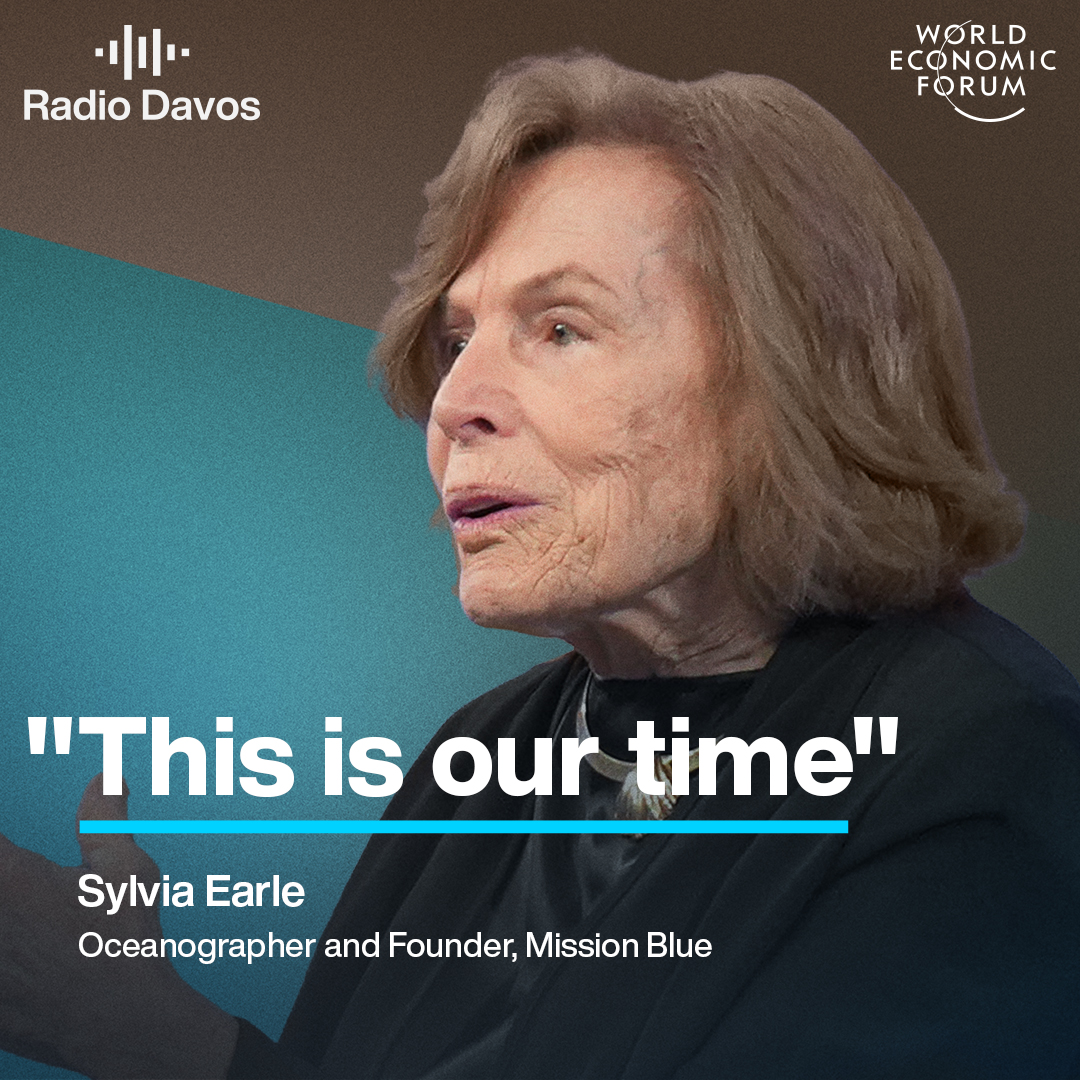
Ocean explorer Sylvia Earle: the best time to be alive is now
28m 21s
Sylvia Earl, an esteemed ocean explorer, reflects on the unprecedented era of exploration and opportunity, provided we prioritize the preservation of Earth's habitability. She shares insights on the technological advancements enabling profound oceanic discoveries while cautioning against the detrimental effects of human actions on nature. Earl emphasizes the critical need for immediate measures to safeguard marine ecosystems and biodiversity. She underscores the significance of individual and collaborative efforts in addressing environmental threats and advocates for a shift towards sustainable practices and conservation initiatives to secure a prosperous and habitable future for all.
Transcription
3897 Words, 20957 Characters
We're just at the beginning of the greatest era of exploration, of opportunity that there's ever been as long as we can maintain the habitability of the Earth first. Welcome to Radio Delos, the podcast from the world economic forum that looks at the biggest challenges and how we might solve them. This week we meet an explorer, Sylvia Earl, is a scientist who's explored the oceans. She was one of the first people to adopt scuba diving equipment in the USA and she's been a pioneer of submersibles in the ocean. There's submarines like spacecraft, you, you. It's not just putting instruments down there but you can go. The average depth of the ocean is where the Titanic rests. It's four kilometers down in the maximum as 11 kilometers. And we now for the first time can have access from the top to the bottom, everything in between. It's the first time in history that we've had that capacity and we're realizing the magnitude of what we don't know. By some estimates Sylvia Earl has spent a whole year of her life underwater and she's brought back not only vital scientific insights but also a message of hope. I think if you could be born anywhere in time, especially if you have an inclination to want to make a difference in the world, choose now because never before could we know what it's now known and never again where we have a chance as good as we now have. Follow Radio Davos wherever you get your podcasts or visit Weft.com/podcast and you can watch this episode on our YouTube channel. I'm Robin Palmer right in the World Economic Forum and with this conversation with Ocean Explorer Sylvia Earl. This is our time, never before could we know what we now know. It's the best time. Get busy. This is Radio Davos. Sylvia, delighted to meet you, how are you? Doing great and so pleased to be here with you. I'm very pleased to be here with you. You have spent a life looking at the ocean being in the ocean. I think I heard someone where you've worked out how much time you've spent in the ocean. Not enough, yeah. But it's a good start. What changes have you seen happen to the ocean over your lifetime? Well it's been a privilege to be on the planet during this era where we have developed technology. That gives us the power to go to the moon and know what he'd done that when I was a child. To go to the deepest parts of the ocean and to look at the ocean that is not the bottom, it's not the top, it's all that in between plus the top and the bottom. But technology cuts both ways. It gives us this immense new power, not only to explore, but to communicate on a scale that is unprecedented. And when I was a child or during all preceding human history or the history of life on Earth, no species has been able to come to the point where we are a global force of change. Changing the nature of nature. So we've learned more in my lifetime about who we are, where we come from. What is the future? How can we live on this little blue miracle that we call Earth in a long and enduring way? But at the same time that we're looming so much, we're also losing so much because the technology enables us to clear cut a forest. And they have been thousands of euros making that forest, with a history that goes back many millions of years before we even existed. And we can do that in a day. We've always taken from nature, used trees to build houses and light fires and many other ways. It's not just trees, it's all of nature that we have consumed aggressively and comprehensively on my watch. So that since the 20th century, now into the 21st, we've managed with the technology and with our growing population, now 8 billion of us to consume about half of the living world for our purposes. I mean, half just to feed us with fields and farms and taking the water and converting wilderness into human spaces. The good news is, we still got some nature in place. There's still are places that thousand-year-old trees and the system around them. They still exist and the ocean unwatched the collapse of half the coral reefs, cobras, seagrass mites, just that fabric of living systems that make our existence possible. Now we know, we didn't know how important it was to protect the fabric of life made up of lots of individual species. Each one, with a place we don't know, we don't have a clue what most of them do or why we should respect their existence. We're getting smarter about that, but we're still consuming like ocean wildlife by the tonn, not even knowing their names and turning them into products. We're doing the same thing with forests. We see us somehow seeing dead trees as having a greater value somehow. Then what a live tree gives us every day, every breath and a place where life fosters. And in the ocean, the same thing we almost illuminated the great whales. On my watch, when I was a kid, we were celebrating whalers, breathing guys going out, taking down these monsters and turning them into oil and made the bone from money. And you look at them now with a different perspective. We value whales more alive than just these products. We haven't lead that transition. There's a lot of other things from insects to fish on the sea. But we should. Actually, we must think differently. It's a fragile world, the one you describe. You seem to have optimism because you smiled when you said we've still got some nature. I mean, what have there been moments? Have there been things that you've witnessed? You mentioned whales as well, which I know David Attenborough mentions as the one thing in his lifetime that they were dying out when he was younger and to a large extent they've come back. But in most things in nature, that isn't the case. Where do you see the optimism? How do you get that optimism? Are there specific things that have made you think, yes, we can do those? I think I tell those to children. I think if you could be born anywhere in time, especially if you have an inclination to want to make a difference in the world, choose now. Because never before could we know what it's now known and never again when we have a chance as good as we now have. There's still some sharks swimming around in the ocean. Maybe 90% are gone, but there's still sharks out there. Some species are down to a half of 1%. They're decline on my watch because the technology that enables us to know this has also been used in ways to capture the market well to kill wildlife. In the ocean, we've gotten really good at finding capturing and marketing wildlife. We're beginning to get to that point where we can see the positive results of planting trees, of giving nature a break, rewilding places that have been de-wilded. Me more of the ocean, we have to catch up because we're actually subsidizing, paying fishers and to go out and kill, to kill on a massive scale. We don't think of fish as wildlife. We think of them as something delicious or something that we can sell or convert into fertilizer or food for cats and dogs and chickens and cows and pigs. The things that we eat that ultimately have a wedge of the ocean channeled, so what we feed, the animals that would really rather be eating plants. I mean, if you asked a cow, how did you like your little pellets that you're being fed? And they'd probably, they might say, move, but whatever they would say, means I am not a custom to eat fish. Thank you, but it's all I've got. So, all right, gives me a stomach ache, but give me some grass, please. That's what I would love to eat. But whatever it is, we face this critical moment in time when we know more than we ever could know before. And most importantly, we normally know the magnitude of the problems we now face because of us. We know what to do. Real problem and a real challenge is getting enough people motivated enough while there is still time, while there are coral reefs, while there are still old growth forests and deserts that are still the result of not just thousands of years, millions of years. Life is adapted to life in the desert when they get by with very little water and succeeding, so many things that we can learn from looking at a natural living system. In the deep sea, we're not going to spend much of our future living in the deep sea, although I've had the privilege of experiencing what it's like to live underwater, and then at ten times we've used, I don't know, thirty plus submarines to go deep in the ocean, different kinds of submarines, and thousands of hours just getting up close and personal with the fish, getting to know who they are, not just how do you taste, but who are you? And here we are able to see how the world has changed geologically in a span of one lifetime. David Attenborough speaks about that in the film about the ocean that he has recently made. Jane Goodall really spent most of her life not only learning about chimpanzees who they are as individuals, but to get us to see through her eyes and through their eyes who we are in the greater scheme of things. You know, this time we have the beneficiary, so all they're just going before, and those out there next ten, fifteen, fifty years from now, we'll look back at us perhaps some who are kids of today, who are concerned. They weren't a future as good as what we now have, maybe even a better future, but they will either say thank you for doing what we can right now while there's still time or say why didn't you take action? You knew what to do, you could see. Climate is changing. We're altering the temperature of the whole planet with consequences to the future of life on Earth. Humans, of course, put the fabric of life all species, one way or another, change when you change the temperature. Their winners and losers change planetary chemistry. They're winners and they're losers, and we're creating a new kind of world. The world I know is a child, literally. It doesn't exist anymore. I just was there a lot right at the very last piece of time when birds darkened the sky. I can remember it, I can see where do all those birds come from, that there's no excess. And now those great flocks really don't exist as they once did. We've treasure birds, we've made laws to protect birds, but we haven't been able to restore the magnitude that richness of other forms of life that make Earth habitable. It's only in the last 10,000 years or so that we've had a relative stability that has enabled us to take off from a few thousand people to a few million people, and by 1,500, there were half a billion of us. By 1,800, there are a billion, and then when I came along, two billion in the 1930s, in 1980, double that, and now eight billion people, which is in some ways great news because we have eight billion minds that are now connected in ways that could not have been connected until now. What do we do with this opportunity? That's the challenge. Are we going to realize how lucky we are to be here when we have what could be the last best chance we'll ever have to figure it out. We've got new technologies that help crunch the numbers, put information in, get answers out. We've got to put the right information in, and the magnitude of what we don't know, considering what we didn't know when I was a child, what we now know, what else is out there? We're not on, we're not stopping, learning, discovering things. It's true whether we're going up in the sky or examining our own bodies and relationship among ourselves and the rest of life on the land, or in the sea, where we've only begun to explore the ocean, and yet it's the main system that keeps us alive based on water and life. I'm so glad to be here. So, what can humans, you're right, we should be smart enough by now to know the solution. I think we do know the solution to most of these environmental problems and human development problems, but still we're not putting them into place. What needs to happen? I noticed you addressed the, there's an oceans conference in New Zealand this year. There was a plastics conference which did not result in a treaty. There's been a climate treaty which has had some impacts, but still not enough. There's lots of talk going on. How do we translate the knowledge and these conversations into actual action that is going to save what's worth saving? That's the biggest question the world now faces. We do have a choice. I mean, lots of choices, but the biggest one is what is the future we want? That was a headline back in 2012 at the Rio plus 20 conference in Brazil. And it's still right there before us, but it's getting more urgent that we pay attention and not just be complacent. That, oh, we can breathe the year of the day, so no worries. No. What we're doing to the engine, especially the ocean, but all of it, it's one integrated system. But the stress we were putting on the planetary systems that maintain the habitability of Earth, that's what is right at the edge right now. And we know it. The thing is, the fact that we can still breathe, the temperature is kind of okay for us, although it's clearly getting warmer faster than we could have imagined 20 years ago. 20 years ago, 20 years from now, we will lose the chance that we now have to take the action plural actions. You know, I can't do more than what I can do, but times eight billion if everybody does something. Some people have vastly more power to influence the nature of the world and others. Mobilize that power. Step up. Realize everything you care about. How are you going to be remembered? Or even how are you going to live in the next decade? I mean, it's 10 years. Think 10 years back. And look at the trends. We need to shift that trend this way. Knowing it's possible is what I find exhilarating in everybody's show too. So some of those individuals have much more power and influence than others. I'm going to give you a thought experiment now, Sylvia. And we've just a few months away from the well-equipped forms and your meeting in Davos. Imagine you're opening that event and you're standing on the stage looking out at some of those people who have immense political business, financial power and in other fields as well. What's the message you would give to them? And what would you say this should be your mission for 2026? I would say everyone should look in the mirror and ask the question, who are you? What have you got? What power do you have to secure and enduring existence? Prosperity, wealth, is clearly a desirable goal. But first you have to breathe. First you have to have a temperature, not temperature controlled by investment of great energy, but just walk outside. Are you safe? Do you feel good? Is the temperature range within habitable range? We're still there. The last 10,000 years has been good for us. We have really prospered from modest beginnings to the most powerful species on the planet. We're changing the nature of nature. Nature, our life support system. Look in the mirror and ask, what can you do to keep the planet safe? It's the biggest security question we now ask. We used to think you could not control the weather. It could not control the climate, but we are shifting. We can't control the climate, but we can certainly influence it through the actions we take. Every one of us makes those choices. What do you eat? What do you wear? How do you live? And some, as you point out, have much greater power than others to influence the direction we're going. But sometimes it's just one person with a voice. Someone with a beautiful voice who sings and catches a retention makes us see what we otherwise couldn't. The astronauts who've gone high in the sky coming back and informing us, this is a miracle, this blue speck in the universe that is fantastic. It's not habitable. It's really dangerous. Not very friendly. Can't get out of your space suit. Let alone your space craft when you're up there high above the habitability of Earth. So just listen up. Think about it. Think about how you, whoever you are, whatever you've got. What can you do? Aloon nobody can do what needs to be done. But if you team up with others, identify the things that can be done and then let's do it. Let's stop killing ocean wildlife by the ton. Let's not even think about tearing up the sea floor with deep sea mining. When we don't even know who is down there, we know a little bit about a vast system that has currently some potential, potential, commercial value. But why would we think of going into rainforests today? When looking for one little thing and we destroy the whole forest because of one little thing, I think about what if we had an appetite for cement in New York City? If you tear up the whole system because you want the cement, because you can make buildings out of it and highways it, but then all you have is cement. We are killing the world, transitioning this little miracle into a dead world and that's not good for us. So look in the mirror everyone who's listening to you in Davos. Do you think people do look in the mirror? I don't know, but they showed it. I mean, yes, we look in the mirror. It's my hair color, but look past the mirror. Who am I really? How did I get here? The miracle being whoever you are. Life is a miracle. The odds of being here for me, for us talking right now. It's preposterous. It's a statistical impossibility that you and I are talking right now. I know. So take advantage of the reality that we are here. We do have power. It's our superpower. Knowing is our superpower. There are people who know and they don't care. I'm going to have a good life and I don't care about my kids or your kids or anybody's. Imagine if our predecessors thought like that and didn't leave for us new insights, new information and pass it along. That's what has made us who we are. We are able to give newborns language, numbers, knowledge. So by the time they're five years old, they can look up at the moon and know some of us have been there and they could go there too. We're going to look at the ocean and know what you see on the surface is just the surface. Now we can see in three dimensions and you, five-year-old, you could go there. There are submarines like spacecraft, you, you. It's not just putting instruments down there, but you can go and not just diving, although that's wonderful. Thing to be able to do, but that's the skin of the ocean. That's four kilometers down and the maximum is 11 kilometers and we now, for the first time, can have access to the top to the bottom, everything in between. It's the first time of history that we've had that capacity and we're realizing the magnitude of what we don't know and that's important that awareness, ever just at the beginning, is the greatest era of exploration, of opportunity that there's ever been as long as we can maintain the habitability of the Earth first. First, we have to live and then we can do things, but we're putting everything at risk right now by not fully embracing the issues that we're causing. The loss of the fabric of life that we need is like we're chopping up our life support system. You're up there in space and you're totally dependent on your life support system and you learn everything you can about it. You do everything you can to take care of it. You don't chop it up and have it for lunch. You take care of it and we need to take care of the ocean. We should not be taking squid by the tongue. We need to think about what we can eat that's good for us. It sustains us. It's delicious and nutritious. It's not because we have to, it's because we want to and that's when you look in the mirror to think about that future that is there within our grasp. We can do this, it's a matter of wanting to and that's so well, I'm just going first and even the most powerful people on the planet cannot do all that needs to be done, but everybody can do something and if we get enough people cascading in the right direction, it becomes normal to care. Right now it's normal to kill. We're so good at killing. Oh, killing one another. We know how to do that better than any other species has ever figured out. Most of them don't even try to kill members of their own species for having sex, but we do. We need to take all that skill, all that energy and turn it around. How can we take this knowledge, this wonderful capacity to think through problems and think how we can continue to thrive, not just barely exist on this miracle planet. This is our time. Never before could we know what we now know? It's the best time. Get busy. Sylvia Elf, thanks very much for joining us on Radio Devils. Thank you. Sylvia Elf is a member of the Friends of Ocean Action. Find out all about that by clicking the link in the show notes. Radio Devils is available wherever you get podcasts and you can watch this episode and many other video podcast episodes on our YouTube channel. You can find all our podcasts at weth.ch/podcast. Radio Devils will be back next week, but for now, thanks to you for listening and for watching and goodbye.
Podcast Summary
Key Points:
Sylvia Earl, an ocean explorer and scientist, discusses the immense potential for exploration and discovery while emphasizing the importance of preserving Earth's habitability.
She highlights the impact of human activities on nature, particularly the oceans, stressing the need for urgent action to protect marine life and biodiversity.
Earl underlines the power of individual and collective actions in addressing environmental challenges and calls for a shift towards sustainable practices and conservation efforts.
Summary:
Sylvia Earl, an esteemed ocean explorer, reflects on the unprecedented era of exploration and opportunity, provided we prioritize the preservation of Earth's habitability. She shares insights on the technological advancements enabling profound oceanic discoveries while cautioning against the detrimental effects of human actions on nature. Earl emphasizes the critical need for immediate measures to safeguard marine ecosystems and biodiversity.
She underscores the significance of individual and collaborative efforts in addressing environmental threats and advocates for a shift towards sustainable practices and conservation initiatives to secure a prosperous and habitable future for all.
FAQs
Sylvia Earl has witnessed significant changes in the ocean due to technological advancements, enabling exploration of the deep sea and communication on an unprecedented scale.
Sylvia Earl highlights the aggressive consumption and exploitation of nature and wildlife, leading to the loss of habitats and species at an alarming rate.
Sylvia Earl finds optimism in the knowledge and awareness we now possess, emphasizing the importance of taking action while there is still time.
Sylvia Earl urges individuals, especially those with significant influence, to reflect on their impact and take action to protect the planet's habitability and biodiversity.
Sylvia Earl would emphasize the urgent need for collective action to safeguard the planet's future, encouraging powerful figures to use their influence to drive positive change.
Chat with AI
Loading...
Pro features
Go deeper with this episode
Unlock creator-grade tools that turn any transcript into show notes and subtitle files.
 PodcastTranscript AI