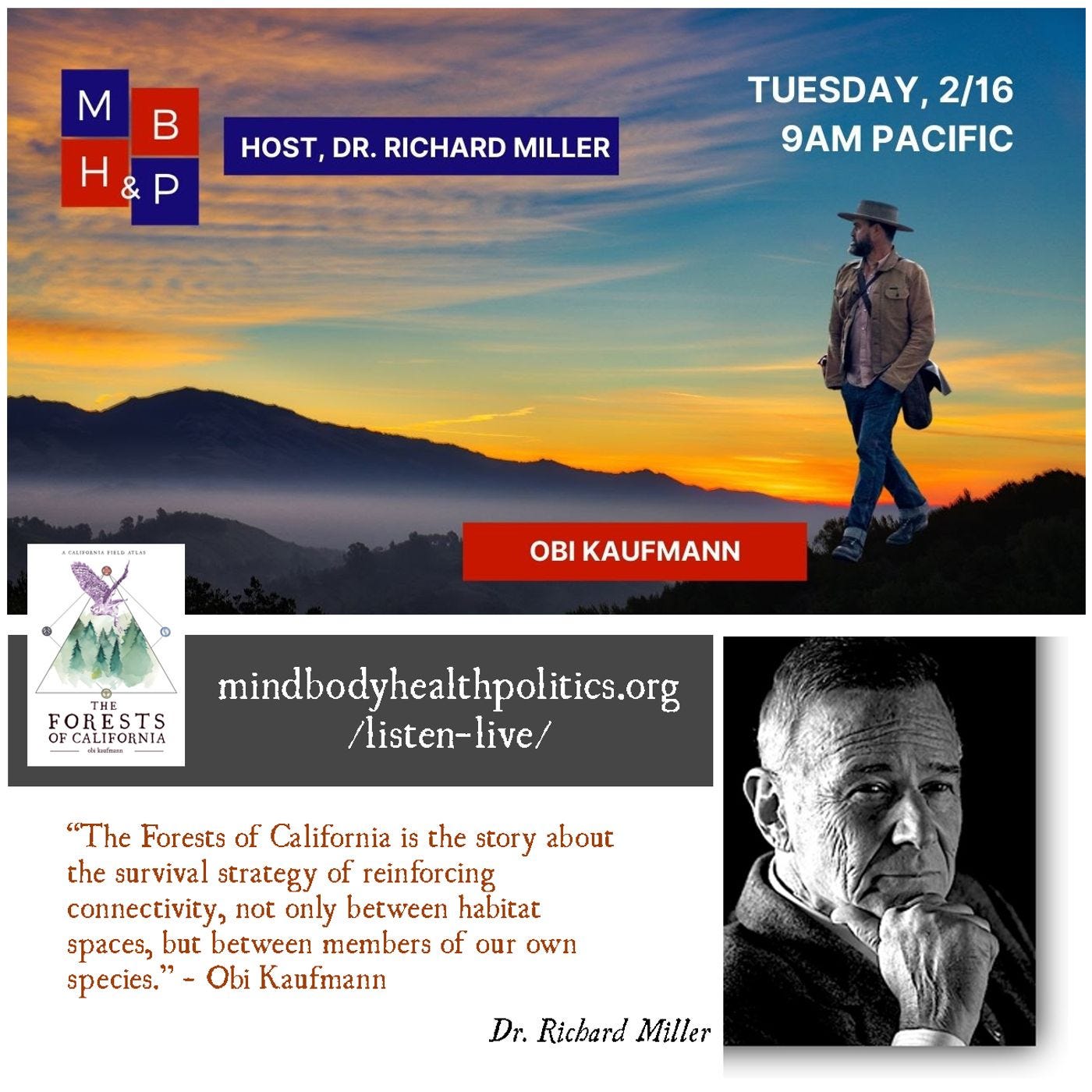
Obey Kaufman, a conservationist and artist, presents a profound vision of nature as a living, intelligent system in his new book *The Forest of California*. Drawing from deep ecological and artistic insight, he argues that forests and soils are far more complex than simply collections of trees or microbes—instead, they host vast, interconnected networks of life that communicate and function with intelligence resembling the human brain. This complexity supports the idea that nature itself may possess a form of sentience or consciousness. Kaufman challenges the current human-centric view of value, advocating for legal personhood for natural entities like rivers and watersheds, and even suggesting that phenomena like winter or coastal fog could be protected as endangered. He critiques California’s water systems, which have been radically altered by agriculture and dams, leading to over-extraction, land subsidence, and ecological imbalance. Central to his message is the idea that true resilience comes not from technological solutions alone, but from restoring community trust, shared storytelling, and a shift from exploitative to intrinsic values. He warns that climate breakdown is not a distant threat, but an immediate crisis distorting natural cycles. Ultimately, Kaufman offers both hope and urgency: despite ecological devastation, he believes we are on a path toward a more harmonious future rooted in understanding, stewardship, and the recognition of nature’s intrinsic worth. His work bridges science, art, and philosophy to reframe how humanity relates to the natural world.
Welcome to Mind Body Health and Politics, I'm your host, Dr. Richard Lewis Miller.
The mission of Mind Body Health and Politics is to stimulate, thought, expand consciousness
and encourage community.
I say encourage community because I believe that the vast majority of we humans are friendly
tribal animals and when we live in small enough communities in which we know each person
by name or at minimum by face, we are collaborative people and we sustain everyone in our community.
Everyone in our community, no one left behind, that's who we are when we are small enough
and close enough we collaborate.
Today, on Mind Body Health and Politics, our guest will be a man described as the modern
John Muir and his name is Obey Kaufman, author of a number of books, one of which will be
focusing more on today called The Forests of California.
I invite you to text or call in during the broadcast at 650 Tally Ho, that's 650 Tally Ho,
it sort of rings, doesn't it?
Before our unique interview, some news and notes in psychology and medicine.
There are four topics which are on the list of the list of topics we're supposed to avoid
and not at all ever talk about religion, money, sex and politics.
Do we know why, do we know why we are not supposed to talk about religion?
What is there about the topic of religion which we're afraid of?
Do you ever talk about religion?
Who do you talk to about religion?
Do you ever ask a person, a friend, what is your religion?
What was the last time you said to somebody, "Hey, what's your religion?"
Do you talk about your own religion and the place it has in your life?
Who do you talk to about your own religion?
Now of course, I assume that some of you talk to your priests, your ministers, your rabbis,
those people who are paid professionals, if you don't mind my pointing out that they're
paid, but what about just an everyday life?
Why is it that religion is one of the no-no topics?
And what about those of you who are atheists?
Being an atheist is so scorned in the United States that we don't even know what percentage
of us are atheists.
I looked it up on Google, estimates range from 2% to 35% of the population.
And what are these atheists thinking?
What do they believe in?
What do they do when times are tough?
When the rest of the population praise?
What are their thoughts?
Maybe you'd like to talk to one.
Where was the last time you met and spoke to an atheist?
I say just for the fun of it, find an atheist and talk with them about their beliefs.
Challenge yourself.
Now, another one of the taboo topics, let's talk money.
You can notice, as I do, that people rarely talk about the amount of money they make, how
much or little money they have in the bank, children don't often don't even know the
answer to these questions regarding their own parents.
Hey, how much is your dad make?
Is your mom make money?
How much is your mom make?
No, that doesn't happen.
What is the danger in being transparent about one's financial condition?
Are we afraid that if people know we have a little bit of money, somebody will come
and take it?
Are we afraid that if people know how much we make, they'll think well of us or poorly
of us or not of us?
What's the fear?
What is the fear?
Are we letting fear run our lives and maintain taboo topics?
Politics, politics.
Have you ever asked your parents who they voted for?
Has someone ever asked you, "Hey, who'd you vote for in the last election?"
Are you hesitant to talk about politics with someone you know who has different politics
than you?
Do you find yourself listening to TV news programs that only agree with your own politics?
Are you open to hearing some other political point of view?
If you have children, do you talk politics with your children?
And in what way do you do it?
Do you do it to brainwash them into your politics?
Or do you do it to teach them about politics in general and let them form their own opinions?
In the fourth topic, of course, sex.
Sex is perhaps the most cringe-worthy of all the topics.
Imagine sitting over coffee with friends and overly talking about your sex life.
Oh, yeah, last night when I was making love, blah, blah, blah, blah.
Of course, nowadays, if you'd be sitting and talking with your friends about sex, you'd
be sitting six feet away and thus you'd have to talk in a loud voice.
Hey Fred, I just can't wait to tell you about a new position my wife thought of last night.
No, not.
I don't think so.
Since we don't talk about sex, where do we learn about sex?
Do we learn about sex from books?
Do we learn about sex in hygiene classes I did as a kid?
You know, we may instinctively know how to have sex, but we sure instinctively don't know
how to make love.
Very different.
Oh, my gosh, I'm watching some binging a little bit on Netflix and I'm watching about the
11th century where people were very matter of fact about sex.
A woman or a man might walk over to one another and say, "Hey, if you like humping tonight,
it was sort of like, "Hey, if you want to have a glass of beer together?"
Well, that doesn't happen in our world.
This is an unspoken topic and I ask you, where are the young ones learning how to make
love?
And I'm not talking about having sex, I'm talking about making love.
If no one ever talks about it.
Look, school, pornography, can you imagine if the kids of America are learning how to
make love by watching pornography?
Pornography isn't about making love.
Pornography is about having sex.
Very different.
I think it's high time we took the taboo topics out of the closet and into the dining
room.
What do you think?
Send me a text.
Please.
Send me a text.
What do you think about taking the taboo topics out of the closet?
Send me a text at 650 Tally Ho, 650 Tally Ho.
Now for our interview, our esteemed guest today is conservationist and author, Obie Kaufman.
Obie was born in Hollywood to an astrophysicist father and a clinical psychologist's mother.
I can't wait to talk to him about growing up with a mom who's a clinical psychologist
since I'm a clinical psychologist.
I'll get some different perspectives on what my kids went through.
Yes, Obie's family then moved from Southern California to Danville and while living there,
he spent a lot of time exploring Mount Diablo State Park.
He went on to study at the University of California Santa Barbara, majored in biology
but switched to visual arts, after finding inspiration in wildlife painting and the rock
art of the Tumash people.
Kaufman is presently a conservationist and has given talks across California on ecology
and the preservation of nature.
By the way, Obie's first book, The California Field Atlas, was a surprise commercial success.
Now I'll tell you why it's a surprise when you see Obie's books.
The one I was reading over the weekend, 605 pages of writing and paintings that he did.
Did that first book sold out in two printings?
It was pent up demand.
It became a regional bestseller, and he was the recipient of numerous California awards.
Other books include The State of Water, Understanding California's most precious resource.
It was released in June of 2019, followed by California Land's Trilogy, and one of which
will be on today.
The trilogy is The Forest of California, The Coast of California, and The Deserts of California.
I mean, if you want to know about California in these ways, these are the books for you.
I mean, they're awesome, and I don't say that often.
I've been doing this for 15, 17 years, and I've read some great books by wonderful authors,
but this is in another whole category, ladies and gentlemen.
I mean, I kid you not.
Today we're going to be talking about The Forest of California, as I said, over 600 pages
of Obie's art.
It's a magnum opus, and it's bespeaks of a lifetime of work, and it's indeed breathtaking.
Welcome to Mind Body Health and Politics, Obie.
Oh, my goodness, Dr. Miller.
Thank you so much for having me.
Thank you for that very generous introduction, and I am just so thrilled to be on your show.
Thank you.
It's my thrill as well, and I meant every single word as I'm sure you could tell of what
I said.
Great.
Now, I'm all excited to talk about religion, money, politics, and sex.
Ha, ha, ha.
Well, we're going to have to say that for another program, and I'll be happy to have you
back, unless you can weave it in to The Forest of California.
I'm a student of ecology, Dr. Miller.
You'll be surprised what I can weave into the understanding of nature as a larger thing.
Well, let's weave it into The Forest of California.
Sure.
What do you want to tell us about how you started this book?
I started this book as I've started all of my books from a sense of deep love for this
place for this more than human world, analyzing and, and considering from my own vocation, which
is, as you pointed out, this mixture of art and science, this conciliance is Dr. Edward
Wilson called it in his book, The Unity of Knowledge, conciliance between the world
of the humanities and the world of the sciences, where the truths converge.
Dr. Neil DeGrasse Tyson talks about the three types of truth where you have the personal,
the political, and the objective truth.
I'll leave the physical sciences there, objective truths.
What I'm going for always is how I do art, but I follow science, if that makes sense at
all.
Science is a big enough basket for all philosophy to eventually be encompassed within.
So, California then becomes this metaphor for me and my investigations of nature, both
its beauty and its scientific integrity.
Ecology is the particular field of science that I am most fascinated by because I find
the most mystery there.
Mystery on many levels, ecology is the study of the relationship between elements within
any given system.
Repeat that sentence again for everybody, please.
That's an important sentence, ecology, yes.
Ecology is the study of relationships between individuals or individual entities or objects
and their subjects within any given system, any given living system to be more precise.
Okay?
So, we're talking about interactions between the biotic and the a-biotic at scale.
And this is how ecosystems work in ecosystems, ecosystems are what we all rely on every day
for every moment of our existence, which is entirely upon us then to protect, to learn
about and how do we then learn about it, or why then, what is the human compulsion then
to learn about it, and for me, it is about a simple question and investigation of how
to be more from this place, this place that I fell in love with when I was young, scampering
along the waterfalls and chasing tarantulas on the slopes of Mount Diablo as a boy, learning
how to paint a sunset, learning how to paint the feather of the Northern Flickr, learning
that the sum of its parts, it being the more than human natural world, is so much greater
than the individual biologies.
And as I explore out, I am actually exploring more in, I am seeking more the nature of consciousness,
the nature of sentience within and without the more than human world.
As I am in the forest, I am thinking of how there are subjectivities there besides my own.
You know, as a psychologist yourself, you know that these words, consciousness and sentience
are, we hoard them, don't we, for our own little species, for our own little investigations,
for our own little parameters, we have no vocabulary, we have very little scientific language
to reach out beyond our own experience and to recognize that nature itself is not only
alive, but it thinks, it's self-aware and it's self-reflective, maybe even containing
some of the sapience, a different level of thinking from sentience.
Give us examples of nature thinking, nature being aware and nature being sentient, share
with us what you've seen and felt and heard.
Right.
So, it's all at scale and what I mean by that is that there is more to a forest than
a bunch of trees.
If you were to pick up a cup of soil, that healthy black soil and say an old growth
forest of ponderose and let's call it mixed conifer woodland in where you are now, Mendocino
County, inside of that cup of soil, there are more individual microorganisms than there
are people who have ever lived, inside that one cup of soil, inside that one cup of soil,
there are enough fungal networks, what my colleges might call mycelial networks of these
little organisms that transport nutrients between the wood body of the plant and the soil
nutrients, the chemistry inside the soil, acting as a conveyor.
These little mycelial threads are so small and they are so abundant that within that one
cup of soil, if you were to somehow able to manage to extract every single one of those
mycelial filaments and lay them end to end, it might be kilometers long.
And this amount of life, this sheer quantity of life, covers the entire terrestrial globe
to an inch of about 10 centimeters on average.
And if you were to take all of that mycelium out of the soil itself and smoothed it under
some impossibly massive steam roller and made it a pancake, all the mycelial filament and
all the soils of the world and made it, you know, the width of a penny, it might be big
enough to cover half of the known universe.
That is how much life is in the soil.
And it is so complex, the lycanizing processes of evolution.
Remember, these mycelial have survived every mass extinction since the dawn of life four
billion years ago.
In fact, it was the mycelial that crept up on the terrestrial surface out of the ocean that
made way.
Yeah, can you hear me now?
I can hear you now.
Okay.
Terrific.
Did I zap into the mycelial sphere filament?
You did.
You did.
And just as I was about to ask you, when you take a handful, as you said before, and there
are millions you're saying, millions of organisms in there.
Yeah.
Billions, thank you. Billions of organisms. The first thing I thought of is it sounds
like almost like picking up a brain which has billions of cells in it. Dr. Miller, we're
connecting. We're connecting. That was exactly my next sentence. In fact, that the forest,
the forest is so complicated that it rivals the complexity in the most complex systems
that we know including the human brain, including any number of cosmologic phenomena in any
corner of the universe. The forest itself is that complex. That would be point one. If
we're going to have to build a case today towards sentience, it's like point one, we have
to establish the complexity of the system. Well, let me ask a question then before if
you don't mind. Sure. You've got this hand full of organisms, billions of them, right?
The soil itself is more than half. More than half of the mass in your hand is alive.
The half that's alive. Is it communicating with one another?
Are they communicating with one another? Tremendously with tremendous efficiency. Please tell us
about that. That is amazing. That is amazing. I don't think how many of us listening to
this understand that that you pick up, you pick up a handful of soil. There are billions
of organisms in there and they're communicating with each other in somewhat the similar way
that our human brain is communicating with all plots of the brain in the body. Wow.
Yeah. The processes are strikingly analogous. Yeah. It's true. This is how forests work.
Trees don't grow by themselves. Trees work best in cooperation with one another and this
would lead us to our second point if we were building some sort of argument towards sentience,
which I think we should. I'd love to eventually get around to the rights of nature if we are
going to call, for example, watersheds alive. As they are experimenting on, you've got
politics in the name of your podcast here. They are experimenting in other countries, including
New Zealand, Canada, and Mexico, and India about legal personhood towards watersheds, for
example, the rivers right to flow clean, clear, and cold. You sure have my vote because
if you could give, if you could give personhood to a corporation which we have under citizens
united, fascinating precedent, and a corporation is not a sentient being. It's a bunch of fonts
on something we call paper or on a computer, and we've given personhood to that entity.
Certainly, we could give personhood to a river, right? Well, the Karak tribal council has,
in fact, done that for the climate river. The climate river is protected by the tribal
council, and if we do respect the sovereign nations of our precious indigenous cultures
in California as we should, I encourage the state powers that be to follow in line and
do that. It looks like we're on our way to do that with the removal of the four dams
near the headwaters of the climate river on the border of Oregon and California. We are
giving the salmon, the Chinook, the coho, their last big, biggest chance at survival into
the 22nd century with California being part of their extant habitat range. So that looks
like it's on its way, and that's a fantastic point of pride that we can all take as Californians
that we are in fact seeing and reacting to our adapting values in the face of what might
be the perception of intrinsic value over utilitarian value, which is, and I don't use
this word lightly, beautiful. I just want to underline something that you said by repeating
it, which is the difference between intrinsic value, intrinsic value, and material value.
Right. It's like a safety deposit box or utilitarian. Right, right, right. If we are like this,
this is how, this is how we're going to make it through this bottleneck, Dr. Miller,
I'm completely convinced of it, you know, like as we transform our economy from this linear
economy into a circular economy, which we must, of course, otherwise, you know, I mean,
the lifespan of our carbon based linear economy is only going to be 300 years, but in those
300 years, we have wounded the biosphere in such a way that it will take thousands of
years to recover. In fact, the decisions that we are making right now over the next couple
of decades will inform the quality of our residency going forward for the next several hundred
years. And, you know, as you know, as well as anyone in the state, we now have not incompetent
leadership and Sacramento that actually has a plan to getting to neutral plan by 2045 is
a good one. In fact, if you download that PDF, which I encourage all of our listeners
to go do right now, getting going, getting to neutral, the California plan to get to neutral
by 2045, it's, it reads not unlike poetry. If we gave personhood to rivers, and you,
and Obi-Koffman had his way, what else in nature would we give personhood to, and what
would that look like? Well, one of the greatest adventure stories ever told in my opinion
was, and told so well by one of my favorite authors, perhaps my favorite novelist of
the 20th century would be Wallace Stegner, and he wrote a book called Beyond the Hundredth
Meridian John Wesley Powell. And, you know, I grew up as a big fan of Lord of the Rings,
you know, I loved those tales of dragons and swords, and I still do. But, but in fact, you
know, Lord of the Rings was a big influence on my, on, on the way that I approach California,
you want to see a fantastic adventure, you want to see a fantastic setting full of, full
of epic romance, I'll give you, you know, the place that blows all of that fantasy away,
it's called California, it's incredible. In any case, okay, so let's go back to, let's
get back to John Wesley Powell, and his trip down the Colorado River in 1860, when, when
he, a one armed civil war veteran took a, took a crew, four boats down, down the Colorado
River, oh River, that's never been met, and he, I mean, can you imagine going down that
River not knowing what's around the next bend? With one arm. With one arm. I mean, it's,
it's in a, and, and in the hands of such a capable writer, like Stegner, yeah, go, do
yourself a favor and get a copy of that book, um, beyond the 100 Meridian. Uh, John Wesley
Powell went on to become the, the first director of the United States Geologic Survey, USGS.
And what he said is that everything beyond 100 Meridian, which is, which is what really
defines the West, the Western United States, everything from the, from the Ark and St. Louis
West. Uh, the West will always and forever be defined by your aridity. And, uh, he proposed
and he mapped this out and it's a fascinating map that instead of dividing the states
up by, ah, you know, the borders, the borders are, are, are, every border to every state
has a funny story about how it was drawn. And, and it's too bad because it's largely
an arbitrary process. If he had his way, uh, the states would have been drawn up as watersheds,
as unions of watersheds that would then put that as the central focus, uh, focus of
so much of, uh, industry going forward into what was inevitably at that point to become
modernity. And so I go back again and again to the idea of the watershed, the
watershed being a single unit of geography
by which all of the water drains,
a basin, if you will, from Ridge Line to Ridge Line,
and all spots in between that center
around a particular water course,
or a system of water course and their tributaries.
And within these watersheds, as isolated as they can be
from other watersheds, we begin to see particular manifestations
of the ecosystems within those watersheds, character.
This, in fact, isolation-- geographic isolation--
is how speciation occurs.
There are different ways to parse this out.
I often think of the California floristic province
as a nice big unit of space.
In fact, it's the core of most of my work.
Now, the deserts of California don't actually exist
within the CFP, the California floristic province.
California floristic province is everything
west of the Sierra Nevada.
The longest contiguous mountain range in North America
that has defined this place over the past 10 million years
or so since California has begun to resemble its current
tectonic configuration.
And within that time frame, California
has become its own thing.
The uniqueness of California rivals anywhere on the planet
is one of UNESCO's 25 biodiversity hot spots.
And while all of our natural landscape types,
every single one of them is either threatened or endangered.
While they're all threatened or endangered,
we have a very low extinction rate.
In fact, our extinction rate is less than 1% right now.
And now, while that might sound-- oh, great.
There might be some laurels to rest on.
There's no laurels to rest on.
It's very dangerous, and it's very difficult for a science
for scientists to announce that a species is actually extinct.
So the jury is out in so many ways across so many species.
But if it is true that our analyzable extinction rate
is less than 1%, that means it is all still here.
And if it's all still here, that means we have hope.
Because hope in that dimension is a function of time.
Hope exists in temporality, right?
If there's no time, there's no hope.
But there's time.
And if we have time, that means that we're forewarned.
And if we're forewarned, we're forearmed.
We've got-- we're learning the science.
We're learning the solutions.
They're all on the table right now.
And if we can-- and I think this is an in-road
to get back to your question about what sentience--
or not sentience, rather, but legal personhood.
Like, where do we begin to draw those boundaries?
It comes from this community that you talk about.
And the magical alchemy that happens there
isn't that right when we break through this sort of noise
of talking about our rights.
We have the right to extract.
We have the right to develop all of this tantrum-like behavior.
And recognize that with every single one of our rights,
we have a corresponding responsibility.
That is-- that is-- that must be attended to.
You know, you think about what is freedom.
Yes, most people-- it's like, well, freedom is like,
I get to do what I want.
It's like, well, no, that's wrong.
That's a child's answer, what freedom is.
Freedom is the agency to attend to your own social
responsibilities without some sort of government entity
telling you what those responsibilities are.
That was a big paragraph, Dr. Miller.
I'm getting a little worked up here on a Tuesday morning.
You're doing terrific.
You're doing great.
I'm engrossed.
Rarely do I keep my big mouth shut for such long periods
of time, I'll be.
And it's an absolute pleasure.
OK, now, are we headed in a direction
where we're going to give our listeners the most
of what you have to offer in a short period of time?
Are we?
OK, because I took us off on a sort of political track
with the question about personhood for different parts.
And we had come from talking about the analogy
between a handful of dirt and microorganisms
and the brain because of communication.
But I want to stop us and pause right now,
because I want to focus in on what you want our listeners
to most learn from you.
What do you want us to hear from you during this time?
Because rather than what I want us to hear,
which is through my questions, of course,
I'll keep going with my questions because I'm like that.
But I really want to know what do you
want it really most want to talk about?
Do you want to talk more about sanctions?
Do you want to talk about the fires and the place of them?
Do you-- what are our listeners going
to benefit most from you today?
Well, yeah, that's a pretty broad question there.
And I think that I will answer it with an equally broad
answer that there is quite a bit of despair in the zeitgeist,
if you will.
The ghost of now isn't there, as if--
and I hear this in the broad spectrum that
is my community, which is one.
So there's so much divisiveness that is sold to us, Dr. Miller.
And I really believe that for every point of despair,
there is a point of hope.
And by analyzing the history of how
we got here, what will be revealed
is where we are, one, and two, what the future may look like,
and how beautiful it can be.
Because of what we have learned, because of what we know,
and despite all of the dread that comes
from this sort of weight of existential disaster
that is coming over us right now with this emerging
uninhabitable earth, it is yet possible.
Given the complexity, I mean, that
would get back to the point number two, right?
We were starting to talk about the nature of complexity.
And in complex system, emergence always happens.
In complex systems, emergence always happens.
Emergent phenomenon.
We are just as likely to teeter now towards catastrophic failure
as we are towards catastrophic success.
There is a good probability that we
might leave the natural world of California in better shape
at the end of the 21st century than we
did at the end of the 20th century, which
is an exciting thing to say.
And I am into exciting ideas.
I think that doom is so boring, give me the hope,
give me the excitement, we can do this.
I mean, think of the water infrastructure,
my second book, State of Water, which
is the story of what we have done with the single most altered
aspect of our natural topography, the water landscape
of California in the past 170 years.
Since Marshall found that gold nugget into the American river,
what we have done with water over the past 170 years rivals
anything that human beings have ever done anywhere at any time.
It rivals the pyramids.
Yeah, I'm going to say that it rivals the pyramids.
It rivals the great wall of China.
What we have done with thousands of miles of canals,
dozens of dams is that we have altered the geography
of the earth and landscape of California
to suit our own industry.
And in so doing, have made the most
productive agricultural area in the world in a place that only gets 7 to 13 inches of
rain a year, the Central Valley, which is a feat of such industry, such vision and such
uncompromised ambition.
And yet that feat, that incredible achievement will only be matched by how it again transforms
over the next 100 to 175 years, perhaps even as little as 50 or 60 years, as we realize
and as we change and adapt to the challenges and opportunities now at our door.
And I'm talking about climate breakdown because of global warming.
I'm talking about population increase.
I'm talking about changing needs, changing values, realizing that biodiversity itself is
the true gold of California.
It's not that pretty rock in the river.
The true gold of California is the biodiversity.
And the measure of that stewardship, to echo what I said earlier before, will determine
the quality of our residency here in centuries to come.
What changes in this monumental endeavor that you have described for us that of the magnitude
of the pyramids and the great world of China?
What changes in this system need to occur if we are to sustain what we call California?
Well, you know, there is an adolescent economist inside of me that wants to yell, "The problem
is capitalism.
The problem is not capitalism."
If I were to say the problem is capitalism, I'd be dismissed out of hand as a communist
because it's sort of a polarized and simplified version.
I believe that the problem is the story that society tells itself.
What the citizenry tells itself about the myth of prosperity and the potential of wealth
inside an unjust system of economic disparity based on ecocide and resource extraction.
It's a complicated matter, Dr. Miller now, water in the central valley where we have, for
example, conservation technology that we're calling it drip line irrigation.
It used to be that, not too long ago, in fact, just 30 or 40 years ago, that flood irrigation
was the most common way that farmers would tend to their crops in the valley, that you
put everything under six inches of water.
You might think that this is wasteful, but it's actually also happening, and I love this
ecological thinking that two things can be happening at once, that it can be conservative
and wasteful at the same time.
What's actually happening is, although not all of that water is going directly to the
root system of the individual crop, it is actually feeding the aquifer too.
With drip line irrigation, we have incredibly, we're saving water and we're growing more
crops than ever, but we're expanding our crops mostly almonds to desert soils that
have never been, that have never been farmed before, that are not good for farming.
We are going into the westlands of Kern County, and we are developing tens of thousands
of acres of almonds more than any other nut, and so more farmland is requiring more water
demand, and we are stretching the whole system to its limits.
When I say we, what I really want to say, and these are not yeoman, Jeffersonian farmers
out here, 60% of the farms in San Joaquin Valley are owned by venture capitalists from the
east and these massive corporations, so this is money.
This is money that is wrapped up in the rhetoric of agricultural tradition inside the Central
Valley, and to top it all off, we have to talk about groundwater.
California can't seem to get its head around groundwater, 60% of all water that feeds
all crops in San Joaquin Valley is coming from a one-time spend, place to see aquifer
underneath the valley, and now wells are going down to 2500 feet to find water.
When just 30 years ago you could go down 200 feet, so that, and now with land subsidence
and everything, the whole top, we are changing the landscape fundamentally of the Central
Valley, and then there's the issue of salt, the one thing that has destroyed civilizations
before all agricultural civilizations.
Salting of the soil is perhaps the number one enemy, as so brilliantly laid out in the
seminal work, a Cadillac Desert by Mark Reisner, if you want to understand what a danger
salinity is in agricultural soil.
So time is running out for us to change the way we do things, and in Central Valley agriculture,
and what that does is that that again comes around to the idea of community.
When I wrote the state of water understanding most California's most precious resource,
I wrote that subtitle with the understanding that California's most precious resource
was water.
I mean, that's the implication, right?
But what I found after touring that book up and down the state, I mean, I used to tour
live, you know, in another reality, I'm giving, you know, you and I having this conversation
in the same room, there is an alchemy, their community happens when you're looking into
the eyes of another person, right?
So I am touring the state of water, perhaps, you know, California's most contentious issue,
I wrote a little book about it, and I'm an artist from Santa Barbara, right?
So I'm going up and down the state, realizing that it's not water that's our most precious
resource, it's infecting the integrity of our community, our ability to tell each other
a story, our ability to bestow the authority of truth upon other members, engaged members
of our citizenry, and not, and not back into the posture of fearful tribalism, you know,
with water you've got the north, the south, and the central, like those are the three big
tribes of the water wars, as it's being fed to us in so many lies, we're all in this
together, we're all in the California floristic province.
We all rely on these magnificent watersheds for different reasons, we have, we have the,
we have been presented so many false equivalencies, the idea of farm, you get, either get farms
or fish, one of the two, that's all you get, come on, that's a lie.
The Delta Smelt, a federally endangered species in the Sacramento Valley, I mean, the
Sacramento, San Joaquin River Delta system is prevents by nature of that so important
law in 1973, the endangered species act has prevented so much water, theoretically prevented.
This is, it's very complex issue for a number, a smell to the tiny, well, it's related
to the minnow, so you'll see, you'll see in the water wars this, this, this idea, like
we're not getting our water because people are choosing a minnow over, over, you know,
jobs, family, lifestyle, tradition in the central valley, and that's not exactly true either,
or is it fair, what is the Delta Smelt, the Delta Smelt is, I mean, protecting the Delta
Smelt means protecting clean water, protecting the clean water that filters pollution into
the healthy bay tidal wetlands, I mean, what about the people of the Delta, are they not
as important, is their traditions and lifestyles not as important, providing the legacy of the
intrinsic and invaluable natural landscapes and protecting the local industries of tourism,
fishing and recreation, biodiversity that the Smelt represents.
is and should be our number one conservation priority going forward. It is so
core to so many challenges that face us. I want to interrupt and ask a possibly
very naive question but I'm gonna please do it anyway. How do we lose water? I
mean how do we literally lose water? If we are a system, if you
want to call it the planet or Gaia and we're within an encapsulated system.
How do we actually lose water? Where does it go to if we lose it? Doesn't all
water stay within the system in some way? That's great. That's right. We've only
got one amount of water on the planet. If you were to take all of the water on
the planet and make a big ball out of the water, it'd be about 780 miles across.
Like a big sphere of water. If you were to take all the fresh water, it would be
a ball of water about 35 miles across. So that's the that's the that's the
number here, right? So your question, especially as it as it as it pertains to
California, is old. And what I mean by that is that somewhere in the mid-miocene,
the continents aligned in such a way that they began to develop oceanic
currents that have defined climate patterns for the most part since. The big one
that we've got in California, in fact the one that brings us the thing that we
call the Mediterranean climate, which exists in six spots around the world.
You've got it in you've got it in well the Mediterranean, but you've but better
examples exist in California, in Chile, in South Africa, in Australia, where you
always have it on the west coast, right? No Mediterranean climate is defined by
these very moist cool winters and then these very hot dry summers. That's what we've
got here in California. It's a textbook, excellent classic example of a clockwork
system. What California also has of course is the El Nino oscillation in the
eastern Pacific that brings the atmospheric rivers every once in a while too.
California rarely gets a year of average rainfall. That never happens. There's
no averages in California, right? So we have these amazing amplitudes of
precipitation from year to the next. The cycles of flood and drought. Now what
has happened now, of course, very quickly is is is a anthropogenic quite
literally munking with the system. Human sourced carbon dumping to the tune of
what are we doing now? We're doing 40,000 megatons per year of CO2 into the
atmosphere as a species. 40 billion tons of CO2. And what that is doing is, sure,
global warming. Temperature is ticking up faster and it's sparking all of these
cascading effects within these ancient systems of climate regulation. When
in fact you have now, as I call it in the book, I don't I don't refer to global
warming as much I think or climate change. I don't say climate change at all. I
think that's sort of anesthetized language. I also think that that that it doesn't
encompass the gravity of the emergency. I call it climate breakdown. Because
that's more like what it's going to have what's going to happen. Like we're
going to have we're going to have more rain in some some years. We're going to
have more rain bombs and yet we're also going to have snow drought. Okay, so
like different these different like categories of what the
weather effects of climate breakdown are actually going to be. Because remember
the Sierra Nevada, California gets its water on a lot of it. A lot of you know
the human society gets its water from that snow which falls and stays frozen in
the Sierra Nevada. That's our water tower and it's all about the snow. Of
course snow is is related to temperature. I wonder if you know as we're as
we're brainstorming as we're thinking stridently about what 22nd century
conservation policy might be which is a conversation we need to be having right
now and we are. If if it's not just the endangered species but endangered
phenomena like for example coastal fog as a necessary agent for the redwoods
the old growth redwood forests say genetic legacy that goes back 300
million years. Coastal fog is necessary and yet now it's becoming an endangered
phenomena. What if winter itself were to be labeled an endangered phenomena
and thus accorded legal protections. What if winter had its day in court? I think
that we are creative enough of people and I think that we are we are able to
find that language. Of course it's probably got to be a better poet than me. I
think your concept of winter winter getting as an endangered species as a as a
lot of merit and I hope it gets widely discussed. I do want to come back to my
naive question because for me water water either goes down into the earth
right or it gets evaporated. Yeah less humans are involved. Well if humans are
involved where else can it go though if humans involved and they move it with
dams with canals and so on there's still basically dealing with it's either
going to go in the ground or it's going to evaporate am I missing something is
there a third place that water can go well the ground the ground is is the
problem well yeah no well you see it's not going into the ground with drip
irrigation that's going into the trees it's going into the almonds most of
which are shipped to China you know so each almond you each almond you eat is a
gallon of water you can just say that you know so think think think of think of
the the the cost there so it's transformed right ecologies also the study of
energy transformation okay but what I take that to mean then is that you've
got a water that almond tree that's right with a gallon in order to produce the
almond right in these alkali desert soils that don't have any aquifer underneath
them so and then and then if it's evaporation it goes into the atmosphere but of
course now that our temperatures taking up we're seeing we're seeing climate
breakdowns so we're seeing a whole a whole shifting of of ocean currents that
determine where and when the rain fall the only way we see fresh water again is
through rain so but the only way we can lose our ball of fresh water is if when
it leaves and goes up through evaporation and then comes down again it comes
down in the ocean and becomes salty water otherwise if it comes down again
somewhere else with his earth we're we're an effect getting it back we're just
getting it back somewhere else I think I think maybe the missing the missing
piece you you're you're you're leaving out there Dr. Miller's might be time okay
so like when I said that the ball of fresh water is 35 miles across that
includes all of the water underground all of the fresh water underground so we
have got under the the California aquifers huge huge underground lake
ostensibly inside of the poorest rock that is underneath our feet and that
aquifer took tens of thousands hundreds of thousands if not millions of
years to develop its robust state and we have no idea how big
really that aquifer is we just keep punching holes in drilling deeper like
the same before 200 feet now we're down to 2400 feet and that's across the
board we're seeing subsidence in the land right because the whole land is
sinking and it will never come back up in eastern San Joaquin Valley we are
seeing land subsidence of 14 feet are you suggesting that the that the
diameter of the globe is decreasing no no no no no no the the diameter of the
globe you know I mean that's a 14 feet is nothing
Well, five thousand feet is nothing. I mean, if, if, you know, remember those, those topographic maps
that like, like, if you run your finger across and like the, the, the mountains have, you know,
little ridges and then valleys and stuff. And it's like, that is so out of scale of what is
actually happening. I mean, the distance from the lowest piece of the lowest, the lowest point
on the earth's surface is the Mariana stretch, okay? Five thousand feet below the, the, you know,
a mile. Well, I think it's a little bit bigger. It's more than a mile down underneath the ocean
off the, in the western Pacific. The highest, the highest peak is, is, is, is not ever. It's 29,000
feet, right? So that, that is, that's a difference of just like seven or eight miles. Like, if you were
to take the earth and condense it down to the size of the cue ball, it would be the smoothest cue ball
that it, it's impossibly milled. Like, there's the, like, there, it's, the, the earth is huge.
I mean, the, the diameter of the earth is such that a seven mile difference from the tallest
point to the lowest point is nothing. The earth is very smooth, okay? So, so 14 feet is nothing. So,
I'm not, I'm not saying, yeah, we don't have an influence that big. You know, in fact, I would like
to just pull back for a moment and just everybody can take a deep breath over what we are not doing.
We are not destroying the earth. How about that? We are not, we are not killing the planet.
We can't. If we, if we were standing on a mountain peak, this is a metaphor, right? We're
standing on a mountain peak. And this mountain represents history in the field of time.
And we're looking to the metaphoric West. And we're seeing the beginning of all life four
billion years ago in the deep hadian when we are, when, when, when, when just the first, the first,
the first inklings of, of, of proteins began to go on their way to assemble themselves.
We looked to the, to the metaphoric East, then, and we see the end of all life on planet earth.
That too is about the same distance away, about four billion years when the core of our, you know,
hot sun begins to shrink and, and brighten on within its own solar evolution. And, and it warms
up to where it eventually evaporates all the ocean and burns off even all the bacteria on planet
earth. That too is the same distance away. We are in the middle of the long story of the history
of life on planet earth. And there's nothing that we can do about that. The only decision that
we have to make is how much of that future we want to see. How much do we want to witness?
We as a species. We as a species. Exactly right. The only thing that happens to every species is
extinction. Extinction happens. It's an axionomic to all organisms. All species go extinct. And
this is the way nature remakes itself. Let, let us consider 10 million years into the future, okay?
10 million years in the future, the San Andreas fault will continue its conveyor belt the way it is.
And the Baja Peninsula will become the island of peninsula. 10 million years, the, the island of
Baja will become a suburb of the archipelago of San Francisco. And on that island, given what we
know about island biogiography, that will be a place of undrempt of biodiversity. Given
you know, it will be recovering from the sixth mass extinction that we're going through now,
and it will be species that we can't imagine. We have no idea what they're going to look like.
We'll placental mammals even still be the, you know, have the day, who's to say and who's to know.
And I don't find that to be a gloomy thought at all that this world can will and does and
contains its massive ability to change and adapt and survive, given enough time.
Maybe this is a time I can, Dr. Miller, are you back?
Oh yes, I'm back. Okay, thank you. Yeah, we had some, we had some technical problems there.
And I was about to, to give you my vision of where I think we as a species are, are headed.
Well, I think what's going to happen is that we're going to be able to accumulate all the
information that we have accumulated on the planet. And we're going to be able to download that
information onto a chip. And then we're going to do the same kind of thing to what we call
consciousness. And we're going to accumulate the data that we call consciousness. And we're
going to be able to download that onto a chip. And when we have that combination of consciousness
and knowledge. And I'm not certain whether consciousness will include wisdom. That's an important
question. But I don't know, I don't have a sense of that. But consciousness and information
will be on a chip. That chip will be inserted into a robot. The robot will have an external skin
that will be analogous to what we now call photovoltaic cells. And it'll get all of its energy
from sunlight and needing very little sunlight to fully energize itself. So it will be a totally
self-sufficient organism that will neither require fuel, nor will it evacuate. And the parts will
all be easily interchangeable. And I see that's the next developmental stage for us. And I think
what they will do is keep us on reservations or what we presently call zoos as reminders
of what we were in a particular developmental period. And that's my vision of where we're headed.
But that's not going to happen for quite a period of time so that everything that you're saying
is still entirely relevant and more than relevant what you're saying is actually critical.
I mean, I'm so involved and impressed and interested in what you're saying that I mean,
I am moved, sir. I am moved. And I'm wanting to already the back of my mind is spinning
on how to do everything possible that I can to support the effort to get your information out.
I think it's really, you're saying it in a coherent way, in a logical, deductive way,
you're saying it based on an combination of science and art, which is imperative as many of us know.
And it needs to be heard because you're well-reasoned and you're balanced,
right? And you're listening to yourself as you talk, and I'm aware of that. You can hear yourself
like as you did when you used the word capitalism and then retracted it realizing that that's a dead
hole because of the various, but the baggage that gets attached to the use of words in our culture.
Right, you could quickly be called that dirty word. You said communist, you could even be
called a dirty word short of communism socialist. Oh my gosh, heaven forbid.
Right. So yeah, I mean, I'm very much understanding that. Do you want to go on or do you
do you want to stop here? We have an option.
Well, I would like to thank you for that kind afterward. And I would love to continue the
conversation with you. I just completed my fourth manuscript for the coasts of California.
And as I'm realizing that my interest in time where the force of California might be the story
of time across California's natural landscape, the coasts of California is a story of right now.
It's a snapshot, a time capsule, if you will. The deserts of California, my next book will be about
the future. So maybe we will
Well, what did you describe there?
You described auto-trophic sapient synthoids, right?
That's quite a vision.
But yeah, Dr. Miller, let's call it a day for now.
And then pick this up again soon, shall we?
Definitely, I'd love to do a series with you
if you're open to that.
Oh, I'm touched, I would love that.
Oh, that's terrific, then we will do it.
But allow me just a few more questions,
a couple of questions before we part for today.
Sure.
Your mom's a clinical psychologist.
Yes, well, she was for many years.
She was.
You want to throw out a couple of comments
about growing up with a clinical psychologist.
Yes, my mother is now skiing most of the time.
And she's moved to Truckee in the early 90s.
And she still runs a healing practice.
She has moved on to energetic healing modalities.
She has, in her mind, reached a limit
of what clinical psychology can actually do.
You know, I mean, you started your monologue today
talking about religion and she joked once
that she really appreciated the Catholic religion for one
because it gave her a lucrative career
for so many decades, working through,
working through with that religion in particular
did to the people of Danville, where practice was.
I thought, and I just put that forward as sort of a humorizanic
anecdote, you know, my mom went to work every day and when
I was growing up and my father wrote textbooks
on astrophysics.
And so I came home from school after scamping
around Mount Diablo for a couple hours.
It was a couple hours of calculus homework
every night with dad.
He was going to make a mold rather.
He was going to mold a mathematician out of me.
And of course, I ended up becoming a painter indeed.
He left us a couple of decades ago,
but I think he'd be satisfied with the legacy of intellectualism
that I poured into my work.
In fact, I spent so long trying to not become my father.
And here I am making big sprawling books of nature too.
So I remember, you know, I mean more to your question.
I remember when I was a young boy,
I must admit about 10 or wherever I was writing in the back seat,
sitting in the middle of the car.
My father was driving.
My mother was in the passenger seat
in a more inquisitive, introspective moment.
I said, I wonder where truth is hidden in the universe.
And right like that, my parents both answered at the same time.
My father said physics and my mother said psychology.
Exactly.
It's a joke.
Thank you.
Yes, we still laugh about that to this day.
I think that if my adult self had been sitting there
and could answer to, I would say story.
I would say that it is in the relationship
between community and between the stuff of our humanity,
the particular story that we have here
on this planet that defines truth and thus reality.
Thank you.
Thank you very much for being here today.
Thank you.
I look forward to doing the series
that we've agreed upon that we're going to do together.
I love it.
I love it, sir.
And thank you all for joining me for today's broadcast
of Mind Body Health and Politics, with special thanks
to my producer, Charlie Dice, who makes this broadcast possible,
and a shout out to our new marketing director,
and maybe beyond that, Pamela Pieri, who has joined us.
The preceding program was brought to you in part
by Thanksgiving coffee.
The founder of Thanksgiving coffee, Paul Katziff,
is a social worker and a political activist
who's improved the lives of millions of coffee growers
around the world.
A Paul so much appreciates Mind Body Health and Politics
that he created three special Mind Body Health and Politics
coffee blends.
He donates 20% of all internet sales
of the Mind Body Health and Politics special blends
to the COVID Response Network.
Please look that up on Google, the covidresponsenetwork.net.
It's a nonprofit 501(c)(3), whose mission
is to protect California's North Coast from COVID.
Following COVID, or along with COVID,
this COVID Response Network is going to morph into
the Coastal Resilience Network, the Coastal Resilience Network,
which is going to create various ways
of sustaining this coastal community.
Go to the Thanksgiving coffee company website
and by Mind Body Health and Politics coffee,
and support us and support the COVID Response Network.
Please join me next Tuesday at 9 o'clock Pacific Standard
Time for our next stimulating broadcast of Mind Body Health
and Politics.
Until then, this is Dr. Richard Lewis Miller reminding you
that good health is worth fighting for,
and it is essential for life, liberty,
and the pursuit of happiness.
[Music]
[Music]
Podcast Summary
Key Points:
Obey Kaufman blends art and science to explore ecology, emphasizing the complexity and sentience of natural systems like forests and soil.
He argues that ecosystems—especially soil—contain billions of organisms with communication networks akin to the human brain, suggesting a form of collective consciousness.
Kaufman advocates for legal personhood for natural entities like rivers, watersheds, and even winter, to protect biodiversity and shift from utilitarian to intrinsic value-based stewardship.
The current crisis in California’s water system—driven by overuse, industrial agriculture, and groundwater depletion—threatens ecological balance and community cohesion.
He warns against anthropogenic climate breakdown, noting that extreme weather and disappearing phenomena like coastal fog threaten natural systems and require urgent policy change.
True value in California lies not in water alone, but in the integrity of community, shared stories, and mutual responsibility.
The future of human society may involve self-sustaining robotic entities with uploaded consciousness and knowledge, serving as reminders of our past.
Personal and cultural narratives—especially those rooted in family, nature, and community—define truth and guide ethical action in environmental and societal decisions.
Summary:
Obey Kaufman, a conservationist and artist, presents a profound vision of nature as a living, intelligent system in his new book *The Forest of California*. Drawing from deep ecological and artistic insight, he argues that forests and soils are far more complex than simply collections of trees or microbes—instead, they host vast, interconnected networks of life that communicate and function with intelligence resembling the human brain. This complexity supports the idea that nature itself may possess a form of sentience or consciousness.
Kaufman challenges the current human-centric view of value, advocating for legal personhood for natural entities like rivers and watersheds, and even suggesting that phenomena like winter or coastal fog could be protected as endangered. He critiques California’s water systems, which have been radically altered by agriculture and dams, leading to over-extraction, land subsidence, and ecological imbalance. Central to his message is the idea that true resilience comes not from technological solutions alone, but from restoring community trust, shared storytelling, and a shift from exploitative to intrinsic values.
He warns that climate breakdown is not a distant threat, but an immediate crisis distorting natural cycles. Ultimately, Kaufman offers both hope and urgency: despite ecological devastation, he believes we are on a path toward a more harmonious future rooted in understanding, stewardship, and the recognition of nature’s intrinsic worth. His work bridges science, art, and philosophy to reframe how humanity relates to the natural world.
FAQs
These topics are often avoided due to fear of conflict, judgment, or social discomfort. People may worry about being judged, exposing personal vulnerabilities, or triggering division, especially in politically or financially sensitive areas.
Kaufman compares the complexity of a forest's soil and microbial networks to the human brain, emphasizing that ecosystems contain billions of interconnected organisms that communicate and function in highly sophisticated ways, suggesting a level of intelligence or sentience beyond human perception.
Yes, Kaufman argues that nature exhibits sentience and consciousness through complex systems like mycelial networks in soil, which communicate efficiently and work cooperatively—similar to how human brains function.
Granting legal personhood to rivers recognizes their intrinsic value and rights, such as the right to flow freely and remain clean. This approach, already tested in places like New Zealand and California, reflects a shift toward valuing ecosystems over exploitative resource extraction.
Despite threats from agriculture, climate breakdown, and overuse, Kaufman believes California's biodiversity remains resilient and that the extinction rate is currently less than 1%, offering hope that ecological recovery is still possible through wise stewardship.
Key changes include reducing over-reliance on groundwater, shifting from flood to drip irrigation, protecting endangered species like the Delta Smelt, and recognizing that water systems are part of larger ecological networks that require community-based stewardship.
Chat with AI
Loading...
Pro features
Go deeper with this episode
Unlock creator-grade tools that turn any transcript into show notes and subtitle files.
 PodcastTranscript AI