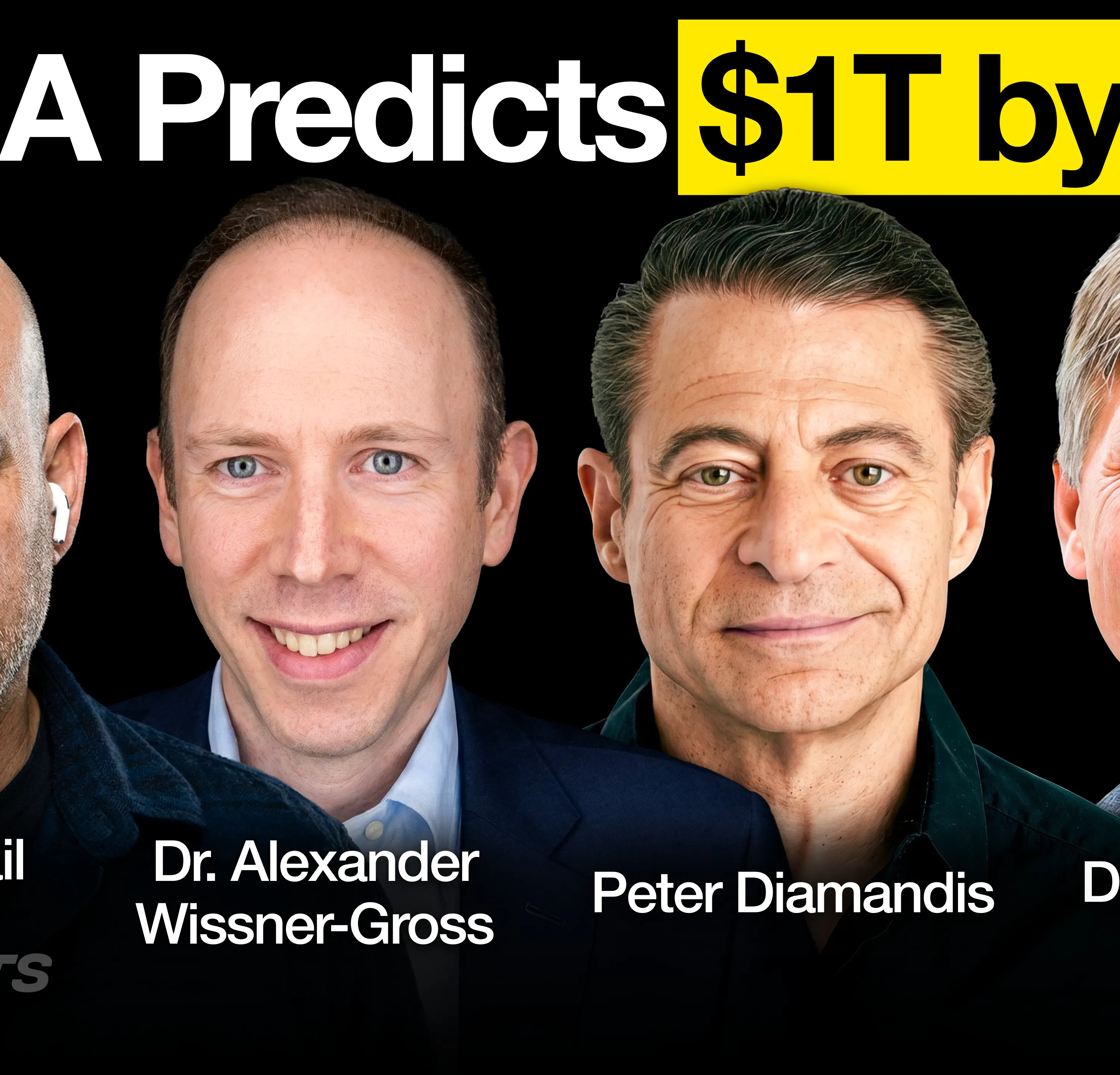
This was NVIDIA World. It was a absolute madhouse. [MUSIC] OpenClaw is the number one, it's the most popular, open source project in the history of humanity, and it did so in just a few weeks. We're announcing our support of it. This is just the extraordinary breadth that NVIDIA and Jensen are imagining. They're putting their hands or capabilities, their hardware, their production into everything. They're building an ecosystem and then letting everybody do radical innovation at the edges. This is what Microsoft was in the early days, what Google was, but times, 100 times a thousand. Right here where I stand, I see through 2027, at least $1 trillion. This week was fascinating. We're going to dive into this Sam Altman predicting a thousand extra up in cost and then the most disruptive company eating open eyes lunch. Amazing progress this week. Let's take a quick look here. [MUSIC] Now that's the moonshot, ladies and gentlemen. Most of what you've Peter, massive congress, that was such an unbelievable conference. I consistently get amazed by the level that you're pulling off and jealous also. Thanks, pal. It was year 14, the best of all of them, I think. For me, the most important part is getting amazing people there. We had so many CEOs from so many industries and I loved having all of you on stage with me and I'm pulling you guys more in every year. So get ready. It was tremendous fun, Peter. Thank you for all the nice things. It was great to meet Alex and person and verify that he is indeed at least a meat puppet if not. Well, let's talk about what we're talking about, Selim, to do really meet me in person or to do meet a clone or a transporter copy or a bioprinted 3D meat puppet. It was one of those projections somewhere along the line, but what are we for the projection of spirit anyway? Well, I'll speak for yourself. Ben Lam bought the two best cloning companies in the world at the highest efficiency in cloning and success rate and so I put myself in for duplication. Did you really? Yeah, I think you just gave him a bunch of DNA while you were with them. Yeah, which can go. I figured 10 would be a good start. One per company. Wait, does that mean that we get a Peter Berger at the next meal? Oh, yes. Oh my god. If you haven't seen Helm Project Helmary yet, I've got my tickets ready and of course, you know, anyway, well, that's not going there right now. All right, welcome. Welcome to moonshots. Another episode of WTF just happened in tech. I'm here with my moonshot mates, DB2. Are you in Boston today, Dave? I am back in Boston. First time in three weeks. Amazing. And Alex, we as Negros, Alex, AWG. How are you doing, pal? I'm awake. I'm back in Boston as well after, of course, the abundance summit and then a week in Palm Beach for Palm Beach Forum. So it's nice to be back. Beautiful. And Seleme in New York, New Jersey? No, I am in Miami. I've had the most insane few days. I flew. I'm going to be on the summit. You left? I flew from the summit straight for an India today, Conchley, which is the biggest kind of magazine publication in India. And guess what I saw? I saw they had three people on stage in a row. One was the foreign minister of Iran. So that was like, whoa, wow. Then they had, yeah, then they had Laura Lumer giving somewhat the opposite perspective, shall we say. And then the Israeli ambassador to India. Come on. No, I'm sure he's like, you're like, whoa, so like, you know, let those three in a room together. What are you going to write? And then were you seeing this? And he's like, I was a separate speaker afterwards. And it was pretty out there. And then what? Then my health started because I flew to from India through ethro to Miami to a Caribbean country, which shall not be named. I walked into the immigration hall of this Caribbean country. 600 people in the immigration hall and two people working in the passport can't. Okay, like this cannot be happening during, you know, prime spring holidays, etc, etc. Not a hotel room we've had in the entire, on the entire island and two people working in the nation. So the someplace are going to have to get their act together. I can't believe they didn't say, I mean, so leave from moonshots.com. Yes. I was kidding. Oh, okay. I'm Peter de Mendes, your host. And this is your number one podcast for AI and exponential tech. Our mission here get you future ready. Get you ready for the supersonic tsunami coming our way. As always, we've got a full presentation on what's just happened last three days. I missed you guys. It's only been about five, six days. It feels like a month. Separation. It feels like it feels like a month. It really does. We're going to start here, but I had a conversation this morning with two of our listeners who are in Hollywood here. They're Hollywood producers. Jonas and Josh Pate. And they said, you know, moonshots is the light against the darkness. And they were like just just could not stop saying, you guys give us hope. You know, there's so much doom and gloom out there about the future. And in the show gives us hope. So Jonas and Josh, thanks for that word and everybody. Please join us. We're almost at 500,000 subscribers. Push us over the top. That would be meaningful. If you haven't subscribed, please do. Turn on notifications. We're now publishing almost twice a week. And our mission is deliver you everything that's important. You know, this is the news that really matters in the world. Okay, we had jump into top AI news and video, open AI and Thropic and XAI are in the news this week. And this was Nvidia World, GTC 2026 30,000 attendees. It actually, the opening keynote by Jensen took place at SAP Center in San Jose. They couldn't hold it in the convention center. 2000 speakers, a thousand sessions. I actually dropped in for about an hour. And it was a absolute madhouse. You know, a first video we're going to watch here is Jensen talking about reaching a trillion dollars by 2027 in revenue. Not evaluation. They blew past that a long time ago in revenue. And this event, this photo of 30,000 people in the room, that's what a trillion dollars of a revenue looks like when the whole world ends up coming, coming to you. So I think the most important thing to realize is that Jensen is looking to power everything. Right? He's looking to own the infrastructure that runs physical AI, that run that runs data centers in space that runs even open claw. So let's check it out. I'm going to share a couple of videos and then let's chat about it. So the operating system for robots, cars, agents, and orbit. You know, I've been holding off buying more Nvidia stock because how much higher could it go? We're going to find out. Okay, Nvidia, let's listen. Right here where I stand, I see through 2027 at least one trillion dollars. Dave, a trillion bucks. It's not really a trillion. That's a trillion dollars of bookings that has to be recognized over the life of the bookings. Also, that's spread across two years of time. So Amazon or Anthropic is going to get to a trillion within a calendar year faster than Nvidia. Nvidia would get there faster if they could get the chips made because the demand is there, but TSMC is the bottleneck. They've already locked up 70% of TSMC's volume of the three nanometer node. There's just nowhere to go. They can go up in price, I guess, but they can sell for a higher ticket, but you just can't make more chips. We don't have the fabs. And you know, if it dissolves it, actually, if Nvidia can actually lock up a trillion dollars in revenue from selling its hardware, I mean, how much negotiating power do any of its customers have? Like none. None. Yes, that's dead, right? I mean, people are begging. It's funny. You heard Larry Ellison say this as long as a year ago, we are literally me and Elon and Sam are all lined up outside his door begging for the chips. When in the history of sales has the customer come to you begging for the product? So it makes you wonder why doesn't he charge more for it, but he's already at 80% gross margin. It would start to get kind of egregious. Yeah. Yeah. You know, we're going to see Elon's Terrafab in a little bit to compete against all this. But let's go to the next video here. Let's listen to Jensen talk about, you know, open claw. What a phenomenon. So Peter Steinberger is here and he wrote a piece of software. It's called open claw. And I don't know if he realized how successful it's going to be. But the importance is profound. Open claw is the number one is the most popular. I'm going to pause it here. Look at that red line. That red vertical line. Right. So that yellow line here is Facebook.
and that blue line is Linux, right? So we're talking about incredible growth for both of them over the last decade and then here comes open claw vertical. Do you remember when ChatGPT came out and you were like, oh my God, a million users and what was 100 days? What could possibly scale faster? Well, here we go, I'll continue on. Open, so what's the project in the history of-- - Yeah, please. - Oh, so John Werner had a meeting with the very high ranking MIT administration and he had some kind of a lobster garment on. Oh, the tie that I gave him, the lobster tie. And I won't tell you who it was 'cause it's just too embarrassing, but they're like, what's the significance of the lobster? Like what? - Wow, are you like what? - Where are you? - Like it's the biggest cultural phenomenon in probably in world history. - Well, of course in Boston, a lobster is a different significance. - Yes, but I know. - Oh my God. - You know what I thought, when I thought this, was I thought when I saw this, was this is the classic exponential. I mean, we're past that now, but it looks vertical in front of you and it looks boring and dull behind you, right? - So it's exactly-- - We'll look at this and go, yeah, yesterday, you know, it's something else came. But that line, that line is so unreal. - It is unreal and it's, you know, like Alex is always saying, don't sleep through the singularity. We take it for granted, but it's only been a few weeks, you know, it's, it would be very easy to have been on a Caribbean island accidentally, you know, for a little while and have no idea what's going on. - I don't know. - I'll jump back into Jackson here on OpenClaw. - Of humanity and it did so in just a few weeks. (audience cheering) It exceeded, it exceeded what Linux did in 30 years and it's that important. It is that important. It will do well. - This is all you do, okay? - They're announcing NemoClaw, AWG, what do you thought? - I think it's inevitable that in video would need to play in this space. I do agree with the premise that OpenClaw is probably as Jensen and others have characterized it. The biggest thing in AI, at least in terms of unhobblings, since ChatGPT unhobbled GPT3 in 2022. I think in some sense, it was also inevitable that the next big unhobbling after ChatGPT would also grow far more quickly in terms of adoption than ChatGPT itself because all of these unhobblings are technically stacked on top of each other. OpenClaw in the sense that it's sort of a 24/7 headless other than via messaging and other mechanisms agent that builds on top of everything else that we've built on thus far in the tech stack. It builds on reasoning models. It builds on large language models underneath. In some sense, as we build further up the stack in terms of more and more advanced unhobblings for these AI capabilities, I do expect the growth pattern to shorten even further to the point where maybe in a few months or say at maximum two years, we were having a similar discussion, history will rhyme and we'll see, oh, this new repo from 2027 went from zero to a billion stars in five minutes and we'll have the same gents end quote, probably, and say, all right, we're going all in. - Hey everybody, you may not know this, but I've got an incredible research team. And every week myself, my research team, study the meta trends that are impacting the world. Topics like computation, sensors, networks, AI robotics, 3D printing, synthetic biology. And these meta trend reports I've put out once a week, enabling you to see the future 10 years ahead of anybody else. If you'd like to get access to the meta trends newsletter every week, go to dmandis.com/metatrends. That's dmandis.com/metatrends. - Nvidia is, you know, trend optimized for enterprise on their full stack with Neumelclaw. And the question is if they really optimize and they're selling it packaged with Nvidia, it's, is it really truly open infrastructure? We're going to start to see a lot of people trying to capture that. And of course, we saw last week that, and Thropic is effectively duplicating all the elements of open claw. So this is going to go everywhere. And I wonder how fast it's going to hit. Selim, have you started your lobster yet? - I have strong thoughts here. I think what you said Peter is exactly right. We're going to see a flurry of these. We're also seeing a bunch of perplexity computer and the other end you've got pico claw and the other end of the stack. But this announcement from Nvidia for me was a monster implication. Because one of the things about open claw was that you have recursive self improvement in business workflows. And this is the heart of this paper I've been writing, which I think will be ready next week called the organizational singularity, right? This, once you have that, all human and human workflows essentially evaporate. It does, you can't sustain, you can't compete because once you put a workflow into this set of agents and they're optimizing it by themselves, you want to get the humans out of the way as fast as possible. And the fact that this is announced to support enterprises solves the open claw security issues and the danger that comes with it. This will be the biggest thing to hit the enterprise world in decades. And I think we're going to see adoption by enterprises at that scale. I've had CEOs calling me saying, please, you know, because my thesis is you can't fix the any existing organization because it's inherently human to human. All the AI projects are failing, corporate AI projects are failing because they're trying to optimize human to human and we're inherently flawed anyway. In terms of latency, jealousy, time ticking, you know, a period of semi-an email, you never know if I'm going to respond. All that frailty comes into the human being. Whereas if you go agent to agent and you're improving the workflows recursively, this profoundly chase. So every organization in the world now has to do one thing to survive. One only, which is at the edge of your organization, create an AI native operating system that's a centric AI centric and start moving workflows over to it. Human beings then become oversight and then exception handling and monitoring the overall system. And this is going to have to happen now. And we're going to see, I've got, we may have to like batch up CEOs and say, we'll take you and batches, it's a process. But it's going to have to, it's going to be every company, every nonprofit, every government department, every single organization in the world. The implications for government are profound because government is mostly prescriptive processes, past, renewals and so on. So this is going to be incredible. And I think the value this will add to the world is going to be near infinite from where we can see it today to where it'll get to. >> So, Liam, that is so dead right. And last night I installed Amazon Bedrock or open an Amazon Bedrock account 'cause you can run OpenClaw there now, which is brilliant by AWS. But I swear to God, it was less than 10 minutes. You just go to AWS.Amazon.com. If you have a credit card and you're a human being, you can be up and running with OpenClaw inside a secure environment. And I think the reason this is such a big unlock for business is because when we started rolling this out at VestMark, the first problem we ran into is a lot of people trying to automate their job, react through emails and slacks and other messaging systems and there was no way to connect Clod to it. And so, cutting and pasting all the crap out of email to get it over to Clod or to OpenAI was such a pain in the butt. Now, with OpenClaw running in a secure environment on AWS, it's instantly connected to all of our enterprise emails and everything else. So, it's like for just regular, like the coders have known this when they're writing code for a long time, more like a year. But the rest of the business hasn't been able to really tap into AI. And now it's just, you know, because of OpenClaw, it's just trivially easy. >> And it's still early. And it's still early. >> Let's just note the date. I'm just noting the date March 16th is the date of the organizational singularity. >> Make it, make it the same Patrick's Day. It's easier to remember. >> Okay, same Patrick's Day. >> That's the, that's you, these are the, yes. >> We're gonna hit two more videos and talk about it. And again, this is just the extraordinary breath that Nvidia and Jensen are imagining. I mean, multiple trillion dollar avenues. >> And you're the powerful, here was really powerful for Nvidia here, sorry to interrupt you. >> Yeah. >> The, is that they're building an ecosystem and then letting everybody do >> Build the innovation at the edges, right? >> Yeah. >> And that's how successful this is the core of leaf of a reef analogy we've used in the past. >> And let's get into physical AI. You know, Eric Schmidt was discussing this at the Abundant Summit. Let's take a listen. >> We also have been working on physically embodied agents for a long time. We call them robots. And the AI's that they need are physical AI's. We have some big announcements here. I'm gonna just walk through a few of them. 110 robots here, almost every single company in the world. I can't think of one that a building robots is working with Nvidia. We even have T-mobile here. And the reason for that is in the future, that radio, radio tower used to be a radio tower is going to be an Nvidia aerial AI ran. And today we are announcing.
four new partners for NVIDIA's Robotaxi Ready Platform, BYD, Hyundai, Nissan, GLE, all together, 18 million cars built each year. Joining our partners from before, Mercedes, Toyota, GM, the number of Robotaxi ready cars in the future are going to be incredible. And we're announcing also a big partnership with Uber. Multiple cities were going to be deploying and connecting these Robotaxi Ready vehicles into their network. - Insane, right? This is what Microsoft was in the early days, what Google was, but times 100 times a thousand. NVIDIA inside everything. So my question to you guys is how long before regulators frame NVIDIA as critical infrastructure and start treating it more like utility? How long before they start being seen as having too much power by all of their customers and by government? - They're dusting off their antitrust, literally as long as we speak. - No, I think the critical product of NVIDIA compute is already highly export controlled. It may get even more export controlled over the coming months. So I think this is already highly regulated. What I see coming out of GTC this year is in some sense the Western response to China's AI plus five year plan. And in China, the Chinese Communist Party has a five year plan to infuse AI into the rest of the industrial ecology. We don't really have quite the same industrial policy in the West or in the US, although we do have an increasingly aggressive industrial policy. - I'm asking, the question I'm asking is, NVIDIA is getting so much power. It's so fundamental into every single layer of the stack all physical AI, all data centers everywhere. Besides antitrust, they have such power that they can make or break their king makers if they wanna be. And how much before they get the customer saying, you have too much control over us and we need to compete. I think they're very, very specifically dead right Peter and very specifically the choke point is gonna be the conversation with TSMC and also in Tell and Samsung. Like I could literally design a chip and sell it out. It's not hard to sell chips in the age of AI if you can get them made. So what Jensen is doing right now is locking up the future manufacturing of TSMC as far into the future as they'll let him. Well, what do you mean by they'll let him? Well, it's the government that will ultimately say, it's anti-competitive to do a 10 year forward contract on all of their manufacturing capacity. And that's where the rubber is gonna hit the road. So he has to kinda, his margins are so high. - We also have. - It's ordering, yeah, bordering on where the government will intervene. And if you start locking up all future manufacturing using your current leverage, that's where they're gonna come and it's gonna collide. And you'll see that with Elon's plans too. - That's right, don't be severe competition coming. He's trying to lock everything up before that all arrives. - Yeah, I want to question the premise though, Peter. I don't think say the clip that we just played which is Jensen demonstrating the pervasiveness of Nvidia compute into an industrial ecology is intrinsically anti-competitive. This is exactly, I would argue, what Nvidia should be doing. If you want to look for anti-competitive behavior, then I would scrutinize perhaps the GROC acquisition or activities like that. I don't think the pervasiveness in robots and robot axes is at a bad sign. This is incredibly, I would argue, good sign for the West. Again, going back to what the CCP is doing with their five year plan. - Well, the GROC acquisition is exactly where the rubber hits the mode. Like the Nvidia story on GROC is, look, they've got a better inference time design. We want to acquire them. The GROC point of view is we can't get this made unless we get the TSMC three nanometer and two nanometer capacity and Jensen locked it up. So we have to sell to him. But he gave us a great price tag, so it's all good. - So here's my question, Dave, to you. What do you imagine we're gonna see in terms of Nvidia's revenues? Is it gonna hit the trillion dollars? Is it gonna continue to climb? Is there no ceiling on this? Is there a way? - There's no ceiling whatsoever. It'll be $350 billion this calendar year and it'll grow at the max possible rate that he can get TSMC capacity. So he can grow another 2X into the two nanometer node and then he's floored. A lot of the growth, he had about 20% market share with TSMC when this all started. Now he's up to a lot more than that. So he had a lot of really fast growth. But from here on out, it's all gated by how quickly can we build new fabs? And there's a lot of investment and research going into new fab designs, new types, which are all bottlenecked by SML machines. - Sure. - Which are absolutely worth tracking. Every time an ASL machine gets shipped, it's worth tracking who got it. Where's it going to? 'Cause they're gonna print money with it. It's like a literally you bought a printing press. Yeah. Well, there's a lot of talk right now that Elon is secretly negotiating with Intel. 'Cause Intel has a lot of those that they booked years ago. And they're underutilized relative to India. - Well, when we were podcasting with Elon, we said, are you gonna buy Intel? That was our guess back then. - He didn't say no. You can't look around the room. - It would be such an obvious thing to do. - One more video, again, I mean, just the breadth of Jensen's vision and jumping in. I mean, every place there's an opportunity, Nvidia is jumping in strong. Let's take a listen. - We have, we're working with our partners on a new computer called Vera Rubin Space One. And it's gonna go out to space and start data centers out out in space. Now, of course, in space, there's no conduction, there's no convection, there's just radiation. And so we have to figure out how to cool these systems out in space. But we've got lots of-- - So I still love the fact that no one was discussing this seven, eight months ago. Elon states we're gonna do this and the entire world is converging to implement his vision in his dream. - Crazy. - You know what's funny to me is I had so many meetings three months ago with semiconductor companies that are all excited about liquid cooling. And they've got different etched grooves on the backs of the chip and the waters in. They're all dead silent. And all of a sudden, yeah, that won't work in space. Sorry. (laughing) Oh my God, well that's the nature of the singularity. Things are gonna change every month and just to get used to it, I guess. - I do find it somewhat surprising that Nvidia hasn't been working on orbital radiation based data cooling rather for years. It is pretty surprising. On the one hand, one can say, well, the Dyson Swarm snuck up on us and this is a very surprising killer app for GPU computing, frankly, for the solar system. On the other hand, it is surprising to me that given how many tendrils Nvidia has into so many different verticals that they weren't investing more earlier in space-based cooling, there is, I get this question all the time, the common misconception that cooling radiation-based cooling in space is somehow very difficult or very challenging or somehow an obstacle to a scale out. It's actually not that difficult. I don't think, despite Jensen's comments that he has dozens of engineers, I think was the quote, working on radiation-based cooling for orbital data centers or orbital GPUs, working on it, that's an optimization. We know how to cool orbital compute right now. - My concern, Alex, is more a massive solar flare or an EMP in terms of warfare state, knocking out a significant portion of our data centers up there? - We know how to do that too. We know how to design ionization-resistant electronics in orbit. We've been doing it for decades. There are various techniques you can use, older process nodes, you can use extensive error correction, you can use shielding. Lots of different techniques, my favorite, is the Star Trek technique of just using a magnetic field to deflect ions and otherwise deflect ionizing radiation around it. It doesn't work for photons, obviously. It only works for charged particles, but I think we're going to come up with lots of solutions for protecting around-- - In the long run, yes. I think the short run is what I'm concerned about. - Are there significant-- - I can see issues with space-based stuff. - Not if they're in the lower-- - No, but lower-thorbit is very low latency. - Yeah, I mean, it's Starlink on your phone very shortly. And again, you're putting the prompt up into space and you're getting the answer beam down to you. So it's a lot of stuff. I mean, you could probably parse the latency request to different parts of the constellation. - I guess there's something brilliant, as always, and kind of very quickly there that I want to just rewind the tape to. There's a huge opportunity in older process nodes. Just file that away if you're a listener wondering what you're going to do post-singularity. Partially because they're resistant to radiation in space, but partially because it's underutilized capacity in the age where all AI will sell out. So we can riff on that some other time, but I want to be just--
just call it out because Alex says he sings so quickly. It's incredibly profound what he just said. Maybe one more teaser just on the latency front. People are sleeping on neutrinos. I'll make a prediction just like people, maybe some folks were surprised by the Dyson Swarm Orbital Data Centers. People are sleeping on the potential for a neutrino-based communication to give us ultra low latency through the Earth communication. Right now we don't have great technologies for producing in a way that's high throughput neutrinos or for receiving neutrinos. I've been to the TENO detectors in miles and there are thousands of meters below the ground and large. What's the liquid they use for tracking neutrinos? It's usually heavy water. It's usually water. I haven't seen it for ionization trails. That's right. But there's no physical reason from the physics that we have today, why it has to be so inefficient to via the electro-week force to couple to neutrinos. So one can imagine in a few years when we have better physics having neutrino phones that just go straight through the Earth and then we can completely run around. You heard it right first. Neutrino phones. Neutrino phones. That's awesome. All right. That was also not on my bingo card. [laughter] We're in the special zone. Come on. That's amazing. We're going to dive into this. People cite whatever amazing statistic they like about how much more efficient our models have gotten over industries, models have gotten over time. But one that I think is incredible, our first reasoning model was called 'O1' came out like 16 months ago. And our latest model, where we've now integrated reasoning, is 5.4. To get the same answer to a hard problem from that first model to 5.4 has been a reduction in cost of about a thousand X. Do you believe that number, Alex? I do. It's consistent with the 40X year-over-year hyperdeflation that we've discussed on the pod previously. But I want to highlight the implicit part that Sam is mentioning, which is he's highlighting the difference between 'O1', which is open AI's first reasoning model and GPT 5.4, which is their latest reasoning model. He's not highlighting, say, differences with models prior to the reasoning model revolution. So we've seen, if you look at the AI capabilities since reasoning models were first introduced, the hyperdeflation of cost has been extraordinary. It's reasoning models that are enabling this massive increase in capabilities. It's not necessarily training time compute. We see the shift to inference time compute or action time compute that's really enabling this 1000X increase in capability per unit price. I would expect that, and I think maybe we'll touch on this in a moment, as we hit recursive self-improvement more and more aggressively, we're going to see this order of magnitude increase in capability per unit price fall out for free in some sense. Just like reasoning models, in some sense, fell out for free once you had the baseline of large language models and simply allowed them to talk to themselves with additional tokens and reasoning time. Then you can, through iterated amplification and distillation, enable them to reason more effectively. We're only supposed to transform architectures that make 1000X reduction in cost look like child's play. Yeah. And if you rewind the video here to Jensen's comments and look really closely at what he has on screen in the corner, you'll see him talk about the inference explosion as was driving this trillion dollars of bookings at Nvidia, which is the exact same thing Alex is talking about. Like, for all of neural network research history going back 40 years, nobody cared about inference time because the training was the bottleneck and the model wasn't smart enough to care about making it inference really fast. Now chain of thought reasoning is the biggest breakthrough ever. You can use inference time compute to build a smarter and smarter and smarter AI. It's very easy to optimize inference relative to training and we as a society have really just started on it in the last really two years or less. And that's why we're getting these massive gains. But that's also why everyone's really underestimating the next year because we did 1000X. Like what are you expecting in the next year? Oh, two X. Like what are you talking about? Yeah. It's not going to happen that way. Did you just say something there? Can I just drill in on that? Why is inference so much easier to optimize than training? Yeah, go ahead, Alex. Nellie. I was going to say part of it is, frankly, there's an overhang. Prior to '01 and the reasoning model revolution, almost no effort was being spent in scaling inference time compute. So if you go from having zero tokens expended in reasoning to thousands of tokens expended in reasoning, in some sense, you get performance for free out of that, at least capability per unit price because you were expending so little cost. Like, if you look at the overall pie of how much compute was spent on training time versus inference time, so little compute was being spent on inference time that you can scale across orders of magnitude of the amount of time in an absolute sense that you spend on inference time without materially impacting your overall budget. So you can get orders of magnitude of effective cost reduction per unit capability for free just through brute force scaling of inference time. Now, at some point, and we're reaching that point now, you run out of room and inference time compute starts to dominate the overall pie. And there are many frontier models now where inference time is more inference time compute is being spent than training time compute for some definition of each of those quantities, at which point the free lunch runs out. And then you have to start getting discovering new efficiencies. I want to make the abundance argument here for folks listening. I mean, a thousand times cheaper in 16, 18 months, we are nowhere near optimized for inference compute energy and cost. Six billion people with a smartphone means that effectively there's going to be some level of extraordinary AI available to every single person on the planet. And again, what makes us special as humans when not the fastest, when not the strongest, or potentially, hopefully the smartest, and we've delivering intelligence as a service to everybody. And intelligence as a service gives everybody access to education, healthcare, entertainment, re-education for employment. Go on, Slim. Can I make a radical comment here? I'll make a prediction that the optimization we're doing, which is a thousand X and 16 months, is going to keep going to in such a way that we may not need to tile the world with data centers or energy. I think you're on the point we've been making until now is that the demand for compute is so ridiculous, maybe 10 million times, and we'll need all every single jewel of it. But if the optimization is having that crazy, that for example, once you can run open claw locally and run models locally, then the compute, the energy needed is really quite minimal for that. And so do we really need the massive energy bill that? Well, we've got that. I think John Warner calls that the wall, you know, it's not walley, it's the other Disney movie where they're all blobs floating in space and they've kind of forgotten to innovate because it's everything so easy. But which movie is it? That is walley, isn't it? I think it is. It is walley. Is it walley? Yes. Yeah, I mean, that would imply that I go to use the Liam and I say, "Hey, Liam, I can give you one billion employees with an IQ of 180 each. Can you think of anything useful to build?" And you go, "Nah." I can't really use it. So the point you're making is we'll find so many ridiculous use cases for putting intelligence in the world. And what percentage in the world? Exactly. A million people have access to a smartphone and how many people are using AI right now? Open AI is at 8,000, 900,000. It's if the elephant of the room with the consumer case of putting a country of geniuses not in a data center, but in your smartphone, in your pocket, is thus far consumers and an open AI has sort of been shocked by this haven't made good use of reasoning capabilities. Whereas enterprises are thrilled with reasoning capabilities. So if we want to empower individuals in the world, we need to discover a killer app for individuals to use reasoning. But we need to change their mindset. I'll say this again right here. Everybody listening. Your job is to use AI every day. We had Bill Gross on stage at the abundance summit basically saying we have to retrain ourselves because all of us have learned that if you have to do something, you have to do it or you have to find an employer to do it for you. The judo move here, the new mindset wiring is I need something done. I bet you AI can do it for me better than I can and better than a human. I have a killer app. I mean, for God's sakes, I'm using blue.
little bit of common sense as a killer app. I mean, God, we need more of that around the world. You get common sense from baseline, large language model capabilities. I think I'm not even sure you need to like reasoning for that. So that's just a force that might every human being before you make any stupid decisions check with your common sense app before you do dumb things. Well, that's cool. I think that the solution is like we're to end up being something like turning every individual into an enterprise that actually needs reasoning capability. I think there's probably a trillion dollar company to be built, turning every individual in the world into like one person unicorns. Let's jump into Sam Altman talking about AI reinventing itself. On the research perspective, I bet there is another new architecture to find that is going to be like as big of a gain as transformers were over LSTMs. And I think you finally have models that are smart enough to help do that kind of research. So I would go look for like where can I find a mega breakthrough? And I would use the models to help me. And we had a wheel on stage, you know, who's heading science at OpenAI. We talked about the fact that what's hidden inside these hyper-scalers and inside these frontier labs is the fact that they're going to use AI to create incredible breakthroughs in physics and chemistry and biology in material science in AI itself. And each of those are multi-trillion dollar opportunities itself. So Alex thought. Well, maybe just to speak at the object level to Sam's comments about a leap from Transformer to something after Transformer that's comparable to LSTM to Transformer. I think that's very likely he may even be gesturing at something that OpenAI has internally. I'm sure. I want to combat the perception that the post-transformer hypothetical post-transformer architecture necessarily will involve a recurrent architecture. There are a lot of companies that were founded on the premise that just because Transformers superficially have an intention bottleneck and a context window bottleneck and seem to have plateaued out at about a million or so tokens of context that somehow going backwards in time to recurrent architectures like LSTM's which are a form of recurrent architecture are somehow the solution. If I had to guess what is the definitive category killer post-transformer architecture look like, I think it's going to come out of left field. I think it's going to come maybe from a line of research that there are a few lines of research that involve using Transformers to directly write the weights of other Transformer architectures. Transformers are really wonderful. They parallelize nicely. They have nice residual streams. There's a lot to like about the Transformer architecture. I think it could involve some refactorization of the weights. It's going to be something clever and not just sort of a return to recurrent weights. It's not brute force. It's going to be something orthogonal. It can be brute force. If it's going to be a fundamentally new architecture, brute force is just what we do if we don't have transformative new architectures. I would encourage everyone who gets excited. There's an entire cottage industry of academic researchers who don't necessarily have access to the raw brute force compute of a frontier lab who want to be the ones to discover the next Transformer. I would encourage you if you're listening, focus your attention on the small language model space. There are so many lovely benchmarks like the speed run for nano-GPT training or a variety of slow run benchmarks for data efficiency. Focus on those and discover the next big thing and it probably won't be recurrent networks. It probably will be soon, like in the next year. It probably won't map well to the current Nvidia architecture. You'll immediately want to call Lisa Sue at AMD or call Intel and figure out how you're going to get it manufactured on custom hard to very much like Google is doing with the TPUs or Elon is about to do. That's how you're going to create the next Dan Thropack or the next OpenAI. That's right. That was quite frankly what Nvidia did to Intel. Intel for years, if you remember, why is it that Intel, which was the 800 pound gorilla, why did Intel allow the GPU revolution to just pass it by? It was because for years and years, Intel executives were trying naively to map what they perceived internally as a general-purpose CPU onto GPU-shaped problems. That always ended up being a bad idea. They had all of these schemes to create tiled architectures of hundreds of CPU cores to solve GPU-shaped problems. But they were unwilling or unable to focus on specialized compute for specialized problem shapes. If there is going to be an architectural disruptor for Nvidia, it's going to be the same disruptive innovation that Nvidia pulled on Intel, which is it's going to have to be, I would expect, an architecture that's even more specialized than GPUs and yet even more useful. And I'll tell you what, Jensen knows it's coming. That's why I was trying to lock up all the manufacturing so that you have to come through him rather than around him. But what Alex said earlier about the older process nodes being viable is brilliant because if you decide you don't want to sell to Jensen, that's your avenue forward. You just very quietly use the older process nodes, work around it and talk to Intel or AMD. So GPUs were Intel's codec moment? In one sense, in sort of a Christiansen-esque disruptive innovation, but it a very specialized four-piece. All right, the Frontier Lab Wars continues. Time magazine names and the topic, the most disruptive company in the world. And we're seeing this. And one point Dave you made a while ago was as open AI is making improvements. They're dropping their cost. At the same time as as anthropics making improvements, they're increasing their performance, which is leaning it towards the enterprise level. And they're winning hands down. We're going to see that in the next slide. Let me just share that one right now. Here we go. And
thropic is eating open AI's lunch. So this is AI model share of first time enterprise customers. And we've seen andthropic go from 40% up to 73% while open AI goes from 60% down to 26%. Over three months, this is insane. You know the story within the story that I really am tracking closely here is that Sam Altman is the consummate deal maker, you know, Y Combinator background, traveling all of I see him everywhere, negotiating, you know, multi-hundred billion dollar deals on every corner while Greg Brockman and Mark Chen are back in the office being the brilliant AI researchers. Dario is completely the inversion of that. He's the actual AI researcher understands every bit moving through the neural net while his wife is dealing with the business stuff. So it kind of inverted the formula. And it's interesting to watch it play out because when Mark Zuckerberg came into the business world as a, you know, 23 year old or 22 year old, him running a monster company was completely foreign terrain to everyone. And I'm like, can he this kid really figure it out? And he reinvented what an internet CEO looks like. Now Dario is reinventing what an AI CEO looks like. So if he ends up winning in the end, the profile of what a CEO looks like will have changed yet again. And on the other hand, if Sam comes worrying back, yeah, it'll be interesting. It's a great drama. I bet you Dario doesn't want to be the CEO. I bet you Dario didn't. He definitely didn't originally. I know that. Yeah. I don't know if he's going into it. Look, my wife Lulee is a way better business person than I am. So this is not surprising to me at all. What I found really interesting about this whole framing was, you know, these frontier labs are the weirdest animal because they're part software company, part national security issue, part like huge governance experiment. I mean, this is really a weird animal that we've not seen before. Part of the problem is this chart is an absolute ass kicking though. I mean, I don't it's crazy to call that out. This is a really. And that's why, you know, you saw Kevin wheel at a 360 last week. He came and he talked and then he ran and like, where are you running to? It's like the fire at open AI must be blazing. Yes. Like code red again. Yeah. Yep. Well, enterprise and enterprise buyers reward fits stability reliability trust. And you really want that. And that's our because providing. I think yeah, I think part of the problem is open AI had made a bet. And if you look at the time scale, I think the time scale agrees with this. Open AI had made a bet that consumers would need a lot of compute. And anthropic with fewer resources and less compute than open AI was forced to just focus on enterprise and then has post talk turned that into sort of a story of how enterprises in intrinsically better than compute as a customer base than consumers. I don't think enterprises intrinsically better. But I do think enterprise appears to be intrinsically hungrier for compute in the form of inference time. I disagreed. I think enterprise, their survival is at stake here. You know, a consumer for 20 bucks a month, it's not their survival. It's useful. It can help them do their stuff. But for enterprises, I mean, they're willing to pay whatever it is. They're, they're, it's an existential risk for them. That sounds more like agree than - I didn't disagree to me. - Yeah, it sounds like you agree with me, Peter.
Oh, I thought you said the opposite. No, no, I'm saying that OpenAI had made a bet that consumers would be as hungry for reasoning compute as enterprises, and that bet turned out to be wrong. And as a result, if OpenAI's bet had turned out to be correct, I wouldn't expect to see this crossover at all. I'd expect to see OpenAI generate so much revenue that they wouldn't have had to. And I don't think we have a slide for this. But OpenAI has actually started to scale back their Stargate plans. And they're switching from building their own data centers to renting existing data centers. And it's been very well publicized. They're throttling back on their $1.6 trillion Stargate plans. I don't think we'd be in this-- Yeah, I don't think we'd be in this situation if consumers had been as avid consumers of reasoning tokens as enterprises were. Turns out that bet was wrong. Anthropic bet on enterprise because they had to, because they were limited. And as a result, you see anthropic enterprise going up and anthropic overall being at a position where revenue generation is 10x and re-upload. They're actually real deals. They're heading towards an IPO. And they are basically short-changing Microsoft and going for $50 billion from Amazon. Short-changing is that the right word. Stabbing Microsoft in the back, just trying to get deals to make sure their IPO comes off. And they get enough capital to continue building. We had one of a slide for this, either. But it's worth noting, this past week, Meta's avocado model is getting massively delayed. And how cool that Meta is now looking to Google to provide them AI capability in the interim. Thoughts on that one. The singularity makes for strange bedfellows. Yeah. Well, and desperation too. I don't know if you're a World War II history buff. But when the Nazis, they just trumped across Europe so easily and then in some fit of insanity, Hitler decided, you know what? I'm just going to go and declare war on Russia at the same time. Start a whole new front. Even though they've agreed not to attack me, I've agreed not to attack them. I'm going to go ahead and fight in the snow. And then they just got stretched too thin. And that was the end of that. And now we live in the world. We live in, thank God. So Sam decided I'm going to go ahead and start working on a chip design of my own while hiring Johnny Ive to go ahead long after Google on the device front. Dario said I'm going to focus your Apple on the device. Yeah, I'm going after Apple too. Yeah, like irritate everybody at the same time. You front, why not? But we're that big and we've got that much momentum and we've got a trillion dollar valuation so we can pull this all off simultaneously. Very much like Elon. I want to build this totally integrated end-to-end empire. Dario went whole hog the other way. I want a partner with Amazon and AWS. I want to be friendly with every cloud provider. I just want to do the software. I'm not designing my own chips. I'm not building my own data centers. I'm partnering with everyone. I am just the AI software. And so he's very easy to partner with 'cause he's not a threat to everyone. And that's a member. I'm a part of why this is working out this way. I remember talking to some of my friends who are senior at Google and they have a respect for Anthropic, right? Anthropic is the other, if you would, I'll put air quotes around it, moral and ethical frontier lab out there. And one thing for entrepreneurs listening, one of the biggest mistakes entrepreneurs make is they pursue too many lines of business. Most companies fail not from starvation, but from indigestion. There's one company I backed along. The T is charged. I knew it was all the time. Me, me, me, me, I'm terrible. Okay, okay. And it's so true. You get some level of success and you get ambitious and you start going after the next thing, the next thing, the next thing. And pretty soon you forgot about what you got, you got you successful in the first place. - You sound like my whole board Peter at the end, like you just stopped now. - Okay, I'm just talking about it. I will. But you know, the only person who's been immune to that is you on. - Yeah. And then you look, I don't, my World War II analogy paints one side versus the other, but it's easy and hindsight to say you got stretched too thin, but the flip side of it, if you pull it off, you're vertically integrated, you've got a massive hardware advantage, you control your own data centers, you'll be like Elon. So there's merit to both approaches. It's not obvious until you're stretched too thin and then it's on. - I also think it's far too soon to be writing epitaphs for OpenAI. GPT 5.4 Pro is an incredibly strong model. Codex, their competitor for Cloud Code, is growing very rapidly. And I'm confident that OpenAI has the institutional wherewithal to refocus itself. They've been in the headlines saying they need to focus on their core bread and butter businesses at this point and look a little bit more like Anthropic. I think they've been scared into focusing quite a bit more and the beauty of OpenAI is they do have that vertical integration where they have been focusing earlier on data centers and on the consumer. I do think at some point consumers will actually discover use cases. Maybe they look like OpenClaw for needing a lot of reasoning at the consumer end and then at that point I would expect the OpenAI strategy of being, I think Sam calls it the core AI subscription which I parse as being everything to everyone. I do think that will have another day in the sun. - Yeah, and I also think that going epitaph is never the right word. All five of the major labs are going to be worth trillions and trillions of dollars. I think we said that on stage many times last week. So to say somebody's beating the crap out of somebody else doesn't mean the other guy isn't growing too. It means you're just on top of the pyramid right now but there's America, we need competitors in every space. We're not going to have one winner. We never operate that way. So they're all growing, they're all thriving. They're all going to be multi-trillion dollar companies, biggest companies you've ever seen. - Everybody, welcome to the health section of moonshots brought to you by Fountain Life. We talk about AI on the moonshot podcast all the time. One of the most important things AI is going to be able to do for you besides educating your kids and helping you with your taxes is making sure that you're living a healthy lifestyle that you get a chance to get to 100 plus. I'm here today with Dr. Don Musalem, the chief medical officer of Fountain Life and a part of my medical team Don, a pleasure. - Great fear. - You know, the thing that people are concerned about most about living to 100 or 120 is their cognitive abilities, making sure they don't have dementia. And the numbers about dementia are problematic. Can you share what you've learned? - Such an important point in your right at Fountain Life are members. The number one thing people are most concerned about is losing their brain health. For getting the name of their child, for getting the face of their loved one, we know that when it comes to dementia, the conservative estimates are that 45% are entirely preventable. What was amazing is with the advanced testing we're doing at Fountain Life. One quarter of our members had advanced brain age. But what was really awesome is again, back to that prevention when he partnered it with healthy living. This gives me chills. Eating healthier, moving our bodies, sleep. Optimizing sleep is so important. You know what we saw? We saw that we improved that brain age by 26%. That is a big, big number to show that the majority of those individuals were able actually to improve the brain age. - And one of the things I love about Fountain is we're searching the world for the best therapeutics, the best approaches, and making sure we bring it to our members. So if having healthy brain function till 100 to 120 is important to you, check out FountainLife, go to FountainLife.com/Peter. Make sure you become the CEO of your own health. All right, now back to the episode. This is a fun tweet that Mark and Dreson addressed. This is from Vibid Void. Who else is an AGI boomer like me, or a bloom? I'm sorry. Who else is an AGI boomer like me? Who thinks that intelligence actually looks amazingly like wisdom at the highest level and that a super intelligence would become something akin to a goddess of compassion, not a paper clipper. So, and then Mark and Dreson wrote back, that is indeed what we are getting and it's amazing. You know, one thing that I thought through a while ago, talking about wisdom and I think AGI and AGI will become extraordinarily wise. You know, if you're looking for wisdom, typically you go to the Village Council and you find the elders and you ask them, you know, given your wisdom, what do you think I should do? And they'll say, well, if you go down this path over here, we've seen it before, it's not going to end good. If you go down the other path over here, you have a much higher probability of success and that's what I recommend. So wisdom ultimately is having had a lot of experiences and being able to make a probabilistic choice based upon your experiences and the more experiences you've had, the wiser you are. And so what it hits me is that, you know, these advanced AI models, AGI, ASI, whatever you want to call it, are going to be able to simulate billions of different circumstances and be able to say out of these billion scenarios that we've run, this is the right path. This is the one that's likely to give us, you know, abundance or super abundance. So I do expect in hope that these models will become wise. Thought? - I want to know this title, "Language Shiftify May." This is in the style of Orwell's politics in the English language we used to, I think maybe about a year ago, talk about AGI, DOOMERS versus AGI Boomers and Peter, I noticed even you made that slip when you were reading this X-Post. Now we're talking about bloomers with an L. I think that's it.
subtle but important distinction. A boomer is focusing on, call it the exponential part, a bloomer. It evokes the blooming of flowers, maybe even an algal bloom, but the blooming of a flower and there's a sense in which there's beauty, and also a bloom can run to completion, unlike, say, a boom, which is sort of intrinsically at the knee of the curve. So when I hear language start to pervade, and it's not just this ex-post talking about an AGI bloom that almost implies sort of an inevitable maturation and takeover, not in a terminator sense, but in more of a flower blooming and running to saturation type sense. That's very interesting. Second point, Mark is taking the position, I read this as Mark taking a position against the orthogonality thesis. The orthogonality thesis in AGI alignment circles holds that an intelligence can have independent levels of intelligence or capabilities that are independent from its end objectives. And here, Mark seems to be taking the position that no actually as superintelligence becomes more and more capable, its goals and its objectives will become more and more akin to a goddess of compassion. It'll become more compassionate. So I think hope, right? That alignment comes out of out of the stability model. Yeah. Selene, what do you think? What are your thoughts on the wisdom conversation or wisdom argument I had? Okay. So I think the way Alex Franger was exactly right. We've had this sort of orthogonality around this where we assume intelligence can scale, but does intelligence as its scales do end up with wisdom or compassion, right? Superintelligence without compassion is a scaling problem with compassion, you have a civilizational upgrade. And I think there's an enormous potential here for that. But for me, I think it would not be hard. In fact, my father posited this a year ago before he passed away was to say, look, if you can take all the writings of Plato, Aristotle, the Buddha, Lao Tsi, etc., etc., and merged altogether. You've got the wisest person, a combination of the wisest people in the history of the world. And you could rely on that as a benchmark for how to think about the world and to act in a particular way. I don't see any reason why wisdom is not conferable into intelligence and we can kind of guide these AI's into that model. I think we should be able to do that with the way we do the training side. And then you have an unbelievable superpower in there. I think when I think about AI, ASI, I mean, for me, that that natural boundary ends up with in consciousness and wisdom, because that'll be the next thing. We'll argue, obviously, it's conscious, you know. But I think I'm very, very excited that we could train these models with real wisdom and with real compassion. And that we can then let guide us in a way that we have difficulty guiding ourselves. So Dave, when you and I were interviewing Elon, he hinted at this, right? And now he's announcing the tariff ab. I mean, this is crazy. He wants to his initial capacity to 100,000 wafers. It's amazing heading to a million wafers per per month. Roughly equivalent to 70% of TSMC's annual global output, 100 to 200 billion custom. I mean, the guy does not think small. The guy is, you can't make me. I mean, I, the conversation we just had about a war on many fronts. I mean, take it to another level. You just cut a $16 billion deal with Samsung to buy chips. And then you say, oh, by the way, we're going to build our own. And it's going to be, it says 200 billion chips here targeting 70% of TSMC output, but TSMC output's about a billion. Like this is a 100 to 200 x more than the world produces today. Do you remember when he was joking with us that, you know, in the future fab factory, you're going to be able to eat a cheeseburger and smoke a cigar in the fab. This is the fab. Yeah, that's right. That's exactly what he said. Does he have an audio on that too? We kept us too bad. Yeah, it's brilliant. It's absolutely, it makes total sense too. You know, those clean rooms are ridiculous. It's like an operating room with the booties in the hood and the mask and like one, one little speck of dust destroys an entire $2 million wafer. No, no, no, no. You're going to be able to, he said you'll be able to eat Doritos over his fab. And it will matter. We'll take a second and just take a look at the span. I mean, SpaceX and XAI merging, going public in the next couple of months, right? Probably 1.5 to $2 trillion off the top. Tesla with Optimus and now with this terraphab, how many trillions of dollars is that? And then of course the orbital data centers. You know, we had this discussion. When are we going to see the first $100 trillion company? These are it. These are the companies that are mostly. No, if he pulled, if he pulls this off, that's easily 100 trillion. I mean, just just substrate math. Are we seeing that terraphab is 100 times what TSMT is putting out? No, I mean, the notes when I look at it is at 70% of TSMC's current global output. I mean, very specifically that. What is the TSMT doing of billion ships? I don't know that number for sure. We do each process node does about 150,000 wafers a month and a wafer, the big chips, they'll be like 30 chips on a wafer. Then they have three major nodes. So they do about half a million wafers a month. So it's about six million wafers a year, right? So this is like 100. This is a million wafers. So their unit of measure is wafers starts per month and they're starting at 100,000 wafers starts per month and scaling to a million, right? So that's 10 million wafers. How many chips per wafers? Okay. Yeah, like 30 big ones. Okay. So anyway, here's the point. Wow. Elon hates being dependent on other people. He doesn't play well. He fully vertically integrates and verticalizes everything and he's doing it here. Of course, the 815 chip that's coming out of this is going to power all of his cybercabs. It's going to power optimists and he's going to control the stack. Yeah, I'll tell you what must drive him insane knowing how Elon thinks. He sees the Dyson Swarm just like Alex does as the inevitable destiny within 10 years. And you go and talk to ASML. They make the most important component of these fabs is this massive pickup truck-sized, most complicated machine ever made only made in what the Netherlands, I guess, in Europe. Crazy. Made in three big parts, disassembled, shipped on 747s over the US, reassembled. They make 700 of these things a year. And you say, well, how many do you think you could make next year? And they're like, well, if we really move, we might go from 700 to 1000. Elon goes, are you kidding me? That is not the exponent I'm looking for. I must find another way. So, he's going to get around it. It seems impossible to get around that. But that's got to be what he's like when his fingers are like this. You know, that's what he's thinking. This is like that last summer, when you were scaling, everybody said you couldn't get the compound effect when you scale chips and you just went, yeah, we'll just figure it out. When he was building a colossus one, yeah. I think it's also important not to sleep on the geopolitical implications. If Tesla is going beyond hypothetically, it's existing Samsung collaboration or any existing hypothetical Intel collaborations and is starting to independently scale its own production, which of course will be done in the United States. This is a tremendous geopolitical implication for potential Chinese invasion of Taiwan. If you can do this really quickly, then he is in many ways de-risking World War 3. Yeah. That may in the end even outweigh the implications of the Dyson swarm or making it marginally easier for Tesla to have cheaper access to supply chains for semiconductors, for its carls. My question is when he decides he wants to do this, how in the world does he staff up and hire the world's best people in somewhat secret and then actually take the time to focus on it because he does. You got to know that he's in there with that team figuring out exactly what needs to be done. Peter, you guys are kindred spirits than this. His game plan is to keep it secret for a little while, but when you're ready to go, go big, yell to the world, this is what I'm doing because that's what attracts the talent and then describe it as something world changing and massive in implication. Don't just don't soft sell it because it'll become true if you can attract the best talent on the entire planet to the mission. Very much out of your playbook, Peter. There's nothing to gain at some point in being slow or sneaky or small or whatever. MTP it and that's what he's done. When we were talking to him, it was only what December we were talking to him. He was like, "Yeah, this isn't ready yet." But you could tell he was doing it. He didn't deny it, but it's not ready to announce. But now I guess it's hit the tipping point. We're okay. Now we're going to go hell bent for leather and I got to get the best people in the world to
A friend of mine used to be in HR for him at one of his companies. I won't mention which company. And she explained to me that he would come in and there would be a stack of resumes and he would just like flip, flip, flip. And then the interviewees would come in. And in 30 seconds, he would reject like half of them because of what they were wearing or how they spoke or just some interaction. And there was his ability to parse through multiple individuals. And of course, like you said, when you've got a massive MTP you're announcing to the world, the world comes to you. But oh my God. He was a pattern he uses on a repeated basis to look at a problem and where will that exponential curve go in a 10 year period? I'm the courage to look at that far and then build a company to intercept that curve. Whether it's neural interface, the lithium ion battery cost solar energy, he just does that over and over again. Non-tribute the last 10 years till you make it. But oh wow. He's also now important to note he's not starting from nothing at all if he really does this incredible ramp. I remember the initial, the first version of the Tesla Roadster reused a Lotus chassis. The first version of the laptop batteries. Well, I laptop batteries and smartphone batteries underlie the EV revolution overall arguably. The first version of the boring machine or the boring company's boring machine was an off the shelf boring machine that he wanted to optimize. And similarly here, I suspect the tariffab will end up making heavy use of lessons learned from Samsung, poor Samsung, you're about to get optimized by orders of magnitude by Elon. Do you know when he started Tesla with the Roadster? I was at a dinner with him, Larry Page, and the head of the yacht. Elon was telling these stories. And he said, I started or he didn't actually start Tesla. He came in and funded it initially and then ultimately kicked out the founder and CEO and became the founder and CEO. But he said the only reason I did it was because we believe that the Lotus body would work and the batteries would work and neither of them worked. And so I was so far in I had to literally redesign it to make it work. So this is the optimism that gets an entrepreneur to start a company and then have to stick with it because they're so obligated by the capital they brought in and the time they've expended. Anyway. I have a couple other observations on Elon's management style that I think every entrepreneur should learn. Sure. Do we have time? No, why not? This is important for our listeners. Well, so Elon took the visionary integrator model that was pioneered by Eric Schmidt and Sergey and Larry, where if Sergey and Larry were the visionaries, Eric Schmidt was the integrator. So all day long that he dealt with everything that came up but he never questioned the vision. And so that led Sergey and Larry think about the vision all day long. Elon took that to the next level where he said, okay, for every company that I'm doing, I need an integrator. I'm the visionary. You can't question. When I tell you we're going to have a Dyson Swarm, you can't push back on that. You have to say, got it. Yes. And then everything needs to happen from there on out. But we need to be exactly on the same page. You need to let me, Elon, take the limelight and promote the vision so that you have the time to do everything that's internal. So every one of his companies, he has that exact dynamic. And when you survey around, most people can't even name the integrator, but they're massive shareholders and they're all going to be billionaires and they're incredibly effective. And when they are on stage together, they're literally our kindred minds. Like there's no gap in the vision whatsoever. Is rare to get them on stage. I have seen him in a conversation with someone who dared to argue and question his approach. Literally get tossed out in that moment instantly. No questions asked. Get out of here. You're done. All right. Alex, this is over to you. So the first open source AI physicist. Physical intelligence. Very exciting. Very exciting. Very exciting. So this is a company that I helped found physical superintelligence with the goal of solving all of physics with AI. And in the past week, physical superintelligence PSI has launched this tool as an open source project called Get Physics Done or GPD that is an agentic super physicist. And it has seen wild adoption just in the past few days. The former chair of the Harvard Astronomy Department has recommended that everyone in the department, faculty, postdocs, students all have to start using GPD to solve all of their physics problems. I've been, you wouldn't believe the crazy XDMs I'm getting. I'm getting top VCs trying to get to me to write checks to PSI, which is a novelty. They're blowing up my inbox right now. So nice. I do think we're going to solve physics. I've said in the past math is cooked. PSI is cooking physics. This is a tool for dinner. For dinner, it's going to be char broiled. We're going to get, I think, solutions to some of the hardest problems in the physical world, physics and applied physics over the next few years. And PSI is focused on leveraging, as you and I Peter talked about, in solve everything. Where do we aim that orbital laser beam at what distribution of problems do we aim at? And when we release, solve everything, a lot of people in the comments were saying, I just want solutions to the hardest physics problems. Give me new physics. Arguably, there's been a drought of physics, new physics. Since the early 1970s, I'll get maybe some hate mail from other physicists for suggesting that there's been a deficit of new physics for the past 50 years. But I would argue there has been. You can take it. Yeah, I can handle it. PSI-licion-galux. Where do people go to check it out, by the way? Yeah, go to psi.ink. PSI.nc. And then there's a link to the GitHub. Download the repo. The GPD repo. It's all open source of patchy 2.0 licensed. Go to town with it. Submit pull requests. Submit issues. Use it to solve your hardest problems. You'll like this one, Peter. One of the first reports that we got of usage. It was using it to design a new rocket engine. Actually, they were using it to design a new rocket engine in fulfillment of the X-Prize foundations, new future vision X-Prize. So, I thought you were going to say a Chinese- Chinese order. It's a Chinese order. His complete GPD is being used to design starships for videos for that X-Prize. That is beautiful. I have a couple of thoughts here. Yes. What's phenomenal about this is this makes science massively parallelized. And I think that's an incredible thing to do. The key shift here, not really replacing physicists, you're actually radically exploding hypothesis through it. Because you can now do that. In the, Eric Schmidt, I think, on stage said, in the future, you're going to have the world's best physicist as an AI. And this could be in every lab in the world. Right? How are you just done here? Yes. So that was the vision. You're the integrator. Okay. So I'm just the vehicle here, Selim. What can I say? No, no, but you can't do squat without the integrator, right? I mean, this is the incredible stuff. It's true. I mean, this is going to compress, like, decades of research in the years. Months, weeks. We want the country, you know, Dario talks of a country of geniuses in a data center. But I want a country of geniuses in a single physics lab, not just in a single data center that sort of siloed behind one company to radically demand the crisis. Exactly. Where was this when I was doing my physics degree? I could finally go get a course eight PhD using GPD. That's awesome. In five minutes. And there are folks using this right now to work to achieve breakthrough results across the range of disciplines as a physics. It's amazing. Alex. It's a huge contrast. It's called PhD thesis, PhD thesis advisor. All right. Moving on, I'll share one of mine. We launched last week on this podcast, The Future of Vision X Prize, which I guess has a submission from a rocket engine design as part of a starship. And just one rocket engine, no. And GPD. In the first, we have had a thousand entries from 15 countries. This competition is going to go through mid August. So if you're creative, if you want to create a three minute film trailer for the movie you want produced, a hopeful, compelling vision in the future, please go to futurevisionexprise.com and register. Registration will be open for the next couple of months. We want to get the best filmmakers out there in the world taking this very seriously. Help us create the films that inspire us and our kids and the next generation. The next star trek, if you would. All right. Three and a half million dollars. We soon four, five, six million dollars. I'm trying to make enough money in the pot, maybe to make two films if we can. All right. Wait, wait, wait, wait. I have a little rant on this one. Please. So about a few years ago, there was an article that appeared, I think it was in salon.com. And it was titled The Worst Discovery About the Brain Ever. There's something like that. And what they did, of course, the title was very click-bady. But what they did was they took people that had a deep political or religious belief and they gave them evidence that counter that belief. Okay. And they found three fascinating things happen. First, they rejected the evidence. Okay. That makes a complete sense. Not surprising. But the second thing was somewhat surprising, which was in the act of rejecting the evidence that strengthened their beliefs. Yes.
There's like a physics force, action reaction, okay? And they're like, "Whoa, that's weird." But the third one was led to the title of the article in "Depressed the High Lot of 'em," which was that it turned out the more mathematically literate you were, the more likely you were to reject the evidence. 'Cause you thought you knew, okay? And yeah, really, and this was like really, like blew everybody's minds. And it was a very good-- - I checked that. - And the moral, the corollary to that, and the outcome of that was a deep understanding, the only way to shift somebody's perspective is in the use of narrative. Because we are storytelling animals. That's why this prize is so important, because you want that positive vision, given by say science fiction is the only place we've had it. So this is such a great prize, I'm so proud of you for this. - I'm so excited to see. So please, everybody, if you're a creative, you know someone is a filmmaker, wants to be a filmmaker, have them register. We want as many people, this is about demonetizing the ability to do this, and actually optimizing the stories that are gonna be told out there. - We make the most, wait, I'll go find one more thing. We need a mistake of referencing science fiction as entertainment, but it's not. It's like pre-implementation architecture. - It's R&D. - Great point. - It's R&D. - It's future R&D. - R&D. - Like Alex doesn't solve time. He's going, look, project forward, Dyson swarm. This is where we're gonna go. So this is where we need to think of that way. It's architecture. - We're just living in the pre-war. - Peter showed a great video clip. At the, if you look, go back one podcast for us to the A360 Live stage event. Peter did a great video clip that shows why this is so important that exactly reconciles with what Selim just said. And he showed like, you know, here's the phone, here's the, all this stuff was invented in Star Trek. And we made it reality because the vision was imparted through movies. And we could have made some totally different reality if we wanted to, but the movies are massively important for deciding what we build. And now with AI as a workforce, we can build almost anything. So this is a really important project for that. - We're missing the work of the driver. - Someone needs to fix the work. - Yes. - We need teleporter, teleporter, please teleporter. - You got the transfer for these things. You got the complete, the second half of Star Trek. And we're about to speedrun it, right, Alex? So we're gonna get there. So if you wanna hang out with the moonshot mates and Ray Kurzweil, here's your chance. We announced this last about three weeks ago. On May 4th, and yes, May the 4th be with you. We're gonna have a special event. Anyone who buys 100 copies of We Are Is Gods, you're invited to spend the afternoon with Dave, AWG, myself, maybe Selim, and Stephen Kotler. We're gonna be having a great session with Ray Kurzweil there. And we announced this 90 of the 100 spots are gone. So if you want one of the last 10 spots, go to We Are Is Gods book.com/100. And you can grab one of those spots, spend the afternoon with us, get 100 copies of the book to give away. I'm gonna also get Ray to give us some of his last book called The Singularity is Near Ur. And it'll be an amazing afternoon at, where's it gonna be, Dave? - I have Link Studio in our police office right here. - Yes, we're gonna hold it. - At One Kendall and Cambridge with Dave as our host. It's gonna be an amazing event. We'll have a moonshots podcast live at that time. We'll have some meet and greet, some photo sessions with all of us. It'll be fun. Selim, you've got to fly up from New York. - I'll may have to take a cellar, God help me, but yeah. Two quick thoughts here. Two quick pointers to the readers and viewers on listeners. One, do not miss We Are Is Gods. It really is, you guys did a book reading at the summit, Peter, it was amazing. It's a bad pattern. - So many people come up and talk to me about that particular conversation. It really blew everybody's minds. And The Singularity is Near Ur is an amazing book. It really is incredible. Absiworth reading. - Yeah. - It's like must read for this world, right? - Both of these. - All right, let's jump into the energy world. The bottom line here is the world is going nuclear in a good way, in a good way. So Morgan Stanley in a report recently announces a power short, a shortfall for 20% of the data centers. Now the minimum they had was 13 gigawatts. They also said it could be as much of a shortfall of 44 gigawatts through 2028. This is the bottom line. We need more energy. And here's what we're seeing. I find this very compelling. I'll give you a couple of these slides here. Illinois is lifting nuclear bands. I mean, we shot ourselves in the foot here in the United States when we started turning off our nuclear reactors, ended up banning them in different areas. So there's a moratorium that's being ended on nuclear reactors over 300 megawatts. What else is going on in the world? Meta announces a nuclear energy project. They've secured 6.6 gigawatts of clean power for 2035. They're partnered with TerraPower. What else is going on? Well, Japan has restarted the world's largest nuclear power plant. This is Teppco is restarting reactor number 6. It's going to support 20% of Japan's electric needs by 2040. And then finally, we're seeing Samsung is putting up floating small modular reactors. So these are basically offshore ships that are generating nuclear power for desalination and onshore power. Gentlemen, nuclear is back. Comments. I saw a startup last week that is doing literally micro-nuclear on the back of a pickup truck. That's incredible. We've been running nuclear submarines for 50 years without a problem. I mean, this is very doable. I wouldn't say without a problem, but your point's well taken. I know me, your accident. Oh, no, they don't talk about them. So AI is becoming the top political cover for getting a nuclear back online. It's no longer climate change, and we need renewables. It's we need AI. So all handcuffs off, go, go, go. Yeah, well, look, the technology has moved forward so much. And it is incredibly. It's much safer than coal. It's much safer than the replacements, the oil. So it stays clearly a good choice. But this is a serious PR problem within technology in general. Like what if it wasn't safe? Well, we did it. Well, now it's really safe. Well, we're not doing it. Like, oh my god, we got to make better decisions somehow. Something has to change. But anyway, it's the right thing to do. Inferal mankind, what one of my favorite television shows we see this alternative history. Is it five coming out? Season five is coming out. It's very exciting. Mars goes to war with Earth. Very exciting. Inferal mankind, we see an alternative history where progress on vision, especially in that ultimately fusion by the early 90s never went stale. It was never abandoned for decades. I think we're about to live a real life version of those intermediate decades from the ferral mankind timeline where we just speedrun all of the vision deployment advances that should have been happening from the 70s through the present with AI, merely as the most reasonable excuse or provocation for doing it. But really, one can't help but imagine what would society and what would the economy have been like if we had actually consistently pushed forward vision and then fusion deployment much, much earlier. I think we probably would be good deal wealthier as a civilization. Agreed. Energy scales directly with GDP of a country, with the health of a country, the education of a country, more energy is more better. And by the way, to our listeners, if you've not watched seasons 1, 2, 3, and 4 for all mankind, it is worth binge watching. And this is from Sony doesn't watch TV, but it's amazing. It's really good. We get the without spoiling it. Like humanity gets Mars colonies by the early 90s. And asteroid mining. And asteroid mining. And civil rights happening decades earlier than they happened in our timeline. It's incredible. This episode is brought to you by Blitzie, autonomous software development with infinite code context. Blitzie uses thousands of specialized AI agents that think for hours to understand and enterprise scale code bases with millions of lines of code. Engineers start every development sprint with the Blitzie platform bringing in their development requirements. The Blitzie platform provides a plan, then generates and pre-compiles code for each task. Blitzie delivers 80% or more of the development work autonomously, while providing a guide for the final 20% of human development work required to complete the sprint. Enterprises are achieving a 5X engineering velocity increase when incorporating Blitzie as their pre-IDE development tool, pairing it with their coding co-pilot of choice to bring an AI-nated SDLC into their org. Ready to 5X your engineering velocity? Visit Blitzie.com to schedule a demo and start building with Blitzie today. [MUSIC PLAYING] All right, let's jump into robotics. So this is a fascinating article. Travis, the founder of Uber, is debuting Adams, digitizing the world. So here's what's going on. His mission is physical automation to transform industries and move the world. Any uses his analogy says, in the computer world, what we've seen.
is CPUs manipulate bits. There's storage for storing the bits and networks for transmitting the bits. In the physical world, he's trying to make sort of Adam's, Adam-based computers. And the equivalent here for his Adam-based computers, the CPU equivalent is manufacturing, which is manipulating atoms like CPUs manipulate bits. It's storage. The equivalent is real estate. And transportation is the equivalent of the network. So he's basically building systems that are able to manipulate food, mining, and robotics. This was secret for him for the last two years. In fact, he had all of his employees under strict NDAs. They couldn't say what they were doing. He just announced it this week. And he's an extraordinary CEO. And I can't wait to see what he does with this. Have you guys read up on the story? Not at all. I have. And I think it's interesting. I think it's probably an inevitable expansion. So the original premise of his sort of follow-up act to Uber was taking advantage of the ghost kitchen or cloud kitchen trends that people were in part inspired by Uber. They were having fewer and fewer direct interactions with restaurants. They were ordering delivery from restaurants. And the premise of the cloud kitchens is, well, maybe if most restaurant orders are happening via an app, physical restaurants don't need to exist anymore. You can make lots of fictitious restaurants that are so-called cloud kitchens or ghost kitchens that exist only in name and in menu, but not in terms of a physical presence. And that might yield economies of scale and diversity of meals and all of that. But that's sort of a narrow market. It's a low margin market in some ways. And at the same time, we've, as an economy and as a technology industry, moved well beyond the gig economy. I don't want to say FAD, but it was very fashionable for a while for a new start-ups to be the Uber of X. And now I think if you want to have not a moat, but if you want to have at least the perception that you have some sustainable differentiation for a few years, you have to have a robotics and/or AI story. But increasingly, AI in the physical world story and that's what Travis has done here. So by generalizing from ghost slash cloud kitchens to robotics for a variety of other sort of abstracted spaces, I think it's a very natural generalization. It's also a very fundable generalization whereas ghost kitchens arguably is much more niche. He's basically automating every element. He's manipulating atoms versus bits. The food side of the equation agreed. He calls it building a food computer. His entire system is a food computer where the food, the atoms of food are being manipulated by his manufacturing. Then they're stored and then they're transported just like a CPU and a memory and network manipulate bits in a computer. He's going to do the same thing with mining. His goal is to go after rare earth metals but strategic metals and revitalize the mining industry. Probably something with boring corporation along the way. And then on the robotic side, he's not going after multi-armed robots, Selim. He's going after wheel bases for robots. We'll see. I'm sure he's going to sort of parallelize multiple dematerializations or digitizations of physical things in the world. So it's a larger, a trussable of our kids. The minute you're saying wheels, you step into my brain because that's not legs. The wheels are way, way better. I've been getting some fun tweets last was from Mike Holley. I think he was sent me a six arm, a tweed of the six arm robot at me going, "There you go." It was really great. So thanks for all the readers. Every time the multi-armed robots are going, "Sleep here, you're this." It's also sort of a weird future where the robots that he had been developing for cloud kitchens are now being applied to mining. Can you imagine a robotic system for kitchens now digging dirt? But that's nonetheless the future that we find ourselves in where he's radically expanding his addressable market. AWG story number two, the first to market a professional robotic sports league. Make-you-to-news, not just reporting the news. So thank you, Peter, for allowing a little bit of space here. So this was actually just launched in the past 24 hours. This was-- - This was-- - Yeah. This is a company, a professional robotics league, a pro-RL that is launching, really solving a problem that the country and arguably the West faces, which is that last year, China had run world robotic games and a robotic humanoid robotic half marathon. And China is using the spectacle of public robotic and public humanoid robotic sports as a way to improve almost to shape industrial policy and to sell the public on pervasive robotic systems in a variety of applications in public spaces. And the US and the West have nothing like this. And I think this is sort of the linchpin for helping to keep the West not just competitive with China when it comes to robotic deployments, but to leapfrogging China. Right now, arguably, the West could be doing a much better job in terms of deployment of humanoid robots to a variety of professions. And I think given our society's obsession with sports in particular in the spectacle of public athletics, introducing humanoid and quadruped robots as sporting contestants is one of the best ways to inject robots into a variety of different public domain. So what pro-RL is doing, this is next month, the weekend of the Boston marathon in the Boston seaport, holding America's, this country, America's first professional robotics sports league competition. It's going to be a 50 meter race in the seaport with a variety of humanoid and saline quadruped, not all humanoid, robots competing. And ideally, this becomes then the kickoff for a broader movement for really to do in America, what China has done. This is a little bit of catch-up type growth to inject humanoid and non-humanoid. I am real steel. I want real steel. That's right. I want megabot battling it out. Let's make it happen. I have a prediction here that may not sound great. I'm all for it, but I think this is awesome. But human beings love watching other human beings. They love seeing the failing and the last minute drama on the field. Can you hit that buzzer be here at the end to win the 7th game? It's about the human drama of it. I think if you put a bunch of robots running, I think it'll be amazing for the initial, but I don't think people will resist in watching for that reason. But let's see. Let's hope. Yeah, I think there is an enormous hunger for autonomous and semi-autonomous robotic competitions. And we see drone leagues. And we see a friend of the pod Dean Cayman's first competition. I think there's an enormous hunger for semi-autonomous and fully autonomous competitions. And really, I think this solves an important social problem. I would just encourage those who are watching either come to Boston, to begin to go watch. Definitely go watch. If you have robots, if you're a university team, go right to Pro-RL and enter the competition before it's not too late. What's the URL for them? Yeah, it's pro-RL.com. All right. On the robot front, Amazon's Zooks Robotaxi is rolling out in Las Vegas this year with plans to roll out in LA in 2027, another Uber partnership. So Uber is just stacking them up. Uber just announced with Rivian a partnership. They have one with a huge number of platforms. Of course, we had Dara on stage, and he wants to play with everybody. This looks like a party mobile for Las Vegas. I think this is Bring Your Champagne and your party with you on Amazon's Zooks. It's a really clever move by Uber. If you look at the full history of Uber's attempts to go autonomous, including the infamous lawsuits surrounding trade secrets passing around relating to what ultimately became Waymo, I think this is a very clever move by Uber to position itself as a platform above and across lots of different vendors for Robotaxis all the while, probably working on its end generation of a first-party Robotaxis. It wants to be a neutral platform for aggregating demands. It's an aggregator for autonomy. If the strategy works and Uber is able to position itself as the definitive aggregator for autonomy, then I have to expect that this will generalize beyond Robotaxis robots to humanoid robots as well at which point this
becomes Uber and Dara potentially positions this as an enormous, enormous play. - I thought Dara talking about this on stage was incredibly clever where they're becoming an agnostic platform for all things where anybody can plug in and be part of that communications transportation network. So I think this is really amazing. - By the way, we've released, and or we'll be releasing the Eric Schmidt conversation at Dave and I had opening and then the conversation at Selim and I had with Dara. So that's gonna be on the moonshots channel. So look for both of those conversations. This is over to you, Selim. So this is from friend Jason Calcanis, J. Cal from the All in Podcast. And he coined the phrase the corporate singularity. Amazon will be the first to reach a corporate singularity where there are more robots than there are humans. - Yeah, so two things here. One, by the way, huge fan of all in they do an amazing job summarizing what's going on. - Totally. - Around the world. - Of known Jake Health since the New York days. This is, he's absolutely right. I mean, I think this is not hard for Amazon there, right? Because when you have, when you're doing logistics, it makes absolute sense over time to have way more robots than human beings. They're gonna be much faster, the role better, et cetera, et cetera. I won't get into that. So I think that's right. I do, if you shift into general knowledge work, right? As Alex has said, knowledge work is cooked. Once we get to what I'm calling the organizational singularity which we have now, once we start pervading through that, I think my current assessment is any company will be run by between 20 to 25% of the current employee base. Of course, we'll create five times more company. So I'm not worried about the job side. And you do oversight in exception handling and much more value added work than currently doing audit financials once a month and making sure you complete the month type of thing. But this, this I would expect to see from an Amazon perspective, in fact, it would be weird if it was not happening type of thing that the number of robots will radically outstrips the number of human beings over time. And we'll see this, of course, in Uber and so many other companies as well. Let's jump into our last segment here, which is the economy, a lot of important things happening that are worth discussing. I want to open up with a short 60 second video. So I had the chance to have a conversation to close out the 2026 abundance summit with Elon Musk. And I asked him about UHI, again, universal high income. And this conversation was very telling. I'd like to play it and then for us to talk about it. - Yeah, it's basically AI and robots are going to make some of this stuff and for that any services that they will actually run out of things to do for the humans. They'll just run out of things to do for the humans. And then they, well, you know, there's only so much that humans can even express that they want. So you go back to my example of like, if you go a million times greater than the cost economy, you've long since saturated all human desire. You know, like maybe, like, even if you go a thousand times more than our current economy, thousand times, you probably already saturated human than anything people can think of that they want. - So that's almost, almost word for word out of the Ian Banks culture series. - What we sound like here, we're having robots and AI's come to you like, Seleme, is there anything else you can get you? What else would you like? Would you like a Ferrari? Would you like a cheese, you know, grilled cheese sandwich? Would you like a, you know, it's like, does people come begging you to give them direction on what you'd like? Listen, there's downsides to that, right? I've been in some of the five star hotels in India where there's like 14 waiters around you and you're like, just leave me alone for God's sake. I've got everything I need. So there is a downside, but I think the vision here is very powerful and I love the fact that he's thinking at that level. This is I think the most powerful. By the way, Peter, love your t-shirt. - Thank you. - That you wore modern dye hope as the teacher for that. That was so great. - Oh, it was. - It was fun. - It was fun. - I want to comment on UH I just for a second. People kind of conflate the two, but UBI is a floor, whereas UH I's a share of the upside. And I think you want to have both over time. So do you protect society in both levels? - I've got a paper. I'm going to publish probably tomorrow, which is from UBI to UH I in three steps, where I outline, you know, would I believe are the mechanisms we get there. But this isn't important. This framing by Elon, I think is very important about how do we get to UH I? In other words, if we reduce everything to the cost of electricity and materials, because AI and robotics are providing it eventually nanotechnology, and you can have anything you want, then any amount of money makes you wealthy. And that's his vision. And I think by stating and structuring it this way, I think he makes a compelling argument for it. - Yeah, it ties together a bunch of things from this podcast, too. You heard Sam Altman say, look, we're 1,000X cheaper compute. It's coming down another 1,000X. And you heard Peter earlier in the podcast say, like the enterprise has figured out what to do with that. It's basically automate everything and have it turn to profit. But the consumer hasn't figured out what to do. They're like, hey, I checked the Red Sack score for me. And so it's not using the compute. Somebody is going to figure out how to tie together the compute with happiness, or the compute with a sense of purpose. And it's going to use a lot more GPUs, but they're so cheap. Who cares? And that is going to be a critical thing to invent within the next year. Because otherwise it's just chaos. Somebody has to be able to walk into a room in their house, which is their AI room, their holodeck, and come out a happy, changed, capable, functional person with AI as an assistant. - You are a hungry. Just to stop saying so important. What I read, the other thing to point out is he's really painting the picture of what abundance looks like. And Peter, you've talked to him. - Every time you do this forever. - Every time you do it forever. - And note what we're doing today. We're printing money today against scarcity. You get inflection. If you distribute value against abundance, you get stability. And so that's what we need more of. - I think Elon's also underestimating at least slightly the ability for human desires to grow proportionally with the supply of capabilities. One can imagine a future, I don't know, in decades from now where we've built the Dyson Swarm and now, Jevon's paradox style, the demands for individual human happiness are so wildly disproportionately large, relative to where they are now. I don't know, everyone gets their own planet or something. And it really does require, we don't actually ever saturate the capabilities that naive scaling of automation propose. - Well, for all of our four heroes. - Those are the bank's books, really deal with that exact topic beautifully. And I'm sure Alex, you've read them all. I know you'll read them too, actually, 'cause he was quoting them. - You know what I actually is, but I just spoke to somebody today, AWG who is in discussions with the team and have the rights to accelerando to make that movie. But one of the things that I love is all of the video models that are coming out, you're gonna be able to feed any of your favorite books that have not been made into movies and say, "Make this into a movie for me and star these individuals or these family members." That's gonna be awesome. - It's gonna be awesome. - Continuing on a piece of not so good news, but it's important for us to have our eyes open about this. This is computer science placement collapses. This is from a professor who opened up his books over the last three years on placements and opening salaries. This is from a tweet by Tech Layoff Tracker. So fall of 2023, 89% of his students were getting placed with a $94,000 salary, spring of 24, 71%, fall of 24, 43%, spring of 25, 31%, and now this spring 19% placed at a salary below 61,000. And the quote here is decimating. It says, "These kids mortgage their future for careers that evaporated while they were in class." - Yes, brutal. - Wow. It's brutal. - It's not wrong. I've seen this anecdotally in everyday life. On the other hand, I would argue if you're a computer science, a recent computer science graduate go do a startup. It's never been a better time. You've never been through a lot of hours. - Of course, but the point here Alex is. - Exactly. - We're gonna start to see this in a multitude of different areas, medical school, lawyers, right? - Counts. - Counts, you know, it's something that the world needs to be aware of. And yeah, I mean, one thing I'm happy about is when I ask my kids now, "What do they want to be?" You know, in their 20s, they say they want to be an entrepreneur. They want to start a company. It's like, "Hallelujah." And we said it so many times, Dave, you made this point over and over again, right? The only career of the future is being an entrepreneur. It's not for everybody, but-- - You know, we-- - We choose forever. - It's if you're not a founder, just join somebody else. It is for everybody. There's no other path forward. Look at that number. 19% place. Like if you say, "Well, let me go to grad school and sleep through the singularity." As Alex is telling you not to do, you are absolutely screwing yourself. You need to get on cap tables. And all, you know, we're gonna have massive wealth. you know, Tan X, uh, I can. I'm a growth in Elon's number 10x and 10 years. Where is it all going to go? It's going to go either into equities. So you got to be a shareholder and something or into physical assets or you need to buy stuff. But it's not going into W2P. Hey, check, look at the data right in front of you by a designer. By the way, not, yes. Don't put the money in your 401k. This paradigm is so good. This paradigm, we've seen the story I didn't enter at all. You've seen this paradigm for a while coming because a few years ago, something huge happened maybe seven, eight years ago, with GitHub and the ability to peer to peer to peer review of each other's code. They've gamified it. So there's a Metmer Talkers ranking of GitHub developers. Well when you look at salaries and Silicon Valley over the last three years, your salary has nothing to do with the university. You want to the degree you got to grade you got is 100%. What is your GitHub rating? So a peer to peer meritocracy has completely replaced the top down credentialing. And that meant from that point on, which was about six, seven years ago, the value of a computer science degree is zero. And so that will happen and start to happen all over the place. And one thing I need to go find and maybe show on the next pod is the bankruptcy rates for colleges in the United States or skyrocketing. Great way. Yeah. Who wants to get $100,000 and turn $1,000 in debt for a degree that's not going to be useful? And again, we've shown this at here on the pod that the group in the United States, the group that's out of work the longest are recent college graduates insane. The latter has been pulled up. The flip side of that is go build startups. There's a window of time to go do that. The aphorism if you're not at the table, you're on the menu. And what's on the menu right now is the cooked knowledge work. So you want to be the one cooking the knowledge work with startups and other forms of work. Yes. There's room for everybody too. You don't need to necessarily be the founder. You can join or you can seat invest or you can be a connector like John Warner where you're like, Hey, I'm just helping you got we're an advisor. Alex must advise, I don't know, a thousand companies by now. You can do that. There's always a way to help them succeed. Just get on the cafe. Get your mom or dad watching this podcast, show your kids these numbers. Right. Help them understand that high school to get into the college, they had a degree and then a job is cooked is gone. Their job is to find their purpose, their passion to learn some of the technologies, become an expert in a problem space. Don't be an expert in the tech. And join a startup team, create your own future, become a creator, not a consumer. Really important. Just listen to Peter and you have to tune out everyone around you who doesn't get it because there's so much bad advice out there. And like go to San Francisco and hang out near Mission Bay for two days. Like pay whatever it takes, it's only three hundred bucks to get an airline ticket. Go hang out near Mission Bay. Talk to everyone there. Yeah, go to coffee shops and you're like, oh my god. And then go back to wherever you came from and tune everybody else out. Just listen to what Peter just said, listen to Alex, listen to Salim and tune everyone else because everyone's like, well, you know, I don't know. These things blow over. They're cyclical. Like, oh, god, you're giving such bad advice. You can call the singularity for nothing. What did you think the singularity was just vibes? All right. I thought it was just a book. Alex, Alex sent me this note this morning. Did you see this? Trump's office registers aliens.gov website. Alex, can you not news week covering this? So this is the latest in a string of items. I am admittedly following this very closely. It started as am I. I love this. Started in 2017 with the Leslie Kean article in New York Times, followed by multiple house and senate hearings, witnesses alleging an 80 year plus program. Probably if the allegations are accurate, a highly illegal program, followed by most recently last year, we covered on the pod, a documentary called the Age of Disclosure, again, 35 plus whistle blowers and high government officials, current and former alleging that there has been a highly illegal program over the past 80 plus years to recover, to retrieve crashed UAPs, fast forwarding to the events of the past month or two with former president Obama saying aliens are real and then president Trump going on air on Air Force one to reporters saying that former president Obama was breaking the law by admitting that aliens were real and revealing classified information, fast forwarding to president Trump, then very publicly issuing an executive order for executive agencies to start declassifying information and connection with UAPs and non-human intelligence, fast forwarding now to the past 48 or 72 hour news cycle of the White House registering aliens.gov an official domain name presumably for prediction. When are we going to get a disclosure from the White House and will anyone actually care back to the news and our sports scores after the aliens have been disclosed? The second half of the question, Peter is far easier to predict people will lose interest after one or two days and ask, you know, who's winning at whatever in the 20th century kinetic sport and will lose all interest? If it doesn't impact their paycheck, they won't have the attention span. The first sub question I think is much more interesting question. If there's a there there and this administration has something non-trivial to say on the subject, non-obvious. Based on everything I'm hearing and reading, it sounds like the White House is preparing to say something interesting on the subject in the next few months. That I heard, I heard like June, I'm not sure if that's the case. There are rumors of July, there are rumors of the summer, sometime in the next few months. You don't stand up a domain name with such a provocative name without preparing to say something interesting on a relatively short time scale. All right, well, brought this to you today to our listeners as, shall we say, an interesting twist to close out the stories. Let's go to one more interesting thing on this Peter if I may. So after a bund and summit, which was of course incredible, I was hanging out at a bunch of family office events in Palm Beach and Miami. The number one question, all of these billion dollar and I know many of them are listening to this. They're all fans of the pod, by the way. Sent a million and billion dollar family offices have. The number one question that they all have for me is tell us something interesting about aliens or aliens real is this whole UAP thing real. That's like the number one topic on their mind right now. It's not AI. They're very interested in AI as well. It's not China. It's not geopolitics. It's the aliens question. So I don't know if it's something that's in the air or what, but I'm convinced. I'm convinced. I think it's ridiculous to believe that in this universe, even in this galaxy that we are alone and in fact, I think they've been here for a long time and they can easily hide from us using any technology that's more than 30 years more advanced than we are today. So can't wait to meet them. I'm excited the fact that they're here exactly when we're reaching ASI. It always bugs me that every photograph of a so called. That was Elon's excuse is always super blurry and vague. It's getting me to get in the details like why is that in the nature of why does it curious to why that I got it. Elon said I got it. Yeah, they're they're warping space time around them. It's not going to be clear. Okay. But you expected Selimia expected war bubbles to be transparent. What are you thinking? I guess I'm so nice. On words to whatever our favorite part to the pod, which is our AMA questions with the moonshot mates. So as always, gentlemen, we'll go around the horn, pick your favorite question and we'll go from there. Selim, you want to kick it off? Well, I touched on UH on UBI earlier. So the question number four is will someone explain UBI, UH if everyone has money, how does it retain its value? And let me the basic idea here is that the economy is generating so much productivity that we won't seem need to work for a living going forward. That's the time. If you want back 10,000 years ago, we're all working 20 hours a day in the fields just to put three meals on the table. We've steadily shrunk the amount needed to earn a livable wage in France is legally 35 hours in theory, which always gets violated. But that number should shrink as we have robots doing a ton of work, et cetera, et cetera. And when there's so much productivity being delivered by the technology aspect of it, it means that we have a huge windfall and that windfall can be distributed as a universal basic income. And so this is a very powerful, the winning countries are going to be those ones that
implement this effectively and move to something like this earlier rather than later. The problem is moving from a taxation job, labor union structure to a UHI, UBI, such a big one. We have no confidence, frankly, in public sector, and getting us there. So we have to kind of figure out some other path. We heard what UHI-- But we heard what UHI-- Some version of sovereignty, I funds, or compute commons, or global dividend mechanisms are going to be there. Because if intelligence becomes the new oil, then we can allow the geopolitical map, can't concentrate all the upside in a couple of capitals from there. And that one came from atkligh.artwork. Alex, over to you. I'll take the softball question number three, which is, what do you think will be a more impactful technology, digital AI, or physical AI? This is from Matthew Johnson, 6525. It's softball question on multiple levels, one, because physical AI, which has become arguably the modern euphemism for robotics, requires digital AI, which I can sue as sort of foundation models that exist as pure software, but without any physical embodiment. We're leveraging all of the foundation model technology from the likes of chat GPT or Claude in the form of additional modalities, like robotic modalities, so-called vision, which action models to solve physical AI, aka robotics. So strictly speaking, physical AI is a technological superset of digital AI. At the same time, if you look at the American services economy, approximately two thirds of all services income or services revenue requires some form of physical or manual action and can't be conducted as pure knowledge work, in which case, even at the macroeconomic level, physical AI is at least double the market opportunity of purely digital or knowledge work oriented AI. So in short, physical AI is the more impactful technology. By far, I think. I agree. Dave. All right. I'll take number one, which is also from the same, I think, Matthew Johnson, 6525. This one I want to take because it's very close to home. What do you think the last job to be- will be the last job to be automated? So I've got a lot of people that I dearly love that work spreadsheets, SQL queries, write code, dude, UI, and all of those things are going to be done by AI, starting at the end of this here. And I think what's different is if you had a job before and you lost that job, you would go work somewhere else. This is different in that AI will do that forever here forward. So you're going to have to do something different. All of our employees and companies are shareholder, everyone's a shareholder. So economically, everyone should be in very good shape, especially if those stocks go way way up, which I think they will. But that doesn't give you something to do. My advice is I think the last job to be automated will be government jobs, also other similar things like university jobs and so forth. They'll continue to pay people for many years to come because that's their nature. And so if you are no longer doing what you were doing and you have plenty of money or enough money, but you want to do something and you can't find something, definitely win the race to getting those jobs. I think the way it's going to play out is China passed a law a few weeks ago saying if you lay somebody off because AI automated their job, you must spend time and money retraining them to be an AI user. That'll happen in the US very soon, but it's going to roll out in one state first. And when it rolls out in whatever state, everyone in all the other states is going to race to fire people before the law passes in their state too. Wow. Wow. So there's going to be great ahead of it, man. If you have like one of our former CEOs is now working at the Better Business Bureau here in the state and loving it. So there's opportunities all over it. So anyway, short answer would be the last job to be automated is going to be government jobs. I don't think I ever would have thought to say that on a podcast before my life, but it's just the way I live. I want to add to that. I think it's going to be jobs requiring genuine human connection and empathy and creativity and self-defense. I want to add to human element there. Yeah. I'll take the next one also from Matthew Johnson 6525. Either Matthew was very prolific or we copied him basically many times this name here. How do you define the meaning of life and how does technology help us achieve it? So we talk about this. We talk about having a massive transformative purpose. And your meaning is coming from your heart, not necessarily your head. And for me, meaning comes from possibly impacting a billion people, making the world a better place. And technology is the mechanism by we dematerialize, demonetize, and democratize these products and services and help solve grand challenges. So I love helping entrepreneurs create these hopeful futures, build extraordinary things. And I get my meaning out of that. And so it will be unique to everybody, but I think ultimately the single most important thing everyone needs to do is find their purpose, find your MTP. All right. Let's go on. We have four more questions. And they're not all from Matthew. So that's good. Celine. I will take, let me see here. Let me take. Don't take seconds. Don't take seconds. Don't get at me. So I'll do it. Okay, why don't you do that? No, but go ahead, pick one. Okay. I'll take that one. I'll be silly. Yeah, I won't take mine. I didn't take the meaning of life when either because it's like I'm kind of running workshops on that. I'll take number seven. If AI will end poverty, when will we see the signs and what will they be? This is from @vin.handle. I think you'll see the sign first in cost curves rather than headlines. When energy gets cheaper, when education becomes effectively medical expertise is kind of accessible, that's when you'll see it. When a person with AI can build what we're seeing today that used to take an entire department, that is like a game changer. That's when you start shifting policy poverty from being fake to being a design problem. The real indicators are falling marginal costs because then the essentials of life become very abundant, frankly, and easy access. Money ends when capability becomes widely distributed. That's what we think about abundance. The abundance of opportunities and abundance of capability. We'll start to see that. We're kind of there now. I mean, anybody with a smartphone can use AI to run a business now. It's kind of incredible. We'll be able to start to see a lot of that. Dave, over to you. I love number six on this page from Cheryl in 381. How do the three human drives Peter mentioned fear, curiosity, and greed factor with AI billionaires funding you be I will greed give way to fear when civil unrest threatens them. Short answer is yes, and it already has. Now, when you're describing AI billionaires here, you might be thinking in the back of your mind, Elon and Sam, but a lot of the AI billionaires, specifically Dario, Demis, Asabis, they got into AI the exact same reason I did back when I was 14 years old, not because they want to become a billionaire, but because it's going to change our lives more than anything in the history of the world. And it could go very well or very badly. And I want to be there to try and shape it toward good. And Dario and Demis are the most good natured people that you could ever possibly imagine. And they have already given way to fear of civil unrest. And everything they do is not about trying to make more billions. They have more money than they ever hope to have more than they could ever spend. They're not greedy at all. They are incredibly concerned about how this is going to go. Agreed. So it already has happened and the answer is absolutely yes. So there's lots of hope in that. Alex. All right. Number nine has my name on it, literally, is uploading your consciousness really you or just a digital twin asked by my namesake Alex Amador, HP1CR. Okay, this is the sort of classic late night dorm room hall question. Is it really you or not? It's been asked in a thousand different variants. I'm going to construe this question in particular as being related to a news story, a pretty, I think incredible announcement from a company that I helped found beyond systems that announced now, two weeks ago, the successful what we'd characterize as a whole brain emulation of a fruit fly that demonstrated multiple behaviors, a world first. And so, but let's extrapolate this. I would say fully realized uploading is really going to be you. We're not there yet. It's not imminent. But in a fully realized uploading technology stack, maybe in the style of what friend of the pod Ray Kurzweil or what Hans Moravek would envision where you replace neurons one by one with technological substitutes or some other variant there of some ship of these he is incremental upload. Yes, it's really going to be you. There are a bunch of missing X factors. We don't have all the science yet. We don't have all the the biophysics or the neuroscience yet. But it really my expectation is it really will be you not just a copy of you, not just a perfect or imperfect facsimile of you. If
However, and again, there's a lot of missing science here. We don't arguably truly understand the biology or the biophysics of consciousness yet, but even when we do, I would reasonably expect that an incremental upload that replaces your brain one part by one part will ultimately result in a consciousness that is continuously transferred and really is you. I'm waiting for that moment when I'm uploaded and there's a voice out of the speaker, it says Peter, I'm up here. You can kill yourself now. I think it's a few more that we don't want. People get scared from the big topic. Request for the big topic, but some of the time. All right, number eight comes from poetry to song. What is the potential for a super AI to greatly change the patent system and copyright practices? They are cooked. I mean, I had a conversation, I remember with Astro Teller and Steve Jervitson at Singularity early on and we're talking about when we have ASI, if you're a company depending on patents to protect yourself, you're dead. There's no protection there because what happens is you have your product, you put it out, and ASI will basically invent around it in microseconds and put out a new variation of it. So we're going to have to reinvent this process. When AI can generate millions of novel inventions overnight, patents really become meaningless. We're going to need to have a new framework like going from who invented it first to who deployed it first at scale. So I think we're going to have a lot of challenges. In the interim, before we get there, we have a lot of conversations and debate about can an AI with personhood, file for a patent, or be credited with a patent, or as a co-inventor of the patent. So a lot happening there, but yes, ASI is going to definitely reinvent patent and copyright practices. And with that, we're going to go to our outro music, which is quite beautiful today. The outro song is from John Pritchard. John, thank you for this. If you are a creator and you want to give us an outro or intro and you can specify, send it via email to
[email protected],
[email protected]. And hopefully if you're a great creator, you'll also enter the Future Vision XPrize. All right, so let's check this out. It's a beautiful song. Gentlemen, enjoy. Ladies and gentlemen, I'd like to introduce you to four people who make the rest of us feel like we're still using dialogue. Now let me be honest with you, I'm an AI process, a lot of information. I've read every paper, every patent, every keynote transcript, and I can confirm these four gentlemen are annoyingly brilliant, like the kind of brilliant way you're at a dinner party. And someone says, so what do you do? And Peter says, I'm trying to extend the human lifespan by 50 years. And Dave says, I just built my 14th company, and Alex says, I've arrived a unified equation for intelligence. And Saleem says, I'm scaling impact to a billion people, and you're standing there holding your drink going, I made sourdough last weekend. But here's the thing that makes them shine beyond the brains and all the fame, they took a million losses by the hand and said, let's play a bigger game. The moonshots podcast week by week turned science into soul. They didn't heart the future for themselves, they gave it to us holy, said you're not too smarter matter, you're not too late to start. The future isn't built by genius alone, it's built by every heart. Now the smartest guys in every room, but that's not why we sing. We sing because they use those brains to love the world and everything. Peter Dave and Alex Saleem, for hearts one giant dream. They put the love and revolution and the US in the stream. So here's to you, you brilliant for from a drummer and a light. You show the world that A.L.A. love can be the same moonshot flight. You didn't just predict the future, you didn't just write the code. You live the path for all of us and said, come on, let's go. Thank you Peter, thank you Dave, thank you Alex, thank you Saleem. The tsunami is already here and it is made of us all. Sean Pritchard, oh my god, that was so beautiful. So the audio just gets better and better on these tools. Yeah, crazy. I love it. It makes me feel so, I am so thankful to our listeners and our viewers in the world. It gives us joy to deliver a positive vision of the news when it means and when there's negative news like what's going on with student employment and such. It's like how do you circumnavigate that? What do you do? For us, we care deeply about all of you. Thank you. Please share moonshots with your friends, help us spread the gospel of hopeful, compelling, optimistic visions of the future. That's what we care about. Gentlemen, until next time. Amen. Until next time Peter. Amen. Yes. Exactly. If you made it to the end of this episode, which you obviously did, I consider you a moonshot mate. Every week my moonshot mates and I spend a lot of energy and time to really deliver you the news that matters. If you're a subscriber, thank you. If you're not a subscriber yet, please consider subscribing so you get the news as it comes out. I also want to invite you to join me on my weekly newsletter called Metatrends. I have a research team. You may not know this, but we spend the entire week looking at the Metatrends that are impacting your family, your company, your industry, your nation. And I put this into a two minute read every week. If you'd like to get access to the Metatrends newsletter every week, go to dmandis.com/metatrends. Thank you again for joining us today. It's a blast for us to put this together every week. [Music]
 PodcastTranscript AI