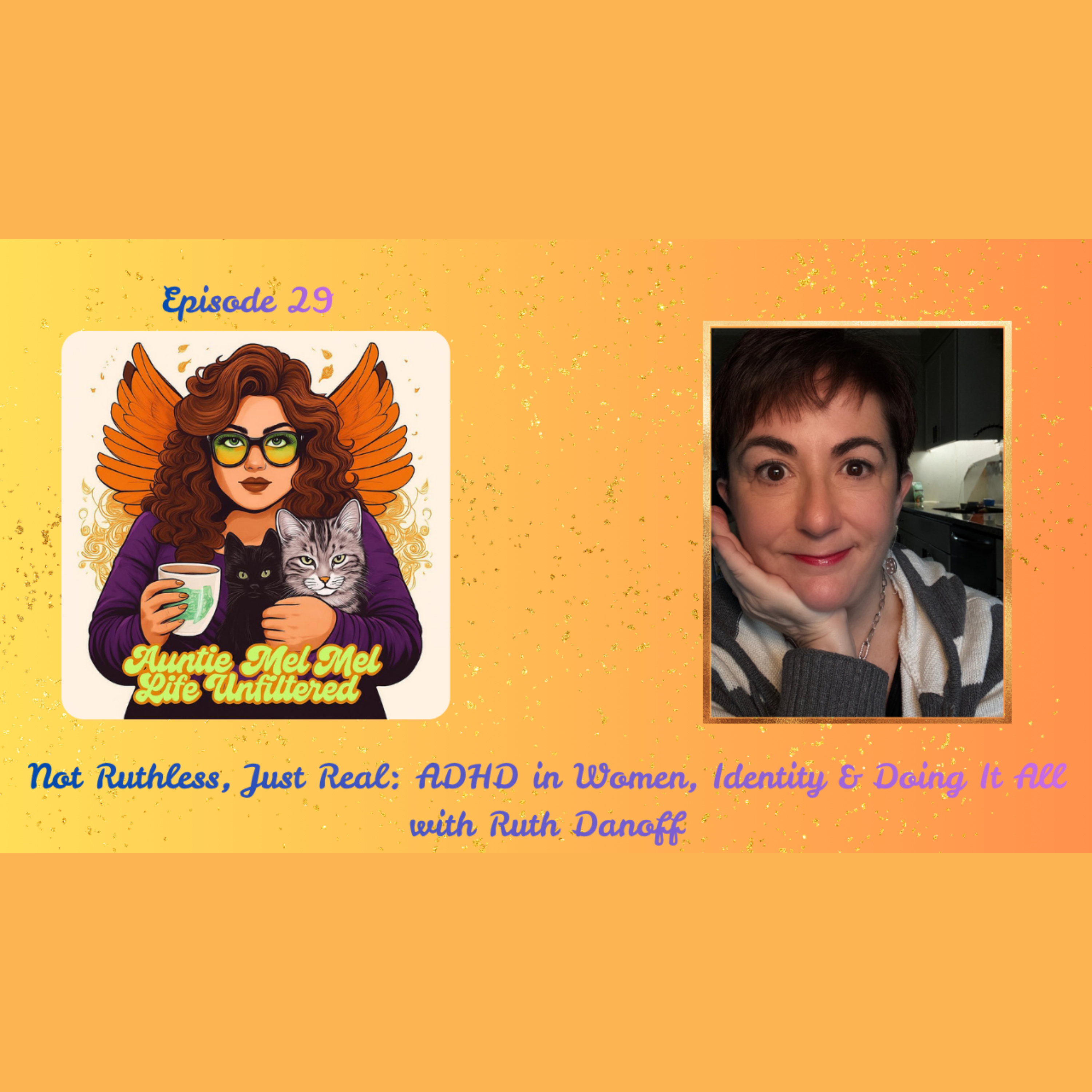
Not Ruthless, Just Real: ADHD in Women, Identity & Doing It All with Ruth Danoff
from Auntie Mel Mel Life Unfiltered
44m 35s
This episode of "ETV MelMell Life Unfiltered" features a conversation with Ruth, who was diagnosed with ADHD at age 50. The discussion highlights how ADHD in women is frequently missed or misunderstood due to historical lack of research and different symptom presentation. Ruth explains masking, where neurodivergent individuals suppress natural behaviors like stimming to fit into neurotypical settings, leading to exhaustion and grief over lost potential. The episode covers the impact of ADHD on work, relationships, and mental health, noting that boredom can cause attention lapses, while overwhelm from environmental stimuli drains energy. Hormones are identified as a key factor that exacerbates symptoms, especially as women age. Ruth emphasizes that healing is ongoing and that self-acceptance grows with time. She advises women suspecting ADHD to consult a doctor for testing, find supportive communities, and learn about their true selves beyond masking. The host shares her own journey of finding authenticity and putting herself first, while Ruth encourages embracing individual timelines and the natural process of coming into one's own. The conversation underscores the importance of validation, connection, and the belief that timing is meaningful in personal growth.
Welcome to ETV MelMell Life Unfiltered. The package has where we say the things everyone else whispers feels or pretends they're totally fine about. Around here nothing is too awkward, too messy, or too "oh my god did she really just say that? Yes, yes I did." This is your space where real talk, real stories, real emotions, and the kind of honesty that makes you laugh, cry, and heal a little. Sometimes all at once. So grab your drink, get comfy, and let's dive in. Because life's too short to sugarcoat it, and I'm not here to do that anyway. Let's get into it. Hey guys, welcome back to ETV MelMell Life Unfiltered. The space where we have real, raw, and honest conversations about life, healing, growth, and everything in between. Today's episode is one I'm especially excited about because we're diving into a topic that so many women are only now beginning to truly understand themselves. ADHD. For years, ADHD and women has been overlooked, misunderstood, or dismissed entirely, leaving so many feeling overwhelmed, burned out, and wondering why life feels harder than it seems for everybody else. Today, I'm joined by Ruth. His work is helping shine a light on the realities of ADHD and women in such a powerful and honest way. We're talking about identity, masking, mental load, late diagnosis, and what it really looks like to live with ADHD as a woman. This is going to be such an important and validating conversation, and I'm so glad you're here for it. Welcome, Ruth. Thank you so much for joining me today. Thank you for having me. I am thrilled to be here and to talk about a topic that is part of my DNA. Yes, I'm so excited to have you here. I've had people from all walks of life, and of course I want anybody that has any kind of journey, whether it's a health journey, a career change, a nonprofit, you know, loss, or sobriety. And I'm trying to have as many different type of topics because we all have our own things. Fantastic. I'm so excited to connect with you. I want so many different avenues for everybody, so I appreciate you coming on here. Yeah. Absolutely. So before we get into what you do for ADHD and what your work is, do you want to tell us a little about who Ruth is? I am somebody. I was not diagnosed until I was 50, and my business, one of my businesses is not Ruthless, and that is because before the age of 50, I was without who I truly am. I was without Ruth and after 50 and still going, I am now with Ruth and loving each version that is being rebirthed these days. I love that. I'm actually in a rebirthing season myself right now. I'm 39, you know, big 40s creeping up on me, and I think I hit that where I just want to be my true real authentic self. I'm trying everything I can to find who that person is, and I'm doing it unapologetically. We have to be selfish in finding ourselves and putting ourselves first. So I could not agree with you more. I have come out of a spiritual awakening. And so many people out there will relate to this and are waking up and trying to help others in their journey. And I think that's part of the reason I was put here and went through it in the early stages to just talk about it and let people know that yes, there's this big shift happening in our universe and it's real and it's okay. It's a good thing. Absolutely. I believe it and I feel it as well. Doing this podcast and connecting with so many different podcasters and guests, like we're all just trying to let everybody know they're not alone. And you know, there is a movement and powerment of all of us coming together and sharing that it's okay to be yourself. It's okay to find yourself and it's okay to deal with whatever you're dealing with. So I love that. Remember that looks like in whatever your process is, you know, everybody's process and timeline is different. Absolutely. And we all just need to embrace each other, be accepting of the other person's timeline. That's something I struggle with a lot. With ADHD is having patience. It's gotten a lot better for me after my awakening. I still struggle with it because it's one of the side effects of ADHD. Like so many other people out there with it, I'm sure that they will understand or I'm coming from. Right. Yes. And that's something I've shared and learned from this is, you know, it never fully goes the way nothing is ever fully healed. You learn to live with it and you find things that help you thrive in life and cope with everything. And this is what this is for and that's what you share your story for, you know, to let everybody know there's ways to help. So. Yep. I love that you said that you really don't fully heal. I mean, you know, we talk about I have healed myself. It's to a point that I am a completely different person now, but it doesn't mean that I'm not still working. I will be doing internal work to the day. I'm no longer on this planet, whenever I'm really. And it doesn't mean that I don't still get angry or I don't still do this that or the other, you know, I'm big now that I'm really so protective of myself. I'm probably more of that. Right. It's okay. Yes, it is. It is. It is okay. Yes, it is. Absolutely. I love that. And that's so true. It's absolutely okay. You got to put yourself first and you got to do things and boundaries come along with that and everything else. Oh, my goodness. I can't lose people. Yes. Yeah. But it's all meant to be. So. It is all meant to be. And it's. I kind of am at a point where I am excited each day when I wake up because I feel like I just don't know what's going to unfold today. And it's an exciting thought. I love that. Some days, some big things unfold, some days, nothing unfolds. But everything's happening when it's supposed to. Yeah. That's awesome. I love that. I'm getting to that point myself and it feels amazing. I made some changes this week that kind of freed me a little bit more and my energy is off the chart. So thank you so much. So I'm kind of, you know, like we were just saying, put myself first no matter what happened. Yes. So. Yes. Absolutely. Now you mentioned you got diagnosed late in life. I know you got diagnosed around 50. Can you go back and tell us what life was like before you were diagnosed or what led you up to getting diagnosed? It's short. You know, people ask me that a lot. And I'm in the one of the projects I have going on right now is I'm writing my memoir and my editor keeps kind of prodding me in a good way because I need help with props to right expand on stuff. And she was asking me, well, what happened that day that you got your diagnosis? What was it like? You know, when you got into the car or whatever. And you know what? It was not a momentous day for me. I think I was a little bit in shock. And it took me, I was living in Maryland at the time. And it took me a year and a half, maybe two years later, I moved to North Carolina. And I finally got on TikTok. And that is when I really started to understand what I was going through. Right. And, you know, from there, it has been a journey. So I hope that answered your question. Oh, yeah, of course, definitely. And I could see that, you know, you kind of just learn that in that moment, you're not unmetedly like, oh, goodness, you know, takes time to process that. And as you said, going on TikTok, as we've kind of mentioned all along here is having finding those people and knowing there's people out there that understand you. And then it all clicks like, oh, my gosh, that is me. And I, yes, I have always done that. Right. And it's not, and I'm not crazy. And I have that selfish. And, you know, I don't procrastinate. And all of the things that I have been gas-lighted for all of my life, and that I have had very low self-esteem around hearing that that hasn't been your fault, doesn't fix it. It takes years. And I'm still, you know, 15 more years later. I am still recovering from the masking for all of those years and being so hard on myself instead of loving. Yeah. I understand that. And that's hard. And that's part of it all too. You know, we always, whatever we are going through, I'm a lost mom. There's a lot of guilt that comes with that. So like you said, it's always a thing. You have to work through that. And like, there's always something. I'm sorry. You're a what? I didn't. A lost mom. I have lost eight pregnancies. So I have no living children. Oh my goodness. Thank you. That's why I started my podcast though, because I share my journey and let people know.
they're not alone and it helped me heal not all the way in ways that I never expected. But that's why I want to do this. Let people know they're not alone and you know that it's okay. That term before. So that's why you're something new I learned today. Yeah. I try to use that because some people are sensitive if I would say like pregnancy loss or miscarriage or something. I try to say loss but yes. Thank you so much. It's a beautiful term. Yeah. Thank you. I appreciate that so much. It's what I do. It's my passion behind everything. Yes. I understand. You know, you have found your thing that is helping to heal you absolutely others at the same time. Yeah. And what more can we ask for? Absolutely. I made a deal. I love it and I'm so happy for this journey. So in everyone I'm meeting along the way. Yes. Yes. It's fun. It's yes. It is. It is so much fun. People absolutely. Yes. Absolutely. I love it. Why is ADHD in women so often missed or misunderstood? Because not a left research has been done. One of the things I plan to do when my windfall comes in is donate to have more research done. I sit on the community advisory council for the Duke Center for Girls and Women with ADHD. It's an amazing organization and full of resources and they are doing research and there are resources out there. So it's a matter of people getting online and trying to find what's going to help them best. There's so much out there that it can be overwhelming. So try to just pick one or two things and stop researching. You know, look at you just printed and then you know, go from there. Speak from experience. We all know what it's like to go down the rabbit hole. Oh yeah. And that doesn't help at all. I'm sure especially with having ADHD it just makes your brain go in a million different directions as well and kind of keeps you. You're not able to focus and truly. Yes. Always chasing that dope for me. Yes. Absolutely. Yeah. That's so important that you say that because I think a lot of people like you said do go to that rabbit hole and to stop and take a moment and take a breather, you know, take a day by day. Don't jump into everything at once and you know, like you said, find like minded people or you know, look for organizations. Like as you mentioned that help and do research and go from there. So. Yep. Yes. Yes. And you know, you hear that there's that so many so many women are being diagnosed late in life. And it's because there's finally being attention paid. Yeah. Oh, you know, there's always been a ADHD in women. It's just now being looked at. Yeah. And it needs to be looked at a lot more closely, especially involving hormones. Oh yeah. I, you know, with with age, my symptoms, not all of them, but a chunk of them have exacerbated. And that is because of hormones. Yeah. Absolutely. Yeah. Hormones. Hormones play such a role in everything. I have PCOS. I have possibly fibromyalgia. I deal with older down syndrome with my skin and all my joints and all that. So I understand that. And as I'm getting older, I'm kind of in that paryment and pause stage. And yeah. Yeah. It's always changing and everything changes daily. So I'll swim and have it rough. Just don't understand what's happening. No. Absolutely. Not. Yeah. Yeah. Emotions especially. Yeah. Exactly. Yeah. Yeah. Yeah. Yeah. Yeah. Why am I sad? There's no reason I be sad. Or you know, like what is going on? Why am I moody today? Yeah. You're in the middle of the I mean, I have been in the grocery store in in an aisle and all the sudden I just broke out crying. Yeah. You know, let's swim in. Yeah. We have it rough. The man get it lucky for the most back as well. But look, I wouldn't I wouldn't change. Absolutely. Thing about, you know, even the hardships I've been through, I wouldn't change a thing because it has gotten me to where I am right now. And I am happier and more confident and more proud of myself than I've ever been in my entire life. I love that. That's beautiful. And I just imagine that I'm so proud of you for being able to say that. I'm growing into my own self with that. So I get that. And you know, it comes a long way for you to be able to say that. And it's amazing and beautiful. So thank you for that. And I do want to, I want to encourage you and give you hope because it does get better with age. I mean, a lot of things. Yeah. You know, there's a lot of things that you can do. But you as a woman, you come into your own in a natural way that cannot be forced. And only time can get you there. Yeah. That's just such a beautiful thing. Absolutely. I feel it. Like I said, I think I'm in that journey now. There's so many things changing, but like in a good way, you know, I'm finding that real who I am. So it is such a beautiful experience for that. Yes. Now we mentioned masking a little bit. Can you explain what masking is and why so many women do it? So masking is what neurodivergent people do to try and to fit into the neuro typical world. It means not so a lot of people who are neurodivergent do some sort of stemming, you know, stimulating. I rock. If I'm standing, I'll catch myself rocking. You know, just always have to have something in my hands or if you know, just doing something. And sitting for me, sitting in a business meeting and not being able to do any of those things is physically painful and incredibly exhausting on top of that because we are having to use every bit of your energy to not do what your body naturally wants to do. Yeah. Yeah. That's a lot. And I'm sure that, you know, especially when you are undiagnosed, it's even harder because you don't know what's going on. And you're like, why do I feel like this? So that's so important. Yes. Yes. Yep. Thank you for that. Of course. Yes. Now you kind of mentioned a little bit about how it impacts work when you have ADHD. Of course, relationships, parenting and mental health are also affected. Are there any specific areas or situations that you can speak on in those situations? Sure. Well, I mean, I've been in therapy most of my adult life, proudly say that. And it has taken that to help me to get where I am, especially after my diagnosis. Unpacking what your life could have been if you had known is massive grief. Yeah. It's just massive grief. And some people can deal with it quickly. Some people it takes longer. Again, everybody's different. And as far as work goes, I always had been in the administrative field. Okay. And I was the go to person, oh, go ask Ruth. She knows. And she doesn't know she'll figure it out. And that's very true. And at the same time, every single performance review I had in my career, I was pinged for not paying enough attention to detail. So and it took me a long time to realize that it's because I was so bored and uninterested in the topic. And when that happens, I can proofread something 10 times. And I did proofread it. And I still miss stuff. And there have been a zillion times when I've been online reading an article I'm interested in or a magazine or a book or on somebody's website. And I catch typos and grammatical errors all the time. Because they're interested. Yeah. Yeah. Yeah. That's so important. Yeah. Yes. It's it's and and another thing about being in an office environment. The overwhelm of being around so many stimulating things. People, like sounds, you know, at the end of the day, it is just draining once you get home. Yeah. And on top of that, even though I
wasn't having drama in my life. People around me that were having drama in their lives and, you know, you hear conversations at the water cooler. You soak it all in. Oh, yeah, you can't help it. And it's just exhausting. Yeah, you know, it just feels so good to know that I am my own boss. And I do what I want when I want. Yes. And I'm working all the time because I'm passionate about what I'm doing. Yes. That's amazing. I love it. Yes. That is actually, you know, I kind of hinted at that. That was my team just so you guys resigned from a position in an office setting and it was a remotely home position. But I've worked in customer service and I'm in a state of work my whole life as well. And I thought it was me in person. I couldn't do it anywhere. I started to get things out of you. All the things around me feeding off of everybody else. So working from home was good. But like you, I lost my passion for the topic. It's not something I'm passionate about. And I was starting to slip, you know, in my work, I could feel it myself. They never said anything, but I knew it my own. And like you said, when you get to that point, like you just can't continue to do that. And that's what I'm trying to do is trying to find things I can do for myself that make me happy. And I'm already 100 percent better just doing what I want to do. So yeah, exactly. So wonderful. Thanks, so yeah, congratulations. Thank you. Yes. That just happened this week. So I'm proud of you. That is a big deal. Yeah, big step. Yeah. And it's something I wrestled with. It wasn't done lightly. I've been trying to change for over a year and a half. And it just got to that point where I was like, I can't do this anymore. So yes, I love it. That's I'm glad you share that. I feel like we're always connected. I talked to people in the right moments in our lives. And I love that. So truly believe it. Yes, absolutely. So this is our second go, right? Second go. Yeah, we were supposed to record about a week ago. Mm hmm. You woke up. You were ill. Yeah, a big deal. That's that's one of the most beautiful things that has come out of my awakening is my realization of timing. Yeah, that's absolutely. And I don't you know, five years ago, I would have been. Yeah, I had plans to do this and this afternoon. Baba, baba, baba, baba, baba, baba. Yeah. When you said that, my immediate thought was, okay, it's not supposed to happen today. Yes. And that's it. And you let it go. And yesterday I recorded another podcast podcast that we had recorded previously, but the technical difficulties and it didn't record. Oh no. It's okay because yes, I think we got a better one the second time. You know, I'm just I'm learning to roll with the punches, which has not ever been easy for me. No, well, that's great. And that's a great thing. And that's something definitely to be proud of because it's already been this and normal day to day, you know, for everyone. So I appreciate that. But I feel that too. I feel like what's always meant to be we talk to each other, meaning to the one we are meant to you. And I've had that happen so much with this podcast, but it's kind of crazy. But I love it. So it shows me that I'm doing the right thing as well. So amen. Amen. Yeah. Yes. So what science should women not ignore if they suspect ADHD? Well, there's I mean, it's not as easy as, you know, when when you're having a heart attack, you're right. Yeah. Having these physical symptoms that you know to immediately get checked out. Yeah. If you think you have it, my suggestion is to go talk to your doctor, to your primary care, talk to any of your doctors and then get tested. I'm not a clinician. I can't right speak to a diagnosis. But my suggestion is to do that because then you will know for sure. And you can take appropriate action. You can find your community wherever you are. You can learn about yourself and who you truly are outside of masking. Yeah. That's so important. And thank you for sharing that insight with us. So like I said, I can't really pin down a one symptom or specific symptom. So maybe just, you know, learning a little more like you said, the stigma around is closing people are being diagnosed more, there's being more research done, which is so great. Like I said, I'm turning 39. So even in the late 80s, early 90s when I was a kid, like, you know, it was still, oh, they're fine. You know, it's still parents and doctors and everything sleeping under the rug. So I completely understand. Yep. Yep. Yeah. And when I was little, I, I, my, um, one of my uncles nicknamed me the mouth on two legs. Because I, you know, I was always so curious. I was always to everybody's business. What are you talking about? Bap, bap, bap, bap, bap, bap. And of course, you know, your little kid and it's in the right business what we're talking about. But I was always just so inquisitive. Yeah. So curious. And yeah. And people just didn't know that that. Yeah. Absolutely. I'm so glad that it is. Yes. That's so many things that this tap or podcast and topics is, you know, there's so much stigma and taboo. You go, I don't know. So many things are things they're overlooked. And that's what I'm trying to bring light. So people are like, no, but real. So it is real and stigmas are lifting. Mm hmm. They are. It's beautiful. They are lifting. And it's, it is beautiful. Yes. I love it. Yes. It's so empowering. I love doing this. It just makes me feel, I get a high from doing these. No, like nothing else. Just because I know I'm helping and it just makes me feel a lot better myself. So same. Same. Yes. That is my purpose. Yes. Excuse me. That is my friend is here on earth is somebody. Be of surface. Oh my goodness. It's climbing all over me. I love it. Oh my. Oh, she's wild. That's their little dancer. Yeah. That's Jade. She's wild. Sorry about that. It's climbing me. Like I said, I keep it real in anus and we all love animals. So I love animals. Yes. Me too. What was I saying? I don't know. We were talking about stigma. It was being no longer out there. Yeah. I think we're almost done with that topic. So okay. We can move on. Yes. I my brain is kind of squeaky as well. Let's see here. What tools help? Or is there anything that helps? I know therapy, obviously, getting diagnosed and then going from there. Are there any other tools that you recommend? Everybody is different. Yeah. And so for me, writing things down, keeping them in my calendar, I have sticky notes everywhere. I think because I was in the administrative field, I was able to put in place some systems for myself that worked. Right. Yeah. Something that I have recently learned that I did not know was a possibility was that people who have been diagnosed with ADHD can figure systems out for themselves to such a degree that they no longer qualify. Okay. They're no longer on that spectrum. And that's great. That is great. That was my something I learned new last month, I think. That's interesting. Yeah. I just didn't know that that was possible. So yeah. But the best thing to do is talk to your doctor, find a good therapist and know that the first therapist you try, if you're new to therapy, you don't have to stay with them. Yeah. Absolutely. You have a good vibe with that person. And you can relate to them and you feel safe with them. And it's okay if you don't, you know, we don't all vibe with each other. No. So then move on to the next person. And yes, there's no judgment, no limit to how many therapists you can try out before you find the right fit. Yeah. It's just listen to your gut. And that is the, that is the true answer. Yeah. I love that. And I have had all kinds of different therapists on here. I've had a matric therapy. I've had art therapists. I've had EMDR. And that is the biggest thing. And I've asked that, you know, how do therapists feel when that happens? They want you to find the right person. It's not for them. It's for you. So they're not offended. They may not vibe, but either you have to have that connection and somebody that understands you. And you can also try different type of therapies too. There's so many different types out there. So absolutely. And a good therapist, you know, with their goal is to kick you out. That's absolutely. Yes.
And I love that you said that trying different kinds of therapists to get therapy. Your therapist, you know, if you have a good one, they will say, well, you know what? I really think that EMDR could help you with this particular issue. - Mm-hmm. So, yeah, it's beautiful. I love it. There's so many different ways. You know, when we were, it kind of goes back to the stigmen stuff, you know, therapy as well was kind of looked down upon and you were thought to be crazy if you wanted therapy, you know, we're all brought up to be tough skin and just go through the things of life throws at us, but that's not how it is. And we all need to work through them to be the great, wonderful people that we are and become our two selves. But yeah, it's so important to know that there's so many different avenues out there. And like you said, and the therapists I've had on here, they will not be offended. They want you to be with the right person. - They want you to find the right thing. And as you said, this is our goal to kick you out. They want you to be healed enough that you can do it on your own or try something else. - Yes. - Yes. - Absolutely. - Yes. - What's something loved ones or family members could do to support women with ADHD better? - Oh gosh. Be patient. - Hmm. That's a good one. - Patient and ask questions. - Mm-hmm. - Family members, I think it's hard to deal with family members. Strangers, except you for who you are, they don't know you. But when you start to learn who you are and shift and change, your family is like, wait a minute, you didn't use to be that way. - Yeah. - And it's kind of shocking for both sides because you're shocked that you're now this whole different person. They don't know what to do. And it can be a really challenging place. - Yeah. - And that's a good thing. - Yeah. - And I think that's a good thing. - Yeah. - And I think it's a good thing. - I think it's a good thing. - Yeah. - And I think it's a good thing to do. - Yeah. - Yeah. - And I can do it. - Yeah. - Yeah. - I think that's a good thing. - Yeah. It is so important and there are a lot of things that I do that a neurotypical person may look lazy or I'm procrastinating and for people who are neurodivergent, there is something called task avoidance and no matter how much you want to get up and do those dishes right this minute you know they need to be done. There is something in our brain that will not allow us to do it. Again, I'm not a clinician, I can't explain how all that happens but it's to be true. You know, it's almost like somebody who has epilepsy, they're disabled, they have a placard but you see them walking right in. Well, don't judge them because it's an unseen disability. Absolutely. And those are the hardest ones. Absolutely. Absolutely. I agree with you 100% on that. You know, the undiagnosed, excuse me, it's a hidden ones are the hardest ones because people judge you immediately. As I said, I have PCOS and fibomaealza and stuff like I am hurting but people are like, oh, you're smiling, you look fine, everything's great. I have my moments as well or I can't get up off the couch and do the things I need to do like cleaning and stuff like that and yeah, people just like, oh, you're just lazy, like no, you don't understand. So yeah, I think, uh, being less judgmental is so important and just trying to understand and try to listen and learn without adding your input. Exactly. And I'm sure as you said, a lot of family, even you mentioned you know, you that nickname your uncle gave you, I'm sure that sings a little bit too, you know, and you think to back to all of that. And it's almost a family also may kind of need to go through therapy and work through things and that's something that I've come back to. I do a special what would anti-melmel do episode every month or people sending questions and we just kind of answer fun questions which I do have past guests that we join me. So you're welcome to come join me for one of those one day. Oh, it would love to. That's a lot of fun. Yes. And it made me think of a question and they're kind of, you know, can you heal in the environment that you have trauma from and you do have trauma from being undiagnosed to your whole life and stuff like that. And yes, as you mentioned, you know how you change and your family members are like, wait a minute, who's this person? That's something like if you said, put yourself first and you have to put those boundaries up and everything and they have to change for themselves. That's something you have to remember this too. They may never change their mindset on ADHD or how you acted growing up or how you are now. Yes. So you have to kind of think about that too. We don't always get that closure with that person and we don't always get them to understand. So you're so wise. Thank you. Oh, thank you. So you have to say, I just made me think of that, you know, we have to remember that too and it's a hard pill to swallow like because it still hurts. You may not be able to be around those people anymore. But as we've said, it comes back to you in this episode, you must put yourself first. It's the most important thing. So absolutely. Absolutely. No, I couldn't have said it better, my dear. Oh, thank you, Ruth. Well, those are all my main questions for me. Well, good to do some rapid fire in a few moments. But if you want to share about your website, how people can connect to you, what kind of services you offer, kind of help you offer. Thank you. My website for my 80 for my ADHD business is www.notruthless.com. And on Instagram, I am at underscore not ruthless. I do support. I do compassionate, empathetic understanding calls with women and to help them understand where they're going through because I've lived through it. I continue to live through it. And it is very healing on both sides. I get so much out of it myself. But one thing I haven't talked about is Arctic undies. Oh, that's interesting. One of the one of the comorbidities I have from ADHD is body temperature dysregulation. I'm always hot. I've been hot since I was a little kid. Excuse me. So long story short, because I know we're heading to take all the time you can need. I am a content creator. I am an author and I am an inventor. And Arctic undies are cooling underwear for women. That is not just about the fabric. There is an electronic component. So every woman I have talked to cannot wait for these to come to market. And I am working furiously. And I need the audiences help because I am raising funds to have the design finished and the prototype made. So my Arctic undies website is www.ArcticArcTICundies.com. And there you can see some renderings. And if you're interested in investing, excuse me, you can sign up there and there's a waiting list. So you can be first when they are out to market. And it's just my my passion project right now. That's awesome. I love that. That's so important. And even just pairing men and paws and having PCOS and having all the hormonal things. I always have a hard time keeping my body temperature regulated. And that sounds exciting. It is very exciting. And I am gaining traction. And that's awesome. Like I said, every day something new is unfolding. Oh, I love it. I can tell your passion and you're in such a beautiful place in your life. And it just radiates. And I love that. You know, we all can feel from each other and we all continue to help each other empower each other. Of course, I'll share all your links. I'll share that so people if they want to donate and find out more about that because that's really awesome. So I will absolutely make sure all the information is out there for everybody. Thank you. I appreciate that. Yeah, no problem. Before we get to the rapid fire or anything else that you wanted this year. I don't think so. I think I think I've covered it all. I'll let you guys. I'll keep you posted. When my book comes out. Oh, yes. That too. Absolutely. And that's something I find in there. So many people, no matter what their journey is, there's so many authors I've met that you didn't know they were authors because they're writing on their journey and stuff like that. It's so beautiful. I love it. So yeah, absolutely. Well, let's get into some of these fun questions. Okay. Are you a coffee or a tea person? Both but more tea. A deodor I got. I've got
The less coffee agrees with my system, but I still love coffee. I understand that completely Morning person or night owl You know for a thousand years. I was a morning person And because I always had to be up early for work. Yeah, but when my life changed two years ago I'm Less of a morning person. I'm say you know I would say a morning person versus a night owl if it hadn't you a black and white, but right It's both some it depends on the day. I understand that completely I've always been in positions where I've had to be more every morning person But I can also see up late and enjoy the night as well. Yes. Yeah Favorite comfort so Um S.V.U. Oh nice. I like that. Yeah. Yeah. I love all those things. You know, it's a key role. Yeah. She's a badass. She's amazing. She is a bad Yes, she is. Even her just gets better with age. Absolutely. Yes, yes And even the actress uh, you know herself where she comes from and where mom and all of that You know, so yes, she has a background since Danes me and field yes. We had a tragedy and her father's And was an actor too. Yeah. Yeah. Yeah. She's a beautiful amazing person. Oh yeah I love it. I would love to be her girlfriend. Right. Yes. Absolutely Sweet or salty snacks sweet sweet Beach or mowins Oh, that's a tough one um both but beach in the cold weather and I know okay You know, I'm not a hot weather person. Yeah, I make cold weather person. Yeah Um Yeah Beats. Yeah My winds I like both of them myself so Yes, how do you water? It's it. Oh yeah. I'm around water. I'm old and yeah, I'm a pacie So I heal by the water so I completely understand that. Yes Favorite way to relax Walking It makes us yes. That's my favorite thing to do So I always tell people you don't always have to you know make a therapist appointment or do something like that Even just grounding with nature is so helpful so I and I will literally You know, I will literally walk up to a tree right by the street everybody can see me and I hug it if I feel Absolutely care left. Yeah, I'm hug you see me hug in a tree what you know, right? It's so powerful people don't realize that and yes So it's being around nature being around the animals um the day after I made my decision that I told you about I got up that day I took a four mile walk through our local trail and this kind of enjoyed everything I have family a deer come out and that we're talking to me. This like staring at me and like that moment sure to so beautiful So yes, that's fine. That was just right. It actually was yeah, I felt it so that's people tend to forget about all the simple things in life like that That actually and all the signs that are out there for us. Yeah Yeah, well, thank you, Ruth. This has been so much fun. Thank you for joining me and sharing your wisdom and honesty Yeah, absolutely. I know so many women listening are going to feel seen in a way that maybe never has been before So absolutely. Yes www.notruthless.com Check it out book a call and let me help you work through it. Yes, absolutely So definitely and as I said, I will make sure to link Ruth and everything And make sure that you guys can connect with her easily So to all of you listening if this episode resonated with you share it with someone who needs to hear it Don't forget to subscribe follow and leave a review because it truly helps more people find these important conversations Thank you for being here and I'll see you all in the next one Thank you bye bye. Bye. Thank you so much All right friends. That's a wrap on today's episode of anti-mel-mel life unfiltered Thank you for spending the time with me and stepping into the real the bra, the messy and the magical Because you know we don't do surface level here if this episode hit home Made you laugh or helped you feel a little less alone go ahead and follow the podcast and share it with someone who might need it too And remember you are never too much Never too little and never alone on the swild ride I'll meet you back here next time for more truth more feels and more unfiltered goodness This is anti-mel-mel signing off stay real stay kind and stay unfiltered
Podcast Summary
Key Points:
The podcast "ETV MelMell Life Unfiltered" focuses on real, raw conversations about life, healing, and growth, with this episode specifically addressing ADHD in women.
Guest Ruth was diagnosed with ADHD at age 50 and shares her journey of late diagnosis, masking, and self-discovery, emphasizing that healing is an ongoing process.
ADHD in women is often overlooked due to lack of research and different symptom presentation, leading to late diagnoses and years of gaslighting and low self-esteem.
Masking involves neurodivergent people suppressing natural behaviors (like stimming) to fit into neurotypical environments, which is exhausting and can cause grief over a lost potential life.
Hormones exacerbate ADHD symptoms in women, and the condition impacts work, relationships, and mental health, with boredom and overwhelm being key challenges.
Ruth advises women suspecting ADHD to consult a doctor for testing, find community, and learn about themselves beyond masking, while noting that self-acceptance and timing are crucial.
Summary:
This episode of "ETV MelMell Life Unfiltered" features a conversation with Ruth, who was diagnosed with ADHD at age 50. The discussion highlights how ADHD in women is frequently missed or misunderstood due to historical lack of research and different symptom presentation. Ruth explains masking, where neurodivergent individuals suppress natural behaviors like stimming to fit into neurotypical settings, leading to exhaustion and grief over lost potential.
The episode covers the impact of ADHD on work, relationships, and mental health, noting that boredom can cause attention lapses, while overwhelm from environmental stimuli drains energy. Hormones are identified as a key factor that exacerbates symptoms, especially as women age. Ruth emphasizes that healing is ongoing and that self-acceptance grows with time.
She advises women suspecting ADHD to consult a doctor for testing, find supportive communities, and learn about their true selves beyond masking. The host shares her own journey of finding authenticity and putting herself first, while Ruth encourages embracing individual timelines and the natural process of coming into one's own. The conversation underscores the importance of validation, connection, and the belief that timing is meaningful in personal growth.
FAQs
The podcast focuses on real, raw, and honest conversations about life, healing, growth, and topics like ADHD in women, offering a space for authentic discussions.
It is often missed due to a lack of research, but attention is growing. Organizations like the Duke Center for Girls and Women with ADHD are working to improve understanding.
Masking is when neurodivergent people try to fit into a neurotypical world by suppressing natural behaviors like fidgeting or rocking, which can be physically painful and exhausting.
It can cause difficulty with attention to detail when bored, overwhelm from office stimulation, and exhaustion from absorbing others' emotions, leading to burnout.
They should talk to their doctor or primary care provider and get tested to confirm the diagnosis, then find community and learn about themselves outside of masking.
Pick one or two resources and stop researching to avoid going down a rabbit hole, as too much information can be overwhelming.
Chat with AI
Loading...
Pro features
Go deeper with this episode
Unlock creator-grade tools that turn any transcript into show notes and subtitle files.
 PodcastTranscript AI