Worth Credit Union promotes auto loan refinancing with low rates, no payment for 90 days, and a $200 cash bonus, emphasizing better financial value. This is contrasted with broader themes of resilience and sacrifice in World War II, where leaders like Franklin D. Roosevelt and General MacArthur drive military and moral efforts. Roosevelt, despite health decline, pushes for unconditional surrender, while MacArthur’s vow to return inspires Allied morale. The Pacific theater intensifies with the Battle of Leyte Gulf and the brutal siege of Iwo Jima, where kamikaze attacks and extreme Japanese fortifications lead to devastating casualties. The U.S. faces a moral and strategic crisis over invading Japan, knowing the cost may be beyond what the public can bear. The iconic flag-raising photo on Iwo Jima becomes a symbol of American perseverance, deeply resonating with Roosevelt’s vision of a prolonged struggle. After Roosevelt’s death, President Truman inherits a war that demands a decisive end, balancing military necessity with the preservation of democratic ideals. The narrative underscores how personal, strategic, and emotional elements—like a simple website or a wartime photograph—can transform ideas, lives, and national identity.
Drive a better deal with Worth Credit Union rates as low as 3.99%, 90 days no payment and $200 cash when you move your auto loan to Worth Credit Union.
Same car, better rate. From your daily commute to your next weekend getaway, let Worth help you get where you want to go.
Worth Credit Union, refinance your auto loan today. Apply online or visit a local branch. Subject a credit approval membership eligibility required.
You'll see WorthCU.org for details.
A beautifully designed square space website is the difference between thinking about photography school and selling your portraits online.
It's the difference between giving away those cookies you just made for free and running your cookie empire.
A beautifully designed square space website is the difference between having a movie reviewing hobby and a movie reviewing career.
The square space, because no matter what you're into, a website makes it real. Use offer code Difference for 50% off select plans in terms of conditions apply.
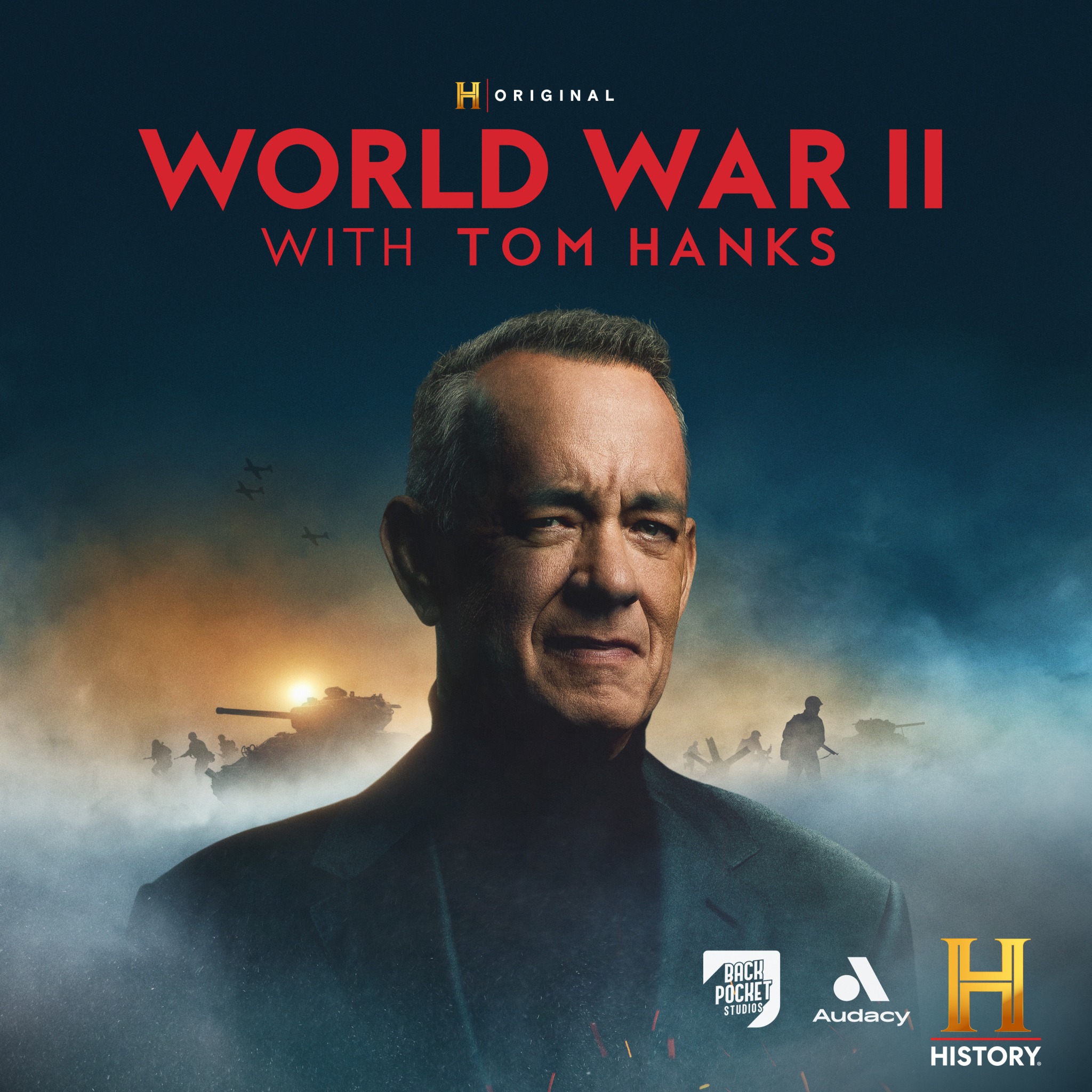
The History Channel, original podcast.
President Franklin Delano Roosevelt is a transformative figure in American history. He steers the country out of the depression and away from isolationism.
In the summer of 1944, Allied forces are battling across France, and heavy bombers are striking the Japanese home islands, but forcing the Axis powers to submit to FDR's demand.
Unconditional surrender. Still requires enormous effort from America and its allies.
This is World War II with Tom Hanks. Episode 17. No surrender.
Summer, 1944. While American forces combat Germany and Europe and Japan and the Asia Pacific, in the United States, it's an election year.
Even though his nation is at war, the commander in chief, the most powerful man in the world, must seek the approval of voters.
Franklin Roosevelt is trying to do something no Americans ever done, which is be elected to a fourth term as president.
And the country is not ready to turn Franklin Roosevelt out, but they're not thrilled about rehiring him either.
Roosevelt wasn't in robust health when he first ran for president in 1932. He's a polio victim as a young man. He's in a wheelchair.
Those who've known him before the war always come away a bit shocked at how dramatically he seemed to age.
The stress of the war has ground him down, so he's got to demonstrate to the American people that he is still firmly in command in this war and can bring it to a successful close.
Roosevelt decides to sail over to Hawaii to hold a wartime conference with his top leaders.
By being on a warship at the site where the war started for the Americans, he has the ability to project an image of continued vitality and strength.
The primary purpose of the Pearl Harbor Conference is to determine American strategy against Japan in the Pacific.
Roosevelt looks at Japan and sees a country infected with a kind of militarism, a desire to conquer its neighbors, a notion of racial superiority over all the other peoples in Asia.
To prevent another Pearl Harbor, he's going to have the stick to the policy he declared in 1943, unconditional surrender.
The United States controls most of the Pacific, including New Guinea and the recently captured Mariana Islands.
The Navy wants to push on and take Formosa, modern-day Taiwan, as a prelude to invading Japan.
General Douglas MacArthur has other ideas.
Douglas MacArthur is one of the most famous American generals in history, also one of the most controversial.
He's got an ego that is unbelievable.
In Hawaii, when he shows up late, he keeps the President waiting on purpose and then rolls in in this leather jacket, decidedly casual, in complete contrast in the Navy, which is all turned out in their dress-wise.
MacArthur believes he's more important to the country than the President. In fact, he believes he is the country, that his will and his desires in some way embody the will and desire the American people.
MacArthur insists American forces must return to the Philippines, for reasons both strategic and personal.
Douglas MacArthur had a long standing affiliation with the Philippines. He had a real affinity for the Filipino people.
He had lived there before the war, and then in 1941 and 1942, he was the commander-in-chief of that garrison when it was attacked by the Japanese at the very beginning of the war.
When Japanese forces overran the Philippines in 1942, Roosevelt ordered General MacArthur to evacuate to Australia.
He understood MacArthur's personal value to the morale of the American public. After months of bitter fighting, American and Filipino troops surrendered to the Japanese.
In the cruelest conditions, they were marched off the Batan Peninsula and into captivity. The Batan Death March.
During the Japanese occupation, hundreds of thousands of Filipinos are killed. Women are forced into sex slavery. Entire villages are destroyed in mass executions.
As he is about to leave, MacArthur makes this famous pronouncement.
I shall return. It's not we shall return, it's I shall return.
This is a vow that becomes really a rallying cry for Americans not only in the Philippines who are captured, but also for Americans back home.
At Pearl Harbor, MacArthur presses the President to strike Japan through the Philippines instead of Formosa.
The problem with the Philippines is it's not just an island, it's an archipelago, and there is a very large Japanese army on these islands, hundreds of thousands of troops.
That could lead to protracted fighting with the Japanese.
But MacArthur has some arguments on his side as well. The Philippines are an American possession, they're a commonwealth.
To simply bypass the Philippines and go to Taiwan, will make America look like a very in constant partner.
Not to mention abandoning the survivors of the Batan Death March.
Roosevelt leaves the conference without making a decision.
A week later though, he sends a letter to General MacArthur agreeing to his plan.
On October 20th, over 100,000 U.S. troops backed by the 7th and 3rd U.S. fleets, land on Leite, a central island in the Philippines with a protected gulf.
MacArthur's campaign to retake the country has begun.
He had the army signal corps of engineers go ahead on the beach ahead of him, so by the time he got there, he gives his radio address.
People of the Philippines, I have returned.
The fact that MacArthur is able to return to fulfill that promise is a morale boost.
But the theater of MacArthur saying I have returned does not translate into straightforward allied victory.
The Japanese know that General MacArthur has promised to return, and so they anticipated the next decisive battle maybe over the Philippines.
The Philippines sit between Japan and the Dutch East Indies, Japan's primary source of oil.
So if the Philippines get captured, it will cut off the supply lines and the military runs out of oil.
The Japanese already have a plan to defend the Philippines, Operation Shogo, or Victory.
They will send all their warships to destroy the U.S. fleets in Leite gulf, then trap General MacArthur's troops on the island.
The Japanese position is absolutely imperative to carry out this operation now.
We've got oil, we've got warships, we better use them or lose them.
This is almost like one last Banzae charge at sea that can have a material effect on the outcome of the war.
That's the kind of spirit in which the Japanese are heading into this battle.
The Allies have promised the Japanese that the war is going to go on until unconditional surrender of the Japanese Empire.
But deep down inside I'm not sure that Japanese believe that.
They still think they can inflict enough casualties on the United States that eventually, despite all the talk of unconditional surrender, the Americans will be willing to talk.
As MacArthur and his troops
land on Leyte, the Japanese fleets moved towards the Philippines.
At this point in the war, the Japanese have suffered terrible losses in the Pacific
from midway to Guadalcanal, but they still have a tremendously powerful fleet.
They have these super battleships, the Musashi and the Yamato.
These are the biggest battleships ever built, and this has always been the U.S. Navy's fear,
if these massive Yamato class battleships get loose in amongst MacArthur's troop ships,
the invasion support vessels, the devastation could be immense.
Two Japanese fleets, a central fleet and a southern fleet, will converge on Leyte Golf,
where U.S. naval forces are protecting the Carthor's landing. Success depends on a third fleet
moving towards the Gulf from the North. A decoy fleet.
There's another aspect. There's essentially a carrier task force that sails towards Leyte Golf
from the North. It has four aircraft carriers in it. It's designed to try to lure American ships
away from protecting MacArthur. And this is the brilliance of the Japanese move. They decide to use
the carriers as bait. The entire Japanese strategy is to trap MacArthur, trap this famous general
himself potentially. They're going to bring these two heavily armed and armored pincers
against the American landing force while it is still unloading cargo and supplies and troops
at Leyte and annihilate it.
General MacArthur has landed 130,000 troops on Leyte, the first step in the American Liberation
of the Philippines. But as U.S. troops establish a secure beachhead, the Japanese navy
enacts Operation Shogo. The Japanese have to figure out how to sneak their forces close to
landing beaches without being discovered because of the come under heavy air attack they're in
real trouble. So they plan to lure most of the American forces out of the fight.
There are two American fleet supporting MacArthur's forces. The U.S. Third Fleet led by Admiral
Bull Halsey. And the seventh led by Admiral Thomas Kincaid. As the Japanese cross the Seabullion
sea, they're spotted by one of Halsey's scout planes.
The Americans attack from the air and they're by the focus on the largest ships they see,
which were the super battleships Yamato Musashi. Musashi is an absolute giant. She has 18.1
inch naval guns, the largest naval guns ever mounted. The Japanese have even developed a special
anti-aircraft shell for them as well, which explodes in this enormous cloud and is supposed to
destroy any American planes that are flying through it. But the attacks that are launched by
these American planes gradually start wittling away at her defensive capabilities.
Torpedo after torpedo streaks towards the Musashi, hitting and exploding below the water line.
17 to 19 torpedoes, more than a dozen bombs, finally get her to go down.
The Musashi sinks along with a thousand of her crew. The Japanese central fleet retreats.
That night, Kincaid's fleet, including battleships that had been damaged at Pearl Harbor,
decimates the Japanese southern fleet. But Halsey again spots Japanese warships north of
late-take-off, including four aircraft carriers. The Japanese decoy fleet. In Halsey's mind,
as a carrier commander himself, any enemy carrier fleet represents the most dire threat to his
mission, which is protecting the invasion forces. So Halsey takes his entire fleet and goes charging
off after it. And so Halsey's played into the Japanese hands exactly as they had hoped.
Halsey's taken all the major firepower north with him. And that puts MacArthur's invasion at risk.
Halsey moves north. But the Japanese central fleet, under Admiral Takayo Kareta, returns to late-take-off.
From the battleship Yamato, Kareta sees that only a portion of the seventh fleet is left to
protect MacArthur's invasion. For Kareta, this is a heaven-scent opportunity. The dawn breaks.
And now there is an American fleet sitting directly under his guns. All he has to do is sink them.
The American vessels that are still around late-take primarily provide support for the landing
forces going ashore. So there's only a token force of light escort carriers and destroyers.
Escort carriers are small, extremely vulnerable. They can carry 25 to 30 aircraft
Macs. They're designed for ground support for the troops ashore. That's their role. It is not
to get themselves into stand-up fights against large enemy warships. The escort carriers
launch their planes against Kareta's much larger fleet. And then these escort carriers,
mostly what they do is turn around and run, because they are not designed to fight a threat like this.
The only force that can match the Japanese, Admiral Halsey's third fleet, remains 100 miles
to the north. His commander-in-chief Admiral Chester Nimitz requests his location.
Halsey receives a message from Nimitz. Where? Repeat where? Is Task Force 34 the world wonders?
Traditionally, naval messages begin and end with sort of a nonsense phrase to confuse code breakers.
The nonsense phrase they could use in this message, though, is the world wonders.
And the world wonders line should have been removed by a cipher officer, but wasn't.
I've always wondered if Admiral Nimitz was also sticking a little barb in Halsey as to what are
you doing up there? And the result is that Halsey just goes into connections, throws his cap on the floor,
swearing up and down. His chief of staff has to tell him to get a grip on this situation.
Halsey realizes the danger. He sends his fastest battleships back to Leite Golf,
then continues after the Japanese carriers.
Now, what the Americans don't know is that the Japanese carriers lying to Halsey's north
don't have many planes on them. In fact, most of the planes have been
offloaded already and flown to the island of Luzon for what is about to come,
because the new and terrifying weapon emerges from this battle.
The kamikaze.
Now that fall is in full swing and October report cards are right around the corner,
keeping up with classroom lessons can feel like a challenge. That's why I love IXL.
IXL is an award-winning online learning platform that helps kids truly understand what they're
learning, from math and reading to science. It gives kids personalized practice, aligned directly
with what they're covering in class, offering instant feedback and clear explanations that build
lasting confidence. Whether your child needs a boost in a tricky subject or is ready to move ahead,
IXL adapts to their exact level and pace. Plus, one subscription covers all your kids
from pre-K through 12th grade, and an entire month of IXL costs less than just one hour of tutoring.
Make an impact on your child's learning. Get IXL now, and listeners can get an exclusive 20% off
IXL membership when they sign up today at IXLlearning.com/audio. Visit IXLlearning.com/audio
to get the most effective learning program out there at the best price.
Do you ever wish you could ask nosy questions about people's money?
I have $729.71 in my bank account.
We bought, you know, a $1.3 million house on a $350,000 income.
On the podcast, what we spend, we ask those questions. It's a show about money,
and all the feelings that come with spending it.
I want to be the kind of person who can just take care of the people in my life.
Listen to what we spend, an Odyssey original available now wherever you get your podcasts.
At an airfield on Luzon, Japanese pilots are assembled for a unique mission.
Japanese pilots at the beginning of the war were the cream of the crop, elite,
hand-selected, and carefully trained. But by this point in the war, Japan just doesn't have
the time or the resources to train its pilots.
The Japanese military leadership has to make a tough decision to make a cost-efficient
way of destroying American enemy ships.
And one way to do it is to undertake
one-way flight that will end with a crashing of plane.
This new unit of 24 pilots, led by 23-year-old Lieutenant Yukio Seiki,
is Japan's first organized special attack unit.
They will soon become known as Kamakaze, the divine wind.
So the Kamakaze in some ways represents a perversion of traditional Japanese
Bouchido doctrine.
The samurai code, this idea of sacrificing one's life for Japan and for the emperor.
It's hard to generalize about their motivations.
You find some of them saying, "I'm doing this for the emperor."
Other pilots talk about their village.
They talk about families, and they say, "I'm doing this for you."
For the Japanese, what they're doing was not regarded as suicide.
It's a death in combat.
So it's the sense that these young men are becoming something really special.
They're almost, to give this level of self-sacrifice, makes you a samurai.
In Leite Golf, the American escort carriers of the US Seventh Fleet
confront a new and lethal threat from the air.
Stopping a Kamakaze plane is almost impossible.
The American carriers can only do two things.
One is maneuver away, and the second is put up a huge curtain of flak.
But oftentimes, the Kamakazis can break through that flak curtain.
You could fire every anti-aircraft gun in the world, but unless you get something like
a direct hit that kills the pilot, that plane's going to hit your ship.
There's a psychological effect as well.
Japanese Kamakaze, you're giving up their lives in those violent ways possible,
simply to kill Americans.
This is something that is difficult for Americans to understand,
that this is a human being who has chosen to do this to you.
How do you fight against an enemy like this?
Lieutenant Seki crashes his plane into the flight deck of an American escort carrier,
the USS San Lo.
It's the first ship to be sunk by Kamakaze attack.
Six other vessels are struck, and barely stay afloat.
But Admiral Carita's central fleet also faces an aerial attack.
Despite the pounding the Americans have taken,
it is actually Carita, who is under a major disadvantage here.
He is up against 350 American planes.
And because Carita is being constantly attacked by American aircraft,
he becomes increasingly paranoid that he is now surrounded by American carriers.
So after these moments of tension, where Carita could have potentially wreaked havoc on the
American fleet in Laita Gulf, he actually withdraws.
Carita retreats ahead of Admiral Halsey's returning warships,
but the Japanese have lost a third of their navy.
It's the largest naval battle in human history, more than 200,000 combatants involved.
And the American victor really knocks the Japanese imperial navy out of the war of the Pacific.
But without a doubt, the Japanese are not going to surrender this perversion of the Bushido
code. It has manifested itself on islands throughout this war, and now it's manifesting self in
the sea and in the air. So it's starting to get in the mind of the allies about how costly it
will be to achieve that unconditional surrender of Japan.
Over two months of fighting in dense jungle terrain, against fierce Japanese resistance,
General MacArthur's troops retake Laita.
Luzon is next. Luzon in particular is going to be a very tough nut to crack because not
only is it a large island with mountain chains the Japanese can fortify, but there's also this
enormous capital of Manila with about a million people sitting in the middle of the island.
And if the American forces get involved in urban combat there, the casualties are likely to be
very, very heavy. Twelve days after the victory at Laita Gulf, it's election night in the United
States. And High Park, a victorious president greets towns people on election nights.
Franklin D. Roosevelt wins an unprecedented fourth turn.
The unconditional surrender of Japan and Germany remains his highest priority.
On January 9, 1945, MacArthur's troops land on Luzon in the Philippines.
Quickly, special operation forces trek inland to liberate Japanese POW camps.
At the end of two years of captivity in Japanese hands, these men are in terrible condition.
A third of them have already died. There are also a number of American civilian detainees
that are in camps that are near Manila. So there's a ticking clock here as far as MacArthur is
concerned. He needs to liberate these camps as rapidly as possible.
In early February, American forces surround the capital of Manila.
Most Japanese troops have retreated north to create an extensive defensive line,
but one group stays with orders to fight to the last man. The real problem of urban warfare in
the modern era is that the city is a gigantic sponge. You can have a million man army,
and suddenly it's split up all over the place. So the Americans find themselves having to fight
street by street, building by building, and it really turns Manila into the Stalin grad of the Pacific.
MacArthur's men are supported by Filipino resistance fighters who provide intel,
disrupt Japanese supply lines, and help secure key routes into the city.
There have been active groups of Filipino guerrillas in existence since 1942,
and those guerrillas have been carrying on a very successful campaign of resistance against
the Japanese occupiers. The Japanese response, like the Nazis in Europe, was to use guerrilla activity
as an excuse to murder civilians. So whether it's a school, the hospital, homes,
Filipino people are being bayonetted, they're being shot, beheaded,
sometimes burned alive, corpses left to rot. There's a sense of scorched earth,
a sense that we will leave nothing for the Americans.
The Japanese will ultimately take the lives of 100,000 Filipino civilians.
The battle of Manila in a lot of ways is a harbinger of what's to come.
Roosevelt and his top military advisors are aware of the increasingly dire implications of a
longer war with Japan, but the American people are very focused on what's going on in Europe,
and they think the war is now winding down. President Roosevelt's just been reelected,
he's looking at the horrors, the brutality of the fighting in the Philippines,
and he's been peppered with letters from the moms of America saying, where is my boy,
what is he doing, what God forsaken island is he fighting on this time?
He needs to find a way to strengthen the will and resolve the American people,
because he knows things are going to get a lot worse before they get better.
Roosevelt needs with British Prime Minister Winston Churchill in Malta
to discuss the strategy for ending the war in Europe and in the Pacific.
The question is, if we have an enemy willing to sacrifice young men in kamikaze attacks,
an enemy that seems willing to fight on beyond reason, how are we going to bring this to an end?
Roosevelt's advisors are arguing that the Japanese will not give up, this war will not end
until there is actually an invasion of the home islands.
Churchill and Roosevelt are in Malta on the way to Yalta, early in 1945,
and this is where Operation Downfall first crystallizes, invasion of Japan.
The sense is that after the war in Europe would be over and all of the resources, all the men,
all the equipment that they could muster would be transferred into the Far East theatre
for a massive, massive operation, the kind of which history has never seen before.
This would occur after a protracted strategic bombing campaign, which as of early 1945,
is beginning to take more and more effect.
At first, the Marines were ordered to take Iwo Jima.
Japan has an airfield on Iwo Jima, and as the B-29s start operating out of Cypan and the
Marianas, they're using it to spot the B-29 formations on their radar scopes.
Iwo Jima becomes a logical place to first of all remove something from the Japanese control.
Second, don't allow them to have any Japanese fighter on their or early warning systems.
And third,
For all those B-29s that are making those long flights, over 1,200 miles,
it creates a place to land if they have engine trouble if they run into any difficulties.
So, Iwajima's gotta go. That needs to become an American airfield.
Now, American intelligence tells the Marines that there are about 13,000 Japanese defenders,
but there are actually 23,000 nearly double what the intelligence estimates listed.
As a result, you have an American invasion force that's going to be meeting a much tougher defense
than it expected.
Japanese troops on Iwajima have been preparing for an American attack for over three months.
The Japanese strategy is to make the battle last as long as possible.
Each day that that battle lasts is a day where the people at the home islands are spared of an American
invasion. So, the commander of the Japanese on Iwajima, Kuri Biashi, says, "We're going to prepare
these defensive fortifications and wait, draw the Americans in, and then attack them."
The Japanese aren't on Iwajima. They're actually in Iwajima.
They have miles and miles of tunnels that they have dug out of this soft volcanic terrain on the
island. And they've also fortified the most prominent landmark on Iwajima, which is Mausurabachi.
Looming over the Marines landing beaches, Mausurabachi provides the Japanese with a perfect
defensive position. It's going to be this defensive hive that the Americans will have to reduce,
cave by cave, bunker by bunker, one thing at a time. An Iwajima, Japanese soldiers are issued
orders to kill 10 Americans before they die. We see very few Japanese who attempt to surrender.
There's a view that this is a great dishonorant, not only to one's self and one's family,
but to the Emperor as well. If you look at the letters that Kuri Biashi writes
home to his family, he's clear right from the beginning that no one on the Japanese side
is coming home from Iwajima campaign. And he starts to issue these orders very clearly to his men
saying, "Fight to the death." But he doesn't want a band-side charge. He doesn't want pointless
suicidal acts. He wants to show the Americans the cost to them of going as far as the Japanese
home island. The Navy bombarded Japanese positions for three days. Now the Marines plan to land
60,000 men across Iwajima's southern beaches, push north and take the island.
So at 8.59 on the 90th of February, the first 10,000 men land. And it's quiet. But then at 10
o'clock in the morning. Every Japanese soldier with a mortar, machine gun or a piece of artillery
will now start to shell the landing beach. In the face of withering fire, the Marines struggle
up dunes of 15 feet or more. Iwajima is not sand. It's volcanic ash. Your feet just sink up to
your knees. It's like walking in coffee grounds. It's incredibly deadly to try and move forward.
Bulldozers are called into clear a path through the dunes, allowing the Marines to continue their
advance. As the Marines finally make their way off the beaches, they're getting attacked from
everywhere, people coming out of tunnels, of mortars coming off of Mount Sarabachi, of hidden
artillery emplacements all over the place with snipers firing positions they can't even see.
An individual soldier has to somehow get up close with a grenade that you can put through
the firing slit and kill the crew that's in there. Ultimately, one of the greatest weapons
that the Marines have is what they'd call zippo tanks, which are tank-sized flame throwers that
can shoot long distances, and that becomes the weapon of choice for Marines on Iwajima.
By the end of the first day, the Marines have secured an airfield and prepared to attack Mount
Sarabachi. On Iwajima, two strategies come into conflict. Once there's no surrender, that's the
Japanese, and then unconditional surrender, and that's the American position. And at Sarabachi,
the Americans make a determined statement that it's going to be unconditional surrender.
There is no position on planet Earth held by the Japanese Army that American troops cannot take.
We just moved into our new house, and I didn't realize just how close we were to the neighbors.
That's when my friend told me about Blinds.com. Blinds.com isn't a medication,
but it can improve how you feel about your home. Customers who shop at Blinds.com
experience excellent customer service, from consultation to installation. Side effects
include increased privacy and better sleep. Talk to your partner today and see if Blinds.com
is right for you. Visit Blinds.com to order your free samples.
After securing the beaches, U.S. Marines and Iwajima attack Mount Sarabachi.
The force that goes uphill fights off Japanese resistance,
and upon reaching the summit, they find a water pipe that had been associated with a Japanese
system. They attach a small American flag to that water pipe, and then they raise that flag.
But they realize the flag is too small. We need a bigger flag.
So what they're going to do is they're going to take a ship's flag and they're going to send it
up there, and about noon it gets up there. Six Marines plant the second American flag.
Joe Rosenthal, an associated press photographer, captures the moment. All the ships offshore
begin blowing their horns. Everyone on the island can see it.
It's a snapshot in time. The composition is nearly perfect,
although he basically shoots it off his hip without even using his rangefinder as he did it.
He can't see anybody's face, and so really it becomes everybody's picture.
Two days later, Rosenthal's photograph is on the front page of newspapers across America.
President Roosevelt immediately understands how inspirational this single image is.
FDR was always a frustrated journalist. He had been the editor of the Harvard newspaper.
He understood visual imagery. It's American determination embodied in a single photograph.
They're all working together, and so it tells a national story. It's not just those guys
on top of the hill that raised the flag. It's a nation that put that flag on top of the hill.
But it's striking that the flag isn't fully planted. It says if the struggle is still unfolding.
And that fit FDR's mood at that point. This isn't over.
We're getting closer, but we haven't gotten there yet.
Two FDR, these six Marines are the perfect symbol of America's wartime effort.
He calls the Marines and says, "Find me these guys. I want to bring them to the Oval Office.
I want to send them on a war bond ride."
So the Marine Corps sends somebody to the island, but they find them free men who are in the photo
or dead already. They died within days of the photograph being taken.
U.S. Marines suffered 26,000 dead, wounded, and missing. Almost every Japanese soldier on Iwo Jima
is killed. Karibashi himself who never believed he was getting off Iwo Jima alive,
he retreats, and he takes his own life. It's the only battle in the Pacific where the Americans
actually take more casualties than the Japanese take. So for American military planners,
the less of Iwo Jima seems pretty clear that if you're going to launch Operation Downfall,
if you're actually going to invade the Japanese home islands, the cost is going to be immense.
Because at this point in the war, most Americans have concluded that Japan is never going to surrender.
After victory on Iwo Jima, the Marine Corps sends three surviving flagraisers back to Washington,
but they will not meet their president.
Ladies and gentlemen, the tragic news of the president's death came to Washington today
as a complete shock, except for very few people who knew of his condition.
Franklin Roosevelt had loomed so large for so long an entire generation of Americans
really only knew him as their president. Supposedly during the funeral procession,
a man is so overcome by his emotions. And another man says,
"Did you know the president?" And he says no. But he knew me. And that's how people felt about
Franklin Roosevelt. Roosevelt had been a very, very active president.
is a very, very powerful personality,
the kind of caretaker to the people.
And he knew you can't fight an endless war
if you want to maintain your democratic ideals.
They also knew how difficult, unconditional surrender
and be to put into actual practice.
During years of fear and uncertainty,
Roosevelt was uniquely able to lead America's colossal fight
against fascism.
Now this job will fall to his vice president, Harry Truman.
Mrs. Roosevelt summons Truman to the White House.
He says, "Is there anything we can do for you?"
And Mrs. Roosevelt says, "No, Harry,
"is there anything we can do for you?
"For you are the one in trouble now."
On assuming the presidency, Truman told reporters,
"I felt like the moon, the stars, and all the planets
had fallen on me."
Harry Truman of Missouri is now responsible
for the successful conclusion of the largest conflict
in human history, including the final destruction
of Adolf Hitler's Third Reich.
World War II with Tom Hanks is produced by A&E Factual Studios,
Nautopia Limited, Play-Tone Productions and Backpocket Studios
in association with Motion Entertainment for the History Channel.
This episode was narrated by Tom Hanks and mixed by John Lloyd,
additional voicing provided by me, Jeremy Reagan.
From the History Channel, our Executive Producers are Eli Lara
and Liv Fiddler.
For Play-Tone, Executive Producers are Tom Hanks and Gary Getsman.
For Backpocket Studios, our Executive Producer is Ben Dixting.
This is Jill Slesinger from Money Moves.
You started a business to follow your passion,
not to get buried in financial details.
Zero makes managing your numbers simple
by bringing accounting, payments, payroll,
and analytics together in one place.
Instead of trying to sound smart,
zero is designed to make you feel smart,
with easy to read dashboards and smart insights
that give you better control over your money.
Join 5 million customers worldwide
who trust zero to keep their business running smoothly
without the hassle.
Learn more at xero.com.
Podcast Summary
Key Points:
Worth Credit Union offers low auto loan rates as low as 3.99% with 90 days no payment and a $200 cash bonus for loan transfers.
A well-designed website, such as with Square Space, transforms hobbies into successful businesses by making them visible and professional.
Franklin D. Roosevelt leads the U.S. through WWII, pushing for unconditional surrender of Japan and Germany despite immense human costs.
General Douglas MacArthur’s promise to “return” after the Philippines’ fall becomes a powerful morale symbol and drives the liberation campaign.
The Battle of Leyte Gulf and Iwo Jima reveal the extreme Japanese determination, including kamikaze attacks and fortified resistance, leading to heavy Allied casualties.
The U.S. faces a pivotal strategic dilemma
The iconic photo of Marines raising the flag on Iwo Jima becomes a national symbol of perseverance, resonating deeply with Roosevelt’s vision of ongoing struggle.
Roosevelt’s death prompts Harry Truman to assume the presidency, facing the difficult task of ending the war without sacrificing American democratic values.
Summary:
Worth Credit Union promotes auto loan refinancing with low rates, no payment for 90 days, and a $200 cash bonus, emphasizing better financial value. This is contrasted with broader themes of resilience and sacrifice in World War II, where leaders like Franklin D. Roosevelt and General MacArthur drive military and moral efforts.
Roosevelt, despite health decline, pushes for unconditional surrender, while MacArthur’s vow to return inspires Allied morale. The Pacific theater intensifies with the Battle of Leyte Gulf and the brutal siege of Iwo Jima, where kamikaze attacks and extreme Japanese fortifications lead to devastating casualties. S.
faces a moral and strategic crisis over invading Japan, knowing the cost may be beyond what the public can bear. The iconic flag-raising photo on Iwo Jima becomes a symbol of American perseverance, deeply resonating with Roosevelt’s vision of a prolonged struggle. After Roosevelt’s death, President Truman inherits a war that demands a decisive end, balancing military necessity with the preservation of democratic ideals.
The narrative underscores how personal, strategic, and emotional elements—like a simple website or a wartime photograph—can transform ideas, lives, and national identity.
FAQs
Worth Credit Union offers low interest rates as low as 3.99%, 90 days of no payment, and a $200 cash bonus when you transfer your auto loan to them.
You can refinance your auto loan by applying online or visiting a local Worth Credit Union branch. A credit approval and membership eligibility are required.
A beautifully designed website helps transform a photography hobby into a career by making your work visible and accessible to a wider audience.
The offer code 'Difference' provides 50% off on select Square Space plans, though conditions apply.
Roosevelt led the U.S. through World War II, steering the country out of the Great Depression, pushing for unconditional surrender of Axis powers, and maintaining public morale during the war.
MacArthur famously promised, 'I shall return,' which became a powerful symbol of American resilience and hope during the war.
Chat with AI
Loading...
Pro features
Go deeper with this episode
Unlock creator-grade tools that turn any transcript into show notes and subtitle files.
 PodcastTranscript AI