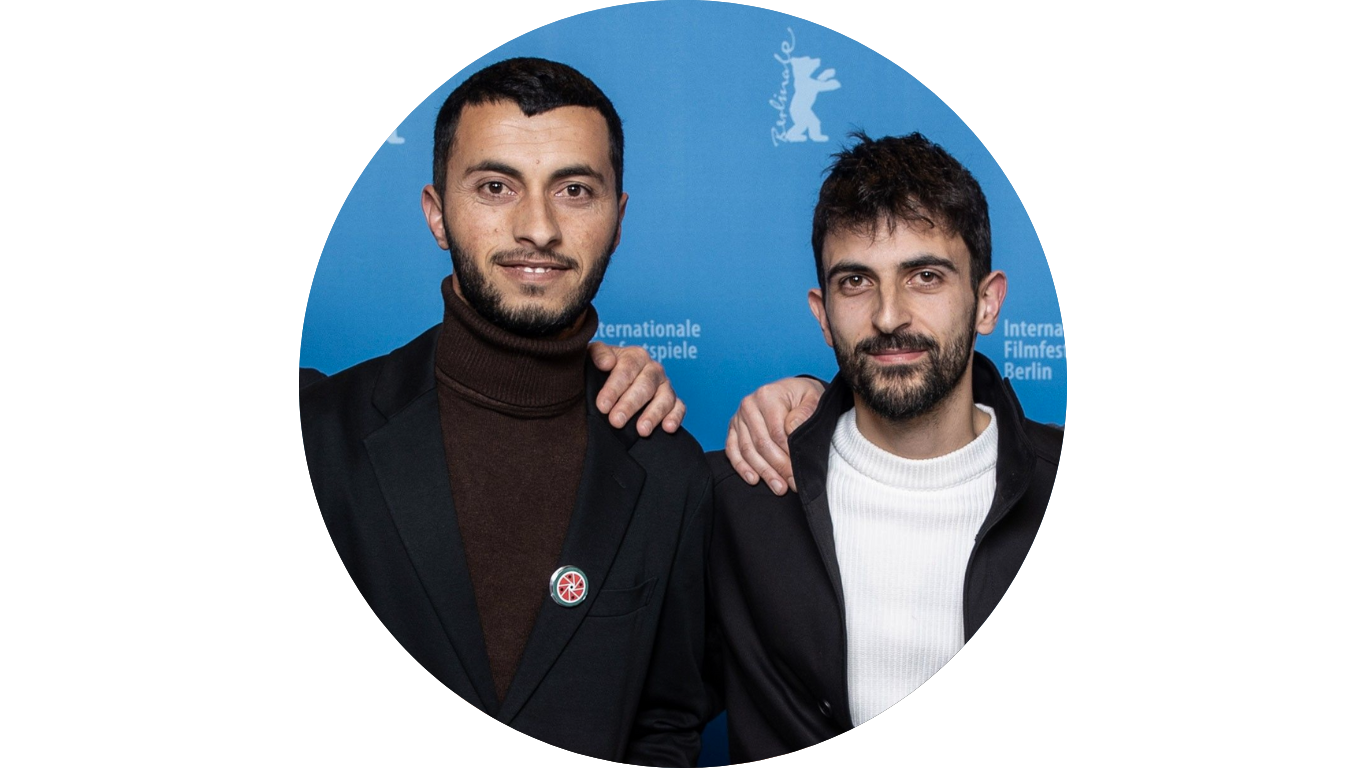
(music) The documentary "No Other Land" is directed by a team of Palestinian and Israeli filmmakers. I won't hesitate to say it's one of the most powerful films of the year. (music) Untamed Powers In This Is Pure Nonfiction. I'm recording this on the night before the Toronto International Film Festival. This is my 19th year as the festival's documentary programmer. This year, one of the most anticipated films is "No Other Land" that was made by a collective of four directors, two of them Palestinian and two Israeli. They spent four years in production from 2019 to fall of 2023. They document life in the village Massifar Yata in the occupied West Bank, where Israeli settlers and soldiers have attacked Palestinian residents for years with violence and home demolitions. One of the film's directors, Basel Audra, grew up in Massifar Yata. From a young age he watched his father as an activist documenting the violence. As an adult, Basel continued his father's work. The film opens in 2019 when two Israeli journalists arrive in the village. On camera we see you Val Abraham and behind the camera is Rachel Shore. You Val has high hopes that if he reports to Israeli readers what's happening, it might do some good. He soon learns it isn't that easy to change minds. But you Val develops an ally ship with Basel and the film's fourth director, Hamdan Balal. The demolitions and violence keep going and together the four filmmakers keep documenting. In one incident they film an armed settler shooting a young Palestinian named Haroon, who's paralyzed by the injury. Haroon's family has their home demolished and are forced to move into a cave to care for him. The filmmakers have very nearly finished no other land last October when violence in the region escalated to new heights. That was a trauma that broke apart many alliances between Palestinians and Israelis. But somehow this team stayed together. No other land premiered at the Berlin Film Festival in February were at one, both the jury and audience awards in the Panorama section. It went on to play several other European festivals winning more awards. Now this fall it's coming to North American festivals including Toronto, Camden and New York. Despite its widespread acclaim, no US distributor has picked it up. The film's backers will bring it to our house theaters in the fall. The only time the four filmmakers were able to attend an international festival in person was in Berlin. Since then it's grown even more difficult for the Palestinian directors to leave their homes as Basel describes in our interview. It's a terrible missed opportunity. I think of many other films that were made under crisis conditions where at least the filmmakers could still travel. That was the case just last year with the Ukrainian film, 20 Days in Mariapol that won the Oscar. Last week I spoke with Basel and you've all been by Zoom. Basel was speaking from his West Bank village and you've all from his home in Jerusalem. I asked Basel to describe his village and what he's been documenting all his life. The documentary is not just only my village. Basically we are in a small town on the southern Okie by the West Bank. The town called Masafriata and it's splitting in small villages, spread in this area. Farmers communities basically that used to live in the Basel in a good life as a farmer. But what we are filming and what they're going to see in the movie is how the life of the people became very hard and miserable under the occupation from because of different policies that the Israeli occupation like targeting our community with. Mainly the policy of home demolitions and the suckers attacks, building settlements and how families are suffering here from not having the same issues. They are from not having their basic rights as a human being. As well you can see between the relationship between me and you've all in the movie. That is showing also the, we're putting it there for the people to understand the difference between the life of Israeli and Balicin and living in this land. So you've all in the film, we see you come to Masafriata to do reporting in the summer of 2019. Can you describe where you were in your life then? Yeah, I was just taking my first steps as a journalist. I had recently, at the time, studied, finished studying Arabic and I became quite fluent in the language, which really was the part of a process of political awakening. And awakening and change for me, I began learning about what was going on practically. I grew up in Israel, in the southern area. So it was not so far away from Masafriata. So I began understanding through meeting Basel, what is life? 20-25 minutes away, people who are living under a military regime or being forced out of their lands, who have no voting rights. And I think for me it was, when I began going to Masafriata and meeting Basel, it was a very important moment for me personally, like all of them. As a journalist, but mainly as a human being who lives in this land and grew up here and changed as I grew up. So that's where I was pretty much when I first came to Masafriata in 2019. I came together with Rachel Shore, who is a cinematographer and we met Basel and Hamdan. This is how we formed this collective of filmmakers. We began working as activists on the ground, basically trying to find ways to stop this process of the destruction of the Masafriata community. Through documenting, social media, through protests on the ground, alongside other activists. And at a certain point we felt that we had to also make a film out of what we were doing and to really focus on this story and on ourselves as activists, as young people, as the Israeli-Palestinian collective, trying to get some kind of political change in this land. Basel, you've seen journalists come and go from your village. When did this project seem to feel like it was something different? Well, we planned it to be something different. Basically, me and Yvonne and other two directors, Rachel and Hamdan, have been in this field of activism, of journalism, working, and writing, articles, and publishing, articles, stories of the community. But even us journalists have to think that we need something different as well, like to make our voice and our story, the story of the community, reaches to new audience, to new people. Because this is our goal, from the beginning, always that we need, at least for me, that we want people to know about us, that we are living here, that we are suffering this suffer, and people should know what's happening to us as Palestinians living in this conditions. And one day, we were sitting together in Hamdan, who is the other co-director, like, say, let's do a movie about what's going on here. And for us, all was like the first experience of working on this project. We started like five years ago, almost, and we began from the zero, almost. But we have a lot of archive footage for the last 20 years. And we started, Rachel started to follow us, and film us, like in the home, in the field, when we are working, when we are in our daily life. And we wanted to show everything about the community. We wanted to show the happiness, moments, the life of the people, the suffering, and the political situation. And because the strategy of the occupation here, it's to make different actions in different timeline, or in different times, which is to not let it look like as a one thing, and one bull is to like have that. Sometimes they want to demolish a whole community, and everyone focused there. And you have a pogrom of settlers that have been in different communities. So that's became the news, as something big happened in another place, that's the news. But this is all things are tied together, what they are doing. And all the things that they are doing has one goal. And this is basically what we are doing.
فقط أن نتطلب الناس لأن كل هذه المنطقة يكون محرقية. سترسة الناس لا يمكنك أن نتطلب الناس لنفعله. سترسة الناس لأن هذه المنطقة يريد أن نتطلب الناس لأن هذه المنطقة يريد أن نتطلب الناس لنفعله. نحن نطلب الناس لأن هذه المنطقة يريد أن نتطلب الناس لأن هذه المنطقة يريد أن نتطلب الناس لأن هذه المنطقة يريد أن نتطلب الناس لنفعله. سترسة الناس لنفعله. سترسة الناس لنفعله. سترسة الناس لنفعله. سترسة الناس لنفعله. سترسة الناس لنفعله. سترسة الناس لنفعله. سترسة الناس لنفعله. سترسة الناس لنفعله. سترسة الناس لنفعله. سترسة الناس لنفعله.
You have the hostages, you have thousands of Palestinians who were taken by Israel. So it's not ending. And I think for us, on the one hand, it makes us very hopeless because things are getting worse. And there is no, I don't think there is enough international pressure, especially from the United States, to have consequences for the military occupation. So on the one hand, it's getting worse. And on the other hand, I feel it shows how important it is what we are doing in our film and our work together. And how important it is to continue fighting for a political change because there really is no other way. And sadly, it's going in the opposite direction of what we are trying to do. But for me, it makes me both, both hopeless, but then at the same time, I feel much stronger about the work that we are doing and about its importance. Asl in the film, we see in October while the world's attention was shifting to Gaza, there was also violence escalating in your village. Can you talk about the things that you were going through in last fall after October 7th? Yeah, I mean, talking about the West Bank in general, to be honest, we call it silent war. There are hundreds of Palestinians being killed by Israeli soldiers and settlers since October. And life has changed very much. Talking about the communities like MSF Riyadh, Jordan Valley and many others of Palestinians like the small villages around have not been able to, for example, to be clear all of three years to help to wet the land, to graze their sheep. And many, many of them have been attacked and shot by Israeli soldiers, settlers just for being in the field have been also kidnapped and tortured in military bases in Israeli prisons. For the communities like ours, they have been under lockdown. Others would drive like their builddozers with the soldiers and they close many of villages in trances, disconnected from the city and disconnected the villages from other villages. In my area, six small communities have freed out of their homes due to settlers and soldiers attacks and threatening to the families during the night if they would not leave their home in 24 hours they would be shot to death. So hundreds of people flee out of their homes. Demolitions of structures has increased a lot very much than before. And settlers like all the time they are building and expanding settlements and outposts and farms taking more land and preventing Palestinians to reach to their land. And if they do, they will be attacked. Like life became very scary in this area. Many of these settlers, even those that have been like sanctioned by the US and other countries they are like, there are soldiers controlling our life. Like you can imagine that this soldier, that everybody knows that he is violent, there is so much document that this person should be in jail or brought to justice is the one actually embossing the law on us as a Palestinians. So it's very hard, even for me as activists, like you watch the movie today, it's like I am not able to run around like before very few times that I go out of my village to go film outside, it's very dangerous and very scary. In other words, what we see in the film, which is already a life controlled by military has gotten even worse since the time of the film. Yes, it got worse. I asked you at the beginning of our conversation where I was reaching you and I was encouraged to hear that you say that you're speaking from Massif or Yattab because at the end of the film, it looks like the situation has gotten so bad that I was left unsure whether you'd still be able to be there. Can you talk about what the situation is right now that allows you to be there? I mean, we like in my community and many other communities still like living on our homes, but what I'm telling you is we're not able to practice the life that was under the occupation, like to go out with the sheep and to go to the field to work here today, very few people that can reach to their fields, many of them have been arrested and tortured and even though settlers start to come like in my village, today what should settlers start to use the road is to go to their outpost and to come down to the main road, which is the thing that they didn't do before and they harass people on their way. In other villages, they come to graze their sheep next to the families homes, like next to the door of the family. And looking for escalation and then they attack and they beat, beating like women and men and children in that house and for sure in the military camp, they support the settlers, they shoot like bullets, tear gas, some grenades and then arrest a few people taking them to jail, make them bay high fine and then bring them back home. So settlers start to come look for like many, many escalations and attacking inside people homes next to the home, next to a school because people are not able to reach to their fields even so they would come to do the escalation in the village. As you saw, like my cousin was shot just after he finished the prayer on Friday. He was like the settler came down with another soldier and another settler and so easy shot him in the stomach. Before one month, this settler, the same one, came and attacked Israeli lift wing activists in my village, the same settler, like instead of being in jail, he's out and he has been able to attack another people and he's not even brought to interrogation like for attacking another people. You've all these days what is your ability to travel to the West Bank and do the kind of reporting that you were doing before in the movie? So my freedom of movement is not dramatically affected and I think it again shows the difference between me and Basel but I'm you know my car has a yellow license plate which means that yellow cars they're like the Israeli cars they can move around like I can go from my house in Jerusalem and I can go to Basel's house directly and then from Basel I can go to the sea to Tel Aviv and I can go and nobody will stop me while Basel's car has a green license plate which is a Palestinian license plate which means it is locked in the West Bank. It cannot leave the West Bank so Basel cannot do the opposite, cannot go to Jerusalem to meet me from my house where I'm talking right now and go to. So it's a very one-sided sort of the checkpoints are like in a way invisible like the ones that are on the border in the West Bank. For Israelis they're almost invisible. For Palestinians they are very visible, they are like a barricade. So I'm still able to go, I was just a few days ago with Basel we were in one of the villages that it's called Zenuta, it's one of the villages that was depopulated after October so the Basel said the residents fled and due to threats for their lives they were afraid to be killed. And now they some of the residents decided they're going to try to come back and when they reached that village they saw that all of their houses including the school everything was destroyed and so they had nowhere to go. Basically the settlers were living an outpost 200 meters away, came with a bulldozer, the settlers not even the army and just destroyed all of the classrooms, all of the houses. And they are not sure what to do and when they tried to at least to fix something they put like a sheet of cloth so they will have something over their heads immediately the military came and told them you're not allowed to build, it's illegal to build.
and they confiscated the cloth. And you know, what do you do in front of something like this? I mean, the power imbalance is so stark. And yes, there is pressure now that it's rising. I mean, there is more and more sanctions now happening against specific settlers. And I actually think that what Canada did, Canada sanctioned Amarna, which is one of the main organizations that is funding the settlement enterprise. And that was kind of like a first step. Like the United States didn't do something exactly similar, where Canada did not only target the individual settlers who are using this violence, but also institutions that are in the background and supporting them. And this had a lot of impact. Like you could tell that this is already something that the settler community in the West Bank is afraid of. And I think that, yeah, I just remember that, you know, to say that I personally believe that more actions like this that are looking more institutionally to apply pressure is one path that I see that will cause perhaps political change. But yeah, in my work as a journalist, like, lately I've been more focused on long-term investigations. And some matches related to Gaza, in what I'm doing right now, because that, yeah, it's very hard not to, you know, to place your attention there in a way, but as Basel said, a lot is going on in the West Bank. And often the media ignores it. Basel, I want to ask, when you watch the film today, what's a scene that stands out to you? Maybe it's seen that you won't expect other viewers to take meaning from, but, you know, of everything that this film captures over several years in the archival footage. You know, what's a scene that's especially memorable to you? Watching the movie is not easy for me to be honest, like being as a character watching myself in a movie, but ask me about specific things, to be honest, I always think about Haroon and Haroon's family. That this guy lost his life for only, like, want to, want to try to build something, a shelter. And I wish that people like, should learn, like, how injustice our life is, and what this, like, brutal occupation is doing to us, even if you're trying to build, like, something, like they want to destroy it, even if that, like, cost is, cost your life. And, yeah, Haroon's and his family is the most strategic family-like stories for us here. Basil, since October, you know, I've read about Palestinian and Israeli allies who have become more fractured, because of all the extra trauma and tension. And I wonder, you know, what you've learned with your colleagues about staying together in allyship, under times of the highest pressure? Well, we, the Israeli's that comes to our area, that they're activists with us, that, and the activism field, together, we believe more than ever that we need, like, this need to have a solution to independence, and the solution should change the roots of, and the cause of the problems. And I think the cause of the problems and the violence is the occupation. This is what I believe. And everybody comes here, is sharing the same values with us. So, and our work, I mean, the work that we are doing together, as allies, is exactly to not like to reach our solution, and not through the solution, like through a violence, it's the opposite, through talking and confronting the occupation forces by staying in our communities, trying to improve our life requirements, and always like put pressure on the Western world, because Israel is getting so much support and money and weapons from the US, from Europe, and this is what should be, this, I believe, the solution would come from there, because very much of the power is coming from there, and if they won't change, they can do it. US can stop doing vetoes against the Palestinians in the, in the, in the UN Security Council. It's, it should like put conditions or sanctions on the, and the weapons that are sending to Israel, to the money that's sending to the settlements, to the settlers, to the, to whatever being used against the Palestinians here. When that will start, I think, solution can come, and everybody can have bitter life and bitter conditions. You've all from your side since October, is divisions grow, starker, and hatred grows more intensive. I can imagine that there, you know, are people around you who would say, why are you doing this, this piece next stuff with, with Palestinians? What have you learned about keeping alliances together? You know, today it's, uh, told me, maybe the only thing that is keeping me sane, and keeping me and who I am, because so much, you know, people that I thought were my, my friends in the, in the Israeli society, I, in the way it turns their back, and generally speaking, like it's, Basel spoke about values, and about how we are sharing the same values, and I think it's true. And, you know, we, we see the injustice and we want it to end, and we want the future where everybody in the land, Palestinians, in Israelis has a good life and has freedom. We want the occupation to end, and it's very rare. I mean, to, you know, to, to, I don't know, like to, to, is it, I feel that if I speak now about the Israeli community, which I know a lot about, and the Israeli left community, it became smaller after October. And as a journalist who was always writing in Hebrew, and I began writing in English, and, you know, especially now with the film, like we are doing a lot of things in English, and this is new to me, you know, having, having an audience that is English speaking. I was used for years just to speak with the Israeli society, just to write in Hebrew and to, and I've, I'm doing that much less now, and, it's difficult because, yes, like, you know, we, you receive a lot of criticism, and, yeah, you can be called a traitor, but, you know, it's at the end of the day, like, I feel that I will be a traitor to my values, and to what I think is right, and to what I think will be helpful for the future. And if I, because of that stop, and standing with Basel and fighting the military occupation, and dreaming of, of, of, of a future of justice and equality, and for the people who live here. And so all of these questions are now in, you know, it's all very fresh, like, I think we don't really know how to deal yet with everything that we are seeing, and I hope I can start writing in Hebrew more, like I used to do. But right now, it's like, yeah, we're with the film, you know, we hope that the film is really seen by, by millions of people, where, we're, especially Canada and the United States, you know, this is now, I think, it's just premiering now in, in, in the America continent. It hasn't, it hasn't been seen there at all. And we still need to understand how, to really get it out with, you know, distribution, and, and we don't know what will happen, but we hope that people will be interested in, and that it will move people, and that they will, you know, that it will spark important conversations. I want to thank Basil Audra and you, Paul Abraham, for speaking with me. Their co-directors are Homme Dunn-Balal and Rachel Shore. Their film, No Other Land, is playing several festivals, including Toronto, Camden, and New York. It will be released in theaters this fall. We have a newsletter called Doc Voices written by Anisha Javari. You can find it by searching on Substack for Pure Nonfiction. If you want to advertise to our 40,000 readers, send an email to
[email protected]. Thanks to our team, series producer, Hannah Norton Swam, partnership manager, Bella Racklin, and web designer, Cross Strategy. Our theme music is composed by Andre Williams, and our executive producer is Rafael and Nate Housen. I'm Tom Powers. Follow us on Instagram and visit our website at purenonfiction.net.
 PodcastTranscript AI