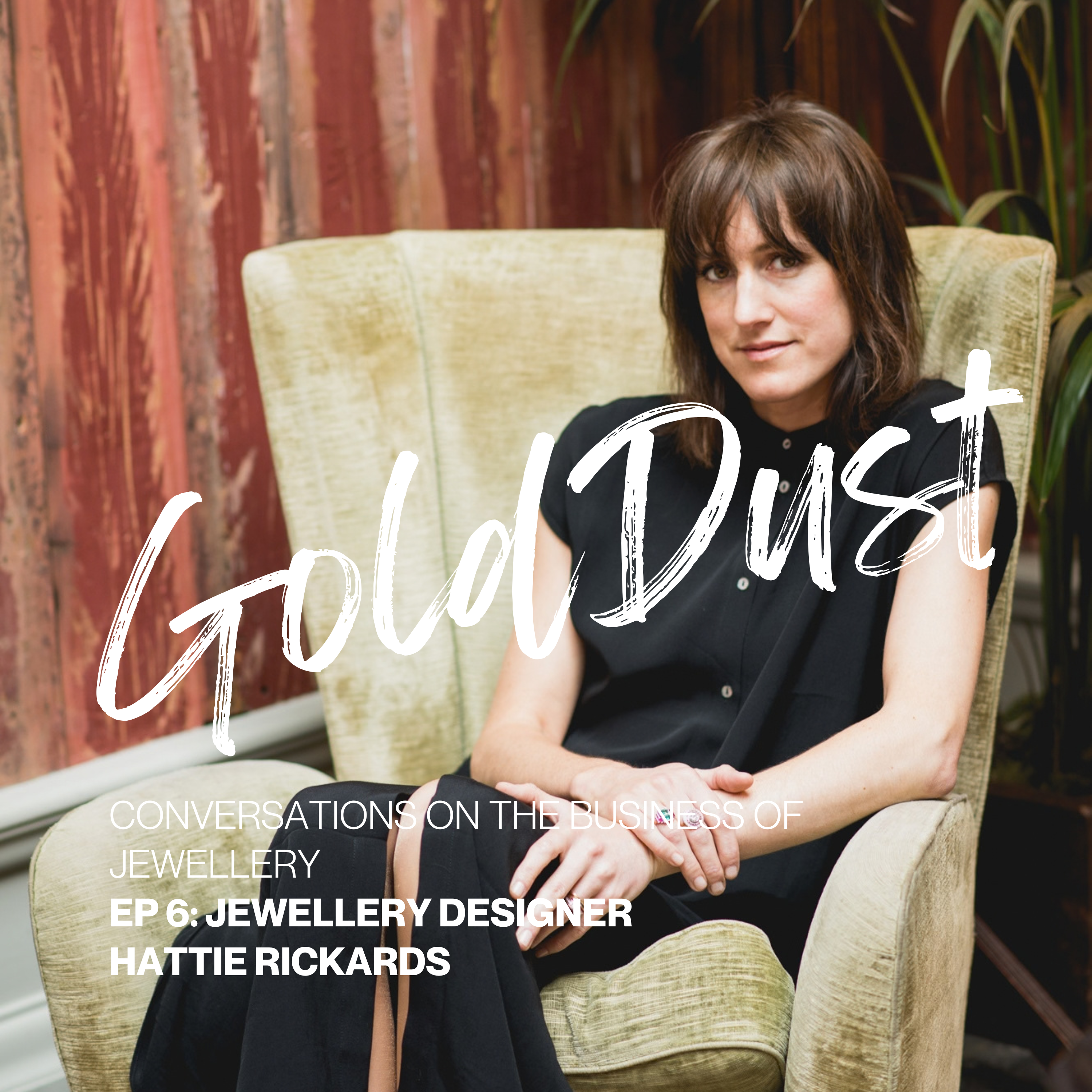
No E-Commerce, No Showroom: How to Build a Cult Jewellery Brand with Hattie Rickards
from GoldDust
59m 12s
Herty Ricards built a highly successful bespoke jewelry brand in the UK without a physical showroom or online store, relying entirely on one-on-one commissions and personal client relationships. She began with bold, artistic collections that established a unique, recognizable aesthetic rooted in her creative vision and protected by intentional focus—what she calls “keeping her blinkers on.” This design consistency has allowed her work to stand out in a crowded market. Each piece is deeply personalized, crafted to reflect a client’s story and individuality, fostering emotional connections and strong word-of-mouth growth. Herty avoids wholesale or mass production, as her intricate, handmade designs require significant time and skill, making them uncompetitive at lower price points. Instead, she invests in signature collections like the Icons and Wardrobe Icons to provide tangible, wearable experiences for clients, enabling them to visualize pieces in real life and build confidence. Her success hinges on trust, transparency, and a deep client journey—from initial consultation to final delivery. With no external marketing budgets, she relies on organic growth through referrals, client testimonials, and authentic storytelling across platforms like Instagram. Over 2,000 commissions have reinforced her belief that authenticity, personalization, and craftsmanship are more valuable than mass appeal. Herty’s philosophy—staying true to her own design identity—has not only defined her brand but also made it resilient, trusted, and deeply cherished by clients who see their individuality reflected in every piece.
[MUSIC]
Herty Ricards is one of the most exciting fine-toolers working in the UK today.
Designing almost entirely for bespoke projects with her clients,
she's built a hugely successful and widely recognised jewelry brand without
actually having anything that you can buy off the shelf,
nor a workshop or showroom that you can visit.
Her cult status in the world of jewelry has led to a legion of fans wanting a bespoke
Herty Ricards engagement bringing more pieces of jewelry, but how exactly has she
managed to grow a business without having a traditional bricks and mortar store
or a click and buy option online? In this episode, we discuss why she
decided to move away from wholesale and focus purely on bespoke one-to-one work,
how you create a recognisable brand when every piece is unique,
and why investing in physical designs rather than in marketing and PR
was one of the best things that she did to grow her business.
I hope you enjoy this episode.
Welcome, Herty Ricards. Hello, hi Kate, how you doing?
Welcome to the Gold Dust podcast, thank you.
I'm just going to start by giving our listeners a little bit of context,
so Herty and I have worked together for probably, I want to say, 15 years.
Maybe we've known each other for 15 years.
We work together on the Cut London, which is the jewelry platform that I run where I showcase
brilliant jewelry designers, and I massively admired, and it was obsessed with your work
when I first discovered it, it was just like nothing that I'd ever seen before in terms of
like a really punchy first collection. It was super bold, it was really colourful,
it was just kind of like unapologetic, and I felt like not many jewelers
launch with that kind of collection, and it was also really, really high level, so it was like
it felt super luxury, straight from the off, like the craftsmanship, the photography,
which yeah, just isn't something that a lot of jewelers can start with when they're first
starting out. Is that something that you took from your working experience?
So you know that you worked for a jeweler before you launched your own brand?
Well, I guess it did all start with Central St. Martins, I think it's like where my creativity
started really being expressed, and although it was like very intense, fast-paced course,
I learnt from St. Martins my passion for design, so it was, although it was both design and making,
I actually found the making side of it quite challenging, I wasn't very natural at it,
I found it very intricate, I actually found it too difficult, but what really excited me
was for the first time understanding a design journey, and I guess taking like any object and
taking on a design journey, developing it into an amazing piece of jewelry, so that's where I
understood where my passion lay, basically, and I wanted to then, when I less St. Martins,
go and work for a really great designer, and at that time I found Solange as a gory
partridge, and I worked with her for five years, and it was a brilliant example of really great craft
standards and really pushing design boundaries, and in 2010, I launched my own company,
Hattie Records jewelry, and I really, at that point, I felt like I had a lot to express creatively,
and that's why my first collection revealed and Geo were very, you know, bold, large, colorful,
gold, kinetic, architectural, they were really expressive, they were like pieces of art,
and that's how I started out, and those were my kind of annual collections. Do you think that
those five years, because five years is a, you know, you didn't come straight out of St. Martins
and launch straight away, do you think you gained a lot from those five years, were they really
important to sort of the foundations? Of course, I mean, with Solange, I only ever did production,
so that is organising the jewelry, so Solange would design, and then I would essentially be helping
to move the jewelry from A to B, and, you know, seeing how our businesses run for sure, so I very
much went in at the bottom, and I absolutely loved working for her, so every single day, you know,
you were doing a bit of production, you were doing some sales, my last years were helping,
being oversee open her store, Madison in New York, so, you know, the whole five years, it was incredible,
and Solange is an amazing woman who I admire hugely, and she was wonderful to work for, so yeah,
I guess being a sponge with all of that going around, you know, it's, it's all gone in somewhere.
It definitely has, and you can see, I think that, you know, because you came out and just were like
straight into really, like you say, like, unapologetic, really bold, it feels like, all your creativity
was like waiting, waiting, waiting to come out on your own. Exactly, and then, and then there it was,
so what did you launch with at the beginning? Could you talk through your first collection that
you made when you first started out on your own? So my first collection was called Revealed,
and it was 12 rings of 18-karat yellow gold and semi-precious stones. Absolute focus on color,
on design, on quite kind of geometric architectural shapes. I love the element of kinetic pieces,
being able to, you know, play with a ring, to distract yourself with a ring. One of the kind of
hero pieces of the collection was the Rubik's ring, and that's like my interpretation of the Rubik's
cube, but in a ring, so you have three connected bands that all are connected, but you can twist and
rotate. Yes. And actually, all men love that ring, because they're like, finally, there's a ring
that actually does something. And it's just, you know, it's fun. It was fun, and it was, it was very,
it was Mike's, you know, very creative expression at that point. And, and then I sold them to kind of
Doberstreet Market, and Asli Clark, and, and then I bought out my second collection the year later,
Geo real focus on geometric shapes into looking together, going to earrings and pendants, and just
a love of baguette cut stones. So all of the colored stones were all this very kind of clean,
geometric, streamlined look. That's so beautiful. Did you consciously create that collection
as kind of like a calling card to sort of show people like, this is, this is my capability,
this is where, this is what I can do, because, you know, you didn't, you didn't start small,
there were very ambitious pieces straight off the bat. Do you think that that was a conscious
decision? Gosh, I don't know. I don't know. I mean, back then I was sharing my vision, but
I didn't also have a huge kind of like, this is what I'm going to be doing for the next 10 years,
and it was very much, this is my first collection, this is who I am, and it had a massive response.
I worked so hard day in, day out, kind of getting PR for it, you know, so to spread the word for it,
and that was all me, you know, churning away, getting in touch, and I would just be a case of me
looking in the back of the magazines, and getting the contacts, and emailing them, and emailing them,
and no response, no response, or yes, can I feature a ring? And that was the start of it really.
I didn't really, I didn't have a PR, or marketing, budget, or anyone to help, so it was just,
this is my creative output. Now let's try and get it out there, and I think because it was quite,
you know, it was quite unseen, it hadn't, a lot of people hadn't seen something like that before,
so it did receive a lot of attention. Yeah, it did, and PR, which was great, but also it took
a humongous amount of work to do it, it wasn't just like, you know, here it is and sit back and enjoy it,
it was like, okay, now we've got to get going. That's good, that's what you can do when you're
young and starting out, you have to just really like bootstrap it and do everything yourself,
but that's great that you've got some retail partners, essentially, right at the beginning.
Yeah, you just think that was the best route to market for what you had at the time, your collection.
I think so. I was also really careful with who I chose to partner up with, so there was
interest elsewhere, and I was very careful of making sure that it met my brand.
Dove Street Market was a really great example for that, and I really was really proud to get in there,
and I think it was, it was a perfect place for my collections, but I will also be honest that
there was, you know, there's quite a lot of
admin. There's quite a lot of a commercial site to it of selling it and getting into magazines
and taking orders and remaking them and a lot of that side of wholesale in all honesty didn't work
either with me personally or for my product. So yeah, because I have quite design love pieces,
they are intricate, they are a real challenge to make even in the CAD stage, they are they're really
difficult, they are not quick easy things to make and I get them all handmade here in the UK which
I'm super proud of but I pay a premium for so my making costs are as they are and that has
always made it very tricky to include a retail margin. I've found it hard to compete with
other brands that can mass produce a ring for a third of the price. I just can't compete with
that because of how my team is set up here and then the second part of that is who I am and how
I design. So I'm less attracted to that whole kind of commercial fast pace, churning out mass
production, it just doesn't feel like me. Where I shine as a person is working with individuals with
private clients. I love people and I love getting to know them and I guess I'm quite an intuitive
person so I enjoy reading somebody and understanding who they are at the last 90 years, what a style is,
what makes them tick. And you just don't get that with wholesale, do you? No and I want to hear
about their stories and I want to put all of that into a piece of really special jewelry for an
individual. Yeah so that's not mass production, it's not wholesale. So that's why I only did those
first two collections. Right and so through that experience you're sort of learning about how you
prefer to work and also how where your designs best fit and as you say it definitely works best for
you on a commission by commission. I imagine quite deep involved design process with the client
rather than repeating the same design so you can achieve your wholesale margins. That makes sense
but I imagine that's quite a slow build. When did you decide to kind of lean in more to the bespoke
side? So after the first two collections I started having private individuals come up to me and
asked me for a piece of jewelry and I always actually remember that one of the first pieces a
it was a friend at that point who commissioned me to make a pendant for her godchild to celebrate
their christening and of course not a huge amount of story at that point for that baby.
Yeah exactly so I kind of sat down with with my friend to understand you know e-cout anymore
information and actually there was a really fun journey for her to get to the christening that
involved an aeroplane and a boat and a bicycle and so I was like great let's in let's like create
three little oval discs on a gold pleated silver chain and engrave those three modes of transport
and so she gave that to the godchild and then that was the first piece of bespoke jewelry which
held that very precious sentimental story in a piece of jewelry and I just haven't really
looked back since I mean it's now 15 years down the line and I've done over 2,000 commissions and
I know that that is where I shine as an individual doing bespoke with individuals and
and it's and importantly it's what I enjoy so you know if I'm gonna work as hard as I do I've got
to enjoy it yeah for sure how did you keep that momentum going then from the first piece do you
did you make sure sort of strategically that you were photographing all your commissions as they
came in so you know you have something to be able to get more work from how did you grow sort of
just from going working on a piece-to-piece basis I would do my hand drawn sketch I would create the
piece I would get it professionally photographed I'd get it onto my website but as far as the you
know spreading the word or the marketing there simply was no budget for that it had to happen kind
of organically but right at the beginning it did start with might with friends and they would
spread the word and then the word spread it happened slowly but it happened really well so I understood
the importance of each an individual project and how how big it is to the person that's ordering
it it's like a huge commitment and it's a and they get so personal and I learned that it was my
job to get this personal piece created to the best standard that was going to be worn and enjoyed
it was an understanding that a huge part of it is experience for them as well as the finished
piece but it was just working with one to one's and and and then spreading the word really sounds
really organic the growth and you just sort of lent in to your your network I guess your peers
and it grew organically from there just fantastic and of course the pieces of press are so important
at that stage because if you have if you're wanting to invest in a piece of bespoke jewelry you
want to know who they are yeah what are their credentials and by that stage my work was being
recognized or put into magazines and written about and you know you could google me and you could
see interviews and you could and I think that was really important yes for the growth it wasn't
just simply took somebody talking to the other person it had to be you had to have those credentials
which I spent a lot of time building because they really are the building blocks and it is
hugey hugely down to trust so those credentials are building blocks for the trust and then when each
private individual comes on board the process they then experience the process with me and understand
what that looks like and how it is and their own product and that is the information that
then gets passed on all that makes them want to pass me on to other people because the experience
has been so good and yeah that makes sense also one thing that I've all that has always been
interesting to me about your work is that every commission that you make is obviously completely
unique it's one of a kind but your work is really recognizable which is basically the holy grail
of being a bespoke jewelry designer how have you developed your sort of hatty records aesthetic
or and how would you describe it as well it has really evolved over the years I think
my style is what it is today because I've I've always designed with blinkers on I much prefer it
that way I like I would rather not know what the rest of the world are creating and designing
it would rather not know so that I can keep true to what I want to do and what's inside of me
so my style yeah my style is I think is just is true to that really it is evolved over the years
and I guess I've now in the past five years created more of what is known now as like my signature
look you know like a central stone with graduating I get some the side and the arch is on the front
and back and I know that what has evolved my style has evolved and hopefully improved and
and I have because of these blinkers and just kind of slightly having my head down rather than being
like open to everybody else's work yeah it has just made allowed me to stick true to who I am
and what my style is and then so once I've now got that style with the bespoke commissions I then
sit down with individuals and hear their stories and what it is that they want and then I weave those
into my style so that you always have that continual thread of recognizable work so you know you
could have five hrj rings all in front of you they'll all be different but you'll recognize them
as being hrj and that's the important thing it's really impressive because I often find as well
when I speak to and and in it highlights how much you are in your own design bubble where I'm
like oh have you seen this so and so design you're like no god it's seen anything I'm just designing away
but I think that's really good the bad thing right I think it's a good thing I think it is a good
thing because it's so easy to get distracted by what we see online and you know subconsciously
or consciously so I think that it's a very authentic true way to kind of live as a designer and
actually now today I do personally and as far as the brand is concerned 15 years in I feel
more authentic and strong than ever of who I am and what our offering is and where we sit
you know, within the industry, it just, it feels like, just, you know, it's strong.
It's good. I get that impression as well from your business, and obviously I've watched
you grow over the years, but I've watched that, that the sort of confidence in your signature
style get stronger and stronger, and also more popular, more popular with, you know, as
you get more and more fans of your work. It's, it's, you know, it's been, it's been really
interesting. Do you think that that is important to have a style and an aesthetic that you can
own as a designer? Do you think it is sort of key to the success of a fine jewelry business?
100%. Back in the earlier days of designing clients could get in touch with a ring and say,
you know, can I have this ring remade and I'd be like, you know, oh, I could, I'm not going
to copy that, but I will tweak it and make it look like this because your style is this,
but now clients just are, I guess I've become established. So people are getting in touch
wanting an HRJ piece that obviously distinctively looks like my work. I think if you don't
have that look, that individual look to your, to your own, then I think you could be, there's
a lot of them out there where you can just be anybody. I'm also really honest with clients
when they get in touch saying, could you make me something like this that in, you know,
if it's not something that I can add my design value to, then it will be quicker and cheaper
for them to go to a jeweler on the high street to create that jewelry specifically as they
want. But I'm just too passionate about like creating something for an individual. So I'm
never going to be like, yeah, sure, I'll just copy that and make that for you. Do you know
what I mean? I just, it's just boring for me. I can't. Yeah, there's no challenge or there's
no artistry in that either at all. What do you do if they, if they come to you with one of
your own existing bespoke designs and they want something, they want the same as something you've
already made? Do you have to sort of gently explain that every piece is unique? Yeah, that happens
loads. So, you know, they, they, they, they might get in touch and have pulled like, you know,
one to four different rings from my website and, and, and then it's a case of me starting the entire
process from scratch every single time to find out who they are as an individual. And then I will
take elements from those four pieces and apply what I think suits them to that into that new
piece of jewelry. But if they get in touch with one specific piece saying, I want that ring,
it's, you know, very honest saying, you can't, you know, I'm not going to reproduce a bespoke
piece. We are going to make some tweaks. And actually, as soon as I've started the actual process
with them, the whole reason behind the process is to, once I've got to know the client, I'm trying
to give them the confidence and the education, the confidence to find their own design boundaries,
educating of like, what is out there? What's possible? Because the, in the world of bespoke,
anything is kind of possible. And so I want them to know all of those options that are available.
And I'm wanting to know everything about them. Once I've hit the sketchbook and we've gone
away from that original ring, they wanted to copy. They're so much happier anyway. They're like,
oh my gosh, there's a speaking to me so much more. So it's, it's not like, I've made them a ring
that's different to what they really wanted in the first place. It's just been improved and tailored
to them, which, you know, they're happier for anyway. I bet they are, because then they are
truly getting something that's even more unique than they imagined in the first instance as well.
Do you feel like you've grown in confidence in being able to have like, those stronger boundaries
when you're designing for, for an individual in sort of saying, no, like, is it such a massive
trust exercise, isn't it? Like this is what you should do. And I often find that that the client
know more than they think they do about what they want. And I imagine that you're very good and
your skills, I know that your skills lie in kind of pulling that out of a client. But I think
that that does take confidence and experience as well. I know that I have evolved and improved
over the years with that. And I know that clients can feel that. I think it's two things because
we are so much more established now that client and also clients do so much more research on their
own, on the web online. They just, I know that when a client finally gets in touch with me,
they have done all the research they want. They have gone and done and looked at whoever
and everybody. And if they have landed with me that they know that's because they want to
get one of my pieces. I definitely feel more confident to read somebody and I'm much more
efficient to know what they want. Like I can quite quickly, I could even, you know, have live
conversations in, you know, and I'm pretty much figured out in my head what it is that they want.
So that's all definitely improved. And I think that clients can feel like they can trust me
quickly as well. I think we get going quite quick nowadays, you know. And the order rate between
getting in conversation to me and actually transferring that into an actual order is it's high.
I don't, conversion rate, yeah, the conversion rate. It's so personal this process and actually
people love it. People loving pulled out of their nine till five to do it. And I think the massive,
the massive USP is that clients have me throughout the entire process from start to finish, you know.
And so the moment they're getting in touch and, you know, we're building the brief and finding out
who they are and my designing and I oversee the CAD. I'm sourcing the stones. I'm doing all the
production. I'm managing everything. I'm in touch with them throughout the whole thing. And then
I'm holding their hands at wobbly moments, reassuring them, explaining, educating right through
to that final moment when they open up their joy books. So they really do have me and that I think,
I think that's huge. It is huge. And also increasingly rare, I think, as well,
to have that properly personal bespoke experience. Yeah, that's definitely a great USP for sure.
So obviously now you work with extremely high end materials, high quality gemstones and diamonds.
I mean, you're operating at high end, essentially. How did you sort of make that step up into
working with those sort of truly luxury materials? Because I know you mentioned when you first
started out that you were still working in silver and experimenting with other materials.
Did you feel it was just a natural evolution to working with the really high quality elements?
Yeah, I think I have just stuck to what I have done and done it on repeat and built it
throughout. So my first collections for gold and semi-pressure stones and that really set the bar
and then it has evolved and increased over the years to more diamonds. I've done more remodeling
work, which has brought more diamonds in as well. And I think as my style has evolved,
my work has become more complicated, more eye catching, larger stones. It has attracted
bigger clients and the whole thing has just fed itself over the years. There hasn't been one
kind of, let's say pivotal moment that hasn't been one kind of big PR piece or one particular design.
It's just that I have stuck to the bespoke process and the trust. I think the trust has just
been the biggest thing that has encouraged more and more and bigger and bigger clients to come to me.
And it has, as they do come, they allow me to be more creative and create more intricate elaborate.
You know, I really feel like some of my work now is operating at the more kind of
couture level of bespoke. So some of the bigger clients, they allow me, you know, budget-wise
to feel more creative. And I've now started almost drawing in diamonds on on rains,
because you know, I've got some of the best lipid errors and they give me the confidence,
because their skills are so incredible that I can really design what I want.
What do you feel were some of the first things that you're invested in in your business that
that really made a difference? I think the first thing was starting, starting high with my,
with my 18 character.
yellow gold collection. So that really. That is an investment. That is an investment and I'm
really glad I did it. More recently, I have launched the icons, which is six engagement rings.
That was in 2024. And I also invested in a new collection this year, which is the wardrobe icons.
And as everybody knows, they are a humongous investment. These collections, they are huge. But what
those two recent collections have given the business have been opportunities for clients to try on
my pieces, which is just brilliant. So because I don't have lots of collections for clients to come
and try on. And because my jewelry is not just a gold band with a stone on where clients can
understand what they look like or how they feel with my more complicated and the proportions and
the angles. And there's a lot going on in some of my pieces, which even in the best photography
doesn't transfer very clearly to clients. So the investment of the two recent collections have
been brilliant to allow clients to come and meet me and try pieces on to try my work on. And they're
like, especially like the more signature pieces, they try them on and they're like, oh my gosh,
it's so much more wearable than like what it was online. Even if I've put a video of me wearing the
ring on it. I know. I'm like, oh, it is just really difficult to give on this. It's hard to
visualize that, exactly. And so those collections have been really useful for in-person meetings and
reassuring clients to see what they look like, what their weight is, what the settings look like.
And importantly, how they will look like on them, like on their fingers. Because everybody's
fingers are so different. I had a client who was in love with the signature ring. And she tried
it on and it looked different to how she imagined it to be on her finger. And so we made a completely
bespoke version of it, but would like curved sides that curved edges to it, which was much
more flattering to her shaped finger. So it's those sorts of iterations or bespoke developments
of the collections that make it all worthwhile. I mean, you obviously did really well without
having a physical collection for 10 years or so. So I can definitely appreciate that
investing in the icon collection, icons collection just really made a huge difference.
Because predominantly you've been operating without a showroom, without any physical stock,
which is an incredible achievement to get 10 years in. I have a thriving bespoke business
without actually, you know, people are just basing. It's how you say it's all based on trust,
which they're just trusting that it's going to look as incredible as the previous pieces
that they've seen. And in terms of your other assets, like your website, your sort of branding,
your photography, do those assets also build trust, do you feel, or do you feel that they're not
as important as your reputation, I guess? I think all of it's really important. I mean, obviously,
I'm a lean, I'm deliberately a lean business with, you know, fewer overheads and assets, so to speak,
but, you know, the things like my branding that I built and worked so hard at right back in 2010,
I am so glad I got, I focused so hard on the branding and understanding who we were and how to
illustrate that. Would you mean the brand as in like the logo and the sort of packaging branding?
Like, you know, our gorgeous purple packaging, I just love to this day, I'm still so proud of it,
it hasn't changed in 15 years. You know, the website is constant thing going on in the background,
but Instagram has been a brilliant shop window and is probably a little bit more interactive
than my website and that has allowed me to share client stories a lot more and share videos that
people can see, you know, how the jury is worn and and get inspired by, you know, before and afters
and why people are commissioning or what they're commissioning. Yeah, that must be a huge asset,
actually, if you're running a bespoke, if you're only bespoke business, you have nothing to kind of
click and buy on your Instagram. So your Instagram can be used as a way of conveying the experience,
the bespoke experience, the clients, the clients sort of process that they go through.
That's a, that's a real tool, isn't it, a really strong tool that you can use?
Yeah, absolutely. And, and then just getting to me as quickly as possible to start that experience.
So it is quite, it is quite important than Instagram. I wanted to ask you how, I mean, everyone is
especially on them, on the membership that I run, everyone is always in a kind of panic about
Instagram. Do you feel that it's, that it, it is very important and it's been really useful in
growing your, your business? I think it is useful. I think it's, it's, you know, it's huge today,
isn't it? And it's, it's, it's hard to not embrace that. And so we have, and we have found
it really useful. And it's helped, you know, spread the word. It's really important to also keep
it completely on brand the whole time and just make sure that it is always feeling authentic to,
who you are and what you're doing. I think if I, you know, didn't have Instagram, I think the
business would still continue to operate by, you know, referrals and moving more organically
by word of mouth and, and Googling, a lot of my clients still Google. Yeah. Well, a lot of,
a lot of men Google. Yes, a lot of men do Google. And I do know that a lot of my Instagram is,
is, is female. And so it is more than mailed that, that Google and they will read nautical on me and,
and then get in touch. So that's still useful as well. I find that engagement ring wise,
it's so much more collaborative nowadays. That's been a nice kind of shift as well. Yes, I find
that too. I think perhaps the way it works is the, the, I mean, this is very, you know, I'm
generalizing a lot, but this is my experience is that there are a lot of women who follow on Instagram.
And you know, it's in their algorithm and there's perhaps influencers who are wearing staff,
celebrities, but then in a heterosexual relationship, the man will, he'll do the googling. He'll be on,
he'll be on Google. He's not going to have any, any engagement ring designers in his, in his
algorithm. So I guess you have to do, yeah, you have to have sort of both things, both things there.
I feel like you're, you're very discreet about your clients. I know, I'm not going to say any names,
but I know that you have had some very high profile clients. Is it, is it sort of all part of your
bespoke experience to be discreet about that rather than, you know, post sort of posting the life
out of every high profile commission that you get? Definitely. It's so private. I mean, unless
they say to me, they're happy for names to be shared, then, you know, I don't, I don't, I don't
really love that side of it either in all honesty. It's like, it's not, it's, um, I just want it
to be more about the piece of jewelry rather than perhaps who is wearing it. The nature of the
work is, is private. It's like, so unless they're happy to be spoken about or named, then it will
be a lot of he got in touch with me or she got in touch with me. And, and I prefer it that way,
really, because then it's more about the work that's being celebrated rather than who is, who's
wearing it. But I guess, you know, those, those people who do have, you know, a bigger presence,
they're coming to me because of the look of my work and they want a piece of that.
I think it's all part of your appeal. You have to feel like you sit firmly in the sort of luxury
sector. Do you feel like I know that you have a starting price for your work? Do you feel that
is important to put out there on your website? Do you know, that's like a useful thing to do to kind
of give people a, a starting price in advance of any kind of interaction? Yes, I do, I do definitely,
I mean, it took me a long while to get that starting price on my website. Um, but it, um, you know,
I just had so many inquiries of the one question of like, what does it start with? What's the process?
Everything. So I was like, do you know what? I'm going to put a lot on my website so everybody can
just take it out there. Yeah. And, um, and the starting price got to where it is is because as my
signature style started to, um, come out, there was a, the proofs in the pudding. It's like, yeah,
I couldn't.
I literally couldn't do it for less than that starting price because by the time we have done all the design and the development and all of those materials and all of the custom cutting there's so many elements in my work that it was important to set that starting price.
So that people would be like, wait, that's not for me. Or like, okay, fine. Brilliant. Let's start talking, but this is my budget. And I do always work to budgets. That's definitely the budget is the thing that defines my design boundaries.
So, but yeah, the starting point is really key. Otherwise, you're dealing with a humongous amount of questions. A lot of admin of emails that you just have to sort of it's a waste of time, a waste of every once time.
Yeah, I don't want to waste people's time either. Like, what a faff to even email me to find out like something that they can do or have. I'm like, you know, no one wants to waste anyone's time.
No, but I think it's important to have the confidence to put that out there and also the confidence to know that, you know, if people find that that is too expensive, something is too expensive, then it's not for them. And that's fine.
And there is an audience for your work at whatever price point you make it, I think. There's sort of no right or wrong in a way.
No, and I feel really, I feel very confident about my starting price. I'm like, whenever we start the project clients very quickly understand why that starting price is as it is.
Like, it's, it's, it hasn't just been a figure that's fucked up in the sky. It's very much like this is what it is because of all the skills and the craftsmanship and everything that goes into these pieces.
It's reassuring, isn't it? I do feel like, particularly with the proliferation of lab-grown diamonds, I feel like prior sort of price and how it relates to a luxury purchase or a purchase that feels luxury and feels special is relevant.
And, you know, I'm always telling my Gold Dust members that you, you have confidence in what you do and find if somebody can find something cheaper elsewhere, then good for them, but the value that you bring, you can't really compare it to somebody else because it is so unique.
And, you know, particularly in your case, there's so much work and so much value that you bring that it's really important to have the confidence in wherever your price has land and to, you know, confidently express that to your customers.
I think it makes a huge difference.
What do you feel that your higher end customers really care about? Do you feel that they really appreciate the sort of whole 360 service?
I know that you do sort of paint-ups occasionally in your presentations along with Cads. Do those things really hit the mark?
I think the first and foremost is that they're, they are wanting a piece of jewelry that they can't get anywhere else and they know that it is going to reflect them and not necessarily be an entire budget on a central stone.
It's going to be spent on the entire process of the experience of bringing that to life with me and for that end result to reflect them in a way that I have understood them.
So, let's say in more of a discreet way rather than a flashy way. What obvious way? In a sense, they're, they're investing in the bespoke experience and the highly, highly personalized process that they go through and the experience that they go through.
Like you say, rather than just my 50 grand budget has been spent on one diamond, I think that that is the sort of future of bespoke jewelry in my opinion as well because you, you're really, you're bringing something that they can't get anywhere else.
Like you say, it's something that is truly unique and the experience is a truly unique thing. They can see that in my, in some of my pieces, you know, the higher price tag pieces are just the, they're unseen anywhere else, you know.
But it's equally, it's, it's of a certain style that is not only my aesthetic, but they can see how I have understood an individual and, and created a ring that suits them in a way that hasn't been seen before.
And I think that that's what I really enjoy doing. I love it when a client might have a bigger budget, it allows me to be a lot more creative. I find that they trust me so much to be like, this is my budget.
You know, and I build the brief and and and it starts evolving. It's definitely allows me to feel a bit freer to answer their brief. It definitely pushes my team to the absolute max.
So I do know when these bigger clients, when I start these projects and it might look wow on the page in my hand drawn sketch, but I also know I'm in one right now where I am custom cutting six stones that just have not been done before and their headaches and the challenges.
And the point one of a millimeter and a touring and throwing and I cannot tell you it has been weeks on these six stones and it's just its meticulous detail and care like I have such a huge amount of care that this, you know, these budgets are met with the best of the best.
They can get really stressful. There's no denying it like, but they also, I know that with those bigger clients that the moment they end up opening up their ring books that they are the happiest people and that makes me really happy.
Do you feel like this is a bit of a weird question, but because you don't have a showroom where they come to visit you in sort of surrounded by loads of work and all your pieces.
Do you feel like because you meet your meeting them in a neutral space that you're able to maybe or they're able to be sort of really honest about who they are and you perhaps have you perhaps have a chance to sort of really dive in to who they are because they're not sort of
influenced by the surroundings that they're in in a way. Do you think that that would make a difference.
Well, I guess so I hadn't really ever thought of it that way, but I, yeah, I think that that that probably enables us both to feel more free to start from scratch.
I mean, obviously I always have my style and me that I apply to them. Excuse me, that I apply to them. I mean, obviously a lot of my work is now remote with people all over the world and they're trusting me with their engagement with their bespoke engagement ring and I just simply never met them.
Is most of your work engagement rings, would you say what what proportion is say about like 80% of the businesses engagement rings.
Yeah, I really enjoy them and then it's remodeling and and then it's the collection pieces.
The collection pieces, I know we've just talked about it already, but I do think it's really interesting that you said that that is the best sort of investment that you could make.
In fact, I do, I do think that investing in design is so much more worthwhile than perhaps like paying thousands of pounds a month for PR when you're not ready or you know,
investing in something that does create sort of huge repeatable overheads.
Do you think that it hasn't diluted your bespoke businesses in any way?
Is it just allowed like another sort of branch of customer to be able to access your work?
Definitely hasn't diluted it. It's helped clients get inspired and feel reassured.
I feel really proud to this day after 15 years we are where we are without any external investment.
Yeah, it's a huge achievement and I'm really pleased that we haven't done that personally because I have grown the business very organically alongside my family.
We've only ever had three months of paid PR in 15 years, which is also quite crazy, but that's because I think that what I have learnt over the years is that I try to do it myself.
I haven't really ever had a big budget to invest lots into it on a monthly basis into PR and marketing.
So for now what works is myself and the actual physical pieces that are the investment that seems to work for us.
I couldn't have done it any earlier, which is quite important to know, like I wouldn't have been able to bring out icons or wardrobe icons like 10 years ago because I wouldn't have been ready.
The collections have been bought out as a result of my style, my recognition, the established
place of where we are. It's a celebration of what I have learned over the years in design,
the six engagement rings. That's what I've learned after doing 500 of them and I know what
works, so bring out a collection of them and then, you know, the wardrobe icons was launched
purely because it made sense for the business because I guess I'm like a kind of modern
take of a family jeweler in as far as it might start with me making their bespoke engagement
ring and then later they might come back for a gift to celebrate their anniversary or
a birth or a 50th birthday. And so I have these lifelong relationships with the clients
that they keep coming back for repeat orders which is so lovely. It made sense at the wardrobe
icons, you know, they're there for people to be like, oh my god, it's my, it's their
anniversary tomorrow. It's our anniversary tomorrow. What can I do? And I've got this piece
already done and we can figure out whether they take that one or we, you know, put anyone
in into productions. So the wardrobe icons are, they are ready to buy pieces or sort of
made to measure like earrings and yeah, they're made to measure. So, you know, you can,
you can take one of the collection that I have if I have it in stock otherwise you place
your order and it takes kind of six weeks to make, but they're a real celebration of
gifting like the designs that I know have been ordered in, well, similar ones that have
been ordered over the years. I know that work and also it's a massive celebration of what
we do best, which is the custom cuttings. We've got lots of arches and like custom cut
diamonds and it's, it's doing really well for that purpose.
That's great. It's such a good compliment to your main bespoke business as well to have
that. So just, as you say, for people if they need something and they probably will already
have been existing customers anyway. So they just, they can just grab, grab what they
need for those big moments. Yeah, that's great. What does your average week look like now
as a, as a busy, busy, jewellery running? Sounds like you're running it solo in the main.
How do you balance all of the different elements that you need to balance as a, as an independent
jeweller? So I have a day a week in London meeting
clients. Right. It's always a wonderful day. It's always exciting. It's either taking
on new projects, getting to know them or handing over final pieces, which is always, always
come back like so elated and kind of, you know, fired up, which is great. I probably
have about a day designing a week. And then the rest of it is production. So that is
me sourcing stones, overseeing CAD, managing our goldsmith, making sure timelines are met,
deadlines are made there on time. That's a lot of work making sure that because you're just,
you know, you're responsible for third parties, fine being efficient, but it's very hard
and stressful being not in control of that time. So it takes a lot of managing. And then
there is a humongous amount of am admin. So answering emails and inquiries and via tea returns
and Toby, my husband does a couple of hours with me every week and he's amazing. He kind
of, he is thankfully business wise, virtual and cheese. So his mind is very much more kind
of like strategy, clear thinking, methodical thinking, cash flow figures, Excel, all the stuff
that I don't really like. And so a couple of hours with him every week is really useful.
I bet. But if you're, I mean, what you do doesn't, doesn't sound unstrategic. If you're,
you know, you're working on all the production and everything, that does sound quite complex.
And, you know, it's not as if all you can, all you're doing is the design part. It's very
much my favourite part. So that my absolute dream is the clients and the design work. But
in reality, it's about bloody percent of the week. And it is, you know, I might lock out
a Wednesday to design. And actually, I've got to put out some serious fires in production.
And it's just like everything gets dropped. It's a lot. It's a lot. And I'm not denying
I definitely reach my way to share overwhelm. Do you think you've got better at it at the
juggle? Yeah, I have definitely. As the kids have got older, mine are now 10 and 11. I have
got better at it. It has become more manageable. But I still do write those huge waves of like,
wow, holy moly. But that's business. And then, but also I wouldn't change it for the world.
Like, you know, I do pinch myself that I do what I do. And I feel very lucky that I have chosen
this path aged 18. And here I am today, like still doing it and, you know, running our family
with it. And just like, it's, it's working. And I believe I'm on this planet to do what I'm
doing. It feels like it's my kind of, um, it feels like it's my kind of giving back, creating
jewelry for people. And it does on all of those really overwhelming moments. What feeds me is the
moment that kind opens up the box of jewelry at the end. And you see their response and you
literally feel it from inside your hairs or a man, you feel really just overjoyed. Or you read
a testimonial and you're like, wow, that's why I do what I do. That's why I need to continue doing
what I do. Because, you know, it works. I'm doing it. It makes it also worthwhile to get that feedback.
That feeling must be incredible. Do you think it was anything that you would have done differently?
If you were doing it all again, um, I probably, for me in the business, I probably wouldn't have
bothered trying to do a lot of people advise that I should bring out a kind of, uh, entry-level
piece of jewelry, like something that could be go-plated silver and enamel. And so I did try that,
on different occasions. And actually, because my mind and my style is so design-led, you still have
those really expensive time-consuming design builds, everything's handmade here, and my goldsmiths
are made up, set up. So it's just made to measure. It's not mass produced. So I just, I could never
compete with those, I couldn't compete with the market really. So I did it a couple of times,
and I think I probably wouldn't do that again. So I've always just come back to a spoke.
That makes sense because I feel like your career and your business has grown because you're always
reaching up, so you're always stretching yourself to go bigger and better. And that feels to me,
if you were, you know, if you were thinking about trying to make something silver or, or sort of
a lower price point purely for the reason that, you know, I don't know, to have a consistent,
easy seller, it would feel like that sort of reaching down a bit for you. So I think that that's
definitely makes sense for you not to do that, and just to focus on leaning even more further
into the bespoke world. Definitely. And all I do is feel like I'm, it's much more comfortable for me,
pushing the boundaries of design and kind of reaching, reaching the ceiling on, on bespoke,
and pushing it into a mature level that is just, you know, the unseen is so much more exciting
to me. Exactly. For my final question that I ask everyone, what is the one piece of Gold Dust?
So the one piece of advice that you would share with a jewelry designer who's starting out now?
I think just like know who you are, create your style and stick with it. Me having had my
blinkers on all over the years and staying true to what is within me and not veering off or getting
it diluted, it's just made me keep true to my aesthetic, which has been the success. Yeah,
and I think that keeping that strong thread throughout is what will set you apart and make you
who you are. That's brilliant advice, Hetty. Keep your blinkers on everyone. Don't get distracted.
Stay true to yourself. Thank you so much, Hetty. It's such a pleasure.
Podcast Summary
Key Points:
Herty Ricards built her successful bespoke jewelry brand by focusing entirely on one-on-one commissions, rejecting wholesale and mass production due to design complexity and personal values.
Her distinctive aesthetic evolved organically over time, rooted in strong personal creativity and deliberate "blinkers" to avoid external influences, making her style authentic and recognizable.
Each piece is uniquely crafted to reflect a client’s personal story, creating a deeply personal and emotional connection that drives client loyalty and word-of-mouth growth.
Trust and transparency are central to her business model, with clients experiencing the full design journey from concept to final piece, fostering strong emotional investment.
Key investments in signature collections like the Icons and Wardrobe Icons have enabled clients to try pieces in person, improving confidence and demonstrating the wearable, personal nature of her designs.
She prioritizes craftsmanship, handcrafted details, and custom stone cutting over marketing or PR, relying on organic growth through client referrals and authentic storytelling.
Her business thrives on high-end, personalized experiences where clients value the bespoke process over price, appreciating the artistry, time, and emotional depth behind each piece.
Herty remains steadfast in her design identity, refusing to copy or offer entry-level products, believing that authenticity and exclusivity are essential to her success and client trust.
Summary:
Herty Ricards built a highly successful bespoke jewelry brand in the UK without a physical showroom or online store, relying entirely on one-on-one commissions and personal client relationships. ” This design consistency has allowed her work to stand out in a crowded market. Each piece is deeply personalized, crafted to reflect a client’s story and individuality, fostering emotional connections and strong word-of-mouth growth.
Herty avoids wholesale or mass production, as her intricate, handmade designs require significant time and skill, making them uncompetitive at lower price points. Instead, she invests in signature collections like the Icons and Wardrobe Icons to provide tangible, wearable experiences for clients, enabling them to visualize pieces in real life and build confidence. Her success hinges on trust, transparency, and a deep client journey—from initial consultation to final delivery.
With no external marketing budgets, she relies on organic growth through referrals, client testimonials, and authentic storytelling across platforms like Instagram. Over 2,000 commissions have reinforced her belief that authenticity, personalization, and craftsmanship are more valuable than mass appeal. Herty’s philosophy—staying true to her own design identity—has not only defined her brand but also made it resilient, trusted, and deeply cherished by clients who see their individuality reflected in every piece.
FAQs
She built her brand through personal, one-to-one bespoke commissions, focusing on deep client relationships and authentic storytelling. Her unique design aesthetic and trust-based process gained recognition organically through word of mouth and client testimonials.
She values personal connection and emotional storytelling in each piece. Mass production doesn't align with her design philosophy or passion for understanding individual clients' stories and desires.
She sticks to a consistent design language—like central stones with graduating arches—across all commissions. This established aesthetic ensures recognition, even though each piece is custom-made to a client's story.
Instagram serves as a live window into the bespoke experience, showcasing client stories, before-and-after videos, and the creative process. It builds trust and inspires potential clients without compromising privacy.
She has a clear starting price based on the high cost of craftsmanship, custom cutting, and design. This transparency helps clients understand the value and ensures alignment with their budgets and expectations.
Her success comes from a strong personal brand, deep client engagement, focus on craftsmanship, and a clear, consistent design identity. These elements build trust and make her work stand out in a competitive market.
Chat with AI
Loading...
Pro features
Go deeper with this episode
Unlock creator-grade tools that turn any transcript into show notes and subtitle files.
 PodcastTranscript AI