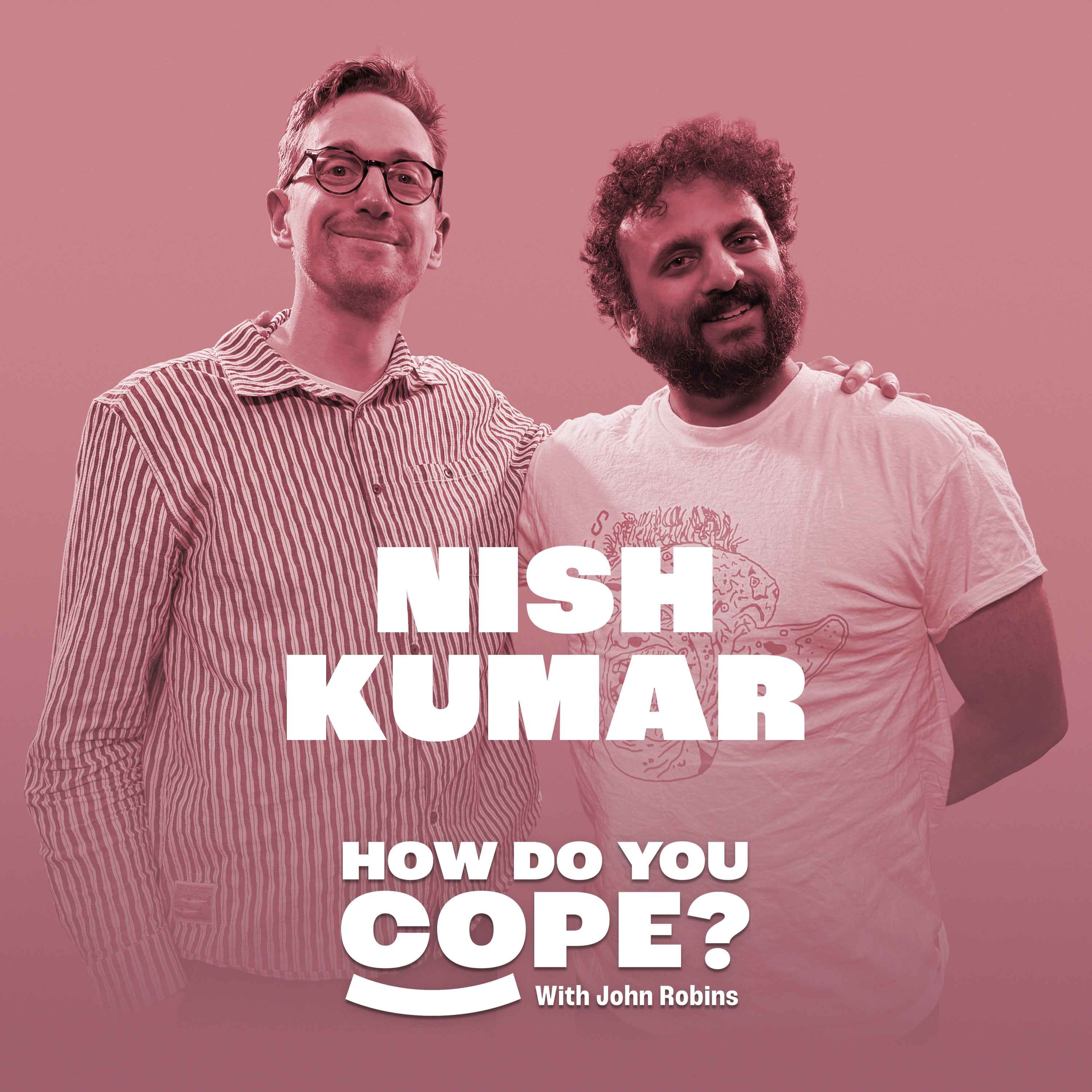
Hello everyone, it's John here, just letting you know that I have written a book. It's called Thirst, 12 Drinks That Change My Life, and it's out now. In many episodes of How Do You Cope, you'll have heard me talk about my relationship with alcohol, and in writing Thirst, I wanted to explore what alcohol means. Why did it mean more to me than other people? Why did it mean some things felt better, and why did it mean so many things went wrong? I also talk about lots of other things you'll have heard me and my guests discuss on How Do You Cope, Meditation, Physical Pain, Gratitude, Trauma and Therapy. There's even a chapter about my bum and its relationship with Buddhism, so if that picks your interest, Thirst is out now, and the audiobook read by me is available wherever you get audiobooks from. Hello and welcome to How Do You Cope with me, John Robbins. This is the show where I sit down with special guests to talk about the challenges they've overcome, and the coping mechanisms they use in their everyday lives. Today's guest is comedian, presenter and podcaster, Nish Kumar. Nish began performing stand-up at university. His career in comedy has seen him take numerous shows to the Edinburgh Fringe, host radio shows and podcasts, including the news quiz, the bugle and pod save the UK, and front television shows including the mash report. Nish is someone who has made a career in speaking truth to power, and an increasingly polarised political environment this has led to him receiving a lot of hate and abuse. A lot of this abuse not only has its roots in racism, but is a verly racist. In our conversation, we spoke about how the fallout from a charity gig in 2019 led to Nish seeking professional therapeutic help. We discussed the stress of speaking up for what you believe in in a political landscape that's become so openly prejudiced in the last few years, and also how diagnosis of ADHD and anxiety disorders interact with creativity. And I wanted to know just how does he keep going. Before we get started, don't forget that you can now watch every new episode of How Do You Cop on YouTube. Just search for How Do You Cop pod, and you can of course listen to all episodes wherever you get your podcasts. Whether you're watching or listening, please hit subscribe so you don't miss any future releases. For more info or to get in touch, head to HowDoCop pod.com. Here's my conversation with Nish. How do you cope with Nish Kumar? What a pleasure to be here, Tom. Thank you for coming. We've got the studio set up differently. On the one hand, we've got the help I sexted, my boss studio, which we're looking at. To your right, do you have some tissues in case you become emotional? I can't wait to really get into it and be lost in thought about some piece of emotional honesty that I'm trying to convey to you and then just see how I sexted my boss in a massive speech, Bob. We like to have light and shade on this podcast. So I've known you a long time and seen a lot of your standup over the years. And I thought, because there's quite a lot of different threads to the Nish Kumar trauma tree. Well, there's certainly lots of different topics that we could talk about. I wanted to start with a gig I saw you do at the Lord's Tabernas. Because I think it's an interesting pet tree dish for lots of different areas of your life and career. For sure, the only reason I laughed is actually a very obvious starting point. It's funny to me. There is something really strange when you do standup about something. A couple years after this happened, I turned it into a whole standup show. It's like a whole 80 minute show where the narrative spine is the stuff that happened. And I think this is probably quite a strange thing to say. But once it becomes a show that you've done that many times, it becomes like meta fiction. You sort of turn it into something that is its own story. Like a false memory. Yeah. And then you forget that when I speak to you, Miles Jarp, Tim Key, Chris Addison, you were all present at the real event. So let me just explain to listeners what we're talking about. The Lord's Tavanese is a children's sports charity and disability inclusion charity. A wonderful charity. Whose aim is to quote, "empower and positively impact the lives of young people facing challenges of inequality." And you were invited to perform a set at a charity event. And the quite a few comedians were there. I think they'd invited, they're sort of trying to get young blood into the organisation. And again, it's cricket. Yeah. It's a cricket charity. Young blood is. Mid-Tourism. People said mid-Tourism. So I always struggle watching friends, especially, or any comedian in any kind of semi-court for environment because it's just, you know how difficult they can be. And I'd been in your position. So I'd been the previous year when Ramesh was doing this set. So I went upstairs to watch and you started by talking about cricket and it was going really well and I thought, "Fantastic, perfect booking. Nish knows his cricket. He's connecting with them and I went for a wee." And I came back from the wee and I'm stood at the top on the balcony and like the tone of the room had just changed. And I came downstairs and sat in my seat and we were quite near the front. And it sort of went. you were starting to talk about Boris Johnson and Tory policy. And the tone went from sort of we don't do politics here vibe to a quite aggressive like Shalapbu vibe. And I sort of astonished because in retrospect a charity who are seeking to positively impact the lives of young people facing challenges of inequality, what you were talking about is the causes of inequality. So it's sort of even though maybe they weren't expecting politics, it makes sense. Yeah. Yeah. And then someone through a bread roll at you. Correct. And it's sort of funny to say that but it is also you had something thrown at you at a gig. That doesn't happen every day. So maybe we could talk about what's going on there because I think politics, when was that 2019? 2019, 2019. So things have moved on way beyond that now. But what do you think was happening, especially with that idea that you're speaking truth to power, which is like one of your main mission statements of your standard in a place where there's a lot of power. Sure. And they couldn't really cope with that. Yes. And it was and the thing that I never really talk about. And I don't know if you remember this, but the thing that I've never really discussed is that just before I went on, they had to sort of round table discussion and Harry Rednapp, the football manager, made a kind of jock killer reference to his tax avoidance. And it got a laugh in the room. And I think in my head there was a part of me that thought, well, if we're laughing about that, then everything's on the table. You know, we don't do politics. It's an interesting thing if you're also willing to love us, I'm making a joke about. I think there was a story where he put something in his dog's name to avoid tax and that was a sort of joking reference he made. And yeah, and it was the week before the general election. And you know, John Birkow was there who was the then speaker of the house. And so I tell you what it felt, it felt like there's a sort of high-minded answer to this and then there's an honest answer to this. And the high-minded answer to this is I felt that at a charity event like that, we were addressing inequality, there's imperative to discuss, like you say, the kind of background to this and the reasons for the inequality. The real truth is, John, I had fuck all else. In truth, that was what my standup was geared towards, that was all the material that I had. And it was all that was on my mind. I was kind of in the middle of the cycle. I had just finished a cycle of doing the mash report, which was a topical show. You know, I'm just sort of semi-regular contributor to the bugle and his ultimate podcast, which is a game sort of topical show. And all of my standup had become geared to this sort of, you know, what was going on in the country at the time, as it is now. And so I didn't really have anything else. And I also thought, well, you know, there's a lot of people in this room who these jokes kind of aimed at. And I guess I think the thing that I was thinking is if you're going to have, you've got to have the guts to say this stuff in front of people who you think might not like it. I think my honest truth is that aside from having no other material, I also felt, you know, I do this material to what our friend Alice James refers to as crowds of braying acolytes. And I think if you're, if you're
willing to do it to the be at least. I felt very strongly that whatever the consequences, there had to be a kind of, I had to do it to people who I thought it might not be received well by. So as soon as it started and it kind of went off the rails, there's a very funny scene in, not very funny, there's a scene in a complete unknown, the Dylan biopic. And there's a lot of bits of that film that are, you know, it's an entertaining film, there's a lot of bits that for a Bob Dylan obsessive like myself are not factually correct, but that's fine. It's the, you know, you have to sort of expedite events for a fictionalisation. The one thing they get bang on is the new por scene at the end when a gig goes off the rails because the view from the stage, the actual shot of the crowd because there's a moment where the crowd disassembles. Like in an ideal world, the audience is a single entity that you're addressing, right? And you, but watching that disassemble is quite an extraordinary thing. And so from the stage, I'm watching this from cover part, I'm watching Chris Addison getting a screaming roul with somebody who was shouting things on Tim Key is looking at me with the same facial expression Jerry Seinfeld gives Larry David when he's doing the producers in Caputon, he hasn't been, it's going off the rails. Key is shrugging his shoulders and looking at me. Then he started to boot. And then at one point the bread roll came at me. So I didn't really, I saw it roll to my right. So it's not very good throw. And then I kind of stayed there and I was sort of just saying to the missing, I'm going to do my time. You can, there's a video of it. You can see the kind of video of me at the end. And then a sort of a man who, you know, sort of came out of the audience dressed, he sort of dressed like someone from the military in the late 19th century sort of comes out and takes me off stage. And then you kind of, you go off stage and then you sort of sit down with this table. And you've got a few people there who were just looking at you like, yeah, we've been there. You know, you key Chris, there's a sort of, there's a sort of camaraderie to it. Yeah, I guess so why I'm interested to talk about it especially is that you had not grossly misread the situation. They had booked niche coupons, a comedian to do comedy. Yeah. And you did the comedy that niche, your mother comedian does. And I just, it represents to me something about the way our political discourse has changed and has changed massively since that. Yeah, yeah, yeah, for the worse. Because it feels like the sort of comedy you do, which was, you know, very common in like the 90s, early 2000s, has now become not just an act of rebellion. Yeah. But almost in some circles is it's like, I've read some, I guess, read some commentary about Invertecumus left-wing comedians by Invertecumus right-wing media outlets. And just the standard of the journalism is so poor. Yeah. But it seems to be this idea that sort of people who are standing up for pretty basic decency. Yeah. Are some kind of really weak problematic, moaning, bunch of wet lefties? Or, you know, tantamount to sort of mowest gorillas. Yeah. You know, like it is, yeah, the reaction was pretty bananas. But have you felt that throughout your career or is that getting worse? No, I never felt that. To be honest with you, I've talked about this quite a lot. I felt pre-Brexit, but it was sort of pre-the-year 2016 because it isn't just Brexit, that that's a big sort of focal point. When you would do, when I would do comedy about the news in a comedy club, the reaction was not disgust or anger. The reaction was total disinterest and border. The immediate reaction, you know, I remember trying to just get jokes about the coalition government. And just people just glazing over, like just not interested. You just have to take a long time because you'd have to sort of explain who everybody was. You know, you talk everyone apart from Cameron Osborne and maybe Clegg. You'd have to sort of do a full primer for them. And so I remember there being years where it wasn't, it was not, the problem was not offence. The problem was the mass disinterest of the comedy audience. Then after 2016, into sort of 2017, there was a shift. I mean, there was literally a shift in my career. So I've had all sorts of things. As we all have yelling stuff, peated drunk people, you know, I've even had people throw things before. But it's sort of general, just that's the kind of, that's sort of the cut and thrust of comedy clubs. But literally the night of Brexit, I was doing a gig at the comedy store. And it was the Friday night. So the vote would happen on the Thursday. So we'd woken up on the Friday morning. We were sort of processing ourselves. And I was sort of doing some jokes about it and saying like, you know, I don't know what the fuck is happening. Like, what are we doing? What's got? What does this mean for the country? You know, and then and somebody shouted, "You can go home." Literally the night of the vote. And you know, I remember I was supposed to meet James A. Castor for a drink because we were doing gigs. You know, the comedy store you do an early show and a late show. And he was doing a gig across the across Lester Square. And we were supposed to have a drink between the early show and the late show. And I remember and he remembers coming to the comedy store and as he arrived, the security security guard on the door saying, I think you'd better come with me because he's not getting out of there at the moment because the guy who would shout it stuff was waiting outside to continue the conversation. And the security guards were just, it had locked me in the back room. And so there was all this kind of sort of chaos happening out there. And then, you know, and then another gig that I, you know, continues to traumatise Brett Goldstein and may well be part of the reason why he moved to America to make films with Jennifer Lopez is that we were doing a gig at the 99 Club and a man was so angry about my material that he unplugged my microphone like it was really, really, it was a really feverial for you years. And sort of side issue, I'm guessing these are the sorts of people who might say you can't say anything anymore. What 100%. You know, the world's gone mad. Yeah. You get cancelled for pulling this or that. And yet, I think that's something I struggle to not having to go through any of this sort of thing. But is do you not see the enormous contradiction at the heart of you unplugging a comedian's microphone because you don't like what they're saying in a world where you think you're not allowed to say anything? Oh man, John, there's some of the stuff that happened to be in those years is almost beyond parity. And you know, I sort of only really took stock of it in 2021 when I was getting ready to write the show in 2022 about all of this stuff. They're, you know, they were constantly articles in the day. So then, so there's all this kind of fever, attention at gigs, but that's kind of, you know, and that I also grew up idolizing a lot of people that really wound people up for whatever reason, political reasons, because they started playing electric guitar. I'm sort of well used to this idea that the audience, and because I was, you know, my hero is Bob Dylan, I have sort of, I've like relatively philosophical approach to it because when he was being booed, he basically would say things like, well, you know, they pay their ticket, they got the right to boo, you know, and so I didn't really have a problem with any of that stuff. The thing that, the thing that shifted was when I started doing the match report on the BBC because then articles started popping up in newspapers, and then it became less, there's an honesty to something that happens in a room when you're doing comedy, but when it starts being written about in papers, it shifts the tone slightly. And in the middle of all of that, there was a period of time where someone at the Daily Mail had written an article saying that the BBC needed to seriously look into the match report, and that it needed to think about pulling it off the air essentially. And then the Daily Mail, I was hosting the Freedom of Expression Awards, and the Daily Mail was one of the media partners, and in my kind of opening remarks, I said, some, you know, wise ass shit about, I'm glad that they've just had a turn around in their views on free speech. And it was received so poorly by the organizers of the event. I got told off by Trevor Phillips, who went on stage afterwards, which to be honest, if I'm being completely frank with your sort of considerate badge of honor. And then Matthew Paris wrote an article in the Times, essentially saying, I mean, I'm amazed that he managed to get through writing this, but the essential thesis was what Hyde Dyn was too offensive for the freedom of expression.
- Of course. (laughing) (soft music) - But like, I don't know how you do what you do because what you just described there. - Yeah. - It's like the world's mad. - Yeah. - I mean, that's mad. And yet, I just get the impression if any of those media outlets were listening to this and or reviewing it or wanting it coming up with a comment, they'd be like, ha, braying liberals, nish Kumar and John Robbins, dro, and it's like, you're not actually engaging with the logic of what is being said. - Yeah, they didn't really see, you know, I'm always fascinated to know how Matthew Parris made it through writing that article. - Because he's like a man of intelligence. - He is held positively. - Allegedly, in which you need intelligence. Like you need a critical thinking brain. It's what it's. - So how do you not go, how do you continue to do what you do? I guess in the face of the fact that your critics are not necessarily playing with a full deck. - Well, because it's not like a comedy reviewer saying like, oh, the premise of the start of the show is really good, but then he sort of gets a bit that's too wordy or he sort of goes off track. It's not that they're not criticizing you on those terms. - Yeah, it's an interesting thing to sort of, yes, it's an interesting thing for people to sort of be ideologically opposed to your comedy. That is a really interesting position. And it's a position that I sometimes find myself occupying because there is some comedy that I am ideologically opposed to and it's interesting, it's an interesting thing. And so I'm not necessarily against it because they, you know, I believe they have the right to write whatever they want. I'm just, it's not, I'm not angry that Matthew Parras wrote that article. I just don't understand how we didn't see the irony, how we had no appreciation of how funny it is to say something was too offensive for the freedom of expression awards. But then there was also, so I mean, the reality is I was just sort of gut, I was like willing to put myself out there and I was willing to go, go, go to bat for the things that I believed in. I think there's a couple of things that happened in those years that were sort of egregious. One of the things that I, this friend of mine who were occupying similar positions, not necessarily in comedy but in other elements of culture, whether they were sort of novelists or actors or right, you know, right to some nonfiction. They, one of my friends will often talk about this idea that because in the immediate aftermath of Brexit, the project malfunctioned. Now that's not me making an ideological assessment of Brexit, though my views are well documented. I'm, I'm all I'm saying is from a totally objective perspective, it didn't go well. And part of the reason it didn't go well is the thing that the campaign was praised for was its lack of definition, you know, that it could be all things to all people. Unfortunately, once you vote for that, you have to actually apply this thing and you've essentially created this constantly moving, ephemeral idea that people can get behind. But then when it becomes about trade negotiations and border arrangements, it's quite, you actually have to define terms and that's part of why it sort of was malfunctioning. And in that malfunctioning, there was a kind of lashing out from a lot of the media outlets and politicians that had actively supported it as a movement. And they just started lashing out at anybody. And you know, there was, you know, there was a lot of hostility to some writers of colour that was speaking out about it. There was a lot of host, you know, the Daily Mail published a front page deeming the judges that was stifling the process as enemies of the people. And the only reason they were stifling the process is it was not being executed in a way that was consistent with the laws of the country. And so there was a lot of very heightened rhetoric that was kind of caused, I think, by this project malfunctioning. And then the conservative party began to malfunction and to reason they ran, you know, chose to call that election in 2017 and she loses a huge amount of ground. So then she can't function in her government. And so then there was a lot of ideological hostility and a need to attack and lash out anyone criticizing the overall project. Then there was this other thing of the BBC. And I was the face of a TV show on the BBC. And a lot of the criticism of me in that moment was a proxy battle about whether the BBC should exist at all. And then there's a third thing. There's the third, the race question, which is basically the sort of Victorian anthropologist. There are still people in this country and some of them unfortunately have newspaper columns that just saw my face and said no. - There's a really good quote from you where you say, there are newspaper columnists who did not believe that someone of my skin color should be able to have an opinion on the operation of the British government and that any criticism I expressed was a form of ingratitude. - Yes. - And I think that's a very succinct way of saying that there is a. There is an undercurrent in this country that minority groups, whether that be people of color, LGBTQ community, trans people, disabled community, basically broad strokes. White men are gonna make decisions about your life. And you have to be grateful for the scraps. - Yeah. - And anything that's slightly better is probably more than you deserve actually. - Yeah, if you're a working class person, and you make a critique of the state, you've got a chip on your shoulder. - Yeah, yeah, yeah. - If you're a woman talking about equal rights for women, you're hysterical and actually can't you see how many rights you have already? It's the same criticisms that it's the same dog shit that's been dried out for years and years. It's not really anything new. But I remember being on a train to Edinburgh in the summer of 2017. I was going up to do a couple of shows and do something at the TV festival and I sat on the train with my partner, Amy, and we saw someone turn over the daily mail and it was a double page feature where my photo was in the middle of it. And it was right after the match report had just started. - You're thinking this isn't a five-star review of my working progress. (laughing) - I'm not gonna be putting this on my posters and again, I don't think the headline reads, "This man is good." But Amy, it actually sort of wasn't about me. It was something to do with the commissioner but it began this kind of period of time where you'd see, I'd see my face in the newspaper and you'd actually look at the article and almost had nothing to do with me. But Amy said very early, I think you need to see a therapist because I don't think this is a normal experience you're about to go through. For all the reasons that we've just outlined, she was very sort of aware and she was being very smart about what the experience was likely to be like. But and I resisted, which is, yeah, so I guess like maybe, I guess the issue with men our age, I think particularly straight men our age is that we sort of know all the right things we should be doing. And so we're good at giving it, it's other people advice. So if somebody described the circumstances I was in in 2017, I would say, oh yeah, you should definitely see a therapist 'cause I think it's gonna be quite a weird experience but at the time I refused and I also felt that it was, I did feel that it was in gratitude, not in the sense that I was being criticized for on the papers, but it was in gratitude to say, oh, I need mental health support to deal with the TV show that I host. I thought it was in, I genuinely thought it was indulgent. I think also as comedians or any creative who like doesn't do a proper job that then becomes a proper job, you're so grateful that you're able to make a living out of this when so few people can, that you do feel a sense of, well, this is what you get for being one of the 0.1% of people who get paid, can pay their rent doing this, can maybe be on telly, and have a podcast, can have an audience. And because you spend all your time around people doing exactly the same thing, it's quite normalized. So for Amy to go, by the way, seeing a newspaper of yourself in what's probably gonna be a very critical article on board of train is not happening to many people and is unusual and you might need some guidance of how that affects you is really important. - Yeah, and in my head I was thinking, well that's no different from bad reviews, I've had bad reviews. But what she was trying to say to me is, no, that's not the same. Comedian doing a show that gets reviewed, you understand all of the variables at play there. The review could be good, the review could be bad. But there's something that's happening here that's out of your control. This isn't a TV review. There's a TV review, she said I wouldn't raise this. The show is gonna get bad reviews and we'll get good reviews as, but this is not a review.
This isn't somebody who's assessing your work on its relative merits. They're having an ideological argument about the existence of the state broadcaster or the rights of ethnic minorities who were born in this country to a pine on the state of the government. This stuff is not normal. So I just sort of buried my head in the sand and then the start of 2018, the show began to be very successful and the mashable and clips from it started going viral. So in summer of 2017, it started and it's rating in the whatever, I can't remember the ratings, to be honest, they were kind of converging on a million, nothing that's earth-shaking. But then January 2018, clips from the show, and it was the first British show to attempt this idea that you could television and it could be cut up and put on YouTube and Twitter and Facebook and Instagram. And then suddenly it sort of had a global audience and there is something funny about British people in every area of the media. When they think Americans are watching, it changes how they relate to it. And Americans started watching and talking about the show. And that, you know, from our side, we started going, oh my God, that's, you know, Madonna shared a clip from the show. We all started trembling with excitement and a kind of cultural inferiority. And then the press attention sort of multiplied exponentially as well. And so then it kind of took 2018, it was pretty intense when I look back at it now. And then in 2019, it was also pretty intense and stuff like this thing with the sensitive thing. It just all was sort of chipping away at me. So then we do this gig. So I'm already now this kind of, you know, a character in the culture war. And so then this gig becomes this kind of flashpoint. But then afterwards, we all went to the pub. - Well, that was what, I mean, one of my questions is about this because like, had I gone through what you had gone through, I would have been eight, off stage, well before my time. I would have been out of the back door, I've been home. I would have got absolutely hammered on my own. And you went to the pub and to the outside, to me, I'm thinking, how the hell is he doing this? - Yeah. - He's drinking with the people who were in there. There are people coming up saying, "I liked it mate, you're right." I would be like, "I'm gonna get out." - Well, it's interesting because I felt very protected by the group of you that I was with. You, Miles J. Timkey, Chris Adison, Vick Marx. - I was also just excited to be Vick Marx. - And a lot of people were very apologetic. - And a lot of people were apologetic. And also, you know, by that stage, what had happened is I had had a bad gig. And it was theatrically bad gig in a lot of ways because it was a corporate that was unpaid essentially. And corporate's unnotiriously bad. And the whole point of them is you get through them because of the money. But obviously there was no money because I was trying to support the charity. It was sort of the whole thing, the whole thing was really strange. And but I'd still, at that point in the day, I was still a comedian that had had a bad gig. And I often when I had bad gigs would, you know, especially when it was in London, you'd just go to the pub with your friends and you'd sort of laugh about it and commiserate about it. And it was, what was great was you normally have to describe what had happened, but because I was with all you guys, you'd seen what had happened. And you know, I guess I felt very protected because Miles Dup is extremely tall. And so I think that there's a joke in that show that something like Miles Dup pick me out. And because he's very tall, it was like, he carried me out like an end to Lord of the Rings. But like he, so I felt fine. And then Tim Key always says, like you, he said, "I couldn't believe it. You were out, we were making fun of you. You were having, we were all sort of commiserating about it. It was great, it was healthy because I still believe and defend the right of the audience to boom me. I believe in that they had that right. I really do. I don't think the person who threw the bread should have thrown the bread, I don't think he should ever put hands on a performer or throw things out there. But booing is an occupational hazard, you know. I have no problem with honestly anything. I thought it was embarrassing, but you know, it's not illegitimate. But then somebody said, oh, there's an article in the telegraph about it. Because obviously it turns out if you're in a room with extremely well-connected people, it will work for the telegraph. [LAUGHTER] If you're in a room with the entire staff of the telegraph, Tim Key always says, that's the moment where your face changed. He always says, we were having a great time. And then right at the end, just as literally, we were about to get in our caps and go home. Because I mean, we did a solid day's drinking. And at the end of that day, we were still in pretty good spirits. And then Key always says, somebody said, there's an article in the telegraph. And I looked at the phone and he said, I think I saw your face change. Because I knew I think once it had got out of the room, something else was going to happen. You know, you already have this background of me as it's kind of whatever, cultural cartoon. But when something gets out of a gig, we've seen it with so many different news stories about things that happen at gigs, and then the news stories are written up. And then the people who are actually there will often say, you know, that's not really what happened. Well, you're losing control of a narrative to people who are quite happy to give a very biased narrative. Like you're being now used. I wondered if we could skip, though, because I think this is related. So when the mash report got-- or the cancelled or stopped, the response to the mash report had taken an enormous toll on you. And I'm right in saying, did include death threats. So no, the death threats happened because of the Lord's gig. No way. Yeah, that's when the death threats happened. That is absolutely wild. Yeah, the death threats happened. The 24 hours after the tabernas gig is when it all happened. I mean, I was getting some threats of violence on Twitter. I know this sounds like an odd thing to sort of sweep under the carpet, but there was truly just an amount of background noise of threats of violence that everybody, that particularly left to include people were just getting on. And there's just a level of that that exists on the internet. The issue after the tabernas was that it was getting messaged to me. And one of them, which I do read out in the show, which is a port-- I mean, as in, it's sort of offensive to about five different-- it's actually almost remarkable that they've managed to offend the amount of groups that they managed to offend in the death threat. But that came into my private Facebook from an unknown account. And that was the thing that absolutely spun me out. And I was going to Manchester to do a charity gig for Undistine International the day after. And so I was on the train, and I was just taking all of it in. The press, the death threats, the-- you know, there were people like-- there was sort of a person leaving voice messages on my Facebook. And it was all-- it was really, really intense. And I remember-- I actually put the death threat on a text group that we're both on. And I sort of put it on there-- I don't know what I put on there. So put it on there as saying, wow, isn't this-- this is weird. And everybody just started replying, saying, this has to go to the police. This has to go to the police. And I then contacted my agent. And she said, we have-- I'm going to call the police now. She said, you have to shut-- just log out of all of these things. Don't look at your phone. Just shut everything down. I'm going to take over this whole thing now, at this point. And then we did-- we sort of had this meeting with the police. And they were essentially telling us that they-- this is not really anything we can do. They were sort of just racking their shoulders. They were sort of saying, this is an ideal. But there isn't really anything we can do. And I then had this-- when I did the show, my agent, the first time she saw it, she said, that's not-- you've misremembered quite a lot of that. And she said, you know, I had a separate meeting with the police before you sat out. I'd completely blanked out a lot of that stuff. And. That what I then, you know, a good sort of year and a half later would realize is the 24 hours after what happened, I have post-traumatic stress disorder from that 24 hours. And it was then, because I wasn't really doing anything about my mental health, and I didn't really understand what was happening to me. But I probably, for a good sort of year and a half, I wasn't fully in control of my emotions after that happened. There would be weird things where I would be talking to somebody, and then they would say something that, you know, this is sort of overused word, but it does have a real diagnostic function, where it would be triggered. And I would suddenly, out of nowhere, feel like, you know, like I was in a tank, and there was water just rising and rising and rising, and I couldn't quite catch my breath. And I would suddenly be getting teary out of nowhere, didn't do anything about it. Nothing. Then locked out. And so, for sort of a year, I'm feeling strange. But also from, you know, I was sort of thinking about it, thinking, of course I'm feeling strange. Of course I'm feeling sad. We live in the strangest period of history. We live in the strangest period of human history. We're all locked in our houses. You know, I'm worried about my grandmother's safety. I'm thinking about, you know, my family members. So in my head, I think I thought I was, but this is a real issue. Probably almost every day for a year and a half, or at least four times a week, my brain would turn, would start imagining what was happening. I would turn into my street and think there was somebody there that was going to kill me. And I would imagine that process and what it would be like to be stabbed or whatever it was. I have a lot of different types of things. I would imagine that process. And I was doing that multiple times a day. And I didn't realize that I was, that was part of the process of me really damaging myself. That was, I didn't realize that was, I was sort of pulling apart my own brain really. So what you're talking about reminds me actually the book behind you surviving White Island by Kelsey Wackhorn. It was on a volcano in New Zealand when it erupted and it killed lots of people. And she survived with terrible burns. But she just, her description of PTSD, which she didn't understand she had at the time. It's so similar to what you're saying. It's mood swings and mood changes entirely seemingly unrelated to the incident. Where she would drop a teaspoon on the floor and burst into tears. Or she would fly off the handle at her partner. For some, you know, forgetting to take the dog out or something. So it's very hard, logically, to connect it to the cause. So you're thinking, am I going mad? But also that hyper vigilance of rehearsing, rehearsing, rehearsing, rehearsing in your head. Which is, if you're imagining yourself being murdered four times a day, that is the very definition of retraumatizing. Like when Amy talks to you about seeing the article in the paper going, this is unusual. You might need some help with this. You can sort of understand someone going, well, it's all part of the deal. But if someone came up to you and said, I imagine what it would be like if I was murdered multiple times a day, you would say, okay, buddy. Yeah. You need to get you somewhere. Yeah. So. You should have an help with that. At what point did you decide to seek help and what form did that first help take? So probably in 2021. I think in sort of early 2021, I was on the phone with Brett and with Goldstein and he was, I still to this day don't fully know what it is that I've said. And he can't even really remember because I've asked him, but I just, I was talking to him on the phone and I was just talking, talking, talking. He basically said, listen, I think you got to see a therapist. I don't think you're, I can't even, he can't even remember what it was. He just said, I heard something in your voice and he just sort of said, you got to see a therapist. And obviously it's a source of great amusement for a minute now to turn around and go, well, well, well. The captain of the woke star Z won't listen to a woman. When Hollywood Goldstein comes calling. And it is bad. And I have genuinely no comeback. And, but he said, and I had sort of thrown up all these excuses could bite something must have been happening because I've been talking about going to therapy with Amy. And I said something that, you know, I did feel bad about saying because Amy's white. And I said to her, I don't think I would want a therapist of color like I, you know, and I said, I hope that doesn't sound bad. And she said, no, when I was in therapy, I expressly sought out a female therapist because there were things that I wanted to talk about that I didn't feel like I could explain. And so she said, I don't need to feel bad about that. And by still didn't do it. So I was just looking for excuses to not go. And then Brett said, you need to see therapist. And I said, yeah, by that point, obviously something in Amy and my conversation because I didn't resist. I said, yeah, yeah. But I said, you know, I'm really looking for someone quite specific. And he just said, I know therapist who is a person of color. And I'm emailing them right now. And so there wasn't, well, I'm really a conversation. Suddenly, you'll see she did on an email. And I think by that point, I obviously realized that something was like was off with me. I wasn't quite myself. And I think I started to realize it wasn't totally just the fact that we were in lockdown and everybody was struggling. Well, not all of us were getting death threats in lockdown. Yeah, sure. Hang on, let me. I know I don't think I got any. It, yeah, it was. So, but you know, everyone we all have a difficult time. Oh, yeah, yeah. Life was crazy. But life was crazy on the terms of the craziness. Yeah. So what was what sort of form of therapy was it? And what, what did it throw up for you that maybe weren't expecting? How did it surprise you? What surprised me was how little I knew about what was happening with my own mind. That was the thing that surprised me. You know, I'm a person who has identified themselves and defined themselves really by their intelligence from a young age. The thing that I prided myself on was exam grades, you know, and achievement. And I sort of, you know, I kind of, so much my identities bound up in my education and how clever I am. And within, you know, the first few, about five sessions in, she said to me, what do you think I'm treating you for? And I said, you know, I've got, I'm having a tough time. And she said, I'm treating you for post-traumatic stress disorder. Everything you've said to me is completely, within five minutes of talking to you, I knew that you're a person that had PTSD. And that was the point where I remember thinking, yes, I don't know what's going on here. I actually have no clue what's happening here. And I don't really know fully what's, I have no control over this. And I think that was the thing that surprised me was that you could, you could sort of, your mind could just completely be playing tricks on you. The whole time. It's a bit like, I was just thinking there that it's so hard to see your own brain and the way it operates as a problem, because your brain is the place from which you solve all the problems. So it's a bit like saying to a fish, there's a problem with the water. But they like that, but they can't be because the water is the water. Like the problems are in the water. No, the problem is the water. Yeah, that's a great way. The problem is the water is a great way of putting it, John. And also for people like you and me, who sort of, you know, define themselves by their intelligence throughout their lives, that is, there's a level of arrogance. There's a real level of arrogance that there can't be anything wrong with my mind because I can solve, I can think my way out of anything. Yeah, yeah, yeah, yeah. And when someone says to you, not only can you not think your way out of anything, the more you think.
the worst it will go. So this therapist is saying, I'm treating you for PTSD. What was that treatment? What tools did she give you? What understanding did she give you about how your brain was working in a way that you weren't noticing? She. I will say one of the things that we did was a MDR, which is something that people who've been through any kind of trauma therapy will have, I guess, at least given a go to. And it was really good. And it was. You know, it is strange because you sort of. you sort of do these repeated patterns where you touch bits of your body or squeeze things. And then you kind of repeat these sort of disconnected tongue twisters. And it. And the most helpful thing someone who's putting you through that process can say to you is, "Now, I know this is going to sound weird." And just. It sort of diffuses the tension that it stops you from raising your hackles to it. And then there was a lot of writing things out, like writing out what happened, writing out the events of that day, the events of that week. Because I was. You know, and even. This is a year, a couple of years of therapy. And you know, I remember being really surprised when my agent said, "You have misremembered a lot of this." Like, this stuff that doesn't. The timeline isn't actually what happened. There's no way. Well, one of the worst things about it is she. She was basically able to say, "Yeah, the timeline is wrong because we had a meeting with the police on my birthday." And you know the day of my birthday. And so there's. Yeah, there's a lot of. There's a lot of. It was. What's. The positive surprise I had was having been dragged kicking and screaming into this process. I did embrace it. So I didn't resist it in the way that I thought I would resist it. Now that being said, it definitely is not a clean line, right? And so it wasn't. You know, I didn't start doing it in 2021. And then by 2022, I was sort of cured of it. I moved on enough in my mind that I was comfortably able to do the show about it. And talk about the PTSD by 2022. I moved on enough that I wasn't. You know, because there were times where I'd be asked about it and I could just feel my heart racing. And I would. I don't think I could have done a show about it with a lot of all that still in my system. But that being said, you know, in 2024, and by this point, I'm kind of three years in. I was in Edinburgh during the race rise. And I. You know, I was. I was. You know, I'm doing news podcasts, so I'm sort of trying to cover it. I'm feeling really guilty because, you know, friends of mine are going to counter demonstrations. And I'm sort of in Edinburgh following my artistic passions as a part of you that thinks, you know, this isn't. You know, where you should be here. And I watched loads of footage of that. And just was gone. For really a full week, I was just completely not in my brain. And for a chunk of time in 2025, after the Tommy Robinson thing that happened in September, I again watched too much footage of that. And I don't think I was fully in control. There was a two-month period where I was in and out of control of myself last year from sort of sort of October to no, like late September to the start of November, where I was not fully able to operate the ship. So what do you mean by that? How does that lack of ability to operate the ship show itself? And be what ways did you get back control? So the first time in 2024, it was the first time that it happened to me since I started therapy. And I wasn't. You know, I see my therapist every week and then there's bits because of work where I'm not able to see her for little chunks of time. And it was basically like, man, I wish there was a more high-minded way of describing this. In the first Avengers movie, there's a glass box that they lock, lock you, right? And they're like, you're securing this thing. And then they kind of live in there. It was like, I'd been locked in a glass box in my own brain. And for. In that, it's. He's been put in jail to protect the other people. But for me, it was like my brain locked and some people that operate my brain, the inside outgang, basically, well, like, you're not safe. So let's lock you up and we're going to put this thing on to autopilot. And so you feel completely disengaged from your emotions. And it's. You feel. You're sort of watching things happen to yourself around that. And people are saying, talking to you and you are not present or engaged. Now, at the time, my family was visiting and my brother had a. As a baby and who was a real baby at that point. And weirdly, the only time where my brain would sort of allow me to be present was when I was literally physically holding a baby because your brain kind of goes, oh, yeah, you've got to be full control here. There's a baby. So you're. I mean, sort of describing dissociation. Yeah. Yeah. Yeah. Basically, yeah. And is that something you then took to your therapist or was it something someone pointed out to you? Was it something that just went. Now, I knew what was going on. I knew what was happening to me. And I knew that I was struggling with it. And so then it was just a question of me getting. Getting to talk to my therapist. And also, I had to leave Edinburgh. Not. I was scheduled to leave Edinburgh because. Because Ellis was going to get married. Ellis and Izzy were getting married. So there was this sort of break clause in the middle of the month where I knew I had to go to London. And I. And I between seeing my therapist and actually having this kind of break clause because I was also going on stage every day and sort of continuing to talk about it, which was not helpful, really. And then you saw a best man speech that cured you? It was. A fin. It was a phenomenal best man speech. What I would say is, if you can possibly. If you're going through any episode of dissociation, get yourself down to Izzy's. He's the analysis James is wedding. Yeah. Watch a best man speak. Get yourself out of yourself. So like I have periods where I am able to see in retrospect, oh you were kind of not so. Yeah. And it might just be an afternoon where something went wrong. It might be a week or a couple of months or you know, sometimes a whole big chunks of time. So what was it. In that break from Edinburgh and seeing your therapist, can you remember when you sort of came back to yourself when you, I guess, associated? Yeah. I mean, it was. It was actually. The break from Edinburgh was where I kind of got back on level terms. The thing that kind of brought me back into the room, the thing that brought me back into my body a little bit was I knew I was struggling. I knew I was sad. I knew I was feeling depressed all the time and I knew I was locked in this box and essentially allowing the autopilot to drive me through my day-to-day life. And I knew I was struggling and this time I was able to say to Amy, I am struggling. I was able to say to my promoters who just, you know, named me Parnell and Rachel Ellingworth were at every show and were basically. When I said to them, "I'm really struggling," they said, "Let's just go home." Like you can go home. And I didn't want to do that for some reason. But also, I'd slightly come back into the room because I spoke to this kid. She must have been 18 or 19. She was a student at Leeds University and she said she had been at one of the shows and she said, "I'm really glad that you said you were scared." Now, I didn't realise I'd said that because I was not fully in control of what I was doing. So I'm really glad that you're scared. She was a person of colour and she said, "I'm really scared." And so I'm glad that you said you were scared because you're older than me and it makes me feel a bit less nuts for feeling scared. And that was the thing that properly brought me back into my body. I was like, "I'm scared." That's really what it is. I'm scared. And suddenly, then I was able to go, "You can let me out of the box for us because I'm not in denial about this anymore." So I knew enough to know that I was in denial about what was going on. My brain knew enough to just fully disassociate because I couldn't be trusted to my good decisions. But I couldn't put my finger on what the actual, which sounds so obvious. But it was only when this kid said to me, "I'm scared." I suddenly went, "Shit, so am I. I'm scared." And this footage of me in
Edinburgh that occasionally sort of burbles up on the internet because we were doing a live podcast and I taught and I you can see me on stage saying I'm really scared guys and but not being aware of what's going It's a really interesting thing to see that footage for me because it I'm completely articulating everything that's happening to me, but I have no I had no ability to cut properly acknowledge it until someone else said to me I'm scared and then suddenly I was able to say oh yeah I'm scared too even though I've been talking about it on stage because again the autopilot lads good job They do wonderful. They do wonderful service and like the mind has fully taken over yeah, and the body is Is gone gone so to actually feel that I guess a moment of connection or even compassion to my girl You're there no like oh, I need to do that to myself. Yeah. Yeah. That's right. Yeah. Yeah, it's like If your ears are blocked off for a flight. That's what I would say coming back into your body feels like it feels like The moment your ears pop and suddenly all that sound comes rushing back in and that is exactly how I suddenly I sort of suddenly fell and There was a point where you can say to the guys Who would operate in the machine? Put me out of the cell I can be back in charge now and then I got to come home I got to hang out with my mates I spoke to my therapist and then we were able to get me back into the room the last year the thing that was interesting was I sort of knew what was happening the whole time and I sort of like I'm taking this real bad I'm really struggling and I know that it's because I'm scared and I know it's linked to all of this PTSD stuff and I know that old thing is sort of linked into linked and But it was a sort of unfortunate Perfect storm of my therapist being away and Amy being out of the country for a couple of weeks and the Me just like spinning out just truly spinning out and And it's sort of got bad enough that like people had to sort of be dispatched to sort of Try and like Chipping me along to Amy sort of dispatched a castor Just sort of basically feel like maybe just go and check on him hang out with him for a little bit But it's and then what brought me back that time even though I knew what was happening to me What really brought me back was my therapist being back and me going this is happening. She's like let's talk about it Let's get into it and let's try and build So this What I'm saying is it's not Clean lines with this stuff But you can see incremental improvement so each one of those three things so first time no idea what's going on second time I did something bad is happening no idea what it is third time know what's happening Know what's going on can't stop it so the next evolution for me is to be able to identify when it's about to happen And do things that it and that's the process that me and my therapist are in and getting me to a stage where before it kind of Goes off I can go Okay, this is what and so you know I'm a bit more cognizant when I'm looking at you know a lot of footage of these kind of race riots that I need to sort of be a bit sensitive to myself about it and Also, I'm we've we've dug in we'd really now You know because she said for the first year we were just firefighting really we were just trying to get you Back in your brain back in your body And now she we sort of trying to dig into all the other stuff because she said your Mental health problems are the reason you get PTSD that's a response to an event But there are people for whom the event happens and because of their mindset and so for me the the two sort of background the sort of consistent problems are An act generalized anxiety disorder and ADHD and when you have those two things your brain is just a kind of pinball machine and The ball is just Things to be worried about and it's just sort of flat all of these things are like flashing all the time And it's very common that people who have ADHD also have an anxiety disorder those are very common quote Comorbidities and so for me I now understand okay My brain is sort of pinballing stuff around So then if the thing that's pinball around is bad is the thing that's pinballing around because we also have talked a lot about She always says to me you got nothing positive in your life from anxiety because there was definitely a point where I was saying to her That's why I've Done well in my career because I obsess about things and she you know because we do it on zoom I think it's a good thing because there are so many times where I can feel her want to grab me by the shirt and shake me Yeah, she's always saying nothing in your life that's good has happened to you because of your anxiety. It's happened in spite of it Every single time every single time she says you have done these the things that have happened to you have happened despite and not because and she said that's the Punishous thing about anxiety disorder is it tricks you into thinking that you need it and you can't survive without it and So you you medicated for a idiot. No, I'm not medicated yet because I'll be planning to be we sort of taking that You know, we're like looking at that as a possibility and So we're starting with therapeutic stuff and also we're trying to like align it with Because you know, I have a bad family history of heart disease and some of those stimulants sometimes people are cautious about But we're moving towards a position where if we feel as we go along we need to medicate it and it will medicate Is part of you holding on to that idea that idiot should you might be this sort of Part of the superpower of of you. Well, she did say part of the issue that we're I'm now going to have to is having spent all this time telling you that anxiety didn't Help you she's that ADHD does have some it there are some advantages. Mm-hmm It's a superpower. I think Reese Nicholsson and I Wrist also has ADHD and we've talked about the fact that it's a superpower in the way that if Superman If every third time he blasted off he shit his pants It's a sort of superpower with some slapstick negative consequences And that's why he wears the extra travel But yeah, I don't know how I feel about it. I think it's interesting I have Some friends and it's really interesting because I know a bunch of people with ADHD who work in the Media or the creative space and about half of them will tell you that They struggle to write when they're on the medication because actually Some of that the sort of ripple effect of your brain is kind of how you make interesting connections And no people who will stop for a while if they need to suddenly yeah, and then there are other people that us We'll say to you. We'll say the total opposite. We'll say I've been able to I was I wrote a book or I wrote a I wrote a full screenplay because I suddenly was able to Knuckle down focus on everything and get it done I think it seems to affect people in different ways and there's a lot of trial and error and so I'm sort of only I'm only moving cautiously because I need to also keep the my awareness of the medical side But I know people whose lives were changed by being medicated for these things So it's like definitely something I'm open to but I think understanding a lot of that stuff has been really useful for me in terms of Setting it in context like I always felt I always felt sort of embarrassed Not sort of embarrassed. I felt completely embarrassed For a while that I had got because I think I still think PTSD I thought PTSD was something that people who Basically like survivors of sexual abuse or soldiers got And definitely the only piece of resistance when I was talking about this stuff initially I was never resistant to the therapy, but I would keep a bit of shame at my core of thinking wow You know You you've I think in the show and when I talk about it in the show I'm I'm presenting this as a unhelpful thought. I say something like wow you got shell shocked by a bread roll essentially But then like I was thinking while you were talking about it Were a spectator journalist listening to this podcast that would be the headline yeah nish Kumar Yeah, four years of therapy because of a bread roll because it's such a fucking That's actually how it was presented by a spectator journalist Yeah So like The body does not care what you think yeah about whether it's yeah about whether it's justified or not Whether this only happens to because it's like it's happening to you man. Yeah So you can you can deal with it or you can ignore it yeah It was interesting because I didn't when I read that there was a there was a thing in the spectator about it That's mad because of that yeah I'll tell you who wrote it off my care But it was um It didn't upset me it there was a part of me I always thought when I started doing the show about it. I always thought I if this kind of They might write and then when I did actually see it. I just thought catchy people are absolute Balance that he didn't make me it didn't make me angry at all it just made me think god this very little There's really very little to say So I guess my final question is Given that you're I mean sort of like
chapter number 34 of "I could not do what you do", but given that your standup is you know political in a world where politics is just something I'm quite happy to take big breaks from, given that it is fighting for what is just and fair and decent in a world where those things are really not seem to be high on people's priority lists, given that involving yourself with the research and the sort of reading of the news necessary to make podcasts and standup about politics, how are you protecting yourself or how are you planning to move forward knowing that you're going to be watching a lot of stuff that's really horrible and you're going to be talking about why can't a world be decent in a world that's showing itself to be pretty indecent for a long time probably. Yes, I'm protecting myself really, therapy is a big part of it for me and you know that it's sort of it's scheduled in my work diary, you know, it's that it's a part, it's a non-negotiable part of my week and the only time to get it's moved are really when travel is makes it impossible and all, you know, that that that's kind of a non-negotiable thing for me. I think also I'm slightly I've sort of slightly I've withdrawn there's bits of the internet that I'm sort of withdrawn from because I think it's not really productive for me to see a lot of that stuff that's being written about me and so there are elements of the internet that I just don't venture towards anymore. But you described in your startup special you said it was about the absolute cesspool of the political situation in Britain and America, that's in 2019. That's it, yeah, I'm well, yeah, I'm probably talking there in 2022 maybe. No, no, no, no, you're you're talking about your 2019 show in a PR interview where you're so oh god, but like how do you keep going? I mean I think that well I think this there's probably two answers to this. I think one of them is that I do I do not subscribe to the idea the sound of comedy's therapy. I do not subscribe to that in any way, shape or form. The thing that has helped me actually the thing that's helped me do stand up about some of these issues and continue doing the kind of stand up is therapy. But I've also sometimes people after shows will say I don't know how you do that like how do you do that and the thing is the people that come to see me the thing I'll be say to them is you feel all those things always right the audiences of my shows these are all people that are thinking about this stuff all the time it's kind of the one uniting thread of quite a sort of group of people that are often quite disparate in their ethnicities sexual orientations and ages you know this 15 year olds and 70 year olds you know the the the rufton quite disparate walks of like the one thing that unites them is a lot of the time this kind of burning sense of fear about what's going on the world there is something what's not therapeutic in the medical sense there's something cathartic about being able to go on stage and just say holy shit what the fuck is going on that bit is cathartic for me that is really cathartic and because as a as a sane person in a mad world are you able to create in those stand-up environments a sane person in a sane world even though what they're talking about is mad yeah there's like there's like a comfort in saying something in telling a joke that kind of contains an idea that I believe in and people laughing at it there's something really satisfying about that there's this there's something really satisfying about being in those rooms and seeing those people and genuinely like one of the sort of great privileges is that I get to meet people sometimes after shows that come to say hello and they will often be people that are you know working in politics or you know teachers or charity workers or one guy in Indianapolis was in the middle was a union organiser who was in the middle of a labor dispute and he hopped out that stuff is you know because it's funny because after as people will say well you're really doing something to help you're like no I'm not I'm doing fucking stand-up comedy you people are actually you know a lot of the time you look at the audience you go you're actually doing the meaningful things that are helping you know push back against a lot of this stuff it's very you know and doing the podcast I've been able to sometimes sit face to face with people that are actually thinking carefully about how we resolve a lot of the problems that we're experiencing and so the part of the reason I'm able to do it is it is quite comforting to be in those rooms and do the sort of type of comedy that I've been doing but also I like I love comedy I'm not a I'm a comedian it didn't it didn't come naturally to me I'm a comedian because I loved comedy I'm a comedy nerd that became a comedian and so I love all comedy and I'm so passionate about the diversity and I'm passionate about you know demographic diversity in comedy but I'm also passionate about stylistic diversity and one of the best things about us to end up night is you could go there and it could be a person doing stand-up about the news surreal one-liners someone doing a character and then a compare who's asking people what they did for a living is all legitimate and it's so brilliant and when I was eight when I was 17 I thought I still think Ross Noble is the coolest guy in the world you know to me like it was he because he everything everything he met everything with the same equanimity and so everything but you know if you look at you know he's one of my favorite comedians of all time if that's not what I do and so but I passionately believe in the that there should be all sorts of diversity but there is a part of comedy that when I was a kid really had a way of making me feel better and sometimes that was because it was escapist but a lot of the time it was things like goodness gracious me and the Simpsons and the Chris Rock stand-up specials from the turn of the millennium it it was you know Chris Morristoff because it was it made me feel better that somebody was taking something I was afraid of and making it funny that it's a very like I think it's such a normal like emotional response to something that you're frightened by it's sort of to turn it into something silly like the relief the release of turning a scary thing into something funny so that so whilst I truly loved all types of comedy there was something about that that particularly affected me as a teenager and I think that is sort of and why I do the type of comedy that I do is that I also found when I started doing comedy that telling those jokes had the same effect on me and as telling those jokes had the same effect on me as hearing those jokes from other people when I was a teenager and that and that was really that's really why I still do it and I love doing it and you know when I listen to like an old Richard prior album those those early albums from the 70s I mean he's talking about the most serious things possible you know there's there's just a bit in it where because also there isn't like a sad bit in those albums he's just talking about you know he's it's constantly so funny but there'll just be a bit sometimes to just hit you out of nowhere where he's just talking about it and he's talking about it and then he's talking about alien invasions and he says white people are very scared of alien invasions but nothing can scare a right person you know not after 400 years of this shit and like but that line it like lands like a hammer even though he's not it's not it's not it's not mordeling it's not that there's not a section laid out for it in the show it's just that that line just lands and I think that there is something really that I am fascinated by in you know standing on stage and you know it's like sword swallowing or something or like like juggling fire like you're standing there and you're taking all these big subjects and you're trying to walk the tight rope of making them funny while it's not undermining the seriousness of the issues that like as an intellectual challenge that sort of appeals to me and also I'm just doing I'm just doing the thing that I wanted that I saw in other people because I found that doing it gives me the same level of
release. Well, Nish Kumar, thank you so much for joining us. That was absolutely fantastic. My pleasure. And as I said at the start, in reality, I've got fuck all else. I think, you know, I think airline food is broadly fine. Yeah, yeah, yeah. It's not bad. And especially if you tell them you need a vegan one or gluten free one, so Nish, thank you so much. And I hope you will join us for our bonus podcast, The Gratitude List. There you go. There was my chat with Nish Kumar. I do hope you find that helpful. Nish will be joining me again on Thursday for our bonus podcast, The Gratitude List. And if you want to get in touch with the show, then send your thoughts and reflections to
[email protected]. You can also find us on Instagram and TikTok @HowDucocopod. Plus, don't forget all new episodes of HowDucop are now on YouTube, so watch and subscribe there. HowDucop is a significant production. See you next time.
 PodcastTranscript AI