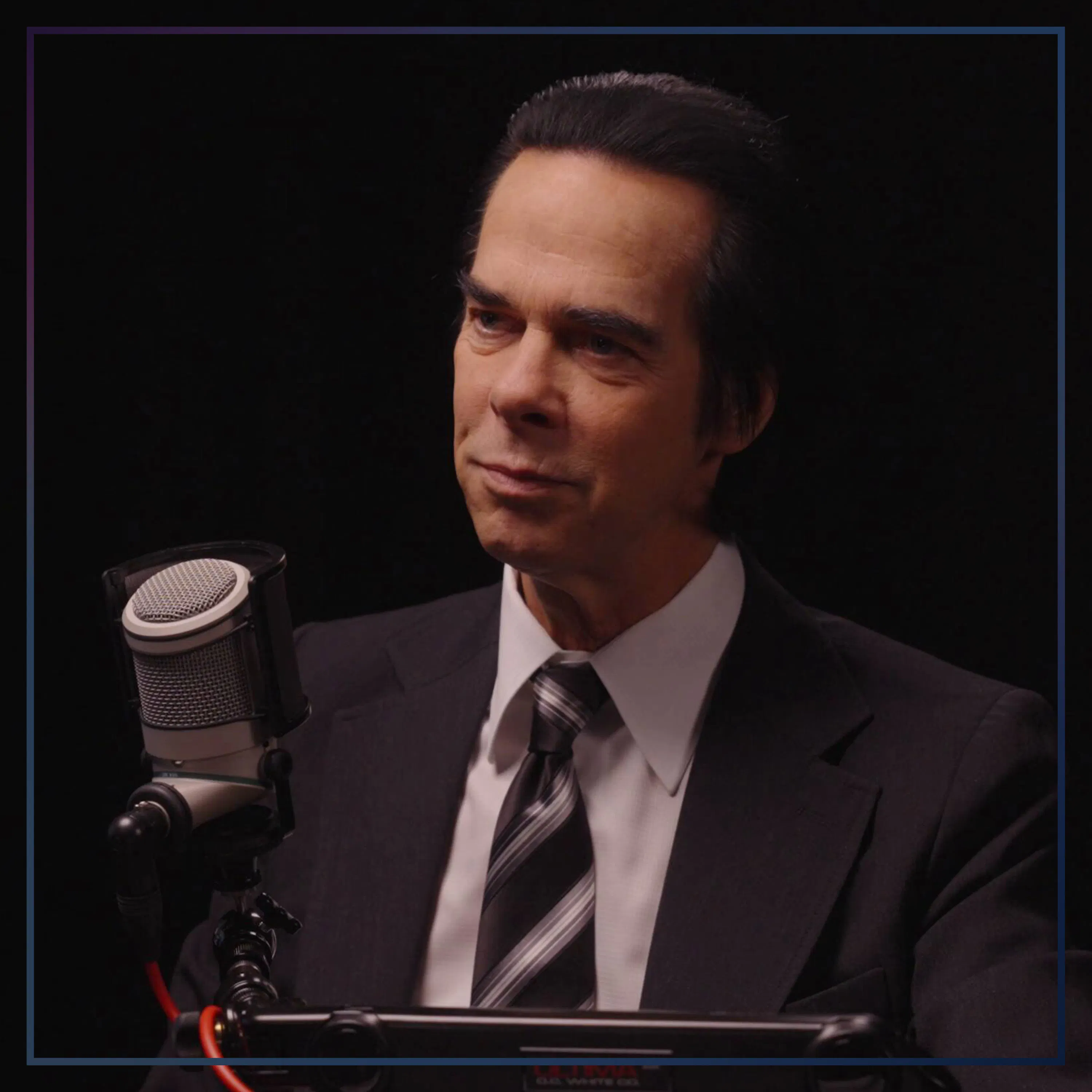
The conversation explores the profound impact of grief on human connection and personal transformation. The speaker reflects on their time with a dying mother, noting how shared laughter and quiet presence created a unique, healing bond. This is mirrored in Nick Cave’s experience of losing his son and later son, where grief led to a deeper, more compassionate understanding of life and loss. He argues that grief is not a weakness but a universal human condition, binding people through shared suffering. Joy, he says, emerges from sorrow, not in spite of it, and that this emotional shift allows for greater empathy and connection to others. Small daily actions—like meditating, going for a swim, or simply holding a hand—became vital tools for navigating the early days of grief. The conversation also emphasizes the importance of language, such as using “allegedly” when discussing death, to respect the limits of human knowledge. Ultimately, grief reshapes the self, leading to a broader sense of love, hope, and belonging. The speaker and Nick Cave both affirm that loss does not mean disconnection, but rather that the departed remain alive in memory, rituals, and daily life, transforming pain into enduring, meaningful human bonds.
I've been thinking a lot about being with my mom at the end of her life.
Maybe it's because Tignitaro was on the last podcast talking about seeing her
friend poet Andrea Gibson die. My mom died in June
2019. She hadn't been feeling well and I took her to the hospital.
That's when she was told she had cancer and didn't have much time.
She was silent for a while and then said, "Well, it's like
that old song. Show me the way to get out of this world because that's
where everything is." Which I thought was a pretty cool response being told
you're about to die. Later she made a joke and
we both started giggling. I happened to record it and it was only when I watched
this later that I realized we both had the exact same giggle.
I'd always wondered where my giggle came from. Now I know it was hers all along.
I took my mom home and we spent a lot of time together in her final days.
We held hands a lot. Any of the old disappointments or
resentments were gone. I knew her and she knew me.
Are you scared? Yeah, I'm not either.
Her voice was becoming just a whisper.
It's a great gift.
I'm getting to spend time with you and I spend greatest gifts.
The kind of times we have now is. It's really special.
You're a good team. That's for sure.
I love you.
I love you, sweetheart. You know that.
I did. All the ways I did forever.
I say that to my kids now. I love you always and forever.
I spoke to Indy Gibson's wife Megan Falley on all there is live recently.
One of the things she said really stayed with me and I want to show you part of that conversation.
I saw something you wrote where you said you started to use the word allegedly.
When you talk about Andrew's death, which I kind of love.
It felt so weird to talk with such certainty to say Andrea died as if
any of us even know what that means.
We actually don't know what it means.
It's true. No, I mean it's true.
I had felt so many sort of signs and communications that it felt
it just didn't feel right and it still doesn't
to say Andrea died.
I love saying that Andrea allegedly died to my limited understanding of
a body and a spirit. Language is very important to me.
If I feel like something is not quite getting it right,
I'm going to make whatever adjustments I need.
I think that idea. I invite you to try it out.
No, I mean I'm crying because what you said is so
unique and I think true.
And yeah, we have no idea what this means.
I don't know if I'll start using the term allegedly but I love suddenly hearing
something that makes me look at loss and think about it in a new light.
We'll be right back in my conversation with singer/songwriter
and author Nick Cave.
Welcome back. Nick Cave is a legendary Australian singer/songwriter
and author. His 15-year-old son Arthur died 10 years ago
in a fall off a cliff in Brighton, England.
Nick and his wife Susie have one other son Arthur's twin Earl.
Nick's first child, Jethro, died in 2022 at the age of 31.
At the request of Jethro's mom, Nick doesn't talk in detail about Jethro.
Nick has authored a number of books, his latest, his faith, hope,
and carnage, a conversational memoir written with Sean O'Hagen.
I feel I was an incomplete or unformed human being before my son died.
Something happened that completely shattered
myself and broke apart my relationship with the world
so that putting the pieces back together again
I've found that I became an entirely different person
with a different relationship with the world.
More fully human, which is what Stephen Colbert has talked about.
I would say more fully human. It's a condition
of being for me, grief. What I came to understand is that
we are all creatures of loss.
We are all suffering in our own ways.
You don't need to have someone close to die to be suffering from this thing.
The world is suffering in a collective way.
You must know that to just by visiting war zones
and this sort of thing, but the world is suffering from loss.
It is the thing that holds us together.
There is an ocean of grief out there.
grief has a specific feel about it, but loss to me
is something a little gentler and wider
and I think that that's the sort of connective tissue that holds us all together.
I can look at you, you can look at me, and we understand that
within our lives, whatever they may be, there is this sort of thread
of loss that runs through.
As I said before, a condition, a condition of being to be.
That's not a bad thing. I don't find grief to be a bad thing.
My heart expanded hugely to be able to encompass
all manner of things in the world that I didn't even recognize before.
One of those things is the capacity for joy.
Joy for me is a different thing than happiness.
I think joy springs.
It's an emotion that sort of springs out of suffering.
Joy does.
Joy is this feeling that you get where there is an understanding
of suffering and that it's a sort of leaping forth from that.
There's an intensity to that word
that has something to do with the aura of things and joy.
Joy only exists because of sorrow.
I would say that joy comes out of the blues
to put it in musical turn, whereas happiness
is more of a kind of day-to-day feeling if you're lucky.
For a lot of people who are listening to this,
who are in the midst of grief,
the idea that you could feel joy again might seem
incomprehensible.
Not only that, it could feel like blasphemous
or an absolute insult to their own feelings.
And I understand that.
But I've found that there are two ways you can go.
You can internalize what's happened
and wrap yourself around the absence of something.
Or you can open up and take in the world
and understand that your suffering is not unique
and that the world is also suffering
and that you are part of a greater thing.
Did you feel that right away?
Or did it take time before you got to know it?
No, no, no, no.
When Arthur died,
I think there was a year, at least,
of absolute devastating, incapacitating sorrow.
Terrible feelings of self-blame
and guilt, complete emotional chaos
and these feelings of cosmic betrayal.
And I remember sitting in the kitchen,
and I could see my wife,
this was some weeks after walking up the stairs
and only being able to get halfway up
and then just kind of collapsing down on the stairs.
And I remember sitting in the kitchen
and unable to go through the door to get to the stairs
to be of any assistance,
just this incapacity to move beyond our own internal horror.
And I remember it thinking,
"I'm not only lost my son, I'm losing my wife."
And my wife spent a long time just in her room,
you know, in the dark,
consumed in her room.
And at some point, some months later,
I think we both made the decision
that we cannot continue in this way.
And we were able somehow to do that.
But these did ultimately transform into something else.
You've said, since Arthur died,
I've been able to step beyond the full force of the grief
and experience a kind of joy that is entirely new to me.
This is Arthur's gift to me, one of many.
Yeah. I think we need to establish something here
is that if I could have it back the other way,
if I could have Arthur back and Jethro back,
of course.
You know, so I say these things with a thousand caveats
that this thing happens and there's no escaping that.
But what what springs from it to is something
of extraordinary beauty.
For the first time, I became a part of something
which is the world.
You felt more connected to other people.
- Yeah, absolutely.
- And everything around you than you had before.
- Yeah, absolutely.
I felt that I was part of I became part of the world
in a way that I didn't even realize that I wasn't.
And my own situation was unique to me,
but also ordinary.
And that the world itself and everyone in it
were living sort of perilous lives,
that everything seemed close to catastrophe in the world.
And that's true.
And this gave me a feeling of a kind of preciousness
around humans, that they are things of intense,
value and extremely precious.
And that idea I didn't have a clue about
before I either died.
- I've had the same feeling in the last year or two.
I've started to view everyone as somebody who has suffered
and it's sort of levels of suffering.
It's an interesting way to look at people
as all sort of children of suffering.
- Yeah, that becomes philosophy of being in a way
to be able to see the world in that way.
We're asked really to divide the world up
into the goodens and the baddens,
but it's way more complex than that.
- One of the things that has helped me is the realization
that I am just one of hundreds of millions of people
through our time who has walked this road
and who has, there has been a me before many times over
who did all the things that I did wrong and about grief
and that this is what happens to humans.
This is the human experience.
- That's beautifully put in.
This is what happens to humans.
And this feeling towards the world was new to me.
When I see a human being walking down the street,
this person has all this stuff going on.
All this sorrow and happiness going on inside them
and we are all like that.
- We'll have more with Nick Cave in a moment,
but if you wanna listen or watch past episodes of the podcast,
you can do that wherever you get your podcasts
or at our community page at scenen.com/allthereiz.
You can also watch our new weekly companion show there,
all there is live.
That's Thursday nights at 9.15 p.m. Eastern.
We'll be right back with more from Nick Cave.
- I'm Adi Furnish.
- I'm Ari Shapiro and it's engagement party.
- Furnish engagement party.
- And we get to talk about what we're obsessed with,
what we're engaged with, what we need to process with a friend.
- And one of the things that is everywhere
in pop culture right now that I feel like
we've been circling around for a while,
so I'm glad we're finally doing an episode about it.
Is sobriety, recovery, drinking less,
these are all related and overlapping things,
getting louder and louder and louder.
- And we're gonna have a guest, AJ Delario.
He was a one time super editor of Gawker Media,
which all came tumbling down in the midst of his addiction.
- sobriety for me is a complete psychic change
as they called in 12-step.
I have to figure out how to treat myself better
in all aspects of my life.
And that takes a lot more work than just stopping drinking.
- Follow engagement party.
- Wherever you get your podcasts.
- Welcome back.
Here's more of my conversation with Nick Cave.
- In this remarkable book that you did
in conversation with Sean O'Hagan,
you said something that really just stopped me.
You said perhaps God is the trauma itself.
Perhaps grief can be seen as a kind of exalted state
where the person who is grieving
is the closest they will ever be
to the fundamental essence of things.
You went on to say, to me it feels like grief and God
are somehow intertwined.
It feels that in grief you draw closer to the veil
that separates this world from the next.
You see God in grief.
- Well, for what it's worth, I see God in everything
and in the good and the bad that it is an animating force
within all things.
- You could say within that trauma
that the face of God was revealed to me
and that I understood that this world was good.
It's good.
It's not indifferent.
We as human beings tilt towards what is good.
Even though a lot of the time there is no evidence of that,
I just feel that on a fundamental level.
That there is an essence within us that is good,
that we stack on top of it all sorts of agendas
and needs and desires that get in the way
of that essential essence.
And I think grief breaks that open
and allows us to connect on some fundamental level,
some sort of heart level with the goodness of things.
And that's what changed for me about the way I saw the world
rather than before I think I've had died
where I was just kind of consumed with my own world
and my career and all these sorts of things.
- There's a lot of people listening
who are in the midst of or in the very early moments
of their loss in grief.
And I know you get this question a lot.
Does it get better?
And if so, how does it get better for you?
How did it get better?
- It becomes different.
It's different.
Yes, it is better than it was as I was describing it before.
Susie and I, we lead, I would say,
it's difficult to say this stuff
because I don't want people to get the wrong idea,
but we lead more meaningful lives
because you and Susie are open in a way you were not before.
- To each other, we love each other in a different way.
We're sort of bound together by a deep feeling for each other
but also for a catastrophe that happened in our lives.
This is a mutual language that we have that's new
and beautiful actually and real.
- And real, it's real.
We have a, it's real, exactly.
- That's right.
And the world is real in a way that it wasn't before.
- Yeah, I think completely different.
- So many couples do not survive the loss
of a child, the death of their child.
- The statistics are terrible, you know.
- But you were able to.
- We were able to, some months after it happened,
we just started to come together with things.
We, there was no blame that often,
I think often happens.
Susie didn't blame me, I didn't blame her.
There was, it was for us just this terrible accident
that happened.
We just came together around the loss of our son.
We had, Arthur had a twin brother.
We focused on him too.
And we all, all of us have a very strong relationship
and I think it, it is in some way cemented
or bound together by catastrophe.
And that's part of the sort of beauty of our relationship,
the depth of our family.
- You were able to ultimately talk to each other about this,
which is what drives I think so many couples apart.
I mean, to.
- We talk about it all the time.
- Even now.
- Yeah, you know, and I don't dream much.
Susie dreams all the time.
And Arthur is always entering her dreams.
- That must be so nice.
- Yeah, I mean, absolutely.
I'm hugely jealous.
(laughing)
Envious of that.
And these dreams are not complicated.
You know, she just sits with Arthur and the last one,
she woke up and said, I had a dream about Arthur last night.
I was just putting his toys away.
And then she said, it was kind of sad.
They are very simple.
She's tying a shoelaces up or is she's making something for him
or these extremely beautiful, simple little metaphors
of love for her son.
And it's a great gift.
- I think I worry that if I move beyond the grief
or past the sense of loss,
that I will lose touch with the people that I've lost,
that they are there in the grief.
- You know, I mean, the idea of letting go
is you know, we don't do that anyway.
No one lets go of this sort of thing.
I mean, how do you let it go anyway?
It simply becomes a part of you.
We can have a tendency to sort of dayify
the one that is no longer with us.
That that absent person becomes everything.
It becomes everything.
And I'm not so sure that that's a very good idea.
There's a sort of comfort in despair.
This is, I can only talk about myself.
I didn't do what you did.
My wife did, but she sort of surrounds herself,
I think, with kind of sacred objects.
You know, photographs and she's kept every little thing of
of authors, and so these things have huge importance to her.
Because you're feeling the other person in it.
Yeah, you're connected to the person that you're, that you're, that is no longer with
us. And I, for me personally, I needed to become part of the world. For me personally,
I've developed a relationship with my sons, both of them actually, and I think about them
every day. I mean, I don't just think about them idly, idly, I close my eyes and you
could say I pray to them, but essentially I think about them and I talk to them. And do
you feel them? Sometimes. You know, sometimes they're of huge, it's, of huge benefit. They're
actually like, um, like patron saints, you could say, I mean, I have a whole, I'm old
and I have a whole collection of these people, right? My mother and my father. And in, in
a way, they all represent something to me. Arthur, for example, represents kind of joy.
Jethro represents, like chaos. And sometimes you need some chaos. Sometimes my life becomes
really stuck and ritualistic. And I think of, of Jethro, and I call to him to sort of,
to sort of disrupt things a little bit. Or with Arthur, when I'm about to go on stage,
for example. And in fact, before I did this, I'm worried about what I'm going to say and
whether I'm going to be able to be articulate because it's serious what we're talking about.
And I don't want to, to not be articulate about things. I worry about that all the time.
But I think of Arthur. And I also think, well, so what? The worst has kind of happened.
It really puts things in perspective, just go and see what happens. And Arthur is that
sort of freeing spirit that I have. So these people live on in a different way within
me, this collection of people that I have inside me. And so I don't feel that I've let them
go. I know the feeling that you're talking about. But I feel the conversation is still continuing
with these people. And maybe it's all a kind of madness. And maybe I'm sitting there
talking to myself. I don't know. But it feels like they are having within their passing
massive influence over my life. You said that you've talked to Arthur for going on stage.
What do you talk about? I just say, look, I'm tired. I'm not sure quite how I'm going
to do this concert. And I talk about things that are immediately immediate problems with
me. I need your help. And sometimes I get these sort of weird, sort of humorous, I would
say affirmations that come from Arthur, which he always did in real life in a way. Arthur
could never be really particularly serious about anything. He was just a crazy little 15-year-old
guy. And funny. And so there's a sort of joyful humor in these sort of, let's say, or responses
that I get. Or we could say imagined responses I get. His voice comes through and it's like,
you know, you're awesome. Go and do your job or whatever. It's playful. It's playful.
You talked about it with the album Ghostine that Arthur is kind of roaming around in the songs.
I would say that's definitely the case. I think that there was something going on with the
making of Ghostine that I felt his presence very closely. The songs were fashioned by him in some
way and that I was finding a way to articulate my need for him. I think one of the things we
all want to say to the people who've passed is that we're sorry, that we're sorry that they're gone.
And did we pay them enough attention when they were with us? But I felt when I was making
Ghostine this opportunity through these songs to articulate the way I felt about my son and to
talk to him and to say that I loved him and that I'm sorry. Sorry that he's gone. Sorry for
whatever failings I may have had as a father and that I love him. We had Andrew Garfield,
the actor on the podcast as well whose mom died of cancer. I just want to tell you something
that Andrew said about Ghostine. Nick Cave. Nick Cave, right in Ghostine, the album Ghostine.
I don't know if you've. Yeah, I would walk around with that album. I would walk around London with
that album. I would get lost in London. And Ghostine is this beautiful hymn, Psalm. It was a friend.
Nick Cave's work became a mentor and a friend that kept me company, kept its hand on my shoulder,
kept me from falling into deeply into the abyss or at least I could meet him down in my own abyss
while he was in his. I love him calling it a Psalm. Yeah, I like that too. I like that because
Ghostine is a religious in nature in my view. There's a lovely thing that happened with the central
section of that song where it says, "And I love you." Well, let me play this part of the
the spinning song with the, where he say, "I love you."
I love you. I love you. I love you. I love you. I love you.
I'm not going to cry at my own. That's right. That repetition of "I love you" beyond
it. You think it's over and it should be over and yet you continue going and it's extraordinary
to me. Yes. A particular record has threw out things that feel that they've come from some other
place. I don't remember doing this stuff. That feels like someone else to me personally speaking
through that song. The line you sitting at the kitchen table listening to the radio,
that's the memory you have of your wife before you got the phone call.
Yeah. That's right. She's listening to a particular song, but that's the final or the last
complete image of my wife before everything. Before we got this phone call,
before everything shattered. On what they went more part from ghosting. Bright horses. This world is plain to see. They don't mean we can't believe in something. And anyway,
my baby's coming back now on the next train. I can hear the whistle blowing. I can hear the mighty roar.
I can hear the horses prancing in the pastures of the light. All the train is coming.
And I'm standing here to see. And it's bringing my baby bright.
back to me. Well, there's something hard to explain. And my baby's coming home now,
on the 5th, 30th tree.
It's beautiful. Hmm. Thank you. We'll have more with Nick Cave in a moment. But if you want to listen
or watch past episodes of the podcast, you can do that wherever you get your podcasts or at our
community page at cnn.com/all there is. You can also watch our new weekly companion show there.
All there is live. Eastern. I'm Dr. Sanjay Gupta, host of the Chasing Life Podcast.
Big question we're asking. Have we outsmarted the biological clock? The big stories, you know,
Anne Hathaway, Natalie Portman, what is going on with AOC's egg freezing? That gets a lot of
attention in the media. We know more women are having children in their 40s. Has something changed
here or is it just that those stories are getting an outsized amount of attention? I think there is
this common misconception. I'm seeing it a lot on social media where people are saying, you know,
we're seeing evolution in real time. Our biological clock isn't ticking the way it used to and
that's not true. Unfortunately, it would take thousands of years to see that type of evolution take
shape. Listen to Chasing Life streaming now wherever you get your podcasts.
Welcome back to my conversation with Nick Cave. One of the things that I've had a hard time with
my brother's death, who killed himself in front of my mom, is very much getting stuck on
how his life ended. My brother left off the balcony of our apartment building and I cannot go
to that part of New York City where that building is. If I drive down the FDR drive,
the building, the balcony is very prominently seen and I literally try to avoid that. And I read
you had to, for a long time, drive by the cliff. Yeah. Where are there a fail?
Well, and you know, if that's too personal, I mean, you probably get it the same way, but
you know, the idea of a cliff in itself as a thing is, seems, it's hard to say this, but look,
you know, we'll never get over that. And in the end, we found it too difficult to live in the
place that we lived in and we shifted and we went elsewhere in Brighton, even though Brighton
is full of memories in that way. The cliffs are too, it's too brutal the whole thing.
Little Earl, his brother, had to travel, had to go to school and had to get the school bus past
that place and back again every day, you know, and how he dealt with that is, to me, you know,
I'm just bored by that child, how he's dealt with the whole thing and continues to deal with that.
But those, the sharp edges of grief, the practical, horrible realities of it, I think never go away.
You may know it with balconies. I sit down and watch a movie with Susie, it starts off with a
scene of some cliffs. It happens all the time. It's crazy. The amount of people who jump off
buildings in movies is extraordinary. Once that's something that you notice, and it happens
out of the blue in movies all the time. Yeah, I mean, these are the things that you don't
the jagged edges. The jagged edges, I would say. It's funny though, when we ask watching TV together
and something like that happens, Susie reaches across and holds my hand or whatever and
jagged edges are also the sort of glue that holds the relationship together in some way. We
kind of wedded together with a certain pain that is very, very strong and very deep and
full of meaning. It means something. And even those terrible things are a part of the
sort of beauty of things too. Is there something you've learned in your grief that would be helpful
to others? One thing I heard you say, which I found interesting and helpful, said essentially,
I think grief needs to be measured by action. You have to construct a series of actions around
your day in order to survive. You exercise, you go down to the sea for a swim, you meditate,
you make breakfast for your kid, you do all the small things that maintain order.
Yeah, that's, I would say that's good advice. The very early days, none of what we're talking about
is of any help at all. You're just in this thing. It's so cataclysmic, the whole thing,
some physical. It's so physical, I could feel this sort of roaring feeling running through my
body's body and this feeling like bursting out the ends of my fingers. It's not something where I
can sit and listen to a podcast and get some help and Susie too. But I remember the small acts
that started to sort of penetrate this feeling of a meditative for quite a while before this
happened with Arthur and the thought of meditating was impossible. How can you meditate with this
feeling that's going on in your body? But I did do it. And for a small second, there was this moment
that was just like a tiny light going on that felt suddenly something that sort of
drifted away a little bit. The second or two where I felt things were okay. And I've told this
story, but I tell it because I think it's, people often want to know, how do you respond to
a grieving person? What do I do? How should I be? And the first time I went out in Brighton,
well known in Brighton, I went to this vegetarian restaurant to get some takeaway food and bring it
back home. And there was a girl that served the food there and I stood in a queue and I could
feel people's sense of me being in the queue and all of that. And I finally got to her and she just
said, what do you want? And I know her. And she didn't say anything to me. And I ordered the food
and I was thinking in my mind, doesn't she know? And when she gave her the money, when she
handed back the change, she squeezed my hand like that and let it go. And to me, this response
was so deeply articulate and so meaningful to me. Did she look you in the eye when she did that?
Yeah, she just, she just, yeah, yeah, she just, she just gave my hand to squeeze. I understand.
It's beautiful. It was more articulate than anything that I've read and I've read all the books.
It was just one human being feeling empathy towards and compassion towards another human being.
Deeply sort of spiritual thing to do that told me that people were good. It was not something
that I ever even thought about before, but there was a moral dimension to what we can be as human
beings and that this person was good. And that on some level, it changed the way I started to see
people. And I still, you know, it's weird. I still get that in, you still feel that. Yeah.
In, in, in sort of stressful times, I still feel a kind of sort of, and that sounds crazy,
but it's quite a squeeze. It was quite a squeeze. Yeah, quite a squeeze.
So we answered the question, is there something you've learned that would help others?
What do you say? After a while, I think you can make certain decisions about things,
about how you're going to be in the world. And I think at the end of it, it was to be defiant.
That's how I think me and Susie felt afterwards, to be defined about what we saw at that time.
And I don't see it this way now, at that time was a, was a, an indifferent world. We were not
going to allow that world to, to, um, to break us. You know, there was that feeling. Neither of us
feel that way anymore where much, we've softened to the world, but at the time we weren't going to allow
the world to have its way. We started to see that hope was a, was a defiant act. I think we made
some conscious decision to, I suppose, to be happy. You can do that. It's possible to do,
The thing is, I think everyone does this.
in their own ways and back in the day I used to go to narcotics anonymous and stuff and I used
to sit there two days clean, absolutely destroyed and there would be some guy there who was 20 years
sober going on about what a wonderful life he has and all that sort of and I used to sit there
and go for God's sake, you know and I'm afraid of doing that too, you know. If anyone had
said those sort of things in the first few months after I've died I would have just, you know,
I would have not been impressed by that at all. Early on that kind of a message that
don't worry it gets better. You'll view it as a gift ultimately. Yeah, as a gift to
fuck you. Yeah, exactly. Deeply so. Yeah. The word gift just has a sort of new age feel about it or
something like that. But, you know, I, I'm just a completely different person than I was before
after died and that's allowed me to feel things that I don't think I really felt in the same way
before. My capacity for love is just, it's just widened hugely and I want to stress that way of
thinking is something that comes through time. It's not, it's not some sort of failure if you're not
feeling that way. It's taken a long time. It takes it takes a long time. It's it takes a long
long time, but beautiful things often do. You could say. Yeah, I'm okay. Thank you so much. Okay,
thank you. Next week and all there is I talked to actor comedian director Ben Stiller about the
loss of his parents and the process of going through all the things they left behind. That's next
Tuesday. This Thursday, join me at 9.15 PM for the new episode of my weekly companion show called
All There Is Live. It'll be live streamed on our grief community page at cnn.com/AllThereIs. That's
every Thursday night at 9.15 PM. Wherever you are in your grief, I'm glad we're together.
Subscribe now. Visit cnn.com/AllAxis.
[BLANK_AUDIO]
Podcast Summary
Key Points:
The speaker reflects on spending meaningful time with their mother during her final days, realizing that shared laughter and quiet moments created a deep, healing connection.
Nick Cave shares how grief transformed him, leading to a deeper sense of connection with others and a new understanding of joy emerging from suffering.
Grief is portrayed not as a loss to be escaped, but as a fundamental human experience that unites people through shared suffering and loss.
Nick Cave describes how he now sees the world as a place of collective suffering, where love, joy, and connection grow from pain rather than despite it.
Personal rituals—like speaking to deceased loved ones or making small daily actions—became essential tools for survival and healing in grief.
The use of language like “allegedly” when discussing death reflects a sensitivity to the boundaries of certainty and the limitations of human understanding.
Grief and joy are intertwined, with joy arising from the acknowledgment of sorrow and the realization of shared humanity.
The enduring presence of the deceased lives on through memory, daily rituals, and emotional connections, forming a lasting, meaningful relationship with the past.
Summary:
The conversation explores the profound impact of grief on human connection and personal transformation. The speaker reflects on their time with a dying mother, noting how shared laughter and quiet presence created a unique, healing bond. This is mirrored in Nick Cave’s experience of losing his son and later son, where grief led to a deeper, more compassionate understanding of life and loss.
He argues that grief is not a weakness but a universal human condition, binding people through shared suffering. Joy, he says, emerges from sorrow, not in spite of it, and that this emotional shift allows for greater empathy and connection to others. Small daily actions—like meditating, going for a swim, or simply holding a hand—became vital tools for navigating the early days of grief.
The conversation also emphasizes the importance of language, such as using “allegedly” when discussing death, to respect the limits of human knowledge. Ultimately, grief reshapes the self, leading to a broader sense of love, hope, and belonging. The speaker and Nick Cave both affirm that loss does not mean disconnection, but rather that the departed remain alive in memory, rituals, and daily life, transforming pain into enduring, meaningful human bonds.
FAQs
Grief reveals a shared human experience of loss, creating deep bonds between people through mutual understanding and empathy. It fosters a sense of connection to others' suffering and strengthens relationships in meaningful, often unexpected ways.
Yes, Nick Cave suggests that joy can emerge from grief. It stems from understanding suffering and is intensified by the awareness of shared human pain, creating a deeper and more authentic emotional experience.
Grief transforms one's perspective, making them more aware of the value and fragility of life. It leads to a greater sense of empathy, connection to others, and a deeper appreciation for the world and its people.
Using terms like 'allegedly' reflects a respectful acknowledgment of the limits of language when discussing death. It honors the unknown and avoids claiming certainty, especially when the nature of afterlife or death remains uncertain.
In the beginning, small daily actions—like exercising, meditating, or making breakfast—help maintain a sense of normalcy and provide a grounding force during overwhelming emotional pain.
No, many find that loved ones remain part of their lives through daily habits, conversations, or symbolic acts. For Nick Cave, his sons live on through rituals and thoughts, showing that grief can deepen connection rather than sever it.
Chat with AI
Loading...
Pro features
Go deeper with this episode
Unlock creator-grade tools that turn any transcript into show notes and subtitle files.
 PodcastTranscript AI