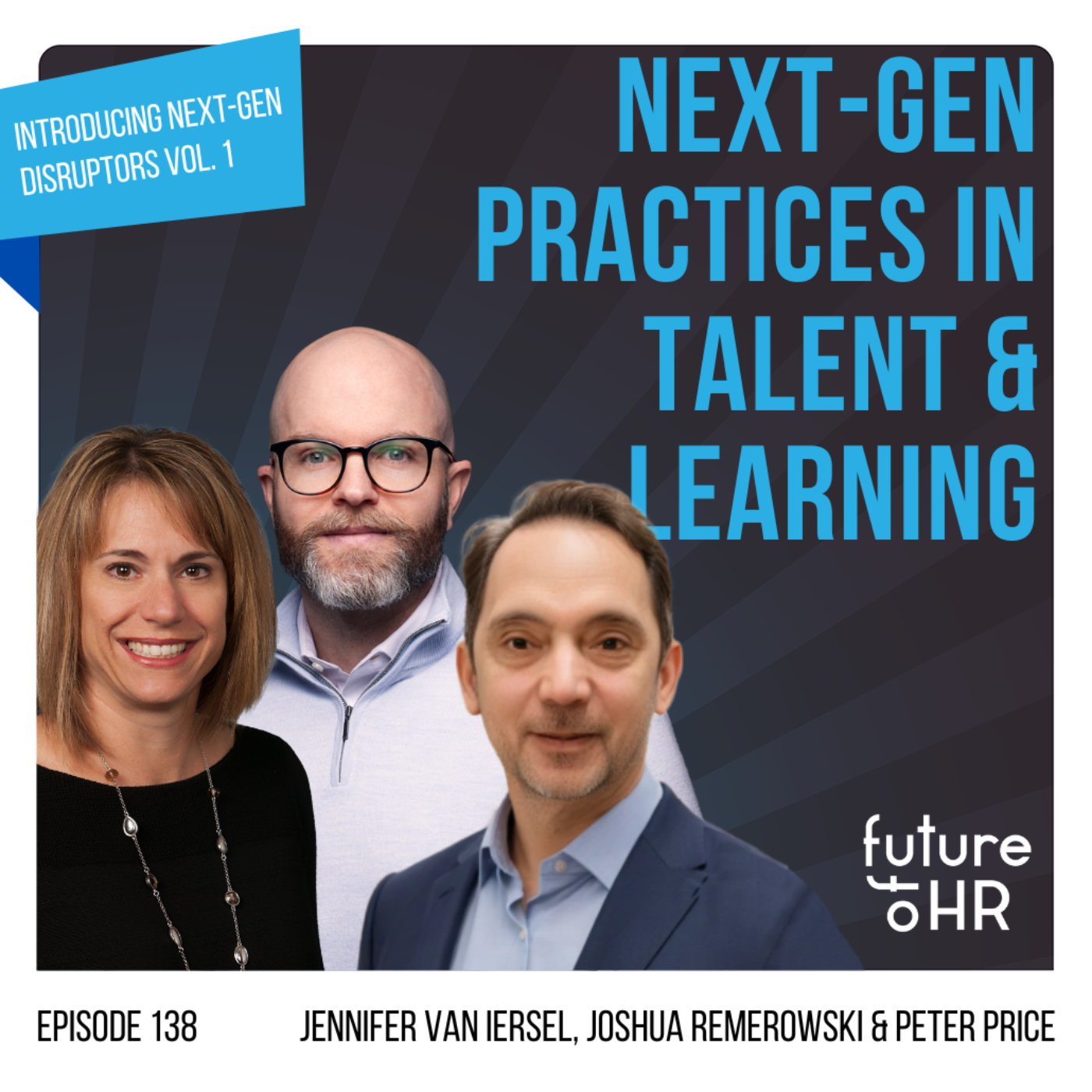
“Next-Gen Practices in Talent & Learning” with Jennifer Van Iersel, Pacific Life, Joshua Remerowski, SRS Distribution, & Peter Price, Providence Health System
66m 31s
This episode of "The Future of HR" podcast launches the "Next Gen Disruptors" series, highlighting innovative HR leaders. Jennifer Van Ersel, Global Head of Talent Acquisition at Pacific Life, details her four-year journey implementing agile practices in talent acquisition. Faced with the dual challenge of hiring tech talent for digital transformation and modernizing TA processes, her team adopted a product mindset, using two-week sprints, MVPs, and tools like Azure DevOps. This shift emphasized planning, prioritization, and transparency, breaking down silos and enabling rapid iteration. Key outcomes include faster hiring, effective technology adoption, and high team engagement. The episode also features Joshua Rumorowski on making learning simple and job-relevant, and Peter Price on a targeted boomerang hiring program that generated over 5,000 hires. Jennifer advises starting small, investing in education, and customizing agile to fit organizational needs, predicting "agility" as the defining future of HR.
This is the future of HR podcast episode 138. We were somehow going to have to figure out how we were going to implement new technology, update our processes, really just work differently while still executing on what the business needed. Ultimately, the way we were able to do that was shifting to that product mindset, thinking about delivering in a different way, which was creating these, using the agile practices to drive two-week sprints, and then working differently as a team, really did transform the talent acquisition organization and the way we work. There's a quote from Albert Einstein that's always guided my approach and I want to make sure people understand what I'm talking about, so they're not confused of what simple means. But the quote is, "everything should be made as simple as possible, but not simpler." So really, the focus is on clarity, efficiency, and not oversimplification with the result being losing meaning or actual functionality of whatever you're doing. And for me, simplicity means scalability. After we've kicked this off just in the last three or four months, we surveyed rehires that joined. Again, what was interesting is the reason they left is often the reason they returned. Welcome to a special episode or the Future of HR podcast. Today, we're launching an exciting new series called Next Gen Disruptors. This series focuses on Next Gen HR leaders who are making a difference in their organizations with their innovative approaches in their delivering impressive results. And today, we're lucky to have three forward-looking HR leaders sharing the great work they're doing into talent acquisition and learning development. First, we're getting here from Jennifer Van Ersel. Global head of talent acquisition in a Pacific life. She's going to take us behind the scenes in detail how she and her team have been using agile talent acquisition practices to deliver exceptional results over the last four years. If you've ever been thinking about implementing agile talent practices on your team, this conversation is for you. Next, Joshua Rumorowski, who is the VP of Learning Development, S.R.S. Distribution, will discuss his customer-centric approach to developing talent. Joshua emphasizes keeping frontline workers and those closest to the customers at the heart of learning program development. I think you'll learn a lot from Joshua's secret sauce for L&D, which is to make learning simple, fun, and directly related to the job. And last but not least, we'll hear from Peter Price, who leads talent acquisition brand and marketing of Providence Health System. Peter and his team have developed a targeted boomerang hiring program that has generated over 5,000 hires in the last two years. In our conversation with Peter, he's going to share the strategies and the lessons learned behind the true remarkable recruiting engine. And since this is our inaugural next-gen disruptors episode, I would love your feedback. Let me know if you enjoy this format and if you want me to search out and bring on more next-gen HR leaders in our field. And with that, let's jump into my conversation with Jennifer on agile talent acquisition practices. Jennifer, welcome to the future of HR podcast. How are you? I'm great. Thanks for having me. Thank you for being here. Really excited to hear about what you're doing in Pacific life and how you have taken agile methodologies to really build out talent acquisition, which I think is awesome. Tell us more about what led you and the team to move to implement an agile TA process. Just about everything starts with a problem we have to solve. This is actually back in 2019. We were about to kick off a five-year strategy for the organization. And a big piece of that was digital transformation. And we really had two problems to solve. We had to hire a bunch of tech talent to drive digital transformation. And we had to transform talent acquisition ourselves. And that was really about how we're going to be able to accelerate the hiring process and leverage new tools in order to do that digital transformation hiring. So those were the two things we were trying to accomplish. And as part of that, I started exploring. I was talking to some of our IT folks, one of them, which was a scrub master. And she said to me, have you ever thought of agile practices? And I'm like, how does that work? Isn't that just for software development? She said, no, it could be applied to anything you do. You just really have to change your mindset and think about what you're trying to deliver and the value you're bringing to the business. So that's how we started to explore it. That is awesome. Just so we're clear, maybe describe a little bit more about what agile TA means at Pacific Life. Just so everyone is listening, because that one has done agile in pride management or tech. And they certainly, most of them, not that are for TA. Traditionally, it is leveraged mostly in tech. And some folks think about agile is just a way of thinking or a way of operating. But we're using it truly in the methodology. The agile practices like software developers do, but we have applied it to talent acquisition. Agile practices is really a project management approach that emphasizes planning, prioritization, iteration, transparency, collaboration, and reviews. This approach is enabled our TA team to drive continuous improvement and execute on hiring initiatives at the same time. And that's the trick, when we started the strategy, we weren't given unlimited resources and unlimited time. We were somehow going to have to figure out how we were going to implement new technology, update our processes, really just work differently, while still executing on what the business needed. Ultimately, the way we were able to do that was shifting to that product mindset, thinking about delivering in a different way, which was creating these using the agile practices to drive two week sprints, and then working differently as a team. We could break down silos, we could see the visibility of work across the entire team, and the team had input to everything that we were doing, because we were talking to each other daily through our daily stand-ups, and then reviewing all the work that we were producing on a two week basis. Really did transform the talent acquisition organization and the way we work. That's really interesting, and it sounds like really incredible, and your leadership had to be instrumental, because this doesn't just sort of happen on its own, so you're pretty committed to this, I'm guessing. It projects some time to get used to, like how did you sort of change to do two week sprints from a traditional project management or even a TA process? Not just about what that was like, that transition period a little bit. It wasn't easy, and the team wasn't initially on board, or didn't understand why we were doing this. I started small, so I even took an agile approach to implementing agile. I started small with the TA leaders and introduced the methodology, and it was a lot to take in, because it's a whole new language we had to adjust to. We use different tools, so we use Azure DevOps to keep our backlog and to facilitate our sprints, and ultimately all the metrics to see what we are accomplishing, but we had to balance learning this new way of working and executing on our day-to-day racks. It was mostly initially the project work that got into our move-dover into the agile practices, and then we were still executing on racks, but eventually we pulled in any kind of big hiring initiatives were created in our backlog, and then we're also prioritized and managed through our sprints. But it was quite the transition, and the first year, like I said, we started with the talent acquisition leaders, and then expanded it to the broader team, and the feedback, which I know we're going to talk a little bit more about, but the feedback was really incredible to see that transformation. It's really really successful, and so that's helpful to understand that you can add an approach and start small, and we're mainly focused on some of the TA projects, a lot of projects across the day, whether we're talking about implementing new systems, new dashboards, play brand new, and it's always a lot of projects that are happening. And as you start to move the wrecks in, how do you think about that in terms of, is that a product or a deliverable? As part of us optimizing the way we work, we went through a process of identifying what types of wrecks. So whether that be high volume wrecks, critical skill wrecks, or officer or professional level wrecks, and we really defined what that was first, and then decided what needed to have the visibility across the team that we would pull into the sprints. Or another example would be there is a class of, say, 20 to fill, and we know there's got to be certain things that happen within that two weeks sprint in order to hit that class deadline in order to make those hires. Wow, that's so cool. That's helpful now. I think we can understand what you've been working on. So let's talk a little more about the methodology, because the shift from traditional TA to a agile TA methodology requires new ways of working, really a mindset shift like you talked about. So how, more about how the team had to start thinking and working differently in agile TA, what the pushback or the initial reaction was compared to where you are today? So initially it was thinking about the value we were bringing to the customer, and the customer being really three areas, the hiring manager, the candidate, and then ourselves. We treated those three and measured it of what were the outcomes we were trying to drive for. So those three customers. And then we needed to think about not being perfect in that we were going to use an iterative process to create a minimal viable product, which we call MVP, in order to deliver. And that really, that shift in mindset enabled us to create the agility across the team. It was a process. I would say it took us probably the first year to really get into shifting in that mindset and being comfortable creating that MVP. And then also thinking about executing, but also failing that we would want to fail fast in order to improve. So when you're creating an MVP, it isn't going to be perfect, and it might not even be right at all. And we have to be able to test and learn in order to ultimately get to the right place. And those two weeks, Brince enabled us to do that. So we could fail fast and then move on to the right solution. That's really impressive, actually. I feel like a lot of times in HR and really just working in corporations in general, we don't want to fail. We don't want to have an MVP, right? We're always looking for perfection and try to have the perfect project plan versus like, we're going to try this and see if it works. Give us an example of what MVP look like in the TA world or one that you can remember that it seems learned a lot from. Yeah. A good one was we implemented a new technology. It was a pre-recorded video interview capability. When we implemented it, we thought every TA partner should use that technology regardless of the type of wreck it was because we thought we were going to gain so many efficiencies from it that everyone should use it. And so that was a great example of literally making every TA partner using it and figuring out that is not working. And we were able to leverage that approach in the sprints to say, OK, well, this was our MVP. Now we need to customize and understand where we can leverage that technology, where it's going to be effective, where it isn't. And we had the data behind it and we're able to review that in our two week sprints and decide how we were going to shift and then also how to optimize it. We found there was a lot of managers who weren't doing the introduction that when we knew if they did the introduction, we were more likely going to get that candidate to complete that video interview. But it was all that feedback in those sprints that we got from the team. So we were able to quickly pivot, make the improvements and optimize the tool. Well, let's talk more about the sprint because I think that might be a constant it's new to some people. So the sprint is a two week and you can address it, it depends on the team. But for us, it's a two week time frame in which we identify the specific work that we want to accomplish. We always talk about right sizing the work. So we want to be clear that it needs to be work that can be completed within two weeks. And some of the work that needs to be completed might be complex or it might require a lot of collaboration, maybe outside of talent acquisition. So you really have to be plan full. So a lot of people when they think about agile, they don't think about planning. And I would say just the opposite. It's actually probably more planning than you're ever doing prior to that. So you're really thoughtful about what can you accomplish and you're realistic so that you are actually executing on that work within the two weeks. So it's a two week time period that you're executing on work. And then you're going into the next sprint and planning and figuring out what is next in order to deliver that MVP. It's great. Another key principle with a product road map. Talk to us a little more about the TA road map and how you use that to drive results. Our product road map is driven by our business strategy. We start with the business strategy. Obviously, then we have the HR strategy and the TA strategy. So that's how we populate our road map. But we are in complete alignment with what our talent acquisition value proposition is. And then the objectives and key results were we want to accomplish. And then that gets populated into what we call our product road map or our backlog. That guides us throughout the year. The wonderful thing about agile practices as we know things change and priorities change in the business. Having the ability to plan every two weeks allows us to reprioritize. So if something does change in the business, work quickly able to pivot our resources and push other projects if we need to. It's a critical part and it's also about delivering for the customer. What are we achieving for the customer as far as supporting our ability to hire quality talent and another component of agile is a retrospective. Talk about what our retro is and how the team uses that to just get better. So retrospectives are at the end of the two weeks sprint. And it is there to help us be more effective at the sprint. So we want to know at the beginning of when we implemented agile practices, it was very much about. Okay, how effective were we in the sprint? Did we plan appropriately? Did we consider the time it was going to take to incorporate other people as part of the work we were trying to get done. So it really just helped us individually improve our ability to leverage agile practices. But I would say as we've gotten more mature in our practices, we use retro's all the time for many different things. So it could be anything from getting feedback on maybe something new that we've done. And we want to know did everyone like it? Did they think it worked? It could also be a year end review where we want to take some time to acknowledge what everybody's accomplished. And so it ultimately is a nice platform where we can provide our thoughts and give everyone some kudos around what they've been doing. So you can use it in many different ways. And that's the beauty about agile is it really you can really make it work for what you need. It's not rigid. And that's what we've seen. We've been doing this now for four years. And our agile practices have changed. It doesn't look exactly the same from where we started four years ago. It's awesome. And think about as you bring new team members on, right, you probably have grown or has any team member changes in that time period. Yeah. Did they give you a look like, hey, what plan are you from? And what are you doing here? Pacific life. It's so different than maybe other. Yeah. So we did learn and yes, we definitely got those looks. But what we have done what we have done differently is we added that into our job descriptions so that we're not surprising anyone when they're joining the talent acquisition team that. And we talk about it through the interview process, but we do take the time to invest in our people. So for example, I have two small masters on my team. So we've invested in the formal training. Those individuals are responsible to help bring our new folks along on the journey and get them integrated because it like I said, it does take some time in the language and getting familiar with the approach. There are people who didn't like it and had to opt it out. So it is it for everyone. But when you see the results, it's amazing to see what the team can accomplish and be involved with. And I think it also gives them a lot of variety in their work because we know day in and day out of filling requisitions. This can be a thankless job, the participation in the projects that we do and ultimately how it's helping the talent acquisition team more broadly be successful is amazing to see that accomplishment. Well, speaking of results, tell us a little more about some of the key wins or successes of the team over the last four years, moving this agile approach. Let's say three things stand out. Number one is just delivering on our hiring goals. We've seen incredible acceleration of our hiring practices as a result of all of our process improvements. And that's kind of my second one is just leveraging new technology. You have several examples of implementing new technology platforms, but also kind of homegrown processes, whether it's just leveraging for soft forms or power BI through our dashboards. The team in general, I would say is very innovative. They're able to make those contributions. So when they have ideas, we're able to put those into the backlog and get them implemented. They don't sit on the shelf for two years. And then lastly, I would say high engagement scores across the entire TA team. This practice agile practices were implemented when COVID hit. So in 2020 actually 2020 was the first year we started doing agile practices and it truly brought the team together and that has continued. I have a team now across the world and they are so engaged. And I think a lot of it's attributed to how we work. Yeah, it's amazing. It just seems like it's so collaborative. Everyone's got visibility. There's clear deliverables from what you're working on and that seems to be very powerful for teams to consider. So Jim, right, you think about you have more to practical tips for other TA leaders or HR leaders who want to have this in the organizations. Where should they start? First, individuals should reach out to a scrub master in their technology organization and learn about agile practices and see how it works and see if they have had examples of agile practices outside of technology. And then also if there is a decision to move forward with it, I would say invest in the education of your team and iterate. This will evolve and you can really customize it to align with what you're trying to achieve in your talent acquisition organization. It's great. Really good tips. I hope people go out and try to do this. I think it's really a powerful way for all organizations that HR to think about those besides just see it but see it's really really awesome when you guys start. Jennifer, last question for you. What is one word of phrase that you believe will define the future of HR over the next five to 10 years? Probably no surprise what I'm going to say, but I would say agility. There's so much happening and I think we see this year over year. There's something new, whether it be Gen AI or new technology coming across. We think about kind of the customer experience. Agility is just so key. There's always going to be something new and if we're not agile and we can't adapt, we're going to fall behind. So I really think agility is the key word for me. I appreciate that. Thank you, Jennifer, agility is your word, but agile TA is what you've been doing doing a great job of that. So we reach out to you. I'll link down to your questions. Absolutely. Great. Thank you for being on my future HR podcast. Thank you. Are you ready to take your career to the next level? If you are, then you need to download the HR leader's blueprint featuring battle tested strategies from over 100 HR thought leaders and CHROs. This comprehensive 18 page guy delivers actual steps, strategic frameworks and real world insights to elevate your impact. No theoretical fluff, just proven tactics to becoming a business focused HR leader. And the best part, it's completely free. To download the HR leaders blueprint, go to future of HR.com. That's future of HR.com. And if you want to get a jumpstart on your 2025 career goals, then you do not want to miss out on the HR leaders blueprint. Thanks again to Jennifer. That was a terrific conversation and it's so impressive how her and her team have adopted and utilized agile TA for the last four years, truly, truly inspirational. Next up is Joshua from SRS distribution. And he's here to share his unconventional career journey and how that has shaped his thinking and driven his success as a talent leader. Joshua, welcome the future of HR podcast. How are you? Oh, good, JP. I'm excited to have you and be part of our next gen disruptor series. You've had a really interesting career because it's not so much an untritional career path, but you really started your career in the front lines. First is a FedEx driver driving some, I think a 26 foot truck. I might be able to call that. And then you worked your way out of rising call center, but now you lead learning development for SRS distribution in which they 10 billion dollar company. Tell us more about how this your career journey evolved from front line to now talent and learning development executive. That's a question for me. I've always enjoyed reflecting on when people ask me because my career has been anything but traditional, just especially in this HR and talent landscape. But I grew up in a blue collar low-income household and really the focus was always on hard work as the core value away of life. And that work ethic for me really carried into my early years and in my career decisions that directly impacted my decision, you know, to go work in the front lines because that was the number one value system that was created. You know, for me and my license and growing up and I was doing those jobs in the front lines and I realized pretty early on that hard work alone is a road to nowhere. So all that tough guy stuff that I grew up around alone wasn't enough. You need to be adaptable. You need to be curious. And I stumbled upon a Stephen Covey quote early on and at time it's that parable where it's the two people at the axe and that there's the one person just chopping and chopping and chopping. But there's the other person sharpening the blade, spending the time and to make it sharp, taking water breaks, taking rest and really being strategic with how they go about chopping down that tree versus just wearing out the axe. What changed for me was just embracing this growth mindset of not just focusing on doing more, but doing what matters and really once I started to learn how to assess the landscape, figure out how to work. I got out of the everyday rigging a role of just working my tail off and started to shift into how to work smarter and then once I really learned how to work smarter, I started understanding how to then work strategic and see around corners and that's what really helped my career take off. Same the front lines was taking that grit, that front line work ethic and understanding what it takes to do those jobs and applying that in a more strategic sense in control, I've got since that's great. I think you really helped change yourself in some way that your agile right you were able to grow and learn from every experience. We talked a little about this before because we know each other for a while, but I think a lot of times organizations don't do a great job with career development for frontline team members and they miss out on incredible talent like you and I wonder from your perspective Joshua, what's missing when organizations think about career development for frontline team members. In my experience, one being a frontline worker and now working with and supporting frontline workers as our customers for the last decade, I see two things consistently missing and career development, one, it doesn't exist. I would say that's a very common thing I've seen in quite a few companies or people that I talk to in other companies or two, the pathways for growth are not clear or accessible for all. So often we have frontline employees, they're so focused on their day to day tasks, they struggle to envision what's next for me. That was the big thing for me right I grew up that hard work was the only way to really a road to know where I could never envision myself above the trees that I have this future where I could just be flying in the clouds and achieve all my career goals and dreams. And so without that visibility into how they can advance in the front lines, this sense of progression, it really becomes unclear for the employee like what's possible. And I think that's a huge missed opportunity not only for the employee, but the organization and I just find often the root cause of that the most important thing is we have many frontline managers and middle managers that have not been equipped with the softer hard skills. Really is their roles evolve from an individual contributor to a leader or from a leader of others to a leader of leaders and they just take whatever their old playbook that they had in their pocket and try to apply it to this new level of leadership or this new level of work. And it just doesn't work many companies really hyper focus on developing their high post which is fantastic, but really need to have some of that roll up your sleeves get out in the field get the voice of the employee and find out what they actually want not so much focus on the white papers and the cliff notes articles that tell you this is what they should be getting. And I think just for me, that's where I really find is the focus goes to the top or to hide potentials and high performers and everyone else kind of gets whatever scraps exists. So I think the better companies can focus on equipping people at all levels, obviously across the board, you're going to have a more dynamic and better performing workplace. Yeah, I think when you talk about that Joshua really kind of makes me think of the art of the possible right I think you know people need to see that there's an opportunity at this company that I could go from an hourly team member or shift supervisor or a manager to other roles in the organization maybe to corporate et cetera. And I think you know companies like Wal-Mart you've seen this I think the restaurant industry are really big I'm sure it SRS you guys were having a lot of those same successes so I think that first piece is that art of possible like showing people that and the second piece you're making a really good point on is the leaders they work for also have to have that ability to see that talent nurture it and give that town the opportunity. And so that's reading to the disservice systems and processes or really just empowering those leaders really good perspective on that helpful for people to think it through because I think we sometimes we'll talk enough about this. Yeah, we really don't. One reason why I want you on the podcast was you are really doing a lot of innovative work which we can't go to into for a variety of reasons with an acquisition that happened at home depot so we're going to be very light on that. But we can talk a lot about your approach and you say that learning development should be simple fun and directly relate to your job which sounds painfully obvious yet I don't think that always happens tell me more about why simple fun and directly related your job guides your approach to lnd. There's a quote from Albert Einstein that's always guided my approach and I want to make sure people understand what I'm talking about so they're not confused of what simple means but the quote is everything should be made as simple as possible but not simpler so really the focus is on clarity efficiency and not over simplification with the result being losing meaning or actual functionality of whatever you're doing. And for me simplicity means scalability if you have simple things and not all these complex frameworks and theories and in methodologies that we tend to get from books and a lot of those books are written by people that have never done those jobs never let anything in the real world and they might be researchers and it's great and I think they serve a purpose I've learned a lot of things from those books. But it becomes very impractical to don't implement something like that in a 300 page book into an organization and deep into the front lines where that's what they care about I can attest to this I could care less about when I was a truck driver or a field tech about whatever complex framework or methodology or pyramid that you want to show me in a PowerPoint I just care about how can you make my job easier. And what is the simplest way for that to occur and I think the more simple the easier the solution is to implement and beyond complicating it with the frameworks can we make it easy from how we speak to people are we speaking in simple language or we using this big $20 words and all these buzz words that many leaders in companies like to say that they don't really sticky have no real substance and aren't transparent. And then at the end of the day fun drives engagement and people should enjoy what they're doing and I know that's to your point it is a novel thought that I know you and I know I have sat through countless things that have been trainings or meetings or whatever they are. And they are painful to the point where I would literally rather be like shoveling holes in the middle of nowhere with no purpose than sitting in that room being bored to tears. And then I think in general if you can create that engagement obviously it's just going to make the learning stick more when it comes to the last part of just in general making things that are relevant to the job no matter what we do should have an exit ticket. That equals how does this make me better at whatever my role and responsibilities are for today and also the future often we focus on stuff that current needs and gaps of behaviors and skills in the workforce but also what are the future. The future blue thing skills and behaviors that we need to equip people with so that they can be successful, but that's my focus with my team that's been my focus in each of the companies that I've led the learning function and it's just to really focus on how do we minimize friction and maximize the impact that we can deliver and not just bring the new flashy thing that someone showed us at a conference to the table and try to implement that that just. That brings in unnecessary complexity and most of the time ends up being a waste. Yeah, I like that maximize impact and minimize the friction piece. I think that's really smart. Joshua and so I love that approach simple fun directly related to your job and we're being really pragmatic and practical. But what's your advice to L&D leaders on how to keep it real? How do you bridge the gap from theoretical to actually I'm now implement money and this is simple practical and fun. Bridging the gap requires a deep understanding of the front line if you want to go somewhere you have to ideally have a map or have been there right you can't just wander upon some of these solutions and I think many of us do that where we just hope will kind of stumble on the way to unlock our front lines productivity or lower attrition rates. You have to have a deep understanding of what they do what their real life situation is I know when I was making $10 an hour living in a duplex and a low income neighborhood with my wife. I'm not thinking about anything beyond just the next day. How do you bridge the gap of what is the real reality of whatever your front line worker is and what their situations are and how do you get out in the field? How do you shadow employees? How do you test solutions in real world settings? Are you deploying things and don't even realize they can't access it because of the technology limitations they have? It could be Wi-Fi or not having a mobile device or not even having a computer or maybe it's a shared computer. If you have the perspective of I'm going to go into the front line for me I think I didn't have a corporate internship or something like that to get placed into a desk job and that's how I set my career. If they haven't done it right if you haven't done this front line work if you really want to bridge the gap go do it beyond just shadow and go figure out how you can work with your leader to get some like real life experience of like rolling up your sleeves. Having people yell at you in your face deal with the consequences of of training not being good and understanding the pressure that some of these folks have in different companies in their role and really allow you to build the context that's going to matter because as people grow in their career you get further and further away from the front line which means you often get further and further away from like the really cause of what's going on and more disconnected. More focused on doing those sexy things with technology that are not always meaningful so if you can't get that experience at the end of the day you need to be making sure you're not creating learning and a vacuum so even if it's not you make sure your team is getting in the field learning what those pain points are and. And designing things ideally with another frontline employees like getting multiple frontline employees involved in finding way to co up these learning experiences that really allow you to have the right input and then create that kind of stickiness that truly moves the needle on performance and also can impact your ability to navigate change resistance which often happens when we just come over the top with a solution without digging into what's really happening in the field. Yeah I really well said I think it's kind of an evolution from empathy and understanding like I understand what a frontline member goes through to experiencing it yourself then you have a little deeper level of empathy to where you're going which is like how do we co create together to build better solutions that really work in a variety of situations because I think that is the key and I think most almost all Ellen dealers want to do that the best they can. There's constraints around that but I think really having that mindset and it builds credibility not only when you do that but also when you start to actually implement people are like oh you know this is so great that we were involved and you tested it and you piloted it and it makes sense and it works that just gets you a big win especially if that is what you're focused on. The other piece I want to ask you about Joshua was that we love to hear more about maybe an example of an innovative learning solution they implement in the past that you felt really move the needle on performance. It's done a lot of innovative kind of learning development initiatives in your career so we'd love to hear your best practices here. Fundamentally one of my favorite ones was I was lucky enough to work at the rise in which in my opinion is a top five learning organization in the world thanks to their chief learning officer Lou Tudrick and ultimately the company's backing financially leadership wise of just the importance of career development. In all shapes informs whether it's formal career development programming or access to education outside of the company it's really great. We did a a hackathon for AR and VR probably back in 2017 really early of early emerging times of the technology and so I was lucky enough to be a part of this small group that came up with the use cases for a store robbery training which used VR in a really practical and ethical way that. We were able to implement and it created that emotional oh my gosh someone's pointing a gun at me you're able to replicate these unsafe situation safely and then we were also able to to have a use case that we built in and delivered in partnership with the third party company. For our field text and for me that one was just like the store robbery geared around safety so how do you go into these manholes how do you climb a telephone pole and what are the things you need to watch out for because at the end of the day I did the field roles of direct TV and I also did it while I was at Verizon like you can die on the job in these jobs and when I was in direct TV we had someone die in the job. While I work there because there's things that you just aren't always aware of of how close danger is to you whether you're on a 40 foot ladder in a crawl space under someone's home in an attic on a roof with snow whatever it looks like you can die in an instant but you can't really replicate those situations in a safe manner without some type of technology intervention. And so really we were able to create these immersive learning and really realistic situations that allowed us to replicate those unsafe situations. Basically and the best part for us was you get great ROI from productivity a safety dollar and cents but you protect your employees which are your most precious asset that you have to meet that was probably one of my favorite early career there's some really cool stuff that I have coming up that we're going to be doing with a on that I'm excited about and we've already been experimenting this year but that's probably one of my favorites from a innovation standpoint very cutting edge ahead of its time. And honestly still the gold standard for what companies have done when it comes to use cases with that technology to this day. Yeah great insights really really innovative training and learning doing PR and things like that I hope that we do more of that in the future. It is cool because you can do something that's really unsafe and keep it safe environment so I'm sure that the team members appreciate that and to have that experience. So we'll see how much more happens there I definitely think AI there's a lot kind of things that can open up with AI and I think we'll see that space really blow up this year. Josh I did want to ask you for early career HR professionals maybe frontline team members who are interested in L&D what experiences or skills should they be prioritizing in terms of their development. For me I think if you really want to truly build a career so grow let's say it's to becoming a chief learning officer one day or lead the talent function or whatever that looks like you have to learn the business in a way that it allows you to deliver value as a strategic partner. In my experience many people not all might even be most and learning and development really struggle with the strategic partner aspect of it they're very good at executing they're very good at taking orders and going back into the business. And just getting exactly what was asked of them done and really that's going to cause you to hit a wall in your career because you're going to struggle to know what matters to the business and then ultimately understand when do we need to pivot and how can I bring that in a proactive manner back to stakeholders to make a better decision that results in better outcomes. And I think it's really nice if you know Bloom's taxonomy and you know adult learning methodologies and you can measure with the Kirk Patrick or Philip's model all those things are fantastic when it comes to to learning and development and many people I know are good at those things but if you can't get scrappy and get programs out that meet the moment of need. It won't matter like it just will not matter so I think if they can learn how to to be a strategic partner and be really scrappy to execute things and then find the way to measure impact and not make the excuses I don't have time or no one gives us the data. There's a way to measure it I figured it out every single time even even when it's difficult and might require you to do some work I think what you're going to find is you will differentiate yourself from the sea of sameness when it comes to all the other people in the space that are doing a lot of the same things and just. Kind of being soldiers in a lot of way which is like here's my marching orders and i'm going to go do it and then I think the final thing would just be pay attention to what's going on in the industry obviously are their ways you can elevate experiences for the employees or your development programs in a practical way and don't just do it for the sake of doing it because a lot of things that you're going to find are going to be smoke and mirrors they're not really going to provide any tangible value on the back end. On the back end when it comes to our why productivity or performance so if you can figure out what those things are in how they help unlock performance or unlock any type of really key attribute for your company yet again it's just going to be a really differentiator for you and really give you that kind of hockey stick growth in your career that a lot of people desire but is pretty elusive for most people. Great advice Joshua appreciate that last question for you Joshua is what is one word of phrase that you believe will define the future of HR over the next five to 10 years human centered workplace human center workplace alright we've heard their Joshua thank you for sharing your story your incredible career story your insights around learning development keeping it simple fun and directly related to our job. What a great conversation with Joshua it's a great reminder for all of us when we're designing programs to get into the field talk to our employees and design with them in mind and of course keep it simple fun and directly related to their job. Next is Peter from Providence Health he's going to share his lessons learned in building a boomerang higher program that has netted over five thousand hires over the last two years amazing results. Peter welcome to the future of HR podcast how are you I'm doing great thanks for having me yeah thank you for being on the podcast thank you for being part of our next gen disruptor series. You had the Providence team have had some great success hiring boomerang caregivers tell us more about why you decide to focus on boomerang employees and how that's become a key part of your talent strategy. For us we always believed in the potential it was already a strategy that was working it was just we were doing it on a on a much smaller scale. At Providence were a really large organization the boomerang that campaigns that we're already doing were decentralized so they were happening typically at the individual ministry level which is what we call a hospital. We knew that if we wanted it to be even more successful it's we're doing it on the enterprise level think about local boomerang outreach it would be coming directly from a local leader where you had worked prior and that that can compliment. An enterprise outreach but we identified the need to centralize the as a centralized talent strategy because frankly we were missing opportunity to reach past employees and so by centralizing we were ensuring that no past caregiver wasn't welcomed back we were aiming to fill the gap there. That's great and maybe through a context how big is Providence now how many hospitals how many caregivers or team members you have were over a hundred thousand our markets were you're in California Oregon Washington Alaska and a small footprint in Texas and New Mexico so we're close to right around 50 acute hospitals and then we also have many many other line of businesses skilled nursing facilities. Home hospice clinics et cetera pretty sizable employee yeah a thousand is not something to sneeze at it's a lot of hospitals which makes sense and why you want to have more enterprise view. And we're talking about how you did this in the work you guys did around boomerang but is it a focus on nurses and non nurses like who were you focusing on what was the business case around trying to find boomerang employees. And nurses are always our number one hiring need it wasn't just nurses but I would say it is really the clinical patient facing roles nurses are as well as medical assistance certified nursing assistance those are core needs as well as a lot of special areas diagnostic imaging is always a challenging role to fill respiratory therapist so the campaign wasn't limited to those roles but the majority of hires that we make are in those roles and to be honest they're the core focus of this because they're the ones that there's a talent shortage of those so not that if you lose an accountant you wouldn't welcome them back but you open up a record account and you might get a thousand recipes where if you open one for an rn for a difficult role you might get zero for amount of time so that that really is the core focus of our needs and really the team that I manage we really focus on what we call priority hiring needs so it is most of our effort is heavily into those are in clinical patient facing roles. Really helpful it makes a lot of sense that you would focus there in the skill gap and the talent shortage around nurses so it's awesome you have to come up with this innovative way to take this boomerang approach to get some hires back. But you know some companies have a negative view of rehiring employees and let's talk more about Providence's approach and philosophy on this. Did you experience any pushback with the initial idea or people just like hey Peter if you can get as more nurses we don't care where they come from. It's a good point I think we are our unique one for the industry that we work in I think health care welcoming back nurses is is probably something most organizations would be would be happy to do. I didn't necessarily get pushback on it per se I also think our culture is it's very welcoming and I would also say re welcoming as well there aren't a lot of individuals that have worked here for many many years and there's a lot of them that left and came back. So being a boomerang here is not a stigma it's almost like a lot of times people will share it with pride that they left and returned. One thing that I did need to confirm internally to make sure everyone was comfortable with it is is really how we defined the audience and looking at our data so I wanted to point out this is for voluntary term employees so we're looking at all of those data fields and identifying who we absolutely know from that that we would want to return. I think that is some of the concerns if there are individuals that there wasn't the intent to be eligible for rehired which so many data fields that we even look at things like no show. I'm so thinking this like someone we hired but they actually never started we took the proactive approach to remove those there may be some unique circumstances where that person may something may have come up but I would say we are fairly cautious looking at the data of who we wanted to include in this because I'd rather be safe there and still a sizable audience. Yeah I think it's right so you're really making sure that you're getting folks that you want to come back there it didn't leave on bad terms or wasn't a no show. It makes a lot of sense but in your size you have to scrub that data it's not like you don't know every person's story individually so I think that makes a lot of sense. You guys have had some great success with the program you've actually had 1,600 boomerang hires in 2023 and over 2,500 in 2024 which honestly I think is truly incredible I mean that is a massive amount of boomerang coming back walk us through how this initiative evolved from a concept these really impressive results. One thing that conceptually from the very beginning when we thought about this we didn't want to view it as a one off campaign this was a ongoing effort the ideas and we really wanted to anchor it with with content and storytelling. So think of this way when someone leaves often you times I mean we all get them in the mail or outreach like oh we want you back but usually they don't really tell you why you should return. We approached us we really wanted to treat it as a give some depth of what's new at Providence what are the reasons why you should consider returning and really approach it as not just the invitation back but a way to share with caregivers that used to work with the we're involved with mission how it's progressing new things that we've done how we've evolved what knew we're offering to our caregivers and give them a reason to join and also do it in a way where even if they're not ready to join. There's value in the communication and driving them to a microsite with a bit of depth of people talking about why they're rejoining talking about what we're doing how we've continued to the mission new things that are happening so we want to make sure it was valuable even if the person wasn't ready to at that moment to return and recognize that and then we also wanted knowing that this type of campaign we're going to reach the same person likely multiple times because not everyone's going to convert the first time so we wanted them to. When they receive that second outreach and we're doing it on a six month cadence because we're and not sure the perfect timeline but we didn't want to be too often or not often enough so six months with kind of where we where we planted the seed is that we're going to do an outreach with every six month we also wanted to make sure that enough had happened that we had a. Having a telling story to tell and sometimes it takes a while for new things to launch so I think that has provisions to be quite successful from the get go we really looked at it as a as a marketing campaign just a versus you know versus recruitment and engagement campaign in some ways it's there's an alumni relations aspect to it as well. That's interesting interesting approach with think about this you mentioned a micro site what is the first reach out is it a male or email how are you reaching out to them to kind of say the six month. It's a great question about the next province yeah and as we've evolved this we we've learned a bit from it and it may be different at different organizations but the first time we did multiple types of communications to see which ones performed best we did email. We did SMS and we did direct mail to determine what was going to be the most effective and what we learned was the text message approach significantly outperformed others then when I think about that is text is such a personal communication and I don't think it's appropriate. To someone that you don't have a relationship with but I think these are individuals that worked for us there's an established relationship and you were able to reach them quickly that way driving them directly to a mobile optimized website so why we compared different combinations in our most recent iterations were exclusively using SMS and it's also very easy to opt out of of course so someone's not interested in receiving communications with a single no they can remove themselves from the campaign there's been some of that but it's a very very small number. I curious on the numbers because 26 hundred 25 hundred this year of boomerangs a lot. What was the total number of people you were actually reaching out to that were boomerangs. Roughly 60,000 that were reaching out to that are in that database it may change because there's been some interesting findings in research of who's converted but we went back five years and we waited six months so if you left today it would be really odd to be like come back because you haven't really experienced what you've left for. They say sometimes the grass is greener but if you haven't experienced long enough so we wanted to give enough time for them to really respect their decision as well but not wait too long to make it clear that the door is open and when we looked at the date of what. Converted it was across the board we saw a lot of success of individuals that were at only left six months others that left a year or two but there were quite a few conversions of individuals that had even left five years prior so we would extend that a little bit further even. Yeah that's great and I think it's helpful thank you for being so candid with all the numbers is interesting to think about this because. Okay 25 hundred 26 hundred out of like 60,000 and I guess it's the same pool probably didn't change that much so maybe you can combine the 60,000 say we have about 5,000 out of 60,000 is that a fair assessment. Yeah I think it is over the course of two years we're adding individuals so it's fairly steady because we're not going past five years and then we're adding individuals that have hit that six months leaving with each. Communication so the told audience has been relatively steady it might be going down a little bit because in healthcare retention rates have improved slightly across the board we're really thrilled that the numbers have. State consistent from year one to year two and it validates our belief that this should be an ongoing campaign and it's okay if someone isn't ready today to make sure they know that the door. Is open and this they love their job we're happy for them if not pressuring in any way or look what you're missing that's the balance that we're doing. Yeah when you add the numbers up it's about an eight percent conversion rate which you know if you go look up email marketing or any marketing campaign that is really really pretty good. Actually for this outreach and so I think you guys should be very proud of yourself. Any other secret sauce that sort of happens once I click go to the microsite. Wow hey providence is up to some great things do they get a different experiences they go through the TA process is there any other things that happen that might be unique for someone who's been running versus a new applicant. Maybe down the road but when we did this the first time we actually set up a short form so the ideas they could express interest in we would reach out to them right away and we did that and what we found is we actually get a much better conversion. Right if we asked them to apply directly and get the process started into view a job we have a very very efficient candidate experience that we leverage a lot of technology it's so human centered but it's very efficient and when we we found that when they're ready they're ready but asking them to become a lead and have a conversation with us it actually was a step that slowed things down. When we first kicks it off we tested that and then when we moved to put them directly into the driving them to a microsite which had them apply similar to how an external candidate was the conversions more than doubled sometimes adding that white glove experience can actually slow things down and that was a unique finding of course with someone reviews the resume they are hiring managers are seeing that they're a boomerang and they're very well qualified so they're quickly getting zero to the screening questions into the right person. But I appreciate bringing that up because I think that's interesting in some ways our initial thought might be oh it's given a white glove experience and really making till special but I think what you guys did by just having them reapply was you put a little friction in there and you made sure the people who apply were really interested like they weren't just hey let's just see if Peter's got a better job for me now it was like well no I really want to come back to Providence right which probably helped you yeah I would agree. What surprised you most about what former caregivers were looking for when considering coming back to Providence interesting enough after we've kicked this off just in the last three or four months we surveyed rehires that joined again was interesting is the reason they left is often the reason they were turned. It's kind of interesting when you think about it makes you understand this audience is someone may leave for an advancement opportunity they'll indicated that slide they left the organization and then we'll ask them why they were turned and they'll say for an advancement opportunity so it's not a bad thing I mean sometimes that's just reality of how careers. It can happen it could be open that are available at a specific time schedules it's sort of why we want everyone to thrive within the organization you recognize that sometimes it's timing welcome them back and career journey sometimes. May involve leaving and returning as a part of that growth we also found that individuals like indicated that they they left seeking more work life balance or wanting to an experience. A different culture and those equally ranked with reasons that they returned so sometimes it can be situation although you're in a role you may be in a specific role on a specific team with a specific manager scenario and we're such a big organization. That there are so many different opportunities welcoming people back and them finding the right role that's a fit for them makes sense I also think with culture and our mission is really a strength here but if you look at healthcare organizations and almost everyone will tell you why you should join is because we offer the best care because of the mission I think it's a strength here that it's truly ingrained within the organization our history goes back hundreds of years for other organizations are much newer. I think it's an exceptional strength and sometimes people may leave and then miss that shared bond and then in the decisions that they're the organization are are making and attempt to find a different experience a different culture but sometimes it makes you appreciate one that you had worked in prior. So that was interesting I thought they're going to be like a magic bullet of like oh this is why people are leaving and this is why they're coming back and they're two very different things it wasn't unexpected after I really thought about it but sometimes as a marketer you're looking for a really specific data point of like oh if we could only. They do better at this they'll never leave but the reality is sometimes you have to experience something different or there's just a moment in time happening. Peter thinking about HR or TA leaders who are listening and want to start their own Bumerang program for the first time what are a few steps you'd recommend they take. First understand your data and that was probably our biggest obstacle were a large organization had grown through some acquisition your historical data was in two different HR systems and they all had different categories of reason a person left etc so dive in understand what you have to work with I feel like there's always a path forward if you're willing to invest in understanding that complexity that was there whether it's building. Crosswalks or pulling multiple files so I would encourage any organization to really understand what they have and then develop a strategy and a path forward for us another thing that we did up front that I think helped make it quite successful internally was we thought about how we're going to report on it and we built really really detailed dashboards that not only said how many. Highers we made and how many people were out reaching to but we were able to segment it by different divisions and different regions because when you're the moment you're doing anything really really big a lot of your stakeholders really only care that only care but they really care about their small piece of it so from the beginning we we built it in a way where we could come back and be like this additional Bumerang campaign led to 2600 hires but if you're presenting that to a CHRO at a individual hospital they're like great. But how many of those hires did we make or even at the regional level how many of those were in California versus Oregon so we ensure that we built the data models we could report on that what's huge about that is we can tell them how important it was and how effective it was for them. And if there were some regions that were performing as higher than others we talked to them about that talked about maybe you want to consider doing a complimentary local outreach from a leader there so sometimes you celebrate success and then you by doing it that way you can also identify opportunities that's some advice I would give and don't wait start like anything you can get better over time but what you can't get back is that. Missed opportunity so it doesn't have to be perfect you can learn a lot continue to expand it but start sooner than later yeah great advice and I think people can learn so much from this entire podcast and what you guys have done a Providence so Peter thank you for going through that last question for you is what's one word of phrase you believe will define the future of HR over the next five to 10 years what comes to mind immediately just the word connected I think it's that balance of. Automating doing communications but connecting all the dots and making sure things are personalized and humans I think there's a lot of automation still in HR but it's usually a lot of times it's a status update it's one to many at many times or indicating that someone's in this specific stage i'm going to give them this. Update but it's really about I'm excited about identifying those micro moments and we're doing a lot of work at Providence of use so many different systems but we're investing in having them all connect and I think historically that didn't always happen and then when you look at that the entire experience as one as a i'm in HR but i'm focused in the marketing there's just so many opportunities of being able to reach people at the right time with something that. Matters to them based on something that they've done prior and a lot of times it's timing i think zoom remarking does a really good job of it but they're. Their challenge is so different than ours were there they're trying to sell a product to someone that is willing to buy it but we're trying to sell an opportunity at the right time to the right person and then that opportunity isn't just what they bought but what they do with it and there is a right and a wrong person and I think what we convey is. Is infinitely more complex i'm excited to see all of that all those opportunities come together and. And even be able to look at it not only on in the recruitment space the full life cycle of. Of an employee and having employer branding equally as focused on talent acquisition as it is on employee experience and retention in growth excited about that. Great well I think connection is a great or and you are definitely connecting to the boomerang employees from Providence so. Thank you for sharing the story congratulations on all the success you're having there's a pleasure having you on the podcast yeah thanks for having me great conversation. And with that that wraps up our first next in disruptors episode thank you so much for listening to this podcast thanks again to Jennifer Joshua and Peter for beat our first next in disruptors and sharing the great work. As always you can go to future of hr.com to view all of our past episodes and learn more about our mission to inspire the next generation of HR leaders. And if you enjoyed this episode of future of HR I think you'll enjoy my future of HR newsletter which is the only newsletter that's focused on helping you to elevate your career and business impact. Every Thursday I'll drop in your inbox with one big idea that will get you thinking two questions to challenge your perspective and three actions you can take to level up your HR leadership game. Think of it as your weekly HR leadership booster shot quick powerful design to help you put those ideas into practice immediately. So go to future of HR calm and be sure to subscribe and you can download my HR leaders blueprint which has 18 pages of real world advice from over 100 HR thought leaders with simple actual improvement strategies to advance your career. And we'll be back next week with Jason LaRue who's the national managing partner of talent and culture at KPMG. And in my conversation with Jason he argues that organizations often over index on skills development but underestimate the impact of employee well-being. We also dive into why he believes benefits can be a strategic asset and why KPMG is focusing on skills not just jobs. This is a great conversation and one you will not want to miss. Thanks again for listening to future of HR and being part of our community. [BLANK_AUDIO]
Podcast Summary
Key Points:
The podcast introduces a new series "Next Gen Disruptors," featuring HR leaders innovating in talent acquisition and learning & development.
Jennifer Van Ersel implemented agile methodologies in talent acquisition at Pacific Life, shifting to a product mindset with two-week sprints to improve efficiency, collaboration, and hiring outcomes.
Key agile practices included using a product roadmap, creating minimal viable products (MVPs) for iterative testing, and holding retrospectives for continuous improvement.
Results from agile adoption included accelerated hiring, successful technology integration, high team engagement, and the ability to adapt quickly to changing business priorities.
Other guests, Joshua Rumorowski and Peter Price, discussed customer-centric learning programs and a successful boomerang hiring strategy, respectively.
Summary:
This episode of "The Future of HR" podcast launches the "Next Gen Disruptors" series, highlighting innovative HR leaders. Jennifer Van Ersel, Global Head of Talent Acquisition at Pacific Life, details her four-year journey implementing agile practices in talent acquisition. Faced with the dual challenge of hiring tech talent for digital transformation and modernizing TA processes, her team adopted a product mindset, using two-week sprints, MVPs, and tools like Azure DevOps.
This shift emphasized planning, prioritization, and transparency, breaking down silos and enabling rapid iteration. Key outcomes include faster hiring, effective technology adoption, and high team engagement. The episode also features Joshua Rumorowski on making learning simple and job-relevant, and Peter Price on a targeted boomerang hiring program that generated over 5,000 hires.
Jennifer advises starting small, investing in education, and customizing agile to fit organizational needs, predicting "agility" as the defining future of HR.
FAQs
Agile talent acquisition is a project management approach adapted from software development, emphasizing planning, prioritization, iteration, transparency, collaboration, and reviews. It enables TA teams to drive continuous improvement and execute hiring initiatives simultaneously through practices like two-week sprints and daily stand-ups.
The transition started small by introducing agile methodology to TA leaders first, using tools like Azure DevOps for backlog management and sprints. Initially focused on project work, it gradually expanded to include major hiring initiatives, balancing learning with day-to-day recruitment over about a year.
An MVP (Minimum Viable Product) in agile TA involves creating an initial, imperfect version of a process or tool to test and learn quickly. For example, implementing a pre-recorded video interview tool broadly, then refining it based on feedback and data from sprints to optimize its use.
Sprints are two-week time frames where specific, right-sized work is planned and executed. They involve careful planning to ensure tasks can be completed within the period, with regular reviews and retrospectives to assess effectiveness and make improvements.
The TA product roadmap is aligned with business, HR, and TA strategies, guiding objectives and populating the backlog. It allows for flexibility to reprioritize every two weeks based on changing business needs, ensuring resources are focused on delivering value to customers like hiring managers and candidates.
Retrospectives are meetings at the end of each sprint to review effectiveness, gather feedback, and identify improvements. They can also be used for broader purposes, such as acknowledging accomplishments or evaluating new initiatives, fostering continuous learning and team engagement.
Chat with AI
Loading...
Pro features
Go deeper with this episode
Unlock creator-grade tools that turn any transcript into show notes and subtitle files.
 PodcastTranscript AI