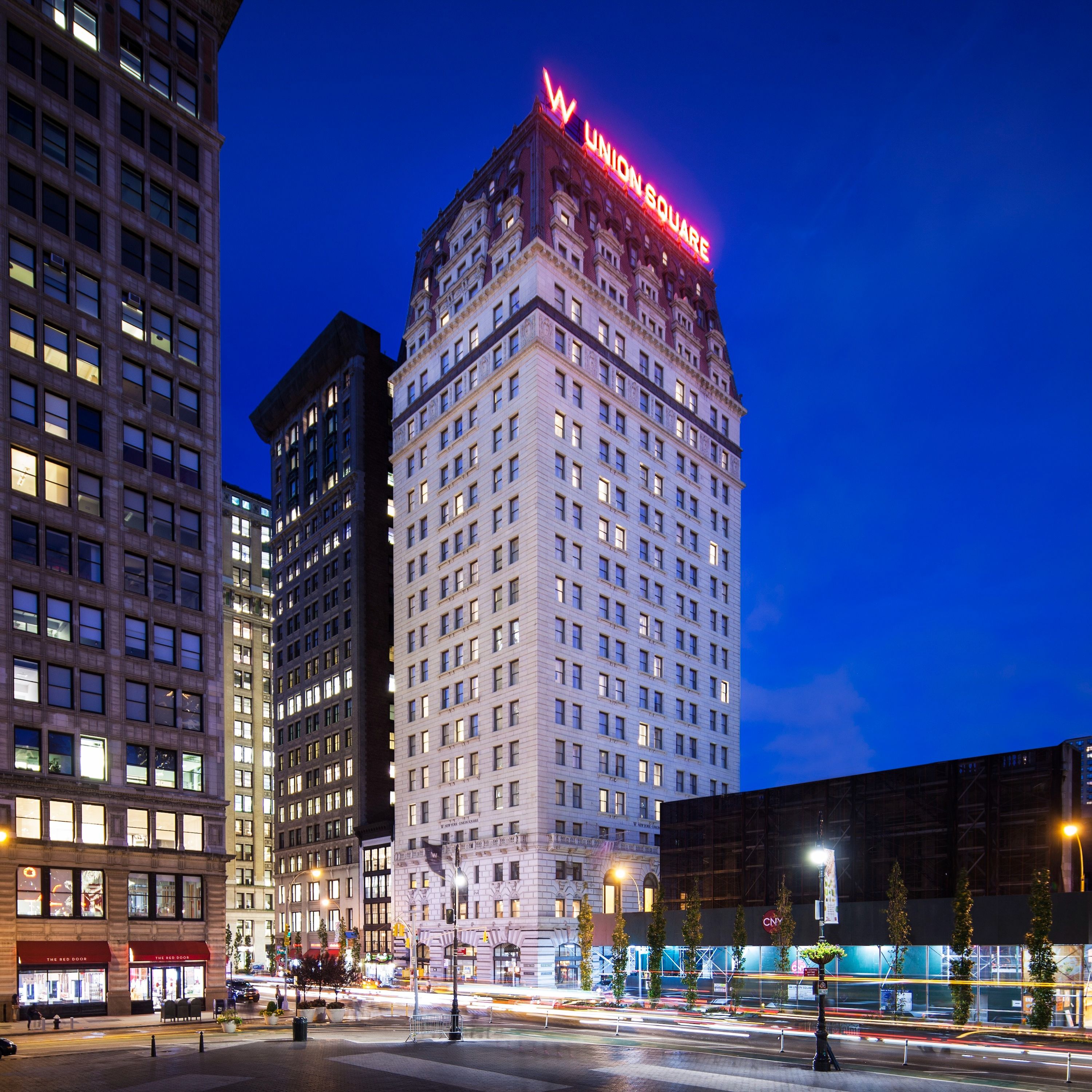
New York City: Discover the choreography of travel with David Rockwell, designer of W New York - Union Square
13m 19s
Union Square has transitioned from a historical site for celebrations and protests to a dynamic space hosting diverse activities daily. David Rockwell's redesign of W New York Union Square aimed to infuse the hotel with the energy and creativity of the park. The hotel lobby underwent a significant transformation to create a more fluid and engaging environment. The relationship between the hotel and Union Square evolved to integrate the park's vibrancy and local culture. Design elements such as the stairs and elevator were carefully considered to enhance guest experience and connectivity. The redesign emphasizes the interplay between indoor and outdoor spaces, aiming to create a seamless extension of Union Square's public atmosphere within the hotel.
Transcription
2229 Words, 12476 Characters
Originally, Union Square was a place for celebrations, for protests, and I feel like it has become
now so much more fluid.
It is a green market one day, it's a concert the next day, the diversity, the amazing tapestry
of New York.
The park has taken on the kind of electric energy of the city, and we've embraced that.
This is Travel By Design, where we chat with the visionaries behind the world's most extraordinary
hotels.
I'm your host, Hamish Kilburn, professional hotel reviewer, and the editor of Hotel Designs.
Today, our destination is Union Square Park, in the heart of Lower Manhattan, in New York
City.
In the late 19th century, Union Square hosted the first Labor Day Parade in the United States.
These days, Union Square Park is still a vibrant gathering place, brimming with commuters,
merchants, skateboarding teenagers, alfresco coffee meetings, and all the other moments
that fit into a New York minute.
For decades, Union Square has also been the professional backyard of renowned designer
David Rockwell.
I'm the founder of the Rockwell Group, and we're an architecture and design firm based
out of New York, Madrid, and Los Angeles.
In the late 1990s, David brought his love of theatre and deep understanding of public
spaces to the design of W. New York, Union Square.
More than 20 years later, he's completely redesigned this hotel, which inhabits a tall
pre-war building off the northeastern corner of the park.
But before we got into that, I asked David about another essential travel location he
designed, an entire terminal at John F. Kennedy Airport.
I wanted to know, what do an airport terminal and a hotel have in common?
I think from a design point of view, I'd been a fan of airports and a student of airports
for 10 or 15 years before we had a chance to design the first airport.
And in fact, any time I had an interview about what was my dream project, I would talk about
how airports seem to be these kinds of dehumanized experiences where there's just a lack of
welcome and intuition, locality, celebrating where you are, which of course is very much
what you want to do in a hotel.
And another thing that's similar is if you were to really x-ray an airport and say what
makes for a great experience, it's not so much what you see, but it's how it moves,
how you function, how you feel in it.
I really recognize that because sometimes when I get to a destination, I just feel out
of sync.
I feel like I need a bit of help to just get into the rhythm of the place.
Yeah, and I think that's very much true in a hotel room.
I think if you look at what most people's frustrations in a hotel room would be, it
has to do with what the architect and designer have done to accommodate feeling welcomed
and comfortable.
So graphic design, movement, all of that was tackled as a kind of choreography.
And I heard that you actually hired a professional choreographer.
Yeah.
It's just so wonderful in so many ways because I could just so imagine kind of dancing into
New York City.
It's so romantic.
Well, I first have to tell you the way I met this choreographer was designing my first
Broadway show, which was in 1999.
And we had done many shows together.
So what he provided was a chance to study movement patterns in Central Park, in Grand
Central, and think about what the dance of New York would be.
And there are things that, as designers, we all know, you tend to move towards a destination.
But there's all the kinds of tools of theater like transformation and seduction, where you
can have a corner that you don't quite see until you move around it.
So we brought in a lot of conversation for the client to understand what New Yorkers
understand, which is movement and chaos is just part of the city if you can organize
it.
So moving on, you've completed a total reinvention and renovation of W New York Union Square.
And this is the rare thing.
And I really want to emphasize this because you were asked back onto the projects that
you originally designed, I have to ask you, what's the difference between the life of
Union Square as you knew it then, in 2000, to the life of Union Square that we would
see today in 2023?
Well first of all, what an amazing, unprecedented privilege to be invited back to revisit a project
that I so loved.
We work on Union Square and have been here for 30 years.
And the original design was a total labor of love.
It was in some ways done at a time when I knew Union Square less.
At that time, Union Square was being used for a kind of beautiful green space.
It's the destination at the end of Broadway.
So it's a seminal place geographically in New York.
The building's a phenomenal landmark building built in 1911.
And fashion was focused in this neighborhood.
But in the period of time from 2000 to now, it has become a place that more replicates
what it was historically.
Originally Union Square was a place for celebrations, for protests.
And I feel like it has become now so much more fluid.
It is a green market one day, it's a concert the next day, it is constantly full of activity.
And as a park that is relatively symmetrical or axial, what's happened now is much more
free flowing circulation.
And I feel like the park has taken on the kind of electric energy of the city.
And I suppose that's a testament to a great public space that it can survive over so many
periods of time and survive in so many different kinds of spaces.
For instance, it's a great source of public art.
There's constantly people out there creating art.
And that is an interesting idea to think about how a hotel lives with that.
It is a place of a wide variety of activities throughout the day, the diversity, the amazing
tapestry of New York, and Union Square is in some ways one of New York's great living
rooms.
And when you think about the hotel and the way it relates to Union Square and the park,
what was that relationship in the past and what's the change that you've made to the
relationship of the location through design?
Yeah, I think in 2000, we saw it more as a kind of haven.
And I think that notion of hotel as retreat, kind of reflecting Union Square as a background,
has been flipped a little bit now.
And we're in some ways bringing the explosive energy of the park into the hotel with all
of the things that happen in the park that make it a kind of unique spot in New York.
People playing chess, a green market, performances, spaces that transform through local artists,
in many cases through projection, so it can happen on an ongoing basis, spaces that have
landscaping on a scale that are really architectural and will change based on the season that happens
in the park.
It's one of the great things about Union Square as you see a change from hour to hour, day
to day and season to season.
As well as like the energy changing or shifting, hospitality trends have changed as well.
Like there's a new restaurant on the ground floor which is open to the public and incorporates
ingredients from the Union Square green market.
You feel local artists, local craftsmen and the restaurant has a very prominent seafood
bar right on Union Square.
So I think it's going to feel like a total extension of the park.
We talked earlier about how public space is either channel or influence the pace of people
moving through them.
And I know that one of the big changes here is the hotel lobby.
So I want to describe this for the listeners, before you had this large welcome desk and
it was underneath a staircase that takes you up to the second floor.
And it was very clearly a hotel lobby, conventional if you like.
And there were a lot of right angles and it was just, you know, it was very clear where
the lobby desk was.
But now when you look at the lobby, all I can see when you walk in is that curvaceous
staircase and you have plants that are growing down from the banisters.
There's that colorful carpet that spills from the stairs to the lobby which really blurs
the boundaries between spaces.
It's less angular.
It's like a lack of right angles.
Everything's more fluid and it feels like the shoulders are relaxed in the hotel.
Well that's absolutely true because in fact it's a much more explosive use of color and
form.
And when we started the hotel, we knew we wanted that stair to be a central feature
dynamic element.
It really fills the lobby because it's in some ways meant to be a transportation place
that seduces you and connects the second floor with the ground floor.
So they're not separate experiences, very different from kind of the bones of the original
Union Square W where the lobby was confided downstairs.
Absolutely.
And I just want to let you know that you are responsible for changing my whole perception
on stairs.
You mentioned in a video once that stairs are an art form and it's so true actually when
you were describing, you know, stairs are completely different to every property and
they offer a different function and there's no reason why we can't take art from outside
of frame, put it into areas like the flooring and the stairs and it's an exceptional example
of exactly that, this hotel that we're talking about.
I also think stairs ascending has a certain emotional quality and in this case what it
did is it does appear wet to face the front door as the risers get wider.
So it really is like a kind of river that moves up with the carpet flowing down and
then the carpet and the banister and the flowers really feel like almost a gravitational
spill down to the ground to pull you up just a whoosh of energy from the park up that stair
into the lobby where the living room has now been reset.
And then that second floor is now given back to the public.
There's also a great elevator right next to it and one of the things, you know, more and
more you have to do is make sure these spaces are accessible to everyone.
So the elevator experience is actually part of the stair experience as well.
And you know, these are shared spaces like the living room, which also locals can utilize
and it's going to have its own programs and I just applaud you for thinking about the
in between spaces.
These spaces are areas that used to just kind of be dead corridors or extensions of corridors.
We do live in these interstitial spaces.
That's what an airport is.
That's what a lobby is.
And I think the rooms are more and more like a mini vacation.
And I think linking outside inside history and then a sense of exuberance, I think it
makes things possible.
It makes it possible to think of the second floor is an extension of the park, a public
space.
David, it's been such a true honor speaking to you.
You've accomplished so much as designers and architects and just hearing about the spaces
that you've designed from the terminals to a flight of stairs and a hotel, the amount
of thought that goes into these spaces.
It just reminds me that, you know, when this kind of work is done correctly, it's invisible
to everyone and travellers and it really is subconscious, yet incredibly impactful on
how we make our journeys and hopefully how we make genuine connections along the way not
only with these spaces, but with people around them as well.
So thank you so, so, so much for your time today.
It's been amazing.
It's totally my pleasure.
I really enjoyed the conversation.
Travel by Design is a podcast by Mariette Bonvoy Traveller, the online travel magazine where
you'll find more inspiring hotel design stories.
If you're curious about the craft of hotel design, then check out mariettebonvoy.com/travelbydesign.
And if you want to go behind the scenes of my travel experiences across the world, then
follow me on Instagram @hoteltraveleditor.
This episode was produced by Narratively Creative.
Our senior producer is James Boo.
Our associate producers are Nidhi Shastri and Greta Stromquist.
Interview recording by Rachel Yang.
Story edits by Priscilla Alabi.
Sound design by James Boo.
And audio engineering by Dorian Love.
Our Mariette Bonvoy Traveller producers are Valerie Connors and Robin Benefield.
Special thanks to David Rockwell for speaking with me about his work.
I'm your host, Hamish Kilburn.
Don't forget to subscribe to Travel by Design in your podcast app.
And tune in next time to hear more design stories behind the world's most extraordinary hotels.
Podcast Summary
Key Points:
Union Square has evolved into a versatile space for various activities.
David Rockwell redesigned W New York Union Square with a focus on energy from the park.
The hotel lobby was transformed to create a more fluid and engaging space.
The relationship between the hotel and Union Square has shifted to integrate the park's vibrancy.
The design elements, including stairs and elevator, aim to enhance guest experience and connectivity.
Summary:
Union Square has transitioned from a historical site for celebrations and protests to a dynamic space hosting diverse activities daily. David Rockwell's redesign of W New York Union Square aimed to infuse the hotel with the energy and creativity of the park. The hotel lobby underwent a significant transformation to create a more fluid and engaging environment.
The relationship between the hotel and Union Square evolved to integrate the park's vibrancy and local culture. Design elements such as the stairs and elevator were carefully considered to enhance guest experience and connectivity. The redesign emphasizes the interplay between indoor and outdoor spaces, aiming to create a seamless extension of Union Square's public atmosphere within the hotel.
FAQs
Union Square was originally known as a place for celebrations and protests.
David Rockwell is a renowned designer who has worked in Union Square for decades.
David Rockwell completely redesigned W New York, Union Square, bringing his love of theater and understanding of public spaces.
The hotel now incorporates the energy and activities of Union Square into its design, creating a seamless connection.
The hotel lobby now features a curvaceous staircase, plants, and a colorful carpet to create a more fluid and welcoming space.
David Rockwell highlighted the emotional quality and artistry of stairs, aiming to create a dynamic and engaging experience.
Chat with AI
Loading...
Pro features
Go deeper with this episode
Unlock creator-grade tools that turn any transcript into show notes and subtitle files.
 PodcastTranscript AI