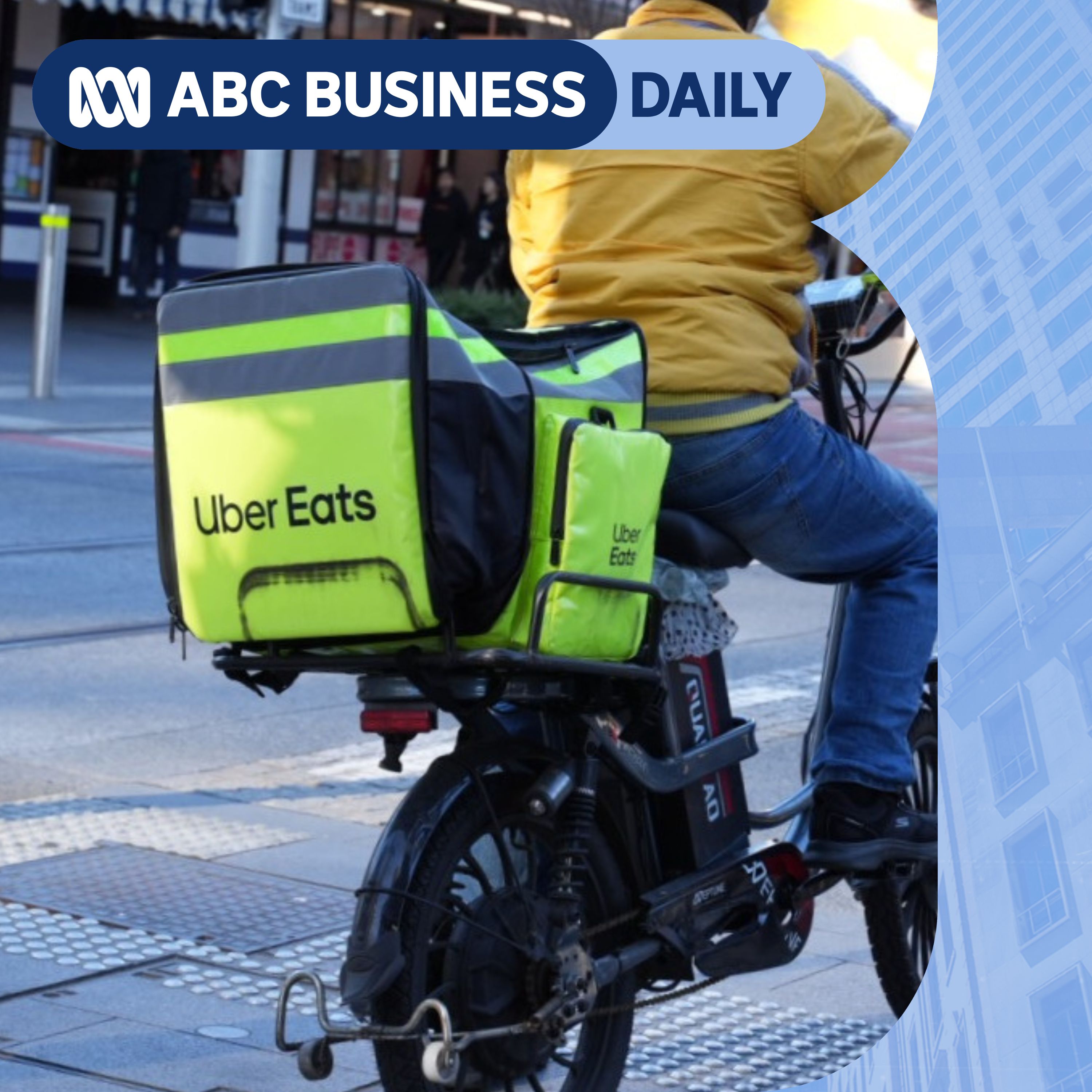
The podcast episode begins with a promotion for ABC Listen's coverage of the Alan Jones trial, where the broadcaster refutes all allegations. Hosts Carrington Clark and Michael Yonder then discuss Michael's European holiday, noting intense heatwaves that may shift tourism patterns northward, and the challenges of installing air conditioning in heritage buildings. Returning to Australia, they focus on new gig economy minimum standards effective that day. These reforms, stemming from the Albanese government's closing loopholes legislation, give Fair Work Commission power to regulate employee-like independent contractors. After negotiations, platforms and the TWU agreed on wage floors: $31.30 for pedal/e-bike riders, $31.50 for motorcyclists, and $32 for car drivers, rising by $0.50 in January. Importantly, pay covers only engaged time (from accepting a delivery to completion), not waiting periods. The deal also mandates baseline personal accident insurance, addressing risks for vulnerable workers, including overseas visitors. Potential consequences include pressure on restaurants to reduce rider wait times and possible efficiency cuts by platforms. The property segment highlights a preliminary auction clearance rate of 56.5%, the highest in 12 weeks but still below the 60% balance point, reflecting weakened demand due to high interest rates and tax changes, with banks reporting significant drops in loan applications.
ABC Listen, podcasts, radio, news, music and more. One of Australia's most recognisable broadcasters is facing the biggest battle of his life. Alan Jones has pleaded not guilty to multiple historical sexual assault charges and now the case is before the courts. I'm not going to dwell here on the allegations made about me. Other than to say that I refute them entirely. As witnesses step into the box in the evidence unfolds, the case of podcast will be your eyes and ears inside the courtroom. Search the case of podcast on ABC Listen or wherever you get your podcasts. Some of Australia's gig workers now have a new safety net in place with a wage floor and insurance protections which come into effect today. But how will this affect the hundreds of thousands of independent contractors across the country and what will it mean for delivery costs? And national preliminary auction clearance rates are the highest they've been in months. Does this mean the property market is starting to strengthen or is the picture more complicated? Welcome to ABC Business Daily. I'm Carrington Clark. And I'm ABC Business Editor Michael Yonder. Michael, so good to be sitting across from you. I've had a few weeks off. Very good to have you back. You're looking refreshed and tanned. Yes, thank you. Where have you been? I've done a little bit of gallivanting around. Most of the time spent in Europe. How was the heat wave? The heat wave was intense. I mean, I think my two takeouts, kind of a macro level, were that you have had a major shift in the way that weather is working in Europe. Obviously, we have to be careful whenever trying to ascribe changes to climate change. But the heat wave was enduring and intense across large parts of the continent this year. And talking to a lot of people, they were really starting to rethink whether or not, particularly if they're from Northern Europe, whether or not they needed to go towards the Mediterranean to Southern Europe in order to get that typical summer holiday. It was so, so hot in different parts of the continent that I visited, including Mallorca, where I was for the eclipse at the end. It was hellishly hot. And I think a lot of people now are looking at maybe Helsinki makes more sense than-- Pining for the fjords. Exactly. Yes. Helsinki makes more sense than Mallorca, perhaps, in summer. There were also anecdotal reports, and some reporting suggesting that perhaps tourism operators in Southeast Asia were struggling, those that were usually dependent on European and American visitors. So now that the UK and Northern Europe actually has a summer, they don't feel the need to travel somewhere else. Well, I think that might be part of it, but I do actually think the fuel crisis is impacted that and the ability to travel through the Middle East. I think a lot of people changed their plans. Earlier in the year, kind of at the height of the Middle East war. And it'll be interesting to see whether or not that does return. Apparently, there has been a lot of other Asian countries have continued to travel to some of those places. But if you were, for example, German translator working in Southeast Asia, perhaps you were struggling this year because those same visitor numbers weren't coming across. But I think if you wanted to-- I think there's a pretty sensible business punt on if you were involved in manufacturing or installing air conditioning in Europe because a lot of these big cities-- Could be an export opportunity for Australia given our expertise in calling things down, which is something they're really not very good at. I noticed when I've traveled in the UK or Germany, they're not designed for hot weather. But it's interesting to hear you can take the reporter out of the studio, but you can't take the economist out of the reporter even when he's on holiday. Well, it is interesting watching kind of the other side of this argument. Obviously, there is a continued debate here in Australia about renewable energy. And we have had large-scale installation of heat pumps, reverse cycle, air conditions. That's going on, continuing to go on in Australia. One of the great things about many European cities is they have these very old buildings. They're obviously under heritage protection. The difficulty is if you're trying to fit air conditioning units, modern technology into those type of apartments or houses, that's very difficult to do while keeping it sympathetic to the way that the building looked, the way that the street looked. So I think it is something that people are really struggling with. For a long time, I remember European friends criticizing Americans for being too gung-ho when it came to air conditioning and also being too gung-ho when it comes to icing up their water. But there seems to have been a noticeable shift in the last few years. And I think that they don't have the same access to copious amounts of sun normally. This year might be an exception. But obviously, their winters are a different proposition. But as charming as many of these cities are, they are horrible to deal with once the heat hits the late 30s early 40s. Just as Sydney and Winter is intolerable in those old federation houses. I can imagine summer in Europe is pretty intolerable in those old, you know, 200-year-old apartment blocks. Yeah, I think that's exactly right. So let's see. I mean, I came back to how to, you know, look, I managed to mostly ignore news while I was overseas. Some stuff seeped through, obviously. But we're still in a situation where oils hovering around 90 US dollars are barrel. I mean, it's still much higher than it was before the beginning of the war, but not as bad as it was at its peak. But also no end in sight. Obviously, that broader question about changes to the way energy is made and the way we use it remain. And the climate continues to change at the rate that it has been. I think that these are big fundamental questions for many parts of the world, including Europe. But let's talk about another change that has come into effect here in Australia. Right. Today, in fact, and that is the first minimum standards for so-called gig economy workers. Now, this is relating to the workers involved in the delivery of groceries and food. So people might think of platforms like Uber Eats, for example. And this is something I've been following as a business journalist for a long time. I think I did my first story near 10 years ago when we had deliver a ru, which actually then went, went, could put here in Australia. And the question about whether or not these type of platforms were effectively exploiting workers because there were no minimum standards. Now, one of the things that struck me when I was speaking to some of the workers at that point, a lot of whom were here on working holiday visas or backpackers and common parlance, was they said, well, yeah, maybe sometimes we don't get paid as much as we think we should be getting paid. But a lot of their peers were being exploited in different ways in the kitchen. Yeah, they've hired under the table or in hospitality jobs and not earning the minimum wage that they were legally entitled to. Exactly. And they obviously have less bargaining power if you're only here for a short period or if your English skills are under strong, but anyway, putting that to a side, the government decided that there was need for change in the way that the negotiation between these gig workers and the platforms, these big tech companies worked and that there should be a kind of minimum standard. So what has been the outcome? And what will it mean for those workers involved? Yeah. So as you mentioned, Carrington, this relates to the closing, the loophole reforms that the Albanese government passed a couple of years ago, which gave the Fair Work Commission power to regulate gig economy workers when they're in an employment-like relationship. So not genuine small business people, totally with control of who they dealt with. And, you know, but when you're an independent contractor that basically works for the same digital platform or the same couple of digital platforms, you don't have any say over the contract under which you work, you don't get any negotiating power, you just take it or leave it. Their employee-like workers. So over the past couple of years, the transport workers union and the delivery platforms like Uber Eats and DoorDash, particularly, have been in negotiations. Initially, there'd been resistance from those platforms, but I think they saw which way the wind was blowing and decided it was better to negotiate a deal with the union rather than have Fair Work come in and just impose a decision. Obviously, the initial concern was that this would either make the business model for delivery unviable or push up delivery costs and maybe push back on some of the restaurants that use these services. But the net result is the platforms and the TWU have come up with an agreement that they think will work for both of them. And so the agreement is about how much, what the minimum wage that these workers will be receiving. But there are a few details that are really crucial aren't there. One is that the hourly rate has to do with when they're engaged is the term. Yes, and not when they're waiting for a job. Exactly. You can't be sitting in your car waiting for the next ping on your app. And that will, I mean, you will be waiting, but you won't be paid for that weight or when you see the delivery riders camped outside, you know, eatery strips, you know, having a chat, they're not being paid for that. They're only being paid while they're engaged. So the interaction between these workers and the platform usually is they log on into their app and then they wait to be basically offered a job, allowing them to take the, let's using just the restaurant delivery to take a meal to the person who's purchased it. As you say, it won't be just that you've turned on the app. It's that you've agreed to do a delivery and from that time, you're engaged until it is delivered. And what the platforms will need to do is to look at how those individual workers
have been employed, how many hours have effectively worked for that platform over, I think it's a three week kind of rolling period. And to make sure that during the time that they've been engaged, that at minimum, they are receiving this wage and the wage is slightly different depending on the type of transport, which I think is interesting that they're using. So from $31.30 an hour, if you're on pure pedal power or assisted with an e-bike, motorcycles get $31.50, I guess, to help compensate the fuel costs a little bit and cars $32 an hour. And that's all going to go up by $0.50 an hour as of January 1. So there's already one wage hike built in and part of this agreement is that this arrangement will be subject to the Fair Work Commission's regular wage reviews, such as the annual award and minimum pay wage review. So presumably, we'll go up by the same percentage as award wages. So interesting to note, this is above the national minimum wage or $26.44. It does remind me of kind of the situation in America where if you're working and say hospitality, there is a minimum wage, but if you're getting tips, sometimes that can be taken into account in the minimum wage. So if someone is earning more than this floor, then it won't really matter. The floor price is there to ensure that they're not earning less than that per hour that they're engaged, but hopefully most workers are going to be earning more than that because they're doing enough deliveries at a higher price, a higher wage, so that this won't actually come into account. I think there's two key things in there. So one, while this is higher than the full-time minimum wage, this is actually lower as some people have pointed out than the casual minimum wage of about $33.5 an hour, which of course includes the loading that you get for not having leaf provisions. And of course, these gig workers still don't get paid leaf provisions if they get sick, they don't get paid. The other thing that I guess this is hope to achieve is we've all had the experience of whether as a driver seeing a Uber Eats or Door Dash Rider or one of the many other brands cut across you and you're like, "Oh my God, I could have killed you." Or as a pedestrian having one of them flash past and nearly take you or your two-year-old child out. Understandably, they're in a real rush to get as many deliveries done as possible. And while some of that pressure remains because of course you earn more if you do deliver more. At least having a minimum means that I guess there's a hope and particularly from the TWU that it will minimise some of the most dangerous behaviour from people who are just trying to earn enough money to get by. And the TWU says about 25 delivery drivers and riders have been killed basically since this type of gig work came into existence through accidents. And if it does help save a few lives by taking some of the time pressure off, no doubt that that's one of the aims and positive outcomes that could come from this. And one of the other key changes is when it comes to insurance. So the responsibility still lies with the individual to ensure their vehicle, whether or not there be an e-buyer, a motorcycle or a car or whatever they're using to transport the goods. But there now will be a minimum level of personal accident cover. How big a change do you think that is? That's obviously huge for workers because it guarantees like with any of us who turn up at our jobs that if you get injured while you're on the clock, you'll get some payout and someone helping pay for your care. And it's particularly important if you're an overseas worker who's not a permanent resident and not covered by Medicare. And if you don't have adequate you know, travel or health insurance while you're in Australia and you get injured badly in an accident and you're not covered by Medicare, having a base level of personal injury protection is is pretty key to avoid people basically being bankrupted through through workplace injuries. Now as you pointed out Michael in the early days when these changes were first suggested, there was pretty major pushback from these platforms that intervention could lead to price escalation. That means that basically this service would not be offered and that would be a lose-leave situation. People wouldn't be able to get the work and then continue to have already seen a couple of the big operators out of the system like delivery route out of Australia because they couldn't make enough money. I guess the question now becomes do you think this is a sustainable situation? Will actually workers see much of a difference by having this floor in place? And will it lead to higher costs for consumers? And that will mean less people using the service? Or conversely might some people who might have been uncomfortable using these services because they will concern that it was relying on the exploitation of these delivery riders or drivers. That maybe they will now use it because they know that at a minimum these workers are entitled to this kind of baseline pay. Yeah, well we'll have to see what the flow on effects are. Obviously there is a price point at which people will become unwilling to pay for the convenience of having the food show up to their door and it may affect different areas differently because obviously as you say the minimum may not apply when you're doing dozens of very close deliveries in a place like say central Sydney or central Melbourne where there's a lot of restaurants close to the people who are purchasing but if you're in a more suburban area and it takes longer to get each delivery out to the customer the other thing that just strikes me as an area where this could have an unintended consequences already a lot of restaurants have very low margins from these delivery arrangements. They do it just because it helps get enough volume through the door and they feel like they have to have to convert somebody who buys who will delivery up into a regular customer. But because the clock starts as soon as the order is given to the rider and it includes their wait time at any restaurant so I can imagine that there is going to be increasing pressure from the delivery platforms on restaurants not to keep riders and drivers waiting for very long. So they're you know if you look at it from their point of view they are paying that rider for every minute that they're sitting at the restaurant waiting to get the order so I can see the potential where this might blow back on hospitality venues and pushing them to minimize those times and potentially starting to write increasing penalties in if they are keeping riders waiting for their food. And these tech platforms are very clever and they what they will argue is that what they are always trying to do is align the the aims of their business with the aims of those individuals that are being hired through or you're being utilized by the app right so they want delivery workers to be incentivized to deliver quickly so that the food is hot when it's in the case of Russian rulers is hot when it's delivered to customers and so therefore the incentive is to do that quickly get the maximum amount of reward and that's a win-win. As you said sometimes there are unforeseen consequences if the need for speed leads to dangerous behavior. In this case it will again be trying to incentivize the restaurant to get the delivery worker back on the road as quickly as possible that might be a good news for again for the customer because the food is fresher but does that put too much pressure on the restaurant and lead to cutting corners for example or some others type of unforeseen consequence. Let's see how this plays out. Door dash has said that they believe that the current rates are sustainable and so they're suggesting there won't be any increase in prices let's see how that plays out. But they're looking for efficiencies elsewhere in the business to cover the costs so again that comes to will this blowback on the restaurant side of things. Let's check in on what's going on in the property market. On one hand one of your favorite topics. One of my favorite topics and it is such an important political debate at the moment it also impacts so many parts of the economy and also impacts and directly the what's going to happen with interest rates which are also being made just by national Australia banks trading update last of the big banks to come out with the latest and again a 15% fall in loan applications echoing what we heard from CDA with their annual results and what we similar to what we've heard from A&Z and WestPAC some a bit more some a bit less but broadly we are seeing the impact of high interest rates and tax changes on on property. Yeah and a complete I think change in sentiment people no longer see property as a one way bet to building wealth and I think a lot of people are apprehensive about that the current perhaps their current investments in property but also about potentially trying to to catch a falling knife so you've got first home buyers perhaps waiting to see how much lower prices can go and that in turn leads to even less demand and you know that's when you potentially get into to troubled water so the latest data from a cartality on one hand it's the highest in 12 weeks for the combined capital this is the preliminary auction clearance rate we'll get the settled numbers later in the week sitting at 56.5% so stronger than it has been in the still below that 60% level that's sort of a balanced mark. Yeah this is the rule of thumb they tend to say anything below 60% so do
just that property prices are falling above price arising and so particularly scientific, but the historic number over the last decade, 68% clearance rate is the average. So this is still well below that and it will come even lower once we get the settled numbers. Interestingly, the reason it was up more than has been over recent weeks was because of the smaller markets. It got ad laid up 15.1%, Brisbane up 13.8, ACT up 14.1%. I will say the smaller markets sometimes can give you a misleading idea of what's going on. Most of the houses, apartments in those markets don't go to auction. So people who do it tend to be more confident about what the result is going to be. It's often higher end properties in those markets, whereas auctions are more common across the board in Sydney and Melbourne. Exactly. Sydney and Melbourne were both down, down 1.4% for Sydney, Melbourne down 3.4%. But still in the mid 50s, though, which is better than where they have been particularly for Sydney, which had spent quite a few weeks below 50%, certainly for the final clearance rate, but hovering just below or around 50% even on that preliminary rate. And we are entering this really interesting period, which is the spring market. So during winter, things usually die down a little bit. I mean, we have seen a complete collapse in how many properties are actually going to auction at the moment, down 30%, I think it was something over the past year. But we are going to, we think, see, perhaps a flood of properties coming in to the market in spring. Let's see how it actually feels. That will be the test. Because when you talk to property analysts, whether it's Nicola Powell from Domain or any of the other, you know, Cotality, the analysts there, Jared Berg, Tim Lawless, what you hear consistently is, let's wait and see what happens in spring, one of the corrective factors in Australian property that tends to bring property downturns to an end is when people stop listing their homes for sale. There's always going to be some people who have to sell because deceased estates, marriage breakdowns, changing location for work, financial reasons, lost job, etc. But there's an awful lot of properties that hit the market that don't have to. They hit the market because people want to upgrade or downsize or just change where they're living, but they're not in a particular rush. They're willing to put that off if they don't think the time's right. And even more so with investment properties, which of course are grandfathered from the changes to negative gearing if people already own them before the budget was announced on May 12 at 7.30pm. And so if people are holding on to those investment properties and they think that the mark, you know, like Sydney prices are now down more than 5% from the peak. If they think those prices are going to get back up to that peak level in the next year or two, perhaps because the reserve bank might start cutting interest rates next year or something like that, they may well hold on and decide that's the time I'd rather sell. Let's talk through some of those numbers because I think it is interesting. So yes, the people are suggesting Sydney's down around 5%, individual properties, or they may be well down, down even more than that. And it depends which end of the market there on. The totality had some really good figures out last week. The 75th percentile, so the top quarter of the market in Sydney down more than 5%, 5.2. The bottom quarter, the cheapest quarter of the market down only 1.4%. And it's a pattern reflected across most of the capital cities, that expensive end down more. That's the impact of interest rates in particular. The cheaper end where first home buyers are looking, not as bad. So even with Sydney down 5%, it would take a 20% downturn just to get us back to May 2021. And that's because we saw this kind of post pandemic massive increase in the price of homes in Sydney. In many ways, if we see a downturn now from the perspective of housing affordability, it's just repairing the immense damage that the previous government's home builder stimulus program combined with the reserve banks near 0% cash rate and their pumping money out to the banks through the term funding facility where they could afford to do four or five year fixed mortgages around the 2% or below interest rate. All that damage takes some serious unwinding. Now the difficulty though is yes, that means for most people who bought before that date, you're still well and you're still in positive equity. The difficulty for people who might have bought in the last couple of years, for example, is they would be looking at this and starting to get very concerned that they could go into negative equity where the amount they owe is more than what the property is worth. And especially if they are first home buyers who took advantage of the 5% deposit scheme. So they have very little equity in the property to start with. So the question becomes where to from here. Now we had the reserve bank decide to keep interest rates on hold. They were definitely talking up their ability to hike interest rates even further if necessary in order to try to bring down inflationary pressures. Now part of that is what we call jaw boning, which is that the reserve bank wants people to believe that interest rates are going to stay higher for longer because if they think that they're going to fall anytime soon, then perhaps they will start spending more and that makes the fighting against inflation harder. But I think it also sounds pretty genuine. I think and they have shown a willingness this year, obviously to to hike interest rates in order to deal with that inflationary pressure. The market, I think, is currently pricing more than a 50% chance that we will see another hike this year. Now the next meeting is in September. The meeting after that is November. November looking probably more likely than September. But if we get another hike in interest rates, that's going to all other things being equal. We'll mean that further downward price pressure on property. Lots of people like having a stab at property price forecast. So so ANZ was one of the most recent to come out saying Sydney could fall as much as 15% from the peak. And nationally we might see something close to a 10% fall, which would be one of the worst. Well, if that's true, that would be the worst fall in or the biggest fall in recent history in Australian residential property prices. But it is a bit of a mug's game because it is so dependent. I think those kind of forecasts are entirely reasonable if we do see another rate hike because that will knock the stuffing out of the spring market, especially if it came in September, but even in November. If however, we get to November, the inflation picture looks reasonably benign partly because of this housing slowdown. If things look okay and we get to next year and we're starting to talk about rate cuts again instead of further rate spikes, then I think you could see the property downturn stabilized. And historically that's kind of what's happened and particularly once sellers have pulled out of the market and they still demand there. And migration is going to be another factor. Yeah, this is another thing that has kind of changed in the last few weeks, I would say. Obviously we saw the rise in popularity of one nation according to the polls and they have for a long time being promising very steep cuts to immigration levels. Now we're hearing from the coalition is looking at perhaps in a much lower number than Labor's number of what they want net overseas migration to be. And the polling does suggest that the population does not support the current migration policy. They don't think Labor is handling in the way that they want. What that looks like is difficult for Labor, the division between the left and right on these some of these potentially inflammatory issues, but it seems pretty clear that the migration numbers for all the parties that potentially conform government are going to be lower. And that again would lead to lower demand for housing and that all other things being equal would lead to lower price growth or potentially further fight particularly when we've had all these reforms at state and pushed by the federal government to try and increase housing supply. Some of which seem to be bearing fruit because we have seen an above average level of housing approvals over the past year or so. So if supply ramps up demand falls both because of financial reasons, tax reasons and sheer population reasons. You've got a recipe for that sort of 10 to 15 percent decline that some economists are now forecasting. While I've still got you, I want to put you a question we had from listener James. And again, it's about one of the factors that might be leading to lower demand for property. So he says have economists been able to measure the effect of the new Oz track requirement relating to proof of source of funds on the declining house prices. I feel this newly established requirement is often overlooked in discussions relating to the current house price. So this was a change that came into the start of this financial year, right, which says that now real estate agents and a host of other professionals need to get across the rules governing money laundering and to make sure they have a better understanding of the source of the money used to invest in property. It's not just property. There's a whole bunch of different assets dealers and general dealers and other people who'd been on the edges of anti-money laundering. But it is important in property, which has been, you know, the regulators will tell you one of the biggest sinks for illicit funds in Australia because it hasn't been covered by this kind of reporting. I think though in your comment there, Carrington, you've just given James's answer. It only came in on July 1. So I think it's too early for it to have had an impact on the current property price downturn. However, it would be worth watching as a potential factor that may extend this down.
turn. And again, if you were looking at segments of the market, you'd say it might affect both the top end for those trophy homes that may be purchased with questionable money from perhaps overseas sources or illicit sources within Australia, but also potentially at the bottom end of the market where people are buying investment properties using questionable money. And in the past, there haven't been questions asked. Now, real estate agents, their confidences, accountants, you know, everyone involved in the transaction if they don't know where the money's coming from, they have to ask the question. Yeah, and I think we should be keeping an eye on this. I think James is right to raise it as a question. And yes, although it only came in on 1st of July, as we kind of saw with the tax changes, sometimes even the suggestion of the changes makes up front of mind to people. So perhaps if you were a criminal or you had illicit funds, even before 1st of July, maybe you think maybe you would have gotten before. You certainly didn't see a pre-July 1 bounce in property prices. And I mean, look, again, this is, we're probably talking even on Oztrax estimates, maybe there's a couple of billion dollars a year of illicit funds being lauded through property. But even if it was 5 or 10 billion, in the scheme of a 12 plus trillion dollar valued property market, it's with, I think it's a the annual turnover something like 600 billion or twice two. It's a drop in the ocean. Yeah, interesting. But we will keep an eye on it, James. That is it for today's episode of ABC Business Daily. We'll be back with another episode tomorrow. Make sure you're following us on ABC. Listen or wherever you get your podcasts. And remember, if you'd like to send in a question, just like James did, you can email ABC Business Daily at abc.net.au. Catch you next time, Michael. Nice to have you back, Carrington.
Podcast Summary
Key Points:
Alan Jones has pleaded not guilty to multiple historical sexual assault charges, with the case now before the courts.
New minimum standards for gig economy workers in Australia took effect, covering food and grocery delivery platforms like Uber Eats and DoorDash.
The wage floor ranges from $31.30 to $32 per hour depending on transport mode (pedal, motorcycle, car), above the national minimum wage but below casual minimum rates, with no paid leave.
The agreement includes minimum personal accident insurance for workers, crucial for overseas workers without Medicare coverage.
Platforms and the Transport Workers Union negotiated the deal to avoid Fair Work Commission imposition, with DoorDash claiming rates are sustainable without price increases.
National preliminary auction clearance rates hit a 12-week high of 56.5%, still below the 60% balanced market threshold, amid falling loan applications and shifting property sentiment.
Summary:
The podcast episode begins with a promotion for ABC Listen's coverage of the Alan Jones trial, where the broadcaster refutes all allegations. Hosts Carrington Clark and Michael Yonder then discuss Michael's European holiday, noting intense heatwaves that may shift tourism patterns northward, and the challenges of installing air conditioning in heritage buildings. Returning to Australia, they focus on new gig economy minimum standards effective that day.
These reforms, stemming from the Albanese government's closing loopholes legislation, give Fair Work Commission power to regulate employee-like independent contractors. 50 in January. Importantly, pay covers only engaged time (from accepting a delivery to completion), not waiting periods.
The deal also mandates baseline personal accident insurance, addressing risks for vulnerable workers, including overseas visitors. Potential consequences include pressure on restaurants to reduce rider wait times and possible efficiency cuts by platforms. 5%, the highest in 12 weeks but still below the 60% balance point, reflecting weakened demand due to high interest rates and tax changes, with banks reporting significant drops in loan applications.
FAQs
New minimum standards set a wage floor and insurance protections for gig workers, particularly in food and grocery delivery, effective from the date mentioned. The wage rates vary by transport mode, such as $31.30 for pedal power, $31.50 for motorcycles, and $32 for cars, with a $0.50 increase planned for January 1.
Gig workers are paid only when they are 'engaged' in a delivery, not while waiting for jobs. The platforms must ensure workers receive at least the minimum wage during engaged hours over a rolling three-week period.
Gig workers now have a minimum level of personal accident cover, which is crucial for those not covered by Medicare, such as overseas workers. This helps prevent financial ruin from workplace injuries.
DoorDash has stated that current rates are sustainable and there won't be price increases, but they may seek efficiencies elsewhere, potentially affecting restaurants. The impact on costs remains to be seen.
Preliminary auction clearance rates have risen to 56.5%, the highest in 12 weeks, but remain below the 60% balanced mark. There's a sentiment shift as property is no longer seen as a one-way bet, with falling prices and reduced demand.
National Australia Bank reported a 15% fall in loan applications, echoing trends from other major banks like CBA, ANZ, and Westpac. This reflects the impact of high interest rates and tax changes on property.
Chat with AI
Loading...
Pro features
Go deeper with this episode
Unlock creator-grade tools that turn any transcript into show notes and subtitle files.
 PodcastTranscript AI