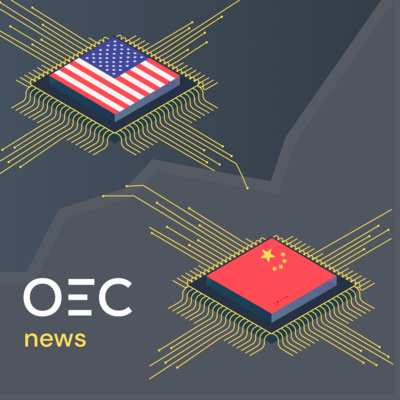
New export controls aim to limit China’s development of high-end chips with AI applications
2m 50s
The United States and China are at the forefront of a fierce competition over integrated circuits, vital components powering modern technologies. While China strives to become a dominant player in the chip market, American firms and allied nations hold key positions in designing and producing sophisticated chips. Recent US actions, such as restricting exports of critical manufacturing equipment and pressuring companies like ASLM to limit technology sales to China, have escalated tensions. Despite these trade bans, China is expected to catch up in advanced chip technology eventually. The battle for supremacy in chip manufacturing is multi-faceted, involving strategic moves and countermeasures. The US-China rivalry in the chip sector is likely to persist, shaping the global tech industry landscape.
Transcription
406 Words, 2628 Characters
(upbeat music)
- Hi, welcome to OEC News,
the best place to understand
the latest international trade data.
The United States and China are locked in a battle
over integrated circuits,
the tiny chips that power everything
from smartphones to military hardware.
The fight for smaller and faster chips
has significant implications
for the global technology industry
and is only getting started.
The United States and China are the world's
largest markets for the most advanced chips.
South Korea, the Netherlands, and Japan
are also significant players,
as well as Taiwan,
which has been the leading manufacturer.
China is working hard to become the dominant player,
but American firms still design
some of the most sophisticated chips,
such as Apple's M1 Ultra chip,
and US allied nations supply essential equipment,
resources, and manufacturing skills to mass produce them.
So China is lagging.
The battle for advanced chips
is being fought on multiple fronts.
The US government is trying to block Chinese entities
from buying advanced computer technology,
and there is concern that China is using US technology
to bolster its military and gain an edge in the race
to develop artificial intelligence.
Recently, the United States government
banned exports to China of American-made
manufacturing equipment needed to produce advanced chips.
This also includes American factories,
Americans, and US green card holders,
who work in foreign factories overseas,
manufacturing the chips.
Dutch company ASLM,
the only organization with a technology
to make the machines using extreme ultraviolet lithography
to mass produce the highly complex foundation layers
of the most advanced microchips in the world,
has also been pressured to restrict sales
of their unique technology to China.
Other Western corporations are expected
to cease shipments in the early aftermath
of new US restrictions
and will resume trade to some extent
once the regulations have been deciphered.
The recent ban is among the most stringent
that the US has imposed,
but China's chip makers will look to find ways
around the new restrictions,
despite the US tightening the screws
and making it more difficult.
China will likely catch up
in advanced chip making technology,
so trade bans are only buying time.
In the meantime, the US and China
will remain locked in a battle over chips.
Remember to visit OEC.world,
the best place to visualize, understand,
and interact with the latest trade data,
and follow @OECToday on Twitter, Instagram, and LinkedIn.
I'm Joanna Williams.
Thanks for tuning in.
Podcast Summary
Key Points:
The United States and China are engaged in a battle over integrated circuits, crucial for various technologies.
China aims to dominate the chip market, but the US and allied nations play significant roles.
Recent US restrictions and bans on exporting advanced chip technology to China have intensified the competition.
Summary:
The United States and China are at the forefront of a fierce competition over integrated circuits, vital components powering modern technologies. While China strives to become a dominant player in the chip market, American firms and allied nations hold key positions in designing and producing sophisticated chips. Recent US actions, such as restricting exports of critical manufacturing equipment and pressuring companies like ASLM to limit technology sales to China, have escalated tensions.
Despite these trade bans, China is expected to catch up in advanced chip technology eventually. The battle for supremacy in chip manufacturing is multi-faceted, involving strategic moves and countermeasures. The US-China rivalry in the chip sector is likely to persist, shaping the global tech industry landscape.
FAQs
Integrated circuits are tiny chips that power devices like smartphones and military hardware. They are crucial for various technology applications.
The United States, China, South Korea, the Netherlands, Japan, and Taiwan play significant roles in the chip industry.
The US has imposed bans on exports of manufacturing equipment and restricted sales of advanced chip-making technology to China.
China is working hard to catch up in chip-making technology despite facing trade bans and restrictions from the US.
The battle has significant implications for the global technology industry and could affect the development of artificial intelligence.
Chat with AI
Loading...
Pro features
Go deeper with this episode
Unlock creator-grade tools that turn any transcript into show notes and subtitle files.
 PodcastTranscript AI