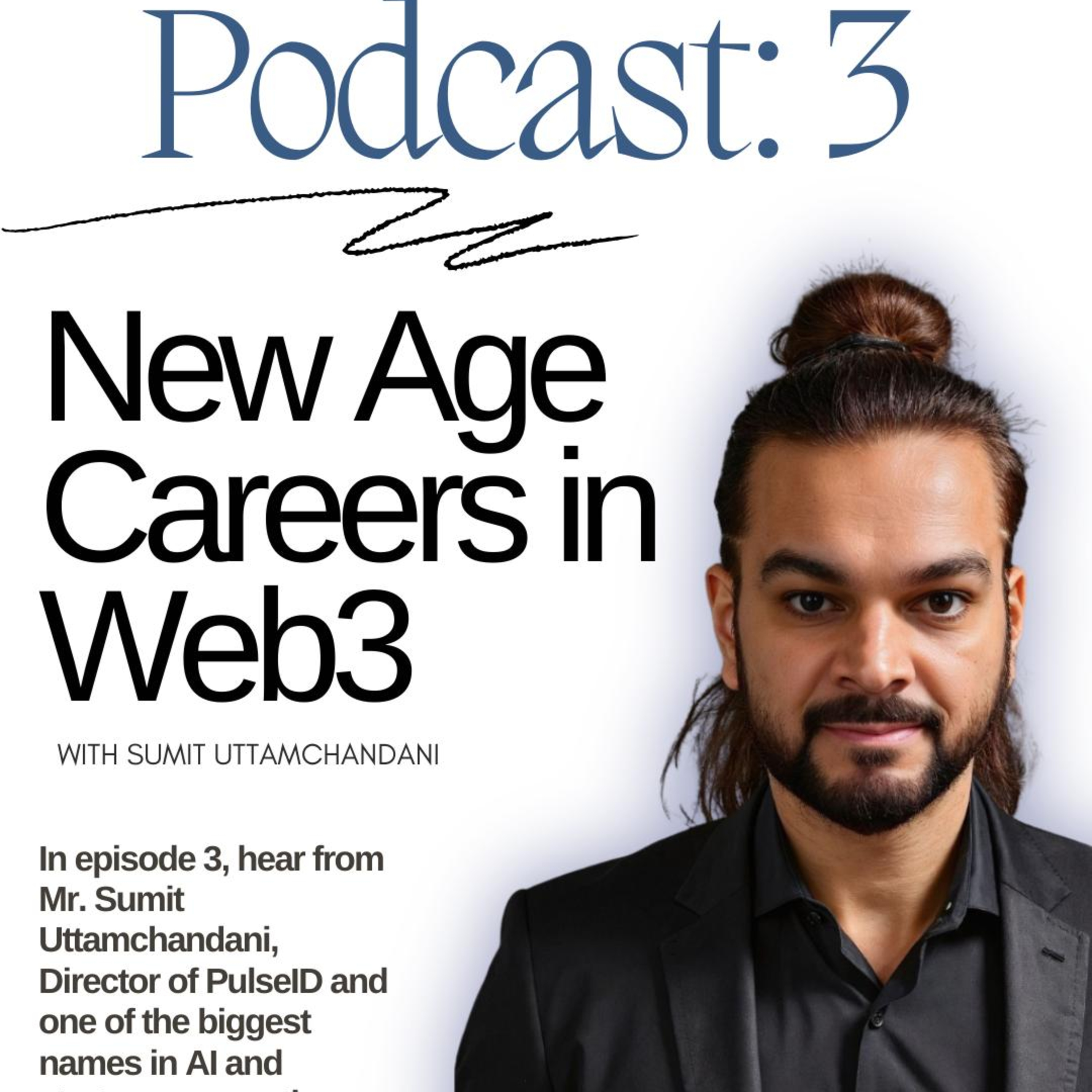
New Age Careers, AI & Web3 with Sumit Uttamchandani - Director, Pulse iD UAE
24m 10s
In the podcast episode, Simran, the co-founder of Curiosity Everyone, introduces the platform as an intelligence portal for the new generation keen on exploring new opportunities without fear of experimentation. The conversation delves into the transformative impact of AI across industries, highlighting the need for individuals to adapt to the changing job market by leveraging emerging technologies. The discussion with Sumit Atamchandani, a leader in AI, strategy, and gamification, emphasizes the importance of understanding and utilizing AI tools to enhance personal and professional growth.
Furthermore, the dialogue touches on the significance of seeking mentorship throughout one's career, underscoring the value of guidance in navigating the evolving landscape of technology. Sumit shares insights on gamification, digital customer experience, and the integration of AI in various sectors. The conversation encourages individuals, regardless of technical background, to embrace AI, leverage emerging technologies, and explore opportunities for personal development and career advancement.
Transcription
3651 Words, 20164 Characters
Welcome to the Direction mindset by Curiosity Everyone. My name is Simran, and I'm the co-founder of Curiosity. A new age, Curiosity's intelligence portal built specially for a new generation that wants to try out new things and is not afraid to experiment. In this podcast, we bring to you all the latest takes on jobs, aligning your passion to a career of your choice, understanding your core strengths, and building something meaningful across your work life. This week's episode is a really special one. I say this because it gets deeper into the reason we started Curiosity. In the past two years, AI has really changed the game. Even for people who were not tech enthusiasts or like myself, digitally, very, very handicapped. Today, almost everyone is wired on to chat a GPT on a daily basis. To get to this point in less than two years means something's exploded in a big way. And we're witnessing a new disruptive age, the age of AI. From finance, to property, to the military, to education, to supermarket chains, almost every industry today uses agentic workflows powered by AI in some capacity. And there's big chances that you've heard pivot to tech, or you're not going to have a job. Is this actually true? Will everybody need to learn how to code to stay relevant in a changing job market? We've got one of the industry's biggest names and a true thought leader in the field of emerging tech and gamification to answer this for you. So please welcome Mr. Sumit Atamchandani, Director at Palsidee. And one of the market leaders in AI, strategy, and gamification across the Middle East. In this episode, we'll get him to tell us a little bit more about emerging tech, and how somebody with no background in technology can leverage all the windows of opportunity that AI has opened up today. So hello, Sumit. Thank you for being on this podcast. Can you please tell us in the most basic terms about this age of AI? What is all this hype about? Hi, Simran, and all the listeners. Firstly, thank you for having me on your podcast. So my name is Sumit. I'm one raised in Dubai, a short quick introduction been in banking and finance for 25 years. Very passionate about everything, emerging technologies from Web 3, AI, Egyptic workflows, and beyond. I think from where I would want to start is maybe talk about what AI is, for I'm sure more or less every listener knows what AI is, but it's not the magic, right? It's just algorithms, processing data, and making decisions faster than humans. That's basically a starting point of what AI is. So emerging tech is basically next gen Web 3.0 AI, and all the related technologies. Just generally clubbed as emerging technologies, emerging tech. It's consists of supercomputers, what's happening today in terms of computing capability, what's happening across Web 3, which includes blockchain, crypto, and of course, the big giant artificial intelligence AI, which now has moved into AI, agentic workflows, AI with human in the loop, and it just keeps developing and expanding from there. So this bubble of new technology is what we want to talk about today. Thank you, that's a brilliant introduction, which makes everything very simple to grasp. Today, when I'm speaking to someone who's probably writing their board exams in grade 12, or doesn't know what course to pick, or a young college graduate, there is a general sense of anxiety navigating the new job market. This anxiety is even more profound at the entry level, and arts graduates very often come back to us and say, the odds are stacked against me. I'm not a coder, I'll never get a role. Plus, a lot of people have already lost their jobs to AI, especially in developed economies where the adoption of AI was at scale very quickly. So is it all bad news in terms of jobs? Are we going to hear more such stories of job losses moving forward? So although there are some risks, but I'll give you the good news first, right? The new generation is kind of being raised in AI-- so what I want to use. In the AI space, so my eight-year-old, for example, can very easily tell a difference between AI, a generated picture, or a real picture, which is pretty rare, but it looks like it's something that they will be growing up with. So it's good news there that we are adopting to artificial intelligence as we grow. For the generation, which is now deciding on what the carrier part to take, I think, my advice is to look at AI as the next big platform. So if you look at internet or mobile phones as one, this is just another platform, right? How can I leverage this platform to make better decisions think faster, optimize my workflow? I think that's the piece or place where everyone should be thinking of. Whether in a personal or professional life, there is a lot of value AI can bring. All right, that's a great answer. Specifically, the point on your eight-year-old. Can you tell us a little bit more about how Gen Alpha understands and sees the world of web 3.0? I think just like the generation or generation after, or before them, rather, was used to internet and then before that used to mobile. I think this is something that they-- I'm not too sure at age of eight, they understand very clearly what's happening in the background. You know, what is algorithm? What's happening there? But as a technology, I think they embed with it pretty easily. They understand how to use it, which is where the core usage is, right? I mean, not everybody needs to be a data scientist. Not everybody needs to be an AI-prompt engineer. But if you can efficiently use these platforms, that's where the magic unlocks, right? And I think this is coming to them natively, because we are seeing this all around them. It's in their tabs, it's in their Alexa, it's everywhere. So I'm pretty positive on how or what effect AI would have to do the coming generations. First of all, hands down kudos. This is an example of new age parenting where we'd want Gen Alpha to be 10 steps ahead of us, and cultivating that sense of ease with emerging tech so early on in a kid is quite commendable. I'm sure most listeners who are parents are noting this down, that today exposure to the real world and virtual world are both equally important for Gen Alpha. Now, shifting gears a little bit from talking about AI usage across generations to national markets. Because most of our listeners are from India, I'm going to talk about the Indian market. I've always said that the Indian economy exists in two states at once, one where you've got massive big business conglomerates changing the face of Indian growth, and the other one, the local economy, being powered by small and medium scale enterprises. This includes family businesses, which have traditionally been the lifeblood of the Indian economy. Today, I see a market aspiration in students to contribute to their family business, and they've got very big visions. But traditionally, this sector has been very, very slow to modernize or change the way it does things. Do you think that the India that exists in the small and medium scale industries will adopt emerging tech? It will. It is just a matter of well and not if, because India already has the talent. Of course, we all know that. I've seen there have been some new developments in terms of these chips being processed or manufactured in India. I think there is another huge move there. So it's just a matter of time. I think once we see Indians use AI uniquely and curated for their needs and wants, that's when I think we'll see some very good new use cases coming out of AI. So in terms of courses, what's a good starting point for someone who wants to enter the small and medium scale industries, really use AI and revolutionize the game? There is already a lot of content online to allow people to understand how AI works, how could it be used, different use cases. There are some free courses by leading universities globally. And AI by itself is a very good tutor, right? You could easily use chat GPT or solve the other LLMs and very easily curate it to become your personal tutor to teach you whatever skills you want to learn. What someone sitting in India today should actually do is ask the right questions, right? Where is there a gap? Where is the problem? How could AI be leveraged there to create that unique value proposition? So I think that's the piece at ground level where they should start. That's what I do, right? Every day, in my work or personal life, I look at AI as a tool. So honestly, I've replaced a personal trainer with AI, I've replaced almost quite a lot of other manual things I do through AI and I think that's what it is. It could be very individual. It could be a solution to something that is in your mind, which is a problem you're trying to solve. And AI could help you refine that approach, optimize it, deliver it. So that's what it is. It's just basically a tool that we should all learn to use. I think that's really sound advice. And the bit that hit home for me the most was that AI is designed to solve problems. It's an algorithm that helps you turbocharge your ability to perform tasks. Be it any industry, any sort of business or any scale. Perhaps the one thing that I see the Indian market pivot towards, and I'm very positive about this, is having AI localized to Indian languages. But that's another conversation for another day. So moving on. Now, particularly addressing students who have a creative vent early on, who are driven to the creative arts, who want to write books, or who want to paint, or who want to become movie directors later on, or do something unique in the creative arts field. Is AI a bad news for them? So in general, my stand on this is that AI plus human intelligence is a future, right? Human in the loop. We have seen it in agentic workflows. That's how basically as I've been used to solve business problems these days, where you have multiple agents doing a particular task and working together. But the best output they give is when there is a human in the loop. So I think AI plus human intelligence is where we are headed. Creative, in general, creative writing or creative as an industry has been changed quite a bit because of AI. But I think it's only adding value, right? It's only improving the content, which is out there, and it's getting better. I know there are a lot of artists using it now, whether it is music, whether it is actually painting, drawing, every aspect writing book, stories, AI has been used. So I think it's again down to understanding the platforms, capabilities, adding your own personal touch to it, and then refining. So what would take a person to do? To maybe write a book manually, say a couple of months, can now be done in a couple of weeks, right? So that's where I think we should all start leveraging artificial intelligence. Now talk about the university space. Of course, the jury is out on the credence and value that a university degree today can deliver. What is your take on it? Will you still need university degrees and specializations? Or are we looking at more micro-credentials trying to self-learn, as you just mentioned? It's a mix of both because I know the challenge everyone faces when they come out of the university is when they start applying for jobs is you don't have experience and then you have to go through that old ringer and grind. So I know the challenges of everyone faces. So that's where I think universities do add value. I think in general education system is improving in terms of learning to adopt new technologies and what's happening. During my school days, which was eons ago, it wasn't that dynamic, it was pretty static. The education system was. So I'm happy to see that there's been a lot of changes there. And across the board, not only in India as well as well. So I think this will keep improving. But to satisfy that niche of, you know, say, you know, I want to be a project manager. I want to do PMP or I want to learn maybe making games coding, et cetera. So there are always these niches that maybe you have to go beyond a university degree to do full fill. But I think from where I see both university degree and your other means of learning are getting better. And I think you have to leverage both today. You don't have an option. It's not either all right. That's now talking about career transitions and your own journey. I'd like for the listeners to know that you've been an early entrant in the field of emerging tech. But for two very good decades of your work life, you were part of the finance sector. You also hold a degree in computer science. And then you pivoted to the world of finance. Now, as life would have it, your back home in a full circle in emerging tech, where your journey actually started. This is one of the rare examples of someone who's not afraid to take risks and pivot into another sector at the right time. Tell us more about your journey. Why come back to tech? And that too, at a time where it was just an experimental space when we were just cracking the surface with AI. When you had obviously made it to top management in finance and your career was extremely stable, what led to the jump? I think it goes back to probably my original passion. So even as a kid, when I received a new toy, more than playing with it, I would break it apart and then try putting it together. So I always had that fascination of how things work, what makes it tick. And that's how my bachelors came into computer information science when they do traditional finance because early 2000s, that was more or less what all my friends were doing, and they were pretty successful. So I decided maybe this is what I want to do. But then very quickly, and I was lucky enough to pivot from traditional finance to financial technologies. And for last, maybe nine or 10 years, I'm really enjoying what I'm doing. This is what I like coming in the place where there's new innovative ideas that I get introduced to every week. And I get to leverage that and use that in my work. So that's what I'm in doing. I think there is a clear link at least for personally for me, what I do today and what I did 20, 25 years ago, because what I did 25 years ago taught me where the gaps are, where the challenges are. And today I think I have the tools to fill those gaps and challenges. So I think that's how I've used this in the full circle. And I think that's the key right for everyone. So the personal experiences that you go through in whatever field you are, you realize these, what gaps are there, what could be done better, you put in your ideas, and eventually, then you deliver it through a platform, which today is AI. Tomorrow it could be quantum computing. We don't know what's happening in next five or 10 years. The growth is parabolic. It's not something that humans are very, can easily understand. So we just have to be ready for the future. Now the most interesting bit and this aligns with what you do on a daily basis today. Like I told the listeners, you are one of the early movers into this space. What is gamification and how does somebody get a foot into the door in this emerging field? So the niche that I personally deal with is gamification of the digital CX, which is digital customer experience, right? So essentially today when you open up your banking app or you open up your mobile wallet that you prefer to use, whether Apple Pay, Google Pay or whichever. So that UX, UI, how intuitive it is and how easy it is to use is generally what gamification is. Now there are modules within gamification, like for example, sometimes when you use your career map, you get a spin the wheel, you get 10% off, 20% off your next purchase. So all of those are components within gamification. It's basically just a gamified version of a customer experience. Now that translates differently in a banking and financial space. They translate differently in a trading platform with sales talks, for example, or a grocery shopping experience. So there are slight variations to it, but generally that's how gamification works. In terms of career paths into gamification, so gamification becomes a component of a piece. So you could either be a techie and design and develop those UX, UI experiences, or you could be on the business side and find solutions for businesses which I've delivered to gamification. A good or common use case is loyalty rewards and engagement. Basically large brands are always looking to improve brand loyalty, customer engagement. They are looking to improve or reduce a chart. And gamification is actually one of the key modules they leverage to build that. So it's pretty simple. Someone who has some understanding of financial technologies, FinTech, which is quite a lot of people these days because it's just everywhere. You have financial technology built into games when you play games, you buy skins, you buy levels, access to levels, etc. It's to do everything. So financial technology, understanding of SaaS business helps, software as a service, understanding of maybe how to understand customer problems and how to then scope out what the problem is and how you'll go about solving it. So these are some basic things that would help someone to get in a broader FinTech, not only just the niche that I'm into, I fall into maybe the financial technology, FinTech space in a broad level. So anyone who is passionate about technology, financial technology understands a bit about financial technology. I think this is the future. AI plus human intelligence, I think that's another key takeaway I want people to take with them from this podcast and keep exploring, keep asking the right questions. There is so much knowledge out there if you're passionate, if you're interested, so many resources are available out there to understand what's happening with the AI, where is it headed, and how could you leverage it? Okay, our last question for today is how important do you think with all these changes underway is seeking out a mentor early on in your life? It is so mean. I think nothing can replace a mentor's role, and it doesn't matter on where you are in that career path whether you're just starting or you've been there for 20-30 years. I think there is a lot of value of mentor that's sad. Since this is more on AI, there are AI mentors now, so you could leverage one of AI mentors to help you throughout. Because what is a mentor? Mentor is just someone to show you how to do things better, someone to share experiences. Internet in general has a lot of knowledge and experience, and if you have a platform like an AI tool which can consolidate and give you that serve it up as a curated meal to have, so why not? So yes, that role of a mentor would never go away. I think there is huge value in having mentor throughout your career path, but I do feel that yes, like everything else, there is very good use cases for us to leverage AI for that. Well, thank you so much, Submit, for helping us understand emerging tech, and the opportunities that it has opened up, especially for students from a non-technical background. I guess my core takeaway from this episode was that like everything else in life, AI is what you make of it. So instead of letting fear and digital reluctance stop you in the tracks, just plug in, play, and have fun with it. Start small, download chat GPT, ask it to build you a grocery list or a diet plan, and then move on to bigger things like building a website for personal branding, creating a business logo, and then in no time you'll be gaining all the right skills that position you favorably in the job market today. Or who knows, you might end up in entrepreneur. For more such content, make sure to hit that subscribe button, and of course, as always, leave us a comment below for us to help you find out what your true passion in life is, future proof your career by letting us train you to leverage AI to supercharge your abilities, and let us show you how to build a career with purpose, with the detailed and actionable career map. That's what we do at Curiosity, and see you next week.
Podcast Summary
Key Points:
Introduction to Curiosity Everyone, an intelligence portal for new generation exploration.
Discussion on the impact of AI on various industries and the changing job market.
Insights on how individuals can leverage AI, emerging technologies, and gamification.
Importance of understanding AI for future career paths and personal development.
Role of mentorship and leveraging AI mentors in career growth.
Summary:
In the podcast episode, Simran, the co-founder of Curiosity Everyone, introduces the platform as an intelligence portal for the new generation keen on exploring new opportunities without fear of experimentation. The conversation delves into the transformative impact of AI across industries, highlighting the need for individuals to adapt to the changing job market by leveraging emerging technologies. The discussion with Sumit Atamchandani, a leader in AI, strategy, and gamification, emphasizes the importance of understanding and utilizing AI tools to enhance personal and professional growth.
Furthermore, the dialogue touches on the significance of seeking mentorship throughout one's career, underscoring the value of guidance in navigating the evolving landscape of technology. Sumit shares insights on gamification, digital customer experience, and the integration of AI in various sectors. The conversation encourages individuals, regardless of technical background, to embrace AI, leverage emerging technologies, and explore opportunities for personal development and career advancement.
FAQs
La inteligencia artificial consiste en algoritmos que procesan datos y toman decisiones más rápido que los humanos. Se incluye en las tecnologías emergentes como la web 3.0 y la computación de alto rendimiento.
La generación más joven está creciendo con la inteligencia artificial, por lo que deben verla como una plataforma para tomar decisiones más rápidas y optimizar su trabajo y flujo de trabajo.
India ya tiene el talento necesario para adoptar la inteligencia artificial, y una vez que comiencen a utilizarla de manera única y adaptada a sus necesidades, se verán nuevos casos de uso muy valiosos.
La inteligencia artificial mejora la creatividad al ofrecer herramientas que agilizan la creación de contenido, como música, pinturas o libros, lo que permite a los creativos enfocarse en añadir su toque personal y refinar sus obras.
Ambos enfoques son importantes, ya que los títulos universitarios siguen siendo valiosos, pero las microcredenciales y el aprendizaje autodidacta son cada vez más relevantes para satisfacer las necesidades específicas de ciertas áreas como la gestión de proyectos o la programación de videojuegos.
La gamificación consiste en llevar elementos de juegos a la experiencia del cliente digital, como en aplicaciones bancarias o plataformas de trading. Para ingresar a este campo, es útil tener conocimientos en tecnologías financieras, SaaS y comprensión de cómo resolver problemas empresariales.
Chat with AI
Loading...
Pro features
Go deeper with this episode
Unlock creator-grade tools that turn any transcript into show notes and subtitle files.
 PodcastTranscript AI