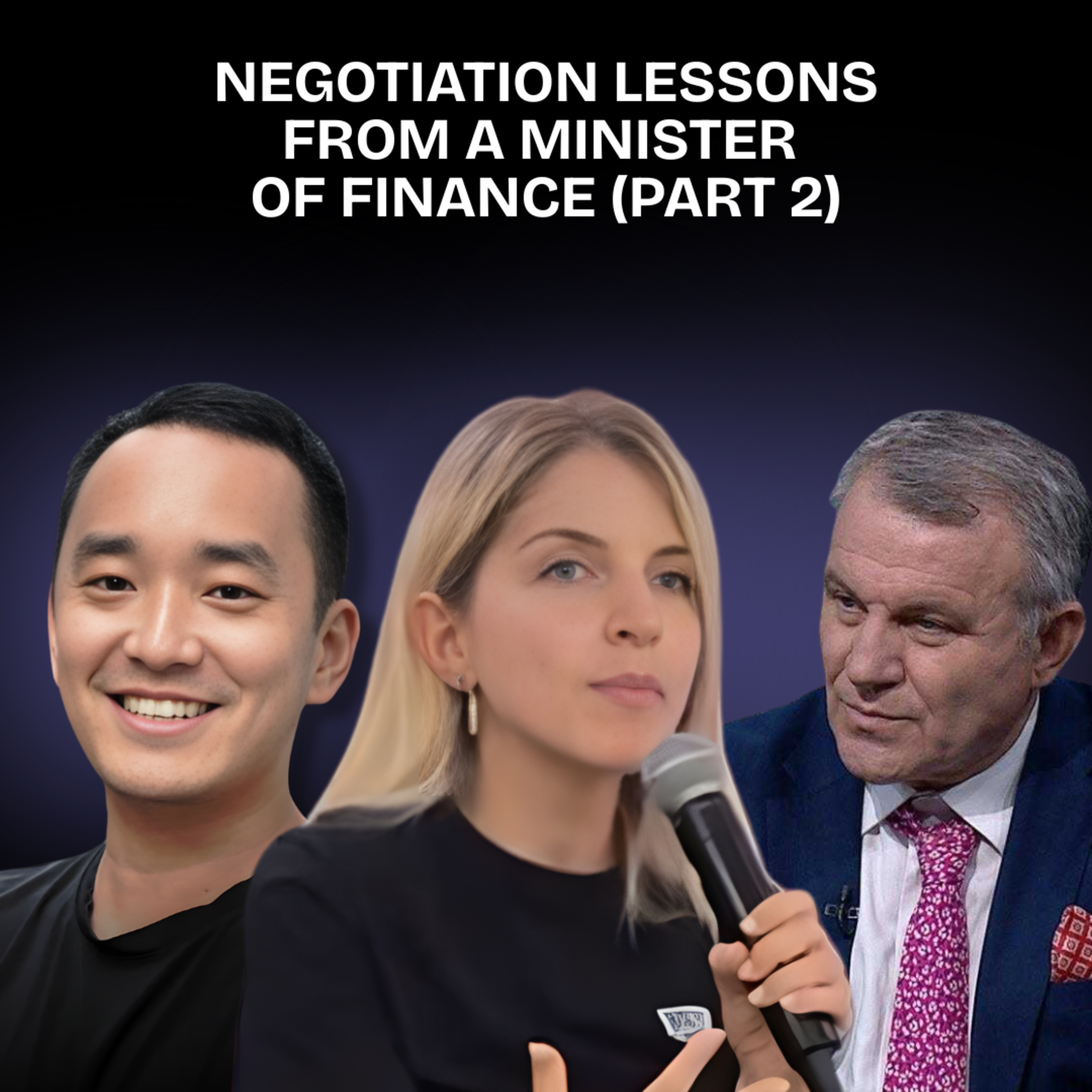
42. Negotiation Lessons from a Minister of Finance (Part 2)
24m 1s
In 1997, during Albania's severe economic and social crisis following the collapse of pyramid schemes, Minister of Finance Arben Maga navigated critical negotiations with international bodies like the World Bank, IMF, and EU. He consistently prioritized self-respect and integrity, challenging condescending attitudes and rejecting imposed solutions. For instance, when the World Bank questioned his capability, Maga asserted his commitment to Albania, ensuring discussions were based on mutual respect. He also advocated for sustainable aid, opposing EU plans for direct food air-drops in favor of a system that would sell food to fund social programs, thereby reducing corruption risks. In managing the pyramid scheme fallout, he insisted on third-party audits for transparency, despite donor reluctance. Maga's leverage derived from his professional skills, love for his country, and principled stance, which ultimately fostered trust and facilitated agreements aimed at Albania's recovery. His approach underscores the importance of integrity and contextual strategies in asymmetric negotiations.
Hello, hello, this is part two of us interviewing my father, Arben Maga, as someone who has seen some super exciting high visibility negotiations during his journey as a prominent politician in Albania. Let's get to it. The second which I like to share with you is about the respect for yourself. No one can misreview without your permission and I will start from this. When in March 1997 we didn't have any international organization Albania, any foreign embassy. After one month the team from World Bank came in Albania and they invited me to visit them in the headquarter in Albania not in my office. They didn't mention why not but my dear friend they had been very sensitive about spying. Basically up until March of 1997 there were no foreign entities in Albania. No embassies nothing because of communism and then all the turmoil and all that. Then April 1997 the World Bank comes in Albania they set up a headquarter. My dad at this point is Minister of Finance and they wanted to meet with my dad but instead of them going to his office they invited him to their office and my dad suspects that it's because communism was very controlling and they had a lot of spies, a lot of tapping, hidden recordings, spying and things like that. You were secretly monitored. You were secretly monitored at all times. My dad suspects that the World Bank invited him to their offices for more confidentiality and privacy. Very concerning if president can record it. They didn't want the president to have access to their conversations with my dad. When I met them in their office the chief of this mission was ready from Germany and she immediately started to mention me do you know how risky situation in Albania are you aware about what is your job? I'm ready to do this and I was upset. The head of World Bank was like do you realize where you've gone yourself into and my dad was offended? But I also as I mean my mid 30s and I'm thinking now he was 31 or something. At that point you were 36. I imagine the head of the World Bank in Albania was like this kid is the Minister of Finance of this entire country that is in a big mess. Can he handle it? I told it please. I know what is my responsibility. I love my country. I can do everything necessary to go out of this crisis as soon as possible. And for this reason you are not treating me as I merit and I can go out of this conversation. If I'll be Minister of Finance I'm governor of my country to World Bank and my responsibility was higher than different ministers. And in this context if you don't respect me I'm not ready to negotiate with you. The main negotiation was to discuss concrete steps necessary to start immediately and start to discuss about new strategy for Albania in the front of what happened after the pyramid skills. Okay so the World Bank invited my dad because they were going to together agree on the next steps on how to handle the situation. And again this is a lot of turmoil the pyramid schemes had just collapsed the country was in extreme civil unrest. But first they invite him to their office instead of going to his office. So you know there's a little bit of these almost power plays but also sort of manners or logistics that need to be factored into the negotiation. But at that point my dad was like okay maybe they're worried that someone's bugging my office okay I'll go to their office. That's number one and then when he goes there the head of the World Bank is like do you know what's going on? Do you realize how bad it is? And my dad is like yeah I do and I care a lot about my country. I'll do anything I can to help my country come out of it so they did not say on the right foot it sounds like. And how did the negotiations go from there? I was about to leave this meeting another member of this team was for minister of finance of Hungary we did good reforms and he was working for the World Bank in Washington. And it doesn't please are been we mentioned this kind of top priorities because based on my experience if you are doing what you promised now for sure you are not survived more than 80 months as a minister of finance. Because all reform have a social cost you will be in the front of headlines many accusations attack and you carry this more than 18 months which happened. So the former minister of finance of Hungary was in the room during this negotiations between my dad and the World Bank and he's like hey what you are saying you're going to do what you're committed to doing. We'll have some social costs because you know cleaning up Ponzi schemes obviously you'll be attacked a lot by different players and he said you will be attacked you'll be in headlines and you will not last more than 18 months. And that's actually what happened. Were they proposing something else? No, we just test each other. I stay very clear in my integrity and my responsibilities. After a close cooperation they created a very positive perception and this investment integrity and to strive for yourself helped me facilitate negotiation with concrete programs. One thing I'm not clear about you go to the meeting with the World Bank. What are you disagreeing on? Of course before to negotiate the first moment is to create perception for partners. They are not going to respect you if they are arrogant because they came from the international financial institution. This is not the best option for them because my commitments depend on my respect, my integrity and my responsibility. They are not going to respect me, you create delays, you can impose some reforms which are not concrete for Albania economy. What's happening in this negotiation is the World Bank comes in and they think we're coming in and we're going to tell this young minister to do what we want him to do and what we've seen work in other countries. And my dad is like this is not the one size fits all and I need to be respected here. I am representing my country through the Ministry of Finance. It sounds like their mistake thinking about what we talk about negotiations is that you need to be very professional, cordial kind and really respect the other party. Like they came in being like do what we tell you and my dad is like you're in my country we need to collaborate, you can just tell me what to do. Because ultimately him who would make the decision and execute them. The second example is that I negotiate your institution to provide food for the Albanian people. I was surprised by European bureaucrats. One of them mentioned me don't worry about food, we can give you food from the plane. Oh like air drops, yeah it drops and we can solve the food crisis in Albania. And I told them now I don't like this kind of option because this kind of option create many opportunities for corruption. Because without accounting, without the responsibility that share, I don't like your option. You can bring the foods in my country and we can organize the process to sell the foods. And from this kind of revenue, we can finance social program for poor people and programs which open work for people in those area. It wasn't easy debate because they imposed this in many countries. The EU Commission now wants to support Albania with food because Albania was a very poor country. What year was it when a politician said we only have 18 months of food left? It wasn't just 18 months, prime minister in 1992 mentioned in meeting we don't have enough resources for more than five days. And the people in 1997 was afraid we'll be in the same situation and they try to get any kind of food. Basically Albania has always been very poor, it's getting better now. But in 1992 it was so bad that the prime minister said we only have enough resources for five days. The country will not have food after five days, no more food. People will not eat after five days, it was that poor in 1992. Now in 1997 people were afraid that things will be so bad as in 1992. So they were going into food storage and kind of taking it. So now the EU Commission meets with my dad in 1997 and is like, hey, we're going to throw food from the air, like air drop food. Don't worry about the food, they meant we'll just bring food into the country, don't worry about it. My dad is like, no, and I'm very proud of you for this because it's so easy to be like, sure, bring food. But my dad said, no, this is not good for the country. You can bring food and we embed it into the system in such a way where we try to sell it and then the revenue from it can be used to create social programs for the poorer parts to reduce poverty and unemployment and all that. You don't just bring us free food, but let's embed it into the system in such a way that the revenue can be used for social programs. I think this is very far-sighted of you because this has been one of the things the West has been criticized and now they handle Africa where they bring free stuff or Asia, the poor countries where they bring resources, but then it kind of ruins the local economy. And I'm very impressed that my dad thought about this such as long time ago. And his concern was corruption as well and how to make it more sustainable for the country. This is great. One thing I'm curious about Arben is Albedo is going through a lot of unrest, there's a lot of turmoil in the country and these foreign organizations like the EU Commission World Bank were coming in. It seems like these foreign organizations have a lot of cards because they can bring resources, they can bring financing to the country. So you would think that they have more leverage than you. How do you think about your leverage and retaining your power in a negotiation when it seems like the other side is holding a lot of the cards? Yeah, because I have only one solution to find the best option to go out of the crisis situation one goal. And if I do only what they say, I'll be just a bureaucrat, not minister of my country. I remember that the negotiation with IMF had been very difficult and lots of reforms, especially in how to close the budget deficit because inflation in 1997 was about 64%. The valuation of Albania with dollars was very high before the crisis was about $1.100 in the middle of this crisis was $1.180. For people who are not very deep in economics, my dad is saying inflation was 60% for context, the normal inflation in the US nowadays is 3% a year, 60% is insane. Budget deficit was about 10%, and public debt about 80%, but the cost of borrow money was very high. This is very critical element because to get money we pay about 46% interest and only 54 black go to spend in budget to expenditure or investors. And we discussed with IMF was very difficult until 4 o'clock AM. They have some strict proposal, I have my proposal, one was I asked them to apply special tax for public security to increase in double level the wages because without public order was possible to get reforms or to improve other elements of your life. Everything start from public order, they won't agree, they told me we understand you, but it's not a good tax policy. And they said, "Okay, I know, it's not a good tax policy in normality, but not in the context which are in and less situation." I like to mention the acquisition with IMF has been very difficult, but they are very aggressive with a strict position before you achieve agreement. They are flexible if you have some ideas, but when you sign agreements, they don't tolerate any elements. IMF have authority as a doctor of who country. A war bank is to give money to implement the standard reforms, and other donors are to provide the financial resources for this kind of priorities. Every institution I visit in 1997 and discuss about the situation of banner, they told me, "Minister, if you don't have agreement with IMF, will give money for humanitarian issues, but not for development of your country." In this context, the responsibility to negotiate with IMF is very critical. This kind of discussion with Web created a perception about my integrity and my professionalism. And support of IMF after the first corporation was a real benefit for other negotiations of my country. What he's saying is that the negotiations with the IMF, which is the International Monetary Fund, they were very tough negotiations. What I'm understanding is they're open to you proposing different things from what they're coming up with. They're very strong negotiators. However, once you land on an agreement, they ask you to stick to it, and you should not deviate from it. I want to come back to Alex's question. You were negotiating with World Bank IMF, very big players. What gave you the confidence and what leverage did you think you have? When your mid-30s guy, not much support, small country, you have big players coming to negotiate with you. What is your leverage? Yeah, three elements. The first, I love my country. Second, I have very high professional skills. The third, very high integrity. For them, there was enough to realize you are a very good partner and to respect you. I remember in October 1998, we organized together World Bank in Brazil, the Donors Conference, and all donors. Mention any kind of help for Albania. All kind of material helps, and I saw there how useful was support from IMF. I think what you're saying is, if you have IMF support, a lot of donors are happy to help you. The first is how the support is not possible to be successful. The IMF team is very nice expert. Mention that we believe in the Albanian government. We believe in their strategy to recover economy. We believe in their programs to go out of the pyramid schemes. And for this reason, we are asking you to support Albania. Another example negotiation was with Donors how to close the pyramid schemes. Who are the donors? Donors are, for example, Italy, Germany, Greece, countries, and second international financial institution, IMF World Bank, Ibiadi, European Investment Bank, and other banks. Donors are other countries that are powerful in the region and more globally, as well as financial institutions, such as the World Bank, IMF and all that. We had a debate about administration of pyramid schemes. There was an internal debate within the Albanian government on how to manage the Ponzi schemes. So the Albanian government in 1997 together with the donors chose to Lloyd the consulting firm to come into Albania and help with the Ponzi schemes. And my dad is saying that the concern within the Albanian government is that if the Lloyd mismanages this, it still falls on the Albanian government to clean up the mess. They're coming into our country to help, but we need to ensure that it's working. Okay, so where is the negotiation in all this? Negotiations this moment was between me and Donors because we didn't know how long take the Lloyd to clean up Ponzi scheme. The argument was we need to have third party out it, the Lloyd. The Lloyd doesn't prefer this because the other company will be the competition and was PWC. Donors mentioned that we don't have money to pay them. And I said I can't sign any demand if we don't find solution how to out it to the Lloyd. You were putting into question the Lloyd's capability is not about the Lloyd is about is about for people who lose the money pyramid schemes accountability. So why didn't you just trust the Lloyd to do? Why did you need someone else to audit the Lloyd, which is already an auditing company? Yeah, because people don't believe Albanian experts. I was wondering why my dad was not having enough faith in Deloitte to handle the Ponzi scheme, but my dad is saying that if there weren't another third party that is more neutral, the people of Albania would start wondering if my dad just colluded with Deloitte and sort of getting corrupted and all that. I will not sign a deal with Deloitte unless there's a third party auditing the process so that everyone has full accountability and clarity what's actually happening. But the donors, which again is World Bank IMF and all that they were like we don't have money to pay for a third party to now audit the Lloyd's process and my dad made it non-negotiable and need someone to audit this process or transparency. Yeah, and after my strict position for that they discuss and they offer solution to finance the third party which will audit Deloitte. And this was necessary also because in the first stage of my career as a minister of finance, I separate responsibilities as a minister of finance and responsibilities for the transparency of pyramid schemes. For the second, we created a special group from the parliament, they choose experts to be responsible for any element of the process of the Ponzi scheme. So I'm wondering, did you want PWC just for your own clean reputation? But what was the point of that? And forget that if you are public figure, you have to profile individual and public. Doesn't matter how far you are in a leadership of your country, no one cares about the profile of you as an individual. They scrutinize everything as a public and I didn't do that to save my country but to serve my country with high responsibility. So my dad wanted a third party which ended up being PWC to audit Deloitte so that the country would have transparency and would have full clarity on what happened to the Ponzi scheme's money, where did it go and all that. So it's not just for him to be like, hey, I've not corrupt, I'm not colluding with Deloitte or whatever, but it's so that people knew exactly what happened, where the money went and all that. The theme that I'm getting is when you're in a position, when the other side seems to have a lot of leverage, how do you build your leverage? Well, it comes to your credibility and in your negotiations, you did a lot of things where not just you showed credibility but you created systems like getting PWC to come into the picture to make it absolutely clear that your credibility could not be questioned. There's nothing about blockchain where it's trustless systems where you don't depend on trust, but then you remove the elements of people needing to depend on trust because the system is such that everyone is already auditing each other. The president of Albania, Professor Jeff Maydan, imagine that the integrity of politics came for integrity of politicians for this reason is very important to not forget that in any kind of negotiation or during your public mandates. What I really like about this is that even though at face value, my dad did not have much leverage in these negotiations, again, imagine big institutions like World Bank, IMF coming into a tiny country. Albania at the time was probably two million people and he is a young minister of finance with not much support coming from random village, what he anchored in himself, not anchor in the sense of negotiation 101, but in himself coming into these rooms, he's like personal integrity, putting my country for those two values, guided him, and I'm not going to be intimidated by these big players. And spoiler alert, what I know about how this goes is that they were like, what is this guy doing with all these non-negotiables against us, but then he proved himself and then he earned their support going forward where they're like, okay, he knows what he's doing his sticks to his word he has integrity and we're going to support him to get even more things done later down the road. So we will leave all that for part two, which is coming in the summer and we'll do that one at a cute studio here in Albania. I think it's time to wrap it up here. Any final thoughts? I just want to say thank you, Arben, so much for sharing about your backgrounds and I think both and Derta and I learned more about you. This was a very special treat for us. To add something, the knowledge is probably good. We have obligation to share them with everyone and to share free. In this context, you can share my email and my mobile, your friends. And for free, I will share any kind of experience or any kind of mentorship, especially for young people who are ambitious to serve like countries. That is very, very generous. Thank you so much. I think that's a wonderful note to end on and we will see you on the next episode of Gentle Power.
Podcast Summary
Key Points:
Arben Maga, as Albania's Minister of Finance in 1997, emphasized self-respect and integrity as non-negotiable foundations in high-stakes negotiations with international institutions like the World Bank and IMF.
He insisted on mutual respect and contextual solutions over imposed policies, rejecting condescending attitudes and one-size-fits-all approaches during Albania's post-pyramid scheme crisis.
Maga advocated for sustainable aid models, such as structuring EU food assistance to generate revenue for social programs instead of accepting direct air-drops, to prevent corruption and support long-term economic stability.
To ensure transparency and public trust, he mandated independent audits (e.g., involving PwC to oversee Deloitte) in managing pyramid scheme fallout, despite donor resistance.
His leverage in negotiations stemmed from professional expertise, unwavering integrity, and a commitment to Albania's sovereignty, which eventually earned him credibility and international support.
Summary:
In 1997, during Albania's severe economic and social crisis following the collapse of pyramid schemes, Minister of Finance Arben Maga navigated critical negotiations with international bodies like the World Bank, IMF, and EU. He consistently prioritized self-respect and integrity, challenging condescending attitudes and rejecting imposed solutions. For instance, when the World Bank questioned his capability, Maga asserted his commitment to Albania, ensuring discussions were based on mutual respect.
He also advocated for sustainable aid, opposing EU plans for direct food air-drops in favor of a system that would sell food to fund social programs, thereby reducing corruption risks. In managing the pyramid scheme fallout, he insisted on third-party audits for transparency, despite donor reluctance. Maga's leverage derived from his professional skills, love for his country, and principled stance, which ultimately fostered trust and facilitated agreements aimed at Albania's recovery.
His approach underscores the importance of integrity and contextual strategies in asymmetric negotiations.
FAQs
They likely wanted more confidentiality, suspecting his office might be monitored due to past communist-era spying and surveillance practices in Albania.
He asserted his responsibility and love for his country, emphasizing that he would do everything necessary to resolve the crisis and demanded respect as a key partner in negotiations.
He rejected it due to corruption risks and lack of accountability, proposing instead to sell the food and use the revenue to fund social programs for poverty reduction and job creation.
His leverage came from his love for Albania, high professional skills, and personal integrity, which he used to build credibility and secure respectful partnerships.
To ensure transparency and public trust, as an independent audit would provide accountability and prevent perceptions of corruption or collusion within the process.
After difficult discussions, the IMF became flexible and supportive, eventually endorsing Albania's recovery strategy, which helped attract further donor assistance.
Chat with AI
Loading...
Pro features
Go deeper with this episode
Unlock creator-grade tools that turn any transcript into show notes and subtitle files.
 PodcastTranscript AI