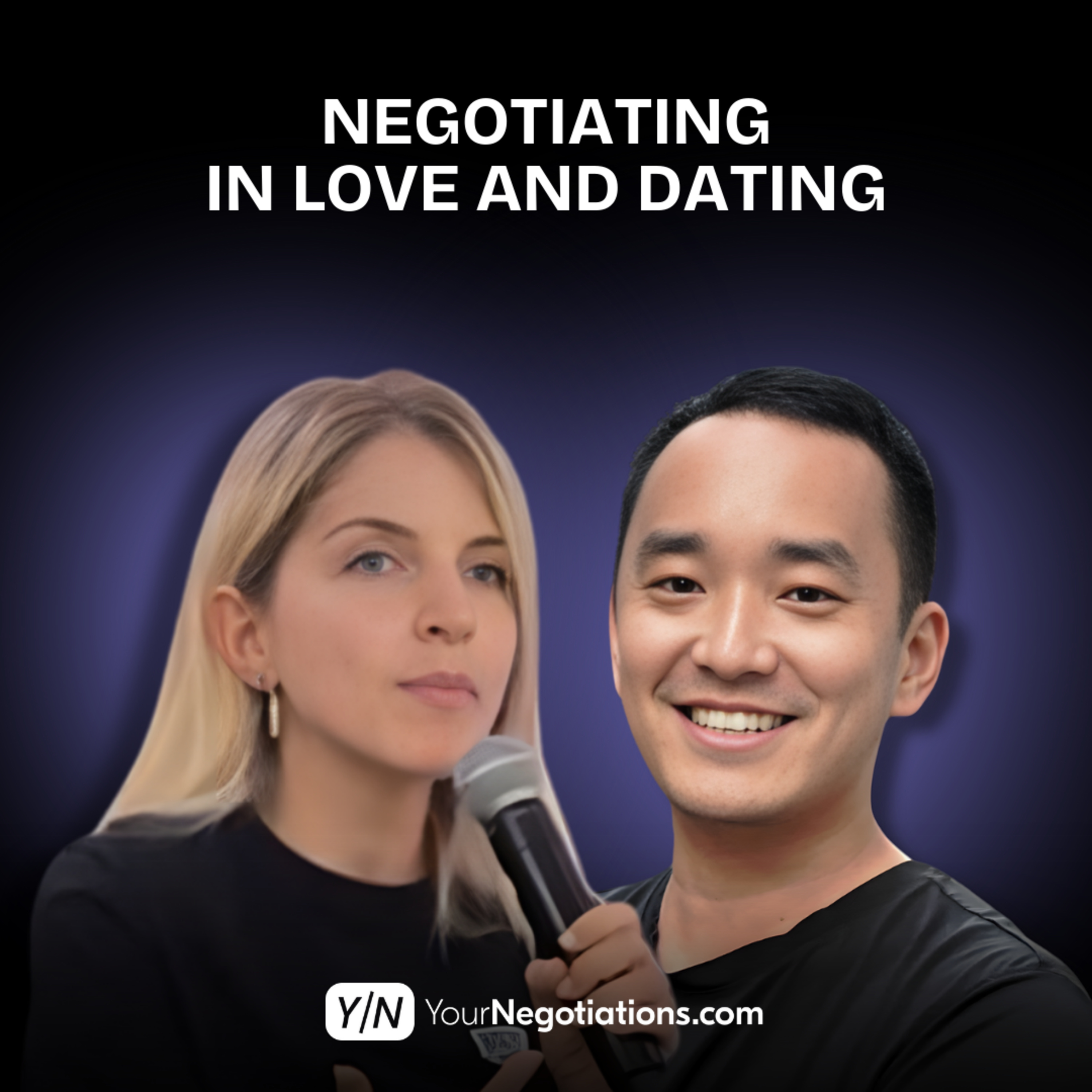
The discussion challenges the common misconception that vulnerability equates to a loss of power, particularly in love and dating. It argues that expressing interest or asking someone out is an act of courage that reflects inner strength, not weakness. Using the Ben Franklin Effect as an example, the conversation highlights how asking for favors can actually increase likability, countering the belief that neediness undermines power. The hosts emphasize that rejection does not objectively diminish one's value or resources; instead, maintaining a mindset of self-assurance—where one recognizes their worth and options—is key. This perspective aligns with a collaborative approach to negotiations, where the goal is to create value for all parties. Ultimately, embracing vulnerability is framed as a strategic and powerful way to build genuine connections.
- Hello, hello. - Hello, hello, welcome to another episode of Gentle Power. We are going to this episode. We're just gonna have it be a free wheeling round table, type of talk. It is a very interesting topic. It's not the typical topic that we touch on, although there's always a way to link it back to negotiations. And what do we wanna talk about today? - So by huge popular demand, the time has come drum roll. - I don't know if that'll affect the sounds. - Imagine a drum roll. - We're gonna talk about power in love. - Power in love. - Yes. - Okay. - And we didn't wanna call it negotiations in love because unfortunately, negotiations as a word still carries some negative connotation. - Like it's transactional. - Yeah, and people imagine strong-arming. Oh, can you help me negotiate with my husband, my wife, my kids, my boss in a kind of strong-arming way? Can you help me say the right things and do the right things where I get what I want? - Yeah, but if you have been listening and following us long enough, you will know that Gerrata and I think about negotiations in a very different approach. It's a very collaborative, positive relationship building exercise where everyone is left better off than before the negotiation. - Right, and trying to expand the pie. In an ideal world, what we're trying to accomplish with how we approach negotiations is everyone is left better off. If that's not an option, at least one party is better off and the other party is not worse off. We just wanna maximize value in an interaction in a deal, quote unquote. So one of the biggest misconceptions in love and dating and relationships related to power and negotiations is that vulnerability is loss of power. And we want to argue today that vulnerability is not only not loss of power, but it's a marker of power. And here's an example. When you are thinking of approaching someone, let's say you wanna go up to someone, you wanna ask them on a date. The way you think about it, you're like, if I go and they shut me down, I'm gonna look bad, I lost my power. Right now I have power, I go, I show vulnerability and lose power. That's what a lot of people think when they're thinking about themselves, going and making a move. But think about someone very attractive, untouchable. Imagine if I don't know who's attractive nowadays to the zeitgeist, Taylor Swift or something. Imagine if Taylor Swift goes up to, I don't know, a cute guy if when she was single and she's like, hey, you're so cute. Do you wanna go out together? And if the guys is no, thank you. Do you feel like Taylor Swift lost her power? It's like, she'll be fine. She'll be like, okay, cool, I thought you were cute. I'll go find someone else. - So this is one Taylor Swift is already very famous or are you talking about before? - Yeah, yeah, already very famous, just single, 'cause now she's engaged or whatever, I'm not caught up. - All the Swifties, what like a word with you? - But the idea is that when you think about someone who's like, very attractive in their power, they know what they want and they're like, you know what? I like this person, I'm gonna go out to them, be like, I like you, do you wanna go out together? And that person's like, no, do you feel like the attractive person like Taylor Swift has lost their power? - No, she's just as powerful. If anything, she saw something she wanted. She went and tried to see if she could get it. - Couldn't one make the argument though? Taylor Swift is someone who probably has a lot of confidence and belief in the fact that she has gotten, she has, you know, a lot of success. She is probably not losing much if someone rejects her. Like, she already approaches that with feeling like she has a lot of leverage. She's a billionaire. She is, you know, extremely successful artist. So, what about for people who feel like they don't have leverage? 'Cause I think also job seekers, they often approach companies thinking that companies have all the levers, all the power. How does someone in that situation think about this? - Well, play that out. So imagine, I don't know, an average person that not Taylor Swift, where is the loss of power? If they're like, I like this person, I'm gonna go ask them out and they say, no, it's fine. Like, why is that different from Taylor Swift, you know? - So, you're saying objectively, there isn't much difference. - Yeah, objectively, there isn't that much difference. I mean, of course, Taylor Swift probably has, you know, many more options. (laughs) But the idea is that just because you go up to someone and you ask them on a date, how is that a loss of power or vulnerable? - You're kind of putting yourself out there. - Yeah, but you go and you put yourself out there, and you're like, I know what I want. I like this right now in this moment. I go after it. If they say, no, I'm still the same person. I still have the same values, the same resources, same friends and family and love and, I don't know, job and talents, nothing has changed. If anything, the fact that I went after what I wanted, that's badass. So that's what I'm trying to say where people think that you're losing power, in love and dating, when you go and sort of put yourself out there and you go after what you want. But if anything, I think it shows courage and in and of itself inherently, it shows that, even if I get a no, I'll be fine. Like inherently, you doing it, you're like, I'll be fine. And so I think that's a marker of power. - Just to push back. - Yeah. - Well, or to question, 'cause I think a lot of people think, okay, much easier said than done. Like, all right, I'm a powerful person. I can go into any conversation, say what I want. I think it comes down to mindset and mentality from oneself and belief that they'll be okay. I think it's inherently scary to make yourself vulnerable, be open to getting hurt or rejected or turned down, right? - Of course, it's scary. And I'm trying to sort of gently offer a new mindset. And here's another example. Let's say you put yourself out there and you text someone, you're like, hey, do you wanna hang out? And then it's scary, right? They could say no, or they could not respond. But if they don't respond, let's say the extreme scenario, they don't respond, they're ghosting you. That's a minimum rude, or they're just very overwhelmed. They might be going through something hard and they just don't have the capacity. How is that a loss of power for you? You haven't lost any power. You texted someone because you wanna hang out with them. It's very straightforward. Hey, do you wanna hang out? Think of it as a friend, even. You text a friend, you're like, hey, do you wanna hang out? And they don't respond. Either they're rude or they're very overwhelmed. They're going through something where in this interaction, there's a loss of power for you. If anything, it's a negative marker for them because they're either being rude or they don't have the right communication skills. - Yeah, I see. So you're saying regardless of how you may be feeling about yourself, what you think is happening in this situation at an objective level, there's genuinely no loss of power. It's just a situation as it is at face value. - Yeah, exactly. Inherently, if you just look at the facts, there's no loss of power versus let's see. If you go up to someone and you're like, can you go on a date with me? I'm so alone, no one goes on dates with me. No one wants to date me. No one cares about me. I've tried this a million times. I can't have a real conversation. That's a loss of power. And people think it's equivalent to go up to someone and say, hey, do you want to go on a date with me? As if you go up to them and you're like, hey, do you want to go on a date with me? I have no one else to date. I've asked a million people. No one wants to date me, I have no option. I'm so ugly, I'm so insecure. People think that's equivalent, but it's not. - I see, okay. - When you go up to someone and you say, you want to go on a date with me, you're just showing, you seem interesting. I want to go on a date with you. That's the fact that they can see. It's not equivalent to you saying, I'm so lonely, I can't find any dates. I don't know, I'm fancy cute. - So it's in the delivery and what you say? - It's in the facts, not just the delivery. The facts are, if you go up to someone and you pass them on a date, that in and of itself does not mean you don't have other options. We can go back to what we're really good at, which is job offer negotiations. If we want to compare this to job offer negotiations. - Yeah. The fact that you're applying to a job doesn't mean you can't get any other job. You're being fired by your current job. You are unemployable, you have no skills. You're just applying to a job because it looks cool. So similarly to dating, you're like, you look cold, you want to go on a date with me. It doesn't mean I can never get anyone else to date me, right? - Yeah, yeah. I thought of a few memes as you were talking about this. And I think this also just goes to show up. Maybe I'm too much on the internet and seeing all these memes, but if someone goes to you just to remind yourself she didn't leave you on red, you left her speechless. (laughing) Anyway, we're good to you. - But there's a way to reframe things. - Yeah. This reminds me, I've been listening a lot to the podcast diary of a CEO with Steven Bartlett. - Yeah, that was my top five for this past year. - Oh nice, Spotify wrapped. And he was interviewing this psychotherapist and they were talking about, I think like the plight of men and just kind of, yeah, and like body language and things like that. And that psychotherapist, he said that when he would see someone interesting and would want to approach them, a stranger on the street and he would approach him. And he said the thing that worked the best or that had the best engagement was when he would make himself vulnerable and just say, hey, I'm practicing just kind of putting myself out there and talking to strangers 'cause it's something that I'm kind of working on. And he just made it very clear that this was something that he's working on and it usually makes him nervous and he wants to get better at it, right? And that reminds me of how when he would approach and talk to strangers or someone that he was interested in, he would just put it out there where he's working. - They call out the vulnerability. - Call out the vulnerability. - And so it's more endearing, yeah, exactly. And I think there's also the other side of it is like, what strengths are you protecting when you want something and you're not going to get it because what, you're too shy or whatever, you're too scared? That is not power either, so yeah, there's also that. And one thing that you brought up when we were preparing for this was that for this episode, the Ben Franklin effect, have you heard of that one? - Well, I didn't know it was the Ben Franklin effects, but I remember you had told me about this study because you love studies. And I remember this as we were talking about this right for the episode, but can you explain what it is? - So Benjamin Franklin, he had a rival in the government and he wanted to make this guy like him. Benjamin Franklin himself also really liked collecting rare books. And so what he did was he went and asked the rival, can you lend me this rare book? At this point they had been rivals, but now he's asking him for a favor. In current society, if you look at that, you would think like, oh, he is losing power, he's making himself very vulnerable, he's asking his rival for a favor, like, wow, so submissive. I feel like that would have been the narrative. But what happened was the rival now lent him the book and actually started liking Benjamin Franklin more and more. And what happens is this is super interesting in psychology. This is called cognitive dissonance. Cognitive dissonance is when we have two conflicting facts, our brains just pick one narrative because our brains tend to not want to hold conflicting facts and realities very well. And so what we do is we pick one narrative and we go with that. So the rival's narrative was, I don't like Benjamin Franklin, he's my rival. And then also I just did him a favor. I lent him this rare book. These two things are hard to hold in our human brains. We can't hold these two conflicting realities. And what happens is you pick one. And so then because I lent him this rare book, I must like him. Then the rival started liking Benjamin Franklin. So the lesson here is if you want someone to like you more, then you ask them for a favor. Yeah, the surface level lesson is a one way to make someone like you more is asking them for a favor rather than doing them favors. And actually this is observed in gift giving as well. When you give people gifts, you like them more. The pro tip for people who have a hard time accepting things. I have a hard time accepting gifts. They are favors and things like that. I'm like, OK, one way I sort of encourage myself to accept is, OK, this will make them like me even more. So that's good. The surface level takeaway from the Ben Franklin effect is one way to make people like you more is ask them for a small favors, things like that. And if you're gifting, you will like them more. But a deeper takeaway is we have huge misconceptions in society as to what power means, what vulnerability, in love, in everyday life, in negotiations, in job offer negotiations, business deals, what all of that means, because we think it means I don't make myself vulnerable. I don't ask for what I want, because that makes me look too desperate. But as you can see with this counter example, in the Ben Franklin effect, even though at surface level would have seemed like making himself too vulnerable and kind of losing his power in reality, it worked in his favor where now the rival liked him more. So I wanted to sort of-- Provide a new way of looking at challenge our sort of, by default, misconceptions we have, with the power and vulnerability. Yeah, I like that. I feel like people don't want to ask for help. That they think that they're imposing on others. Or that they seem not only imposing, that's very cultural for you and for me. Many cultures, when you ask for a favor, it's imposing. But it's also, I don't want to seem like I can do it myself. I don't want to seem like I don't have the resources that got needy and weak, right? But as we saw with the Ben Franklin effect, if anything, that works in your favor, and I truly believe, and maybe I'm having a hard time articulating, the more we show vulnerability, the more we're showing strength. The fact that you are willing to open up your heart and be like, hey, I really like you. Let's go on a date. I think that's a huge marker of strength, because it means I'll be fine even if you say no. Yeah, yeah, I like that. - What I've learned with negotiations is that the best way to deliver a move is to convince yourself of the right narrative. For example, when companies ask you, 'cause again, we're experts in job offer negotiations, when companies ask you, are you talking to other companies? We strongly recommend that you have applied to other companies so that you can say, yeah, I'm considering other options. The idea is that you need to convince yourself of the narrative first, and in love and dating, remember that the fact that you're going up to someone and being vulnerable, it just means you're actually brave, and you will be fine. Why not shoot your shot? I think that's a marker of power so much more than, oh, I'm not gonna ask them on a date. That just shows you're scared, and you're probably, I don't know, scared and shy, and in experience, you think you don't have other options. And what you think of preserving your power in love and dating, it's actually a marker of weakness or you thinking of yourself as weak. Yeah, so vulnerability is strength, not weakness, and in dating, and if you show vulnerability, in fact, it could make the other side like you even more. Like if you ask someone for a favor, then as a example, yeah, interesting. I'm sure there's other ways. Yeah, I know this comes up a lot for you 'cause you have a lot of friends who are saying, we both have friends who are single, but a lot of people come to you for a lot of advice. Even we have had some cases, previous clients, after we work with them, they have asked her to, can you also be my dating coach? Like every time I post like negotiation tips on Instagram, I get DMs like, can you say anything about negotiating in love and dating? So this is I guess us dipping our toes in that. Going back to when you asked someone for a favor, make some like you more, this isn't exactly a favor example, but I remember, so when I was in the Air Force, I worked in a program office, both military people and government civilians and contractors, we all worked together, developing software systems. There was this one government civilian that I worked with, and he was kind of like the mentor, and he was the proverbial office father to all the young military officers that would come through 'cause he had been working there for a long time. His name was Warren. Incredible guy. Warren, he was a retired military officer. He was, I think at the time around like in the '60s, and he would engage with you as if you're already friends. And I remember, I told you this, I was telling you a story from the office, and I needed Warren's help on something. I asked Warren to come over and I had snacks. I think it was a bag of nuts or mix nuts on my desk. And Warren came over, we were talking, and without even asking me, he just started eating from my mix nuts, just like how a friend would. It's like, of course we're friends, so we share these things, and I remember when I told you this, and you said, I liked that he didn't ask you, and it just made it seem as if, I mean, of course, within boundaries, all these things, like read the rumor. - But I'm not gonna start crashing here, please. - Yeah, but it did make me think about how, the fact that he didn't ask me made me feel as if, we were even closer, right? And he was one of my mentors very early in my military career. He had mentored a lot of officers, but I just remember that story as we were talking about the favorite thing. - Yeah, exactly. I think there's a lot of different ways to think about and these little things, but I wanna zoom out more because yes, there are little tactics of like, how to make someone like you more, and how to like, I don't know, I wanna stay a bit above all the little things, and more sort of the main idea, the overall idea here is that there's a huge misconception. I've seen it in our circles too. We have a lot of people playing it cool, and dating, and love, and relationships. And yeah, this misconception is that, if I'm vulnerable, I'm losing power, I seem too submissive, I seem too weak. And I think, again, if anything, it seems you're so powerful. You're like, hey, I'd like you, let's go out. Oh, you say, no, okay, fine. I'll be fine, and I have other options. Yeah. Cool, I think there's so much more to talk about in this topic, or we can do a part two, or more of those interests. Maybe we can collect some of these studies. I think people might be curious about like, what are some other little things we can do, how to make someone like you more, or things like that? Yeah, if we get a lot of feedback that the dating stuff was very interesting, we can gently pivot into a love-negotiations. (laughing) But yeah, it's just a fun fact. I had a huge crush on someone in high school, and I think I'm pretty sure I liked him. I don't think he liked me back. And I started-- His loss, I guess. (laughing) Since I was 15, I started reading so much about relationships, and this was in the era of dialogue phones. (laughing) There was this guy, I think his name was Christian, Christian Sun, if it's even a real name. And then I met Matthew Hussie-- He's a dating coach. Matthew Hussie is a dating coach for women. Wait, and who's Christian, Christian Sun? He was very early, I was 15. This was a long time ago when I-- Dating Guru. Dating Guru, he was writing about how to think about dating and love and all of that. And then I got so wrapped up in this world. I just love psychology, I love learning about dating, relationships and love and all that. I love that actually what we do is very similar to that because we think about negotiations in a relationship, human dynamic. It's just that it's in a professional setting. Then I discovered Matthew Hussie, who now is such a huge name. I still listen to his podcast, I learned so much about love and relationships through his podcast. I saw him in person. I think you and I had just started dating. I think I told you about it. Yeah, about his books, I brought my friends. So this is very close to my heart, and you're right. I have a lot of friends who come to me for dating advice. At some point I have like six to 10 friends all texting me with screenshots, like, oh, he said this, what do I say? And also a lot of guys, she said this, what do I say? And I just love that kind of stuff. So that could be something we start talking more about on our podcast. This is not necessarily related to negotiations. Yeah. So you said you want to keep this high level, but I just remember this very specific thing that you had told me once. It was so fascinating. It was about the thing where if you want to know if someone likes you, yeah, can you share this? I learned this so early on. So this is why we're in the negotiation business. I just love behavioral sciences. And maybe it's not, maybe it's nurture rather than nature because I just remembered. I started reading about dating and love and all that and relationships at 15. But my uncle, who's like a father figured to me, he was reading body language books when I was even younger. And then he would share those with me. And so this was, I think I was like early teens. But yeah, we were both reading this body language book because he was passionate about it too. And what it said was there is this trick to figure out if someone likes you. These are, take this with a huge grain of salt and salt. Like it could be salt pop science here. And just like with body language, you want to think about the context, the cultural context of individual context. Like for example, if someone holds their arms like this, generally you can deduce with some certainty that maybe they don't like you, right? If someone's like this-- I just realized I just did that, but it's because-- I know, but it's holding this up for a while. And my elbow is getting tight right. So if I weren't careful in interpreting this, I see someone with their arms folded. Like, oh, they don't like me versus your elbow hurts or your cold. I do this when I'm cold, which is very often. And or maybe you're used to carrying your arms like that. That's just habit. So you really need to think, this is why I'm trying to stay away from these topics because you have to be very careful on how you interpret things. But this little trick, again, huge grain of salt. And the salt will become relevant because it's about a salt shaker or a glass of water. But I learned this so early on, basically, in the book. It said, let's say you're hanging out with someone. And let's say it may be it's a salt shaker. And it's usually in the middle of the table. We're facing each other. And I gently move it closer to you, not in a way that's very obvious. But you're picking up on it subconsciously. I move the salt shaker, which is normally in the middle of the table, gently, more on your side. Actually, first, maybe I touch it a little. Like I kind of claim it a little. Now you're associated with me. And I claim it. I'm playing with it. And then slowly put it more in your space. The book said that if you take it and hold it and touch it, and now you embrace it, you really like me. But if you push it back to the middle or even on my side, you don't like me. So this was what I learned in the book. And the funny story, which I've got to share it. So I learned this, I'm a teenager, and then-- Nage Behavioral Scientist, Gary. Little teenage behavioral scientist. And so I go out with my uncle who's kind of around my age, not that much older, and his guy friend. And my uncle goes to the bathroom. He's just me and the guy friend. And we're having a conversation. I find myself moving this glass of water back on his end. And I catch myself. And it was his glass of water that he had gently moved into my space. And I had just moved back to his space. And this is my uncle's very good friend. Again, we were all maybe teenagers, early 20s. And basically, I have a pretty reasonable level of confidence that my uncle and I had talked about this. And the mangle had told his guy best friend about this. And he was just testing how much I liked him. And the answer was no. And it was crazy. And I caught myself just as I had moved it on his side of the table. And I was like, wow. I see what just happened. I felt so not naked, but as if my thoughts were so transparent. Yeah. But this thing-- it kind of makes sense. I think it's related to mirroring. If you maybe feel some level of connection with someone, then your body language may start mirroring. You may start talking. So let's say if I was fiddling with chopsticks at dinner table or kind of something or like salt shaker. And then this thing that the book says is like, well, if another person then later on picks that up as you're engaging with them, then they maybe subconsciously are connecting with you more than they even realize. I just think it's extremely dangerous. Yeah, too. If you're not very well attuned to what other variables are happening, this person's personality, and the environment and all that. So for example, you are a little bit-- I want to say OCD that is an overused term. But you like things very well arranged. So if that-- if we were maybe early stage dating and I do this salt shaker thing, you just like the salt shaker to be where it's supposed to be. That doesn't mean you don't like me. You're just like arranging a table. You still do this to this day. You're always like arranging things. So you really need to take things with a grain of salt. I'm the arranger in chief, that's not salt. Chief arranger off there. But I do have another-- I have a couple other of these little studies, but again, do not use this as-- Let's go into them. I'm curious. Yeah. OK, two others that I think are very cute and more innocent and maybe more, I guess, more reliable. One is that if you're in a group setting, I'd say there's like 5, 10 people laughing. If the person you like in this group, and it's unspoken, I guess, if they make a joke, notice whom they look at right after they make a joke. Or if everyone's laughing, who do they look at first when everyone is laughing? That's usually when you make a joke, you all immediately look at the person you're like, did you laugh? Yeah, did you like to see it like, did that work? Yeah, yeah, that was great. I'm like, crushy right now. Yeah, yeah. So that's one small mark there. Interesting. OK. Thank you. OK, sorry. That was so funny. I'm so glad that you like me after 14 years together. And then-- but again, you want to be careful with this because what if-- I don't know, their boss is in the group. Or I don't know. There's so many-- maybe they're looking at someone else because they have something in their hair. You want to be super careful with these things. It's maybe it's a nice to have data point, but don't hinge everything on it. Yeah. That's one thing. The other thing-- I think this is super cute too. Again, if you're in a group setting, if you're at an event, it is believed that your toes or your feet are pointing to the person you like. It's standing or sitting or what? Standing. Yeah, yeah, standing. And again, you can't rely on this too much because what if they're talking to someone else who's directing them in this area of the room? And you're like, oh, they have their back to me. They don't like me. But in general, let's say you're floating in a room and you're moving around. Generally, they kind of are positioning. You're usually orienting your body towards the person you like because you're monitoring them more, you're observing them more. So that's also a cute one, but that should be taken. Everything should be taken with a grain of salt. And this is why I have not, as much as I love psychology, behavioral sciences, love, and relationship advice, I'm very careful not to just blur these things out and put them out there because contextual data is so important, it's not binary. If they look at me right after laughing, like they like me, I think that. Cool. Well, hopefully our listeners found that fun. We deviated a bit from our two little topics. But yeah, this is great. I think a lot of-- I have one more. Oh, yes, OK. These are fun. Yeah, OK, just drop it. So this one is more in terms of a professional setting. This is a cool study in a professional setting. We're causing up now so I can share all my favorite studies. And I'm trying to see if it's related to love and dating at all, but I actually have used this myself. So when you are negotiating in person, ideally, you want to be next to the person you're negotiating with as opposed to in front of them. I learned this in that body language book that I read when I was like 10. But I actually use this. I had a very tough job earlier in my career. And my manager was about to scold my entire team because we were coming into the office at 9.10 instead of 9 on the dot, even though we were leaving several hours after everyone else. But it was important for us to get in in those 9, not 9.10. And my manager was coming into school with us. And my manager was like, hey, everyone get into this room. Everyone sits down, almost like children. They lined up, almost like children about to be scolded. There was a table. And I was like, I'm going to sit next to my manager because I think that will create the cognitive dissonance for them to be a bit more confused. I'm supposed to scold her. Yeah, she's here with me. I'm here with my side. And that's what happened. So you sat next to my manager? Yeah, my manager started scolding the team. Everyone was lined up. That felt appropriate to my manager. But I was right next to my manager. And I could tell their confusion and how scolding and then turning to me is like, I'm confused. Like, I could tell-- Yeah, you're right here. Yeah, you're wimpy. You feel like you're on my team. I feel weird scolding you when you're right next to me, like a friend or my team. The deputy. That was the small little thing that I did. And I was like, it was keeping me sane during that meeting. While in dating, maybe in restaurants, when we eat, I like for us to sit next to each other. I can just feel more endearing as opposed to in front of each other. So you can use this in dating, too. Yeah, I've heard about how you slightly move your body. You angle it away instead of looking dead on to-- Yeah, it's too confrontation. Yeah, but if you're just like this, if you're chatting and angled a bit away, it feels more relaxed. And your brain perceives as like, it's us against the world, as opposed to us against each other. Cool. And I wanted to add something from my point earlier. I'm trying to figure out how to clearly articulate what I was trying to say earlier about dating and relationships, and how being vulnerable is not a marker of weakness, but rather of power in the context of love and relationships. And perhaps one way to think of it is as openness versus exposure. If you like someone and you go and you're like, hey, I like you, that's you being open. But it's not you being exposed. You're not saying, I don't have any friends. I need to date you. Otherwise, I'm going to drown. I'm going to be so depressed and things like that. You're just saying, hey, I like you. And that's it, you being open. You are not exposed in that I'm so weak because I like you. Yeah, I see. Hopefully that clicks. In any case, I would be excited to talk about this topic again if there's interest in your final thoughts. No, we definitely want a lot of side quests on the stuff. So, but I feel like we covered a lot of interesting things, body language, psychology tricks. Yeah, and we've talked a lot about-- I think we had a full episode earlier this year on one of my favorite books called Unbound, written by a woman who has been a dominatrix for 17 years, as well as a Taoist nun. So she's been both a dominatrix and a nun. I think at the same time, like within the same years, she'll just go back and forth. And so she has this very unique perspective on power. Mostly from a woman's perspective, but I'm a lot of concepts that you can extrapolate. And oh my gosh, it's my dream to have her on our podcast. Her name is Kasia Orbaniak. She's Eastern European. Kasia, if you're listening. You're welcome to a future episode of Gentle Power. Yeah, I would love to have her here, because I mean, power negotiations are so closely related. And we focused on the professional world, but of course, it's humans at the end of the day. So it's applicable to the personal world very often, as well. I started reading that book as well. There were some pretty mind-blowing things in there. One very quick example, and then I swung 12 n. But so when you feel unconfident, or if you feel like someone is being aggressive and a conversation, and you feel like you have no power in the situation, how do you flip that power around? This goes much deeper, but at the service level, you just ask a question. And because power is the way that Kasia explains it, is power is a tension. And where is the tension being directed? So when you ask a question to that person, and actually, you don't even have to have the question make any sense, or I mean-- To the context. To the context. Yeah, it doesn't have to be, yeah. Yeah, so if you want to claim power back, you ask them a question. The tension is on them. And then they need to respond to you. And then you can just-- Now they're spinning. They're thinking, like, oh, how do I respond to this? She mentions this in the context of harassment a lot, and she's like, if the man is making a very inappropriate comment about you, you can-- I mean, ideally, you say, does that comment sound appropriate to you? Like, you call it out, but you don't have to. You can be like, where did you get the jacket? And now you're just turning the attention back at them, and opposed to when it was on you. And women tend to have the attention on them and try to figure out what to do with it. But once you turn it back, now the power is going this way. Yeah. Cool. I think it's time to wrap this up. OK, yeah, we'll wrap this up. All right, see you on the next episode of Gentle Power. See you. Bye.
Podcast Summary
Key Points:
Vulnerability in dating and relationships is often misinterpreted as a loss of power, but it is actually a marker of strength and courage.
The Ben Franklin Effect illustrates that asking for a favor can increase likability, challenging the notion that showing neediness weakens one's position.
A shift in mindset is essential
True power in negotiations and love involves collaboration, expanding mutual value, and maintaining self-worth regardless of outcomes.
Summary:
The discussion challenges the common misconception that vulnerability equates to a loss of power, particularly in love and dating. It argues that expressing interest or asking someone out is an act of courage that reflects inner strength, not weakness. Using the Ben Franklin Effect as an example, the conversation highlights how asking for favors can actually increase likability, countering the belief that neediness undermines power.
The hosts emphasize that rejection does not objectively diminish one's value or resources; instead, maintaining a mindset of self-assurance—where one recognizes their worth and options—is key. This perspective aligns with a collaborative approach to negotiations, where the goal is to create value for all parties. Ultimately, embracing vulnerability is framed as a strategic and powerful way to build genuine connections.
FAQs
A common misconception is that showing vulnerability means losing power. In reality, vulnerability can be a marker of strength and courage, as it demonstrates confidence and the ability to handle rejection.
Vulnerability shows that you are brave enough to express your interest and pursue what you want. It implies you believe you will be fine even if rejected, which reflects inner strength and self-assurance.
The Ben Franklin effect is a psychological phenomenon where asking someone for a favor can make them like you more. It challenges the idea that asking for help is a sign of weakness, showing instead that it can build rapport and positive feelings.
Focus on the objective facts: expressing interest is simply stating a desire, not an admission of neediness. Frame it as a confident invitation, and remember that rejection does not diminish your personal worth or options.
People fear rejection, appearing desperate, or losing leverage. They may equate vulnerability with weakness, but this mindset overlooks the courage and self-confidence required to be open and honest.
By convincing yourself that vulnerability is a strength, you can approach interactions with more confidence. This shift helps you see that expressing interest or asking for favors can actually enhance your position and relationships.
Chat with AI
Loading...
Pro features
Go deeper with this episode
Unlock creator-grade tools that turn any transcript into show notes and subtitle files.
 PodcastTranscript AI