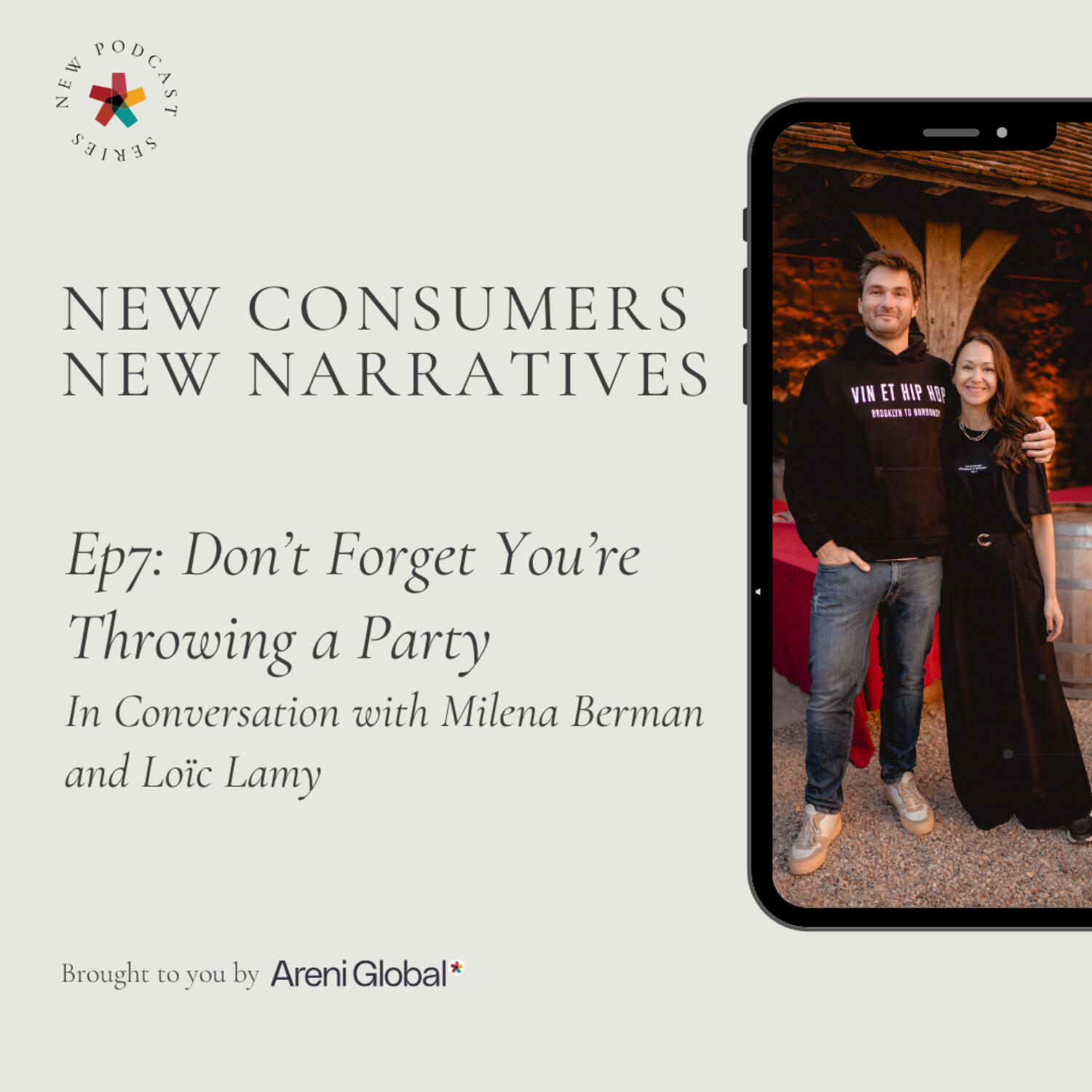
The podcast episode explores how the fine wine industry can engage younger consumers through experiences and community, featuring Old Court founders Louis Clamie and Milena Berman. Their company, based in Burgundy, organizes events like "Fine and Hip-Hop" that integrate wine, music, and local culture to create joyful, inclusive experiences. Key to their philosophy is curating authentic, two-way conversations between hosts and guests, avoiding extractive tourism by ensuring mutual benefit for winemakers, visitors, and locals. They emphasize "sense of place" by connecting wine to broader cultural landscapes—geology, cuisine, and art—rather than focusing solely on prestigious appellations. Old Court’s events often feature diverse creatives from outside the wine world to challenge entrenched traditions and attract new audiences. The founders stress the importance of listening to guests’ interests before sharing information, creating spaces where wine becomes a shared, relational passion rather than a solitary academic pursuit. By making wine accessible and joyful, they aim to open the industry to a broader, younger demographic, demonstrating how meaningful experiences can drive long-term engagement and retention.
[Music] Any sector that wants to stay relevant must invest in their future consumers and fine wine is no exception. But everywhere you look now, people are re-evaluating their relationship and attachment to alcohol, wine and food and redefining our current understanding of luxury, lifestyle and success. What does this all mean for us as an industry and as an individual brand? How can the fine wine sector engage with a new generation of consumers in a meaningful way in such a change environment? And a rainy global, we believe that complex questions require in-depth research. I am Pauline Vickard, the co-founder and executive director of a rainy global and in this new podcast series, new consumers and narratives, and meet marketing industry legends, speak with academics and researchers and push the doors of private member clubs. Come with me as we discuss the best possible ways for our industry to invest in its future. [Music] One of the key findings from a rainy recent study, the new fine wine consumer, is that younger consumers engage with wine through experiences and communities. Fine wine rarely becomes a solitary passion. People discover it, learn about it and eventually collect it because they find others to drink with. Non-contumers not simply buy bottles but memorable experiences. And as Joseph Pine and James Gilmore argued in 1998, work is theatre and every business stage. Events matter more than ever. But what kind of experiences resonate with a new generation of drinkers and how to create events that feel joyful, welcoming and culturally relevant to people who may not yet identify as wine lovers? That is precisely what Old Court has been exploring from his headquarters in Burgundy. Founded by Louis Clamie and Milena Berman, the company is the force behind Fine and Hip-Hop, the now called event that brings together wine, music and community and the historical shuttle du Claude Vujon. As Eric Azimov wrote in The New York Times, Fine and Hip-Hop was a resounding success and a glowing example of what can be done to present Fine, not as a forbidding academic exercise but as a joy, a delight, as emotionally moving as the beats and rhythm of a great song. In this episode we sit down with Louis and Milena to understand the philosophy behind its success and what the wider industry might learn from it to attract and retain new consumers from all backgrounds. This is a seventh and final episode of this podcast series New Consumers and Narratives, and if you are interested in this central topic, we encourage you to listen or revisit the first six episodes. While we explore key questions such as deconsumption, the future of luxury business models and the new generation of fine wine drinkers with international figures including Jean-Nuel Capferrère and Sir Jean-Hagarte. And all the links are in the show notes. But back to the episode now, enjoy! Well, Milena, Louis, welcome to the show. It's such a pleasure to have you with me today. Thank you so much. Thank you for having us. First question, always the same, quite a classic, but can you tell us who you are and what you do? Sure, so I'm Milena Berman and we are old coat together. I moved to Burgundy, originally from California and I've been in Burgundy for coming on 15 years now. I moved here to Bone with a background in art and art history and I worked for a company that organized art tours all over the world for museum patrons and trusty groups. And I did that for seven years up until the pandemic and during the pandemic, that all of course closed down. And so transitioned more into wine working for Dementou Jacques. It was maybe a pandemic job but much, much more than that in the end. It was not planned but ended up being a very important experience for me and had been in Burgundy very much immersed in wine but not actually working directly with wine until that point. And then after some time as the world started opening up again along with Louis, who was working for Dementou Maltier at the time, we decided to start our company, Old Coat, bringing together wine and culture. So sort of my background in his and our shared passions in opening up this sort of world that had been closed down during the pandemic and generally speaking in Burgundy is a bit harder to access. Yes. We always open region in the world. Yes. No, we always say the doors around here are much heavier than they are in other regions, other wine regions specifically and that we've sort of figured out how to make them lighter and that was our initial goal was to sort of bring people in from my previous role, you know, the people that I met in art and culture and then people that Louis Knu from his past lives and bringing them to Burgundy and then helping people navigate the landscape around here which is actually quite complicated. Louis, your background is in wine? My background is not in wine originally and it's the time of my life where I thought that working was not fun at all until I was actually living in Asia at the time. I moved between Hong Kong and Singapore and as a French foreigner in Asia, everybody was always talking to me about wine saying, "Hey, oh, let the French get big wines." And I realized that I knew absolutely nothing about my own culture. So I came back to France and started passing a sum exam so I became a sum working a few wine bars and restaurants and realized that I was actually more interested in production. So moved to Burgundy because you know, yeah. Why not? And started working in production, started working in the vines. And then I started working in the vines. And I started working in the vines. I started working in the vines. And enjoy this events. That's also a nice way for us to give back and thank them. Because, as Mio was saying, we've been. Bergenjans described themselves as quite close and not very welcoming. We think it's quite the opposite, actually. And yes, we wanted to give back to some extent. We realized that we didn't want to do something purely extractive, which tourism can feel that way. Bringing people, and then we didn't want to build our business off of asking favors of our friends and community of winemakers here. And so it was. It started with. We had this element of giving back from the very beginning, which we can maybe talk about a little bit later. But that was always important to us to not be extractive in the way that we started our business. But then events actually became a way of building something here for locals as well. Our events in the meantime have traveled outside of Bergenjans. They're really rooted in Bergenjans and very much community-based. And so that's. The events were sort of something that's happened secondarily. It was not part of the original business plan. What was the first. What came first, then, like, what was the business plan based off originally? Travel. So the. Yeah, so it was these trips. I mean, event planning is production, essentially, whether it's. Yeah, that's why in my head I actually got them together to meet almost the same thing, because you're organizing something. They are. Sure. And so even, you know, a trip is a series of small events. But at the beginning, it was. You know, we were working with one sort of similar or wine importer, or wine advisor, or someone in the wine world, who then would come with a small group of their kind of clients. And we still do this. It sort of represents about 50% of our business now. Yeah, I like what you said about Bergenjans, because, I mean, coming from Bergenjans myself, it's an interesting region, because depending on how you see things, it's also a very welcoming region. People. Like, you said, doors are heavier to open, but when they're. When they've opened, they're, like, kind of open for life, unless you screw up when you do something bad. But, like, it's. People want to share, and they want to connect. It's just like, they are asked for so many things, like all the top wineries, and even, you know, everyone is. The solicitations are so many that they don't really know what to do, and who to give time to. And I like your idea of, we don't want to be extractive, we want to build something, which is a win-win-win, like a win for us, of course, as even organiser or travel organiser, for people that are. that take the time to travel, but also for the people that take the time to host. And that's kind of like curation of the audience versus the host and like organizing the conversation so it's relevant for everyone that I like. And I think one of the things that we've learned through the study that we've just done on young consumers, this is really important to create the opportunity of not just, you know, I come, I see, I take an Instagram picture and I come back, but taking the time to establish those conversations, and it's really a Savocha fair, it's not that easy. Like you have to take time to listen to both the host and the audience so that you can curate and match make between, you know, create those matchmaking. - We think of it as exactly that, actually, matchmaking. And we won't, you know, we actually interview our clients. So if someone comes and says I'd like to organize a trip in Burgundy, we will take time to have a call with them, understand who they are, what their interest is, and something about their background. - And the most precious resources that people have at your level as well, and I guess for your clients too, is their time, like don't waste their time and to not waste their time, you need to understand who they are and what they want. And that reminds me, we're gonna talk a bit about tourism and how what you do can be applied to people that have hospitality in the winery, but I was with this top winery in Italy, and we were talking about young consumers and how to find ways to engage them. And I tell them, well, you know, people like talking about themselves, if you want to create memories and experience, you have to start a conversation with them, you have to let them space, to give them space to tell you who they are and what they want. So they came back after a few hours and they're like, "Well, we've timed everything, and even if we time it really well, I don't think we have time to ask them questions, we have so much to say." And I'm like, "Well, this is exactly the problem. You have to make time." Like asking people question, is the most important thing that you have to do before pushing information on them, you need to understand who they are and what they want to learn. Maybe not at every level, I understand scale and everything, but you are, when you are designing top, like top notch experience, it has to be a huge part of the job that you do. So thank you for starting with this. But coming back on where you are, so you called Oatkut, I suppose as a reference to the Oatkut where you live, or how did you come with the name? - I would say we live in the Oatkut, but it's mostly this idea that behind the super shiny, famous wineries from the courts, there's an entire world right behind them of people working hard, having been there for generations, people who live in less-known villages, but are doing an absolute fantastic job. And we thought this is equally interesting actually, and C. Bergen Diaz-E-Hole, and we thought, let's show people coming to us. Of course, the big names that they want to see, the bottles that you know and so on, but also these less-known areas that are so beautiful with so many interesting and new projects happening, and we thought that the Oatkut was representing that, so that's how we came up with the name. - Exactly, it's quite conceptual, because we may be finding that Oatkut kind of producer in Von Romane, it doesn't mean that they're in the Oatkut, but it is this sort of the road last couple. We didn't, you know, an event production company in Bergen Diaz called Rudi Gran Clu is, would have not misaligned with what we're trying to do. Trying to also have people take a little bit more time, go on some of the back roads, not take a big bus up and down the Rudi Gran Clu, and take the boxes of what they've seen. So, and people's favorite memories are often, you know, the picnic in Sahama, or the hike in the forest above the hills of Von Romane, or, you know, there are so many, you know, we've gone, we were doing a lot, going to the Abed de San Vivon, Petit Bonheur, these like, that's the Oatkut in Rhee, and such a hidden gem, where you can drink a bottle of DRC, white for 70 euros at the time. And yeah, just kind of those experiences that you only locals know, that was sort of the idea. - So, about your events in general, the art, the wine, everything combined, can you tell us where, where does everything start? Like, how does your creative process work? - I would say they have started based on friendships. So, the first one, Vyah Hip Hop, started with collaboration between, so I had just stopped working at Dementou Jacques, but we had been sort of doing a project with Germain Stone, who was the podcast wine in Hip Hop, and then we were starting our company with Loïc, and Germain was coming through Burgundy and said, "And we're just, as I say, friends, because it felt really like a collaborative, "Hey, I'm coming through town, let's do something." And maybe it's a "Wine Maker Dinner" something, and we said, "Well, no, people, "Wine Maker dinners are what we do every night in Burgundy, "it doesn't work so much here." "Denners are why make your dinners." So, why don't we do, oh, it's the, you know, end of harvest will be around the time you're coming through. Oh, why don't we gather some people, because here in Burgundy, we don't have sort of a real moment to celebrate the end of harvest. Every domain has their pole, but we don't have really this, like, moment, I mean, honestly, we feel like we haven't seen each other for months when the harvest is done, because everyone just puts their head down and is working through harvest and verification. So, it sort of lets throw a party, where should it be, who should we invite, we should we have some wine, let's have some music. It really started in a very authentic, organic way, like that. On your website, you have that sentence that's dead with me that says, "We tell stories of plays through deep dives into cultural landscapes." And that's a beautiful sentence, but I was wondering if you could tell us what it means, like in practice, how does one tell the story of plays through events? I mean, I think that places are very layered, and so we are interested in holistically looking at a place. We don't want to stay just on the surface. As we said, we don't want to do just the hud de conclure. We don't want to do even just wine maker visits. So we also visit Boulangerie in the Otcaut de Bonne, an incredible baker. We visit a coffee roaster, or we can take a walk through Vineyard with a geologist and talk about terroir through that lens. And so really in the meeting people, the cultural landscape culture is also, well, culture, as we just spent three days in the vineyards with Domain Arnolescio. I was reminded many, many times that culture, culture is what they're doing in the vineyards, cultivating. But also, it's everything else. It's the people. It's engaging with local people. I mean, our ultimate goal is for all of our travelers to come to Bergenjian, feel like they met like-minded people, even though didn't grow up in the same environment, country, do not speak the same language. And eventually feel like they made friends. And that they would start a relationship on their own. That's our ultimate goal. But which really is about the connecting, the work of the people with the place, and see that it's all interconnected. Chefs couldn't work without the wines, and the wines shaped the local cuisine and the local taste. I mean, you know, Pinot and Charbonne being such delicate gravarities, you're thinking of a cuisine that matches that. And also, it's all interconnected. And we're trying to say that Theroux is definition. That's quite agreed when it comes to wine, but it links to everything in the region. And that's what we're trying to show. I should. Absolutely. We are setting the stage for the stories to be told. We are not telling the story necessarily from our-- you know, as Loïc said, we're not local burgund-- I mean, we're not native burgundians. We can tell our story. We can introduce people. But we see ourselves more as curators or setting the stage producers and then inviting a lot of people to tell their stories. And that's how a story of place is told by bringing in people to every single dinner, every meal that we share. We invite other people or all of the visits just have these incredible storytellers through the whine makers, the chefs, the geologists, et cetera. And so I think people really leave with the holistic idea. And sorry. And we are working a lot to open the walls. Basically, if wine was a table, we're trying to make the table bigger and invite people to that table that are not necessarily part of the wine world. So that's-- Yes. That's most of what we're trying to do is to say that wine should be much more inclusive. And it could be if it was addressed to people differently. I think that it seems unrelated to the cultural landscape part, but it's actually very much enriching the cultural landscape. So we did a tasting at Domendil Embraix.
with in the context of Terra and even the guests, it's not just about, I mean, Jack Devosha's an incredible storyteller, but also the guests themselves were from the art world exclusively. And so they also shared their reflections on the wine through an artistic lens, which Jack felt very interesting. - Yeah, that's what a conversation is. And we started by saying, that's a two-way street and often I feel like a lot of wine events or a lot of wine tourism experience are really one-way streets and it's people pushing information and not having a conversation. And that, to me, that makes all the difference in the world. But I was wondering, again, with that sense of place, 'cause sometimes it feels so natural for people that do this, but can you give us an example of what, like a counter example, what would be an event that for you wouldn't be a success because you wasn't telling the story of a place? What would you have to do to create an event that wasn't telling the sense of place, if I may ask you this way? - It would be inviting like minded people. - Oh, okay, exclusively. - If everybody was coming thinking, Bergenji has been built by Nego's Chahouses and the whitest thing should be about Nego's Chahouses only, that would not make sense. Because what Bergenji is today is a multiplication of small initiative, for instance. And as we were saying, bringing to the table some people that are not from the wine worlds because something seemed to be naturally done because they've been done in a certain way for decades. And we see new people coming saying, "That doesn't really make sense." And everybody is looking around like, "You're actually right, we know the thought of it." So it's quite important for us to meet from very different backgrounds and that can bring new perspectives. But what wouldn't work, it's very important for us to bring on creatives from several industries. So as much as we can have creatives, that's always great because they bring a newer, fresher point of view. And especially in regions like Champagne, like Bergenji, that's our anchor in the past. We need these people to broaden the vision of the future. - We talk a lot about the UFO effect is what we don't want. So if you do an art Basel Bergenji, it wouldn't work. We are with Tara trying to think very much about the terror, the history, the context of this place. If we were to take an art exhibition from Miami and put it in Bergenji, it just won't work here because people are, the Bergenians are sustenstions at a heart rate there. This is the heritage that they're coming from. Things are done in a more discreet way, in a quieter way, and really integrated into the existing landscape, natural, and also architectural. And so for Tara, I'm thinking a lot about, with my collaborators, about the context of the place and not just plopping a sort of big bunny sculpture in a vineyard, it just wouldn't work like that. - What I liked about what Louis said as well in sense of place. So you know, you mentioned that terroir has a definition which is more or less accepted by everyone. I'll challenge this because I've had those conversations all around the world and people have the same base, but sometimes they don't include a lot. And for me, terroir is the soil, the climate and the people, but not just the people that makes the wine, the people that also buy and drink the wine. And the market has a lot of influence on the terroir. And on what you said, it was interesting, because sense of place, and I could debate the nuance between sense of place and terroir for hours, I think that's a fascinating conversation. But you mentioned that sense of place is the people that tell the story of the place and represent the place, but also the people that come from outside and can feel that sense of place that sometimes is so ungramed in the local people that they don't realize. Like it makes sense of place visible through the eye of someone who's not from that place. And I found that quite interesting too. And how in our fine wine definition, we, in our last white paper, we ask, who decide what a fine wine is? We talked a lot about what fine wine is, and then we had a question about who decides, is there one authority that decides what's fine and what's not? And we actually came with eight category of people that influence the status of fine wine and that perception. And one is the outsider. So people that come from outside and I can actually see that, like perceive the sense of place, which is sometimes so unconscious, but also can challenge things and question things because they don't really understand why that's special. And that's really really interesting. And again, that conversation things, that's two way streets between someone who's not from here and someone who's from here and how sense is the sense of place emerged from that. That's fascinating how you expressed it. Hi, listeners, two very quick things before we go back to our conversation. This podcast series is a part of a larger Ironique Global Research project and we have a whole series of articles and publications in the pipeline. So don't forget to subscribe to our newsletter at a rene.global to be the first to read them. I'll put all the links in the show notes. And if you like what you've heard so far, please do subscribe to the Ironique Podcast channel on any of the platform that you are listening this episode on and give us a cool rating. It really helps. The more subscribers we have, the more resources we have to continue our exploration. But back to the episode now. If I continue my fine wine analogy, so we spend a lot of time trying to define fine wine, but one of the shortest way to explain it is, I mean, at least to explain a fine wine maker, he's someone, it's someone who wants to do the best that they can, like thriving for excellence or thriving for extraordinary and there's a nuance there as well. But if we continue on that image, what would be a fine organizer be? Like what does excellence means for an event organizer from your perspective? And how do you measure that excellence in that success? It's very hard to measure. I would say it's something that we are very excited about first and foremost, something that it's a celebration that we would love to attend ourselves. It's a celebration of people that we would love to meet or spend a little bit of time with or share conversation with. - That's in our community, I would say, sort of the community and burgundy that we have here, we are all leaving these events, a successful event is everyone leaving. I mean, Los Angeles, I would count as a successful event for this reason of the feedback that we received only got home was everyone was buzzing from the people that they met and ourselves included and just having had a really good time. Afterwards, of course, we have to look at the finances they have to think was that worth, you know, me going over there and was it, did it all make sense from a sort of marketing or brand building or a financial perspective. But number one for us on a human level is just did everyone have a great time? Did everyone feel seen? I think that's one of the more complicated things is there are a lot of people to be acknowledged. There's so many people who are very generous and who are participating and we need them to get visibility. We need no one to be, you know, yeah, there needs to be an equality and in the way that everyone's presented and. - But also for the people in the audience, I guess, 'cause that's what you want to do, like creating those conversations for people to be seen and to feel like they are cared for. And that's that's, yeah, and heard. - Yeah, and belong. - 800 people at the Claude Vujot last time. That's a more difficult thing. I sat next to someone in Los Angeles at a wine maker dinner who said to me, I have been a VIP at your event for the last two years and I was shocked that we hadn't met and, and I, you know, then, but I was so happy that we had this opportunity. We were sitting next to each other. You know, I definitely knew the name from our guest list, but, you know, there are a lot of people, so we just hadn't had a chance to sit and actually chat. And he said, he's a, and he's actually like, really exactly who we want to have coming to these events. He's a next-gen wine lover who's a, from the creative industry, he's a music producer based in Los Angeles and he's come in through the door of sort of a wine club that maybe doesn't do so many young fun events, but is working with us to do some. And so he came and he said, wow, I felt so seen and also allowed to ask my questions and, and, you know, I could be totally myself at your event. And for me, that was such a, it was exactly what we're hoping for. He, even though I didn't get to meet him because we can't just, you know, physically say hello and meet 800 people. We hadn't met, but he had felt seen
and completely invited and welcomed and had it with another event recently, where people said, "Wow, the hot is burgundy, normally that warm and hospitable." And they felt that through the event, just this complete acceptance and invitation into the community. And if we're able to do that without actually speaking to someone and saying, "Hey, you're so welcome here, we're so glad you're here." And I would say it starts with the wines themselves. I had several conversations that started with someone from the wine industry saying, "Oh, I saw the domains participating in your events and the list did not make sense to me." So I was like, "That seems cool, I want to be part of it." Because you would find, along for the years tasting, some superstar domains, some domains that are highly respected because they are very traditional and showcase the very best that a village or a terror has to offer. You see some really new projects. You see young ladies, young men, old ladywise maker, old male wine maker. You see people from super different backgrounds that are very different stages. You found it difficult in terms of wine makers to convince them to come and be next to someone who is not the traditional neighbors at a tasting? I would say it's actually super easy for several reasons. First, we are not wine merchants. We are not trying to sell anybody anything. You also have people, like at the top wines, where they have quite a strict policy on who they want to be seen next to. Like they only want to pull their wines if it's with the top wines of the world, if that's a certain context. No, we're really reaching out to people who we feel. It happened the other way, actually. Some states, some top states, and I'm thinking of Domain du Jacques, Domain des Contlafonds, Domain Jean-Marcoulot, where among the first ones to say "it's new and we want to try and see how it goes", and they saw the hype building around the events. And then some others who are maybe more traditional, who wouldn't imagine to be included in such events. And I will not name names. That said, the following year is, guys, actually, if you were to invite me, I would be happy to come. They would definitely have said "no" the first year, and that's okay. It's also a completely different way of even though they are neighbors, they have very different ethos. But we're super, super happy to see that some states that would never have considered being part of a hip-hop events. Now our lines are gladly joining. And some of them are just setting us a few bottles. Some others want to be a bit more involved by hosting a tasting, some others want to be pouring their wines at the event. And it's totally fine. Again, we're trying to do something for the community, local and international community, and whoever wants to be part of it, we're happy to, you know, me and our saying started with a small circle of friends, and this circle is getting bigger, and that couldn't make us happier. Again, we've just released a study that's called the new fine wine consumer, how under 40 find their ways into fine wine. So we wanted to understand the younger side of the demographics, what got them interested in fine wine first, and what are the type of levers that will help them stay. And one that we always, I think, always underestimate is the community part. So we started the study with the hypothesis that young people will trade up when they get more money. So, you know, as they grow in their career and make more money, they trade up because they have the financial means to. But that's only part of the answer. Actually, what was really fascinated, and we've done that across six different cities, Singapore, Hong Kong, New York, Shanghai, Paris and London, so very different markets. And all three of the boards, what we've seen is people only trade up when they have the community to drink the wines with. And what they want in terms of what makes an event successful to them is that if they are paired with people that have the same level of interest and the same level of budget. And it's not a judgment or a classification and you can go to an event when we solve about a wine maker dinners with people that have large wallets and are only here for the labels. Because if that's their community fine, but if you're here for something else, then you need to find your people to drink the bottle with. Because otherwise people don't trade up, they might have more money, but they're not going to spend more time and resources acquiring those bottles. If they don't have the guarantee that they will find their people to open them. And that's what I like about what you were describing, because it's about getting those people. And that might not be the only wine community out there. It's not for everyone. Inclusive doesn't mean that it's for everyone. It's like doors are open and you might connect with a project or not. But at least it gets people friends to open bottles with. And that's something that we don't create enough, I think, in the wine world. Because it gives people the opportunity to actually open their bottle and drink the wine. Well, we've been talking about wine and hip hop for quite a lot of time. But we I realize that I mean, I know what the event is, but it might not be the case for everyone. So can you shortly introduce what happens at the Clovis Jojo, during that day? And who is it for and how the day goes? So as I said, we started this with this initial party, end of harvest celebration party. And the format actually has not changed in the sense that the first year was that the Cludu Moulon won outside of Marso and we had five producers pouring their wines, one wine per producer. And they were all white was the decision that year. So wine. I made. In jeans. And we're all white wines, all shardonnay. I made grilled cheese sandwiches and we had a local DJ and there was music. And that was the formula and the formula has not changed. It was Dominic Laffel who came to that event and said next year you kids do this at the Cludu Jo and we laughed. And we with his help and Jeremy Sess's help and Arno of Sells help at the stage got to do it at the Cludu Jojo. And it's really the same. The number of people has grown, the number of wine makers has grown, the dishes have evolved from just grilled cheese sandwiches, but not too far evolved. The idea is to have a tasting now we have between 12 and last year 18, Domin pouring one wine each for the first hour and a half of the event and there's music played but it's really more background at the beginning. And then it turns into a concert. We have international acts coming on the stage and performing while a wine bar opens. So the tasting is then done and people are able to go and purchase wine from a bar that is our bar at this stage. So it's we think it's the best bar, a femoral bar for 24 hours in the world. So we are getting all of the wines directly from the Domin. The Domin are being very friendly with their pricing and our goal is for the, this is the opportunity for people to what did you call it? Yeah, right. Right up. Right up. People get to trade up at this event and buy a wine that may be taken by the wine and then you resell. Okay. That's right. Yeah, and yeah, the producers are very much working with us to decide on the pricing and we're, you know, transparent about the idea that we'd like to be 10 to 15% lower than what they could find at a retail shop here. So they're very competitive. And the wine spends from 20 euros up to 700. That's right. The average price of a bottle is around 80 euros. The idea is again having side by side some very affordable bottles, some super niche unicorn kind of wines. And it's one of the perks of the parties to know that as you arrive you will find an incredible wine is that actually that is actually very, very friendly in terms of pricing. So you feel like you're not taken for a ride. No, and we have very few wines of each. So the idea is that there are chalkboards and when wine goes and so there's the being scratched off the list. We spoke with someone recently who came to last year's event who told us a story that made us feel like that we're, we felt seen or this is exactly what we want, which is that she had always wanted to buy a bottle of Eschizou. And on that night she saw that there was Joe Mendozaque Eschizou on the list and it was a reasonable price. And obviously it was still a big purchase for her. But she said if I was going to do it anywhere, I decided it would be a value hip hop that I wanted to do it because one, it came directly from the demand. Two, there would be a good simulator to open it. We work with a great team of Psalms who come in internationally and some local and in
And they're taking it very seriously. So two, I know I'll be served it well. And number three, which is what really struck me the most. She said, I won't feel like I'm posturing. And she said, you know, it's quite intimidating to buy an expensive bottle of wine like that. And I guess I hadn't really thought of it that way. I thought, well, if you can, you're not good for you. What's to be embarrassed about? And she said, no, it can be embarrassing because people can think you're posturing or you know, it can feel. And she said there, I felt we were all leveled in a way that it felt safe. I could buy a bottle of bulgania or a bottle of Eschizou. And no one would be looking at me sideways or any different kind of way. And she bought the bottle and she shared it with a younger person standing next to her who she said, I would not have been able to afford this at your age. So I'd love to share this wine with you. And they shared and she said it was that's why she wants to keep coming back to this event. That made us incredibly happy because that's what we want. How does that event work financially? What makes it financially viable for you? It's an important point. And it's not necessarily financially viable, yes. It is an important point because we have a limited amount of space at the Claude Vujot. We're very grateful for them. They brought the Pompeier, the fire department back in to expand their Joj, which by the way for the record was we had 734 people out here. I don't want to go on the record saying that we had 800 when we're not allowed. Rounding up, rounding up with all the staff. And anyways, the idea is that we have a finite amount of people that we can bring in. And so if you were to take the cost of the event and divide it by the amount of people that we have, it's an incredibly expensive event. And what we don't want to do is charge everyone 500 euros to come in the door. And so we are doing heavy, heavy fundraising so that the event can remain accessible, which is for us a meal, a wine tasting, and a concert for 100 euros. So that's the price of the tickets. So the price of the ticket for wine pop is 100 euros to participate. No, it's 80 euros that includes your bus rides, two and from the events, that includes the wine tasting with the rooster of a state participating, the dinner and the suite of concerts. Yeah, pop and hip hop is 100. So, but we have not yet gone over 100 euros for any of our European events and we really do not want to. So this is why we spend a lot of our time fundraising to offset the cost of producing and bringing in these artists and all that it takes to run these kinds of events. And your time, because again, it's one of the things that I find sometimes the most difficult is that that curation to create that audience and that magic when it comes to bringing the right people on all the different sides of the event so that you have that feeling that it's really working well and nobody's losing their time. It requires a lot of time from you because you have to know everyone and you have to understand why they're here for. And this is kind of difficult to monetize because that's not something that other organizers will usually spend time doing. So I guess this is also. We just spend a lot of time on it, but I also want to say that some of it is just happening naturally because people come to our hands and look around and say, wow, this is very young and very diverse. How are you doing it? We are not doing that. You started the raw. Like you started the snowball and then it's snowballs, but yeah. Yeah. I mean, there's intention for sure. And as Luis said, the making the table bigger is really important to us. However, there are a lot of events or more corporate kind of activities that feel a bit contrived because they are trying to tick the boxes of having X amount of women and X amount of people. Fuller and X amount of young people. And we are not doing that. We've just started to tell ourselves, oh, we might want to look at some of that data. But it's really, we look around and we like the way it looks and it feels, but that's happening because of the music, because of the open door and the presentation, because the price and the navettes coming from bone and diesel, the hip hop dance school of diesel being invited, all the domain that we work with get tickets also for to share with their team. So, you know, that's what's important for us, but we're not really looking at percentages. So revenue, you have the tickets revenue, you have the font raising that help cover the cost. And I suppose the bar is the third one. So what you sell and you have a cut on that. If you had to tell me three things that you can't absolutely under looked, so this you have to nail and three things that you think even organizer spend too much time in it's actually not that important in order to have an event like this to be successful. What would that be? When it comes to people, even organizers, I focus in too much time on in my opinion is trying to be sure that everything happens at the minute and everything is controlled. The good party someone told me the recipe to the good party last week actually, which was enough wine and not enough seeds around the table. And I like that because that means people have to move around and chat and it leaves space for spontaneity. The first edition of wine pop at the Claude Vujot, MC Solar was in the audience. He was absolutely not meant for him to go and stage, but he had a good time. He probably had the good glasses of burgundy and he grabbed the mic and started wrapping. We were young. Yes, the international audience is a very famous French rapper, maybe one of the first to have that kind of popular fame in France. Even outside of France, he's a very recognized face. The OG of French rap for sure. Even us, the organizers had no idea that he would do that. During the LA events, with Califa, showed up on stage and that was agreed the day off. All of that to say that we, as well as the audience, see that this space is for creativity in the last minutes, is what makes the events real and fun and cool. So I think that over-controlling is not actually a key to success for this event. So then brings back to my people in Italy that wanted to control absolutely every minute of the narrative. So leave room for spontaneity because that also allows people to feel seen and feel heard. So that's your first rule. Okay. Number two. Clear communication with your partners and including them. So we work with a lot of wine makers. It would be difficult for us to run every single decision by all of the wine makers we're working with. And it's important to note that sort of champagne, for instance, was not low-eek and Jeremy's decision to go to champagne and start a pop and hip-hop there. So it was the champagne producers who came to Bergen D and then a group of about eight of them said we'd like to bring this to champagne. And so that was a big group of people for us to then be working with, but it was so important to listen to them and to work with them because they're, it's she's a, so we didn't want to be a UFO effect of a burgundian concept coming into champagne to have any credibility. You have to work with locals. So the same in Los Angeles, we had local partners with Manian Matthias Moroccan and several others who helped us with community outreach and with them. And just, yeah, working with locals, I would say, is number two. And so clear and good communication and it takes a village, I would say, you know, if Louie and I were doing this on our own or, you know, already having the two of us plus Jeremy is amazing. And then we also have a wonderful team behind us here at Oatcoat and and then, you know, really talking with people and taking advice and and so yeah, I would say sort of the team effect is important. So get, yeah, get the producer and have clear communication about, but also your expectation and and their expectation and what everybody wants to do. So that would be number two. What would be your number three rule? Maybe staying open, I'm good. That's kind of similar to the spontaneous, but we have a bit of a road map of where we're going and that's great. And we do think a lot about it and spend a lot, a lot of time talking about it. But are we open for it to go in different directions? Yes. And, you know, we've, we didn't set out this project to go to Los Angeles and now it has and it will go again. We're thinking about New York very much for next year. Eduardo is on the calendar close coming up suit to and we've been approached by a group of producers from the Piedmont region and these, this is where you, you have to stay flexible and nimble and kind of go with what is exciting and where you want to go. I think that if, you know, if you people stay too rigid in their in their plans, you might miss some opportunities. So for us, it's maybe that.
If I can add another one, which is give back, which is so important, because always with the idea of not being extractive in what we do, thinking of the sum community, for instance. We keep talking about how wine is struggling, Jenny speaking, but we need to think of the restaurant industry of the sums. And we've been working very closely with the Roots Fund, around a lot of wine and hip-hop events. So I don't know if you're familiar with the. Yes. Do you want to talk about it, me and I, because you've been working more closely with them? Sure. I mean, yeah, this was integral from the beginning, that we should have this event, should have a charity partner, and we work with the Roots Fund outside of IHIP-HIP-HOP as well. So the Roots Fund provides opportunities for people in sort of underrepresented communities in wine, and so scholarships, grants, internships, and all kinds of opportunities. And they really follow them closely from A to Z and our great community as well. So part of our revenue goes directly to the Roots Fund, and also we have some aliase from the Roots Fund coming to be part of the events. So yeah, I think that's another one that feels important. There needs to be purpose and meaning beyond whatever hour and time, or why makers' intention art has to be going beyond that. Yeah, but I think being. Inviting in a way with intention, remember Mike D's advice, our first edition at the Clod Hujo. This was really important. He said, "Don't forget you're throwing a party." Because at one point, Loïc and I were totally overwhelmed with people who were sort of, you know, so and so wants to add three guests, and so and so's adding one guest, and we were like, "Okay, we're nervous about numbers, but we're also nervous about who's paying, and how is this all going to work out for us?" And you know, this was us taking a big risk. And Mike D from the Beastie Boys who came as our first performer said, "Don't forget your throwing a party." And you know, maybe that was difficult for us to hear at the time when we were also thinking of the financial side. That was quite scary that first year, but it is true. And we have learned that, you know, when you're throwing it, it's a throwing a party. It's not just this, yeah, it has to be this big invitation, and it has to really feel that way. And people do, they say, "I felt like I was at a private party at the Clod of Wujo, even if they paid 80 euros to get in." They still feel like, "Wow, I've gotten to come into this." And that's what we want people to feel is. And I guess that that's also how we translate what you do into how it can be relevant for people that have to preserve an experience and host at the winery. It's like, "Don't forget why people are coming." They're not coming to just learn about why. They're coming to make memories in their drip. And they're coming to enjoy themselves. And if you spend your time pushing information on them for 60 minutes, they don't feel, invite it. They don't feel anything. They're just in a very passive position. - Sort of like looking at dinner party or something. - Exactly. Like when you host, it's the hosting thing. It's what I keep telling people. It's like, hospitality has a meaning. It's all about your guest. It's not about you. It is about you. It's your responsibility to make your guest have a good moment. But it's about them enjoying themselves first. And I guess in your rules, there's something that you've said that if I can make rule based on what I've heard, it's that kind of building a cycle. It has to be beneficial for everyone. Otherwise, it can't be long-term. And there's also something you've mentioned culture and how Arnoleschou has repeated what culture is. What I like and it works so well. What I like in the Broman's language, so French, Italian and English. Sorry, French, Italian and Spanish, not English. Is that culture and culture has the same, it's the same word for culture, like the arts and the music, but culture for agriculture as well. And it's exactly the same word and it's used across the board. And when you look at the root of that word, it's actually something that says, "Grows through care." So either you grow something in the field because of the care that you give, or you grow something in the mind of people because of the care that you give them. And again, that's something that I've find sometimes, like missing in wine events, is that attention of growing through the care that we give to others. And I feel like that's something that's really visible in the events that you do. I'm just going to end with a last question. So you've mentioned, so you have a vine in hip hop, which is in Burgundy, in the autumn. And then at the end of the month, when the podcast will be live as well, it will be pop in hip hop. So a similar event adapted to the local terroir of champagne. You've taken vine and hip hop outside of Burgundy, because now you do a round of events in Los Angeles, and you've mentioned maybe doing it in New York. You've mentioned Bordeaux, you mentioned Pierre Montey. I mean, can you scale those events? Like, what do you need to scale them? And so every region can have those sorts of adapted terroir-based events that's about having fun and drinking great wine and enjoying ourselves with other people. The scalability is often something that's difficult to achieve. Yeah, I mean, I think we would like to grow vine and hip hop, and we're excited about the opportunities, especially because they're coming from producers and partners of ours, rather than saying, you know, one last time just avoiding the UFO effect, you know, if we were to say, okay, we want to go to X-Place, and we're going to, you know, do this in Provence. If the Provence producers aren't, you know, saying, hey, we've come, we want to do this. It's not going to work or feel authentic. And so, you know, it's, yeah, champagne producers made it very clear that we're doing this in champagne together. Pimante to Baldele as well. And LA, it was a lot of our sponsors or, or collaborators who said, can we, can you come and do this in Los Angeles? So we're sort of following where it's taking us, and we do think it's scalable. We're excited. And New York makes a lot of sense, right? We started Brooklyn to burgundy. We knew from the beginning at some point it would be burgundy to Brooklyn. And we're, you know, work very closely with the Brooklyn nets and New York Liberty, this whole team of BSE. And we're excited about doing something with them in New York. But it starts from, it starts from the partner. And I like this as well, because sometimes wineries are like, oh, we don't control our distribution. So it's not really our role to engage with the end consumers and to engage with the people that drink our wines, because we're not free. We've got the distribution system in the middle, but actually it all starts from the winery. And regardless of the distribution system, you can create those space to connect with your consumers and the people that enjoy drinking your wine. So I like this. If they don't want to do it, it's not going to work. When you talked about something that doesn't work, someone recently approached us and said, could we do an event with cheese and maybe bring in a DJ? And we were laughing because for us, it's not about, and I would take away for anyone in events, don't just add a DJ. That's not the key. It's not about, you know, let's do a wine event with cheese and, you know, put a DJ and call it a day. It has to have some meaning there, you know, there has to be a reason for it. And so we're being intentional, but also multidisciplinary because we think that people are multidisciplinary and multidimensional. What do you think, I mean, for the last five minutes of the conversation, but we've talked about those younger consumers. And I know that wine and hip-hop has a lot of young consumers, but not just is very multigenerational, which is what I like about the event. What do you think is the most misunderstood thing about younger audience? Like, what does the wine world still fundamentally misunderstand about the young generation of wine consumers? That it's not because it's all, it seems that wine has always been around and that everybody imagines that the new generation automatically will follow that trend and stop drinking and start being part of its NE. It feels to me that the new generation is changing and you cannot just tell them why wine is fun and sexy. You have to make it fun and sexy because they won't believe and as consumers, generally speaking, you cannot see an art on TV that says, "It is, you'll feel good. You actually need to have some proof or at least live an experience that's meaning for that you can cling with wine." If you say, and that's my estate in Italy, they were saying, "Well, we want to feel inclusive, but we only want our wine to be served in certain contexts that are very controlled." And I'm like, "Well, that's your first dichotomy here that might not be very reconcilable or we want to engage with our consumer, but we don't have time to ask them question." That's another thing that people like, we can still create those kind of opposition, I guess. So if you're, we have to finish that conversation with three things that piece of advice or comments or things that you want people to like the audience to keep in mind when and it comes to engaging with your audience through you.
events or hospitality because I guess again that there's a lot of the things that you've shared that is really usable for people that do house that the winery. What would it be? Three things that you wouldn't want people to keep in mind when they have to host people in some forms. If I can start with something very simple is that the opinion that we formulate around wine comes from something that's highly personal. It's our nose and our mouth talking. So being told that we are wrong when we express an opinion about wine is a big no-no. So we should let someone's going to province to come back to your example saying, "Oh, I really enjoyed the rosé that you made in three months, but I didn't really like the red that took you two years to produce." Is it yes? Okay, great. You shouldn't make people feel that they do not understand what you're trying to do because if they express an opinion, it's very legitimate and it needs to be welcomed. And then I think the hospitality part is very important. Making people feel welcome, making people feel that they are part of a community. So if we can link hospitality with community as one perhaps, one of the biggest rewards for Louis Can I has also been seeing people who've met at our events and go on to open bottles together in many places all over the world. So we'll see pictures on Instagram of a table of people in New York or in London or in Washington, D.C. and we're like, "Oh, they were at the event. They met through this event and whether it was Tara or Vaheya Pappar. Do you have practical ways of doing this like to actually go from events to community? I mean, I think that people, yes, actually Louis Can I initially, we went to a wedding in Greece and there was a series of events spread over three days and it was, I think, the same year we kind of started taking Vaheya Papp up to the next level. We came back from that and said, "Wow, we actually met people." It was the first time we'd been to a wedding where we felt like, "Okay, we met them at that Apparatee then. We had a walk through a gallery together and then we had a lunch there and then we, final night, you've met everyone and you're dancing and having so much fun with the people that you've actually created a relationship with and then maybe afterwards the next time you're in London, you reach out to that couple that you actually spent three days getting to know." So we said, "We want to organize Vaheya Papp like a wedding weekend." So that intention of creating the event for people to meet and facilitating those meetings. For me, for one of the events that I do, it's always a work-a-lot-the-table plan. We have a three-day event and you're not going to sit next to the same people that you are working in the groups. It's down to me that with the 60 people that we have for three days, you will have a chance to have a conversation with them at one point of the event. That's one of my key things. It's my role as the organiser to facilitate the fact that people will have conversation with different people because otherwise people tend to stay with their groups. Exactly. So maybe that's number two is hospitality and community and then can we say that number three is about having fun genuinely, not contrived fun, not trying to put a Gigi. Yeah, organizing, having a, even then after parties should happen naturally and tends to do that. Yeah, like the hospitality and the meeting people, again, if I can make that parallel with hospitality rooms, one of the things that changed the most in the pubs, like we did a, we did a study of the pubs here in the UK and one of the things that we've heard the most is from pub owners is what changed the atmosphere of their pub the most is when they stopped having a bar and start serving people at the table. So people will come with an already-made group, seat at the table and don't interact with any other people. And before when they were at the bar and at least there was part of the experience that was convivial at the bar, you had to meet people and you had to engage with other groups. And suddenly the pub was that place is where you were meeting people and not just the place where you were going to have fun food, sorry, food. And I thought in terms of winery visits and experience as well, like so much is made, like when we think about fine wine and exclusive and expensive wines, so much is made to keep you in your small group just for you when sometimes the luxury is actually meeting people. And they will be like-minded people because they visit the same winery as you. They will have common points because they spend the same amount of money, they've made the same effort of going there. So maybe there are ways, even the hospitality at the winery that we can create those bridge, that we can facilitate those moments for meeting. We use wine as a social lubricant and we hear, oh wine is so important because it connects people. So what are we doing in the events that we put together in the hospitality that we do that actually facilitate those connections? I think it's a really important question that everyone can ask themselves regardless of the type of hospitality and hosting that they do. But you do think a lot about it and you go the extra mile of like putting that in a community so congratulations for the work that you're doing. Thank you so much, Milena. Thank you so much, Louie, for all your time and generosity. Thank you. Thank you so much for hosting us and spread the words about what we're doing. It means a lot. You've been listening to new consumers, new narratives, a podcast series produced by O'Rini Global, a think tank dedicated to the future of fine wine. O'Rini Global helps wineries, distributors and retailers to understand how the world is changing and how that creates risks to be managed and opportunities to be seized. What risks, what opportunities, we'll be sure to visit our website at O'Rini.Global to subscribe to our newsletter and follow us on social media so you don't miss any of our reports, events and analysis. Until next time, cheers!
Podcast Summary
Key Points:
Younger consumers engage with fine wine through experiences and communities, not solitary passion; they seek memorable events over simple bottle purchases.
Old Court, founded by Louis Clamie and Milena Berman, creates events like "Fine and Hip-Hop" that blend wine, music, and community to make wine accessible and joyful.
The company focuses on curating authentic, two-way conversations between hosts and guests, avoiding extractive tourism by building win-win-win relationships.
Old Court’s approach emphasizes "sense of place" by incorporating local culture, geology, cuisine, and diverse perspectives, rather than focusing solely on famous wineries.
Success requires inclusivity—inviting non-wine creatives and diverse backgrounds—to challenge traditions and broaden wine’s appeal, avoiding one-way information pushes or disconnected events.
Summary:
The podcast episode explores how the fine wine industry can engage younger consumers through experiences and community, featuring Old Court founders Louis Clamie and Milena Berman. Their company, based in Burgundy, organizes events like "Fine and Hip-Hop" that integrate wine, music, and local culture to create joyful, inclusive experiences. Key to their philosophy is curating authentic, two-way conversations between hosts and guests, avoiding extractive tourism by ensuring mutual benefit for winemakers, visitors, and locals.
They emphasize "sense of place" by connecting wine to broader cultural landscapes—geology, cuisine, and art—rather than focusing solely on prestigious appellations. Old Court’s events often feature diverse creatives from outside the wine world to challenge entrenched traditions and attract new audiences. The founders stress the importance of listening to guests’ interests before sharing information, creating spaces where wine becomes a shared, relational passion rather than a solitary academic pursuit.
By making wine accessible and joyful, they aim to open the industry to a broader, younger demographic, demonstrating how meaningful experiences can drive long-term engagement and retention.
FAQs
The fine wine sector needs to engage a new generation that values experiences and community over solitary passion, requiring events that feel joyful, welcoming, and culturally relevant.
Old Court was founded by Louis Clamie and Milena Berman in Burgundy. Its mission is to bring together wine and culture, creating experiences that connect people with the region's terroir, community, and hidden gems.
Fine and Hip-Hop is an event that combines wine, music, and community. It is notable for presenting wine as a joy and delight rather than an academic exercise, successfully attracting diverse audiences.
Old Court interviews clients to understand their interests, curates visits to wineries and local artisans like bakers and geologists, and fosters two-way conversations to build genuine connections.
The name 'Old Court' references the back roads of Burgundy, symbolizing a focus on lesser-known villages and producers behind the famous vineyards, offering a more authentic and holistic experience.
The 'UFO effect' refers to imposing external concepts, like an art exhibition from Miami, onto Burgundy. Old Court ensures events are rooted in the local terroir, history, and culture.
Chat with AI
Loading...
Pro features
Go deeper with this episode
Unlock creator-grade tools that turn any transcript into show notes and subtitle files.
 PodcastTranscript AI