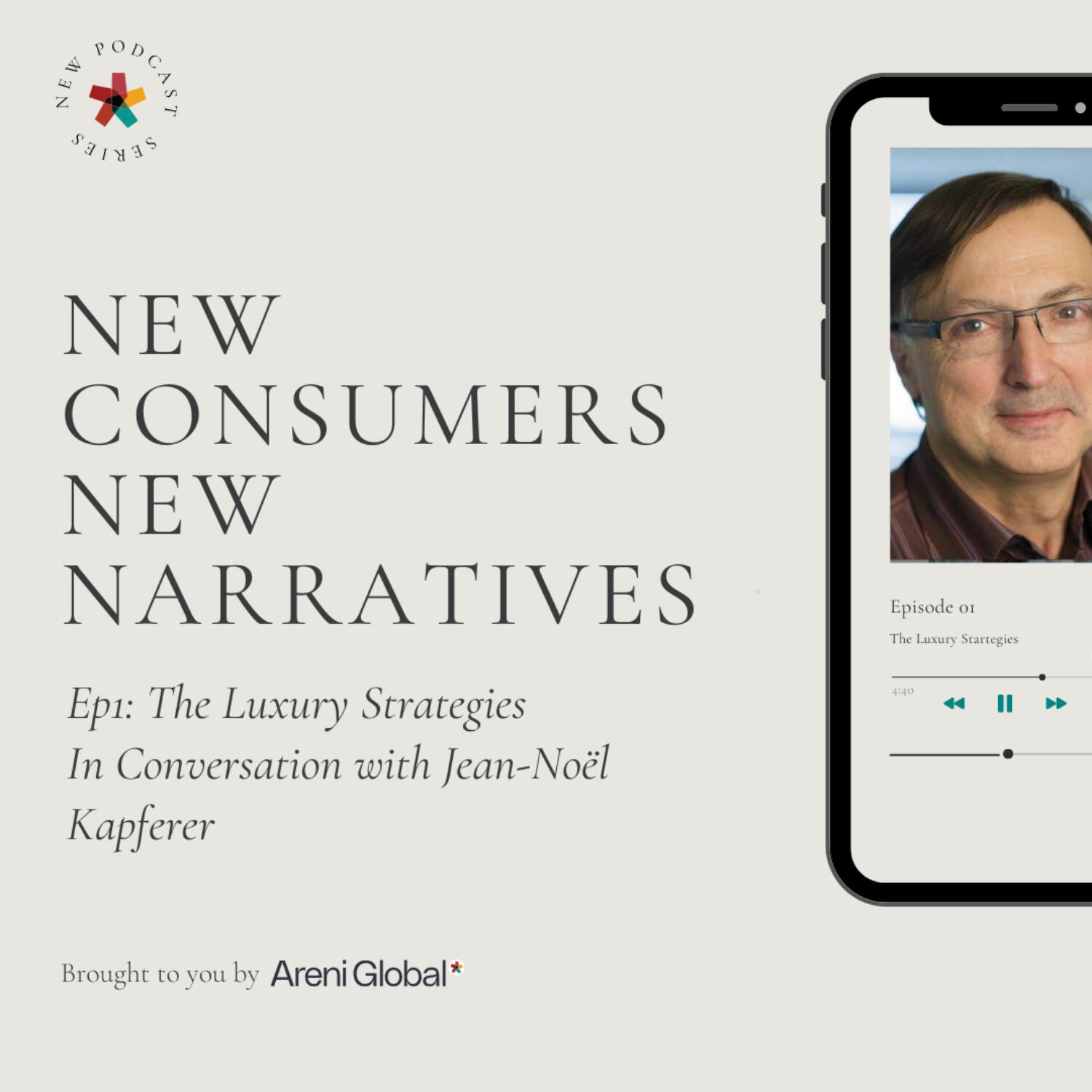
NCNN Ep1: The Luxury Strategies: In Conversation with Jean-Noël Kapferer
87m 58s
This podcast episode, hosted by Pauline Vicar of O'Ringly Global, explores how the fine wine industry can engage new generations of consumers amid shifting attitudes toward alcohol and luxury. The guest, Jean-Nuel Capvereur, a luxury brand strategy expert, provides three key definitions of luxury: what is socially desirable but not accessible to all, needlessly expensive, and outstanding products with emotional qualities. He emphasizes that luxury is not universal but culturally relative, contrasting French notions of history and hierarchy with Italian focus on craftsmanship and American emphasis on speed and inclusivity. The discussion highlights that younger consumers initially prioritize creativity and sustainability, but their preferences evolve toward traditional luxury as they age. This has implications for wine brands, which must balance exclusivity with accessibility and adapt their messaging to resonate across generations and markets. The episode underscores that definitions of luxury are strategic tools that shape business models, distribution, and brand identity, particularly for fine wine, which must navigate its position as a luxury good in a changing global landscape.
Any sector that wants to stay relevant must invest in the future consumers and fine wine is no exception. But everywhere you look now, people are reevaluating their relationship and attachment to alcohol, wine and food and redefining our current understanding of luxury, lifestyle and success. What does this all mean for us as an industry and as an individual brand? How can the fine wine sector engage with new generation of consumers in a meaningful way in such a changing environment? At O'Ringly Global we believe that complex questions require in-depth research. I am Pauline Vicar, the co-founder and executive director of O'Ringly Global, and in this new podcast series, new consumers, new narratives, I meet marketing industry legends, speak with academics and researchers and push the doors of private member clubs. Come with me as we discuss the best possible ways for our industry to invest in its future. In this first episode we meet industry legend and world-renowned researcher Jean-Nuel Capvereur. Jean-Nuel is professor emeritus at HEC, Ashucy, one of France's elite universities specialising commerce, marketing and trade and is the global expert on luxury brand strategies. His books on luxury and the new strategic brand management are world references and have defined the ways, generations and marketes have approached the luxury business. What are the best ways to define luxury? How do these definitions impact business strategies? Can fine wine even be considered luxury at all? And if so, or if not, what impact does this have on wine brand's business models? What can we do to remain attractive to our future consumers? Both as an industry and as individual brands? Well, let's find out. Jean-Nuel, thank you so much for being with us today. I can't tell you how excited I am about that conversation. I've got so many questions as you know, I think the biggest challenge for us will be to keep it to an hour. So I want to start straight away by how we love definition at Irene and how we spend quite a lot of time thinking about the definition of fine wine. And I wanted to ask you about your definitions of luxury. And I know that there are several, so maybe your three favorite definition of luxury and why they are your favorite. Yes, first luxury is not a world that belongs to business nor to wine. It's a part of common language. It's part of philosophy as learnings. So I have picked three definitions that make me think a lot. And I hope they will make new think also. The first definition is luxury is what is most socially desirable but not accessible to all. Okay. That is a motion of desire. We don't need luxury but we want it. We desire it. But it's not accessible to all. And that's the source of its value is that there are obstacles. And this is true as much as for us. You know as to fine wines as to fresh air or silence. Silence is very desirable but very few people can in fact access to silence. So that's the first definition. A second definition that I like, I read it in a blog of a California expert called Seth Godin. And I like the American. He says luxury is needlessly expensive. This is very very short definition but needlessly expensive really coins the fact that very very high price you pay for luxury has nothing to do with the function. It's it's it has to do with everything but need a need is something you need for instance you need to breathe. You need to eat you need oxygen etc. And I know here is nothing to do with that the basis of the price which is part of the definition of the very as nothing to do with any. Fulfilling any function but being expensive. A third definition which I like because it's it's quite precise. It's outstanding products with emotional qualities. So very is notion of very highly emotional things can be services by. But it needs to be outstanding non comparable because if it's only very good where we have the worst premium or find that that are enough. Outstanding make put a foot somewhere on something that is not normal but you need to add emotion and a lot of things which are remarkable but not very emotional. But emotion is what puts people in motion. Yeah great definition that I've got so many questions to follow up I will add to that one of my favorite definition of luxury was given by Maggie Enriquez who was at the time the head of of Krug I'm sure you know her very well and she was talking about luxury from coming from locks and the Latin route of light and actually luxury being a light. So something that leads the way and that's also something that echoes a lot for me and you know adds a dimension to those very very interesting definition that it's also something that guides people and leads by example and I think it's an interesting definition to have in the time that we are living in as well. The etymology of luxury is no flux. Yeah no. But luxury managers like to in fact create a storytelling about the etymology because this storytelling is useful. All sectors need to legitimate themselves and it's you know flanting in a way to say that luxury comes from light and luxury is enlightenment. It can also be the you know darkness. Yeah the absence of light of course. So far there's as you know there's an evolution of the conception of what is the etymology of luxury and luxury is closer to success you which is something apart. Okay. Something that goes with trade and it's very important because luxury is not more of something is somewhere else and this is very important for all the questions you will raise during this interview. So not something more but somewhere else and something else? So yes very important. This is why the pricing tell be only 10% more than premium or fine. It has to be you know an FHE the supercar of Ferrari that is going to be the new great supercar of Ferrari is 3 millions and 500 thousand euros. It's somewhere else. It's needlessly expensive and the price itself is the message. I wanted to come back to the first one where you said about the social dimension of luxury. Social units are right. Yes. So it is desired socially in the way that it has to be desired by a lot of people also to make it luxury if it's desired by one or two people in the world then you know. But so it raised the question to me and that's a conversation we had before and I have heard you talked about but how relative is luxury to a given market or to a given moment in time? How much does the notion of luxury evolve depending on the cultural context? First it is desirable socially. Social means it has to be desired by a lot of people but you forgot the second part of the definition. It's not accessible. Now a lot of things which are very desirable but accessible to all. This is not a luxury. This is progress. Of course. If you may, if you can't create progress because everyone can you know benefit out of this desire. Now it's the difference between a lot of people desiring and few people accessing which creates the engine of demand. So now you are asking me about the cultural differences. If we were in Italy we would not be talking about luxury because they grasp it. But in Italy we would never talk about Lousseau. Lousseau is the translation of luxury but it's very important that the syndicate, the professional syndicate unifying all the actors of what we call luxury in Italy. They don't call themselves Lousseau. They call themselves Altagama. And Altagama means high range. So it's very interesting that in fact the French love this word luxury. And VMS calls themselves in auxiliary groups. Colbert talks about luxury. But when we go out of France they do luxury but they don't call it that. There's a lot of positive notion around luxury in France as well. You mentioned the committee Colbert for the people that might not be familiar with it. It's the syndicate of all the Maisons du Luxe and every company that works in a luxury sector in France coming together to define what luxury is and what French luxury is. We will talk about French luxury in a minute. So it's important to see that as soon as I go in Italy and I love Italy because I think it's the country of culture, beauty or it's incredible. The whole country is a beauty park. But they don't call it luxury as if they did not need that word. And second.
second, that the conception that they push in Italy is quite different from the French conception of what is or what makes, because in fact luxury is made. It does not exist, it is made, it is something an output of a number of behaviors. And what I want to say is that Italy, for instance, doesn't care about the past and cares a lot about the fabrics, the material, the craft, et cetera. They are very much in the, how would you call it? They are not bragging, they are very humble. Even the wine industry in Italy, they keep on being humble. It's very, very different from, for instance, the Bordeaux Grand Cru Classé, who are early built on aristocracy, et cetera. So the meaning of what we call luxury beyond the fact that some countries don't use the world is different. So I mean, can we talk about the French luxury? I mean, we two French people, and I had this conversation in multi-international context. I think the French have a different way than the rest of the world to understand or to define what luxury is and what luxury businesses are, and why did it all come together and how did it become sort of a benchmark for the rest of the luxury world? That's kind of three questions in one. In fact, beyond brands, the competition is a competition of visions. It's not the French versus Etc. The French companies, the French syndicates historically have exported their vision. And it's important that this vision, for instance, the Chinese have been influenced by this vision because brands like Hermès or Vito, et cetera, have entered China. And the Chinese, they are therefore learned about this world that they don't know, which is called luxury, through what it meant for French brands opening stores in Shanghai or in Beijing, et cetera. So what is important to see is that it's not the French, let's say, lack of humility. In fact, there is a vision that luxury is here to elevate people above their level. And there is behind this a hierarchical vision, which is very different from that, pushed by Americans, for instance, or pushed by Italians. And this vision is coming from the 17th century or 16th century. And it has been considering luxury as a key element of the soft power of the state. So it's part of our diplomacy. It's like the French food or the French, whatever. It's part of politics. It's part of the expansion of the very petition and of the power, which expresses itself through armies, through weapons, through soldiers, through wars, but also through culture, through elegance, et cetera. And this is why luxury is a political asset, in a way. And this is very tied to a period of France, where France was very successful. Now it is less successful politically, but we have kept the elements of success from the past called luxury goods. Yeah. And what you were saying is it's very much linked to the past, to history, to legacy, to the fact that those brands are rooted and they've been here for a very long time. If we take a business approach to luxury, the interest of having a definition is that definition should put you in a good perspective. So as France, as history has a land and has a know-how, we push these elements in the definition of history, of luxury. Whereas for instance, as I told you, Italy doesn't stress so much the notion of history. They are much more in the present time, the trend, the fashion, et cetera, because the creation of Italy as a single country is much more recent than the creation of France. So in fact, definitions are ways of putting you in a good perspective and in a sort of monopoly where in fact you have history, so you rely a lot on it, and those who don't have history, they have a problem with this definition, but they have not pushed their own definition. So they are in fact second in rank compared to the one who came first, who owns the denominator. And we can use this also for the Michelanguai. The Michelanguai is very interesting because you could say why is the Michelanguai the reference worldwide? Well, because they push a vision on which we are very good and on which the other competitors of the other countries have less assets. So there is a notion of definitions are not there by definition, but they are there to put you in a very favorable position. So how do you other countries react today, again, just to finish to understand how other countries might understand and might do business differently around luxury. For example, in the US, how did they react to that knowing that they couldn't have exactly the same definition as France? What would be their definition of luxury? How would it differ? Like a luxury brand in the US versus a luxury brand in France, a French one versus an American one, how they differ in the way they see things. Well, they differ in the way they do things. Okay. It's very interesting. I once took part in the discussion with John Idol. I don't know if you know John Idol is the CEO of Michael Cors. And it was in New York and John Idol said, "We are the fastest growing luxury brand in the world." And it was very pleased to be the CEO of the fastest growing luxury brand in the world. Now, you will never hear any CEO of a French brand or a French group stressing the speed of growth. Because if you want to have the speed of growth, you will favor a lot of channels of distribution that give you the speed of growth. Second, you will not hesitate to go into outlets and off-priced channels. In fact, you will consider that taking time is not as useful as going fast. Whereas in Europe, I would say, people say, "Well, below 10 years you cannot build an luxury brand." Because the only way to grow fast is really to be not very exclusive in terms of selective distribution. And so, the difference between American luxury and let's say European luxury is the relationship to time and the relationship to speed. Because speed means that you take your time, if you know, you will go only in very high-end stores of internet platforms, etc. In the other case, you will say, "Well, we don't really care. The important is to get high market share." So, it's really the way you manage the brand that makes the difference. And I think that in the US, which is an immigrant country, the notion of exclusivity, which means excluding people, is not very well accepted. This notion of luxury as a stratification, social stratifier, and a diminution of a number of people, excluding, is not in the culture of the United States. So, they are luxury brands, two-f� years, etc., are not as exclusive. It's not a criticism. It's just, it's not that culture. Yeah, it's very interesting. And it's very interesting how that's still visible today in the wine world. And in choices, just like distribution, where sometimes people in Europe won't take an option for wine distribution because that would be too quick of a change or too quick of an increase. And it's not that they are afraid of growth is that really, as you were saying, the importance of time and long-term vision, it's so rooted, whether or not, you know, I'm not just talking about the most expensive wines there, but it trickles down to the rest of the wine world most of the time. So, thank you for explaining the difference of context, which I think are fascinating. And we can spend hours digging into that because it's really interesting. Sociologically and anthropologically and everything. But I wanted to go back in terms of context on, we explained on market and on geographic difference. How relative is the understanding of luxury when it comes to generation? So, my question being we see a new generation coming in Germany aspect seeing the world in a different way and living in a different world. Will they change the understanding of luxury or is luxury actually quite absolute anyway? This is a very good question. The meaning of luxury will change all along our life. If you take new generations, they are called the young ones. In fact, I'm not sure they value a lot craftsmanship, tradition, history, etc. They value where the enter of the market, they [BLANK_AUDIO]
value, creativity, singularity, quality always, and what you may do in terms of sustainability or not, etc. This is when they are in between 25 and 30 years old. But we all evolve. And I think that through time, the new generations, as they grow older, will rediscover the benefits of what we call the traditional luxury. But when they enter the market, they want things that resonate with the reason why they consume, they want more creativity, they want new things, they would parents and say, "Well, are there sulfites in the wine or not?" They may expect from people who supposedly represent excellence, a number of things that, in fact, their previous generation did not expect. So there are two things to stress. First, one generation vis-a-vis the former generation, second, within the cohort, that is, within the new generation, as they grow older, they change. It should take oligarchs. Oligarchs, Russian oligarchs, that is, billionaires, or Chinese oligarchs. The role of wine in their life at the beginning is competition. Competition is fun. Wine for a millionaire or a billionaire is not expensive. Even a Romanecante bottle is fun. It's a price, if you buy 10 bottles, it's fun. For people who have really money, it's fun. So at the beginning, the competition around wine is a competition with friends and the duality bottles you have, what yours, etc. But 10 years after you take the same people, they have changed. They are more in depth into the wine culture, etc. So their whole attitude will probably change and they will become collectors. They will not buy wine just for investing reasons. They will become experts. They may even buy wine out somewhere. So there is this notion that luxury accompanies you not only generationally, but also within your own life cycle. Is that something that you see in other branch of luxury where young consumers, and I understand how limited that expression is in young consumers because they certainly not. I mean, young people are the former ones. Yeah, younger than the former ones. You need money and they need money because not all young consumers, this is something very, very important that we need to keep in mind. On the whole, if you look at the Bane data, the Bane data estimate that the whole luxury market, whatever it means, is 5% of the population, which means 400 million people. And there are 8 billion people on earth. So we still are thinking, talking about young people who are enough money to buy things which are needlessly expensive. Most people buy things which are not needlessly expensive. But they are needed. Which are not expensive at all. And they are going to shine, going to Zara etc. gives you a lot of ways of creating your own image at a price which is very accessible. So the question is, we are addressing the young people who need the expansiveness as part of their building of their own status. Do you think that we will see either the actual brands, and I'm talking in luxury perfume, jewelry, like the classic luxury segments. Are we going to see the traditional luxury brand have emulation of their brands that will be about creativity, that will be about sustainability, and then keep the Maison-Mer about the traditional values. Are we going to see new brands that will cater to luxury at the beginning of the journey and then of the younger consumers that will finish with the traditional brands? Or are the traditional brands completely going to change their message? Like what are the different scenarios? You talked about Maggie Enriquez, the former CEO of Kog. Kog, for a while, was on the top of the pyramid. And after the Second World War that was very a long time ago, the United States were the big winners and came don't worry about it. But don't worry about it was nowhere before and became the new star. Then came the Russian regarts 50 years after and came Christophe Rodová. So each new generation needs their new gods and goddesses. Okay. Doesn't mean they forget everything else, but they need, it's like music. New generations have new cult musicians, new music, etc. new heroes. It doesn't mean that the party is over for the former ones. But you need more maturity. The first thing when you are young is create your own identity and identity in these elements of cult. And this cult is not generally what your parents loved. This will come later in your life discovering the value of things. But at the beginning, it's the social value of things before the inner value of things. And the social value of things is insisting on the social desirability. And this is why there will be celebrity wines, celebrity champagne, Jay-Z for instance, champagne, etc. And this is part of the luxury of new generations. And later they may come back to don't worry no or to polroge or whatever. But at the beginning, each generation needs to say here we come with our own vision and culture. And they will probably insist more on the social dimension, the luxury for others than the inner dimensions. What's in it that makes it a luxury good? Can you actually expand on this? Because that was a question that I wanted to ask you. I've heard you said that luxury value consists of two elements, the luxury for the self, so the self reward. You do it for you to feel good. But the luxury for others, which stems from the emotional pleasure of flaunting prosperity. This is very important. You sure are buying only for others. You always know. A lot of people, the buy things they don't understand the value, but they know the name is very known. And they being known, it will make the others look at you and say, "Ah, look, they are drinking this or that." The good stuff, yeah. So it's part of human motivation to be loved, admire, and respected. So there's nothing wrong in that. This is called luxury for others. The main motivation is a social motivation. And if you don't understand why, which is what happens with the new commerce to the luxury world? Most of the time now I travel to Asia. I go to Korea, to Seoul, etc. And people, they order the most known Bordeaux, Burgundy, wines, etc. And I say, "Do they understand what they are doing because they are drinking them with beer?" So I say, "Well, it's something wrong, but you know what?" But I say, "Okay, in the meantime, maybe later, they will understand why these wines are so expensive and it has nothing to do with the social dimension. It has to do with the inner dimension." And to summarize what I'm saying, we should not ask, "Is this luxury or not? Is this bottle, a luxury bottle or not? Is what is the luxury in it? Where is the lover?" And when you say, "Where is luxury or what is the luxury in it?" Then you are addressing the luxury for yourself, because luxury is a new relationship to the elements that make it non-comparable, superlative, and no comparable to anything else. Now, new generations, they stress first, what image will I cast if I drink this or that? Okay. This is the luxury for others, because the identity of you and me is first the social identity before being an inner identity. It's easier to define ourselves as your friends than the other themselves. It's very difficult to say who I am. Yes, that's one of the hardest questions to answer, and then it's what do I want? It's the next one, which is quite difficult to answer. Before moving on to the next topic, I just wanted to go back to one of the definition, I think the first one. You mentioned the social desirability, but the fact that it's not accessible to everyone. And I want to come back to a term that I've heard you used a lot, which are the obstacles that a brand creates for consumers to access the product. Can you touch based on those different obstacles that may or may not have been invented by the friendship? I understand correctly. Not only with friendship, you know. If you produce very rare single malt whisky, they're hard obstacles. They're hard obstacles to the culture. These obstacles can be divided into many parts. Okay. Which means, by the way, that luxury is not something which is something you create or you create. It's a way of doing things. And there are people who don't, okay, who don't want to play that game and where they play another game. And there is nothing wrong. Even if they call themselves luxury, in fact, they are not putting in action a luxury strategy. My book is called Luxury Strategy. It's not called what is So for instance price is the first obstacle. Second distribution is the second obstacle. Feld availability is the third obstacle. Hermès is very known for instance for managing the kind of scarcity by not producing enough. The Ferrari does the same. Ferrari produces 13,000 cars per year and and pork is 200,000 and more. So in fact each brand defines what the level of exclusivity they aim at. And some are very, very exclusive but creating too many obstacles has a problem. Is that is volume at the end is too short to be profitable. But in the meantime if you open big doors and you have no obstacles you are not in the luxury business. You are in the premium business you are in the whatever business you want and it may be very profitable. But you are not in the luxury business. The luxury business is there won't be enough for everybody. But other obstacles which are cultural. What is a cultural obstacle is for instance there is a big difference between advertising for a luxury brand and advertising for a premium brand. Advertising for a luxury brand does not need to be understood. That is why most of the time you see advertising for carcassier etc. And you say one hour you cannot really say oh they are telling me this. The promise is that and the benefit is this. Everything I learned about advertising was make a promise, state a benefit etc. When you look at advertising of product etc. you see bizarre pictures, bizarre photographs etc. Which apparently cannot be understood by everyone. So there is a cultural obstacle. And I think I have heard you say that is that the true luxury doesn't need to explain itself. When the old gam or the premium you have to explain and you have to state why your quality is better. Is that right? Yes and this is why the luxury is close to art. Because when you see for instance La Joconde and the Louvre, in the Leonardo da Vinci painting in the Louvre, below the painting there is no explanation of why it is she smiling. In fact they don't give you any explanation. You just have to take it as it is. Whereas when you are not in art, people ask what does it mean? What does it represent? What do they want me to think? As soon as you are in this frame of mind, you are more in the classical business or marketing which is premium products. Because premium products have to explain why they are premium. In luxury you don't explain anything. It's a statement plus a behaviour. Behaviour pricing, we are your obstacles, behaviour of excellence, behaviour of relying on the past, relentlessly etc. It's a way of doing it. I grew up in a time where luxury was mysterious and you didn't see anything and everything was happening behind closed doors. I'm not saying behind closed doors. I'm saying that the problem of luxury is to always try to rebuild a difference which states we are another world. You cannot compare us to anything else. And this is why they behave as they do. They say, "Okay, don't use the same grids, the same criteria to evaluate what we do, that you have been evaluating, for instance, premium goods or others." Yeah, because that doesn't mean that you can't be transparent or that you can't be authentic to use a very trendy word. I see the nuance there. You're talking about, so that's the perfect segue because you're saying, "You can't compare us to others. We are somewhere else." I really like that part that you said. And we act differently as other people. It's very important. It's like comparing goga and van Gogh. Who is the best? The question is meaningless. And if you are going to a Rolex shop and you are talking about what Mark Piguet, the Rolex salesman will probably say, "We respect strongly what Mark Piguet, but we cannot compare." It's like, "Goga and van Gogh, you cannot compare two pages. You cannot sell this one, it's superior to the other," etc. Whereas as Suda is going to the fine wine domain, etc. There are more objective elements of comparison that can help you say, "Oh, but I prefer this or that." Hi, listeners. Two very quick things before we go back to our conversation. This podcast series is part of a larger, a reneglobal research project and we have a whole series of articles and publication in the pipeline. So don't forget to subscribe to our newsletter at erine.global to be the first to read them. I'll put all the links in the show notes. And if you like what you've heard so far, please do subscribe to the Euronee podcast channel, none of the platforms that you are listening this episode on. And give us a call rating. It really helps. The more subscriber we have, the more resources we have to continue our exploration. But back to the episode now. So one of the things that I wanted you to comment on was that you said, "Let you can't use the classic benchmark to compare us with other people." And I've heard you talk to lots about the "Loxification of Society," which makes me wonder if we are at the end of a cycle for luxury, because the minute everyone talks about luxury, then no one is luxury. Can you comment on this and what do you mean by the "Loxification of Society?" Well, first I did not create that word, it's just a word that is becoming more and more used by experts, etc. "Loxification of Society" refers to the fact that everyone calls and sends a journey. Yes, like little. Yeah, and I would say the less people know what is luxury, the more people use the word. And, okay, because the word "sense" the word is magic. It's like art when you say everything is art, okay? If everything is art, that's great. So the question is, what is the "Loxification of Society?" Now you have luxury in macaroon, you have luxury in shortlets, you have luxury in skincare, you have luxury in. You can't find luxury in every part of your daily life. But of course, it's relative luxury. It's not luxury like you would say, "Rose is luxury." That is luxury for everybody. The relative luxury is a luxury for you, but not for somebody else. So, in fact, there is no judge of peace to say, "Oh, you should not use the word." Everyone can use the word. I remember I was recently in Miami and at the airport, there was a store saying, "Luxury at $10." Yeah. What does that mean? Luxury at $10. But I mean, maybe for somebody young who doesn't have very much money and who wants to make a gift, a nice gift to his mother or friend or whatever, he would say, "Okay, I only have $10. What can I buy? I can buy M&Ms chocolates at $10. You should just be, you know. No, I want to do something special." And Luxury at $10 says, "Even at $10, you can have something special." Okay. Now, this is a very relative, it's also called accessible luxury or very accessible luxury. So, this is a justification of society that is now you find the word everywhere and there are no judge of peace to say, "I'm sorry, you should not use the word." The word, we live in a word of freedom and the world's ten cents are accessible to anyone. So, relative luxury, I understand, and it's what's luxury for me and might not be for you. When we go back to the absolute luxury that you've mentioned, then you quoted Rolls Royce as an example, are the absolute luxury always absolute through time? Is it always going to be cars and jewelries and things like this? Nothing else forever, I, you know. Yeah, even time and. So, it's true that the luxury industry likes to say that they think long-term. Jean-Widdumain, the late Jean-Widdumain, they have managed Hermès. Once I think said, "We are here for 100 years again. My job is to maintain Hermès in 100 years," etc. Yeah, we've got 200-year plan in the wine world, yes. Yeah. Will Apple still be there in 100 years? Will Apple still be there in 20 years? They high-tech, the Silicon Valley, they are successful because they had, they don't think that way. What is important is the pace of change, the speed of change, and high-tech is by definition a constant redfinition of what is the most progressive form of technology. So, although we can argue and have heard you argue that before, then tech and luxury can be opposite because tech is about functionality when luxury is not. Which, my question was more on the absolute luxury, maybe not a brand, maybe Rolls Royce in particular won't be there tomorrow, but were the type of goods still be the same? Because I've run around, you know, that definition given by an American futurologist that says that, you know, the modern luxury are the three teas that are time, truth, and trust. And I've heard also, you know, all of this, which is, you know, luxury is a hot chocolate on the rainy day, reading a wonderful book, just like you were saying silence, for example. And there's this notion of like, luxury is what you can't buy because,
because it's so desirable, less, less, and less accessible. And I wonder if, because those goods are desirable, but they do not cost financial money usually, is it a way of reconfitting the poor people that can't buy the thing that money can buy? And just said, you know what, have a quite life. I used to unlock it, 'cause you can actually look at the rain, falling from your window, and that's the true luxury. You can go and go camping and be in nature. And there's always a part of me, which is like, you know what, no, that's not really luxury. That's the kind of thing. Can moments be luxury, or will it always be good? - No, no, no, first, it depends if we talk in the business context. In the business context, luxury is interesting. As long as it creates value, it creates a market, it creates, et cetera. Now, as I told you at the beginning of the interview, Fios offers have been discussing about luxury. At the Greek, at the Greek, at the Greek, or at the Roma, at the Pope. So luxury is not part at that time. Nobody talked about business or marketing, but there was already this notion of things that people do without any functional objective over than their mere pleasure. So, where I agree with you is that there is luxury for others, there is absolute luxury, relative luxury, and my look, and whenever you ask the question, what is your luxury? People never mention products. They generally mention things which are not in the market, but they are things they wish they could be doing much more, but they don't have time or they don't, there are obstacles. There is always this notion of obstacle to a goal and idealized goal. So, a lot of people would say, I wish my look is to spend an afternoon with my children, and I wish I have more time with my business life to spend with my children. So my luxury is taking this time, and time is probably one of the rarest things we have on Earth looking from a longitudinal perspective. So my luxury is not a product, but in the context of this interview, if you want to create a market, it must be transferable into money. And this is why so far silence is not a market. Well, it can, I mean, all the fancy hotel that pamphes you and gives you a parenthesis of quietness in the world with no noise. And, you know, kind of is, I think you can monetize quiet and calm. It will become a market and a luxury market, if it is expensive. If it is expensive, yeah. OK. If it is expensive, there are places where you have fresh air, pure oxygen, high silence, et cetera. It's the North Pole. And the cruise boats that go there at a very high price sell you, in fact, the elements of rarity that you are defining. So I'm not saying there is only products by definition. But if you want to transform them, this luxury into a market, it has to create value and attach a price to it. I see what you mean. Let's stay on that part of business and luxury business and luxury brands. So one of the definition that you gave in your book is, you know, luxury product refers to high quality, hedonistic products, often handmade, that express traditional heritage and are sold in selective environments at a price far beyond the function utility, such that they are associated with taste, elegance, and the elite. That's where we've got a bit of social class kind of analysis here. But so if you are not a luxury brand and you feel product and not luxury product, what else can they be? You've mentioned Oud's Gam or Artagama, you mentioned premium. Is there a hierarchy on more expensive things? Yes, it is. The big difference between luxury and offers is that if somebody said, you are a luxury brand. If by asking an incredible price, everybody finds it normal. OK. And if you are not a luxury brand, then you are the same price. People will say, this is just stupid and crazy and meaningless. When Hermes asked 100,000 euros for a Berkine crocodile back, people say, "Why is there a mess?" Now, let's suppose coach asked these people, they were totally, they are totally crazy. That's so funny in the wine world because some of the regions really do suffer from this because you can't break the price ceiling of some regions. Because people are like, what 40 euros for that wine? That's ridiculous for a wine that comes from less than one regions. But 3000 for another one that's, that totally makes sense. So how does that pyramid look like? So we've got luxury, which is somewhere else. And I think that you made that very clear. It's very much like everything you do, when your strategy is to be creating a luxury brand, everything you do must look from another planet. And so if we look at other expensive goods, so if you come back to a regular planet, how does the hierarchy plays and is organized between premium, odd gum? Is there a clear-- Premium, an odd gum for me is the same. OK. Premium means primus from Latin primus, which in first. And if you say, I'm the first, there must be a ladder somewhere of comparison. And if you are in the premium market, generally, you make your quality explicit. You say, OK, this is why I am in the fine wine market, for instance. And this is what already said in one of the very excellent podcasts before is, there is a man who has a vision of the kind of wine he wants to grow. And there is an authentic vision, a long term vision, and a very applied vision, et cetera. And he actually achieves his vision into the making of their wine. And this is for me the essence of what is called a fine wine. There is a man behind. Now, La Fithrochille, Bordeaux, the Grand Cruc classé, La Fithrochille, there are owners, there are growers, but there is no more project, there is prestige, there is history, there is exclusivity. We are in another world, but we don't talk anymore really about an agricultural product. And the man who-- there is no real project behind. There is just prestige. And prestige makes that people don't discuss. They say, wow, I have the chance of having this wine at my table today. When we are talking about premium and older guy, there is a project behind. And we there is a man or woman behind this project. And they can talk about their life, what they are doing, et cetera. So I guess my feeling is that I'm more interested in fine wines today because there is much more innovation. There are people doing this. There are inventing new wines, inventing new tastes, inventing new qualities. They are not in the real business, but who cares? They are in the business they want to be in. That's fascinating because it's the first time I've heard it explained the nuance between the two that way, is that fine wine is about the people and the vision. And actually when it transcends that, when the brand becomes so much more, because loads of those prestige luxury wines, investment wines, secondary market wine, however, we define them. Most of the time they've started with that fine wine
ness of having a person, a project, a vision. And then they grow into something more. And they grow into that highly desirable, extremely difficult to access wine either because they wanted it, and that was by design, or because it kind of happened to them without not too much control of it. But then when it becomes something else, when it goes beyond the vision, that's when it's actually prestige and luxury, and it can exist without the people behind it. I find that fascinating. But let's focus on wine now that we are on it, because I've heard you said before that there's no luxury wine. So I wanted to ask you about this. Can wine be a luxury? I think that wine can be part of a luxury life. Wine is at the edge of a luxury life. But wine, in any case, even a 5,000 pounds bottle, is accessible to the rich. For them, it's fun. It's not an obstacle. At that level of price, this is not a yacht. This is not a private island. This is not a private jet. This is quite accessible to the rich. For them, it's not a financial obstacle. But for all the other people in the world, it's out of reach. This is why we have to make the difference between relative luxury. Relative luxury. It's a luxury for whom. Well, if you are unreachable to the majority of people, you are an absolute luxury. Now, let's take a bottle of wine at 200 pounds. It's not an accessible. It is accessible. Even a worker-- I'm sorry-- if he wants to say to a younger, who is lower or below, I love you can put half of his salary into a bottle of wine because wine is sacred. It's a--
it's something which says much more than simply, you know, what it is made of. Yeah, I understand like even 5,000 euros for a bottle of wine and I don't want to sound terrible. Or something, but it's nothing. Yeah, and even for, I'd say, you know, I don't want to send disrespectful to anyone, but even for middle-class people, if you really want it and you say for five years, you can buy it like, it's not like something as you were saying, like 300 million or something, like sums that I will never see in my life probably. I did not fully answer no question who said, well did I say that there are no luxury wines? The first thing is that we are still a kind of product, which is quite accessible even though most of the people we say that makes no sense, makes no sense. Second, I've never seen anyone coming to a restaurant and say, give me a luxury wine. What are your luxury wines? People enter and say, what are the luxury watches? What are the luxury cars? What are the luxury hotels? But I know no why. There is a reluctance to talk about luxury wines, but people would say, oh show me your most prestigious bottles. Prestige is not a problem. Prestige has less difficulty entering the stage, than luxury when we talk about wine. And this is why I know companies like Perna Riccard, who are selling wines and spirits, their segmentation of the range comes from the highly accessible products to most prestigious ones, but they never mention luxury all along the range. Prestige is an interesting word. Do you know the origin of prestige? I don't think I do know. Well it's very simple, I didn't know so I looked at what is the origin of prestige? Prestige comes from impress. Yeah, so I'm not surprised because it's mostly luxury for others, right? Prestige. Well there are some people who say there are no luxury brands without prestige. Because if you are not prestigious, you are premium, you are delivering things which are excellent, but the vision of you will not cast a positive image of you, something that prestige is something when you have a prestigious car or a prestigious whatever, it's your only image which is in fact changed. Now when you are drinking a very fine wine or even an luxurious wine, it's your relationship to the product that is changed, but no one knows exactly what's going on between you and this product. So prestige is the external facet of fame. That's what you were talking about luxury, you know, for others, the upwards. And I guess in fine wine there's a lot that can be said about the inward dimension, like the self-luxury, and it's about what I like as well. I guess I would never find someone that used the terminology fine wine actually admitting that they've bought wine that they don't like, like your personal taste for fine wine is always really, really important. And I've heard also, you know, one of the things that we say in the wine world that wine can't be a luxury product because we don't have 100% control of our distribution. And because we go through distribution chains that I've got so many different intermediaries and middlemen, that just because of that we can't be luxury. Is that a good criticism? Is that a good analysis? Do you think like this? It is true that part of the luxury strategy is get direct contact with your end consumer end client. Spirits and wines don't control their end client, they control the middleman, the importer, the agents, and then the experience of drinking wine A or whiskey B or cognac C is that is in fact delegated to someone else. Now a good luxury brand, generally, is very, very selective about the distributor that in fact are in charge of being the ambassador of your brand in different countries. So there is no luxury brand without selective distribution. Selective distribution is the intermediate just before selecting your end clients. Okay. So that somehow I can take this as an excuse and funnily enough, I think that's what a lot of wine brands have realized and that's one of the things that we wanted to demonstrate through the series we've done on the plans of the board, is that there is precision distribution. I guess we had precision, physical chair in the 2000s and now we are in the area of precision distribution. Where we acknowledge that we can't be B2C in most parts of the world, you can't have 100% B2C, but you can have precision distribution. Some brands or some groups I should say because brands, the problem of brand is size. If you are alone, if you are a champagne brand within a group with five of our champagne, you have the power of doing things that you would not have the power to do if you were alone. I know a lot of brands now who do, who DTC, they sell DTC which mean direct to consume. They deliver the products onto the yacht. Yes. In the private jet, in the villa, on the island. In fact, it's a level of servicing and of personalization which is remarkable, but then you address really very rich people. They will not order one bottle or not, but hundreds, hundreds of the top. Then you are direct to consumer, delivery, selling, etc. In fact, it's probably one of the most exciting thing you can promise to a very important person is direct access to the provider in self, to the producer. If you say, "Well, you can talk to Mr. Bonperignon when it does not exist, but to the CEO of Bonperignon, that's a fantastic thing you can promise." You've mentioned that the last step will be to select the consumers. Selective distribution is the last step before selecting your consumers. Luxury brands and wine brands in particular. I ask this because that's something that I see happening more and more, a tendency or a willingness for wine brands to pick the exact consumers that they want to sell. I think about a top wine that I'm not going to quote, but someone who you arrive as the export director and looked at the people who had allocation. It was like, "Well, this is just the guy that read on part of the estate. He worked on the terrace two years ago and he had an allocation, but clearly that's not the type of clients that we want." It was like, "Well, if the guy who stunned the terrace two years ago has the will to actually buy your bottles, why should a need be in your client list?" Is it a dangerous exercise? Or is it actually a very good exercise to be very precise on who you want to buy and to consume your product? What you want from your customers is not only their money, it's their prestige. What you buy from your clients is not purely cash, is in fact, do they have some prestige and can that prestige go to my brand? Because prestige does not come onto brands by kind of holy miracle. It prestige is given by the key clients. The candy bag God is named from Grace K. The backing bag God is named from Jane Berking. So the clients we want from our clients not only their money, but their aura and reputation, which means that for instance, if you go to Ferrari and you say, "I have a lot of cash and I want to buy a Ferrari," people will say, "Okay, first you have to queue. You cannot buy a Ferrari just because you have a lot of money." And it depends. You have access to Ferrari's where anyone can buy them. It's 300,000 pounds and you have very, very exclusive Ferrari's with a queue to at least two years waiting and they send them to already owners of Ferrari's. So this is our Ferrari. Select the kind of people all across the range from those who will never get one and through those who can enter a store and get out with the ready, you know, accessible Ferrari, accessible minstri and 100,000 pounds minimum. Okay. So the idea is that there are some brands who try to control the people who will become the ambassadors of their brand because as soon as you wear luxury brand, you become somehow the ambassador of that brand which stays, you know, because of its logo and the visible signs on it, this person is wearing my sign. So in fact, is carrying my values and you cannot let anyone carry your values. I understand that. I understand that for prestige. But this is generally very much criticized. Yeah. This is criticized, but this is for instance the basis of the success of Hermes. They don't sell to anyone. But they don't tell you we won't sell to you. They are a number of products anyone can buy and others you say, oh, I'm sorry, you have to take an appointment and maybe of this product we don't have in
anymore, etc. This is called creating artificial scotting. Yes. And artificial scotting is a way of infact selecting people. I understand that for a group or brand like Hermes, but we've just agreed that maybe wine is not a luxury. So I'm wondering if adopting that strategy of really selecting the people that can access your wine, because we do know, you know, artificial scouts it's in wine. That's how you do in distribution is putting less wine into more hands. But it's going a step further into deciding which hands gets access to that. The problem with this approach is that it's often an excuse not to address the new generations, the new clients, the new consumers, the new values. It's relying so much on the past that you become hostage of the past. And in fact, you don't evolve as society. Exactly. That's my point about the risk because I see more and more wine brands trying to become more and more invisible. So going back to an ancient notion of luxury that it was only just for the aristocrat and normal people will never even see it because it would be locked into the houses of the rich. So I see wine brands that now only distribute through private collectors network. So it's not just about the money, it's also about the connection that you have. It's about all the capital, right? Social capital, cultural capital and financial capital. And I can see the short term value of this of making yourself difficult to access. But in the midterm, I'm like, if you become invisible, if nobody sees you, then how can you continue to be desirable in 30 years? And I guess that's the perfect segue to ask you to talk about the equation of dreams because I think you've put that into numbers. Like how many people need to desire you in order to be bought enough by the right people? Can you address that? Yes, the equation of dream is in fact a nice world to explain what stimulates desire. And stimulation of desire is, and it has been proven through statistics by asking people who are the wines you would love to. We ask you two questions. The first question is, do you know these brands? And we list 50 brands. Second, have you bought ever anything from these brands? So for instance, if we take Chanel, it can be a lipstick, it can be a fragrance, it is not always a or a true true, right? It can be anything from that brand. And we noted, and the third question is, how much do you dream of this brand? How much is this brand desirable to you? And we notice that desirability was a function of the difference between level of brown awareness and level of ownership, which means that if you have no brown awareness, you cannot have desire. The desire has a part of, I buy something which is known, and the people will see that I'm wearing something which is known. And the second thing is, when this thing is too ubiquitous, too many people are owning it, desirability falls a little. It's not a problem in normal marketing because everyone knows Zara and everybody buys Zara, but they are not in the luxury market. Yeah, that's the mayor exposure effect. Yeah. Yeah. So because desirability at some point in time has a price, and there is desirability at 20 pounds and desirability at 2000 pounds and desirability at 20,000 pounds. And in fact, the distinction between I know and the obstacles to ownership, which is the basis of desirability in the luxury market. So yeah, the more desirable the luxury brand is, the more it sells, and the more it sells, the less it desirable. Yeah. Come back to what you said. If the channel of distribution makes that you will remain unknown, it's a problem from the standpoint of building a brown equity. Yeah. It's a problem. You cannot have desire on things nobody knows. Yes. So you have to be known, but you can't be bought by too many people. That's obvious. Yes. Yes. Unless you are in the fine wine business, where the notion of how many people is less relevant. Okay. So that's where you would put a difference for fine wine. Fine wine for me. Fine wine to be clear. Fine wine is where innovation comes from. Okay. I very in love with fine wine because this is where really there is excitement. Now, if you think in terms of prestigious sacred things that we will worship forever, it's more the luxury side, but if you want to see what's going on, what is new? Well, what is new? New zealon, what is new is the future wines which we will be growing in London. What is new is the bio wines, etc. In fine wine, there are human beings with a project and a vision and they are doing things that others have not done before. And that's very interesting and they can, but they will reach at a certain point the glass ceiling in terms of price. It doesn't matter for most of them. Now, if you want to move beyond the glass ceiling, then you will have to have more than a project. You will have to look for prestige. You will have to look for the sponsorship of great clients, etc. It's another story and it's another stairway. We agree that there's two different ways of managing your business there depending on who you want to be and how much you want to sell for probably. And if you want to be in that top 100 wines that do sell the same way to the same people, there's a couple of rules to follow. Do you know a champagne called Celos? Yes, of course. Yeah. It's fine. It's not a luxury champagne and yet you are bottled at 500 euros. But Celos is Jack Celos and the person who told me the first time about Celos is Houg. They said, "You know, General, the danger for us, our competitor is not redere or we've click on whatever. His new commerce, who are doing an excellent wine." Yeah. And in front, the body says that champagne is wine. People say champagne is champagne. Okay. At Coug, they told me, "Oh, but they are doing an excellent wine." So back to the product, back to the roots, back to the things before they get prestige, etc. There is a vision of somebody who says, "Well, that is surely a different way of doing things which will really create benefits to the client." And this is not a prestigious brand. Most people to whom I ask the question say, "I've never heard about it, but they are earning respect from their community and once your community around you feels that you're doing a great job, it's the first step that I want something higher." Now, where is this higher? I think Celos, they are not looking for becoming luxury. They are very pleased to where they are. Probably one of the most interesting innovations in the champagne world for a piece of years. Yeah. And it's really interesting what you say as well, because one of my question is, can you decide who you want to be? But I think you've been very clear from the beginning that, whether you are luxury or fine wine, the definition doesn't matter if it doesn't influence the way you act. So actually, you kind of decide of your vision and how you implement that. I want to ask you a couple of questions that everyone is asking me at the moment. I'm very curious to know your point of view. But we've talked about the consumers of luxury. We've talked about the new consumers. And everyone is asking that this question is, how we can bring the new consumers, maybe not just the billionaires of the world. We understand that in some case, they are important and they need to buy our wines. We also need to cater for the younger generation of consumers. And what is, according to you, the best way to cater for people that do have less money in that premium or gum luxury segment to actually make them comfortable with your brands. Do wine estates like a cheval blanc or a maceto or an ala, a laia accruge, needs to have kind of massaged kind of wines, or is it better to stay uniquely with the two wines they've made? Like how do portfolio management enter the conversation when it comes to making sure that the new generation is engaged if you see the point of my question? What comes to my mind is new generation means new ways of consuming. Okay. And by the way, new places also of consumption. It's part of new ways of consuming. For instance, I was very impressed when I saw the first pomerie champagne small bottles. I remember this small bottle. Yes. Yeah. Yeah. It was directly inspired by the way the young people go and buy beer. They come with a packaging with six bottles of beer and the people at pomerie, pomerie is, I would not call it a very brand, but it's still a champagne. And they said, okay, we cannot just ask the young people go and buy a bottle like your parents did and your grandparents did the same, etc. Okay. Second, they put color on the bottle. It was blue. But it was still champagne. It was still the same pomerie champagne, but they totally changed the packaging. They changed the conditions of usage of the conditions of transportation. And this is all they were young. They were young because they understood that they are new.
Okay, second thing, generally we associate wine and spirits, at least wine with restaurants or hotels, etc. But what about karaoke? What about the swimming pool close to the hotel? What about the music festival? I never understood the music festival. So I will instead of a very often new brands enter these new places, these new moments, these new occasions, these new ways, because they are much more reactive, because they are no other choice than much the demands. So what I'm saying to the great so-called great brands is there are many ways of innovating beyond the product, because the product is your treasure chest. So before you change the taste of the product, the way you produce it, etc. are be careful because this is what has put you, which has given you a long history and resilience. But there are so many ways of innovating beyond the product itself that exploit this and try to match the new lifestyles of the new generation. So we could see Cheval Blanc and Carol Kippah, for example. I would, yes, for instance, because it's where you drink that shows who you are more than what you drink. Okay, that's very, very interesting. I had another very, I don't know, intellectual philosophical question, but that's a huge debate in the wine world as well is one of the things that we have that is probably unique and doesn't really exist in the rest of the wine world. Is the power of the soft brands? So you were saying, you know, Pomerille is not luxury, it's still a champagne. So champagne in itself is a soft brand. And as I was explaining earlier, there are some regions, however qualitative a wine may be depending on where it comes in the world. It's really the monopoly, right? If you come from a region that is really at the beginning of the monopoly, regardless of your effort, you kind of know that you have a, the ceiling, your price ceiling is lower. Anyway, that someone that will do probably less quality, but is, you know, situated in those who'd like to be for the French people, monopoly. I don't know what it is for the UK one, the most expensive street in the UK monopoly or in the US monopoly. Is there a collective dimension of luxury or quality like do people need to have a collective dimension in the wine world in order to command luxury or higher price? Okay, it's a very good question. I have lived all around the world, but I'm French. So my software, my personal software is that believe in regional differentiation. Okay. So Bordeaux is Bordeaux, Burgundy is Burgundy, Codioro is Codioro, and Provence is Provence. You could call them soft brands. Provence, you know, Provence. Okay. Now let's suppose I am in New Zealand. Mm hmm. Well, why should I expect anyone in the world to know where New Zealand is and second, what are the different regions of New Zealand? So probably I would not really like too much on regional appellations. I would really put all my money on branding, you know, Penfold. Penfold is a typical example. That's the example that we use all the time, but then because it's successful. It is successful. It is successful, but then I will challenge anyone to do what Penfold did with a normal wine marketing budget because it's always what we say is that either you've got buckloads of money to make your brand loans and you kind of have the budget that a luxury good will have for marketing, which is way more than the wine world does and way more than what it costs to produce. When the rest of the wine world, if you don't have those kind of budget, you're only way forward is collective. Usually we see people breaking the glass ceiling when there's an average level of quality recognized for the region. And we see this in regions of the world that haven't been traditionally defined by region like, you know, South Africa, New Zealand, Chile, all the top producers realize quite soon in the journey to the top that if they are not enough of them at the top, then they will be limited in how much they can influence the price ceiling unless they have almost unlimited budget and a very creative team to produce something like Penfolds. That's why Penfolds to me is so remarkable as a brand because they manage to do something that no one else in the rest of the wine world has done. And by the way, I don't know if you've seen that ad, but it's one of my favorite wine ad in ever is that Penfold had that big poster of a master note walking on the moon and saying, fine, never walked on the moon. We're not fine. We extraordinary. And I've found that so amazing and it's exactly what you described is because everyone's talking about fine wine, which is about the same thing as luxification. Everyone uses this word without knowing what it entails or without defining what it entails for them. Then Penfold broke totally away and said, we're not in the same planet. We don't want to be fine. We extraordinary. Fine is just meh. And I thought that was just pure genius. I thought I was just a brilliant ad. You know, looking ahead, what will be the biggest challenges and opportunities for luxury brands tomorrow? I mean, you and I, we walk up in a very different world today because it's election day in the US. And we all know the results by now. But when we look at the world in a global context and we put luxury goods in that global context, what are the main opportunities and challenges within that? Yesterday I took part in a meeting about how long we luxury use animals, crocodiles, sharks, etc. The idea is what a lot of the price of bags or clothes has been based on the fact that it's made by hand, by craftsmen, we use the 10 days to make one thing that plus the prestige of the animal whose skin we are using. But maybe in 20 years, we will not consider acceptable at all to kill an animal to make a bag. Because the feeling about biodiversity, the sensitivity of people, I'm not talking about the whole world because, you know, even first there is still a huge firm market in Russia and China, but in the West you cannot buy animal fur without taking a custom risk when you go on the streets. So there are a lot of things which we consider as given in the luxury way of doing products, etc. That probably will be challenged. And then the question is, if you have a bag made up, we've levered coming from mushrooms, can you ask the same price? If you don't have an exceptional brand, as the price you used to ask because you are using crocodile alligator. And we know the answer is no. So some literally brands will have to face a challenge because this challenge about the way they have been operating production for decades or even for centuries. That's one thing and you can apply this to wine because of the climate change, they have humidity change, etc. Yeah, water, access to water. Yes. So in fact, the taste of Grand Bordeaux tomorrow will not be the same as Grand Bordeaux today as the taste of Bordeaux, la ficture, or chile, or whatever, is not the same as the same bottle taste 50 years ago. So everybody is saying, well, where do we go with this change? In fact, we say we will never change, we will sell resilience, we sell eternity, etc. In fact, it's not true. Everybody is working on how to survive in a context which is so much change. It's changing everything so it stays the same. In a world which is so polarized like we have today, are we at a risk of seeing luxury scene as an ethical? I mean, there's a risk for fine wine, for example, to be seen as very cynically, like expensive things that use natural resources that taking away from agricultural product and using water and land to produce an expensive something just for the rich and actually also has alcohol in it. Are we going to need to justify the place of luxury or excellence in the world of tomorrow? Yes, I see it. This risk is taken very seriously and this is why the luxury industry is undertaking what I call the what is called an "artification" that is being more and more compared to art. And culture. Not painting on canvas, but painting on clothes, etc. Because art is close to culture and culture is not something you can criticize. So it's very interesting to see that artistic director are some of them co-vem artists making us forget that when they don't sell any more of their fire and you don't fire an artist but you fire an artistic director. But there's notion of creating museums, sponsoring exhibitions, etc. We are part of the culture alive. They make us forget that this is business, this is a financial dream, this is something that concerns the stock exchange,
But when you visit a Chanel exhibition and when you talk with artists etc. you say, "Well, in fact this is culture today." And culture today is straight art, but it's also luxury, but luxury taking products as media of culture. Yeah, you've talked about museumification. It's hard in English. Yes. But the fact that now people like luxury brands open foundation and museums and things like this. Because they have the money to do it. And the public museums are lacking money. And this is what it is. But behind these things, no, we are all talking about products, but outputs of culture. Yeah. Do you think why should be doing the same thing? Trying to put, like to talk about itself at output of culture? Well, by definition, wine is the produce of a culture. Culture, agriculture. Agriculture, yeah. And agriculture, temperature, humidity, place, history, etc. It's, you know, somebody told me once, wine is poetic geography. Yeah. That is, in fact, it's coming from a land. It's not coming from a machine. It's coming from a land, uh, worked by people in the context of a vision and in the context of a climate. It's a very poetic definition that might not, you know, translate all the truth of our industry, I must say. But yes, but if you talk about fine wines, you don't have the same problem as mass market wines because we didn't talk about it. Yeah. But there is a segment called mass market wines, which are heavily branded. Yeah. We've product which are less costly than Coca-Cola and which sells a lot to people who prefer to drink wine than drink water. Yeah. We are not, even when we talk about fine wine, we are not in that segment. No, of course. You know, do luxury brands have any responsibilities or, or if I can reformulate, you know, however you decide to define luxury brands or fine wine in particular. They sit at the top of the pyramids or maybe in a different world, next to a different world. Do that top of the pyramids have a responsibility towards the bottom? Can the top exist and be successful in business without a solid bottom? Let's take an example. In a category like wine because I'm not sure it's exactly the same. The top of the pyramid did not move fast about sulfites. And if I was a bottom of pyramid innovator, I would start with a no-sulfite wine. But there is so much to look. There are in fact very much, I would say, they live on a chest of reputation. They live on a chest of reputation based on history, etc. And they are very fearful of making a move that may create that loss of reputation, which will never be recovered. So they are a bit frightened by the status they have. And in the meantime, if they don't move, they are dead. Yes. But they may not want to, to say, allowed what that they are moving. But they need to move a little because there are societal expectations. And second, there is this climate change and things that will probably change the whole production. So the top of the pyramid has a difficult task of saying, I will never change though this is the source of my value. And in the meantime, if I don't change, I may take you a risk of losing my reputation. So if you had one last advice for our listeners and any wine brands that want to be at the top of their game, whether in the fine wine segment or in the luxury wine segment or in the premium segment, what kind of advice would you give them? You know, I've never met somebody coming to me and saying, I want to create a luxury wine. And I would be very suspicious about this because I say it's a bizarre way of. I would argue that it probably happens in the US. There would be a very normal way of thinking. Yes, because the experience means price for them. Yes. It means entering a specific segment. So I'm going to create a California wine, opus wine with my friend Mondavi, with my friend Rochelle, then they took ten years. What I like is that they took the time of doing it. They didn't say, I want the fastest-going luxury wine, etc. So we, this is the problem with Chinese wines. The Chinese love China. I used to go there often. They love speed. They're not here to wait ten years. So when we tell them, take the time because luxury is another set of rooms. They say, yes, yes, yes, but in fact, they ask you in our many stores, we are present, in our many restaurants, etc. And they want to have acceleration of the presence and of the penetration of the product, which is by definition somehow contradictory. So I see a lot of people saying, I want to enter the luxury segment, but it's luxury seen by an American, not seen by European. So I guess your advice would be first to know the type of markets you're operating because, again, is what you said, the definition is what you do with it. So brands will probably act differently, whether the American brand wanting to develop in the American market or French brands wanted to develop in the European market. And your advice, are we going back to it, would be take your time? Was that the advice that you wanted to give? Luxury takes time because everything must be perfect. And you can be perfect immediately. You have to learn, you have to define, you have to look for the best workers, the best directors, the best growers, the best material, etc. It takes time to build perfection. It's not a really made thing and people generally discover it while they are doing it. They say, yes, yes, yes, of course, but then they realize how much perfection takes time. If you want to have the best wine growers or the best harvester, etc. Well, you have to recruit them, perform them, teach them, etc. It's very different than just, you know, plugging an application in a robot. So Jean-Nuel, for the very last question, I've got a bit of a philosophical one. We've started to talk about philosophies and we'll end with philosophy. But the big question for the conclusion of that podcast is, do we still need luxury and why? Well, my answer is excess is what makes life exciting. Thank you so much. Jean-Nuel, I will take that. Thank you so much for your time. You've been extremely generous. It's been a fascinating conversation. Thank you very much. You've been listening to new consumers, new narratives, a podcast series produced by a REGLEBAL is think tank dedicated to the future of fine wine. A REGLEBAL helps wineries, distributors and retailers to understand how the world is changing and how that creates risk to be managed and opportunities to be seized. What risks, what opportunities? Well, be sure to visit our website at REGLEBAL and subscribe to our newsletter and follow us on social media so you don't miss any of our reports, events and analysis. Until next time, cheers!
Podcast Summary
Key Points:
The fine wine industry must invest in future consumers, who are redefining luxury, lifestyle, and success.
Luxury is defined as socially desirable but not accessible to all, needlessly expensive, and outstanding products with emotional qualities.
Luxury definitions vary by culture
Generational changes in luxury perception are temporary; younger consumers value creativity and sustainability but evolve toward traditional luxury as they age.
Fine wine’s status as luxury impacts business models, distribution strategies, and brand positioning across different markets.
Summary:
This podcast episode, hosted by Pauline Vicar of O'Ringly Global, explores how the fine wine industry can engage new generations of consumers amid shifting attitudes toward alcohol and luxury. The guest, Jean-Nuel Capvereur, a luxury brand strategy expert, provides three key definitions of luxury: what is socially desirable but not accessible to all, needlessly expensive, and outstanding products with emotional qualities. He emphasizes that luxury is not universal but culturally relative, contrasting French notions of history and hierarchy with Italian focus on craftsmanship and American emphasis on speed and inclusivity.
The discussion highlights that younger consumers initially prioritize creativity and sustainability, but their preferences evolve toward traditional luxury as they age. This has implications for wine brands, which must balance exclusivity with accessibility and adapt their messaging to resonate across generations and markets. The episode underscores that definitions of luxury are strategic tools that shape business models, distribution, and brand identity, particularly for fine wine, which must navigate its position as a luxury good in a changing global landscape.
FAQs
Luxury is what is most socially desirable but not accessible to all. It is about desire and obstacles, as seen with fine wine, fresh air, or silence.
It means the high price of luxury has nothing to do with fulfilling a basic need, but is part of its value and message, as exemplified by a Ferrari costing millions.
France emphasizes history and aristocracy, while Italy focuses on present-time materials, craft, and humility, avoiding the term 'luxury' in favor of 'Altagama' (high range).
Luxury is tied to French history and soft power, used since the 17th century to elevate people and express state power through culture and elegance.
American brands prioritize speed of growth and high market share, while European brands value time, exclusivity, and selective distribution, often avoiding fast expansion.
Younger consumers initially value creativity, singularity, and sustainability, but as they age, they often rediscover traditional luxury traits like craftsmanship and history.
Chat with AI
Loading...
Pro features
Go deeper with this episode
Unlock creator-grade tools that turn any transcript into show notes and subtitle files.
 PodcastTranscript AI