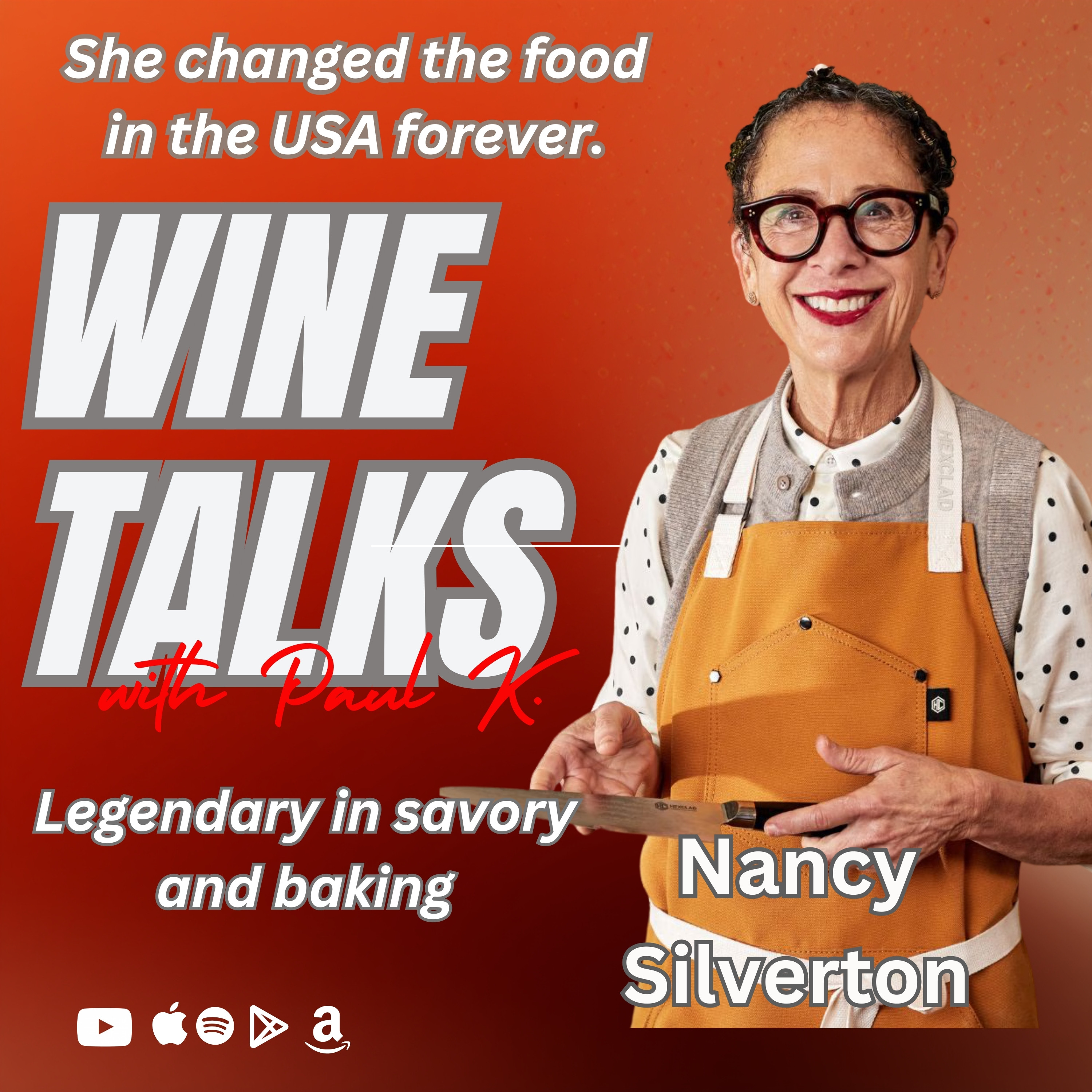
Navigating Restaurant Legacies with Nancy Silverton: The Evolution of Dining and Social Media
46m 37s
In this transcription, host Paul K and chef Nancy Silverton discuss the evolution of food culture, focusing on the shift from a revolution led by chefs in the 1980s to a modern era dominated by social media. Silverton notes that younger generations are "food obsessed" but often prioritize posing for Instagram over eating, and they lack awareness of the pioneers who reshaped American dining. She reflects on her own career, from discovering her passion for cooking in college to co-founding iconic establishments like La Brea Bakery and Campanile. The conversation highlights how the American food movement, born in places like Los Angeles, broke free from rigid European traditions, fostering creativity. However, Silverton laments that today's cooks are more captivated by online trends than culinary history. She critiques the reliance on social media for restaurant success, arguing it has diminished the role of knowledgeable food critics and created an environment where followers matter more than skill. Despite this, Silverton acknowledges the necessity of digital marketing for business. The dialogue also touches on her personal life, including her daughter's baking career and her own cookbooks, which she designed to be accessible for home cooks. Overall, the transcript underscores a tension between the authentic, hands-on spirit of the food revolution and the superficial, follower-driven culture of today.
I'm going to say the younger generation is food obsessed. I mean, you go out to eat and you kind of look around the room and I would say more than half of the room is actually barely eating but they're posing with different plates for their Instagram. You know, uh, nobody wants to be a food critic anymore. Everybody wants to be an Instagrammer. Get back and grab a glass. It's wine talks with all K. Hey, welcome to Wine Talks with Paul K and we are at a way game today. It's beautiful. I wouldn't call this something. That's not something I thought about what part of town is it? Well, we're in Southern California. Well, that's true. But we're also in Los Angeles. I just say Hollywood because everybody knows where that is and we're close enough. Look at you go up Highland and all of a sudden you're in Hollywood Boulevard. That's it. That may have a name, you know, oh, I know. Guess what? If you look out across the street, there's some sort of like a green sign that you got it crankier. Yeah, we'll have to do it. And it says media district. Oh, that's right. I like that. Well, this is a, I'm going to read this, this chapter, the introduction of this. Sure. Because I just figured it's a little bit. Let's see if it's right. All right. Can I correct you if it's wrong? I will. Okay. So, what's the point of the introduction is the pioneering American chef Baker and restaurant tour known for reshaping the way Americans think about bread and Italian cuisine. She co-founded the La Brea bakery in Los Angeles, sparking an artisan bread revolution and co-founded the beloved restaurant Campanilla. Silver to Zinfluen says extends through their mocha where we're at today, restaurant and her James Beard Awards celebrated for her commitment to quality and flavor. Like leaving an indelible mark on American dining. That's pretty accurate. That's pretty good. Good ol' AI. Yeah, that's pretty good. Well, actually, I'm going to tell you a story. The last time I was here, we were in the West East side of town. So we don't get down to the media district very often. But you were working the Buffalo Mozzarella bar. I didn't introduce myself. I just said, you know, you just inspired a young chef. This is many years ago. How old is the mocha? You know, it'll, well, Pete Cerea next door will be 20 years. Wow. However, the Austria where we're sitting right now, and that's where the mocha relabar is, is one year behind. So it's 19 this year. Wow. That's amazing. Did you expect that? Never. You just-- But see, I still think when someone asked me how old I am, I'm thinking, I'm 50 years, and then I realized, oh no, I'm not. I'm 70. You know what I mean? I always reverse the numbers and sound just like that. Yeah. So no, I didn't think. Well, I went to the bar and you were working very hard. I said, you know, you inspired a young chef. And my daughter, who was with Jonathan Beno, she was the head baker of record when he earned his star at Beno. And then, you know, COVID came 30 days later, closed the whole place. But she had worked the line at Lincoln. Where is she now? We need people. Well, she'd love to come. She's in Paris. What's she doing? Texas. Oh, I like the pause. What's she doing there? She's raising four kids. Why in Paris, Texas? Well, her husband's in English and priest. And he got a jersey. Wow. Yeah. So it's a bit of a quieter ride. Yes. But they just found out, and there's a bakery in Paris, Texas. It's called the Paris Bakery. It's very good. It's very French. And they just found out that she's a baker. So anyway, the story goes, she wanted to work the line. She did not tell Jonathan Beno that she was a baker by trade. And he found out, and he brought her to Beno. But he says, you're going to have to choose between savory and pastry and bakery. She was nasty, didn't. Oh, I love that story. So he's looked at her like, oh, well, I guess you're right about that. So she was at Easton Joe. She was at the Land of Casse School. She worked in Paris. She came back worth a super bus. She actually fixed some bread at provisions, daily provisions in New York. And then had a kid. And then another, and then another. And another. That's not about her. Well, yeah, no. But it's about your influence in this industry. And I was, one of my questions was, and I got all these questions, but I'm not probably get to them because we're going to have a nice conversation, which is, this restaurant is here now 19 years old. How many patrons come in here and know of this renaissance of food in the 80s that you created along with the host of other chefs? Well, I have to say only the older generation certainly because, you know, and this reminds me of, this was last year sometimes, sometimes, let's say, celebrities that don't want to risk a paparazzi finding them at the front door will ask to come through the kitchen. And about a year ago, gentlemen walks through, sorry, the back kitchen. So they avoid that front door. And walked through and everybody on the line said, who was that? That was Mick Jagger, by the way. Oh, no. They had no idea who Mick Jagger was, right? That's great. So people definitely in the kitchen, if I asked every single one, have you heard of, did you ever hear of Campanilla, you know, which is the restaurant you're referring to? They never would say they did. Michael's, Ken Frank, absolutely not. Jonathan Waxman, no. And that's fascinating. And it doesn't feel, it doesn't feel rewarding or to the feel, maybe you understand this business finally that you're able to transcend that. I mean, that's where you've made your mark along with all those chefs you just mentioned. And here you are. You've superseded that into a generation that doesn't even know. Yeah. And I don't think, you know, today's social media helps that because I think today's generation of cooks is so cut up on Instagram. It's happening of the moment and doesn't realize where food came from, right? That's a good point. And they don't. They don't realize the influence of my generation. It is a generation where they can, well, we made, we were actually tonight because my kids live with me. One daughter has been in my three grandkids because of the fires in Alphadena. She's been in Loser House just displaced for a while. We're tonight's Nancy Silver tonight. Which means what? She's using the Mark P. O. Nancy Silver's book to create dinner. Did you know, I mean, has she used it before? No, she bought it for me for Christmas. It's such a simple book to use and it has just a wonderful variety and offering of food that you can actually cook at home. You know, a lot of these chefy cookbooks, including my own, really require a sous chef, a comey, probably a dishwasher and more bowls than you may have at home, right? And we write these cookbooks because people want recipes from your restaurants and yet, are they really doable to home? No, but the one you got, which is called Mark P. O. Nancy Silverton. I had a cooking at home, yeah. I remember the title because it was the second book that I did and it came out in the 90s. So that was, I think it was cooking for friends and family, something like that. Yeah, but that was post-revolution. Let's go back to that second. I'm going to quote George Taylor from the judgment of Paris show, an event in Paris when the French lost to the American wine business. And what he said was the revolution of wine in America, American wine in the world would have happened, but maybe it would be 10 years delayed. And here you folks are. I guess he has the late 70s, early 80s when all this started. Do you think this would have happened? Do you think that this advancement of cuisine in America would have occurred just later if the scene hadn't arrived here? Yeah, eventually, absolutely. But we were lucky enough to have enough and a scattering throughout the country of really talented young cooks that were able to come from. They come from, they came from, well, a lot of them came from their hometowns, right? Cooking with their mom or something. Cooking with their mom, a lot of them. And then there was the ones, the sort of the lucky ones that got to travel. That would be the Jeremiah tower and the Alice waters, right? That during college or after college, we're lucky enough to go to Europe and eat food that they weren't used to eating when they were going up and they realized, wow, there's something there, right? And they were, you know, the rest is history. But certainly, regionally, there were a lot of people, I think, you know, coming out of New Orleans, like I'm thinking of like the Paul Prudome. Do you remember that name that nobody would know? Certainly, commanders, palace and the Lewis and a lot of that generation that actually, I don't think were really appreciated until that American movement came about. Right. It's interesting. Because I was Patrick Cue, the famed off of his friend, runs the Strandhouse now at Manhattan. His book about La Pavillon, which is interesting. And I'm wondering why L.A. was just hotbed because Joe Kim was also
the front of mine, he came here from Nice. You were always here? - I was born here. - Oh, you were okay. - And so I was born knowing about the Brown Derby and Chasins and Scandia and those classic places, but we didn't have the French influence like New York had as much, right? - No, that's it. So it never really happened. I was just, for some reason I was on the web, maybe it was on my phone probably. And I stumbled across the brochure for the 1939 World's Fair in New York, where Andre Solet came from basically to start the pavilion, or in the Patrick's book. And I'm thinking maybe New York was still that French influence, the way they served food, the way they, you know, it was one seating basically for the whole night. And that's, we transcended that. You guys bucked that sort of staunchies traditionism. I think that LA as a whole did. I think I just remember when somebody was kind of comparing the New York on a restaurant vibe versus the Los Angeles restaurant vibe, say. And New York was much more about finance and the stock market, you know. And LA was much more about laid back Hollywood. And so that could be one of the reasons is the lifestyle. - For the beachy people. - Right. - And the weather's good because surf and ski in the same day. And that, but this isn't treating to me. And it's happened in the wine world. The French come here to grow grapes and Oregon, their Napa, their, you know, all the central coast, because the new world is the new world that you can do whatever you want. And I've always respected the idea that in Italy and in France, they protect their regions, they protect their food, their cheeses, they protect their dried meats, they protect their butter. And I'm jealous of that a little bit. But maybe that was the impetus for this movement that you could think outside the box a little bit. - Right, there weren't those rules. And I'm with you. I really appreciate those guidelines, you know, the parameters that you have to work within to be recognized whether you're making Parmesan, right? And you have to be in that region or Balsamic vinegar. - Do you think Americans, now this generation understands, we talked about the fact that they probably don't understand the revolution, but do they understand the fine cuisine, the fact that, well, there's that video view somewhere on the internet where you're rejecting a whole truck of vegetable hostages. - Oh, that's right. - Yes, I think that that educate, yes. I think that food, I think universally, you know, I spend time, for instance in Singapore because I have a restaurant there and I've had a restaurant there for a long time. - Wow, really long. - That, and I've spent time in Hong Kong. - You should be jittin' to find that. - They did it, and I've spent time in Hong Kong for various reasons and little time in Japan. But it seems like those countries in particular, I'm gonna say the younger generation is food obsessed. I mean, you go out to eat and you kind of look around the room and I would say more than half of the table is, sorry, more than half of the room is actually barely eating but they're posing with different plates for their Instagram, you know. - Nobody wants to be a food critic anymore. And interestingly enough that the importance of a influencer has surpassed the clout of a food critic because an influencer has a lot more followers. And these days it's all about the following. You wanna write a book, say a cookbook, first thing your potential agent or publisher might say is how many followers do you have? - That's right. - Not enough. You gotta get those followers up. So I was lucky that I got into not only the restaurant business but also the business of writing cookbooks way before that mattered 'cause it's very difficult to get a cookbook these days. And you see that more and more of the ones that are coming out are ones that are coming out because they are having online presence or they have a TV show. - So I don't know if we can call that a good thing or a bad thing. I mean, obviously the Elmer deals-- - I'm gonna say a bad thing. - Okay, this is our what happened. The Elmer deals and the Merle Shindlers of the world are no longer pertinent. And I don't even know what Jonathan Gold passed away years ago. But-- - He would have been because he was such a champion of restaurants that came out of the restaurant and appealed to a much greater. - So I don't-- - When we travel, we just got back from the Paris France, not true, well we were in Paris, Texas too, but we-- I don't use any of those services, Yale, Foursquare, and because I don't know the people that are dining of those places understand what they're getting or if they care, or if they're not that I'm a Swiss person. - I'm working on that. That's not the way to describe it. - That is Michelin because at least it's a standardized judgment in nobody's-- - Down by people that know food, right? I agree. - But-- - Any word of mouth, right? You call me, you respect my palate maybe, and so you ask me what of my, you know, last three great meals in Paris and I would tell you, but I agree. I don't, you know, I think those are the worst platforms to go on to figure out where you want to eat. - Do you have a social network group here, but marketing promo sort of group of people that worry about Nancy's followers? - Yeah, they do because in today's world you need it, so people will always say, "Oh, I follow you on Instagram now. I don't have an Instagram account. I don't even have it on my phone." When people send me stuff from Instagram and they send me something and I always press to open it up. I can never press, I can never open it up 'cause I don't have that app, you know? But yes, my quote unquote, people take care of that world 'cause you have to be a part of that world for business sake, you know, not anything other than that. - I mean, digging a little bit of digital marketing, which is what I did forever. I don't know if you know I had the oldest wine club in America for 35 years, but I'm lying, we didn't know this, whatever. But one of the original premises of social networking, which was really to be social, there wasn't about this stuff, this is newer, was the fact that a publicly facing company that was on Facebook, let's say Mocha, a stereo Mocha, could publicly address the group, let's say somebody gave it a bad rating. - Right. - And that you could go on and let everybody see how you would handle that rate. It was a huge factor for restaurants, but then it turned into where restaurants are chasing those five stars. And doing things that might not be, you know, ethical, literally buying people to do it to take something bad down. And so you can't even trust. - That, I think, yeah. - I think you can't trust it. You don't know how I got there. Let's go back to the old days for a minute, just because the mustard and crazy. I worked in corporate America in the 80s, it was nuts. - Here in Southern California. - Yeah, when, did you know that this revolution was occurring or you just were having a ton of fun. If you read Chef Strugg's "The Rock and Roll," I mean, you realize what the environment was like. But it's a hard environment anyway. - Yeah, and I, you know, it is a hard environment. And it's funny when I decided that this was my profession, it would be my profession. I had just been working in my college dormitory kitchen for about, you know, just only a couple months. I never cooked before. I went to, I lived in Sonoma County. I went to Sonoma State. - Wow, okay, your wine catcher. - Yeah, so it was right there in the wine country and I got to tell you, the wine country, then, and I'm talking I went to school in 1974 and now, both in Sonoma County and Napa County, unrecognizable. - Totally. - But working in a kitchen and I didn't realize it, well, I didn't know it before I started to do it because I hadn't cooked at home. It just checked all the boxes for me. The two most important boxes that I didn't realize that it would check. One was using my hands. Using my hands in a way that felt very comfortable to me. My mother always said, "I think you are gonna be an artist, the way you use your hands." And I was so self-conscious about my art. And when I thought about art, it was, can I draw a person, right? And I couldn't draw people. And so therefore I wasn't an artist. - We're in the same page. - And she said, "I'm just gonna tell you, you're gonna end up doing something with my hands." And just holding the wrong ingredients in my hands and working with them gave me so much pleasure. And then that would be the cooking part, but what I didn't understand was the hospitality part that when I would bring out the food that I would make and I would set it down and people would come over because I was cooking in my dormant toward kitchen.
and talk about how much they loved what I made the day before. Wow. It really touched my soul. That's great. So, and I thought, "Ha-ha, this is my profession." But the way I saw my role in this profession was, "I want to be a cook." Yeah. I didn't think I want to be a chef. I didn't never thought I want to own a restaurant. I never thought I wanted to write cookbooks. That's where my fantasy stopped. I want to cook. And now you ask a young child. I mean, I was, okay, already, I don't know, what, 19 or eight, whatever, you know, freshman and colleges. But we all know in today's world what the TV food network and television shows and parents bringing their children on trips and exposing them to television chefs. There's so many seven-year-olds that I meet that want to be cooks, right? That I want to be a chef when I grow up kind of thing. So they know that at seven, or they think at at seven. But they're already thinking about their television show. Yes. Or they're thinking about how many varieties of tomato sauce they'll see on the shelf, you know? There's a lot more possibility in that world. But there's a lot more that they're exposed to. Mine was, I want to cook. Yeah. And that's what I thought I would be a cook for the rest of my life. Was there, I guess there was, because of places like La Pavillon, et cetera, that a chef-centric part of the business versus a cook? Did that really do? Yeah, but I never, I don't know why, and it's funny because I also came from a household that was very not only supportive, but encouraging to all of the females in the family, right? I had very strong women as great aunts and very powerful politically. And so it wasn't like I thought, I can only be a cook 'cause I'm a woman. And I'll never wear a white toque, which I still don't wear, or a button down jacket. I didn't think that. I just thought that that, they just never saw me as a, you know, just like if I was in college and I thought I'm gonna be a lawyer, I probably never would have seen myself as a judge, which is sometimes, you know, the next step for a lot of lawyers. Was that received well in your home? It was, and I'm shockingly, because shockingly because of the year, 1974, today when that seven year old says they wanna be a cook, the parents are so excited, I come meet my seven year old, or when you sign the cookbook as his first cookbook, or her first cookbook, because she wants her, he wants to be a chef when they grow up, you know? And today's world again is different, and I was shocked because you know, I dropped out of school in my senior year, second semester of senior year, I said, I'm not doing this anymore. I know I wanna cook, and my father was a lawyer, and my mother was a television writer, and short story writer, and so they had all of the, sort of all of the credibility, and you would have thought that they would have said, you cannot do this. You need to finish school, or you have to have some sort of a backup, or you need a real job, and then cook on the side, and they didn't, my father just said, how about if you sign up for the court of blu, then I didn't even know what the court of blu was, you know? - Well, it's not around here anymore, but. - Well, there is, well, no, it wasn't past, you know, they did have a couple branches, nobody changed the name, so I think you're correct, there isn't the court of blu, but I went to the one in London, at that time there was London or Paris. - Yeah, that's right. - And I didn't speak French, and so I chose Paris, London. - This is interesting because it seems like that industry. We took our daughter around, we took the CIA at Greystone, and she was looking for that. We required her to finish college, she went to USC and finished that, and then she wanted to go cook. And when I was having a conversation with Jonathan Waxman on the show, and that time we established his Jewish heritage and his family, and when I told him about her being a baker, he said, he paused, he goes, "You must be very proud." And I said, "You know, our meeting community families are much like Jewish families, and that they're supposed to be a doctor and a lawyer, and you know, something professional." And I said, "I never thought I would have reacted the way I did, but there's something about the creativity and the soulfulness of cooking, and for you, this tactile experience of cooking with your hands, must have just really sunk home on your soul to do this." I mean, it's a hard road at that point. You don't make a lot of money, particularly as on the line. It's no different today, right? But was it aspirations to own a restaurant at that point? - No. - Just to share your love of it. - I think, you know, who knows what have happened? I'll tell you, so I started working at Michaels in 1979 when I got, had finished the cordon blu, and I worked there for about a year and a half, close to two years, and then I went over to work, help. I was hired as the pastry chef at Spago, the original Spago in 1982 when it opened. - The one I saw in the set. - And I loved working for him. I loved working there, and I probably would still be there, no, I'm just saying that, 'cause I probably wouldn't, but I could have still been there to this day, right? I could have been one of those employees that said, "I've been working here for 40 years, "'cause you certainly run into them at old school places, "right? You walk into Langer's and a server there." - Yes, right. - I'd say, "I've been there 40 years or campters," or, you know. But anyway, I was married at the time to the chef of Spago, Mark Peele, who I met over at Michaels. And after he and I were both sort of, well to say, poached by a flamboyant restaurant tour in New York, Warner Lee Roy, to redo the menu at the infamous Maxwell's Plum. I wouldn't have gone, but again, my husband, who was under the shadows of Wolfgang, thought that this was his great opportunity to be in charge. - That's a big load. - So we did, and I went for him. Still never thinking about having a restaurant, having a very, not a great experience at Maxwell's Plum. And so it's like, now what do we do after a year, you know? And that's when it seemed like the only thing at that time was to open our own restaurant. - Wow. - But I don't, I definitely wouldn't have done it then. I didn't feel ready. Would I have one today? Had I still been married or not married to him? But possibly, or I could be one of those employees that were for Wolfgang Pog for 40 years. - Michael, when he was on the, no. When I went to see Ken Frank, it's Napa. - It took, yeah. - It took. - Yeah. - Right. - Which he had here, you know? The original, the tow. - Yeah, it was on sunset. - It was on sunset. - Yeah, yeah, yeah. - Yep. - He said something very funny. He goes, I don't think I ever saw Michael pick up a pan. (laughs) I don't get that's hilarious. I won't bring that up when I talk to him. And there's another funny back story that I saw Chef Puck at a big port event and he came out and I went up to sit with him. I said, you know, tell me about Cobb Coss. - Yeah. - And only because my auntie doctor is his grandson. - Do you have a current auntie doctor? - Yes. - Someone here needs one. - Oh, I'll give you a name. - It's the owner of Cobb Coss's grandson. - And where is he? - USC. - Mark, Mark, Mark, Mark, Mark, Mark, Mark, Mark, Mark. - Okay. - So Mr. Puck lived up because this old history, this person that wanted to use, you know, I was in the kitchen in Maryam. The wife was telling me, Chef, you got to get me out of here. 'Cause my son, my husband sits in the front house and he just talks to people and I'm back here cooking. And that's when they bought Cobb Coss's. - Yeah, I have my first wife. - But for C. Cobb Coss, because of going to work there, right when he had taken it over. - Yeah, it was really like wow. - I don't know what your vision is, but this place needs a low love. - You know, you said something interesting because, well, you know, that's interesting. You're talking about Singapore. And I'm gonna go to Shanghai just for a minute. There was a huge Armenian enclave in Shanghai. And during those years, and Cobb Coss came from Shanghai, originally. - I didn't even know. We'll see. I thought it was Russia. - Well, they started in Russia in Moscow. - Okay, okay. - And because I had these conversations sitting on the exam room with Dr. Markar and he said, you know, he had a jump, the Bolsheviks were coming. And he was so well known because of his restaurant that the oligarchs gave him a pass to leave. A full train car to go into Siberia. They say it's leaving this time of date, stuff it with people or furniture, whatever you want and get out. And that's why he had the machine. But the recipe for her famous leg of lamb, which is of course a very Armenian dish, had soy sauce in it. And that's why. - Yes, it had a comfortable thing. - That's interesting, right? Anyway, I want to touch on this to see what you're opinion. When you travel France and you go to, you know, for Nenplong and you go to the Togro brothers and you go to all these famous Michelin-Stuyer restaurants, there seems to be a legacy of food and a legacy of family and a legacy and they're still around 30, 40, 50 years later with the thing. And we don't really have that in America. Do we have that? Thanks.
kind of lineage with restaurant, restauranting. 'Cause you know what other-- - I'm trying to think off the top of my head and I wanted to say that there were possibly a few in New York, like I don't know if there's anybody around from LaGround Wii, you know? - Yeah. - I was trying to think, but certainly not near, right? - It's a bit of a culture that's different. - It's just different. - Because I guess a lot of kids, you know, well like for instance, Emerald Legassi's son, I think he's definitely under 25. - Really? - Wow. - And apparently he took over one of Emerald's restaurant and is getting just the highest praise. - Long, great. - Yep. And Larry for Gioni's son, these are people that kind of I grew up within the restaurant. - Yeah. - Well they were a little bit of, before me, few years, but I would say that's kind of my generation. Larry for Gioni's at least one son. Super talented Mark has a handful of restaurants in New York. He's gone on to work for his father, Charlie Palmer's sons are running the business. So there are Charlie Trotter's son is gonna restart. Yeah, but I bet you most in this country don't want, they see their parents and they may have seen them as working too hard. It took too much demanding, maybe not rewarding enough, but I don't know that many generations of restaurants whose kids have followed, except for the ones that I just named. - What do I know that is? - And like you said, in Europe, - It's very traditional. - Very traditional. - Yeah. - This environment now is speaking of your lineage in the clientele here. I'm wondering if the audience of the 80s was being exposed to this new idea of, in Chef Joaquim will tell you, like we used to do that in this anyway. We went down to the market and bought our vegetables. We bought our fresh oysters. As long as there's no big deal, we come to America, that's a fresh thing, a new idea. But how has the complexion of the clientele chain? Besides the fact that they look at their phones and they rate everything, but is it an appreciation for these kinds of food? - Well, you know what? Definitely an appreciation, but also, that more educated, much more, I mean, I don't know how you were when you were growing up, but myself growing up in the 60s, I was born in, you know, mid 50s, but say growing up in the 60s, families didn't travel the way that they travel now. Right, we went locally, like a vacation for us was going to Palm Springs or Santa Barbara. You know, we didn't go to Europe. My kids had been to Europe more times, and you know, I can count on five hands, right? So I think there is that exposure that makes it, makes it very different. - It's a, in Paul Freeman's book, the 10 restaurants in Change America, it's very interesting, you didn't talk about McDonald's, that's what he talks about, like the Mandarin, and he talks about, and have a funny story about that, Teret, and Mama Zone, but, because of the highways, it lost this regional character, like you can get Texas Chilean Manhattan, then you get my hand clam chowder in LA, and you can get Texas Barbecue, and it goes back to the idea of this old country where you can still do that in France or Italy, but they're still pretty regional. - Not so much, you go to those regions, I know in my region, which is Umbria, every single restaurant pretty much has the same menu. - Really? - Yeah. Unless you go to those few cutting-edge restaurants where the chefs are really trying to reach a little bit further in sort of an international cuisine, you see the same menus. It's regional, you know, the same pasta shapes, the same sauces, the same cuts, the same protein, things like that. You know, you see lake fish in my area, 'cause I'm right next to Lake Trezzamano, but you don't see fresh water fish, you know, you don't see seafood, uh-uh. - That's interesting, 'cause I had Pat Trey on the show, this little mommy's zone, you were there for a while, right? - No, I never, I worked at Michaels, and then went to Spago, Mark worked at Mommy's zone, and that's what he knew Spago, Wolfgang from. - He's credited with, one of the things he's credited with, and we're just in tour d'Archeon, actually. - I figured that that's really come back, that it slept for a number of years, and it's really doing well. - We were there in 1993 with my parents, so my dad was a French speaker, and so we went, 'cause he wanted to celebrate something, and I have a long story, I went to boy with it now, but I decided to go back with my wife last time we were there, and we think it was really quite spectacular. The service, I didn't hospitality concept was all there, the food, the wine, of course, was amazing. But they credit Pat Trey with bringing the back house to the front house, and bringing Wolfgang Puck out of the kitchen and onto the floor, which is still does daily, which you do. Is that accurate? That was sort of the-- - Him? - Yes, the idea of bringing-- - I didn't know, you know, because it wasn't until Spago opened, and Spago was one of the first, not the first, 'cause there was a couple in San Francisco, restaurant that was built with an open kitchen, where Wolfgang was on stage there, and the customers could see who that cook was, as opposed to being behind a closed door. And also, we certainly can credit Wolfgang with becoming the first really celebrity chef. There were a lot of popular cooks out there, but as far as what we think of as a celebrity chef, that was really Wolfgang. So was it Patrick? Maybe he provided the groundwork for that. I didn't really know who Wolfgang was. I knew that when I returned to Los Angeles, and I worked at Michaels, and I didn't really know Wolfgang, I don't think, I had heard of Mommy's Zone, and I went to eat there while I was working at Spago, but I'm not sure if I heard of-- - That's interesting. - Mommy's Zone, or if I heard of Wolfgang. - Yeah, I heard of this. - But Wolfgang may have come into the dining room, you know, in weekends and things like that. - Well, I was gonna take exception to that. - Yeah. - Oh, yeah. - Because there was a restaurant in San Francisco called Lomor Chienz, owned by a guy named George Martinique, and he owned a big piece of property in the Napa Valley, never grew grapes, but he grew vegetables for his restaurant. And he wouldn't let a patron leave, and they'd talk about the four years and 50s, unless he had a chance to visit them. - Uh-huh, well. - On the way out the door. - You're talking about touristy restaurants. - Yeah. - But that period though, was it just fun and games, or are you guys thinking I'm gonna make change the world, and then baking became part of your thing. And I was thinking about this tactile feeling idea, and I watched my daughter need bread, and how I can't do it. I just can't do it. My hands are like rocks. I cannot need a bag at the same time in my life. And she's so natural. - Right. - One of the baking part of it become, one of your pastry chef at Spago, but one of the love of baking. - It started, really it happened while I was at Michael's. It was the only opportunity to be in the kitchen. The only opening was in the pastry department. I was in the section. - Really? - Two people. - Yeah, there was only two people in the department, and then a plater at night, so there was really three people in the department. But that was the only opening, and so I looked at it as a way to get my foot in the door, and it ended up being something that I didn't leave for several years, right? And not that I ever left it, but that became, kind of my home in the kitchen, was the pastry department. That wasn't what my favorite thing about cooking was. When I went to cooking school at the Cordon Bleu, that was my least successful, my least successful of the classes that I took. - How interesting is that? - Yeah, and now I definitely was much more, ambition was to be at savory, of savory, common cook, not. - So then when did La Brea come around? - That came around, met long time after La Brea bakery opened in 1989. - The Spago opened it in 1982. I was at Michael's in 1979, so. - Wow, that seems like a history of 1989, really. Sorry, 30 years ago. But what's the inspiration for that? Because sour, no. - Well, the inspiration was really to have good bread at my restaurant. Wolfgang taught me early on that the two most important courses of a restaurant is the bread, the first course, which is when you sit down, it was traditionally then to put a basket of bread on the table, so the bread and the dessert, it what draws them in and what a customer remembers when they leave. And so I was like the bookend, I did it both, you know, bread and pastry. - Do you think, do you ever think in your wildest Jews back then that they would start charging for that basket of bread? - Right, no, on.
And I think about that now because there was a lot of money that went into that bread. And it was slowly, that's only been recently, you know, and I think it definitely 2020 it gave restaurants the opportunity that they've wanted for a long time but just couldn't really face their customers to either eliminate that from the table or charge it with an upcharge of homemade cultured butter or something like that because it really was a money lizard. And that's why for so long people, restaurants could get around using bad bread but the more restaurants that had a bread program and had better bread on the table kind of exposed all the customers that it's still that way. I think I mean, you know, you know, except that bread, when you go to a restaurant and this terrible bread, it's like, well, it's just as easy to buy if you're not going to make it by bad bread as it is to buy good bread. The complexion of the hospitality has changed considerably. I think post COVID, you know that, ready to people just getting people here probably, but you must have a very loyal staff because of the way you run your business. But would you even recommend anybody to try and open a restaurant right now with the way the government rules are and the costs and the minimum wage and all that? I would, but I would say that, you know, I find that what I'm seeing country wise, country wide is people opening more modest restaurants that are geared towards their neighborhood, not geared towards a destination. And those, if you look around LA and you talk, look at the restaurants that people are really talking about, I don't mean the very expensive tasting menus where people have on their, you know, bucket list to go try. I'm talking about the restaurants that are really being, you know, supported. They're the neighborhood restaurants that are modest with a, I shouldn't say an affordable price because it's not a quick serve restaurant price. It's not cheap, but not, doesn't break the bank kind of places. And those are the places that are really popular. You know, that's interesting because we live in East Pasinena, it was Arcadia, Ceremodry, and that is the local Ceremodry restaurant. So the ones that we visit the most, and frequent in there, they're busy, they're busy year, we don't get in the car and drive very far. But it's just so hard to do business today anyway. I did it by company. Right. Any kind of business, you know, I mean, yeah. In what we were in France, it was a big, huge wine show, wine pairs and everybody singing the blues in the wine trade. No, I know. My nephew was in it. He was in it? Yeah, he has a label called Fingers Cross. Oh, yeah, I know. Do you know, yeah, that's my nephew, Nick Crankle, and his father was my ex-brother-in-law, is why Nick is my nephew, a manford crankle. You were born on the show. Yeah, manford crankle. You should bring Nick on the show. Yeah, I should. He would love it. He loves to talk about wine. He grew up in, from a California wine maker, a very successful one. So what's his, I mean, I'll relate it to what's happening here, much up, but you see the dip, you see. Oh, he's nervous because people aren't drinking wine like they used to. It's cocktails. What do you have here? We're selling a lot less wine than we've sold before. I'll tell you, a lot less. People are, there's a lot of people that aren't drinking anymore, but then those that are are not committing to whole bottles. They, yeah. And they're. Have we ever looked at license here too? Yeah, here we do. We do not have a liquor license. So beer and wine only at key spot at the next door and beer and wine only at the Pizzeria. We're applying for a full liquor license at both only because. Good luck. Oh, yeah, I know. It's hard, but only because they're such a draw. Yeah. And cocktail programs and people want to drink cocktails and. Well, the pressures are a new prohibition movement, low sugar, low alcohol, no alcohol, ready to drink cocktails, cannabis drown. There's all kinds of Gen Zs. Now, you said something, we have to wrap this up already at the end of time here. But you just said some early didn't jump on. I wanted to talk about just for a minute. I have three millennial daughters, one of them I've told you about. And that generation grew up much more not appreciating. I saved for the Mustang or the hot rod, but this generation was much more used to spending $100 on a sushi plate and not saving for the car or the house because experiential dining, experiential, everything is part of their culture. And the Gen Zs tend to be, I don't want to be on my parents, you know, that's kind of what they're at and what it is. And what's the complexion here? Do you get the blending of these generations? I think we do get a blending of these generations, but I still would say we don't. We do get a blending and I'm very happy about that. You don't walk into this restaurant, I think this is an old folks home. Or you don't walk in and think another hipster restaurant, right? So there really is a blending, but if I had, excuse me, to say overall, I think it is overall a more sophisticated crowd than just a hipster restaurant. How about that? Well, congratulations on this amazing success in 20 years because we know when the restaurant to eat business, this is a long haul and that's legacy at this point. And maybe it was your reputation to proceed with you and that's what's happened, but it's probably because it's just really honest food. And I think it is honest food. Yeah, because I have this pitch about honest wine. Yeah. And that will transcend the rest of the industry. You know that they just put wine in a pouch, like a sippy pouch for a kid. You open up an apple sauce in it. Like what's the drink that makes sense to me? But anyway, such a pleasure to have you on the show. And thank you for having arranged until my buddy Mike. I will. I'm going to go look because I needed a couple of bunches of watercress. Oh, okay. Go. Thank you. He might be here. So I'll kick me, not literally. Okay. If he knows you're here, I'll find him.
Podcast Summary
Key Points:
The younger generation is described as "food obsessed" but more focused on social media presentation (e.g., Instagram) than actually eating or understanding culinary history.
Nancy Silverton, a pioneering chef known for La Brea Bakery and Campanile, reflects on the American food revolution of the 1980s and how many young cooks today are unaware of its influence.
The conversation contrasts the old guard's emphasis on craftsmanship and hospitality with today's digital-driven culture, where influencers and online followers often outweigh traditional food critics.
Silverton shares personal stories about her daughter's baking career and her own journey from a college cook to a celebrated chef, highlighting the tactile and emotional rewards of cooking.
The role of social media in restaurants is critiqued as a double-edged sword
Summary:
In this transcription, host Paul K and chef Nancy Silverton discuss the evolution of food culture, focusing on the shift from a revolution led by chefs in the 1980s to a modern era dominated by social media. Silverton notes that younger generations are "food obsessed" but often prioritize posing for Instagram over eating, and they lack awareness of the pioneers who reshaped American dining. She reflects on her own career, from discovering her passion for cooking in college to co-founding iconic establishments like La Brea Bakery and Campanile.
The conversation highlights how the American food movement, born in places like Los Angeles, broke free from rigid European traditions, fostering creativity. However, Silverton laments that today's cooks are more captivated by online trends than culinary history. She critiques the reliance on social media for restaurant success, arguing it has diminished the role of knowledgeable food critics and created an environment where followers matter more than skill.
Despite this, Silverton acknowledges the necessity of digital marketing for business. The dialogue also touches on her personal life, including her daughter's baking career and her own cookbooks, which she designed to be accessible for home cooks. Overall, the transcript underscores a tension between the authentic, hands-on spirit of the food revolution and the superficial, follower-driven culture of today.
FAQs
Many young diners pose with plates for Instagram rather than eating, and the influence of social media influencers has surpassed that of traditional food critics.
Mozza is 19 years old, with its neighbor Pizzeria Mozza being 20 years old.
No, most younger people and cooks are unaware of that era, as they are focused on current trends and social media rather than food history.
She enjoyed using her hands and the hospitality aspect of serving food, which she discovered while cooking in her college dormitory kitchen.
LA's laid-back Hollywood lifestyle and lack of strict culinary rules allowed chefs to think outside the box and innovate.
She sees it as necessary for business but personally avoids it, noting that follower counts often matter more than culinary expertise for cookbook deals.
Chat with AI
Loading...
Pro features
Go deeper with this episode
Unlock creator-grade tools that turn any transcript into show notes and subtitle files.
 PodcastTranscript AI