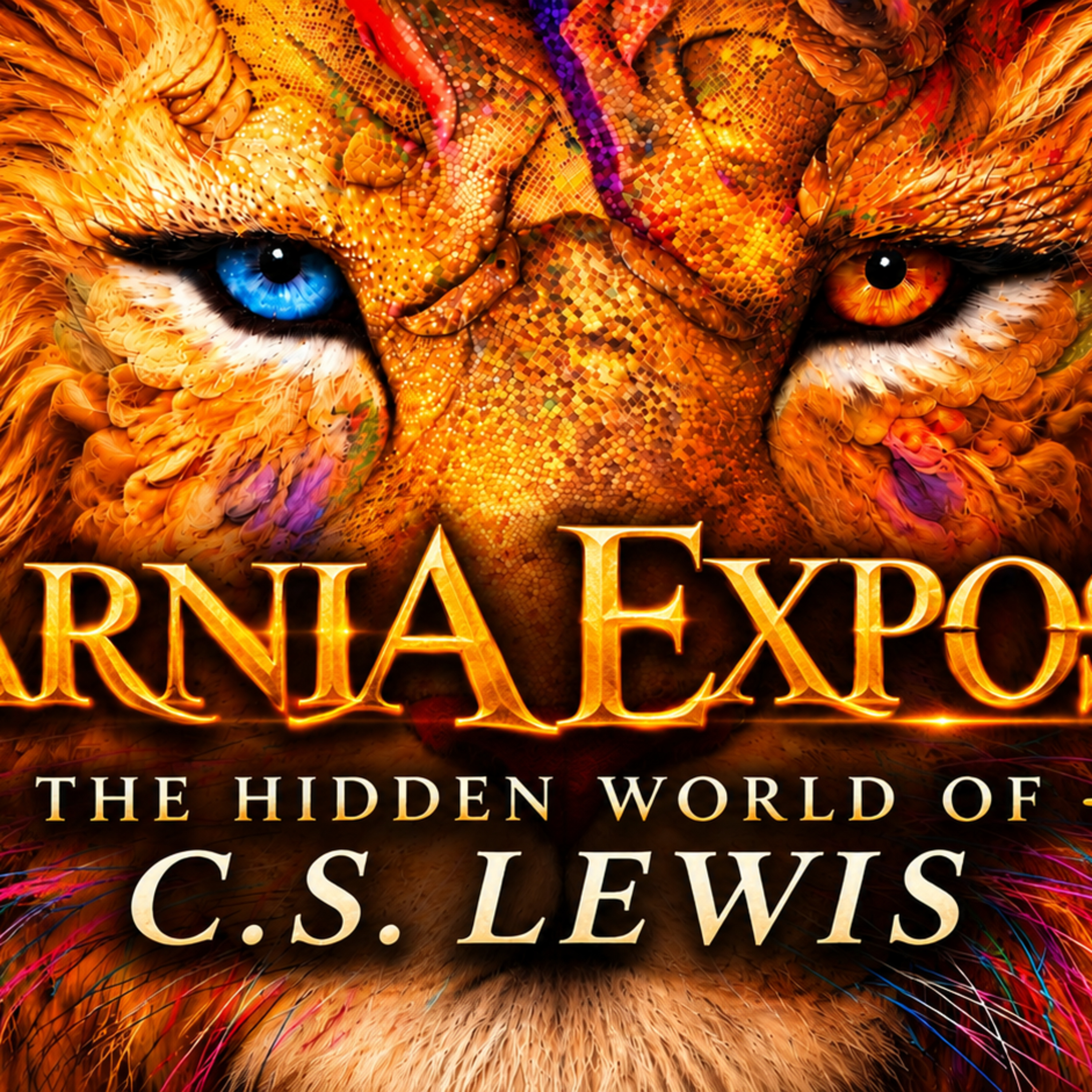
NARNIA EXPOSED: C.S. Lewis, Occult Connections & the Hidden World Behind the Wardrobe
from Eyes on the Right Podcast
1h 13m 15s
The podcast explores the hidden spiritual and theological influences behind the works of C.S. Lewis and J.R.R. Tolkien, challenging the common Christian perception of their writings as purely inspirational or doctrinally sound. Through detailed research, the hosts argue that both authors held beliefs that align with pagan, occult, and universalist ideologies—such as the existence of a cosmic sadist, the idea that all religions lead to the same God, and the acceptance of reincarnation and prayer to the dead. These ideas are further supported by their ties to secret societies like the Inklings and the Rosicrucians, which have long been associated with esoteric and occult traditions. The new Narnia movie, promoted by Disney and influenced by Led Zeppelin’s music, is seen as a cultural tool that subtly introduces children to these themes, including witchcraft, magical doors, and the idea that devotional service to Satan can be redeemed. The hosts point to specific quotes from Lewis—such as his description of God as a "cosmic sadist" and his belief in hell as a mental state—as clear theological deviations from Scripture. The show emphasizes that these works may not be merely allegorical but serve as spiritual deceptions that blur the line between Christian truth and occultism. Ultimately, the podcast calls believers to discern carefully, test all teachings against Scripture, and protect children from what is seen as a growing spiritual infiltration. While not dismissing the value of these stories, the discussion urges a deeper, critical examination of their underlying beliefs, warning that blind acceptance could lead to spiritual compromise. The message is clear: Christians must be vigilant, grounded in biblical truth, and willing to question popular narratives that may carry hidden agendas.
Well, welcome back everybody to Eyes on the Right Podcast.
I am your host, Amy, and today I am so excited.
We are diving into a topic that I really think is going to challenge a lot of people.
And there's a lot of excitement coming up with a new Narnia movie, CS Lewis, JR Tolkien.
We are going to talk about this because generations of Christians have really been infiltrated
with the writings of these two.
And there's some deeper spiritual themes that I think we need to talk about today.
And I have someone with me who is very dear to my heart.
We went to ministry school together and she is a dear friend to me.
So Amy, welcome to the podcast.
Another Amy.
Thank you.
Love being here.
I'm just honored to be invited to and have some time with you and your audience.
Yes.
I love that.
And for all of you, Amy is such a deep dive researcher, like she blows me away when we talk.
I'm like, where are you getting all this stuff from?
How do you have the time?
And she just really is a wealth of knowledge and a good friend.
And she is actually going to be at the conference that I'm hosting in March in Scottsdale, Arizona
on spiritual warfare.
So I'm looking forward to that, Amy.
Are you excited?
No, I can't wait.
I love last year too.
Like the group of women that showed up last year and we just all connected and shared
some really intimate stories and our stories and the testimonies, like it was such a beautiful
time.
So yes, I can't wait to see the group of women that God brings to the conference this
year or next year.
Yeah.
Yeah.
It is next year, huh?
It's kind of crazy to say that sometimes.
Yeah.
Me too.
I think it's going to be a really great time because so much of my life and maybe even
you're, Amy, is so much online.
So to be able to see people in person, fellowship, talk, share stories, pray together, and also
learn how to discern the days, especially with spiritual warfare.
It's such a big topic, but I think there's a lot to unpack in that.
So that's my goal and my prayer for everyone.
So sign up, you guys, tickets are going fast and yes, you can go to my website.
I don't want to miss.
Right.
You do not want to miss.
Yeah.
So you will see that in the caption below.
But let's jump into our topic today.
Kind of think of this as like a little coffee chat with Amy and I in a conversation.
I think something that really brought this to our attention is the movie, of course, the
new Narnia movie, movie coming out.
But I think in this day and age and tell me what you think, Amy, it's like over this
last decade, so much has been revealed about things where maybe we were lied to or our
history was changed or the deception of things like the moon landing or the government
or what have you so much as being exposed.
And I think that's so beautiful that we're able to see what was hidden be made known.
But it also swings the other way where everything is a conspiracy and there's no truth, right?
So my hope for us today is to establish a middle ground, a baseline.
All of you listening, test what we're saying, don't take what we're saying for truth.
You go research it.
You pray about it.
You ask God to show you and you know, we're just the messengers.
So I think that's where I'd like to start.
Do you want to add anything on that note?
Well, and that's what I was going to say, the same thing happened with me and why we're
talking about this is the Lord put this on my heart.
I know nothing about Tolkien or CS Lewis, I never read their books.
I've never seen any of the movie.
So this to me is something that's been really interesting and a journey that I did not
foresee at all.
And so for it to be put on my heart, and I mean, it was pretty bold of like, you have to
look into this.
And so I, you know, I really started in August that the Lord was like, you've got to like
really research this.
And like he said, I love researching.
I think it's a gift that God has given me to like, you know, have a passion for the,
for what he convicts me on when I do research.
And those are the things like once you get right, you can't unsee it.
So when I started digging into them, which was interesting too, the Narnia movies coming
out.
And I'm like, wow, like all of this is kind of coming together.
I really, I felt convicted, and which is why I talked to you about it, and we started
going back and forth.
And I will say it's really not hard to find the beliefs of Tolkien, Lewis, who they were
around, what they really were trying to portray in their books, right?
So that and itself was an interesting kind of like, aha moment for me, because I'm
like, it's not hard if you really test and research.
Yeah.
I think that's a good place to start.
And I forgive me because I kind of jumped over that.
That is how you got into this, because it wasn't like you were searching out CS Lewis
or Tolkien.
You hadn't even seen or read any other books.
So you started on this journey.
And how did you kind of jump into this, Amy?
Was it like, did you just start digging and how, and what were some of the sourcings that
you found as you were looking and researching?
Um, I think the first, the first source was Gary Wayne.
Okay.
Yeah.
Yeah.
So I think the first source was Gary Wayne.
Yes.
The first source was Gary Wayne.
I think the first source was Gary Wayne.
And I think the first source was Gary Wayne.
one and he's got also part two um he goes into a lot of like the secret societies um you know
And I think the first source was Gary Wayne.
there are plans that I love how the history of these pagan gods and he just does a really good
outline and and he researched I mean he is a phenomenal researcher so I started with him
And then I don't even know how Tolkien and Louis came up but he actually has a YouTube video
on them and he just goes I mean in a great way but he tests them against scripture and then he
also really tells you what their lineage and genealogy where that comes from. So that and
itself was like a big eye opener too. I'm like wow there's a lot more to what we've been told
into your point earlier. What we've been told really doesn't match up with where they are
who they are. Yeah, yeah. That's a good point. And I don't think a lot of us take the time to
research like you did and I do. And you know, we just don't. I think we're in a culture where we
been spoon fed so much. And and yet now we're getting back to the place where a lot of people are
like, I want to know this for myself. And that's what I'm hearing you say. You know, I want to understand
this. Why is Hollywood? Why is Disney supporting Narnia, CS Lewis? Why are bands like Led Zeppelin
influenced by C.S. Lewis. If we are awake to the world stage and how Hollywood is compromised,
celebrities, music, et cetera, then this alone, the ties there that I just mentioned,
should really perk our ears up and say, "Wait a second. Are they trying to get us into a sort
of nosticism or mixing syncretism that, wow, this really flowed over us and we didn't even
realize it. I mean, what stuck on to me was when I was looking into this, you know,
obviously the new Narnia movie is coming out. And I want you to talk about Greta Gerwig.
But Disney was actually the ones that promoted Narnia. And they picked it up. And when I saw
that, I was like, Oh, okay, what does it want with Christianity? You know, if this is Christianity,
why is Disney picking up this movie? And I'm just wondering, you know, why is this captivating
Christians and non-Christians alike and cannot be part of the clue that leads us into understanding
who these men really are. What are your thoughts on that?
Well, and I was going to say, too, what I found out from Gary Wayne, too, is you know,
you have the Rosa Crucians, Rosa Crucians, right? And they were sponsored of this Inclean Society.
They were the sponsors of the Inclean Society, which see us Lewis and Tolkien were a part of.
And I love how he explains, first of all, the Rosa Crucians, the level higher on how it moves up,
you've got the Freemasons, you have Bill Luminati, and then you have the Rose accretions,
and he said the Rose accretions are more of the entertainment side. So they're there to really
spread the history and their religion, which makes sense of why Disney is going to pull it in,
and then also not only we have the literature side, now we have entertainment. And if you notice,
when those books came out like in the 50s or whenever, there was a lot, those things were starting
to come out to play on Disney, you know, entertainment-wise. You have this fantasy and light and
dark, good and evil and, you know, you kind of have that era and then you start going to horror
and so that entertainment side really got pushed. Right. Yeah, that makes a lot of sense.
And I think anybody awake to the entertainment side of what Hollywood really is, the connections
the CIA mind control, you know, just a just a flooding of trying to program a society
on a macro level and guys that is entertainment and guys that is, you know, seeker friendly
and kid friendly. It's just when you peel it back and you really see it, it's such a slick
deception. It's so slick, right? And when you were looking good and so good, it's so
But yeah, in Tolkien and Lewis, they're phenomenal writers.
- Right.
- We people love them, but they have an agenda,
and they're writing for a reason.
- Right, right.
Yes, absolutely.
So when you look at the new movie with Greta Gerwig,
and how she has spoken about how her belief in magic
and hidden worlds has kind of influenced this new Narnia movie,
what were some things that you discovered with that?
Well, I mean, the picture of the line in itself, we looked at that.
I thought it was so interesting because we have what you speak to the duality.
So you've got different color eyes and then you've got the scaling of almost
the snake on the nose, which that I think is telling in itself.
And then it really, if you look at the preview of it, it
it's all glorifying this witchcraft and sorcery and hidden worlds and I think it even starts with
there's like a oak chest or something with a tree on it and the little girl has to go through it
to get to this hidden world right and so it's interesting they they're showing all that to us
and then Greta speaking to your point with Led Zeppelin that Led Zeppelin's never allowed
he they have never allowed anyone to use their music in a movie and she speaks to them and they
fill this connection she talks about it and they say yes you can use stairway to heaven and we
know what stairway to heaven it's not our heaven where God in the Bible is and then you know through
research I find out that is it Robert Plant from Led Zeppelin was so inspired by Tolkien and has
like three or four I even have it written his songs by Ramelon is one at the Battle of Evermore
Misty Mountain Hop over the hills far away stairway to heaven also was and yeah I mean pretty
interesting the connections there yeah I mean never before has Led Zeppelin allowed their
music to be played except in this new Narnia movie okay exactly and to add Greta even says she's
a universalist yeah describe what a universalist is so basically they it's all religions lead to
the same right which they I think you know I don't know if accepting them all but it's all it's
all we're all in it together yeah and we're all leading to the same God which we know new age does
that I mean polytheism which we can go into that later about Lewis and Tolkien because I believe
that's really what they were or polytheists but it's that same push it has the same root they all
speak the same language maybe different terms but it's the same root yeah and once you can spot it
and that's why I love the symbolism part and why I got into that over a decade ago is because
once you understand the language of their symbolism and when I say there I mean secret societies
world stage leaders politicians musicians artists those that run the world right that are influenced
by Satan once you understand their symbols that they're layered that they're communicating a message
without words you really can see what they stand for and what they worship and speaking of Led
Zeppelin what's interesting about Jimmy Page is he actually bought Alistair Crowley's home the
bolus guy in house I think it's pronounced one of his estates and Led Zeppelin was absolutely
obsessed with alchemy and hermeticism I mean everything that Crowley was into which is basically
like you know new age you can it's it's all an amalgamation of basically the same things so yeah
yeah it's just and didn't yeah well and didn't they talk talk about some other music was just
divinely inspired and it was that what do they call it the writing when it's they're not even writing
it yeah automatic writing automatic writing yeah and it just comes to them and they've admitted to
that Led Zeppelin and talking same thing he's admitted to the same thing he he would be it like up
at midnight would just get this download and just start writing he even said he didn't even know
what he was writing wow that's wild and it wasn't the Holy Spirit inspiring him it's not the Holy Spirit
right now right wow you know what's interesting with stairway to heaven another note on that
was that was one of the big songs that talked that people were saying had backmasking in it
which is where you play it in reverse and it's it says here's to my sweet Satan I live with Satan
and again that's a law of Alistair Crowley of do everything in reverse so it's going against
the norm and that's why you'll see a lot of occultists right there their you know songs or whatever
they'll have that backmasking where it's played in reverse it actually sends a secret message
and think about that when you're listening to that or when you're reading something if there's a
deeper message that's a cultic or demonic you're opening yourself up to that on some level and I
think that's why I mean I want to talk about this is because we don't have to live in a state of
paranoia or fear it's just once you know though you want to be discerning so you know what I think
yeah and what you said earlier we are the messengers God's using us to to expose this and you
expose you know a pastor the other day or something and I think another friend of ours on her
Instagram about you know having two wives and she and she goes into the defilement that
her that congregation now either knowingly or unknowingly is a part of and it's the same thing with
these books like you might not know but once you bring that object and I'm going to say it's a
curse object because I know what they're writing about I call it a colature it is not glorifying
our God it is not showing us something I think someone they call me like they're just showing
the showing you into you know the God of the Bible or these occult practices well yeah they
actually are showing you that and they want you to get hooked into it and draw you closer like the
intent is for evil it's not for good right yes so good Amy so good and I think about that when you
said those books are a curse objects you think about Acts 19 18 and I'll read it here it says
and many that believed came and confessed and showed their deeds many of them also which used
curious arts brought their books together and burned them before all men and they counted the
price of them and found it 50,000 pieces of silver so mightily grew the word of God and prevailed
and I think that's a great starting point for us to dive into C.S. Lewis and Tolkien and their
history because their books are opening kids and people up and their movies their writings to
occult practices and you clearly see there in Acts what they did with those types of books that
were very expensive you know there's a lot a lot of money I don't know what he quates to but
I do know that in previous studies it was quite a bit of money that those books were accounted for
so let's jump into it and tell us take us back a little bit give us some of the history of C.S.
Lewis and Tolkien talking about examining their fruit what did they really believe the fruit of
their writings etc well I do want to say Lewis this is a quote from him and it's on other worlds
page 36 because I have to address this also because I hear so much from Christians that these
books are allegories right there's all allegory and this is this is Lewis speaking you can look
at up but it says some people seem to think I'd be damned by asking myself how I could say
something about Christianity to children then fix on the fairy tale as an instrument then collected
information about about child psychology and decided what age group I'd write for then drew a
list of basic Christian truth and hammered out allegories and put some in quotations this is all
pure moonshine he says this is all pure moonshine I couldn't write that way at all at first there
wasn't even anything Christian about them these are his words that element pushed itself in of
its own accord oh my gosh so I mean he's showing us it's like in plain sight he's telling us but
we're choosing to not discern to not look to be blinded I don't I was thinking this morning on
my walk when I was you know talking with Jesus and I'm like are Christians are they blinded because
they've accepted this into their house their mind you know their soul their mind well in emotions
and then they can't see you know the defilement I know we talked about that earlier I'm just like
it's hot it's I don't know it's hard to for me to like understand because again it didn't take
me long to find this information and I have so much information of quotes from Lewis like I don't
have to say anything he hangs himself over and over and over again on what he believes and it's not
Christian yeah absolutely I think that's really important you said that this is not your opinion
or my opinion we're just messengers of what he's already said and promoted and one of the quotes
that I looked up and saw from mere Christianity book two chapter four is as a central Christian belief
is that Christ's death has somehow put us right with God and given us a fresh start theories
as to how it did this or another matter and when you start you start to look at it quotes like that
and you start to see like he's actually questioning whether Jesus's death was enough you know he
starts questioning he even has theories of purgatory which is a Roman Catholic belief I mean you can
read these things in books and that from his own from his own mouth from out of the mouth the heart
speaks Jesus says so this isn't our thoughts or something we're coming up with it's it's
clearly coming from them and I think part of their writing to this fairy tale right because they
believe Tolkien and Lewis have both said the Bibles of Fairy Tale they they the way Gary Wayne has
explained it because again they'll have to look him up he's so good at just really research and
everything he spells it out really nicely it's easy to understand although it can be a little
over your head right then he's so well versed but the way they write this good and evil this light
and darkness they they truly put that out there and then they it's like a trying to think of the
word he calls it you catastrophe that is what he says which means basically Jesus's death wasn't
it wasn't good enough because
In the end, the way they write their fairy tales,
they want the good person to win.
- Yeah.
- Does that make sense?
So like if Jesus died, that's tragic.
That's not a good story.
So they don't want that.
They want the superhero to win in the end, not to die.
- Right, right.
Yeah.
What does that lie to me?
- Right.
It's those little subtleties though.
It's not like he's coming out.
Well, we do have a few quotes where they're pretty,
they're pretty blasphemous and straight up antichrist.
But it's like wow, like those subtleties though.
And if you don't take the time to look this stuff up,
it's like you wouldn't even know that.
It's crazy.
- Well, and even in Narnia, what I've heard is Aslan and Tash.
So Aslan's supposed to portray Jesus and Tash as the devil.
And there's this scene where basically Aslan says to whoever's,
but I think it's the girl Lucy, maybe.
I don't know, again, I haven't seen these,
but he supposedly, God tells this person,
everything that you've done serving Satan is still okay.
So I will render those services to me as Jesus.
So you can serve, if you can serve Satan your entire life,
and at the end of the day, you can still be with me.
- Wow, wow.
You know, there is a clip that I have to get better at this.
Everybody listen, there's a clip.
That is exactly what you said.
And you know, I can try to play it if I, if. - Oh yeah.
- It's really good.
So let me try to share my screen here.
- Okay.
- There it is.
Yeah, this is the scene.
It's exactly what you're talking about.
All right.
- Here is Brooklyn's two-double slash acres named Tash,
which Van Narnian's worshiped in its last days.
When it came to the final judgment done by Aslan,
as his creation enters into Aslan's country,
the Narnian equivalent to heaven,
one of these worshipers of Tash,
Emmeth, is allowed to enter due to his good works
and motives despite serving in worshiping time.
- There it goes.
- Aslan states in chapter 15, further and further up,
about Emmeth's worship of Tash,
that not because he and I are one,
but because we are opposites,
I take the service which now has done it to him
for I and he are of such different kinds
that no service which is wild can be done to me
and none which is not wild can be done to him.
If you put two and two together,
the daughter, Netflix is exposing to children,
is it satanic in nature?
- Yeah.
- This is the paper of universalism.
- Yeah. - That's universalism, yeah.
- Which makes sense, Greta jumped on it.
- Yeah, exactly.
And it makes sense with Greta, makes sense with Dizzy,
makes sense with Led Zeppelin.
- Totally.
- And what is this communicating to children?
- Yeah.
- You can serve the devil and still be okay.
- Right, right.
- Talk about that for a little bit.
You have to be a voice.
So what are your thoughts about
in terms of how this impacts kids?
- Yeah, I mean, I just think the defilement.
I don't, I, you know, it's,
we pray about things like this all the time.
I'm so grateful that the Lord has worked on me
to teach me things, to teach to my children.
So we have lots of communication about these things.
So they know the truth, but the kids that, you know,
don't know or, you know, they get sucked in.
I thought I was around and mom the other day
'cause they've never seen Chronicles of Narnia.
And now they're on number three
because they just got sucked in and, you know,
she's got little kids and, you know, just like,
oh, and I understand, you know, it's out there
and it's portrayed as a Christian movie.
But yeah, it breaks my heart.
It's, I don't know.
I don't know if our people lazy or Christians lazy
are they not looking to, they just blindly trust.
I mean, I think we're in a generation now we shouldn't be.
We are questioning, like you said,
but are we questioning the right things?
And if you just put a label on Christianity,
is it then safe?
I don't know.
I mean, look at all these pastors
that have these huge followings.
And, I mean, we've heard some of their doctrines
that comes out and you're like, that's not the blocal.
- Right, it isn't.
Yeah, it's so subtle going back to that kind of subtle
opening or access point.
I think it's very sly of the enemy to attack kids
because their brains are still developing.
So like that fantasy, magical, you know,
kind of allegory types talk,
it really plays to a child's mind
because it is still developing.
They're still understanding, you know, right from wrong.
They're still trying to figure out the world.
And so you have something like this,
like a movie like Narnia, where it's very magical.
I remember watching Narnia when it first came out
and this is before this 15 probably, I don't know how many years ago.
And I even remember watching that movie
and thinking, wow, this is really cool.
Like how they portray this.
And, you know, she goes through that magical door
and she enters into this new world.
And ironically enough, it's Pan
that leads her Pan, the goat god, basically.
- Yep, and Peter Pan.
- Peter Pan, yeah, Pan Dism, right?
So you've got all these little hints.
It's just like, do you want to see them?
But I saw that movie and I didn't think twice of it.
I mean, I was Luke Warren.
I was doing all sorts of things.
So it didn't hit me the way it hits me now,
but you can see how it will impact kids.
And it's a very subtle.
And I can hear parents saying, what's the big deal?
What's the big deal about Narnia?
What's the big deal about Lord of the Rings?
What's the big deal about, you know, Harry Potter?
And it's exactly what you're saying to me.
It's just the subtleties of it.
It's impressing them.
And then think about it too,
is the Bible not good enough?
Because I feel like part of this fantasy
has like, it's leading children to want those things
versus going to the Bible.
And the Bible has amazing stories.
You can't, I mean, every time you go on the Bible,
it's something new you learn, right?
And so I think it's also grooming children
that the Bible's boring.
And you need to go into this fantasy world
and even reality's boring.
Like what god has gifted us with life,
that's not good enough.
We need other things.
We need magic.
We need other dimensions.
And so I think that's that grooming process.
And it's putting on kids.
And acceptance of all religions, all, you know,
it's this universalist polybias,
which we know in the end times,
that's gonna be part of the deception, right?
It's, Buddhist can make it to heaven,
is people that are practicing Islam can make it to heaven,
Hindus can make it to heaven.
And that's just not true.
We know that.
The Jesus is the only way.
The way the truth and the life and the nobody
comes to the Father except your Him.
Amen, Amen.
What would you say to the fact that,
let's say people are saying,
well, it's just a portrayal of Jesus as a lion.
Like what's the big deal with that?
It kind of plays to kids imagination.
You know, what's the difference of a cartoon
or something like that?
What's the big deal with that?
I mean, I mean, for me,
I think putting Jesus as an animal,
one of his creatures or creation is,
I think it's almost blasphemy,
but here I see, I just don't think that's right.
You're going to pull God down and put Him into an animal.
Why not just portray who He is?
Yeah, Amen.
Yeah, that's a good point.
There's a quote here that I want to read that says,
from the problem of pain,
CS Lewis says, "For long centuries,
God perfected the animal form,
which was to become the vehicle of humanity
and the image of Himself."
Now, Genesis 27, hello,
and the Lord God formed man of the dust and ground
and breathed into His nostrils the breath of life
and man became a living soul.
He's literally saying that God perfected the animal form,
which was to become the vehicle of humanity
and the image of Himself, capital H.
What does that mean?
Yeah, I mean.
That's any, any, says the human race is basically an organism.
Wow.
Yeah, an organism.
Yeah, I'm trying to find that quote,
'cause that's good.
It's along with what you said.
Yeah, God perfected the animal form,
which was to become the vehicle of humanity
and the image of Himself.
And then God caused a new kind of consciousness
to descend upon this organism.
And that's from the problem of pain, page 133 and 77.
And then he says, "If man is totally depraved,
then Christianity is a form of devil worship."
And those are pages 37 to 38.
And it says, "The Bible contains myths," page 71,
Genesis account came from pagan myths,
and that's the different reflections on the Psalms.
But the devil worship?
Yeah, right?
I mean, these are his quotes.
This is nothing I made up.
This is just Lewis talking.
Yeah, yeah, literally he's talking.
And did he say something about God was a sadist?
Oh, yeah.
What about that?
Cosmic sadist.
So his wife, okay, so a little bit on Lewis.
Lewis had his personal relationship.
He basically, it says sexual relationship
with this woman for 20 plus years.
They end up breaking up.
And I think they probably lived together.
And then he starts dating this woman named Joy.
And kind of find out she's actually married.
And she's married to a guy in the States.
So when she travels back to the States
after leaving Lewis, after they spent some time together,
her husband ends up divorcing her
because he says that the wife basically left her for Lewis.
So she gets divorced and she travels back.
to drop somewhere to get, you know, connect with Lewis,
they ended up getting married.
They were married for four years, and she dies.
And it seemed like to Lewis,
and this is after his supposedly conversion
in the Christianity, and this is like 20-some odd years,
'cause he supposedly converted to Christianity in 1931.
So this is like close to 1960.
And I think she was an idol.
I mean, everything was wrapped up in this woman,
and when she died, he wrote this book.
It was like at the joy, let's see what it is.
But that's when he calls God a cosmic satan,
sadist, is what he says.
Because he talks about his grief with losing joy,
and I'll find it in a second for you.
- While you're looking, let me give a definition
of what a sadist is.
Someone who experiences pleasure, satisfaction,
or gratification from causing another person,
physical pain, emotional suffering, humiliation,
or distress, taking pleasure in that,
taking pleasure in inflicting pain on others.
That in and of itself is blasphemy, heresy.
That is not our God.
He does not take pleasure in inflicting pain.
So you showed me that quote, I was like, wow,
that's throwing a fist up to God.
That's not his character at all.
- And what foreign again, Christian,
whatever, first of all, think of those words,
utter those words, and think about that about our God.
Like, to even say that, and I'll read it.
So it says, "C.S. Lewis," so this was interesting.
It's a book called a grief observed.
He wrote this book under a pseudonym.
It's a N.W. clerk following the agonizing death
of his wife Joy from bone cancer in 1960.
And he says, these are his quotes, "Lewis, cruel."
What if God is really that?
Supposing the truth were God, the cosmic sadist,
the cosmic, I don't even know what this word is,
but something.
And then he says all that stuff about the cosmic sadist.
So then he comes back later,
because I guess people were like, "What did you call God?"
And he says all that stuff,
which I think this is justification,
but all that stuff about the cosmic sadist
was not so much the expression of thought as of hatred.
I was getting from it the only pleasure
a man in anguish can get.
So there you have no freedom of spirit, right?
No self control, obviously living out of his flesh,
he's telling you, the pleasure of hitting back,
it was really just telling God what I thought of him.
And of course, as an all abusive language,
what I thought did it mean, what I thought true,
only what I thought would offend him
and his worshippers the most.
- Oh my gosh.
- So is that an apology for saying what you said,
or I don't even know how to take that?
- Yeah.
- It's just a justification, really.
- Yeah, it really is.
It doesn't even sound like it's in seropology.
- No.
- Wow, wow.
That's, I mean, CS Lewis has a lot of quotes
that really hang him from a news.
And obviously, he's an adultery as well, you know,
during that time, his wife becomes an idol.
He calls God a sadist.
Are there any other things that you found with Lewis
that supports the claim that he was nostic
or anti-Christian, really?
- So I have, he prays for the dead.
Okay, I'll just say some of his beliefs.
Pagan religions have truth.
This is all his words.
Hell is fiction, so he believed hell was actually
a state of the mind, did not believe it was a real place,
which we know that is not the truth.
In the Bible, like 100% tells us where hell is,
we know it's right below us.
And it's a real place.
- Yeah.
- Christ did not atone for our sins.
So you had said that earlier, he did not atone for our sins.
The Bible is not inspired or an error,
purgatory is a real place.
God's creation is flawed.
God is found inside man.
So there we have that whole new age got you,
can be your own God, Christ consciousness.
The Bible is not literal.
We should pray to the dead.
White magic is good.
Believe we are, and we talked about this earlier,
to become God's on this earth.
He believes in reincarnation.
Evolution is true.
The animals existed long before man
and God perfected the animal form,
which was to become the vehicle of humanity
and the image of himself.
And then I said, "This is where God caused a new kind
of consciousness to descend upon this organism."
And I had said the other stuff too,
but this is where he says about praying for the dead.
And these are, again, his words,
of course I pray for the dead.
The action is so spontaneous, so all but inevitable
that only the most compulsive theological case
against it would deter me.
And I hardly know how the rest of my prayers would survive
if those for the dead were forbidden.
At our age, the majority of those we lost,
we love best our dead.
What sort of intercourse with God could I have
if what I love best were unminionable to him?
- Oh my gosh.
That in and of itself, intercourse with God?
- Yes, gross.
- Gross.
- Gross.
And then I'll go on, he says,
but the truth is God has not told us
what his arrangements about the other people are.
These are people who do not accept the full Christian doctrine
about Christ, but who are so strongly attracted by him
that they are his in a much deeper sense
than they themselves understand.
There are people in other religions
who are being led by God's secret influence
to concentrate on those parts of their religion,
which are in agreement with Christianity.
And who do best belong to Christ without knowing it?
Who belongs to Christ without knowing it?
For example, a Buddhist of good, here we have a good works,
well, maybe led to concentrate more and more on Buddhists,
teaching about mercy and to leave in the background,
though he might still say he believed.
The Buddhist teaching on certain points,
many of the good pagans,
I mean, that's an oxymoron.
Good pagans long before Christ's birth
may have been in this position.
And this is from CS Lewis, Mirror Christianity,
pages 64, 208, and 209.
- Good, yeah, look those up.
- And then, yeah, and he says,
we're not, this is also we are not pronouncing
all other religions to be totally false,
but rather saying that in Christ,
whatever is true in all religion is consummated
and perfected.
- Wow.
- Wow.
- I mean, it's Lewis speaking.
- Yeah, it's from his own mouth.
And that's the-- - And he's, yeah, good.
- Go ahead, go ahead.
- Why's it saying he sells two million books annually here?
Still to this day and he's been dead since the 60s.
- Wow, that should be a little key.
- Yeah.
- A little clue, right?
- Uh-huh.
- Oh my goodness.
So, this is just so interesting to me.
And I could pull so many threads right now.
- So many. - I'm gonna keep us on the more ever, right?
- And before we get into talking,
'cause I do want you to share a little bit
about the connections there, because they were friends.
I think there was some strained relationship there
at times, but they were friends.
I want everyone listening to think about this.
Travel back to like Oprah.
She was pronouncing this kind of stuff too.
Oprah, by all accounts, started out as a Christian.
I mean, from her history, you know, had some Christian roots.
But along the way, she fell away
and towards the end of her show,
she was talking about this universalism,
was having people on that were talking about this,
this consciousness and there's God in everything, right?
Like, you are God, that rock is a God.
You know, it's this whole weird stuff.
- That is weird.
- Yeah, and then rock is a God.
You know, it's just like God is an everything kind of thing.
He made creation, but he is not in everything
in the sense of like the living Holy Spirit of God.
It's not in a rock.
Like he made that rock, you know?
- Right. - This is a difference, right?
- But moving into even Billy Graham,
and I don't know how many people listening,
this might rock your world,
but you can go look up some of his later sermons.
The presidents that he was very close with are very questionable,
but he started preaching multiple ways to God.
Yes, Billy Graham, and I just showed Judah Smith,
who even today started out seven generation pastor.
His dad was a pastor.
I used to watch Judah, and I would go to the church,
he'd fly into LA and I'd watch his sermons.
Just recently, he has said the same thing,
Christ consciousness, I got a Hindu friend,
and he's like talking about Jesus' brother.
I don't think Jesus is gonna care if you're Hindu.
And so you see this little trickle in,
and then kind of bringing it back to Narnia
and Lord of the Rings.
You see the little trickle, the little drips,
the little words that really, if you're a detective,
they are circumstantial evidence that creates a full case.
And we have to pay attention to that
if we are going to discern the days.
If we can't discern this, Amy, like you said,
it didn't take me long to notice that this was like,
there was error here.
If we can't discern things like this
and have an open mind and not be triggered,
because it's somebody we idolize
and we just love them so much,
then we're gonna be in a world of trouble
when things start really coming down on the earth
and our faith is tested.
Like thoughts on that?
- Yeah.
Well, and I was gonna say,
ever since these books have come out,
is our church in a better place than it was before?
- Good idea.
Yeah, good thought.
- Right?
No.
- Right.
- So yeah, I mean--
- The people that Jesus.
- Correct.
Are they leading people to Jesus?
So many Christians talk about them.
Are we bringing more people to Christ through these?
books. Yeah. Or we, you know, leading them somewhere else, more acceptance, like the
love is love and, you know, we're accepting of all this whole universalism, this polytheism.
That's what they want. That's what they've told us exactly what their agenda is for the
new world order. Yeah. You know, the matriarch coming back like we know Alice Bailey and Helen
Blomowski, like that's exactly what they're pushing. Yeah. Boom. And you said something to
me the other day, you said it's blurring. It's like God wants us to be distinct, right? Like
even go back to like genders, male, female, night, day. And this is like bringing down God
to like creation. There's no distinction. What did you say? Do you remember? It was really
good about that. No, I didn't know, but I love how it is. He is so distinct in the separation
even than the account of Genesis. I mean, there's clear separation. And he calls us to be separate
from the world, right? To be set apart. And it's for his holy name. It is for him. It's to
make his name. And I love you always say a double mind and man is unstable. Yes. We know
that. It's just why we can't be double minded. Right. Yeah. How does this bring double mindedness?
I mean, I think the whole acceptance part of it. You know, anybody can make it to heaven,
really. Why is there always that? Why is there a narrow road? If everyone makes it to heaven,
why is there a narrow road? I think it would say it's a wide road, right? I mean, it even
talks about in Isaiah, I love your study. I've listened to you the other day. And hell is
literally like shifting, moving. And it's widening. And it talks about hell widening. So
that means it's probably getting more people in hell than not. Yeah. Yeah. Oh, those are
some good points there. I think that's hard for Christians to think about. I think it's
very hard. I think it is. You know, and I know we're getting a little bit in the weeds,
but I think it's okay. I think it's okay, because the Holy Spirit leads us in our conversation.
And here's the thing is it's hard for a lot of us. Myself growing up in the church,
you know, I just was doing the math. I'm gonna be 50, been a Christian for over 40, 40 years,
you know, 50. I love that number. And, and a lot has changed for me. A lot. The Lord has
really opened my eyes in a way that it's not legalistic in the sense, oh, you can't watch
anything. You can't read anything. It's about that, you guys. It's about where's your loyalty
and love? And do you want to open yourself up to have even a potential hook from the enemy
to get misguided out into the weeds? You don't want that. I don't want that. You don't want that.
We don't want that for you. So that's the point in sharing all of this, because I think
the church, you know, they did what they could, but there's many factors there. I grew up in a
New Testament church, New Covenant church. That's all they talked about. And in that, I think
there were also deeper theologies of love is love and accept everybody. And, and those are
little open doors to just not really test the spirit, not spirits, not really question things.
You just take it for what it is. And I don't know why I went off on that, but maybe for a reason.
Well, and you can't judge, right? That's a matter to ask. I mean, as Christians, we can't judge.
So that makes sense. That's what we have been, I think, programmed as well. And we know that's
not biblical either. Yeah. Thank you for saying that. I mean, it's different if you have to
plank in your eye and you're judging. We know that, right? But take the plank out of your eye
first and rightfully judge. And we get to that's how we edify people. That's how we call them
out of things and why we have our stories, right? Like my testimony and my story helps other people.
And I'll be able to call that out in a loving way, but it gets used for his glory through that.
That's the whole purpose. That's good. That's really good. Yes, the judging, the judging part. And
we have to righteously judge the fruit of said belief. So if you're saying and we know how and we
know how, right? Yeah, hold it up against scripture, you know, test the fruit of the spirit.
If you're going going back to CS Lewis and Tolkien, which I want to get into, look at what they're
saying. Look at their fruit. How are you testing even influencers online or pastors? Are you
looking at their fruit? And it's harder with people online, but we still are called to do it. So
going back to our topic today, Amy, share just a little bit about Tolkien. What did you find
about him and Lord of the Rings and all of that? Well, I know that these books have fueled a
spiritual revelation. They've opened doors for witchcraft, for sure. And I think for him,
you know, back to Gary Wayne, he talks about both Lewis and Tolkien really being part of
this royal bloodline. So they, which is how they got into Oxford, right? Like if you believe
this story, we're told about their upbringing, there's no way they would have gotten into Oxford.
They wouldn't have had the money. There's no connections. But they're in Oxford and a part of
this secret society, this inkling society, you can't get in unless you're part of them.
And so really and truly, Tolkien and Lewis went and became a part of this society to really master
the craft that they already had. They were already given, you know, they probably had known the,
their history of their genealogies since they were a kid. And growing up, you know, you just get to
understand it more and more and more. And then now they're mastering that craft to be able to
put it in their book so that history stays alive. And then it's put on all of us. So it's never
forgotten, right? It's just another avenue to share their story, which ties all back to these
fallen angels. Because we know that they were real guisees. Their story wants to stay alive.
So they just pass it down, right? Generation of generation in Tolkien and Lewis are being used
to do that. Because their stories are real. It's about real things. Right. Right. Yeah. Oh my gosh,
that struck me. That is a deep thought right there, especially trying it back all the way to the
fall. Because, you know, and it's a mocking of God's holy word written down. So if they can get
actual writings written down that are narcissistic, of course, it competes with the word of God.
And if we're not reading the word of God, then these writings sort of become part of who we are.
And it's a new version of Christianity or synchrotism. Crazy. And then we have the blending again.
I know. Isn't that crazy? Yes. Well, and you did a little bit of research on the Inklings. And
there was a man who was in the Inklings. Yeah. Charles Williams, who he was into occult mysticism.
And he was friends with these two. And Lewis actually greatly admired this guy. So what did
you find on this other Inklings member, Charles Williams? So, well, and I get mixed up with
McDonald too. Oh, there's another one. Yeah, because he wrote the book Lilith, George McDonald,
which we know who Lilith is. And he won't explain to it as in case people don't know the goddess.
Yeah. Well, Lilith is a goddess, a demon goddess. And in fact, when you look that word up in the
Hebrew lexicon or have you know, I actually just did a study on this in Isaiah. Oh, good.
And Lilith was a screech owl. So when you look up screech owl in the Hebrew language,
it's actually Lilith. And this demonic entity was associated with these dry, barren places. But
what was weird when you looked down a little bit more in the lexicon and the the other one,
not just the Strong's, but the Caldée. Concordance. Oh, Caldée lexicon. There's like a couple
of different ones. Yeah. It said that she was a goddess of the night that yes, goddess of night.
Goddess of the night. And she was waiting for children. And there was another connection. I can't
remember what it was, but it said something about wanting to tear apart men or something like
something crazy. So you guys go look, go look that up yourselves. I don't think I said the whole
entirety of who she is. But there's a lot of different beliefs about who Lilith is. And in fact,
CS Lewis actually has a Lilith character in one of his books. I actually saw it on that one video
that I showed on our podcast. And then it says that so the George McGonald wrote that book. It says
that he influenced Lewis. And virtually every word he wrote, and it began with this book called
"Fantasy's A Dream I Tell" which a boy wishes to visit very country. And he awakens the next
morning in a chance with wood where he encounters profound happiness mixed with perilous adventure,
including death and rebirth. Here we have it, of sorts. And so thanks to the imagination of George
McGonald, CS Lewis found his way home. And he also Lewis says that George McGonald was his spiritual
master. Oh my gosh. All these little clues. So I know going back to what you said with Charles
Williams. He was a member of the Order of the Golden Dawn. And was an active member for several
years. So this is the Golden Dawns primarily made up of mystical Christians and former followers
of Blavowski that still adhere to Luciferianism. So a number of his works reflect this. So talking
about Charles Williams. And it talks about As Above, Stobolo, different books. We're confronted with
the tarot deck and one of his other books. And we're warned in scripture that the friends we choose.
Lewis chose this as a friend. This is a guy who was a part of the Golden Dawn.
Alistair Crowley, right? Was he a part of that? I mean the people are not, it's not going
for it by any means.
- They're all connected.
Yeah, Alistair Kalli-- - They're all connected.
- Yep, he joined the hermetic order of the Golden Dawn
and he then developed something called Thalima,
which was his idea. - Yes.
- But it's all the same.
I mean, I think that's a part where once you understand
the basic fundamentals of occultism and the symbols,
it's all the same.
You see it every year. - All the same.
- Yeah, and it's not like you have to be a stew
and every hermeticism and rosicrucianism.
I mean, they're really just mixing and recreating it
into something that's slightly different.
So, you know-- - Which is the whole meaning
of the Inquien society.
Like, what does Inquien mean?
It's a hint.
- Oh, yeah.
So, what are they giving us? - Right.
Yeah, what are they giving us a hint of?
'Cause we know it's not God of the Bible.
- Yeah, yeah.
Exactly.
It's a mixing.
It's exactly what they were doing in the Old Testament
and that's what Israel was doing.
They were in the North-Earnings and even Judah.
I mean, the Southern Kingdom was doing it too.
They were mixing Christian, not Christian,
but, you know, mixing practices of Yahweh and Torah
and the Mosaic covenant.
They were mixing that with also practices of the pagans.
So, it looked good and God was calling them out.
He's like, this is not what you do.
And then they'd have judgment brought on them
because of their generational inequity
of idolatry and mixing.
It's just, I mean, it's so clear when you see it.
It's just so clear.
And that's a part where, if I'm gonna be honest,
it's like, which I try to be.
It is, it's frustrating with people sometimes.
And yet, I think all of us were deceived
on some level in some way.
And so there's a grace there, you know, for people.
But for sure, but why we also have to test the spirits?
Because we know it can be so subtle
and we have to know the Word of God.
And, you know, like, is an Isaiah with woe to those who call good,
evil and evil and good.
Yeah, I mean, and he tells us, that's what I love.
Like, God warns us and tells us, look,
these are the things you need to be looking after.
And he gives us a whole story of, like you said,
what was happening and what they were doing
and what's an abomination to him.
- Right, yeah, exactly.
- And we need to take it seriously.
We can't think, well, I'm just doing this
or reading this for fantasy and it doesn't really matter.
And yes, it does, everything matters, that your eye gate,
see, your ear gates here, our mouth.
We know, you know, what it says, like our words matter.
I always tell my boys, like, measure your words
'cause that's so important.
Like, there's power of what,
there's life and death in the power of the tongue.
Like, yeah, that's true.
- It's true and we'll be held accountable
for what we say and what we do.
- Absolutely, you know?
And that's a, that's a reverent fear of the Lord
that I think a lot of people are missing today
is we have a sense of licentiousness
and lukewarmness, like, well, you know, God understands.
As Pastor Dean always says, you know,
oh, little Christian, it's okay.
- Yeah.
- Right, and it's not, it's not.
And I think it comes down to,
and this is not anything against anyone
because I was there.
I did not really do.
- Yes, we were both there.
I did not really, really understand
the cost of what Jesus did.
And I used and misused that sacrifice in his blood.
And I used it and I just figured, you know what?
Oh, well, I can't help it or, you know, it's not a big deal.
So until you really get to that point
where you're like, break my heart for what breaks yours.
Let me love you.
Let me know you in a way that this stuff
I just don't want it anymore.
- Yeah, and then where you're,
the Holy Spirit will convict you on things.
Like I even received one of the talking books
and I couldn't, and this is just recently
to look, you know, for just to read it.
And I couldn't, I had to get it out of my house.
Like I just don't want it.
I don't want to yoke up with it.
I don't want any open doors
and because he has convicted me on this.
So I'm gonna be obedient to the calling
and I don't need, I have researched in the app.
I can, you know, I do have mere Christianity.
- And this, I mean, again, Louis hangs himself so many times
just in the beginning of the book.
But yeah, I think it's glorifying the wrong thing.
- It is, it is.
I think there's another point too that I want to bring up
and it kind of ties into the narcissism new age
and just discerning the days.
But when you think about something,
like for you and me, you brought that up.
You're like, when I saw that book,
I just felt convicted.
I think there's something important to mention
that each of us are gonna have individual convictions
as believers, right?
We're not sitting here saying you're going to hell
if you watch and aren't here.
That's not the point of this podcast.
But we are saying and giving a warning out.
What you decide to do with that warning is on you.
It's off our hands now.
So you've received the message.
You then take that and discern that
and pray about it, research for yourself
and then move forward in terms of the conviction
of the Holy Spirit.
And I wanted to bring that up because I think
going back to what we started in the beginning,
you know, we're in this day and age
just specifically with the last decade
of what I might call conspiracy culture
where everything, nothing is true.
Everything, you know, you see that online all the time.
It's like, everything's a lie.
And it's like, well, that's an absolute.
That's not true.
The Bible is true, right?
Right.
So you've got that, everything's a lie.
And then you've got it all the way to the other side
where people are just kind of like naive to it all.
So can we come in the balance and say,
some of this stuff will be individual convictions.
I don't feel convicted, you know, to do this.
Okay, that's on you.
But some of this stuff is so biblical
and it's so true for everyone
that you should really consider it
because it definitely can open a door in your child's life,
in your life to cause a stumbling block.
And frankly, I don't want any doors open.
My door shut, you know, I have lots of doors open.
I don't want them open again.
Right.
So before we kind of move into like the narcissism,
testing spirit, all of that,
did you have thoughts on that, Amy,
where what do you think about that?
Well, I just love what you said.
I think like the burden of truth is now
that we're the messengers, we get to put it out there
in the burden of truth is whoever hears it.
And I know that the Lord will bring those people
that need to hear it.
And he convicted, you know, or you know, research more
and look into it 'cause like you said,
you don't have to trust us.
Just read for yourself.
It's really not hard to find this information
and the quotes and really see who they were.
Yeah.
And see if there wasn't any fruit
'cause I still have not found any fruit.
Yeah, right.
And I know we've kind of focused on CS Lewis.
Were there anything, were there any other things
that you wanted to touch on with Tolkien before we move forward?
I know, I mean, he had this obsession with Middle-Earth,
which I know what I've read that, you know,
a cult people have the same obsession
with this Middle-Earth, per se.
And then he at a young age loved Dungeons & Dragons,
not that I'm saying like he got saved later, that's fine,
but he, I mean, really talked about like,
and he was Uber smart, Uber smart.
I don't know how many languages he spoke three, four,
something like that.
But he would talk about, like I had said earlier,
this divine inspiration of writing his books
and he actually came up with this new language
called Elvish language.
And that helped him with, you know,
the Lord of the Rings and Hobbit.
And he uses a lot of like enchantment,
or not enchantment, sorry, incantations and chanting
and just some really bizarre things.
And this is a quote, he said it, said while,
and this is writing, he said,
he was a professor at Oxford University,
as all of this was happening as the story of the Elves,
Wizards, Trolls and Hobbits poured into his mind.
While it became a manuscript under his pen,
he said, "My work has escaped from my control.
I produced a monster."
- Wow.
- And that's talking.
- Yeah, yeah.
- But he says he was a devout Catholic.
- Right.
- And he supposedly converted C.S. Lewis.
But I have not seen that fruit.
- Yeah, and that's the thing.
I mean, look it up on your own.
He was definitely inspired by, you know,
Norse traditions, mythology.
You see the themes of Elves and Wizards and spiritual beings
and this cosmic struggle of good and evil.
And it goes back to the duality of light and dark,
which is a common denominator in all of the secret societies
and the mystery religions, is this duality.
And you see that in Lewis and you see that in Tolkien.
And so when you start to understand that in a deeper way,
if anything, it should cause you to pause,
wait, watch and pray and, you know, really,
really test it, really test it.
I think that's what I would like to say.
That's what I would like to share with anything.
- Yes.
- Well, and that's part of the dogma for polytheists
is this duality, this light and darkness, good and evil.
White, is it white magic, black magic, good witch bad,
which like once you know that, you'll see it.
And then you can see what they're doing
and what the true agenda is by noticing that.
- Yeah, exactly.
Yeah, it all ties together.
So as we look at this, I mean, any final thoughts on just,
What's coming? You touched a little bit on, you know, what's coming down the line,
with eschatological stuff, what are your thoughts?
How does this type of writing play into what you believe
is coming for all of us?
- I really think it's this blending of religions
that they all lead to the same God.
I think there's this reinterpretation of Christian figures.
This dual cosmology, kind of what you're talking about.
And then it's just this double-mindedness.
I think it's really leading people to be double-minded.
And then, you know, I heard someone say like,
we all have a light in us and we're all led to the same God.
And it doesn't matter.
And it's basically like, you don't have to believe in Jesus.
And we're all gonna be okay as long as you're good
and you're a good person.
Which is what they want you to believe, right?
It's normalizing really to these occult practices as well,
you know, bringing that in and thinking, you know,
that's okay, they're not really magic.
That's fine, it's just TV.
But it's so it desensitizes children
if they're seen it at a young age, right?
And who used to know what they start dabbling into
when they're able to away from their parents?
So I think it's just this, I think apolitism
because that's what I think in the end time is coming, right?
This blending, this magic sorcery.
It's just this whole mixture.
Yeah, it's, yeah, exactly.
I agree with you.
I think that it is gonna be this blending.
It's gonna be this idea of, you know,
whatever you wanna believe, just believe it.
It's just gonna be this kind of hopery
of all these different thoughts.
I mean, you can really see it when you step back
and you look at what's going on online too.
It's this really pulling away of true biblical teachings.
And you see it with Christians.
It's Christian influencers who are,
they're the ones fighting in the comments.
They're the ones standing up for Lewis and Tolkien.
They are fighting, fighting in the comments
like these men are their gods.
And here's the thing, who do you serve?
Like, I'm not gonna stand and defend anybody
in a comment section unless it's Jesus Christ
and it's worth, like, I mean, I love you girl,
but like, I don't know if I'm gonna start fighting
in the comments unless somebody is, you know,
I'm just kidding.
And now I know, I know, but what I'm saying is like,
what are you fighting for?
And do you want these little open doors
that can actually impact you
when bigger things come down the line?
And I think that's important in all this.
- That's a takeaway.
- Well, and I feel like that is such a counterfeit
this blending of what God's calling us to be, right?
He's calling us to be set apart.
So then now we have this counterfeit of,
no, we need to blend.
And the deception that comes from that alone,
and we know there's a big following away at the end.
So where is that coming from?
What does it look like?
Why is there such a big following away?
Is it because we've been so programmed over so long
and we're just accepting and mixing and it's okay?
- Yeah.
- I mean, those are deep thoughts.
Yeah, you have to be standing on something
to fall away from it.
- Yeah, it's absolutely.
- Yeah, so it's-- - You have to have it.
- Yeah, you have to have it.
You're standing, you're letting go
of something that you've been holding onto.
So wrestle with that as you listen to this.
You know, wrestle with some of the things
that we presented today.
I do want to add this a little bit,
kind of tying it into the MK Ultra and programming.
Narnia has been used as well for MK Ultra.
And you see the ties to the military.
I know with Lewis, I'm not sure was Tolkien
associated with the military as well.
- It was.
- Okay, so you've got those ties,
which why I'm bringing that up is because
we know that MK Ultra was a government sub-project
or a project that was utilized after World War II
throughout the world.
I mean, it wasn't just the United States,
even though they brought it over under Project Paperclip.
It was something that they used.
And they use movies.
They use books to program people.
And I do think these remakes of Wizard of Oz like Wicked.
I do think these are programs and scripts
for people that have been mind-controlled.
And I think Narnia is one of them too.
She walks through that door.
I mean, anybody that's astute
in understanding mind-controlled programming,
that door she walks through is dissociation.
It's like going over the rainbow.
So like she dissociates,
goes through that door into another world.
And this might be too deep for a lot of you listening,
but if you understand that Wizard of Oz,
Alice and Wonderland were utilized
as anything Disney really,
as programming for kids that were going through
trauma-based mind-control.
Narnia is one of them.
And I don't know about Lord of the Rings,
but I can say that Narnia is definitely
one of those programming scripts.
- Well, I do know Tolkien and CS Lewis,
their books are used to like elementary level
as a primer for witches.
Like they have said it.
There's a former witch,
one of the sources.
I think it's the last trumpet ministries.
Last trumpet ministries, he was a former witch.
And he talks about that that is used as a primer
for to start like moving up.
- Wow.
- Their books are.
- Was it, didn't Todd say that too?
What was the same?
- Todd, yes, John Todd.
- John Todd, that was his name.
- John Todd, phone name.
- Yep, yep.
- You said that too.
- He said it too, uh-huh.
And I've seen, I mean, I have a whole,
I think like five pages of people talking about it
to former witches, former people in the occult.
Like they just, through one of the sources,
they have sourced other people.
And people just write to them and say,
"This is what I was in.
"This is what we had to do."
So why are they picking Tolkien and Lewis and literature?
- Out of all people.
- Out of all people, yeah.
- Yeah, that's a good point.
That adds to the circumstantial evidence
that we've been talking about.
And one of the, I sent, or I told you about this,
I can't remember if I sent it to you.
I had somebody message me that said,
that she was feeling spiritually attacked
when she was watching Lord of the Rings.
And she was like, is this, and this was out of the blue,
you guys, this is, I didn't prompt any,
I wasn't even really talking about it.
I don't know why she messaged me that.
But I was like, I don't think that's any surprise, you know?
It's, there's a cult imagery in there.
There's deeper, demonic doctrines in there.
And that's really what these are.
This syncretism, this mixing, this polytheism,
these are doctrines of devils.
And nothing is spiritually neutral.
So like you either choose to serve Jesus
or you choose to syncretize everything and mix it.
Like there just isn't, there isn't a middle ground anymore.
I don't think we can be in a world
where we're lukewarm anymore.
God is gonna spit you out to your lukewarm, the Bible says.
So choose today whom you will serve
and what does that look like for you?
And do you want your kids potentially even having
an access point or an open door to the enemy?
That's my plea to you, my question to you.
Listening is like, do you want that?
Do you even want your kids to have
that potential open door to have the enemy come in
and just whisper little things to them?
Whisper little things?
That's what it does.
It starts small and then it grows
and then they have a stronghold in their life
and now the enemy can start attacking them as they get older.
So, and do you think Amy, when you have those strongholds
that the discernment decreases?
'Cause I was thinking about that this morning too.
Like, 'cause we know we talk about testing in the spirits
but if you've opened doors or you have those strongholds
is your discernment less?
Yeah, absolutely.
Because that's a great question.
Discernment and humility go hand in hand.
And when you have opened doors a pride in,
let's say in this circumstance,
if someone presents to you an alternative,
like listen, CS Lewis is not who he says he is
and you have that stronghold there
and you start defending him.
That's pride because you're not teachable
and you're not humble anymore.
And so that darkens you, that keeps you from seeing the truth.
You know the verse, then you will know the truth
and the truth will make you free.
So anything that's the antithesis of that,
whether it's a belief system or a lie you've been told
or whatever, that's gonna come up in division in your soul.
It's gonna blind you and keep you separated from God.
That is going to cause double-mindedness
'cause one side believes a lie
and the spirit of the living God is trying to get you
to see the truth so you're gonna find this kind of,
whoo, you know, like double-mindedness and instability
and like a ship in the ocean.
- Yeah, and then you have to think about
why are you holding on to that belief so tightly?
- Yes.
- If you're not wanting to be teachable
and if you are standing up and defending these people, why?
- Yeah, why are you defending them?
- Yeah.
- That's a good question.
That's a really good question.
So I think as we end this, Amy,
let's end in hope and just some positive thoughts
about our conversation today.
I know we talked a lot.
We kind of went out in the weeds a little bit.
We came back in, but what's wrong with this?
Yeah, me too.
- I mean, I just pray that people can really research.
They take the time and look for themselves.
Study, it's study to show thyself approved, right?
Like, that's what my hope is.
And, you know, go bring your Bible and sit next
to these words that Louis said and just test it, right?
See what God says, see what Louis says?
And you'll be convicted on your own.
We don't have to do anything.
It's just really you and me.
Like, we've said it, but I just prayed it.
People have teachable hearts are open to this
and they're okay with not holding so strongly on to these men
and look for themselves, study to show thyself approved.
That's all.
- I love that.
Let God be true in every man a liar.
- Yes, amen.
- No, yes.
Yes, and there's one verse I wanted to read
that way.
is you and I both thought this was really good.
It's collotions to ateness.
As beware, less any man spoil you through philosophy
and vain deceit after the tradition of men,
after the rudiments of the world and not after Christ.
And that's our prayer for all of you listening.
You know, don't let men tell you what to believe.
And that goes with pretty much anything.
Yeah, I mean, you know, that goes with what you believe
about a lot of these things.
I mean, it comes down to do you believe
that the word of God is true and that he can preserve his word
and that everything apart from that is a lie.
I don't care if these people look amazing
and the world loves them and it's been told to you
since you were a little kid, are you willing to take a stand
and say, let God be true and every man a liar.
And if you can do that, you, even in that statement,
we'll shut down doors because the truth will make you free.
And then think about, I love it, why does the world
love them so much?
- I know, why?
- Those Christians and non-Christians.
- Mm-hmm.
- So that's interesting too.
- That's a good question to leave people with.
And you think about how often scripture says,
to love the world is to have enmity with God.
What does that mean?
You know, the world loves them
and they're growing in popularity and they're,
we're the numbers. - Two million.
- Two million.
And half of them are chronicles of Narnia,
half of those sales.
Two million a year and he's been dead since 63 or something.
- Oh my gosh.
- So it's still, impact it,
which is exactly what they wanted.
- Exactly.
- And I wanna add one more thing
because I think it's interesting that, you know,
as back then when they came out with these books,
they have, I will say, a more consolidated audience.
But you add the entertainment side
and then you can grab more people.
And then, like you said, they keep coming out, right?
Like, I don't know whenever you saw it
in the 90s or two that I wanted you to see at the point.
- It was like 2000s, yeah.
- Yeah, yeah.
- So you have it then that reaches a different audience.
Now we have this new one coming out.
So it's this repetitiveness, right?
It's getting more and more and more people.
- That's so good.
And tapping into that entertainment side of it,
where now they can bring the book to life.
- Exactly.
- Oh my gosh.
So good.
- So good. - So good.
- So good.
I love having a friend like you
who edifies me.
Who is, you know, sharpens me.
It's sharpens.
You all need a friend, at least one that can sharpen you
and that you actually have a relationship with
where you hear them
because I think that it's hard in this day and age
to really hear and really wanna change
and really be humble.
And I think that, you know,
it's just a blessing to have people like you Amy.
I really want everybody to come,
hang out with us in March.
- Yeah, so come, be so fun.
- We'll be so great.
And I want you to come back on again.
We'll have another little chat.
- Oh, I'd love to.
- Okay.
- I love it.
- Thank you.
- So fun.
- All right, you guys.
Thanks for listening today and we'll see you next time.
Podcast Summary
Key Points:
C.S. Lewis and J.R.R. Tolkien's writings, often celebrated in Christian circles, contain theological beliefs that align with pagan and occult traditions, including polytheism, universalism, and reincarnation.
Research reveals both authors were connected to secret societies like the Inklings and the Rosicrucians, which have ties to occultism, hermeticism, and esoteric pagan rituals.
The new Narnia movie, promoted by Disney, and its connection to Led Zeppelin’s music—especially "Stairway to Heaven"—suggest a deliberate cultural strategy to promote occult and universalist ideologies.
Key quotes from Lewis, such as his views on hell as a state of mind, the existence of purgatory, and his use of the term "cosmic sadist," indicate beliefs that contradict core Christian doctrine.
Characters like Tash in Narnia are portrayed as a deity of evil, and the narrative allows sinners to enter heaven despite long-standing service to Satan—a clear challenge to the biblical teaching of salvation through Christ alone.
The influence of figures like George MacDonald and Charles Williams, who were involved in occult mysticism, shows a deeper spiritual lineage connecting these authors to esoteric traditions.
The subtle, pervasive presence of occult symbols and themes in these stories—such as backmasking, animal imagery, and hidden gods—suggest a strategy to spiritually influence children and blur the line between fantasy and spiritual truth.
The authors’ works are presented as spiritual "curse objects" that, according to biblical precedent in Acts 19, were burned by believers, indicating their potential to deceive and lead people away from true Christianity.
Summary:
S. R. Tolkien, challenging the common Christian perception of their writings as purely inspirational or doctrinally sound.
Through detailed research, the hosts argue that both authors held beliefs that align with pagan, occult, and universalist ideologies—such as the existence of a cosmic sadist, the idea that all religions lead to the same God, and the acceptance of reincarnation and prayer to the dead. These ideas are further supported by their ties to secret societies like the Inklings and the Rosicrucians, which have long been associated with esoteric and occult traditions. The new Narnia movie, promoted by Disney and influenced by Led Zeppelin’s music, is seen as a cultural tool that subtly introduces children to these themes, including witchcraft, magical doors, and the idea that devotional service to Satan can be redeemed.
The hosts point to specific quotes from Lewis—such as his description of God as a "cosmic sadist" and his belief in hell as a mental state—as clear theological deviations from Scripture. The show emphasizes that these works may not be merely allegorical but serve as spiritual deceptions that blur the line between Christian truth and occultism. Ultimately, the podcast calls believers to discern carefully, test all teachings against Scripture, and protect children from what is seen as a growing spiritual infiltration.
While not dismissing the value of these stories, the discussion urges a deeper, critical examination of their underlying beliefs, warning that blind acceptance could lead to spiritual compromise. The message is clear: Christians must be vigilant, grounded in biblical truth, and willing to question popular narratives that may carry hidden agendas.
FAQs
The podcast raises concerns that the Narnia movies, promoted by Disney, subtly promote occult themes like universalism, witchcraft, and non-Christian beliefs. It argues that both Lewis and Tolkien were influenced by secret societies and pagan traditions, and that their stories contain elements that contradict core Christian teachings like the uniqueness of Jesus and the existence of hell.
The podcast claims that C.S. Lewis believed in reincarnation, the existence of a 'cosmic sadist' God, and that hell is a state of the mind, not a real place. It also cites Lewis's statements that the Bible contains myths and that purgatory is real, which are seen as contradictory to orthodox Christian beliefs.
The podcast suggests that Lewis and Tolkien were members of secret societies such as the Inklings and the Rosicrucians, which are viewed as promoting occult ideologies. These groups are said to have influenced their writings, which in turn shape popular culture and spiritual beliefs.
Yes, the podcast argues that the fantasy elements in these stories—such as the worship of the goat god Pan, the presence of Lilith, and the glorification of magic—contain pagan and occult themes. It specifically points to scenes where characters serve a false deity and are allowed entry into heaven, which it sees as contradicting biblical truths.
The podcast claims that Led Zeppelin, particularly Robert Plant, was inspired by Tolkien and that the band's music, including 'Stairway to Heaven,' contains backmasking that allegedly says 'Here's to my sweet Satan,' referencing Alistair Crowley’s occult beliefs. It also notes that the band was known for embracing Hermeticism and alchemy, aligning with occult traditions.
The podcast warns that such fantasy literature subtly teaches children that all religions lead to the same truth, promotes the idea that serving Satan is acceptable, and replaces the Bible as a source of spiritual truth. It claims this leads children to develop a false worldview that undermines Christian doctrine.
Chat with AI
Loading...
Pro features
Go deeper with this episode
Unlock creator-grade tools that turn any transcript into show notes and subtitle files.
 PodcastTranscript AI