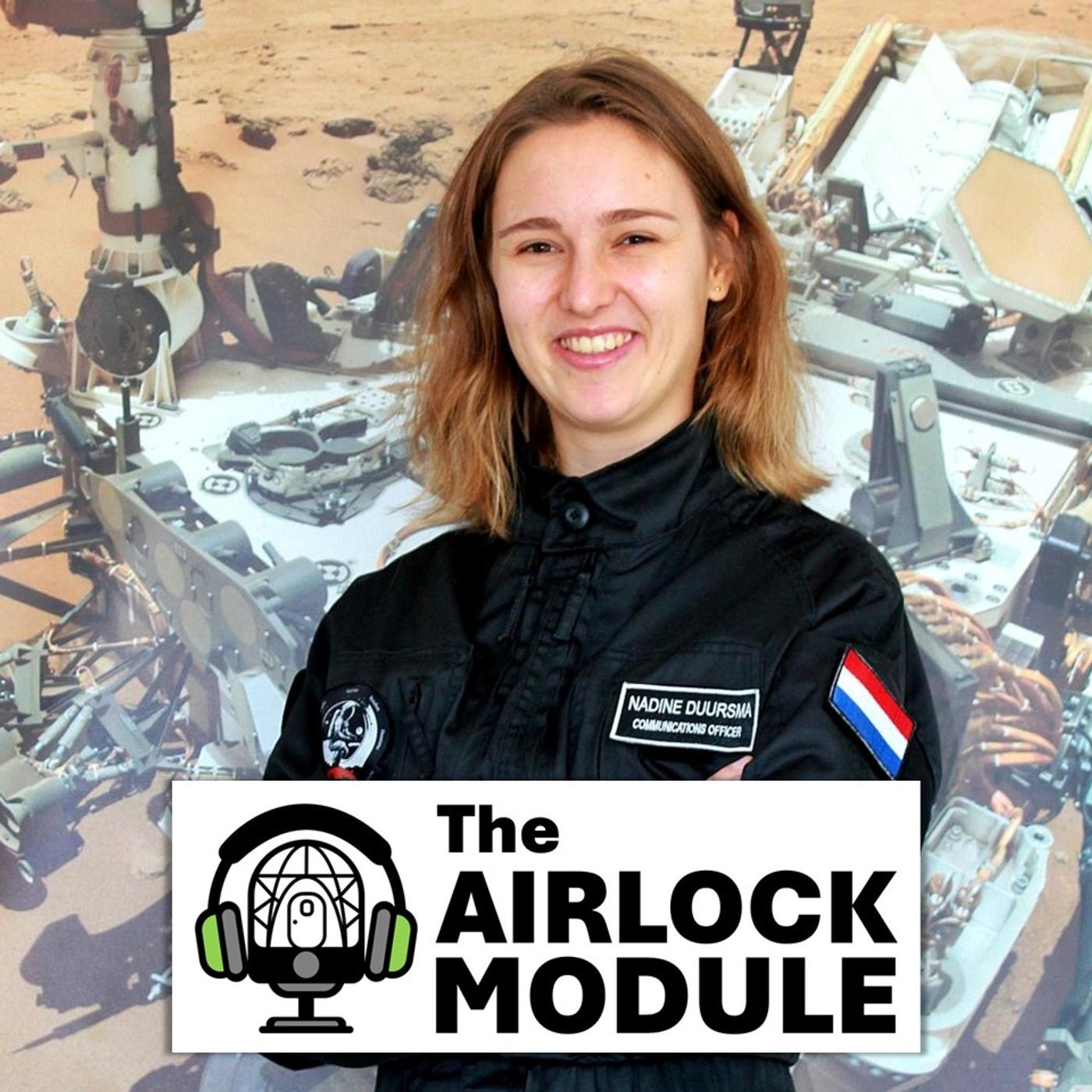
Nadine Duursma: Communications Officer at Monsaraz Mars Analog Mission
45m 5s
Nadine Doorsma, a student from the Netherlands, is close to finishing her double master's degree in science and robotics and space engineering. She has had a varied background, working in locations like the Arctic, Houston, the Australian outback, and Italy. Nadine recently participated in the Manceraz Mars analog mission in Portugal, where she served as a communications officer and engineering support. Beyond her academic pursuits, Nadine is engaged in outreach activities and co-authored a children's book. She is particularly interested in developing robots to assist astronauts. Her experiences reflect a passion for exploring the unknown, contributing to significant projects, and making a positive impact on Earth.
Transcription
7878 Words, 42148 Characters
Hey there and welcome to the airlock module podcast. I am your host Yuki Nishimura. Today we're stepping into the dome with Nadine, Doorsma, born and based in the Netherlands, and just three months away from finishing a double master of science and robotics and space engineering. Nadine's path has been anything but still. The Arctic at Andoya space, a summer in Houston, the Australian outback racing a solar car 3000 kilometers, and a stint in Italy as a visiting researcher at the European Space Agency. Most recently, Nadine served as communications officer and engineering support on the Manceraz Mars analog mission. The first analog conducted in Portugal and part of the world's biggest analog will talk about arriving to an empty dome and building the habitat in 48 hours. EVAs and 35 degrees Celsius heat running experiments from drone drop mechanisms and rover teleups with latency to DNA traces and rock samples. And Kingwood and spinach growth trials. Beyond the lab, Nadine co-authored the children's book, Met Mama Nar Mars, and helped reach 50 plus schools and 2000 students across three continents. We'll explore what it takes to turn five strangers into a crew, why outreach matters, and where she's headed next, maybe Antarctica, maybe MAD 27 ground ups, but definitely forward. Cycle the air, seal the hatch, let's begin. Okay, so we are recording first of all. Thank you for coming on the show and talking with us today. Can you tell us where you are located and a little bit about yourself? Yeah, of course. So first of all, I'm Nadine and I'm from the Netherlands, and that's also very currently located. And for me, it's quite rare I would say to be located in the Netherlands, well, in the past years I've been all over the place. I lived in the Arctic, I lived in Houston, I lived in the Australian Outback even, and in Italy. And now I'm back home finishing my double master's degree in robotics and space engineering for an exciting project with Isa. And I think why we're here, I'm just back from the World's biggest analog mission, Munsarash mission in Portugal. And that's was very exciting. That was also my last trip, that was last month in October. And yeah, it was really nice. Nice, nice. Yeah, well, we'll get into all of that. And speaking of, so you're pursuing a double master of science and robotics and space engineering, what drew you to that combination and what kind of problems do you hope to solve through it? Oh, that's that's an exciting question. Actually, I don't know if I should start from the very beginning, beginning, what got me into aerospace. But for the double master's degree, that was actually I couldn't choose. I wanted to do three of them. I wanted to do biomedical engineering. I wanted to do robotics, and I wanted to do space engineering with the goal to develop robots for assistance for astronauts. And by doing two, I only had to drop one, which is biomedical engineering. I thought that's the thing that I can do the worst. I'm pretty bad at turning things by heart. And then I saw the tick book. And I was like, I'm not going to make it. I'm not that smart. And then I picked two. I really love programming. I love everything with engineering, equations, automation, solving problems in Python. And I'm very happy with my choice. And maybe I get to learn the biomedical parts once in my life, but not through a certain engineering degree. That would be a bit too much. How much more do you have to go? I have three more months left. Wow. Three more months. It's very little. Sorry, going through the capstone program. Are you doing your thesis? What's happening in these three months that you have? I'm finishing my master thesis. And I have a very exciting project with the European Space Agency. So I developed a new concept of Earth observation. It's called Tip and Q. So you have two satellites, one with the white field of view and one with the narrow field of view. And then you can both achieve, you can both observe a large area and also achieve very high detail, which is not possible with one satellite. And I'm mainly doing the programming onboard AI. Everything that's exciting for robotics engineers and programming nerds, I would say. Have you interned with the USA or are you working with them right now? And not interned. I did my internship in the Arctic with Andrea Space, but it's a visiting researcher position. So I've been there for three months in Frascati. It's half an hour away from Rome. And now I'm finishing the whole project at home. Well, it was just three months there and the nine months in the cold in the rain in the Netherlands. It's not always, it's not always party time. Awesome. So what happens after three months? Three months. I have no real, real, real plan yet. I may apply for a ISA graduate 20 position, but then in north bike while after moving to five countries, I mean, it's really nice that you're moving, you're building up something and you're leaving again. So it's not really sustainable for the long term. And also before I move. Does that scare you at all? No, no, it doesn't scare me that much. But I remember actually the last time it was already when I came back from Houston. So after the four time, I was just having a cup of tea with my mom. And I said, I don't want to go anywhere. I just want to have a cup of tea with you. And I was staying in the Netherlands. I'm done. But it was always two weeks in between. Just just wait too little to be home and to really get to see everyone again. And then I searched for master thesis within Tudel and I thought I picked the very first and best project that took my interest. I contacted the Tudel supervisor and I just graduate close home. And then my supervisor said, oh, I'm not with Tudel anymore. I'm now with ISA and during Italy, would you like to come with us? And I said, yeah, I was really love to, but not now. So I did the project for six months from home and then I went to Italy. I'd say the time and Italy was really amazing. Like I was at Philok. It's really nice place, really nice people. But then after three months, I was also very happy to be in my bike in the rain in the Netherlands again. That's amazing. All right. I think you covered a little bit of my next question. But you found yourself working in the Arctic, Houston, and the Australian outback. And it sounds like in Italy as well. What took you to all these places? Ooh, that's so cute. But actually, it started maybe already when I was in high school, at least a dream to go far abroad. Well, with my family, I saw all the people at my school going outside Europe for vacation. And we only went to Austria with my parents only Austria. Every year, it was not a question to which country do we go, but to which state in Austria is our next. And after 16 years, I wouldn't say I was really jealous, but I was really looking forward to do that as well. And I wanted also to go far and I dreamed about going far. And then during my studies, I had the first opportunity to go abroad. That was to study in the US, which I then really, really enjoyed. And I saw that the world is so much more than just the Netherlands and Austria, in that case. And that really, yeah, pushed me to look further. So I joined the solar team of the Tio Delft. That was the first project we lived in, two months in Australia. And we raised 3,000 kilometers from Darwin to Adelaide with the solar card that we built. Yeah. And since then, I don't know. I just applied for an internship in the Arctic. Well, I had been there a week before with an ESA project. I got it. And then also for space studies program, we used them that followed to which after that I did it. And then Italy after that. So yeah, it was just mainly myself just really, really to go abroad. And especially not necessarily traveling, I would say, but mostly to combine it with work. Well, then you get to know the people, you get to know the culture and more the local life instead of just seeing all the tourist things from racing solar cars to building cube sets, your background spans engineering, science and storytelling, which will also get into a little bit later. What connects all of these experiences for you? I think maybe doing something that hasn't been done before or at least something that people want to say is impossible or at least for me that I myself once thought I wouldn't be able to do and then just contribute to something bigger and go faster, go further and also make something that can help to make the earth to make a better place. Now we move on to your analog mission before we get into the details. What organization was involved in that? And how did you get connected to that? Well, that was mainly through the Austrian space room, how I went there. So the story from that was, I was in Houston and that was the first time that I heard about analog missions and World Biggest Analog. And first of all, it's so cool and it seems so far away. I never imagined myself being in the space you'd already be here after. And then she told me, "Oh, you can just apply for World Biggest Analog Day applications open." So we got the group with friends in Houston and we all applied to World Biggest Analog and we were super excited about that. And then we realized that around our entire group is just poor students that couldn't afford the fees of the World Biggest Analog. And I was really disappointed actually because of that I almost gave up. But also from an inner perspective, it didn't make sense for me to pay something and to deliver the work. Well, I'm just, yeah, I mean, I would really do, if I would have been able to, whether that moment, I'm just a student. So I was not able to do that. And I looked for something that's maybe more scientific and more not really focused on the commercial thing. Well, from an outsider, it seemed a bit commercial and that's how I landed at the Austrian space room. And I made quite a bold move. I would say I applied to the analogue astronaut, which I later found out that it's a pretty tough selection to become that. Well, there are hundreds of people applying that know the current in analogue mission. I just thought I applied for analogue astronauts. So I had a call with Gernot. That was, he's very nice actually. It was a very good con. He said, "Well, analogue astronauts may be hard, but you know what? We have also other teams at Austrian space room that you can join." And by the way, next week we have an event from Emily 24 in Salzburg. Why don't you come over there? So I spent my last 300 euros to travel to Salzburg the week after. And I went there to meet all the teams. And then I found out about ground operation support team. And I talked to the people there. And it seemed really cool to be actually on the base and to, yeah, just to help with the mission itself. And I could get well along with the people. So I said, "I want to be in that team." That would be really cool. And then I got into the team and I called with someone from there. And then they told me about, well, we need one more non-portuguese person. Well, they already had three Portuguese persons on the Montserrache Mars analogue mission. And also three Portuguese meals. So we need a non-portuguese female. And there was me. So they put me on the Montserrache Mars analogue mission. And it went all very fast. I was very happy to do it. And, yeah, of course I said, "Yes, yes, I would love to do it." And I got to go, I want to go. And it was really a good experience. During your training days, did you get to meet Anna Harutsune in that all? Only at the MAD workshop. Yeah, I got a chance to talk with her a couple of episodes ago. She was amazing. Yeah, she was on one of the MAD missions as well. She was wonderful. She I met her for one week. And for now in the same team. So I guess we will be friends in maybe a year. All right, so take us inside the Montserrache Mars analogue station. What was it like to arrive early to an empty dome and build your habitat from the ground up? Well, it was nothing, nothing like we expected. My commander actually had multiple analogue missions. And the command thing is you arrive and everything is settled. You have two days of training, you get to know the team and you just start the mission, pretty relaxed the days before. Just to get rest and to get well on the first day of the mission. When we arrived, completely empty, no furniture. The floor was full of rocks like the rocks like this. There was no carpet. And it was two days before the mission. So yeah, we actually, it was immediately quite a team building challenge. I would say we got a carpet at first and the carpet only covered the third of the dome. And I was like, oh no, we should probably be our shoes and then only have carpet in the sleeping area if we get the sleeping area at all. And I couldn't imagine how we're going to live there for two weeks without having anything. But luckily there was observatory nearby and they had the analogue project before with high school students. So they had some desks. And within two days, we moved all the furniture from there with a very big tractor. So we had a tractor with a hanger. And then the hanger was full of tables and we were just sitting on the tables to be transported. And within two days, we completely build it up. We made our own, yeah, our own interior as well, our own interior plan. So it really felt like our home. And I think also that's what made our team very close in the end. Because yeah, we didn't know each other. And then being at so high pressure from the beginning, you have to work together and you get to know each other very well. I think that's what made our team the strongest, maybe. Yeah, that is a good team building activity. Because a lot of a lot of these missions, yes, you prepare leading up into those missions, but then they're virtual. Usually most of the time, if you're meeting them for the first time in person during the training days and then you go through some trainings and then you go, you get locked in and you don't really know what to expect. You don't know their personality, things like that, but you really got to experience all of that and to see basically it's your first kind of experiment of like how everybody is going to work together and the preview of what's to come. And we were also so proud of it when it was build up. I actually texted my parents picture, like, oh, this is what we have made and we're so so proud of it. It's so beautiful. And they replied like, is that all you're gonna sleep there? Oh, I can't imagine too. They are very, they are just not that adventurous to me. I would say they couldn't imagine. And I think because we build it up ourselves, it really felt like our home, like something we're proud of. And if I would walk in, maybe with the same thing that was already standing there, I wouldn't feel that much at home compared to after we have built it ourselves. Well, we know how hard it was and also the alternative option of not having it being like that. It's just what's longer times worse than what we actually had. So help us paint a picture so it's a round dome. You have like where was your living quarter relative to the research section relative to like food prep area? Like how did you lay out the dome? So we didn't need a circle. And then if we take the top as north, so in the north was the sleeping area. Then we had on the east, we had a robotics area and a bit of working experiments corners. In the middle was our working area. So we had a fish shape of desk and a very big screen in front. Then we had on the bottom are EVA area. That's also where airlock was placed. So it or spacesuits there and all our stuff to prepare for that. Then here we are going a bit more to the west, southwest. We have our our biogeology app. So we were growing our plants there and analyzing the rocks. And then in the west, totally west, that's where our kitchen is. And on our dressing room and also a biomedical check room for a bit more. Yeah, probably see. Nice. Thank you. The months were us was the first analog in Portugal. What unique challenges came with pioneering a completely new site? I think that we didn't have anything to rely on from previous missions. So there were no procedures. There were no things like even the suits had to be fixed from the beginning because they didn't work. And yeah, we had no, also the people we made the schedule, we made all the checklist just internally in our team. And we took everything from the previous mission experience from the commander. So I think for him, it was really the hardest role to to put up a new mission from the start. And then also brought some challenges that we didn't know. For example, in my first EVA and also the first all-female EVA. One of my years got stuck in the ventilator system. Oh no. And normally we practice emergencies like getting tape and then going back and then doing emergency compression. And I was like, yeah, for real emergency, we got to go back. I actually lost a very tiny bit of here because of that. Oh no. So yeah, that's those kind of things you just have to figure out all the way from the first time. And I think if you have more experience. So then the next team that will work with the suits we will tell to the bandage on the hat. So that things like that wouldn't happen. Wow. Were you tasked with evaluating the effectiveness of the new facility as a new analogue habitat? Not by ourselves, but they will take our insights and then use it to probably build a permanent habitat. Okay. And yeah, they mainly look, I guess, at the things that we build up like schedules, also eating sports and everything we have done. And for the interior, I'm not sure. Actually, they will probably have an architect to look into that. And we were also quite limited in the furniture that we had and how we arranged it may not be optimal as we had to do it very short within two days. But I would be all actually all members from our team till that for even a permanent habitat, we would recommend team building activity to put everything together from the beginning. I don't know if I take it into account. But it was a, that was, I think, maybe in the end one of the nicest experiences, especially for the first mission. How long was the mission and how many crew members were part of it? It was two weeks and we were with five crew members. So as I said before, we had three Portuguese, the commander, the geologist and also the robotic specialist, then there was another lady from Philippines, our biomedical engineer and me from the Netherlands and my main responsibility was communications officer. So as the communications officer and engineering support, what did a typical day look like during your mission? Very, very dynamic, I would say. I don't think that every day was the same. But on average, we had one or two EVA during the day. So let's start from the beginning. We wake up at seven. Every day we wake up at seven. No matter if we can turn on one weekend, not at seven. Then we go for medical checks. Then we have a very delicious freeze-dried breakfast where we could choose between X or oatmeal. And after that, usually we had the EVA in the morning because it was very warm. It was around 35 degrees inside the dome during the afternoon and also outside. So then during the EVA, the rules were different. We swapped the bits. So sometimes I got to go out, sometimes your haplacons, sometimes haplacons work, take the notes and another time you're flying the drone just to make images or do an inspection of the area. So I have taken all the rules and everybody in the team took all the rules, which is really nice. And after the EVA, we go for lunch. We have a warm lunch with the juice of 13 freeze-dried meals, which was also something to look forward to. We expected it all to be taste very bad, but it tasted quite well in the end. And the afternoon was usually filled with either an other EVA or just experiments or something I worked on was the mission lockbook sports. I usually get sports in the afternoon at the warmest moment of the day. It was really, I always like interval training. I'm pretty fanatic with sports and then I was sweating all over in 40 degrees, doing my intervals. And after all that kind of stuff, we have dinner and the evening was usually a crewbuilding activity. So moving out or we did some fun games together and those were karaoke. I think we have done any any type of fun activity. In terms of food, you mentioned freeze-dried, did you have ingredients that you were putting together or were these like pre-packaged meals? It was not directly ready, but it was packaged with everything. So the only thing we had to do was cook water, then add it and then steer for eight minutes, which was not always eight minutes exactly, but we were supposed to. And then we could directly eat it. And it looked pretty good. It was just dried rice and vegetables are like vegetable chips. So I also tried them without the water. It was pretty decent and then also dried meat. And with water, it looked like a decent meal. I mean, you can even put it on the plate and serve it to people without knowing. I don't think they would even notice it's freeze-dried. They just think it's, they didn't, that can't cook today, but they wouldn't notice it. It's freeze-dried, I would say. Did you guys take turns preparing or that everybody kind of picked their own packet and then put water in it? It was all at the same time. So before the mission, we could pick our meals and we had a choose of 13 and we had to choose for every lunch and dinner what kind of meal we want. And then everybody got their own packet. We were just steering briefly for eight minutes. It all together on the table and having a talk, having a song and just waiting for the food to be ready. And also evening and the lunch, we had two separate forms to pick it. So some members had the same meal during the dinner and the lunch, well they didn't pay attention. And I said, oh, can I swap? Can I swap? And they're also some very spicy meals that nobody liked. So they were also swapped, especially for the proteins. Speaking of water, how did that work? Did you have a tank? Like all the water that was in there was what you got or was it connected to the city? What was the water situation? We had a few packs. So I think we had 40 liters in total per person and that was for 14 days, around three liters a day I would say. And that was for everything for washing, for eating. So for cooking the meals, that was already, I think we used around the leader just to prepare the meals because we had to add the water. And then for drinking, it was pretty warm. So everything that was left, we just drank. And before we actually calculated on having a very small tap outside to do the preparation of the meals, but the water from the tap was not drinkable. So we couldn't use it at all in the end. And we had to manage everything that's what we had. And we informed before, like maybe we'll have an emergency need an extra delivery because we didn't calculate for the food. It was only for drinking three waters, but in the end, it was after three days we found it was enough. So you didn't run out? We didn't run out. No, it was perfectly enough. But I was curious, did you guys have to do sponge baths or wipes to bathe? Yes, wipes. So I had one wipe a day and I wanted to cover in the morning after sports and before sleep. I was quite managing and reusing the same wipes sometimes. I sometimes felt like, oh, should I really do this? Is it maybe clean or not to do it at all? But in the end, I found a method that if I use it in the morning, it's okay. Then after sports, I throw it away. And then in the evening, I get a new one. And that worked out pretty well. And for that hair, for your washing the hair, that was the biggest challenge. So we tried out different methods. One of them was filling a box with a very thin layer of water than pour your head inside and try to use real shampoo. That they don't work so much. Then the second time we tried dry shampoo, but that was very sticky. So in the end, we also needed some water to get it out. And the boys tried a shower cap. So it's just a cap with all sorts of shampoo inside. And then you get a very nice hot massage. And after that, it's supposed to be clean. And yeah, I was happy to take a real shower after two weeks. Yeah, I've been into analog missions. One, we had to do a sponge bath where water was tight. And just like your situation, we had to use the same water for experiments, for cooking, for drinking, for flushing, showering. And so we have very little water to go with and very cold water to do a sponge bath. And then we had another mission where we actually had a shower stall. But yeah, regardless, different habitats have different unique situations and they're all learning opportunities. Yeah, it was not super, super tough in the end. Well, for me, for the leader's water, like two leaders at eight, it felt almost like unlimited. As I've been bike-packing before. And then just being in a very small tent. And sometimes it was raining, raining, raining. And we couldn't leave for days. Oh wow. And then we really had to manage the water and supplies very carefully. So it was doable. And we had a big tent. We had a normal sleeping bed. It felt quite comfortable, I would say. But to survive two weeks, I think, of course, you need to be a bit more than just a small tent and being locked up in two square meters. Just nice, a bit more. All right, can you tell us some of the experiments that were conducted inside the hub and outside on your EVAs? We had many actually from many fields. So the first one, I think the most exciting one for me was one from a startup that's called CleverHive. And they had a robot and we needed to control it from the outside. So I was one of the robotics engineers. We got a controller and we couldn't see the rover that they placed outside. We had to operate it. And at one moment, they also modeled a latency and reverse the controls. And we had to map the rocks, the geological area and to identify based on the color of rocks. Where do we want to drill? Wow. So that was one. Then we had the drone and a dropping mechanism. So the drone got an emergency supply. So we modeled all emergency there. So who in the space suit we need to repair it with tape. And then the drone came and dropped off the tape that we needed and run out. And then we also tested the maximum range of that mechanism. And we had for biology. We had a plants experiment. And then we had three different types of soil. And we grew spinach and quinoa. And tested it every day. We had to measure the plants and count them, which was quite some work, I would say. Well, sometimes you had such a small box with five tiny plants and then oh, this is 3.3 millimeters. Oh, this is 3.5 millimeter. And especially just going before better quite some effort to measure the plants. And for geology, we had experiments with rocks. So we were just measuring the hardness, the composition of the rocks and the samples that we took. And in the end, we also checked if there's DNA in the rocks, with specific tools that we can then later use to check if there may be DNA and traces of life on Mars. And for psychology, we also had to experiment. One of them was ethnographic research. So we made a drawing of our habitat. And based on the items that we were drawing, they looked at which items are important to our crew. And which items are important on a long duration mission. So for example, we drew the chocolate mousse stock bigger than the robotics workplace. And then they knew, okay, we probably have to give these people chocolate mousse rather than much robotics to keep them happy. That's the conclusion. And also the last one was a psychological study, just recording videos and reflecting on your responses every day. And then they could monitor the social dynamics. Wow, that's a lot for five people. Yeah, that was quite a field schedule, I would say, but more than eight experiments across all of those experiments, which of those stood out the most challenging or rewarding. I think the most challenging was the one where we had to control the rover because we also had many challenges that we didn't plan for beforehand. For example, the sunlight, we did the experiment just before the sun went down. And then because of the light, we couldn't distinguish the rocks anymore. And then there were some connection issues. So the controls reversed, as I said before. And then, yeah, it's also not all frustration during the experiment. But then once we still got the drilling area, despite these challenging, this was also the most rewarding with the team. And the most fun I found, the drawing experiment was also some collaboration and just team dynamics to make it wrong together. I assume you guys have mission control. Was there time delay built into that to mimic either the lunar mission or Marsha mission? No, no, no, no time today. No, we, we, they were also Mars and we mimicked as if they were in orbit around our planet. Nice. So there's no time delay with mission control. That removes some of the distress during your mission because both of my missions had the 20 minute delay, assuming that we were talking with Earth. And you always had to be careful like in how you draft your questions, comments, just so that you don't waste 40 minutes coming back with. But what did you mean by that? You know, so, you know, having instant communication is very nice. And then you can then primarily focus on all of your experiments. Just nice. Well, 40 minutes to me to just wait the minute. Yeah, just to wait for a response. If they have the response immediately, right, because it's 20 minutes and then they get the answer and then 20 minutes back. And then the answer. We're figuring out what inspired your interest in AI based tip and queue strategies at the European Space Agency? And how do you see that connecting to future space missions? Oh, that's a good one. I especially liked that it has never been done before. So it's a little bit about that. A bit about that. Yeah, I, I, my supervisor proposed it actually proposed a list of six topics I could select from. And then at five, I was like, oh, yeah, yeah, that's okay. It's nice, but not like that exciting. And then it told me about tip and queue. And especially that we would be one of the first to do it. And then I was like, whoa, that's actually really cool. And what I also like is that it's really solving a global problem. At one hand, we want to better monitor the earth for better sustainability measures and also, yeah, to better keep track of it. But on the other hand, we also need to reduce the number of satellites. Because otherwise, we will have spaced your tree. And then with tip and queue, you both contribute to better monitoring the earth. And at the same time, you can reduce the number of satellites that that's necessary to achieve that due to effective collaboration. So explain a little bit more about like how tipping queue strategies work. Okay, so you have, first of all, the tip satellite that has a very wide field of view. And that scans a very big area. So that flies in front. And then when the tip satellite sees something interesting, it asks the queue satellite to rotate its camera and then zoom in. And then you need onward AI to make a very quick classification of the targets. And then with that, you can reduce the response time as well. So for example, for wildfire monitoring or vessel detection and things that require very fast response, those strategies are very effective. And I can imagine you could use it for like climate change impacts, whether it's like seaweed growth or coral reef degradation, things like that. I actually do a case study for wheel monitoring. Oh, nice. Yeah, counting the wheels. Okay. Because if you know how many there are and also where they are, it gives an indication of the overall ecosystem health. Because they are on top of the chain of the ocean. And if there are many, you know that the entire ocean is doing well. And if they're very few, you know that there's something going on, maybe fewer fish, maybe a bet, yeah, that's coral reef. And then the top predators always the one that's, yeah, that can be an end metric to measure those kind of things. Yeah, makes sense. The solar car project sounds epic. Racing 3,000 kilometers across Australia with the Brunel solar team. What did that experience teach you about resilience, team coordination, engineering, under pressure? Oh, I'm not actually really a lot. Well, it was my first big team project, I would say. Well, before in university you work in smaller teams, but most of the work is in the video. So you take the courses individually, most projects are individually. And being educated as an engineer at university, I would say you become a very good programmer by yourself, but not really learn to work together. And then going on a solar team, you first learn to work with people from other disciplines. So I was in aerodynamics. And then there were other people in electrical engineering and mechanical engineering. And then aerodynamics says, oh, we want just a very narrow car. And it needs to be aerodynamic. And then electrical engineering says, no, no, no, that's not the best solar car. We want the solar panel to be totally flat. So it can orient towards the song and mechanical engineering says, oh, we want stability. We want a very, very broad solar car. And then you don't only need to think about yourself, but how to build the best solar car overall, and not only from your perspective and everything needs to fit. And you're also under pressure with some weeks over 80 hours. And then to handle different kind of personalities, to do also things that you haven't done before, for example, manufacturing in that case. That is something that I think brings the real experience. And I learned more from the solar car project compared to my double master's degree. Oh, for a while. It's okay. Yeah, solar cars and building furniture in the app gave you more experience. That's fine. All right. I want to be mindful of time. There are a couple of other things that I wanted to give you opportunities to speak to. So you're outreach. You reached over 50 schools in 2000 students across three continents. Tell us about that. And what kinds of questions the students ask that really stuck with you. That was in the during the mission. So we had three sessions with schools. That's something that our partner planned for us. And we had two Portuguese schools. And then also one school in Philippines. And beforehand the students could send questions. And it was just so much that we couldn't select which one to answer which one not. So we picked the yeah, some of the general ones, but also some specific ones also during the session. That was so collective. One kid was dressed as an astronaut. So I really felt like, oh, this is so nice. We're actually the hero that I watched when I was younger. Maybe I'm now the hero for that kid that that's now looking at me. So it was very special to to feel that kind of connection. And there was one school from blind children. And that was very interesting because they asked the question, if we listen music during the mission. And then you get to see, of course, from their perspective, that's something that's really valuable. And in the end, it was also very valuable for us, because we had daily exchanges with mission control. We got to learn other cultures through music, team building through karaoke. And then you see that even though there's something that's even with the disability, there's still something that has a lot in common. And I hope that it also shows something that inspires them to also dream big and maybe also aim for space and for the stars in the future. Amazing. All right. And that actually is a good segue into my next question. You co-wrote a children's book. Please tell us about that. Give us the title. And how do you hope stories like that inspire the next generation of explorers? It is called With Mamma Narmars. So with Mamma Narmars in English. And I wrote it with two friends. So we were together in a scholarship project from ASML. And we had to do something to inspire the next generation about technology. And first of all, we wanted to program a game. We were not so superstitious at all. We thought we just ticked the books and program a game. But I lost the only programmer. And I would have liked to program a game. But not as the only person that just programs the game and they are just going to play it. And then we had a talk and we were like, I actually always wanted to write a children's book. And my friends were like, oh yeah, I also wanted to do a children's book as well. So then the ID came to to write it. And at ASML day till this year, you can just print it yourself, read it at your primary school. And then you ticked the books for the technology ambassador project. But we didn't like that. We sent our story to 10 publishers. And one of them immediately replied. And then we got to publish it. So it took two years for them to make drawings and to correct the story as well. And in the end, we were holding the book in our hands. And we also went to primary schools to read it. That was really, really, really amazing. And I hope that it may give the kids something that that I didn't have as a kid or at least I didn't really have a hero to look up to. And it was not very expected from female to go in engineering. At least not for I am from the village and it's for me. And it's for people that are only doing the programming. And I hope to show the kids that you can actually do very different things with engineering. Also part of the story is a drawer, an engineer, a missed, a mechanical engineer. And that it's very diverse and not limited to just just wanting. And I hope that they also inspired to dream big and follow their dreams and work hard. It's not something that falls off the sky. How did you come up with Luna? Is Luna one of you guys? Is it a represent? The main character in each is called Luna. And that's also fun. Well, when we wrote the story and we sent it to the publisher, it was called with mom to the moon. And Luna means moon. So we named the main character Luna for moon. And then the publisher came, oh, there are already so many books for moon. Why don't we make it Mars? And it changed to Mars. But the main character remained Luna from the moon. So a bit of both. Was the character an inspiration of somebody? The main character, yes. Yeah, I thought a little girl with her mom and they just go together on an adventure. And also some characters in the books. So they're all female scientists. And they are named after pioneers in history. So we have well-named after Catherine Johnson, well-named after Marie Curie. And then we hope to, to honor them as well. All right. Well, we'll put that in the link once the episode is published. Thank you. So you've explored extreme environments, the Arctic, Australia, Portugal. What's the next frontier for you? After some time in the Netherlands, I would actually love to go to Antarctica. I guess that's one of my dreams to go there, but not just for vacation, but really to do research and contribute to Arctic sciences. And also do an overwintering for a year. I've also thought about going to Japan and maybe work on robotics there because that's where they are very advanced into robotics. I thought about becoming a flight controller for even spaceflight. Well, I just made me too late. Maybe lunar gateway by the time. I've thought about going to Canada, going to the US, to NASA, and feel maybe back to the Arctic to undo a space. Actually, that's the main plan. I really want to end up there in the future and to build a future there. Maybe in the Netherlands, if I missed the Viking too much, I have many ideas that I like. And I usually have planned A1, A2, A3. And with any of them that happens, I would be very happy. That's good. That's good. All right, we're at the end. So this is the part where I ask if there's anything else we should talk about that we did not cover that you would be like, oh, I should have mentioned that. Oh, I think we covered a lot. Really a lot, yeah. Already like my entire life is made in an hour. So very efficient. Great. Great. All right. Well, Nadine, thank you so much for sharing your experience, inspiring the next generation of space explorers and spending time with me. Thank you so much for having me. I really enjoyed it. If you enjoyed this conversation, please take a moment to follow the airlock module podcast wherever you get your podcasts. And please leave a positive review or rating. It really helps the algorithm boost the show so that more people can discover these stories and join our growing analog astronaut community. You can also connect with me on social media, on Instagram, threads, and on X. If you would like to go one step further in supporting the show, I've set up a Patreon where donations are just $3 a month. Your support helps cover the monthly costs of website hosting, editing software, podcast hosting, and other things that help improve the quality of what you hear. Every contribution goes right back into the podcast. I will also thank every contributor at the end of the show. Thank you so much for tuning in and for being part of this journey. Until next time. So before we get started, I wanted to make sure I pronounce Monsaraz correctly. Do we pronounce the Z at the end or is it Monsaraz? You should ask the Portuguese not me. How? How? I said Monsaraz. Okay. Okay. We'll go with that. And they probably said something else. They can blame me. Yeah. They can blame me if I, I'll refer to as Monsaraz and you can refer to it as the, the Hab. Whatever you're comfortable with. All right. We'll get started.
Podcast Summary
Key Points:
Nadine Doorsma, based in the Netherlands, is nearing completion of a double master's in science and robotics and space engineering.
She has had diverse experiences, including working in the Arctic, Houston, the Australian outback, and Italy, as well as participating in the Manceraz Mars analog mission in Portugal.
Nadine is involved in outreach, co-authored a children's book, and is focused on developing robots for astronaut assistance.
Summary:
Nadine Doorsma, a student from the Netherlands, is close to finishing her double master's degree in science and robotics and space engineering. She has had a varied background, working in locations like the Arctic, Houston, the Australian outback, and Italy. Nadine recently participated in the Manceraz Mars analog mission in Portugal, where she served as a communications officer and engineering support.
Beyond her academic pursuits, Nadine is engaged in outreach activities and co-authored a children's book. She is particularly interested in developing robots to assist astronauts. Her experiences reflect a passion for exploring the unknown, contributing to significant projects, and making a positive impact on Earth.
FAQs
Nadine was drawn to the combination of robotics and space engineering with the goal of developing robots for astronaut assistance.
Nadine worked in the Arctic, Houston, the Australian Outback, and Italy before her current project with the European Space Agency.
Nadine got connected to the Montserrat Mars analog mission through the Austrian Space Forum after applying to become an analog astronaut.
The crew faced challenges of arriving at an empty dome with no furniture, having to build the habitat from the ground up in just 48 hours, and improvising with limited resources.
The Montserrat Mars analog mission had five crew members and lasted for two weeks.
A typical day included waking up at 7 am, medical checks, freeze-dried breakfast, one or two EVAs, warm lunch with freeze-dried meals, and dynamic tasks throughout the day.
Chat with AI
Loading...
Pro features
Go deeper with this episode
Unlock creator-grade tools that turn any transcript into show notes and subtitle files.
 PodcastTranscript AI