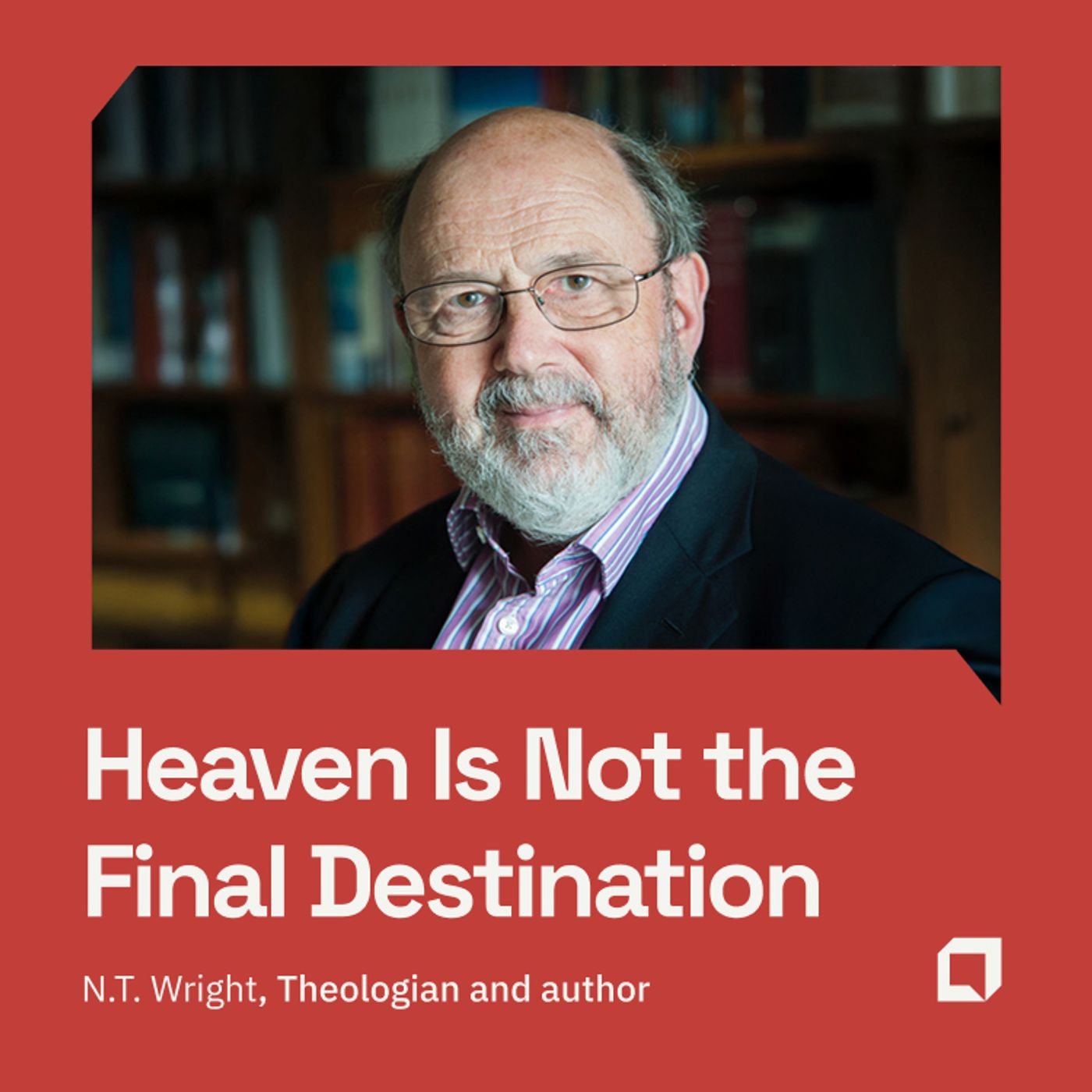
Speaker 1What is heaven? Heaven is God's space. God makes heaven and earth, and heaven and earth are made for one another. Heaven is God's sphere, God's realm, which is always designed to work together with earth, so that from time to time in the Old Testament, the veil is pulled back and you can see what's going on. You know, N.T.
Speaker 2Wright argues that the church has read the Bible through Plato, and that the Bible's hope is God coming to a renewed creation rather than souls leaving for heaven. And I pressed him on some questions. For example, one of the questions I pressed him on was like, well, what do pastors say at funerals? Now, how does the church keep gospel proclamation alongside care for the world? So we're going to re-air this episode. We're very excited to be able to do so. Remember, The Exchange with Ed Stetzer is sponsored by Galoo, and we're going to re-air this episode because, again, the timing fits the season, right? Where November opens with the Advent, a season about the coming of God, and very soon we're entering into the fullness of what we might call the Christmas season. I recognize for the purists, it's still Advent. But here's the questions we've got to ask, and I ask N.T. Wright, is how might we see the stage for these events, the first and the second Advent, the coming of Jesus, the resurrection of the body, the eternal life, and more? And N.T. Wright weighs in with us here on The Exchange with Ed Stetzer. Okay, Tom, I call you Tom. People here call you Tom, but everybody calls you N.T. Wright elsewhere. Is there like a secret to that, a secret identity?
Speaker 1No, the thing was, when I was born, I was called Nicholas Thomas because every first child in my family, my father's family, had been called Nicholas something or other. So there were far too many Nicholas Wrights around, but I had to have that name. And Thomas was my other grandfather's name. And so my parents called me Tom. And then when I started publishing books, I said, well, I'm known as Tom Wright. And the publishers in America said, oh, that's far too informal. We call you N.T. And sometimes Americans refer to me as N.T. Somebody greeted me the other day, hi, N.T. So that's a very American thing. Nobody here does that.
Speaker 2All right, so you've written a new book, God's Homecoming, which is just even the title is fascinating. So big thesis, kind of explain to us what we're getting wrong and how we see it right. How's that for a subtle beginning?
Speaker 1I think what we've got wrong for a long time is that we've been trying to read the Old Testament through the lens of. Of Platonic theology. That is to say, we've been assuming that the Old Testament is a book of allegories and figures and types, which are really talking about how we go to heaven, even when they appear to be talking about how we go to Jerusalem or something like that. And my book starts with quite a substantial section on the Old Testament, showing that there are two main strands of the theme of God's homecoming in the Old Testament. One is that again and again, and it's interesting how it gets repeated. There is this promise that the earth will be full of the knowledge of the Lord or the knowledge of the glory of the Lord, as the waters cover the sea. And this is God's plan to flood the whole of creation with his own glorious personal presence. And the language there is like the language of when the glory of the Lord fills the tabernacle in Exodus 40 or Solomon's temple in 1 Kings 8. God wants to do to the whole creation what he did, proleptically as it were, in the Old Testament. In the tabernacle or the temple. So that's what one day that is the ultimate homecoming of God. Now park that and we'll come back to it because the other one, which is a theme that I've worked on now for 30 years and more, is that when the Babylonians invaded the Holy Land and destroyed the temple, then the prophet Ezekiel particularly talks about God abandoning the temple. It goes off somewhere we know not where. The later rabbis wondered if he went with the exiles to Babylon at the time, etc., etc., but he wasn't around. And then you get this very odd period, which I've been lecturing about this term actually on the book of Malachi, where after some of the Judeans have returned from Babylon, they didn't all come back, but quite a few did, and they rebuilt the temple, they restarted the sacrificial system. But nowhere in that whole period from that return and Ezra and Nehemiah and all that through to Jesus, nowhere does anyone say that the divine glory of the Shekinah has come back to dwell. Now, Isaiah says he's going to, and the glory of the Lord will be revealed and all flesh will see it together. Nobody says we've seen it yet. Zechariah says it's going to happen. Malachi says it's going to happen. There's these promises that God will come back, but the New Testament is very clear because it takes precisely those promises and it applies them via John the Baptist to the coming of Jesus. The Malachi chapter 3, I will send a messenger before me, and then the Lord whom you seek will suddenly come to his temple, because the people have been saying, where is he? Doesn't he care? Isn't he going to come back to us? So we've got these two strands of biblical expectation about God coming home to be with his people, with the whole cosmos, because this then sends you back to Genesis 1, where God creates a world with human beings in his image, because he wants to come and live with them. And in Genesis 1 and 2, it looks as if he is living with them, and then it all goes horribly wrong. But the idea then is not, oh, well, one day I will take you humans out of this world and I'll take you off somewhere else. The idea is for heaven and earth to come together and for God to be there in the midst of them. And it looks as though God made humans in his own image so that it would be appropriate for him to come as a human being. So then what I've done is to track those two themes of expectation into the New Testament. And the New Testament is very clear actually about retrieving those. In other words, the New Testament does not say, well, the Judeans up till now, they've had a very this-worldly expectation. They thought it was all about family and land. And we now know it's in fact about going to heaven. So many, many Christians, and I grew up like this as well, assume that there's a kind of grinding of gears, a big gear change between Old and New Testaments and that the New Testament abandons all that Jewish stuff. And people used to say that Jewish stuff, meaning works righteousness and so on, in favor of a going to heaven narrative. But actually the New Testament retrieves precisely those themes of God's promise to come home. And the idea of God coming back at last to the temple, very obviously in Matthew, Mark, Luke and John, they're telling the story of how this was accomplished in and through Jesus, that Jesus is the homecoming God. At the same time, and I see this particularly in Paul's letter to the Ephesians, but it's in Acts, it's all over the place. The idea that God will one day flood the whole creation with his personal presence is anticipated when they talk about the powerful breath of God's wind, the Spirit, filling the church or filling the house where the church is meeting in Acts 2. In other words, God is going to fill the whole creation with his presence and love. In the present time, he fills individuals and communities, loosely called the church, as an advance sign of what he wants to do with the whole creation. So that's the thesis of the book, really. And once you've got that, all sorts of other things, shall we say, look a bit different as a result. But my case is that actually, if there is a gear change, it happens in the third and fourth and subsequent centuries, when the early Fathers start drinking from the wells of Neoplatonism rather than from the well of the Old Testament. They still retain the Old Testament because they're not Marcionites. They don't want to lose it. But they have to say that the Old Testament is a book of allegories and figures rather than actually the concrete book about the good creation and how God is going to rescue it. So that's the long and the short of it.
Speaker 2Certainly a shift. I mean, Judaism is much more earthy in so many ways, maybe a simple way to put it. The villain in this book is, I would say, Neoplatonism, but also in other categories. So to unpack that, because not
Speaker 1everyone's familiar with that term. Yeah, well, about five centuries before Jesus, there were great philosophers of whom probably the best known is Socrates. But Socrates' dialogues were written up by Plato, and probably he was making things up as well. But it's Plato's idea. Plato is not a total dualist. He doesn't say that the present world of space, time, and matter is bad. It's just not the real thing. It's a sort of secondary thing. And that we humans have these things called souls, which existed before we were conceived and born, and will go on existing afterwards, and which came from a place which we can loosely call heaven, and which are looking forward to going back there again. And at the moment, we're kind of trapped in this space, time, and matter world, and these space, time, and matter bodies. And that's a bit of a nuisance because it's messy and painful and things go wrong. And I mean, one of the clearest exponents of this in the first century is Plutarch, who was a younger contemporary of St. Paul, and who says in one of his treatises very clearly, and remember, he's a pagan priest in the shrine in Delphi, as well as a man of letters and a biographer. Plutarch says very clearly, we all have immortal souls which came from heaven and are looking forward to going back there when we're allowed to, and say, phew, we've got to get rid of all this mess It's a messy physicality. - Shed dust. - Exactly. read that treatise of Plutarch, I remember thinking, "That's what most of my Christian friends think Christianity is."
Speaker 2The mortal takes on a mortal, yeah. Well, that's… Well, I'm jumping ahead, but just don't get distracted from Plutarch. You keep going.
Speaker 1Sorry. Well, no, no, no, because it's about leaving behind mortal, by mortal meaning physical, so the world of space, time, and matter, and going into an eternity which is certainly trans-spatial, trans-temporal, trans-physical, but very different from the present existence. And then if you read the Bible with that as the goal, as I say, the Old Testament, you can only do it if you make it a book of allegories and figures. And the New Testament, likewise, where, you know, read the book of Revelation, the strapline in the last great scene is the dwelling of God is with humans. Not the dwelling of humans. It is with God. And the idea of the new Jerusalem coming down from heaven to earth is the polar opposite of what many Christians think is the destiny. I remember once going to a performance of the Medieval Mystery Plays in Litchfield Cathedral where I used to be dean, and those Medieval Mystery Plays, they get a lot right. They enact the story of the Bible from Adam and Eve through to Jesus, etc., but then the last scene is always saved souls going. Going up to heaven. Sure. And you think, where does that come from? Not the Bible, but rather from the Medieval tradition. And so, in a sense, and this is part of the problem that we Protestants, insofar as I as an Anglican am allowed to be called a Protestant. We're going to count you. We Protestants go back to the 16th century, and we say, well, there was this funny thing called Medieval Catholicism, and fortunately Luther and Calvin and Tyndale and all the rest, they read their Bible. They read their Bibles a lot better than that, and so they said, no, we're justified by grace through faith, not by good works, da-da-da-dum, but they never challenged the basic assumption, which was that salvation consists of our souls going to heaven. They just had a different route by which that would happen because one of their main concerns was we need to go to heaven, but we don't need to do time in purgatory on the way. Purgatory was a huge issue in the 14th and 15th century, and so getting rid of purgatory, that's a huge issue, but they retained the idea that the main aim is to end up in heaven rather than the image of new creation. One of the passages I always go back to on this is Romans 8 where Paul talks about the whole creation groaning in travail because it's going to be set free from its slavery to decay. In other words, the thing which Plato looks at and says, oh, it's decaying, it's nasty, it's smelly, it's rubbish, let's just get out of here, instead Paul says God is going to do for creation as a whole what he did for Jesus at Easter. He's going to bring it through death and corruption and out the other side into a new sort of physicality. Now that little bit of Romans, Romans 8:18 to about 27, never made sense within the Reformation idea that what we were waiting for was our souls to go to heaven. And so if you look at the King James Version translation of that passage, it's more or less incomprehensible. Because they weren't really interested in that. They were hurrying on to get to those who justified them who also glorified in verse 30. And I'm always kind of amused that clearly that bit about the renewal of creation was not where they were at and they weren't particularly interested in it. So we skip over that and it's a rather odd translation and then we get to the bit that we think we know what it means. And so for me, as a lifetime student of Romans, thinking all this through has been quite a challenging. I've had to change my mind about a lot of points of interpretation. And you're trying to change our mind as well.
Speaker 2Of course. The entire consensus. It seems to me that part
Speaker 1of the burden of being a biblical scholar is that one is supposed to try to persuade the church that actually this way of reading the text is better. Well, you're not a subtle man.
Speaker 2I mean, the book comes out, you've been reading this wrong. That's a common theme sometimes.
Speaker 1But me too. When I look back now, some of the stuff I was writing even as recently as 20 years ago, let alone 30 or 40 years ago, ideally I would go back and rewrite it. I'm not about to do that, by the way. I'm too old.
Speaker 2Well, you know, Guston published retractions at the end, so there's still time. I know, I know.
Speaker 1Didn't he? Well, he's kind of spent too long looking in the mirror, I think.
Speaker 2Yeah, probably. Probably. Well, I want to see what's wrong with maybe the regular view, the normal view, the view that maybe you grew up in, and I was maybe even disabled in. There is this sense that, you know, you talk about the Old Testament, and from the Old Testament we come into the New, and then the gear shift as you talk about it, and people point to Jesus' words, you know, "I go and prepare a place for you." So maybe before that people were in this place of waiting, Sheol, maybe Jesus went and preached freedom to them, and then He goes prepare a place for us, that's heaven, and then when we die, we go to heaven, and then there's always that question about what happens at the second coming, what happens, are our physical bodies resurrected, are they joining our spiritual
Speaker 1bodies? Sure, sure, sure. So what's wrong with those pictures? Those pictures are all taken. They're taking individual texts out of their larger context, I mean, the one you just quoted from the beginning of John 14 about going to prepare a place for you, if you read on to the end of the chapter, it's very clear that I and the Father will love you and will come and make our home with you. So this is not a one-directional thing, and it's as though Jesus in the Farewell Discourse is saying it from several different angles at once. And in the specific thing about, "In my Father's house are many rooms, mansions, whatever," the word, I mean, it's a very interesting bit of Greek, the word there is mone, polymone, many dwelling places. And I was puzzled about this, so I went and looked up all the different Greek lexicons that I could find of ancient Greek, and they all agree that the word mone does not mean a place you go and live permanently. It's like a wayside inn or even somewhere you pitch camp before continuing on your march. So I see that passage as not being about. "This is where you're going to live forever," but yes, there will be an interim state, a holding pattern, a place where you will be with me and I will be with you, and that'll be a good place until the time when finally God completes the whole project. So that, of course, part of our trouble is here, and I know this from taking funerals as a clergyman, that at a funeral, everybody wants to know where are they now? Sure. What are they now? That's a very central pastoral concern. Exactly. But it wasn't in the New Testament. Yeah. There's very, very few passages in the New Testament which seem to be concerned about that at all. One obvious one is Paul in Philippians 1, "My desire is to depart and be with the Messiah, which will be far better." But that isn't the end of the story, because in the next chapter, Paul talks about, "Not that I've already attained this, but I'm waiting the resurrection of the dead." And when Jesus comes again, Philippians 3:20 following, he will. It says in Philippians 3:20, "And I'm waiting the resurrection of the dead." "And I'm waiting the resurrection of the dead." I'm waiting the resurrection of the dead. to be like his glorious body not to get rid of bodiliness but to be like Jesus glorious body Jesus' risen and ascended humanity. And it's the affirmation of the goodness of bodily humanity, which, of course, is what the resurrection is all about. And there are many other passages as well, and people will quote me. I'm quite used to this with Jesus talking to the brigand on the cross. "Today you will be with me in paradise."
Speaker 2I've got to cross these off as you go through them. We're going to address them before I get to them.
Speaker 1There's about eight or nine of them. I have a a whole chapter, as you probably saw, where I go through them. But paradise was never designed as the ultimate destination. It's a blissful garden where you go to be rested and refreshed until the time when God's new creation is going to come about. Now, to be sure, as I say in Surprised by Hope, all our language about the future is a set of signposts pointing into a fog. and those signposts don't necessarily give you a photographic reproduction of what you're going to see when you get to that future but they're as good as we've got for saying something about that future and one of the things it rules out is the idea of a non-physical future which is after all what most christians in the platonic tradition have envisaged so when people talk grandly about eternity and so on. I know what that means. And that can be a kind of a placeholder for saying God has got a great future in store for us. So, you know, I don't go about with placards outside funerals saying, please don't believe in eternity or anything like that. I'm hoping not.
Speaker 2But you do have to answer that pastoral question. You're a bishop. So what is the, and maybe you would have answered it differently 20 years ago. So what would be the answer to that question where someone says, where is my son? Where is my mother?
Speaker 1I would say they are with Jesus the Messiah, and that is, from all sorts of points of view, a better place, but it's not the ultimate destination. And Paul addresses very specifically in 1 Thessalonians 4, in the passage which is so horribly mangled up by being taken over literally by the left behind people in 1 Thessalonians 4 about the Lord will descend and we will be caught up in the clouds. And I'm waiting the 그 no, I've written about this. Yes, I'm aware you have. But the point of that whole paragraph is to say, look, you're worried because some of your Christian friends and relatives have died. And you're saying, what's going to happen? How will it work out? And the whole piece is about Paul saying, don't worry, it's all right. God's got that well in hand. And in the end, we will all be raised from the dead into this resurrection world that God is going to make. And he uses these different themes of different ideas. It's like Moses coming down the mountain with the law, or it's like Daniel 7 with the son of man coming upwards on the clouds to sit beside the ancient of days. Paul mixes these all together. As a way of saying, think biblically, and you'll see that there's this collection of images, which is all about God making. A new world into which we and those who've already died will be gloriously welcomed. And so they won't miss out and we won't miss out. We'll be together.
Speaker 2The resurrection, so central to that passage, several, many other places, many other passages. So give us more then about this state that you're pointing us to. There's a final state. And this is the final state where, you know, as you, God's homecoming when heaven and earth, there's not one between the one and the other. But what's the state from then until that point? And how would you describe it?
Speaker 1I describe it, and one of the most, to me, surprising and certainly original bits of this book we're talking about is the chapter on the role of the Holy Spirit in the post-mortem world. Because if the Holy Spirit has indwelt us in the present life, and if then, as Paul says in Romans 8, the Spirit who raised Jesus from the dead dwells in you. God will raise you to life as well through his Spirit who lives in you. So that the Spirit is there in God's people at the moment. The Spirit who will raise them from the dead. And though I don't think it says anywhere in the New Testament that in between the Spirit will be holding onto you and looking after you. When you put together those odd verses from the Psalms about being held in life, and then when you put that together with Paul saying, my desire is to be saved. And then when you put that together with Paul saying, my desire is to be saved. And then depart and be with the Messiah, which is far better. And then there's the passage in 2 Corinthians 5 as well. Then I think we can say that the Spirit that has indwelt us will look after us in the nearer presence of Christ until the time comes when that same Spirit will say, now's the moment, and use the same power which raised Jesus from the dead to raise us from the dead as well. So that in a sense, what we're talking about is a trinity. A trinitarian post-mortem existence where we'll be indwelt by the Spirit, held in life. And this is where, you see, part of the difficulty here is the Christian language about the soul, I think, has taken over from the Christian language about the Spirit. It's interesting that when Jesus dies in Luke's Gospel, he says, Father, into your hands I commend my Spirit, which is an echo of a Psalm, of course. And when Stephen is being martyred, he said, Lord Jesus, receive my Spirit. And people talk about the Spirit being given back to God. We've tended to think loosely in terms of the soul, and that has enabled us to borrow as much Platonism as we want at the time. But it seems to me, if we're talking about then what Paul says in Romans 8 about the Spirit bearing witness with our Spirit, then there has been some sort of fusion, however you would describe that, it's difficult to know what language to use there, between our human Spirit, and God's own Spirit. And that Spirit will then, the Holy Spirit, will keep us, our spirits, our ruach, our breath, until the time when then it is given back to us in terms of the resurrection of the body. Now, as I say, this is all signposts pointing into a fog, but these are, I think, the best biblical signposts we have to address that particular bit of the fog.
Speaker 2I mean, there is, though, some sense that there is now a non-corporeal existence from death until that final day. Is there a consciousness during that non-corporeal
Speaker 1existence? I think there's definitely conscious, because, for a start, the language of sleep, we shall not all sleep, etc., is a regular Old Testament metaphor for death. And so, it doesn't mean we'll be unconscious. It means we'll be physically dead. But I think if Paul had thought that it would be unconscious, I don't think he would have said, "My desire is to depart and be gone." I don't think he would have said, "My desire is to depart and be with the Messiah," which is far better. I think he would have said, "I'll just wait there and I won't know anything about it." But if it's far better, it's because the thought of being, as he says in 2 Corinthians 5, absent from this body and present with the Lord. So there's the "with the Lord-ness." And that's between the last day. It is. It is. Between bodily death and bodily resurrection. My last day. That's right. So that he then says, like at the end of 1 Corinthians 15, that the mortal must put on immortality. And the immortality is an immortal physicality. That's what Platonists can't get their head around. The idea that something which is solid and physical could actually be immortal. But that's clearly what's true of Jesus' resurrection body. And you see the way Paul is working with that idea, say, in Romans 6. It's clear that this is a body which cannot now decay or sin or die, but is definitely a body. And there's so many controversies about that, of course, in the reading of the relevant bits of the Corinthian letters and so on.
Speaker 2Okay. So then when we think in terms of—you know, we're both—we're at Wycliffe Hall right now, right? This is where you're academically resident. You're a professor here. And I just come occasionally, do a couple things with evangelism and mission. But we've both been in this chapel together where we've cited a creed that talks about the communion of the saints or the cloud of witnesses. Where does that fit into all this?
Speaker 1It seems to me that, as in the book of Revelation, there is this great multitude which no one can number of every nation and kingdom and tribe and tongue. And I assume that the worshipping company of God's people are worshipping before the throne in some way or other. Is that now? Yes. I think it's very clear that the vision in Revelation 4 and 5 is a glimpse of the present heavenly reality, which is normally hidden from us. But if the veil is pulled aside, that's what's going on. This is the heavenly reality which corresponds to the earthly reality of the suffering little church saying its prayers. And so living, as it were, bifocally at the moment. And part of our trouble here is that some of our great hymns have got it wrong. "Changed from glory into glory, till in heaven we take our place, till we cast our crowns before thee. Lost in wonder, love and praise." A great hymn. I love singing it. But that last bit is a reference to Revelation 4 and 5. But Revelation 4 and 5 isn't about the final scene. That's Revelation 21, 22. It's about the vision enabling you to realize what is going on right now. And, of course, for suffering small groups of disciples in Western Turkey in the first century, that was just ridiculous. It was ridiculous. It was ridiculous. It was ridiculous. It was ridiculous. Who are you kidding? But as the church has grown and swelled and moved around the world, it seems to me it makes a lot more sense than it would have done to them to think of that great multitude, including the great Christians that we have known and loved, who are now at rest, but that they are, in some sense or other, and again, we don't have good language for this, they are part of that company which is currently praising God. At the same time, of course, in the Book of Revelation, you have: There's a very odd bit in Chapter 6 about the souls under the altar who are saying, "How long before we're going to be seeing our vengeance on the people who killed us, who persecuted us?" And they're told to wait a little longer, and here's a white robe to keep you going. It's a very strange passage. I don't claim to be able to know exactly what's going on there. But that is a way of saying God is looking after his people. And yes, of course, of course, until everything is sorted out and the final new creation has happened, we are still on the way. I find myself going back again and again to 1 Corinthians 15:20-28, which is basically about where we are now between Resurrection Mark 1, Jesus' resurrection, and Resurrection Mark 2, which is all Jesus' people being raised from the dead. And Paul says, interestingly, he must reign until he's put all his enemies under his feet. In the other words, what Jesus is currently doing is implementing the agenda from Psalm 2 and Psalm 110 and so on, which is the messianic rule through which the enemies of the kingdom of God are being dealt with. And we wish he'd hurry up and do it, you know, and then obviously we all have to be careful what we wish for, etc., etc. But the idea of living in that interim period, it's interesting, that's more important in the end than it is in the end of the day. And I think it's important to in many ways than the personal interim period between Hobart bodily death and our bodily resurrection they're both interim periods but that first one is that this is this is where we are this is the story in which we are presently involved and i think more christians should be concerned about that than uh fussing about where great aunt bessie is now that she's in her coffin and buried yeah and i think i
Speaker 2when i read the book i mean i clearly saw and things that i agreed with for example i'm so glad well i know you know there's parts i had questions but the inbreaking of the kingdom of god here now we're making the moral world more like jesus would want it to be uh i put in categories of showing and sharing the love of jesus now that's the inbreaking kingdom of god now and i don't know that your thesis was particularly controversial that you know between our death and the you know final state that that we're no no that's not
Speaker 1controversial i think what i'm not sure if it'll be controversial or not we'll wait to see what the reviewers say but but the idea we're having this conversation before the book is out we should say of course of course but the idea that um the the means of our being held in the nearer presence of jesus is the holy spirit and that though the new testament doesn't say it's a whole chapter on that yeah yeah which some of that was new to me yeah well it was new to me too right right but then i
Speaker 2think the the big issue that you're maybe pushing back on the larger narrative when we all get to heaven you know that that kind of idea you you make the point that the new testament never uses heaven as the final destination isn't that funny it's
Speaker 1interesting when i say that in lectures it's a kind of a gasp goes around the room and like the new testament never uses the word soul psuche in the platonic sense of this interior self which existed before i was conceived and which will automatically go on existing afterwards and which is the thing the bit of me that is going to get to heaven if it does and the new testament never uses psuche like that now it's tricky because in greek psuche is regularly representing the hebrew nefes and nefesh is not the platonic soul nefesh is more like what we would mean by a person a character it's it's more than just a body more than just an attitude more than just a mindset it's it's the whole the whole person but a living person um and and when god takes away their breath they die and return to their dust and so on in the psalm um so that it does demand a major rethink and i look back to you know sermons that i preached when i first ordained assuming the normal reading of heaven i think for me that all started to fall apart when i started to teach the gospels to students and started really to think for the first time about what did people hear when jesus said the kingdom of god is at hand because i had sort of assumed that he must really mean let me give you an inside track on how to get to heaven after all and the more i looked at the judean texts of the time and then read the gospels in the light of that more thought that is just not a plausible reading of what jesus was saying to them um so that's when things start to and i remember interestingly saying i was lecturing at regent college vancouver in 1986 and i'd been teaching that course on jesus and the gospels for a while and uh i had to do a chapel talk and and i was sort of asked so what's going on in your thinking now and i remember saying the more i think about the kingdom of god coming on earth is in heaven the more i realize that i've bracketed out of my thinking the question of the social cultural political meaning of the gospel in our own day and and i remember saying i would rather not get into that but i think i'm just going to have to and i've spent the last 40 years getting more and more i guess i
Speaker 2would say i don't know that that part i mean i think from lad lads influence forward you know the idea of the kingdom of god and kind of thinking in terms of inaugurated eschatology those categories it's not everybody but the evangelical consensus today i would say is that you know you're birthed into a kingdom you know the kingdom's already you're a citizen an instrument of that kingdom um and so and i want to unpack that a little bit but but i think the thing where the bigger kind of contrary to the prevailing view is is the heaven question but let's let's go and talk about the the societal influence and impact that's there because you know one of the questions i mean here we are you know i teach the mission course here for wickliffe and i go through the anglican marks of mission yep and you know which were revised at different points and increasingly added more societal impact yep marks yeah we're at the kind of the beginning it's it's it's it's more maybe almost conversionary make disciples as the first yeah so so my concern sometimes as a missiologist is is that christians who discover this aspect of the kingdom they they lose sometimes a focus of the gospel proclamation and that kind of work how do we hold those
Speaker 1both realities yes um i used to use the language of vertical and horizontal um i gave that up some while ago because it seems to me to concede too much to a platonic uh strand and but i mean i know there are places i could take you to churches some not far from here and some in scotland which i know where they are taught week by week that we leave all that horizontal stuff to the politicians and the social workers because our only task is to make sure that people are going to heaven and so we're just on the upward vertical i don't know that i know maybe maybe the people
Speaker 2i hang around with is maybe yeah i'm a theological educator sure sure
Speaker 1well i think i suspect that is true but but even where even where people uh give lip service to the fact that of course this have to has to be worked out it's it's more the going to heaven narrative does have some spin-offs rather than saying um kingdom of god on earth is in heaven and not restoration but relocation
Speaker 2is a big theme right we're
Speaker 1going to get out of this okay yeah yeah yeah and and and so then the question of what would it look like if god really was king and how do you know and how does how does that happen and this is where i have a riff which you probably read me saying various places because i tend to say it people assume that if god really wanted to sort the world out he'd send in the tanks he'd just sort of say okay enough of that right it was send you lot packing and so on but i i've come to read the sermon on the mount as god's agenda for how the kingdom comes that when god wants to sort things out he doesn't send in the tanks he sends in the meek and the broken-hearted and the hungry for justice people and the this that and the other and by their very ordinary below the radar work they actually demonstrate to the wider world what it looks like when god becomes king on earth as in heaven and when people say but how can you possibly live like that then the answer is again and again well we are followers of jesus we find as we read the gospels and find ourselves drawn into his story and find ourselves praying to the god who he called father through him and invoking his own holy spirit then this transforms us so that we can then become world transforming people and so there you've got that sense of personal faith personal transformation and being transformed ourselves in order to be world transformers and and one of the ways i've been saying this i forget whether i say it in that book or not is a rereading of justification in terms of justification and justice that god has promised again and again in scripture to put the whole world right i mean psalm 96 psalm 98 the trees in the field the animals the sea will shout for joy because god is coming to sort the mess out that god is going to put the whole world right and then through the gospel he puts human beings you and me right with himself etc not in order that we can escape the world and do something else but in order to be part of his putting right project for the world so that justification means we are now justice bearers justice bringers for the world which is a totally different vision i remember oh 30 40 years ago oliver donovan and i were at a big evangelical conference um in the swanic in the english midlands here um uh talking about justification and somebody asked us the question how does justification go alongside justice because it's the same word isn't it and i didn't have even the beginnings of an answer oliver donovan who's a wise political theologian he had some very good things to say but i now see exactly what the right answer was god's going to put the whole world right he puts us right through the gospel and the spirit so that we can be part already of his putting right project for the world which is why in my book on ephesians which you've seen god yeah one of the recurring themes and i remember because i originally gave it as lectures standing at this podium so it has good memories for me here in this in this chapel um the the the theme was of the church as the small working model of new creation um and i used to get i would get to the point where i was about to say that and then i would look out at the at the congregation and say so the church is called to be the and then they would all get it say small working model of new creation so it kind of gets into the gets into the system but in other words this is not you've got the gospel and getting saved over there and then some social responsibility over there it's it's a of how God, the creator, is summing up all things in the messiah things in heaven and things on earth that's ephesians 1 10 and how then the gospel draws people into that project already and hence and i mean i feel i'm living in two completely different worlds here because i see so clearly now the pauline vision of the church as the people whose life demonstrates to the world that there is a new creation and that it's already breaking in and yet i live in a church i work within a church which is itself vociferous and which is part of the larger vociferous nature of western protestantism where we've split this way and we've divided that way and we're against each other there and and any idea of the church being a single family demonstrating to the world that god is god when you look at the reality seems laughable but i mean i'm a new testament scholar i think we're supposed to go by the book i
Speaker 2want to push a little bit on history though yeah people sort of seem to discover the kingdom of god in sort of theological waves and moments i think of uh the early part of the last century uh you know what would later be called the social gospel was really just a realization of the kingdom of god breaking into the world uh the missio day movement which you know flows out of willing in in the late 60s and around there and in both of those cases there we might say overrealized eschatology but they became very driven by social action yeah which i think evangelicals could use more of of caring for the poor and all those things sure so that's not my concern my concern is how do we not how do we not lose it because i think we would say we would look back at the the the social gospel movement we look back at the missio day movement and i think broadly people would say that ended up not going well yeah yeah so how do we engage these ideas and still
Speaker 1maintain no i i i take that point i mean my sense is that as with some other great um theological movements the first half the 20 century they didn't actually have the biblical backup that they should have done i mean i feel this right when i when i read young maltman who to whom this book is whose memory this book is dedicated um i noticed that that i i want to say again and again with maltman um yes but you could get your biblical stuff better in line and i think the answer is the exegetes were not giving him any help the german exegetes were just not interested in the kind of stuff he was doing so in a sense there are some exegetical footnotes but he's exploring out and ahead of them um and the danger with that is that unless it's firmly rooted in scripture it's not going to have the purchase and people are eventually going to lose it because it won't come up in the lectionary or the way they're reading the lectionary so i think i really want to say it's time to have another go only this time let's get it much more grounded in exegesis i mean you mentioned just now about the the care of the poor and so on i i find myself repeating again and again from psalm 72 um you know if if you want to talk about um the true king and i know people like walter brueggemann don't like the the royal psalms because he says they're they're kind of abusive and a power grab but actually look at the picture of the true king in psalm 72 he's the one who cares for the orphans and the widow and the down and out and the poor and so on and that's why all nations come to do him homage because that's the sort of rule he has not bullying and and so on um and this there's a straight line from there to jesus words to james and john in in mark 10. the ruler of the world the ruler of the world of this age boss and bully people around we're going to do it the other way one who wants to be great among you must be your servant um and i think only when the church is doing that will then there be the coherence with all the other things we're supposed to be talking about at the same time it's perfectly plausible as a reading of church history that things will not simply get better and better as we get better and better understanding because there are all sorts of other forces at work here paul says we are not wrestling against flesh and blood but against principalities and powers and the principalities and powers have a nasty way of striking back and sometimes destroying whole perfectly good movements um and uh great things which have then gone down because um either there's a world war or something i mean some you know william temple had he not had to be archbishop during the second world war he might easily have been able to articulate and encourage um a much more holistic vision of what the church could be and should be in and for the world and people respected him from all sides um but then there was this thing called a war and and then actually he got sick and died so there are moments like that when you look back and say ah if that had been able to to move forward then things might have been very different so the fact that we've had some i wouldn't call them false starts the social gospel movement etc the the part of the problem is that they are often in reaction against um precisely the kind of fundamentalist or or whatever either catholic or protestant fundamentalist thing and so they get traction because we're not like that a lot um and we're we're real boots on the ground people we're not pie in the sky people um and so they they lack that integration and if we can articulate the biblical integration um then we're not going to be the same people that we used to be and so we're not going to be able to do the same
Speaker 2things we used to be and so we're not going to be able to do the same things we're not going to be able to do the same things we're not going to be able to do the same things we're not going to be
Speaker 1i.e. God makes heaven and earth, or the heavens because it's a plural noun in Hebrew, and heaven and earth are made for one another. Our problem here is that again and again we've thought of heaven in a broadly deist or even epicurean fashion as a long way away up in the sky, somewhere quite inaccessible, and if there are gods they're up there and they don't know what we're doing and we can't reach them. That's the sort of popular image. If you look at the opening chapters of C.S. Lewis's book Miracles, he contrasts what he calls naturalism with what he calls supernaturalism. Actually what he's doing is contrasting epicureanism with Platonism, so that then his heaven is really a platonic heaven, and Lewis lets that cat out of the bag a few times in his writings, where the old Professor Kirk in one of the Narnia stories says, oh it's all in Plato, bless me what they teach him in these schools. Jack Lewis, now come on, actually there is a bit of a difference here. So many people have either thought of heaven as this remote, unconcerned, far away place, or this platonic eternity to which our souls have a secret access at the moment. If instead of that we say, try the Old Testament, where heaven is God's sphere, God's realm, which is always designed to work together with, earth, so that from time to time in the Old Testament, the veil is pulled back and you can see what's going on. Remember that wonderful passage early in 2 Kings, where Elisha's servant says, oh no, no, look, the enemy army, they're all around us. And Elisha says, open his eyes, and the Lord opens his eyes, and he sees the mountains are full of horses and chariots of fire round about the prophet. That's a sudden glimpse of a heavenly reality, not miles away up in the sky, but that's the present reality. Of God's heavenly host with his people in the present time. And we don't normally see that. That's one of the odd things, that heaven and earth are normally opaque to one another. But Revelation chapter 4, when there's a window open in heaven, I don't think that's John having, as it were, a long range telescope, seeing something that's going on way, way up there. Heaven is right here, and suddenly there's a window open, and here we are, we can see the throne room, and the beasts, and the angels, and the redeemed, and so on. So that heaven as God's sphere, as opposed to earth being the sphere he's given to the humans, you know, the heavens are the Lord's, the earth he has given to the children of men, it's a psalm. That idea, I think, it's very difficult for people to pick that up, because the language of heaven is in the liturgies, it's in the hymns, it's all over the place. In some sort of a way, it's very difficult for people to pick that up, because the language of heaven is in the liturgies, it's in the hymns, it's all over the place. In some sort of platonic form, and trying to get rid of that, it's like trying to get Japanese knotweed out of your garden, you know, you can uproot it, and it'll come back again.
Speaker 2Last question. What's your hope? People read God's Homecoming, how does it impact them in their personal walk with the Lord? What does it help them see more clearly?
Speaker 1My hope is that it would help them read the whole Bible more coherently, without that awkward gear change halfway through, and thus to understand, particularly the ministry of Jesus, but then the whole question of the early church as the fulfillment of the very, as we would say, this worldly hope of the Old Testament, but as being what it looks like when heaven and earth start to come together, and it's still messy and awkward because the thing isn't complete yet. In other words, teaching people to read the Bible for all it's worth. I mean, my case, I know I've said some things which people say are revisionist or radical or whatever, but all I'm saying is, He says, "Sorry guys, take the Bible seriously and and that's that's what i love to see going on but then if that happens then the missiology which will flow from that is a holistic missiology and i know you know this i know you're on board with it in which the church is called to do and be the things which say there is a new creation this is what sort of what it looks like and it's all about following jesus and invoking his holy spirit to enable us to believe and to do this stuff and and you're welcome and come on in the gospel appeal is very much this is what new creation looks like please come and join us learn how to pray learn how to love jesus and be part of the team of building for the kingdom not and i know you know this not building the kingdom but doing the things which are genuine anticipations of the time when heaven and earth will be one you
 PodcastTranscript AI