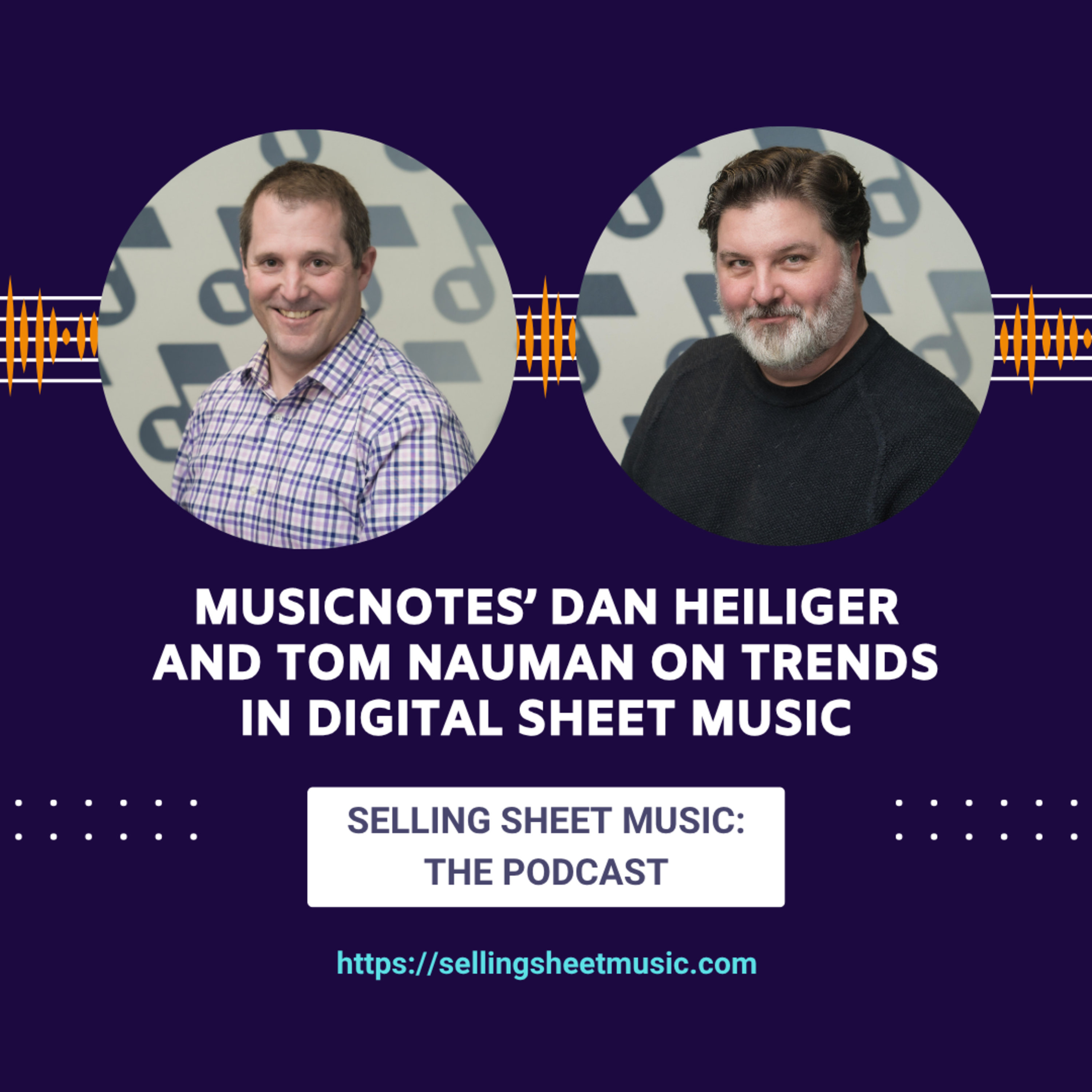
61. Musicnotes' Dan Heiliger and Tom Nauman on Trends in Digital Sheet Music
41m 7s
The Selling Sheet Music podcast features interviews with industry insiders, such as Dan Heiliger and Tom Nauman from Music Notes. Dan serves as CFO and VP, while Tom is the chief publications officer. They discuss Music Notes' history, transition to digital music distribution, and decision-making process for content selection. Both guests have musical backgrounds, with Dan being a pianist and Tom a classical guitarist. They share their paths to working at Music Notes, highlighting the company's shift from physical to digital music distribution. The podcast delves into the importance of data-driven decisions in selecting content for the platform, balancing evergreen classics with trend-driven music, and meeting customer needs through various music formats. The conversation sheds light on Music Notes' unique position in the music industry as a digital-first company offering a wide range of music for diverse audiences.
Transcription
7538 Words, 41341 Characters
Hello, and welcome to Selling Sheet Music, a podcast for composers, arrangers, and songwriters
to learn more about publishing and marketing their sheet music.
I'm your host, Garrett Breeze.
Thanks for listening.
For today's episode, I'm sharing an interview I recorded on location at Music Notes Headquarters
in Madison, Wisconsin with Dan Heiliger, the CFO and vice president, and Tom Nauman, chief
publications officer.
We had a great conversation about the history of Music Notes, digital music in general,
how to react to trends online, and a host of other things.
I learned a lot from this conversation, and I think you will too.
Well, why don't you two introduce yourselves, say who you are, and what you do.
Yeah, I'm Dan Heiliger, CFO and vice president of Music Notes.
I handle all things finance and a fair amount of operations here at MusicNotes.com.
Tom Nauman, chief publications officer, been with the company since almost the beginning,
started in 1998, so 26th year here.
Basically, I and my team are in charge of making the product, making sure that the product
is of the quality we need, and getting all that stuff up to the site for sale.
It's an interesting job for a guy with a music degree, and happy to be here.
And are both of you musicians?
Yes, I've been a piano player since the age of five.
I still play piano on the weekends at church regularly.
I started playing trombone in the fourth grade, and played through college at the University
of Wisconsin in their marching band.
Dabble and guitar just a touch, and have sung a little bit in the past.
Sounds good.
I am a classical guitarist by training.
Started off, as most people do, in high school, and went around on electric guitar and stuff
like that.
But when it came time to get serious, decided to study classical, have a degree in performance,
and that's gone a long way to help.
In this job, obviously, classical guitar music is notationally pretty complex, so it was
a good testbed to get my head around the concepts and the exceptions of language and things
like that.
Also involved with a local non-profit, Madison Classical Guitar Society, it's just a small
performing organization that tries to bring music into town and stuff like that.
We put on concerts and other events and do some outreach, and yeah, nice little non-profit
on the side there, so that's a fun thing for us.
So how did you end up in these roles?
It's not the typical career path for a pianist and a classical guitarist to end up running
a digital music company.
Yeah, exactly.
That's a good question, Garrett.
Going into my later years of high school, I was in band, choir, taking piano lessons.
I knew I wanted to keep music a part of my life, so thought about addition to the School
of Music here in Madison, Wisconsin at the University, changed gears a little bit and
went pre-business and going into pre-business.
I still wanted to play the trombone, and Madison had a great marching band, so continued
on with trombone for four years, but fast forwarded into my college careers, got my
degree in business, accounting, and my dad said, "Hey, you can make a little more money
doing business versus straight music," and I said, "Okay, I'll get my degree in business."
And was he right?
Maybe, maybe not.
It works so far.
But to fast forward after I got my accounting degree, I sat for my CPA exam, worked in public
accounting for five, six years as an auditor.
So financial auditor by trade, auditing external financial statements, learned a lot, learned
a lot, learned quickly, worked a lot of hours, but the burnout in public accounting is pretty
quick, but managed five years in public accounting.
So it's not just the music industry where you burn out in five years?
No, exactly.
It comes across the whole board, but when I was auditing and doing financial statement
reviews, music notes was one of my clients.
So I worked with chairman Tim Ryland, who was a CFO at the time, and I had an inside
track to the books and records of music notes.
So I thought, hmm, the controller at the time was nearing retirement age, and this might
be a fun gig if the job ever opened up.
So then a couple years after I got out of CPA, I've got word that the controller was
retiring and they needed a replacement.
So being a musician, a lifetime musician myself, and love of numbers.
So numbers and music kind of go together hand in hand.
I applied for the controller job, and Tim remembered me and the rest is history.
So I've been with music notes about 10 years now, and it's great.
Just love looking at the books and records from every angle and managing.
It's been great.
People here are a lot of fun.
And my story is convoluted, but it's a music job.
Throughout college, I had always done lessons and things like that, and being music being
my path, I always kind of anticipated that going into education or something along those
lines was going to be, as a career path, the thing I do, went to college in Dubuque, Iowa.
Great town, small town, a small city.
And knew that I wanted to, just having taught lessons, beginner guitar and all that kind
of stuff, knew that I wanted to teach at a higher level.
So I would need an advanced degree for that.
And to do that, I need to come to Madison because Madison had a formal classical guitar
program.
So I moved to Madison and intended to work here for a year to get residency to continue
on in the education process.
And during my time here, I got a recommendation from a concertizing guitarist that, oh, there's
this publisher in town called Air Editions that does kind of musicological research publications.
So lots of historical music and stuff like that.
And every once in a while, they put out a job listing for someone to do music type setting.
Again, this is '90s, so computer music engraving was still pretty new, but it was something
that I had studied in school and was all about it.
So I figured I'd give it a shot.
I did.
I went and I applied for a job at Air Editions just to see, dropped off my resume.
And when I got there, music notes had started.
The concept of music notes was already off the ground and there were people there.
So I dropped off my resume and they're like, is this for Air Music Notes?
And I'm like, boo-hoo.
So luckily they got in touch with the right people and got on that way, came in as a sheet
music editor.
Yeah, basically doing all the music type setting, engraving work, finishing up the multimedia
files in the same kind of way that we still do today.
Over time, about 2004, I got promoted to manager.
And then beyond that, director and now chief and we've got a new manager and good team.
So a lot of right place, right time, which is a lot about opportunity and being open
to taking them.
And that's what happened there, so.
What is it about Wisconsin?
I mean, you got music notes, got highlight, like why is all this published music here?
That's a really good question.
I've wondered the same thing because there was a lot of print infrastructure.
How Leonard uses regional printers and things like that.
So the physical printing and book distribution being centrally located is handy for that.
But that's kind of the only thing I can, we've always been digital.
So the actual gravity of where we are is less of a factor.
But how Leonard being so close and everybody else is on the coasts or in Nashville.
Yeah.
I don't think there's a, I was wondering the same question, like why, why Wisconsin being
how Leonard music notes pretty close down the, I mean, that's what, 80% of like sheet
music 75, I don't know how you measure it, but it's a lot of West here in Dairy State.
But you know, we do have the university here, a few tech spin offs and startups are two
of our cofounders, Tom Hall and Walter Burt tech minded.
So you know, being in Madison and a few tech, tech gurus, I'm not surprised, but it is,
it is kind of a unique, a unique situation.
I don't know if the, the centralized location argument actually holds a lot of music notes
used to also sell and ship physical books and our warehouse for that was on the East
Coast.
Yeah.
It's like, yeah, that's a really good question though.
I don't know why it's here, but we're a digital company.
We're global.
I mean, Kelly's here.
That's why music is here.
Yeah.
But, but you know, there's more than just y'all, which is just interesting to think about.
So the whole premise of music notes was to be a digital first music company or digital
only, depending on how you define that.
Digital first, I think is fair.
The concept came out of a time when it was still CD sales.
iTunes didn't exist yet.
There was a, you know, and it was always the thing where you'd go to a music store, either
your local music store would have the selection.
If you're looking for something that's a little off the beaten path, you couldn't go to Amazon.
You'd have to go to the music store.
And if they didn't have it, you'd have to order it and have to wait for that to come
in.
And then you're going to get a third hand copy that's marked up.
Same idea with books.
You know, you only want to play that one song from the band you like, but you have to buy
the whole book from the music store to get it.
All of those kinds of things are starting to come to the fore.
Like I mentioned, iTunes, it's the same kind of thing where people had to buy an entire
album when they wanted to get the new hit single, that kind of thing.
So that movement was already kind of in motion.
But it's one of the things that got my attention about this job in the first place was earlier
days of the internet, it was a digital ethereal product that you could actually deliver something
physical through the internet.
You could sell someone something that they could print out and have tangibly in front
of them.
And that was kind of rare for a product at the time, plus they could only get that song
if they just wanted that song, they didn't need to buy the whole book.
So that motion was kind of happening.
And the founders, in addition to Kathy, were both tech guys or both programmers.
Tom Hall had written the software that I mentioned from Mayard, the proprietary house software
that we used to edit all of the stuff that we created internally.
Notation editor built in the '80s, modified in the '90s, we've been modifying it ever
since and still use it.
But that idea, having that asset, that engraving program to work with, one of the first, and
then Walter was kind of a web guru.
And they kind of came together and said, you know, we could use this, we've got this file
type in these graphics, we could marry that with some mini playback and also be able to
deliver that in a web plugin to a user and have them get it.
So that was the whole concept, digital first, definitely.
Books came later.
Over time, we moved away from actual physical shipping for many reasons.
But yeah, we're digital forward now and we're delivering very well to a lot of people, I
think.
Yeah, we were really split in the early days between physical and digital.
I remember my first exposure to music notes, I was high schooler trying to get a piano
flute duet and, you know, the music store didn't have it and we needed it in two weeks
for Christmas.
And my mom goes online and we find the song.
So music notes, drop-shipped it from the East Coast warehouse to my home here in, you know,
Stoughton, Wisconsin, just out of Madison.
I had it, had it in a couple days, was able to practice it, rehearse it, play it right
in front for church that, you know, that Christmas.
So it's that speed of delivery, fast, easy, you know, now we're digital only, but having
it right from your own printer or, you know, use our apps now.
We can just consume it as soon as you purchase it, that speed delivery and then our vast
library just makes it so easy for the consumer to get that song quick.
Yeah, same kind of experience for me as a classical guitarist, there was a whole lot
around here, you kind of went with the large collected books and the public domain stuff,
but if there was any new composition, stuff happening, like, you know, people still write
for that instrument.
It's some amazing music is coming out of it, but it was hard to find.
So, you know, having that kind of digital platform where you could actually have everything
never be out of stock, it's always there.
I published once, I was in stock.
I find music notes to be a really interesting sort of, I don't know, case study of the industry
because you do a little bit of everything, right?
You're a licensing company in some respects because you're getting the rights for people
like me to publish arrangements.
You've got artists on YouTube that are publishing through y'all, but you're also a distributor
carrying other people's products, other publishers, but you're also publishing your own editions
and your own arrangements of things.
And so it's this really interesting mix of all different parts of the industry.
How do you decide what you're going to put on the site?
How do you decide what songs, what formats?
Obviously, you're not going to open up your ultra sensitive company strategy, but how
do you go about making those decisions?
Is it data driven?
Is it instinct?
Is it something else?
Good combination of both, mostly data driven.
We do spend a lot of time on the numbers and the metrics.
We have partnerships, obviously, that you need to honor.
You have people publishing new music and they want it out in timelines.
We try to honor that as well as best we can.
But yeah, when it comes to the things that we actually embark to invest in ourselves,
the new creation of a new transcription of a new pop song that came out or whatever,
we turn to the data.
We have meetings every week where we look at search activity.
We get people who are looking for something and getting zero results or a lot of people
looking for a thing and nobody buying that thing or some old song that's bubbled back
up in the zeitgeist for some reason.
We're not really sure where it came from, so we'll look at those kinds of things.
It's like, oh, this is a TikTok trend.
Somebody did this on YouTube.
This was performed at the Grammys.
Figure out where that interest is coming from, figure out if it's going to last long enough
to actually make its money back.
There are some things where you just need to have it out there in multiple forms so that
the person who's looking for it, okay, they might not want the piano vocal, maybe they
just want a solo piano, or maybe they play clarinet and they just want the melody.
We try to make sure that we can make an arrangement, but we can also make all those other versions
of it for those other use cases.
We try to maximize the titles that we've got, but that's the short answer.
The intuition side is we've got a trend that we call sheet music friendly.
There's a lot of stuff where it's a hook or a loop and you give the entirety of what you'd
play on an instrument away in the first two bars, and that just keeps going.
There's a lot of music out that does that.
That's an easy transcribe, man.
It's an easy transcribe.
It's a tough sale because you put it on the website and that first page gives away everything.
We need to pick and choose.
It needs to be something that we believe people are going to spend some time with and actually
get some value out of.
Sheet music is different that way.
It's not a passive experience for the most part.
People actually need to sit down and spend some time with it, passively read 75 songs
in a day.
At least most people don't.
We try to make sure that the people are actually going to use it, have something to use.
Would you say the approach then is more trying to make sure that everything that goes on the
site is a banger and a success, or is it more about trying to find that one thing that's
a hit, throwing out 20 different things and if one of them takes off, then that batch
was considered a success?
It's a little bit of both, but like Tom said, we do mind the data to a point where we know
certain types of arrangements sell better than others.
We'll start with one, like the piano, vocal guitar, or our own singer-pro first and then
we can get that on the site first.
Start the investment that makes sense in front, but don't spend all the time and effort to
do everything all at once.
We can offer less costly versions if we're kind of on the fence about it, if we just
want to try something.
When people show up, we don't want them to say, "No search results."
We don't want them to find nothing, but we're kind of on the fence.
Maybe it's not the most sheet music friendly, or maybe we think it's not going to last as
long or whatever the reason is.
We can offer something like a chord chart or a lead sheet.
There's something that people can find and a lead sheet is perfectly useful.
You can get the chord changes and the lyrics.
You can work from that.
It's fairly inexpensive to make, but still useful for the people who need it.
If that does well, then we expand.
Or likewise, if we get something that we know is going to work, we're fairly confident it's
going to work, we'll put it out there for performs while we start making other things
from that as well.
We'll break that out of other types of arrangements and get that coverage that I was talking about
before, making sure that every use case is covered.
We do have some loss leaders for sure, but I mean, part of that is the investment in
the perception that if you're looking for something, you're going to find it here.
This is the place you come for that kind of thing.
Even if you're looking for some obscure video game soundtrack title, you're likely to find
it here.
That's a cool thing.
I will add that our sales mix can be somewhat predictable, Christmas songs, holiday tunes
sell very well for us, so we know going into Q4 every year, we're going to put a special
effort there.
We do have what we call evergreen songs that just sell year in and year out, no matter when
published, over the rainbow, Hallelujah, titles that just do really well for us because they're
great popular titles and never go out of style, and then aspiring singer or pianist wants
to learn how to play that song because everyone's heard it.
Yeah, it's surprising how much evergreens are a part of our daily, it's just people are
constantly always looking for those songs, yeah.
What's the balance between those evergreen things and the let's call them trend-driven
things?
The music notes site right now and half the top songs at the moment are all from Wicked,
not a huge surprise there, but then you also have like George Frederick Handel, Paso Caliglia.
That was actually a freebie that we gave that away recently, so that was-
That bubbled it up, yeah, but it's just interstellar is still on here, that's not a new movie.
Do you have any sense of what online sales is driven by, you know, the moment of these
are the movies that are out, these are the things on TikTok, these are the videos people
are watching versus just, you know, here's the next year's worth of piano students coming
to get their stuff?
Yeah, they are leaning towards the evergreen side, which carries the bulk of our sales,
they won't divulge or crown jewels of what's the exact split, but an 80/20 rule is enforced
here in fact, meaning that the year in and year out evergreens and the older songs do
help carry the business through when maybe the new pop songs, there's not as many good
ones as there used to be, you know, so it's a fine mix, we have our own public domain arrangements,
we offer freebies every month, so we kind of interspersed that mix to kind of keep it
fresh and new for folks to keep coming back.
That is one of the interesting metrics, because one of the things we can track is percentage
of sales coming from things that were released in the last X time period, and that's kind
of an indicator of the hope of the industry as a whole, because you can see, you know,
if we've only got two songs that were released in the last six months that are still in the
top 10, you know, if, like you said, if Halloween is the top of the sales chart, yeah, it's
like we're not, we're not, there's not anything really strong hitting with people right now,
and that's the thing you got to be careful of with the real space content and stuff like
that, it's catchy, everybody starts looking for it, but they look for it for a couple
of months, and you know, you got to make it available, so again, you got that perception
that oh, music notes has that as well, but yeah, just kind of keep it high.
So what, what percentage of your total revenue as Leonard Cohen's "Hallelujah?"
Give me that number at least.
It's a good number.
It's a good number.
We have a couple hundred thousand titles, but it's, you know, definitely more than it's
fair share.
And that's another one of those things too, where there's several, several, several versions
of it.
Well, I mean, that's the customer service rabbit hole too, because Leonard Cohen himself
wrote like 75 verses for that song, and different versions change over time, and we get to
have that argument several times a year with someone who says, "This isn't the right thing,"
and it's, well, it was right, he performed it in 1978 this way, that one time on this
one show, and omitted that verse that you like.
So it's, it's, it's a fun thing, but yeah, that title as a whole is, is well fleshed
out by many, many publishers and people.
It's interesting, going back to what you said about, going back to what you said about what
selling being sort of an indication of the health of the music industry as a whole, or,
or maybe how much is selling, being sort of an indicator, just from, you know, my vantage
point is mostly in choral education or like ensemble, you know, school education.
I certainly see it there that a lot of this, a lot of the music they're looking for is
not the current stuff, because the current stuff is not sheet music friendly.
And so it's really interesting to kind of see the ups and downs that go along with that.
Have you found, have you found a trick for that?
Like how to make something that's not sheet music friendly passable, like how do you adapt
something like that?
Oh, that's a really good question.
I've already dated myself with this company, but I've pulled dubstep era.
You get EDM titles and things like that, things that, you know, we're transcribing for piano
primarily.
And you get those things that are not possible to play on an acoustic instrument, just, you
know, some of those dance titles or just any, anything of that experimental electronic genre.
People look for it.
It's hugely popular.
You kind of got to figure out what to do to emulate some of this loops and boops, to make
it something that someone could perform and some, you know, anyone who's listening to
it is going to go, I know what that is, that sort of it.
So it is a challenge sometimes, but that's the whole sheet music friendly thing.
We will take a chance on some of those, but we tend to gravitate towards the things that
actually have that discernible, identifiable mood to them, chord progression thing, you
know, things that go through a harmony in a way that makes sense for someone to actually
recreate in their home.
I think swoops and boops is the moment you're next to do all of them, all right?
Let me know when it's ready.
Okay, swoops and boops.
I'll do some charts for you.
That'll be great.
Yeah, I know you're editors and we've gotten pretty creative at times, but they do a nice
job at, you know, making, making the non sheet music family songs playable on the piano.
And they come out pretty good.
There's a lot of tricks, but that's the art of it.
It's not something, I mean, there's a lot of AI tools out there and stuff like that
now.
So, I mean, you can feed that stuff in there and it'll give you a starting point, but there
is an art to making something that's possible and, you know, might actually be enjoyable
for a person to play at home.
So that's the goal.
Well since you brought it up, what is AI going to do to the sheet music industry?
It's really interesting.
Also.
Everything.
No, we've, uh, there's tools there, definitely.
I mean, we've got stems extraction, things that are all over the place.
You can take a full remix thing and really peel it apart to hear the insides of it that
you might get lost in the mix, which is great, or, you know, people use those all the time.
There's also transcription tools coming out of that as well.
Some are better than others, but I don't think any of them are quite there yet.
There's, there's, I like to say there's a grammar to it.
You know, music is, there's an art, but it's also a grammar.
You can misspell things readily if you don't know what you're doing, you know, being things
wrong or make things more difficult to read, which is where the actual professional editor
touch comes in.
You don't realize it's a problem until you see something that you can't count because
the beaming's all off or the, you know, you've got eighth notes tied to eighth notes tied
to eighth notes tied to eighth notes for Ed infinitum.
And that's the kind of stuff that comes out of AI currently.
It is getting better.
We're definitely keeping an eye on it, but I see it as a tool to enable people to work
better.
Same as in programming, same as it is in any other kind of, you know, writing or any of
those other things, you know, you can, you can get a script from AI, but you probably
want to revise it a bit yourself before you actually say the things that are in the AI
script.
So that's the state of the state.
I think it's a suite of good tools that are getting better, but there's still something
to be said for people who actually know the proper grammar and how to bring it all together.
Yeah.
I'll quickly add that music notes.
We pride ourselves in being the quality sheet music provider.
It's going to be the right, you know, right notation on the page.
As Tom just, just elaborated, but it's, you buy a piece from us.
It's going to be correct, especially our interactive products.
Editors touching every single one of those, those notes on a page.
So it's, you know, we, we, we pride ourselves in having a good solid core of publication
folks, editors, you know, the data behind it's correct.
We're paying the appropriate royalties, everything we do in touch to that sheet music.
It's kind of handcrafted.
So it's not just run through an automatic system.
You know, sure we can use those, those tools to help us and get, get efficiency.
But at the end of the day, we're all about quality.
You know, something that should be easy for a computer to do like transposed keys.
You want, you know, something that was written in a, you want it B flat for whatever reason.
The translation that you would think a computer with semantic knowledge of what the notes
are should be able to do cleanly.
We see time after time, there's not just us, but other packages as well have some difficulty
with some of those key transitions, especially if you're trying to do a broad spectrum.
For us, we don't, we use software to make those transpositions, but the transpositions
are still individually reviewed, proofed, edited to correct those foibles in there.
They go quickly, but yeah, there's a lot of other experiences that rely on the software
to do that in real time and it doesn't always work out automatically.
So like I said, it's, it is this kind of special extra, extra touch to have real human people
try to read it as a customer and make sure that it's legible.
Obviously, I think the premise has borne out with music notes being a digital music company.
You're still here.
Has it turned out the way that you expected?
Or I mean, obviously every company has to sort of pivot as things come up, but, but
thinking back to the beginning and what the predictions of what digital music would look
like in the future, how has that sort of matched up with reality?
I would say early on, we were very content and licensing heavy.
We talked earlier about getting the rights, you know, we're a music publisher first, where
in order to sell the music, we needed the rights to do those.
And we've worked very hard on the early days, first 10 plus years of getting licenses with
all of the music publishers, you know, since their early days, quote unquote, we've gotten
those licenses.
Now, hey, we're, we're growing our site, we're a tech company, so we do our own development
on the web and our apps, you know, we were around pre the app store and now we've developed
our own app on Apple and Android and, you know, and, and, and lastly, we've really got
to invest in our tech, you know, I think, I think in most recent, recent history, we've
put extra money in the tech and the tools, making, making our product, you know, up to
the current state.
And so, you know, it's been, we're kind of a three-headed juggernaut being e-commerce
B2C, doing the development music publisher, getting those licenses, and just being able
to do that development on our own, on our own platform, on our, with our own internal
developers.
So it's, we've kind of had to pivot throughout the course of history, but since COVID it's
been a little bit of a struggle, you know, businesses have stagnated or we know there's,
we've lost some musicians given whether they've stopped performing or, you know, found other
things to do, but we're, we're, we're managing well.
Yeah.
Same with the rest of the music industry, I think the early days of COVID were great
for the music industry because everybody was picking up their hobby again.
Yeah.
That was interesting.
Another thing there, I mean, you're at the music notes office now, it's a fairly, for
what we're doing, I think it's a fairly small team and a lot of the reason we are still
here is making sure that we're keeping an eye on the trends, but kind of knowing which
ones you're hoping we know which ones to chase.
There's a lot of new technologies and happenings and the whole sheet music space, you know,
people making an app that has this experience or that experience or, yeah, we like to keep
our focus on education on literacy and actually being able to re-cheat music, not finding
workarounds for it.
Yeah.
Being a useful tool for musicians to be able to get done what they need to get done.
We've definitely monitored the technology and all the up and comers and all of the sound
recognition AI.
There's great tools.
There's great tools, but do they have a licensee and do they have the funding, the backing?
They'll come and go.
A lot of fades, but our foundation is built where we stick to our core and we'll make
the necessary investments in the right areas, but we're very picky and choosy.
So most of the time we look at them, might turn them down, but we just got to be very
picky and choosy of what we focus on because our team is, you know, on the smaller side,
like Tom said, we're small but mighty.
Licensing is a real hurdle there too.
It's the thing that everyone wants.
You can make a great technological experience, but if you don't have the licenses for the
content, that's going to slow things down.
So we see a lot of that come through and it's making the next shiny isn't always the hard
part.
It's the relationships, the getting the licenses in place and making sure that what you're
building is benefiting the people who create the music as well as the app or the business
that you're creating.
It was sort of the like birds eye view of just the amount of music that you have on
the site.
How much is going up every day, every week?
What's the size of the company sort of in broad strokes?
Yeah, I'll let you talk about the throughput and then I can touch on maybe the order volume.
Sure.
Yeah, throughput, the current team size, we push about 200 units a week, give or take,
even though by units I mean like individual song products.
So we do a lot of that in addition to that.
We also have the transpositions that I mentioned before.
That's kind of it's separate.
Also the same team, the editorial team is also the QA department, so they keep each
other in line.
If anybody starts slipping, somebody's going to let them know, which is great, but yeah,
that's current volume is about 200 units per week.
It's been as high as 500.
It's been, you know, 200 is pretty standard these days, but yeah, that kind of answers
that question.
So it's about 400,000 units on the site.
Yeah, I'd give or take 400,000 individual different types of songs on the sites, including
variations and arrangements, but that's, you know, we put up as many as we think customers
will want on a normal basis, you know, there's occasional titles that, you know, we'll put
up on upon request, but we really monitor the search results like Tom said, we're driving,
you know, 10,000 orders a day.
So, you know, we're a high-volume, low-average order value business, so, you know, we talk
how many customers, average customers, I think our average order is about one, one-and-a-half
songs per order at most.
We see a lot of people that come every six months to order a song.
Sometimes we get some one-and-dones, but we do have a nice growing membership program,
which will offer the more power users, the, you know, the professional musicians who do
come back at us an opportunity to, to, to, to, to drive that repeat customer.
And the majority of the product is popular music.
Is it not?
For the most part, yeah, like you mentioned, we do have our public domain.
We've got our, one of our focuses now has been solo ensemble contest music.
We have choral content as well, obviously.
Yeah.
But the bread and butter of the company is those kind of singular pop titles, you know,
things that most people know.
Yeah.
Yeah.
Piano, vocal, guitar is our bread and butter.
We offer all instrumentation, but those top three, you know, carry a good portion of
our business.
There's kind of this idea out there for both composers and artists that kind of the way
to get traction, the way to get attention is to cover a popular song and then you get
noticed and then you can try to feed them something else.
Do you think that works?
Or is that, is that kind of dated?
It's definitely a tech.
Yeah.
I mean, I would, I would say it's effective.
Definitely.
There's definitely trends.
And, you know, I mentioned kind of the trends are getting sometimes shorter and shorter term,
where if you, you know, the new video game again is hot, you know, it's like the soundtrack
from that video game, everybody's going to cover that and then, you know, build their
channel on that kind of content or use that to get some of their original stuff out.
It does happen.
I would say that's definitely a thing that happens and it still happens.
It's just kind of this catch 22, right?
It's like, I know this thing's going to be popular.
Like I know Wicked's going to be popular.
So I should probably do an arrangement of, you know, a choral arrangement of Wicked.
But I also know that everyone else is thinking the same thing.
And so then you just get this like volume of music, that's all the one thing and, and,
and you end up getting lost.
Yeah.
And, and, but then if you do the unique thing, you don't necessarily get found like just
like, like as a, as a creative as on the arranger side of things, picking what song to do or
what format to do it in.
It's such a tricky thing.
Do you, do you have any insight into how to figure that out?
And navigate that because a lot of people, I think end up just sort of spinning their
wheels like, Oh, I'm going to do an easy piano version of Moana, but then it just gets lost
in the thousand other versions that are out there.
Yeah.
And we do partner with a lot of, we had talked about like YouTube creators and things like
that, people who do those kinds of volumes of things.
And I think they'd be wrong to presume that even though music adults can handle licensing
and actually pay royalties on the sales and all that kind of stuff, to hinge that reputation
on that platform alone, like let the sheet put it out there and the sheet musical stand
on its own, isn't always going to work for that to break through.
You kind of have the YouTube audiences kind of figured that out.
They build their audience based on the breadth of content that they've got as that channel,
as that personality, and that drives people to their content that they can buy, which
is great.
So, I mean, yes, if any time a new song comes out, you're absolutely right.
We do get a lot of versions of different songs for different audiences.
We've got a kalimba channel, we've got people playing all these crazy different types of
use cases, and it's great to have that coverage, but people are looking for that from the creator
that they trust, and that creator kind of needs to build out that ecosystem around their
brand and their channel, and that helps the sales, helps us, helps them.
But yeah, I totally agree.
If you do just try to cover them, like just submit the sheet music and don't do anything
else, that is as likely to get lost as anything unless you've got a super, for your thing.
Yeah.
Yeah.
I would add the signature artists, the special arrangers that do well with us are the ones
that come in with a bigger channel.
So obviously, the more followers, the more links we get back to us, the more sales.
So it's the more established channels that tend to do better for us, although we've had
a couple of great up-and-comers, sheet music boss out of Australia, they've done really
well in growing exponentially since we started with them.
So it can go both ways, but it's more easier done if you have that kind of established channel.
I will add to your point on doing covers versus originals or your unique own thing.
It's getting harder.
I'd say it's getting muddier with just the number of mediums you can release, new music.
But I think our attention span of just even the recent generation post-COVID is getting
so short now, I notice it with my kids, it's like, "Okay, Dad, what's next?"
So the shelf life of a hot new song is becoming shorter and shorter.
So it's that short attention span, what's the next new song?
Okay, that was yesterday.
What's today?
So it makes business a little trickier to monitor the trends.
And again, what we would, historically term, is vanity publishing.
It's true.
I mean, people will create a thing, and if you don't have the audience, people aren't
going to be looking for it.
So I don't care how much you put out there, it's not going to bubble up.
You kind of need to build your audience along with the content that you're trying to sell.
Your brand brings the interest, the mere existence of a thing doesn't necessarily mean that it's
going to sell.
So that makes sense.
Yeah.
So it's a good observation.
You're right.
It can get lost.
This has been great.
Anything else you guys feel like we should cover or take again?
Yeah, I just say Music Notes is here for the songwriters and music creators for the industry.
We're all about rewarding, you know, the, we're credit, it's due.
We've paid 130 plus million in lifetime royalties, we're fully licensed, fully legal, you know,
we're paying the creators, we're reaching back to the inquiries, responding to certain
takedown notices where, you know, we think we're doing it the right way and we've, we've
been in business 27 years now to support that, that claim and it's, it shows.
Yeah, we're trusted and that's a good thing to have and encourage people to sign up and
try to sell their stuff on our channel just for those reasons.
I mean, you try to reward the creators and make sure that the people who created the,
if it is a cover, the people who created the original thing, you know, are also compensated.
So it's not just the free sharing ecosystem.
There's actual value to these things and musicians should value the content that bring them joy.
Yeah.
Well, that's a great note to end on.
We'll put links for how to do all that in the show notes so people can check it out if
they're not already involved in publishing through Music Notes and thanks again to both
of you for coming on the show.
Thanks, Garrett.
This has been a pleasure.
Thank you for listening to another episode of Selling Sheet Music.
If you like the show, please rate and review it wherever you listen to podcasts.
You can read episode transcripts and get caught up on past episodes at SellingSheetMusic.com
and you can find my music at GarrettBreeze.com.
Selling Sheet Music is written, produced and hosted by me, Garrett Breeze.
Post production for this episode was done by Brandon Haney and our theme music was written
by myself and David Dykstra.
I'll see you next week.
Go write something.
Podcast Summary
Key Points:
Music Notes podcast features interviews with key figures from the music industry.
Dan Heiliger and Tom Nauman share insights about Music Notes, their roles, and musical backgrounds.
Music Notes' journey from physical to digital music distribution and decision-making process for content selection.
Summary:
The Selling Sheet Music podcast features interviews with industry insiders, such as Dan Heiliger and Tom Nauman from Music Notes. Dan serves as CFO and VP, while Tom is the chief publications officer. They discuss Music Notes' history, transition to digital music distribution, and decision-making process for content selection.
Both guests have musical backgrounds, with Dan being a pianist and Tom a classical guitarist. They share their paths to working at Music Notes, highlighting the company's shift from physical to digital music distribution. The podcast delves into the importance of data-driven decisions in selecting content for the platform, balancing evergreen classics with trend-driven music, and meeting customer needs through various music formats.
The conversation sheds light on Music Notes' unique position in the music industry as a digital-first company offering a wide range of music for diverse audiences.
FAQs
Dan Heiliger es el CFO y vicepresidente de Music Notes, mientras que Tom Nauman es el director de publicaciones de la compañía.
Dan Heiliger es pianista desde los cinco años y toca el trombón. También ha incursionado en la guitarra y canto.
Tom Nauman es un guitarrista clásico con formación en guitarra clásica y experiencia en el ámbito musical sin fines de lucro.
Dan Heiliger pasó de la música a los negocios, mientras que Tom Nauman comenzó como editor de partituras en Air Editions antes de unirse a Music Notes.
Aunque se encuentra en Wisconsin, Music Notes es una empresa digital global. La ubicación central y la presencia de cofundadores con experiencia tecnológica fueron factores clave.
La idea surgió de la necesidad de ofrecer partituras digitales accesibles y específicas, evitando la compra de álbumes completos o libros enteros.
Chat with AI
Loading...
Pro features
Go deeper with this episode
Unlock creator-grade tools that turn any transcript into show notes and subtitle files.
 PodcastTranscript AI