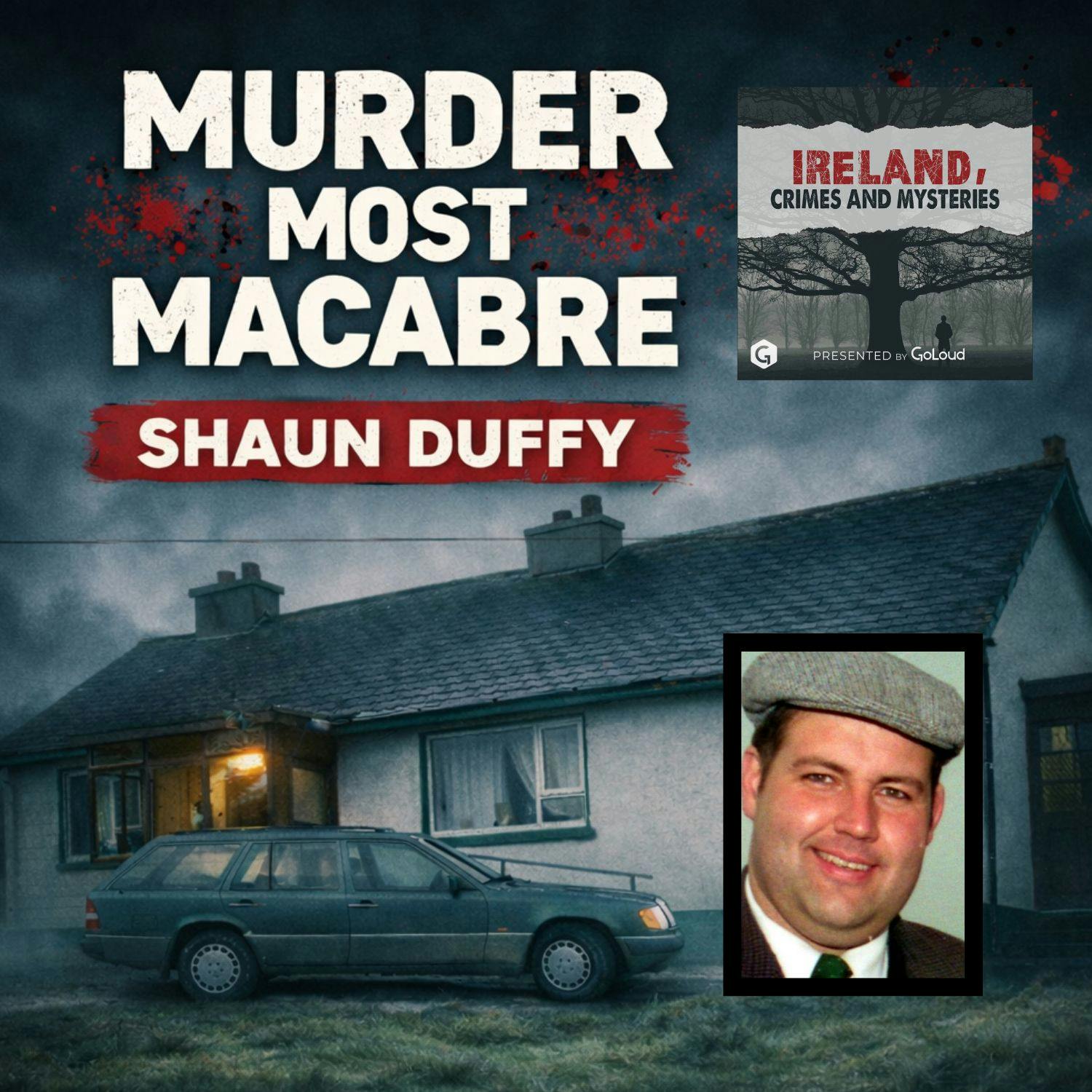
Sean Duffy, a 36-year-old from Meenacross, West Donegal, was murdered in his own home on January 29, 2005, in a case that remains unsolved. The night before, he had celebrated his brother Kevin’s 18th birthday at a local pub and returned home around 2:20 AM. His body was found the next afternoon by Kevin, who noticed the porch door—always kept locked—was open. Sean had been stabbed four times, struck nine times on the head with a blunt instrument, and shot through the arm with a crossbow arrow. The house was ransacked, but no forensic evidence linked to suspects was recovered, and the weapons were never found.
Sean was a well-known local figure: an undertaker, mechanic, horse dealer, and bouncer, with connections across Ireland. However, he had enemies, lived in fear, and was on bail for assault charges at the time. His mother testified he feared for his safety, and his family believes he was killed because he knew something about a criminal gang. Investigators suspect two men lay in wait for him, but despite over 1,550 inquiries, 600 statements, and multiple appeals over 21 years, no one has been arrested. The inquest in 2010 returned a verdict of unlawful killing, with the coroner calling the murder "cruel, calculated, cold and callous." The case remains open, with authorities urging anyone with information to come forward.
Hey guys and welcome to another episode of Ireland Crimes and Mysteries. I want to thank you for joining me today and if you're a returning listener I want to say a big thank you for your continued support. It is your first time listening to my podcast "Welcome". It's great to have you on board. So what I'd further do, let's get started on today's story. Ireland Crimes and Mysteries is presented by Goal Out, Ireland's leading audio publisher and the home of Irish podcasts. Find new episodes on the podcast first on the Goal Out app and on your favourite podcast platform. Pictures Saturday afternoon in the west of Donniegall, late January 2005. It was the kind of day where the skies sit low over the Atlantic and the wind off the water gets into your bones. It's the sort of quite afternoon where nothing much happens. Kevin Doffy is walking down the road from his mother's house, he's 18 years old. The night before was his birthday and he's been trying to ring his older brother all morning. No answer on the mobile, no answer on the landline. His mother Catlin has been trying to again and again, getting nothing. So she asked Kevin to walk the 500 yards down to Sean's bungalow just to check in. He's probably fine. Kevin arrives at the house, he goes to the inner porch door, the door of the chorn by habit always kept locked, always without fail. And on this Saturday afternoon, it isn't locked, it's open. Kevin would later testify under oath at his brother's inquest, I knew straight away something was wrong because he always locked it. He steps inside, while she finds in that sissing room, will stay with him for the rest of his life. His brother, 36 years old, a man built like a wall. More than capable of looking after himself, he's lying face down on the sofa. There's blood on the walls, blood on the doors. The furniture has been torn apart, a coffee table smashed, and protruding from Sean's right arm is an 18 inch arrow. Kevin reaches for a pulse, there isn't one. Sean is cold, he's been dead for hours. Between approximately a quarter to three in the morning and three o'clock that afternoon, Sean doffy's phone had received at least 60 unanswered calls, 60, and all in that time while his mother ring, while his family ring, while the questions mounted, nobody heard a thing from inside that bungalow. This is the story of Sean doffy, a man who has many things to many people, an undertaker, a mechanic, a horse dealer, a bouncer, a brother, a son, a neighbor, a character known far beyond the quite roads of Westonigah, a man who was brutally murdered in his own home on the 29th of January 2005, and whose killers, more than 20 years later, have never been brought to justice. I'm news, and this is Ireland Crimes and Mysteries. To understand what happened on that January night, you first need to understand the man, and Sean doffy is not an easy man to put in a box. He was born into a large family, one of eight children raised by Kathleen and Liam Doffy in the mean across area of Westonigah. He was the second eldest. He had five brothers and two sisters. His first cousin was father John Jo Doffy, a local priest. He was a close-knit, well-known family in a part of the world where everyone knows everyone, and where family ties run deep. Sean himself was hired to miss. Physically, he was an imposing figure, six foot four, and broadly built. His sister Karina described him in an interview with the Donnie Gal Daily as a gentle joint. That phrase is worth sitting with for a moment, because it captures something real about him. He was a big man, and he knew how to handle himself. As Karina put it plainly, he never started any fights, but he was able to finish them. But alongside that physicality, there was a warmth to him, a sociability, a larger-than-life quality that drew people to him. He was a bachelor living alone in a bungalow at meanacross, just half a kilometer from his mother's house up the road. That closeness to the family mattered. He dropped in regularly. He was a presence. He was, by all accounts, the kind of person who made a room feel different when he was in it. In terms of work, Sean defies any simple description. He was a qualified undertaker, a role that in rural Irish communities carries real weight, built on trust, discretion, and a particular relationship with grief. You don't become a trusted undertaker in a small community by being careless with people. You earn it, and Sean was a known and respected figure in that role. He was also a mechanic, someone who understood engines and vehicles and the practical world of how things worked. But beyond those two trades, he had a whole range of interests and activities that took him well beyond the roads of Westonigol. He was a hearth-stealer. He went to hearth sales, a world of deals done on hand shakes, of knowledge passed between people who have been added for generations. Through those connections, he was known nationally. He'd been to Dublin. He was a recognizable face at horse fairs in a way that most people from a small town's land in Westonigol simply are not. He was involved in motor racing and motor sport. He dealt in furniture and antiques. He worked as a bouncer at local events, including the internationally known Mary from Don Low Festival and the Mina Cross Show. Between the undertaking, the horses, the carers, the antiques, and the doors he minded at events, Sean Duffy was everywhere and knew everyone. The official garada appeal published in 2022 described him as well-known, but locally and throughout the country, including Dublin, due to his interest in horses and motor sports. That national footprint matters to this story, as will come to. The broadcaster Gayburn, who had a home in the Donigol area, knew Sean personally. Think about that for a second. Gayburn, a man who spent decades at the centre of Irish national life, knew this man from Westonigol. That tells you something about the circle that Sean moved in and the impression he made on people. But Sean's world was not without its complications. By the time of his murder, he had made some enemies. His mother, Kathleen, testified at the inquest that he did have a lot of enemies and lived in fear of what might happen to him. And that because of that fear, he always, always kept the doors and windows of his home locked, always without exception. The unlocked porch door that Kevin found that Saturday afternoon was not a small detail. It was the detail that told the whole story before Kevin had even stepped inside the house. There were legal complications too. Sean had already pleaded guilty to two charges of assault causing harm, relating to an attack on a father and son at mean more in Dunlough. He was on bail at the time of his murder and was due back in court the following month. Guarady were, according to reporting at the time, aware of this background and investigated whether these charges and the people connected to them had any relevance to what had happened to him. None of that tells you who killed Sean Doffy, but it tells you that the man who drove home down that dark road at 2.30 in the morning was not a man without history. He was a man who had lived a full and complicated life in the space of 36 years, a man who was loved, well known and feared by son, and who, on some level, was aware of that fear and carried us around us him every day. His cousin, Father John Doffy, would put it plainly at his funeral. Sean was not just a son and a brother, he was a parrot of this community and when he was taken, something of that community went with him. Friday, the 28th of January, 2005, earlier that day, Sean had driven to Leforkinny, a fair distance from Minacross, out the east of the county, accompanying a brother to collect furniture. After that, he made a few visits locally before returning home. It was an ordinary enough day. That evening, the focus shifted to the Strandview Bar, which was a pub about three-four miles outside Dunlough, perched near the Atlantic coast. It was a gathering for Kevin's 18th birthday, family and friends, a normal Friday night out, a few drinks, good company. By all accounts, Sean was in great form that night. There was nothing unusual. There was no arguments, no confrontations, nothing that those present would later point to as a warning of what was to come. He was sociable, relaxed, celebrating his younger brother's birthday. When the evening wound down, the group didn't go straight home. They all went back to Kathleen Doffy's house in Minacross, the family home, just up the road. They had pizza, more time together, a nice comfortable end to an evening. They all enjoyed the last few hours together as a family. Not knowing it was going to be the last time they'd all be under the same roof together. At approximately 20 past two in the morning, Sean left his mother's house. He drove the 500 yards, literally half a kilometer, down the road to his own bungalow. That sharp journey on the quiferold in the dark areas of a jangry morning was the last time anyone who loved him would see him alive.
What happened inside that bungalow in the hours that followed was, in the words of the coroner who would later preside over his inquest, "Cruel, calculated cold and callous." According to the postmortem carried out by deputy state pathologist Dr. Maital Curtis, Sean suffered four stab wounds to the chest, neck and abdomen. Two of those wounds caused serious injuries to two of the main vessels of the body in the chest. He sustained nine separate blows to the head from a blunt instrument and a narrow, fired from a crossbow and straight through his right forearm. The former cause of death was recorded as multiple stab wounds to the body and blunt force trauma to the head. There was no signs of a break in anywhere in the bungalow. Yet when Kevin walked in that afternoon, the place had been ransacked. Furniture tossed and turned a coffee table destroyed, blood sprayed across the walls and doors. Guaradi established that there had been a violent and sustained struggle inside that room. Given the sheer scale of what was done to Sean, the combination of weapons, the number of blows, the ferocity of it. Investigators believed that whoever carried this out must have left covered in blood. But they left behind no recoverable forensic evidence that led to an identification or an arrest. And the weapons used, the knife or knives, the blunt instrument, the crossbow have never been identified or recovered. There was one detail about the crossbow that became a point of friction between the family and investigators. At the 10th anniversary, Sean's sister revealed publicly that Guaradi had told the family that the crossbow belonged to Sean himself and had been kept on his fireplace mantelpiece. His sister rejected that flatly. I knew my brother Sean she told the Donniegall daily and he did not have a crossbow on his fireplace. He was vain and only had a mirror on it. That conflict between the official investigative position and the family's certain knowledge of their own brother has never been publicly resolved. The Donniegall Democrat reporting around the 7th anniversary noted that Guaradi believed at that stage that two men had been lying in wait for Sean when he arrived home. Wow, let that learn from in a say, two men believed to have been inside or waiting at the bungalow at 2.30 in the morning. They're specifically for Sean Doffy. Based on the evidence, investigators believed Sean had no idea anyone was in the house when he got home. His family said that had he suspected anything, had there been any indication he would have turned around and left. He was not a man who would have walked into a situation he couldn't handle and yet he walked through that door. After approximately quarter to three in the morning his phone began to ring and ring and ring. His phone ring unanswered for 12 hours. Nobody came. Kevin found him at 25 past 2 and Saturday afternoon, 29th of January. Kevin Doffy's Inquest testimony gives us the most detailed account of what was found. He arrived, noticed the unlocked porch door, stepped inside and found his brother lying face down at the sofa. There was a large gash on his head. The arrow was in his arm and he fell for a pulse. There was none. Sean was cold. He told the Inquest. I knew straight away he was dead. Kevin who had just celebrated his birthday the night before was now standing in his brother's destroyed fishing room on that quiet Saturday afternoon, which his phone in his hand. He called the emergency services. Guardi arrived at the bungalow in Meanacross and within hours a major investigation had been launched, one that would eventually grow into one of the most substantial murder inquiries ever mounted in West Donigal. The 40 detectives and uniformed officers mobilised in the area under the command of Chief Superintendent Noel White. House to house inquiries were carried out across Meanacross and the wider local area. The surrounding countryside was searched for evidence and for the weapons used in the attack. Dozens of samples of blood splattered wallpaper were taken from inside the bungalow in a bid to establish where any of the blood came from the perpetrators. In the days immediately following the murder, Guardi also examined a car found abandoned on a roadside near Guidor, approximately 10 miles from the murder scene. The vehicle, an Opel, had been there since the early hours of the Saturday morning and only came to guard the attention several days later, whether it had any connection to the murder has never been publicly established. Investigators appealed publicly for anyone who had been in or around the Strand View Bar on that Friday night or who had seen Sean at any point that evening or in the early hours of the following morning to come forward. They were trying to piece together who had known Sean would be on the road at that hour. Think about what that means. For someone to have been waiting inside or at that bungalow at 2.30 in the morning, they would have had to know or been able to predict that Sean would have been coming home around that time. The birthday gathering, the route, the hour, someone knew where he was going to be. The scale of what followed over the subsequent two decades is what's spelling out clearly. As of the 17th anniversary appeal in January 2022, on Guardi's Shia Kona confirmed that the investigation had generated over 1,550 individual inquiries, that statements had been recorded from over 600 people and that more than 1,430 separate lines of inquiry had been pursued. A formal peer review of the entire investigation was conducted in 2017 and 2018. Those are not small numbers. That is a major sustained, expensive investigation. At multiple anniversary appeals on the 11th, 14th, 17th, 20th and 21st anniversaries, Guardi have stated publicly that they believe a number of people have yet to come forward who have information that could assist with the investigation. In their own words, at the 21st anniversary appeal in January 2026, Superintendent David Kelly said, "Investigation team, Milford Garter Station would like to thank those who have offered valuable information or assistance to the investigation to date." They continue to appeal for information and believe that a number of people have yet to come forward, who may now be in a position to assist in bringing those responsible to justice. In July 2016, the Donnie Gall daily reported what was described at the time as a significant development, that new witnesses had come forward following the 11th anniversary appeal, generating several new lines of inquiry, and that a number of people had been interviewed as a result, but no arrests followed. In January 2022, Garter published a detailed formal appeal through the Crime Card programme and through the Garter website, setting out the full facts of the case. They confirmed the investigation statistics, confirmed the peer review, and again appealed directly to people in the community with information to come forward. And also specifically that allegiances and relationships may have changed over the 17 years since the murder. A carefully chosen phrase that tells its own story about the nature of what they believe they are dealing with. The Inquest in Sean's Dead opened in Leifrakenny in September 2010, more than five years after his murder before Colonel John Cannon and an eight-person jury. Kevin gave the evidence about finding his body. Kathleen gave evidence about her son's life and her fears for him. Deputy state pathologist Dr. Michael Curtis gave detailed medical testimony about the wounds. Colonel Cannon addressed the jury directly, describing the killing as the perpetuation of a cruel, calculated, cold, callous debt of a human being. The jury returned a verdict of unlawful killing. No person has ever been arrested, charged, tried, convicted or sentenced for the murder of Sean Doffy, 21 years and not a single arrest. Over 21 years, a number of theories about motive have circulated. Some in the public domain, through reputable reporting, some spoken of in the community in hushed tones that never made it into the print. Let me walk you through what the verified public record actually contains and be clear where the evidence ends and where theories begin. The first and perhaps simplest thread is money. Kevin Doffy testified at the inquest that in the weeks before his debt, Sean had made approximately 20,000 euros from business transactions and had been openly displaying 500 euro notes in the local area. Kevin estimated that approximately 10,000 euros of that money may still have been in the house at the time of his death. The robbery was the primary motive or whether the ransacking was done to stage the scene or locate something specific has never been publicly established. What is sworn in quest record is that a large amount of cash was in Sean's position in the weeks before he died and that the house was torn apart the night he was killed. Guardian never publicly closed off the money theory and never publicly confirmed as either. This remains part of the open record of what was known about Sean's circumstances. Sean's own mother.
testified under oath that he had many enemies and that he knew it. He was a man who locked every dawn window of his house, not out of habit but out of genuine fear for his own safety. His family knew this. It was a fact of his daily life. At the time of his death he was unbeiled, having pleaded guilty to the charges of assault causing her, relating to the attack on that father and son in Dunlough. He was due back in court the following month, regarding the investigation where the people connected to those charges had any bearings on what happened to him. They have never publicly stated that they did. What those charges tell us and what his mother's test of morning confirms is that Sean Doffy was a man who operated in a world with friction in it. He had a history with people, he had enemies, and he knew in the way that some people just know that his safety was not something that he took for granted. Sean's sister has been the most publicly vocal member of the family across the years, and she has been entirely consistent in what she believes. In an interview with the Irish mirror, Karina says, "Sean knew something about somebody, and that person or persons didn't want the information made public. We are certain of that." The Irish mirrors reporting which drew on information provided by Karina, referred to Sean having knowledge of a criminal gang involved in a cross-border carousel scam, and suggested he may have been about to take what he knew to the Guardian when he was silenced. This is what the family believe happened. It has not been proven. Karina has never publicly confirmed it as an established line of inquiry. Karina has also been specific about the mechanics of the attack itself. She believes at least three people are involved. She believes the crossbow was used first, specifically because Sean was such a physically powerful man that subduing him with the crossbow bolt to his arm was the only way to bring him down quickly enough for the rest of what followed. She is certain the crossbow was brought to the house by the killers, not kept her by Sean, and she has always been clear that Sean had no idea anyone was waiting for him, because if he had, he simply would not have gone in. That image of a man stepping through his front door into a trap that has been laid and waiting is when the family has had to carry for 21 years. In February 2022, the Sunday Times newspaper published a report which, according to subsequent coverage in both the Donigal Daily and Donigal Live on the 20th of February, stated that detectors investigating the Sean Doffy murder were at the time examining a theory involving possible guard and involvement in his debt. I'm not telling you that the guard were involved in the murder of Sean Doffy. I'm not in a position to make that claim and I am not making it. What I'm telling you is this, in February 2022, the Sunday Times published a report that raised this as a theory under active investigation. The Donigal Daily and Donigal Live both reported on that Sunday Times piece. Those are facts. What the Sunday Times reported is a matter of public record. What is not a matter of public record is whether those allegations are true. According to the Donigal Daily's account of the Sunday Times report, the theory centred on the disappearance of another man from the Don Low area. His name was James Kern. He was 64 years old, a single man, and he was last seen collecting his pension in Don Low on the 16th of July 2003. James Kern has never been found. What happened to him has never been officially established. The theory as reported by those newspapers were in his follows. It was alleged in the Sunday Times that a vehicle associated with members of on-guardish Yucana was involved in an incident that caused the debt of James Kern. It was further alleged that Sean Duffy in his capacity as a mechanic was asked to repair that vehicle. And that in doing so, he became aware of what had happened. The theory as reported held that Sean subsequently attempted to use that knowledge and that this situation ultimately led to his murder. On-guardish Yucana in response to the Sunday Times report issued a statement which the Donniegall Daily reported as indicating the force does not engage with rumor or speculation. That is what was reported as their response. No individual guard officer named in any connection with this reporting has been arrested or charged with any offense. No court has made any findings. These are reported allegations nothing more. The Donniegall Daily's account of the Sunday Times report also included one further detail. A detail that does not appear in Donniegall's life's version of the same story which I want to flag to you very clearly as single source reporting. According to the Donniegall Daily's account of the Sunday Times investigation, witnesses reportedly told investigators that in the hours before his body was found, Sean Duffy was heard shouting the words "they're going to kill me". Now I want you to hear all the layers of attributions stacked on top of that claim. The Donniegall Daily reporting on what the Sunday Times reported says that witnesses allegedly told investigators those words were spoken. I am not in a position to verify it. I included it because it is in the public domain because it forms part of the publicly reported record of what investigators were allegedly told, because if it is true, it is the most devastating detail in this entire case. It would mean someone heard Sean Duffy call out a warning in the early hours of that January morning and for whatever reason, fear, confusion, disbelief or something else, the alarm was not raised in time. But I will not dress that detail up as established fact because it is not. The same body of the Sunday Times reporting also alleged according to the Donniegall Daily account that investigators had established Sean was involved in organized crime and money laundering and that two individuals described as having "Republican paramilitary connections had visited his home in the weeks before his death". Again, these are unproven allegations reported by the newspaper. They have not been confirmed by Guardiany, they have not been tested in any court, they have not been cooperation in any independent source in the public domain. The Donniegall Daily also reported that G-soc, the Guard of Shikana Umbudsman Commission, was made aware of the allegations contained in the Sunday Times report. No public reporting on any outcome of any G-soc process related to this case has ever appeared. What I can tell you is this, in January 2025 and again in January 2026, three or four years after the Sunday Times published those allegations, Guaradi at Milford Garada Station were still issuing anniversary appeals asking members of the public to come forward with information, still saying the case is a priority, the investigation continues, nobody has been charged. Sean Doffey was buried on the 3rd of February 2005, following his funeral mass at St. Patrick's Church in Minicross. Hundreds of people came to say goodbye. His cousin, Father John Joe Doffey, was the chief celebrant. Father Doffey's humbly that day became widely reported because he did something that not every priest would do. He addressed the killers directly. Standing in that church in front of Sean's mother and father and brothers and sisters and the wider community of Minicross, he said, "Not only have you murdered Sean Doffey, you've also done it to his family, his neighbours, and this community. Life comes from God and nobody has the right to end another's life. You will never be able to live with the crime you have committed. Every day it will eat you up more and more. The only way to free your conscience is to hand yourself over to the Guaradi." Those words spoken as a funeral in a church in front of a community that was in shock, landed in a particular way, because Father Doffey wasn't speaking to an unknown abstraction. He was speaking in the implicit understanding of everyone in that church to people who were possibly there, possibly in that community, possibly people some of them knew. The funeral cartage passed the Strandview Bar. The pub where Sean had been celebrating his brother's birthday less than 48 hours earlier. He was buried in the local cemetery about two moils from the church. The impact on the community was enormous. Elderly people living alone who felt particularly unsettled. They were checking their locks, afraid to answer the door. Fear had settled on the area in a way that Westonigal had not been accustomed to. The sense of safety that a quite rural community had always taken for granted had been shattered overnight. The immediate weeks after the murder, that fear was palpable. People who lived alone checked their locks. The community of Minacross is small and remote. A place where you know everyone and everyone knows you. The idea that a man could be killed with that level of ferocity in his own home by people who arrived armed and prepared. And that those people could then disappear into the night without trace. That really shook people in a way that would take a long time to get over. And yet, 21 years on, the locals in Minacross today rarely speak of the killing at all, not even privately. A silence has settled over. That I can mean many things.
healthlessness, acceptance, or perhaps something else entirely. Gardy have consistently said they believe people with information have not yet come forward, that silence and that belief sit very uneasily beside each other. Sean's sister Karina has been the exception. She has spoken publicly and repeatedly at every significant anniversary, refusing to let her brother's case fade. At the 7th anniversary in 2012, she spoke to the Johnny Gall Democrat and said, "We've heard nothing since the inquest, or fed up that they haven't got anywhere, but I don't think they ever will, to be honest." And I thought that from day one, there has to be someone locally who knows something, and it wasn't one person who was responsible for it, it had to be more. Sean was more than able to look after himself. She called at that point for the case to be handed to the cold case squad. They should pass it onto the expert cold case, Gardy, who could find who killed him, she said. By 2015, at the 10th anniversary, she was still pushing. Johnny Gall, Gardy, can do no more. New Gardy's most come into Solve Sean's murder. Nothing has happened in the case for ages. The Gardy have told us nothing new at all. It's the same old story. At that point, she also revisited the crossbow detail. Gardy had told the family it belonged to Sean, and was kept on his mantelpiece, and her flat rejection of it. I knew my brother Sean, and he did not have a crossbow on his fireplace. That small detail, a mirror instead of a crossbow, tells you something about Karina's relationship with her brother. She knew him, she knew what he was like, she knew what his fireplace looked like, and she was not going to accept an account of him, that she knew was wrong. I wanted to help on the crossbow for a moment, because I think it's one of the most under-examined details of this entire case, and tells you something important about whoever did this. In Ireland, in 2005, a crossbow was not a weapon. You could pick up easily. Under Irish law, crossbows are classified as restricted firearms. They require a firearms license, same process as a rifle. You apply to your local guard, a chief superintendent. You provide character references. You demonstrate secure storage. You show a legitimate reason for ownership. In the years between 2019 and 2021, far more recently than 2005, only 42 crossbow licenses have been issued across the entire country. 42 in the whole of Ireland. That gives you some sense of how unusual this weapon was in the hands of a civilian in rural Donigal 20 years ago. A crossbow is not a weapon of impulse. You don't grab it in a moment of anger. It takes planning to acquire, planning to bring and deliberate intent to use. And crucially, whoever fired at a chau and doffy that night brought it to his house with them. The family of all was being clear that chau and did not own one, and there's nothing in the public record to confirm that he did was brought there. Someone planned this killing carefully enough to source the restricted firearm. They brought it to the house. They used it first, not to kill, but to disable. An 18 inch arrow through the right forearm of a six foot foreman. That's a calculated shot designed to stop infighting back long enough for what came next. Four stab wounds. Nine blows to the head. Crossbow killings are exceptionally rare anywhere on these islands. When they do occur, they speak to a particular kind of planning and a particular kind of cold deliberation. Whoever killed Sean doffy didn't arrive angry. They arrived prepared. Sean's father, Liam, who passed away in November 2018, never saw anyone held to account for what had happened to his son. His mother, Kathleen, who testified at the inquest with quite dignity about the men, her son was, and the fears she carried for him, she has lived with the absence of justice for over two decades. His brothers carried his coffin into St. Patrick's Church on February morning in 2005. They carry something else now. Guaradi have maintained every year that the case is active and it's a priority, saying a number of people have yet to come forward. That phrase, a number of people have yet to come forward is one. Guaradi have used at almost every single anniversary over a decade. It is carefully chosen. It does not say that nobody knows. It says that people who know have chosen so far not to speak. Whether that is out of fear, loyalty, self-interest or something else entirely, only those people know. 21 years, more than 1,500 inquiries, 600 statements, 400 lines of inquiry, a peer review, crime call appearances, anniversary appeals reported by RTE and all the national coverage year after year, and no arrest. Sean Doffy was 36 years old when he died. He was in his sister's words, "A gentle giant." A man known from the hearth spheres and racetracks and the funeral homes of Westonigal all the way to Dublin. A man who locked his doors because he knew somewhere inside himself that his life had edges to it that were dangerous. A man whose cousin stood at the altar of his own church and looked out at the congregation and said words that should never have needed to be said. That the people who took Sean's life were out there, that every day was eating them up, that the only way forward was to hand themselves in. He came home from his brother's birthday party in the small hours of a January morning. He drove 500 yards down the road, he walked through his own front door and someone was waiting for him. If you have any information about the murder of Sean Doffy, please contact Milford Gardestation on 07-4-915-3060. You can also contact the Garda Confidential Line on 1-800-666-111. That line is available 24 hours a day and you do not have to give your name. To Sean's family, his mother Catlin, his brothers and sisters and everyone who loved him, I hope that one day someone finds the courage to tell the truth. Sean Doffy deserves justice, his family deserves answers. Thank you for listening to Ireland Crimes and Mysteries. So guys, that's it for today's episode of the Ireland Crimes and Mysteries podcast. Again, thanks for your listenership and don't forget to subscribe to the show and hit that auto-download so you never miss an episode. Until the next time, keep your eyes open and you're mind-curious. This podcast has been compiled from information gathered in the public sphere, like news articles, documentaries and open-source material that can be found on the web. Everything in this podcast is alleged unless a conviction has taken place.
Podcast Summary
Key Points:
Sean Duffy, a 36-year-old man from West Donegal, was brutally murdered in his own bungalow on January 29, 2005, with no arrests made over 21 years later.
He suffered four stab wounds, nine blunt-force blows to the head, and an 18-inch arrow through his arm from a crossbow, indicating a violent, sustained struggle.
The porch door, always locked by habit, was found open, signaling something was wrong; his brother Kevin discovered his body that afternoon.
Sean was a multifaceted figure—undertaker, mechanic, horse dealer, bouncer—well-known nationally, but had enemies and lived in fear, always locking his doors.
The night before, he attended his brother Kevin’s 18th birthday at a pub and returned home around 2:20 AM, likely with killers lying in wait.
Investigators believe two men were inside or waiting for him, but no forensic evidence led to identification, and weapons were never recovered.
The investigation generated over 1,550 inquiries, 600 statements, and 1,430 lines of inquiry, with repeated appeals for witnesses who have yet to come forward.
Motives remain unclear
The inquest in 2010 returned a verdict of unlawful killing, with the coroner describing the murder as "cruel, calculated, cold and callous."
Summary:
Sean Duffy, a 36-year-old from Meenacross, West Donegal, was murdered in his own home on January 29, 2005, in a case that remains unsolved. The night before, he had celebrated his brother Kevin’s 18th birthday at a local pub and returned home around 2:20 AM. His body was found the next afternoon by Kevin, who noticed the porch door—always kept locked—was open. Sean had been stabbed four times, struck nine times on the head with a blunt instrument, and shot through the arm with a crossbow arrow. The house was ransacked, but no forensic evidence linked to suspects was recovered, and the weapons were never found.
Sean was a well-known local figure: an undertaker, mechanic, horse dealer, and bouncer, with connections across Ireland. However, he had enemies, lived in fear, and was on bail for assault charges at the time. His mother testified he feared for his safety, and his family believes he was killed because he knew something about a criminal gang. Investigators suspect two men lay in wait for him, but despite over 1,550 inquiries, 600 statements, and multiple appeals over 21 years, no one has been arrested. The inquest in 2010 returned a verdict of unlawful killing, with the coroner calling the murder "cruel, calculated, cold and callous." The case remains open, with authorities urging anyone with information to come forward.
FAQs
Sean Doffy was a 36-year-old man from West Donegal, Ireland, known as an undertaker, mechanic, horse dealer, and bouncer. He was described as a gentle giant and was well-known locally and nationally.
Sean Doffy was murdered in his own bungalow in Meenacross, West Donegal, on the 29th of January 2005. He was found dead by his brother Kevin that afternoon.
Sean suffered four stab wounds to the chest, neck, and abdomen, nine blows to the head from a blunt instrument, and an arrow fired from a crossbow through his right forearm. The cause of death was multiple stab wounds and blunt force trauma.
No, no person has ever been arrested, charged, tried, or convicted for the murder of Sean Doffy, even after 21 years. The investigation has generated over 1,550 inquiries and statements from over 600 people.
Theories include robbery, as Sean had about 10,000 euros in cash at home and the house was ransacked, and Sean's family believed he knew something about a criminal gang. However, no motive has been officially confirmed.
Sean kept his doors and windows locked out of genuine fear for his safety, as he had many enemies and was on bail for assault charges at the time. His mother testified that he lived in fear of what might happen to him.
Chat with AI
Loading...
Pro features
Go deeper with this episode
Unlock creator-grade tools that turn any transcript into show notes and subtitle files.
 PodcastTranscript AI