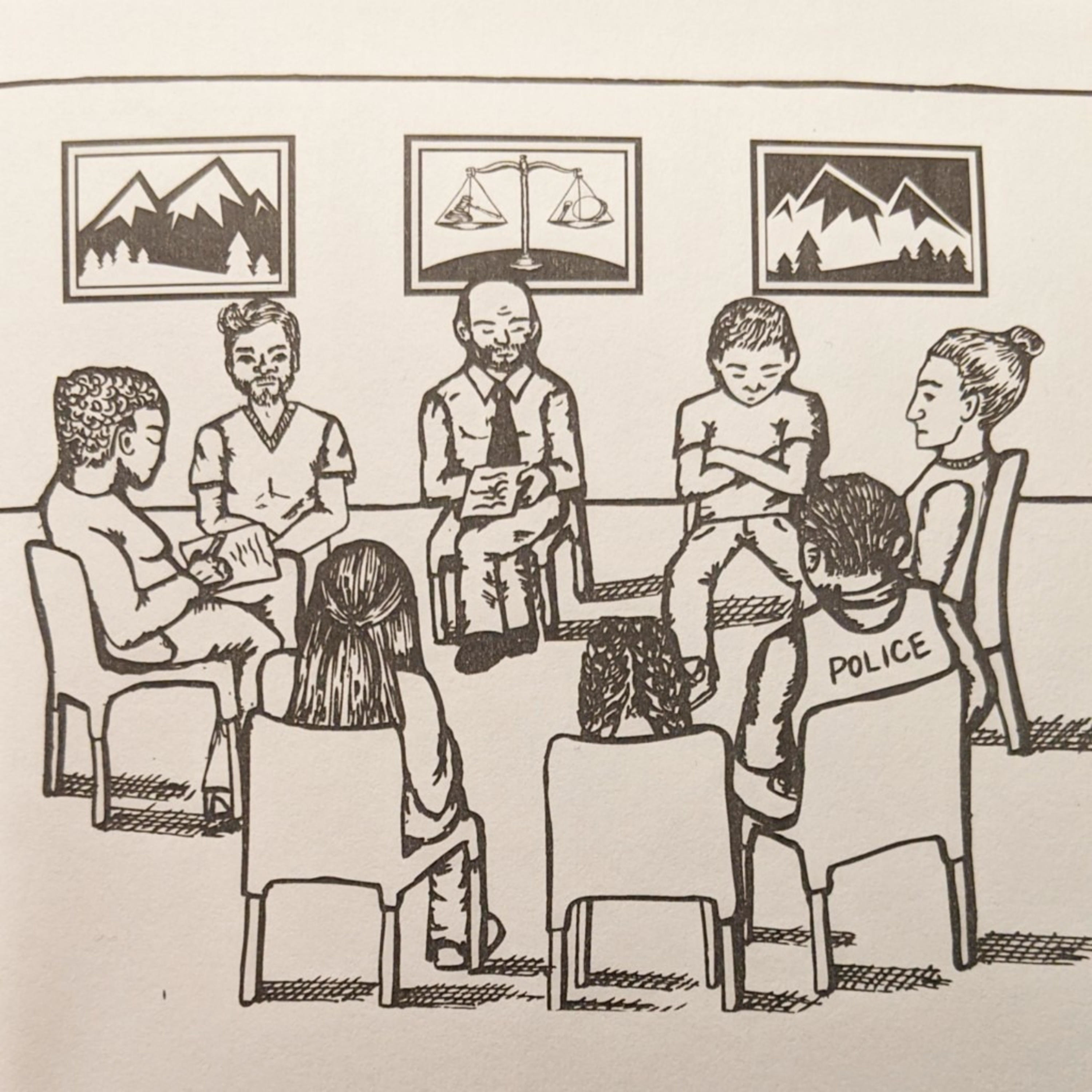
from Vancouver Association For Restorative Justice
57m 24s
This radio play, produced by the Vancouver Association for Restorative Justice, centers on a real-life incident where 17-year-old Derek, living in foster care, assaults artist Laura during a community mural project. The story unfolds through a restorative justice process that prioritizes healing, accountability, and reconciliation over retribution. Laura, the victim, experiences physical harm and deep emotional trauma, while Derek grapples with his own history of instability and neglect in the foster system. The narrative explores the intersection of personal trauma, colonial history, and systemic injustice, particularly regarding Indigenous communities and residential schools. Through guided conversations, Derek expresses genuine remorse, acknowledges his harmful behavior, and begins to understand the historical and cultural significance of Laura’s mural, which depicts Canada’s painful history including the spread of smallpox through contaminated blankets and the displacement of Indigenous peoples. A resolution agreement is reached, including financial compensation for Laura’s lost wages and medical expenses, 200 hours of community service, and ongoing mental health and counseling support for Derek. The process also highlights the importance of community involvement, especially from Indigenous artists and advocates, in fostering truth-telling and long-term healing. Ultimately, the story underscores restorative justice as a transformative approach that allows both victim and offender to confront pain, rebuild trust, and work toward a more just and inclusive future.
The Crown Prosecutor agreed to this, and so?
You are listening to a recording of Renai Morrisos, mural for social change, restorative
justice, starring Olivia Lucas, Austin McWhorter, Margot Kane, Paulo Ribeiro, Pippa Mackie,
Genevieve Fleming, Phillip Prejou, Davey Calderone, and Quinn Grayson.
Restored of justice focuses on the rehabilitation of offenders through reconciliation with victims
and the community at large.
It is an approach to justice that emphasizes healing in victims, accountability, reflection
and personal growth on the part of offenders and the involvement of citizens in creating
healthier, safer communities.
But what does an RJ process look like?
In this radio play, Derek and Laura's story allow us to witness a harmful incident, the
unfolding of an RJ process, and an interesting and constructive outcome.
This radio play was produced by the Vancouver Association for Restorative Justice, the text
is accompanied by a guide that encourages exploration of issues and questions raised by the play.
For more information about the play as an RJ Educational Tool, please go to varj.ca.
We thank the law foundation of British Columbia for their support of this production.
My name is Randy.
We're here today in this community conference circle to resolve what happened on July 22,
which was Derek striking and kicking Laura and breaking her arm.
As well, Derek is charged with resisting arrest.
We'll be discussing what Derek did and how you've all been affected through this circle
today.
I'd like us to go around the circle and introduce ourselves.
I'm the affected person.
My name is Laura.
I'm Laura's and Rayna, her community support.
My name is Reggie and I work for the Murrow Festival.
We are the people that commissioned Laura and her co-creator, Helen, to create the mural.
My name is Constable John Malcolm.
I'm the police officer that arrested 17-year-old Derek Parade.
I'm Derek.
I'm the responsible person.
Yeah, the offender.
Hi, I'm Tina, Derek's cousin and his community support.
And I'm Jennifer, Derek's social worker.
Okay.
Let's be clear, first of all, that we are not here to judge Derek's character.
Instead, we are here to witness and find out how others have been affected by Derek's
actions and to find ways to repair the harm done seven months ago on that late morning
on July 22nd.
Hey, looks like you've been doing this for a while now.
Cool.
So you're paid to paint this mural, like to paint it on this building?
After years of studying and lots of mistakes, yeah, I'm paid.
It's for the Murrow Festival.
And that kid's face.
That kid doesn't look too happy.
He has smallpox.
Wow.
Well, aren't we happy, go lucky?
It's history.
Right.
Only kids in the past are sad and sick.
In the 1760s, blankets were given to First Nations by the British.
There are stories about the blankets here in BC in the early 1900s.
They were contaminated with smallpox.
That's what's wrapped around him.
One story in the history of Canada, not a lot of people know.
Shit.
That's depressing.
Yeah, that's going to make people feel really proud of being Canadian.
Can I pour you some tea?
Yes, please.
Thank you, Raina.
Can you repeat that, Randy?
Laura, being involved in restorative justice is not solely to meet with the responsible person,
the offender, who brought you harm.
It's about how we can best serve you.
To repair the harm you've experienced with this assault.
What do you need?
What do you feel would be a good resolution agreement with Derek?
And if you choose not to participate, it's completely up to you.
So if I choose not to meet him, I can write to him.
He'll be there with me through this whole thing, right, Randy?
That is if I decide to.
Yes.
And I can talk about this assault on video if I don't want to meet him.
Can I ask you questions to ask him?
Can I write him right now?
Hey, maybe you can draw him a picture.
Yeah, right, Auntie.
Our family is back in Manitoba.
And as her community support person for this restorative justice process, we hope this
boy can learn some lessons.
We have people from the mural fest and from our ceremonial family here in Vancouver.
We've been supporting Laura in her recovery.
Yes, restorative justice is about that.
We're going to create an agreement together for Derek to fulfill.
Laura, your impact statement about what you need to live safely will help when we all
come together in the community conference circle.
Who is this kid?
The responsible person is Derek Brade.
He just turned 17.
The offender.
So you're paid to paint this?
Because you're native, you got this job?
I'm paid because I'm good at what I do.
Oh, yeah?
What school did you go to to learn all this?
The schooling with my family and friends since I was a child back home.
Actually, this history I'm painting is. Yeah, I get that.
But like, college, university. Since I was a child, I was surrounded by visual artists and storytellers that shared
their. And you get paid to paint a building.
Cool.
Yes, I have great teachers.
But if you don't mind, I'd like to. No, no.
I know what you're saying.
But come on.
You actually didn't go to school, so you got this gig because you're native.
That's cool.
Wish I could say that.
Wow.
Don't we have issues?
That's what I'm trying to tell you.
You get to paint this and you didn't even go to school.
I mean, that's pretty dope.
Thank you for sharing Laura.
It must have been difficult for you to hear what Derek was saying.
I can have my Aunt Raina be my proxy to meet this responsible person because I can't
seem to.
I mean, it's hard to. How this crime affected me and to actually meet him to. Hey, sweetie, we can stop.
You don't have to.
I know this is upsetting, and thank you for taking the time to meet with me.
It is up to you and how you'd like to be involved, Laura.
In the Restorative Justice Community Conference Circle, you can have your support team, a counselor,
a cultural advisor, your aunt with you, and you can have your aunt be your proxy.
She can speak for you if you choose not to attend.
It's up to you.
Yeah, I can do that.
Meet with this Derek prayed without me?
Yes, I can.
Randy, you and Laura had some conversations already without me.
But how did you find out about this?
About what happened to Laura?
Consible Malcolm, who arrested Derek, was the one that reached out to us and felt this
process would benefit you both, especially with the cultural and sensitivity Derek demonstrated
in Consible Malcolm's presence.
And Derek prayed just turned 17 years old.
He was living in a foster home at the time of this offense.
So because he's in foster care, still a minor, and kind of screwed up, the police officer thinks
Restorative Justice is a better option than charging him?
He's charged with assault causing bodily harm and resisting arrest.
That totally sucks.
So this restorative justice process would be a way for him to see what damage he's done,
right?
Instead of putting him in duty, he gets to meet us scary Indians, or just me.
If you don't want to meet him, I'm kind of thinking this can help you, honey.
Thank you, Auntie.
But I can't even think of meeting him.
I hear you, Laura, and you don't have to meet him if you don't want to.
This is our first meeting and we'll probably meet a few more times before we do the final one in the community conference circle.
Now, I haven't met with Derek either because the first step is to see if you are interested in proceeding with. You need an answer. Right. Oh. I'm feeling a bit overwhelmed.
If you decide to move forward, I'll meet with him and begin the conversation and what he needs to do to make things as right as possible with you.
Randy, I'd like to talk to my Auntie alone. Can I do that?
Of course.
Auntie Reina, this is so very scary.
Laura, you go through restorative justice or go through the court system.
You go on the stand, relive what happened, being cross-examined and all. Yeah, sounds fun.
This restorative justice thing is about you, him, and what he did.
Let's give this kid some history lessons. Maybe he can do, I don't know, community hours with me in the downtown east side.
It's up to you, but we can influence what this process is and do some community healing along the way.
This kid needs to understand more than just Canadian law and punishment.
Whose side are you on? Oh, my girl.
I know you're hurt. I just want to go back and finish painting and I can't.
Your arm will heal.
I can't because I'm too damn scared. And they have people finishing it anyway.
The mural festival said they will support you in having someone with you to help paint.
And I'll be there too when I'm not working. I already told them I can't.
Oh, I didn't know. I'm so sorry, honey.
It's okay, Auntie.
We hope in Matissewin, it's always about a good life for all people.
In our hardest times, we've never forgot how to dream it.
And at times, that's all we had, my girl.
You'll keep dreaming and painting our stories.
And you'll be with me always.
Okay.
Yes, to restorative justice.
But I'm not sure I want to meet him.
What he made me feel.
No, no, I don't want him to know who I am.
This is. oh, Auntie, why me?
Randy said that we can have a counselor present for you.
I mean, Mabel, over at Culture Saves Lives, can be there for you.
She's good people.
They're not ready for our stories.
Really? And why do I feel guilty?
I'm just painting for Pete's sake.
Damn, I hate this cycle of up and down.
Look, you're still raw and that's okay.
You have lots of questions, so let's go ask them.
Randy is waiting.
I mean, I had a choice too in what I was saying to him.
I should have seen the signs. I should have known.
Hey, you may not know this, white boy.
Other cultures have practices like teaching art, telling stories, dancing,
and people learn from that, like me.
This mural is specific to what First Nations people experienced in Canada.
Oh, okay.
Where are you from?
Canada. I'm Canadian.
I go to Canadian schools.
Why don't you pay the good stuff about being a Canadian?
Okay, I was raised on a reservation in Canada.
We have shitty water, and I had to leave home to go to a high school in Canada.
One of the images I'm painting, this is about our dancing.
Our drums are part of our healing, our ceremony.
That goes over in this section.
And what about you? Where are you from?
Sorry, but I'm here now, and this ain't my history.
If I paint my past, it puts yours in the deep, deep past.
This Canada, this Canada you're painting is stuck.
I guess it's not your Canada either.
What's your Canada?
Hey, put the paint down, man.
If you want to help me paint, it's all good.
I haven't mapped out, but let me give you the color.
Here, let me look.
Thanks, Derek, for meeting with me.
And thank you, Jennifer, for being a part of this.
As a social worker, you'll be his community support.
Yes, I've been with Derek for about a year.
He's been in care since he was seven years old.
I'm Derek's cousin.
I had a difficult childhood, too.
And now I'm in a place to help out Derek.
I suppose I'm his community support, too.
I'm so happy he's with me now.
Yeah, and because of Tina, she told me lots of stuff
about this thing we're doing, and yeah, Tina is dope.
I wasn't able to help him for a long time, Randy.
And it breaks my heart knowing Derek was alone for so long
without family.
Derek, you can do this.
Thanks.
And thank you, Derek, for the information on our questionnaire.
Again, these questions are asked to get to know you a bit better
so that we can build a meaningful and effective restorative
justice process for you.
She wants to do this.
Laura is interested in participating on the assault
causing bottling harm charge against you.
You also have the charge of resisting arrest.
If you follow through with the whole restorative justice process
and fulfill the terms of the resolution agreement,
the charges of resisting arrest will be dropped.
Okay, so tell us what happened.
Yeah, so I was walking around.
Didn't feel like hanging in the foster home
and I saw this boy's sad face on the side of a building.
He looked like me when I was fostered out.
Derek was putting care after his mother died.
And Jennifer here is the 20th social worker I've known
since they put me in the hold.
Now, don't start going there.
Just kidding.
I mean, I had a lot of different social workers since being, you know, fostered.
Yeah.
I'm home now with my cousin Tina.
I'm with her now.
At the time of the incident, you were in the process of being moved
from one foster home to another, right?
Yeah.
What happened next?
I walked over and was talking to her, you know, go on.
And she's like painting, filling this whole wall of this building.
Did you know she didn't go to school for that?
And like, here I am not knowing where I'm going
and she's young like me and yeah, like, I don't know.
Talking about this isn't easy.
It's really hard, but it's necessary.
You're doing good, Derek.
Yeah, go tell that to the victim.
Derek.
Sorry, I'm just not liking this, all of this.
I don't want to share my poor week stupid story.
You are the person who decides what is shared, Derek.
So in the final circle when we are all gathered,
you and your support team and Laura with her support team,
you speak about what you want to share.
I'm not going to speak for you.
Jennifer or Tina aren't going to speak for you.
Okay.
My job is to understand how to move forward respectfully
with yours and Laura's concerns and questions.
We'll be meeting a couple more times, Derek,
because it helps me prepare and I hope it helps you
in knowing what to expect.
Yeah, okay.
I want the community conference circle to be a safe space
for everyone and it's based on these meetings we're having.
My next meeting with Laura will be more informed as well
because of our conversations.
This helps before we all come together
where your resolution agreement will be drawn up.
Yeah, in the conference circle.
I get that. She sprayed me in the face with paint.
That burned my eyes, man.
What about that?
Derek.
No, I know why she did that.
I shouldn't have ruined her big drum.
But you painted over her art.
She reacted too.
As an example in our final circle.
Perhaps you might want to talk about that?
Man, one thing and then another.
Now I'm sitting in my own shit.
Language.
We were talking about this last night.
Dirk mentioned that the event was held in the city of San Francisco.
and how he was reacting to his own pain when he hurt Laura.
He feels a lot of shame and we're figuring out the words to that.
Apparently I do a lot of side-tracking.
Avoidance when it comes to taking the blame for what you did.
I'm guilty of hurting her, but my mind then goes to reasons why, then I go, "What about
my pain?"
And then, "Oh man, I'm done.
I can't do this no more."
Derek, I've sat in many restorative justice meetings such as this and your experience
is similar to many responsible people facing what they've done.
You're moving forward.
I hear you're having good conversations with Tina.
You're letting Jennifer know how you feel about being in the foster care system.
Is it okay if we continue our talk about what happened?
Yeah, if you'd like, you can tell me about when Laura let you paint.
You mentioned she gave you a can of paint.
Yeah, I was painting it blue.
You got it.
Dane the lines.
Awesome.
And now I'm a painter.
I paint your history.
And what have you learned about my history?
Yeah, not much.
The downtown east side seems like a reserve, more Indians there than on your reserve, I bet.
But that's not your reserve, huh?
I am Sulto, Prairie Inish Nabe, and that's rude.
You think that most of the people in the downtown east side are native, so it's a reserve?
Must feel good to know where you came from, huh?
I mean, being from up north somewhere?
Like Manitoba, sure.
Where are you from?
Me?
My home is right here.
No home outside of me.
It's all inside.
Well, that's a start.
Go start somewhere.
What's this I'm painting?
It's a powwow drum.
And see up there, 34 hand drums.
These hand drums will be emblazoned with the 34 names of the indigenous languages here
in B.C.
Okay.
So you like learned all this from your community?
I learned it from sitting with elders and listening to the stories of my co-creator on this
project, Allen.
He's from the Squamish Nation.
Lots of the original languages in B.C. are becoming extinct.
Come here.
Walk with me.
Okay.
This story I'm painting, a child wrapped in a Hudson's Bay blanket, the second image
will be Cedar trees and water to represent Indian arm.
Allen told me stories about what that history is up Indian arm.
The third will be about the railway cutting through the mountains and the Chinese who built
it.
And the fourth is that part you're doing, our cultural practices today.
You see how I've divided the space?
There'll be four overall images.
Cool.
What's your name?
Derek.
I'm Laura.
What makes it that you get to paint your history must feel good but it's kind of sad.
You ever hear about reconciliation?
Yeah.
But that means nothing to me.
I live out here.
I don't have a home to go to.
Where's my reconciliation?
Really?
You're going to pull the old poor pitiful knee card?
Great.
Just great.
My parents aren't around.
Compared to what you're experiencing with the trauma that generations of my people experienced
in Canada, you're a work of art.
You should talk.
You don't know.
No, I never had contact with police before.
When the police officer found me, I was all hyper and running from him was all part of
it.
I just found out.
Me not going to school and not wanting to go to counseling.
That home, those parents, they had enough.
So yeah, I was a bit stressed.
I was being kicked out again.
And then what happened?
Then I ran into a painting of a crying dead boy on the side of the building.
I mean, I know it's not me, but I was pissed off that my history will never be put on
a building.
But hey, it's for reconciliation.
Do you know what reconciliation is?
Yeah, it's where white people are guilty about what we don't know.
Sounds like you're feeling angry about Laura's mural.
I don't know why.
I mean, I'm always told I'm wrong.
I'm just like angry in that even walking down the street, I'm told I'm wrong.
Sure, guilt is a part of what we feel when we find out about what happened in Canada
with First Nations.
But Derek, it's more than feeling guilty.
Can I read you what Laura says about her mural?
Sure.
Let's both feel guilty.
Oh, poor Derek, come on, it's not about you in what happened to First Nations people
historically.
Randy, please, we'd love to hear what Laura wrote, right, Derek?
Yeah.
Part of reconciliation is to understand how this history is still very much alive today.
Laura says she wants her work to create conversations about Canada's history.
She wants to encourage people to reassess their own hidden bias or how they see the original
inhabitants of Turtle Island today on our streets and in the institutions.
She includes a story for each of the four murals.
Yeah, she said something about that.
She goes on to say that she hopes people do their own research in understanding what reconciliation
means to them.
And that's what you're doing, Derek.
Now, part of reconciliation and restorative justice is to make amends with Laura through
a resolution agreement and to really understand how we can make things as right as possible.
That's why we are meeting with you again.
What do you think you need to do to make things as right as possible with Laura?
Derek?
Yeah, I'm thinking.
Remember when I told you I had come to terms with my addiction?
I really had to dig deep to see how I've hurt my mom.
You know, to look at what I've done, figure out how I can make it up to your antidorene.
I stole from her and lied to her.
Derek, you were really sad about what happened to you with your last foster parents.
I get that.
Randy, he's just starting to figure this out.
We're both figuring it out.
Maybe I can fix what I destroyed?
I seriously don't know how.
I mean, sure, I suppose I think natives have it better than me.
Here you go again.
I mean, in my school, they have special programs for them in art and cultural stuff that we have
to watch in the auditorium and the rest of us aren't involved.
We just watch.
I just watch.
But she did let me paint.
Anyway, there is a lot of info online about residential schools and we've been looking
at that.
We watched a film called We Were Children.
We had a great conversation afterwards.
Derek, I really think that was sad, man.
I mean, really?
Canada did that.
The church is like, for real?
Yeah.
And that's great to hear you're doing some research and there are freaking graves.
Children's graves.
Unmarked.
A lot of indigenous writers, residential school survivors, children of residential school
survivors who've written books about their experiences.
I'm sure in your research you'll be able to find out who these writers are.
Can I ask a question?
Please.
Can I talk at this final circle?
As Derek's community support, the stories you're sharing about the research on the history
of First Nations could be a welcoming story on what you were doing to understand Laura's
world.
And I get to talk about what happened and what I did to her and then we listened to her.
Yes.
You'll hear how your actions impacted Laura and through our conversations, this will tell
us how we'll create the resolution agreement.
Oh man, this is crazy.
Okay.
Okay, I totally fucked up.
Watch your language, Derek.
Sorry.
This is what it's all about, right?
He gets to talk about where his mind was at when it happened.
Yes, Tina.
Part of the resolution agreement, Derek, will be for you to think about how you can make
it right by doing what you do in the future.
And right now you are doing research to understand where Laura is coming from in her work.
These are good steps forward.
Damn.
I don't know why.
Maybe you think I'm being selfish in talking about my shitty life.
Maybe because I still don't know who my dad is.
Maybe because of that, I heard her.
Why did I do that?
I heard someone.
She let me paint and I still fucking kicked her down.
You had no family around you since you were seven.
You never had good bonding with any of your foster families and mourning the death of your
mom.
I made it all adds up inside you.
It's hard work.
But you're doing it, and I'm with you, man.
Tina, thanks for being here.
I have a relative, you're my relative.
Randy, okay.
Gotta do it, I gotta do it.
I don't know why I did this.
It's like, not even me.
I was totally fucked up that day.
I just wanted to talk with her,
so I didn't have to think about my shitty life.
Remember what I told you?
I went to my mom and told her I'm sorry.
I continue to tell her that.
By what I do today, and I can say,
with all the work I've done on my own shit,
I can say we're on good terms.
Get to the good terms with this.
You'll feel a weight lift.
I'm telling you, my mom and I are on good terms,
and that's why I can help you.
Anti-Durian is pretty dope, she always makes me laugh.
I can see by your conversation
that you have huge support, Derek.
And this means restorative justice
can really help with making amends
to what you do in the coming days, months, and years ahead.
Derek, can I continue?
Yeah, sure.
Walk me through what happened
when Laura's arm was broken.
What do you mean you don't have a home?
And the downtown east side isn't a reserve.
I'm just saying, 'cause there's sure lots of your people down there.
Okay, I'm not getting into this with you.
This mural is about a new path.
It's acknowledging what my family experienced with Canada.
Let alone reconciling with our own family's first.
Let's start there.
Okay, we're reconciling with who we are today
in our own communities, in our own families,
which is what you're painting, the drums,
and the vibrant colors of our regalia.
Our lived.
You think 'cause you know all this stuff
that you've been trained by your community,
that you get to paint this?
That makes you better than me?
I didn't say I was better than you.
I think you don't know much about First Nations
'cause you have a lot of assumptions
and really you're too young to be a racist.
Just admit it.
You're caching in on being the flavor of the month.
Whoa, slow your horses down as relevant.
I'm a survivor of a childhood gun wrong too.
A shitty life that you--
Yeah, and we've been dealing with Canada's policies,
racist institutions that continue to deny--
And that's your pity card.
Well, I'm a survivor too.
That kid you're painting is me.
Fuck it, you paying your work and I'll pay mine.
Stop it!
You're ruining my work!
Ah, you got it in my eyes!
Get out of here, you trying!
Ow!
You think you know everything about fucking pain.
You live in your world.
I live in mine.
You knew nothing.
This is fuck.
[laughing]
Call the police!
We are!
Oh, my God, my God!
It's okay.
He's gone.
I've seen it all.
Can you get up?
My name is John Malcolm.
I'm the Constable with the Vancouver Police Department.
We received the call at 11.30 in the morning on July 22nd.
Derek was running and I pursued.
When I caught up to him, unfortunately,
I had to restrain him, including putting handcuffs on him.
Thank you for joining us today.
And can you describe what happened?
Sure.
We picked him up and we were on our way to the station.
[coughing]
Okay.
I get it.
I'm the bad white kid who's scalping the Indians.
Well, son, those days are long gone.
But you have some explaining to do.
How old are you?
Just have my eighth birthday.
One plus seven equals eight.
I feel like a frickin' loser right now.
My eyes fucking burn.
Seventeen.
Okay.
Do you know that an ambulance was called
to help the lady that was painting the mural?
The woman you hit?
A witness said you pushed her down
and kicked her several times.
Yep.
I'm a loser.
You don't seem drunk.
Are you high?
Never do drugs.
No.
I don't get me.
Lock me up.
Throw away the key.
You seem like a nice kid so cut the smart Alex stuff
and tell me what happened.
I'm a frickin' loser.
Just shoot me and get over it.
Children, kids, disease.
Do you know that I'm being poisoned?
Well, not like you did before.
But I'm poisoned.
Like my head is spinning.
Okay.
Call my social worker.
Call my parents.
Yeah.
Right.
Yeah.
I'd like to see my parents.
Do you have something to wash my face?
Are you making?
Duh.
I'm the bad white kid who literally scalped
a mural painting artist.
She's from some rest.
Man, I don't get all this tribe stuff.
I mean, no wonder their kids were taken.
I've been poisoned too.
Not just them.
Really?
And thanks for calling me your son.
At least I'm somebody's son.
Thank you, John, for sharing.
One last thing.
When I was taking Derek's statement,
he appeared manic in our conversation.
I reached out to youth mental health
and the Street Youth intervention team.
This is why I reached out to restorative justice.
Derek made numerous comments about first nations
that were disturbing.
I felt this process would do him good,
and most especially for Laura to have some resolution,
not only in what happened to her physically,
but perhaps an opportunity to tell the whole story
of what she was painting.
Derek can hear this firsthand.
If I can be so bold to say,
Derek can begin to understand that the role of art,
as in Laura's mural, is about social change.
My mind is racing.
There he is.
I can't breathe.
He's looking right at me.
This. This. Sorry.
No, I'm very sorry that I actually did that,
and everyone knows that this isn't going to go very well.
Stay in prayer.
Stay centered in my spirit.
Breathe.
I am able to take responsibility on this.
I am able to do this.
Thank God for Tina.
I'm. I'm just racing.
Why did I do this?
I'm who I am because of the shit that happened to me.
Damn.
That's an excuse.
Why did you do this to me?
God!
I must have done something to deserve this.
No excuses.
Make amends.
My mind is racing.
My spirit is broken.
But hope.
I hope, yes.
How do I fix this?
No.
No.
How do I make amends?
My hope.
With the lesson here.
Damn.
My mind is racing.
Here, Laura.
Have some water.
Can I say something?
Yes.
Please.
Yeah.
I get that.
Her work is bigger than my brain can handle,
but. I'm really sorry for breaking your arm.
I'm really sorry.
I'm not going to make excuses here for what I did,
because apparently I make lots of excuses.
Nothing can make up for what I did.
The counseling is helping,
and one of the things I've prepared with my counselor's help
is the statement about my behavior.
I collected, shaped, and talked about what isn't the truth.
About First Nations.
I need to make amends and understand the real history
natives had with Canada.
I don't know much about this history,
your history, native history, so. Yeah.
Sorry.
Thank you, Derek.
Laura, would you like to respond?
I think you're still making excuses.
I'm scared.
Angry and totally blown away, but what I heard today.
You've had a hard life, Derek.
I get that.
And it can look a lot like what might happen to my ancestors,
but it doesn't take away that I was totally disrespected
by you physically, mentally, emotionally, and spiritually.
I'm an artist and a storyteller.
I'm scared and saddened that what you did to me
stopped me from painting my family's history.
That you don't like.
That triggered you to respond in such a horrible way.
I don't forgive you.
But what I can say, this process here today,
lessened the burden of it.
I've been heard.
I see that you're sorry.
I can see that you were choosing your words well.
Keep doing that.
Especially in how you talk about First Nations in this country.
Thank you, Laura.
Does anyone care to respond?
Yes.
Hi.
As I said in the beginning of our circle, my name's Reggie,
and I work as the community liaison for the artists
who are doing the murals for this year.
I just wanted to let you know what we had to do after a
Laura was hurt. Our festival runs on the schedule and Laura was supposed to be
finished by mid-August. That didn't happen. If you look on the building now, Laura's
coworker, Alan, completed the mural. We supported the creation with paint
supplies, food, volunteers to help finish it. Was there a cost attached to the
work you did? Of course we had to fix what Derek did and again that was with a
volunteer team. If we had to put a money figure to it including a cleanup, paint
supplies and the hours it took to finish the whole mural, we'd say about 1,000.
That is above what we estimated for the work had Laura finished it herself. I just
wanted to say that since Derek has been living with me, he's been doing well.
He does talk about his shame and guilt about what happened and I can say that
he's been going to counseling and to school. We've been doing some research online
about reconciliation. We're both learning. Thank you. Okay. And if there is no
one else that would like to say anything, we'll move on to the final stage of our
community conference circle. Creating consensus on the resolution agreement.
What do you think needs to happen to make things right? Some of you answered this
question already, such as Reggie mentioning the cost to clean the mural, it would
be what Derek needs to do for his resolution agreement. Now Reina, you mentioned
Derek doing community hours. I have contacts that can be approached for Derek to
do that. But my first question is, how safe is he to do community hours with
vulnerable people who make their home in the downtown East Side? Maybe he needs to
do counseling first. So counseling first before Derek does community hours? Yeah.
Yes. And Reina, you know which organization can be approached? Who've done this
before? Absolutely. They have people to help out volunteers. I can pass these
contacts to you, Randy. Okay. Thanks, Reina. That's helpful. Although Derek is
seeing a counselor, I think it's important for him to see a doctor to assess his
mental health. We are working on finding him a doctor. I'll let you know when that
happens. Great, Jennifer. Thanks. In terms of his counseling, I like to see
specific counseling on managing his anger. Yes. Write that down, Randy. And see, I'm
just saying because we talked about that. Thank you, Laura and Reina. And I did make
a note of that. Yeah. I'm seeing a counselor now and we're already talking
about that. You know, like, ways for me to not get angry. His counselor's also the
one I had, so I totally trust him. Yeah. I really like him, Tina. For the
Miro Festival, our primary concern is our community safety. Randy, you can let
me know when Derek completed all his counseling. That's when we will be open
to having Derek with us. Yes. I'll make sure to do that, Reggie. Laura, you mentioned
the loss of wages. I wanted to ask also about your current health needs. You
mentioned you were seeing a physiotherapist. I can't paint right now. I miss the
opportunity to do my first mural in Vancouver. I've lost mobility in my arm. I
lost my fee for painting this mural. The last portion of it at $1,500. I've been
seeing a physiotherapist a couple of times a month since I got my cast off. I
started in September. So yeah. I have paid up four months at $80 a session. So
$640. I'm getting better, but I'm still building muscle and mobility. All
right, Laura. That's good news. And you'll continue for a while longer? Yeah. I'm
going till I have more mobility, ain't there yet? Just one thing. Since I've
worked with volunteers and other people doing community hours, I'd say he
should do 200 community hours. Okay. Any other comments? 200 hours? Yes. Sure. I
also want to say that you sprayed me in the face, Laura, with your paint. And I
understand why, but I just wanted to let you know that, like I said before, we
were reacting. I hear you. I was reacting to what was happening to my work. I was
reacting to all the bits and bites of our conversations. And it took a while for
my eyes not to sting. I just wanted to say this in this circle because, well, I
just wanted to say this. I hear you. And I know that I did that. Randy and I spoke
of this in our meetings. And like I said before, I'm not going to apologize. No, no,
it's cool. I just wanted to say this. Okay. I'm still living with what you did to
me and Laura, I hear you. You're still struggling with what happened to you. And in
your own time and your own pace to understand the whole interaction of what
you've experienced can be scary. Derek is letting you know how he felt when you
sprayed him in the face with the paint. I can't raise my arm above my head. I can't
lift. I don't feel comfortable right now with this conversation. That's okay. Make
sense. Thinking about what happened and how you feel about it isn't something
that will end with this meeting. There's a lot to be learned here. And I
appreciate that for both of you. Derek, do you have anything else you'd like to
say? Well, I just feel my reactions are known and at least Laura. I mean, Laura
still has her art and all and that's good. I hear you too and not wanting to
forgive me. I get that. Laura, do you want to respond? No, but it's good you get
that. It's okay, my girl. Randy, can I say something in response to
constable Malcolm's statement about Laura's work being about social change?
Yes. Thank you for saying that constable Malcolm. My beautiful niece Laura has
changed because of this attack. She was painting a mural about Canada's
history with my people and she faced an assault by this young man to keep things
the same way. The same could be said about the justice system and in Derek's case
the child welfare system. How do you feel about a foster system that Derek has
gone through since he was seven years old and he comes out with a negative
attitude about First Nations people? Let alone the fact that he will age out of
care and then what? Who will care for him? What does that say about our society?
You don't have to answer. But I just want people to understand because we're
experiencing this today with indigenous children and care. Yes, Derek. Your
story is similar to what First Nations Children are experiencing in Canada
today. Moving from place to place in this foster system. Now my people's story
is a bit more complicated. The child welfare system comes out of the history of
residential schools in the beginning of this country and under Canadian rule Laura
was painted one aspect of that history. Disease. Constable Malcolm you're a member
of this justice system and what I'm talking about goes beyond what restorative
justice can do in changing the attitudes and behaviors of Canadians and how
they see my people. My hope in this conversation here today is about giving Laura
and Derek closure in what has happened between them but really Laura and I will
walk out of here and hear of more children being taken into care from across
this country. It's heartbreak. So Derek you have an opportunity to move
forward in a good way and Laura you keep painting our history. This
experience should make you even more determined to tell our stories. Hi. She
would much. Thank you. Rayna thanks for sharing and for all of you here today.
Thank you. Thank you Auntie. Thanks Rayna. I'm going to continue with what will be
in Derek's resolution agreement. Currently we have a total of three thousand
one hundred and forty dollars of costs incurred from the mural festival. Laura's
lost wages and Laura's current physiotherapy costs since she had her cast
removed five months ago. What we don't know is the cost of her current lost
wages because she is still mending and doing physio twice a month. So Laura does
this sound fair to you so far? Like the three thousand one hundred and forty
dollars overall costs and some of that would come to me. Yes. One thousand
dollars would go to the mural festival for the costs they had when they had to
fix your mural. Yes. I'm good with that. Yeah. That's good. Including my
costs. Save for the next four.
months of physiotherapy?
So the total would be, let me see, $3,780?
Yeah, that's good.
Two sessions a month for the next four months.
She's not working now because she can't.
She's had to turn down a couple of gigs.
Can this be put into the agreement?
I mean, she's an independent artist.
Penty, it was one gig.
And I'd say between now and the next four months,
if I have to turn down work because of my arm, I can report that.
Yes, you can, Laura.
I will put that into this resolution agreement.
I just want to say something about this.
I'm going to make damn sure Derek is going to pay this.
I work at a shipping company, and he'll have to apply.
But there's always work on the weekends.
Might take him a year to pay, but he'll work to get it done.
Right, Derek?
Yeah, yeah.
And Laura, you'll let me know of what you lost with wages
between now and the next four months.
Yes.
And moving forward when the time comes with positive outcomes
on Derek's counseling and determining his mental health,
Jennifer and Tina will support Derek
in maintaining his doctor appointments and counseling.
Yep, yes.
That's great.
OK, let's talk about his community hours.
You mentioned 200 hours, Reyna.
Yes.
And when that time comes, I'll speak to some of the organizers
in the downtown east side that I currently work with.
Derek, you will have up to a year from today's date
to complete this.
Do you understand all of this?
Derek, you have something to say?
Thanks.
And yeah, I understand.
OK, great.
I just want to say, as we come to the end
of our session here today, thank you all for being here.
I've learned a lot from each of you and appreciate your support
for Derek with his resolution agreement
and support for Laura to move forward in a good way.
So Laura and Derek will take the time now to sign these documents.
And we officially have come to the end
of our community conference circle.
Yes, Auntie, it's all good.
And I'm OK with seeing him today.
Yeah, 18 months, four days, and 17 hours.
But thank you for keeping me in the loop.
I'm sorry, I can't be there.
But he's been doing good with the elders and youth down here.
Is your student there today?
I have my assistant here, Brenda, yes.
And she is learning the ropes.
All me later, let me know how it goes.
Little do, talk later.
Bye.
So you haven't seen him in 18 months.
He's like the guy that beat you up?
Yeah.
He's the guy that's been working with my auntie
for the last little while.
That's the lady that was here the other day.
She talks a lot.
Tell me about it.
She seemed nice.
OK, I'm going to go on my break now.
Oh, is that him?
Yeah, that's him.
Do you want me to stay?
I can stay.
Hi.
Hi.
Looks like you're back at it.
Another child?
What's the story?
Well, this is a little dancer.
Actually, this mural is about children dancing
from all nations across Turtle Island.
A jingle dress dancer, fancy dancer,
and over here is a little dancer from the Slavetooth,
a wolf dancer.
How's your arm?
My arm is good, and I'm ready to take on the world.
I'm glad to hear.
I'm still in counseling.
This rabbit hole I'm coming out of and being raised
in the child welfare system, I mean.
Yeah, it's good here, too.
So you're still living with your cousin Tina?
I'm sorry. My aunt Raina tells me how you're doing,
and well, kept me in the loop.
Yeah, she tells me what I year up to as well.
You went to do ceremonies back home
because of what I did to you.
To hurt in your heart and mind.
And wow, yeah, I'm feeling better.
Yep, my auntie does like to share.
I was in so much pain when I met up with you, Nora.
I put that pain on you.
Yeah.
Yeah.
How is Tina?
She's great.
Man, she is my lifeline.
She never gave up on me, and because of her,
I can say I am deeply sorry for what I caused you.
That means a lot to me.
And sorry for springing you in the face.
I deserved it.
But yeah, wow, thanks.
It means a lot to me.
This is beautiful work.
Thank you.
So this story you're telling, how did it come up with the idea?
Oh my god, you have to tell them
about your sound of silence.
I'm Brenda, by the way.
She's my mentor.
Like you said, there's a sound in history.
And when you look at a blank canvas,
is the untold story that bubbles up?
Yeah, thanks Brenda.
These children, I mean, what's happening now
with our indigenous children in care?
More indigenous children in care today than ever before.
Yeah.
I want to restore and fight for a different future for them.
Raina told me you've been busy volunteering with children,
teaching them to paint.
That's awesome.
Laura is totally awesome.
It's nice to meet you, Derek.
Laura, I'm going on my break now.
OK.
So it looks like you've been doing this for a while now.
You're paid to paint this?
You are.
And thank you for allowing me to be here today.
Wanna help me with this?
I got to tape this section over here.
Yeah?
Like, go up the ladder?
Scared of heights?
Yeah, I actually am.
Don't worry.
I won't let you fall.
Thank you for listening to Renai Morisos, Neural for Social Change.
This radio play was produced by the Vancouver Association
for Restorative Justice.
We would like to thank Renai Morisos, Kathleen Flaherty,
Jennifer Bruso, Monica Carpendale, Bruce McIvoy, Carolina
Ribeiro Dalmeida, Anita Werner, Jillian Linquist,
and the Varge Board.
Music credits include Honor Song by The Late Frank City,
performed by Renai Morisos and McGurll Music,
and Landback by A Tribe Called Red.
Sound Design, Editing, and Additional Composition by Vaughn Wagner.
Podcast Summary
Key Points:
The radio play illustrates a restorative justice process following an assault on artist Laura by 17-year-old Derek, who was in foster care.
Restorative justice emphasizes healing, accountability, and community involvement rather than punishment, focusing on reconciliation between the offender and victim.
Derek and Laura’s story reveals deep personal and systemic pain, including trauma from foster care, historical injustice against Indigenous peoples, and intergenerational harm.
Key steps in the process include personal accountability, community dialogue, mental health support, and a resolution agreement involving financial compensation, community service, and counseling.
The mural project becomes a symbol of social change, with Laura’s art highlighting Canada’s colonial history and the need for truth, healing, and reconciliation.
Derek expresses remorse and begins to understand the impact of his actions, while also acknowledging the trauma of his own upbringing and lack of stable family.
The community, including social workers, artists, and local organizers, supports the healing process, emphasizing safety, dignity, and long-term recovery.
The resolution agreement includes financial compensation for Laura’s lost wages and medical costs, community service hours, and ongoing mental health care to ensure sustainable healing.
Summary:
This radio play, produced by the Vancouver Association for Restorative Justice, centers on a real-life incident where 17-year-old Derek, living in foster care, assaults artist Laura during a community mural project. The story unfolds through a restorative justice process that prioritizes healing, accountability, and reconciliation over retribution. Laura, the victim, experiences physical harm and deep emotional trauma, while Derek grapples with his own history of instability and neglect in the foster system.
The narrative explores the intersection of personal trauma, colonial history, and systemic injustice, particularly regarding Indigenous communities and residential schools. Through guided conversations, Derek expresses genuine remorse, acknowledges his harmful behavior, and begins to understand the historical and cultural significance of Laura’s mural, which depicts Canada’s painful history including the spread of smallpox through contaminated blankets and the displacement of Indigenous peoples. A resolution agreement is reached, including financial compensation for Laura’s lost wages and medical expenses, 200 hours of community service, and ongoing mental health and counseling support for Derek.
The process also highlights the importance of community involvement, especially from Indigenous artists and advocates, in fostering truth-telling and long-term healing. Ultimately, the story underscores restorative justice as a transformative approach that allows both victim and offender to confront pain, rebuild trust, and work toward a more just and inclusive future.
FAQs
Restorative justice focuses on healing by repairing harm through reconciliation between victims, offenders, and the community, emphasizing accountability, personal growth, and community involvement.
It involves open conversations between the affected person and the offender to understand the impact of the harm, explore accountability, and create a resolution agreement for healing and repair.
Yes, participants can have a support person, such as a family member or counselor, represent them and speak on their behalf if they are uncomfortable meeting the offender directly.
Outcomes may include financial compensation for losses, community service hours, counseling, and support for mental health or rehabilitation, depending on the needs of the affected person and the offender.
The mural represents Canada’s history and Indigenous experiences, and the incident involving the artwork created a context for dialogue about reconciliation, trauma, and cultural understanding.
Unlike the court system, which focuses on punishment, restorative justice emphasizes healing, understanding the impact of actions, and rebuilding relationships through dialogue and community support.
Chat with AI
Loading...
Pro features
Go deeper with this episode
Unlock creator-grade tools that turn any transcript into show notes and subtitle files.
 PodcastTranscript AI