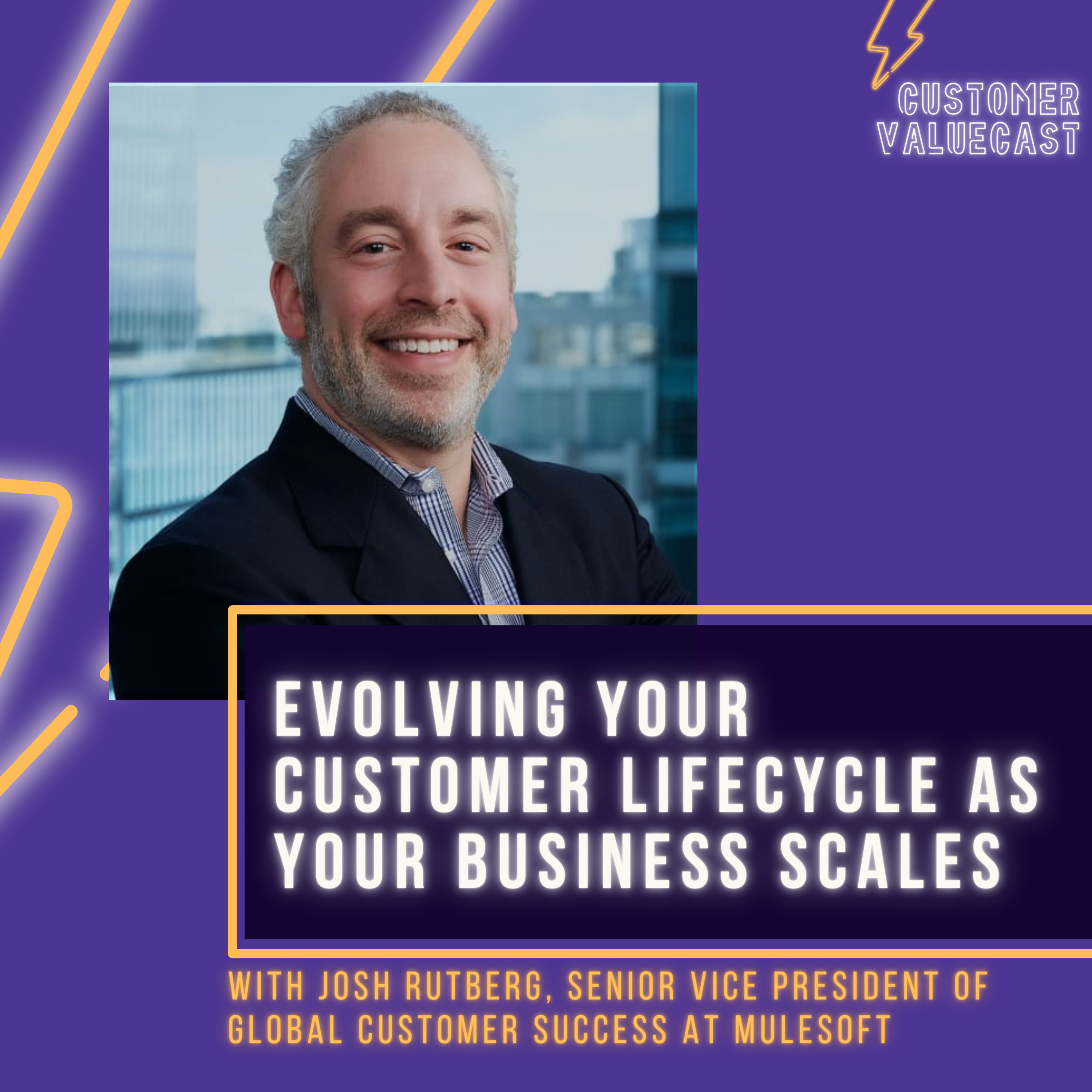
Welcome to Customer Value Cast, a podcast dedicated to helping you acquire, retain and expand more customers by putting measurable value at the heart of your customer life cycle. Join our host, Ross Holtin, founder and CEO of Value Eyes as he dives deep into how reoccurring revenue businesses are maximizing their growth and valuations with the industry's leading experts and pioneers. Now, here's your host, Ross Holtin. Hey everyone, welcome to another episode of the Customer Value Cast, the podcast from Value Eyes. This show is all about putting measurable value at the heart of your customer life cycle so that you can create more value for your customers and as a result, retain and expand more revenue for your business. Today I am joined by Josh Rutberg's SVP of Global Customer Success at Muirsoft. Josh, thanks very much for joining us. Ross, thanks for having me. I'm really thrilled to have the opportunity to talk to you and talk to the folks that are going to listen in. Awesome. I know we're going to have a great conversation. You're working and leading pretty compelling set of work over there at Muirsoft, which we're going to drill into. But Josh, for people who are listening, watching, who haven't had a chance to connect with you before, maybe introduce yourself, your background and your role at Muirsoft. Great. Thanks. My name is Josh Rutberg, as Ross talked about. I have been in Muirsoft since 2016 in customer success. Before that, I was at a start-up in the Fintech space for a couple years before that I was at a consulting firm called Bain & Company of 15 years. At Muirsoft, I have been in customer success since I got in. First coming in as an individual contributor, doing big special products like codifying our delivery approach, determining our operating models, etc. And I have the privilege of leading the Global Customer Success Organization. Fantastic. I know, because I'm obviously retooled, and we connected a while ago. And Muirsoft is continuously improving, and right now there's a very significant programme that you're leading that is really focused around evolving your source approach to customers. And it's got a very cool name project, Infinity, which I love. And I think it's fascinating and exciting to drill into today, because certainly what we do at Value Eyes, and just I think what you both, you and I, see and hear about and discuss within the wider community, the concept of evolving how companies approach their customer life cycle to succeed better as a business, but then also to obviously ensure that our end customers are succeeding in an optimal way. Is a type of programme that is extremely relevant in a lot of companies, and it's either a very mere term strategic aspiration for some enterprises. They've just come out of a, maybe a programme, positively or negatively, candidly, sometimes they work, sometimes they don't. But Muirsoft, in what you're leading right now, it's happening, it's live action. And I think our audience is going to get a lot of interesting insight, perspective and learnings from you in terms of sharing how it's going, what you're focusing on, why you're focusing on those areas, what lessons have been learned. But maybe set the scene for us in your words, Josh, around what project Infinity, at Muirsoft is a little bout what was the genesis for it and what are the key outcomes. Yeah, thanks for my opportunity to talk about it. I did want to just acknowledge, Ross, part of the reason we actually met in our exploration of this and I will go through the context and the why we reached out to you and value us, because we had heard from others and we said we got to talk to the experts in the marketplace and you were one of them in your firm and you were very helpful in your team. We're very helpful in providing guidance, advice and how, and we've incorporated that into this work. I just want to acknowledge and appreciate your personal investment in your teams and giving us some help along the way. So let me talk about the context of what happened and I believe companies go through sort of organizational barriers or walls at like a hundred million, five hundred million billion where you have to change what we've done, what work before it doesn't work going forward is think about scaling and we were in the throes of that hitting a billion dollars and it's like true. Okay, we had gone from single skew, a heavy high touch model, one to one engagements with all of our customers or anything around that. It was basically a one size fits all model and there's just no way to just keep throwing bodies and saying that's going to get us to 10 billion. We're multi skew, we have very different types of customers, they're expecting more, we can't scale the same way with profit margin expectations. So we said, okay, hold on, we got to rethink this. So that was sort of the starting point of what's the first step saying you have a problem with step one, like the acknowledgments, okay, we had it, we acknowledged and it got, I didn't get my leaders there and they did and they were like, yes, and we're like, oh yeah, we got to fix right now and they're like, oh no, I like what we've done. We can't lose that. So how do you take the best of and modify it? And so we said, we got to do something different. And in fact, this was so important to our journey. I took six of my managers out of the field at anywhere from 50% to 100% of their time, they indicated just to this on a global initiative because I needed the practitioners to be involved in driving it, with, you know, reporting out to me and my leadership team as sort of a steering committee. So that's the context. Does that help? It does, no, I think that's a very important context, a great summary. I'd love to drill into, again, that concept of, we have to acknowledge that there is an improvement opportunity, a K, a problem, which is a kind of the loaded term, that improvement opportunity, definitely, but that term, how has that improved an opportunity framed to the stakeholders that you needed to kind of wanted to get by and from? Was it framed as an economic piece around sort of a key set of economic metrics? Has it more an experiential thing or multiple? Let me try to frame them in the areas. So first what I'd say is that there was economic pressure, sure, on thinking about scaling the business and getting efficiencies out of that. So yeah, that was one. As you scale out of business, everyone should expect you're giving more back, right? Second I would say was the employee experience that said, you know what we do is we come up with the coolest new thing to do with customers and we said, okay, CSMs, can you do this? All right, here's the next neat idea, can you do this? And all of a sudden, what happened is we hire these amazing people, we bring them in the door, we say, here's the 40 different plays you need to know. Here's your list of 20 accounts. Good luck telling me if we need any help. It's just incredibly inefficient and effective. So from the employee experience, we had a challenge. And then, and I'm not saying this last is actually probably first and most important customer experience. Our customer is still, it's not so easy for them to be self-sufficient and drive mass adoption of their own as a platform provider that's real challenging. And so it takes an inordinate amount of care feeding and much more push versus pull model when you think about growth. And so we were struggling, how do you think about that? And then we got some early warning signs that some customers might have said, you know what, we're spending a lot more money than we thought with MuleSoft. We want to make sure, I think, Ross back to one of your comments on this, are we getting the return we need? And how are we thinking about driving mass adoption? How are we making sure customers are getting measurable outcomes and how are we creating promoters at our customers? I'm like, are we set up to do that? And we're seeing some chinks in the armor around that. So those are the three buckets I think of. Yeah, yeah, that's awesome. And I think like it's two very key takeaways, framing that those improvement opportunities put in quantifiable numbers and metrics against them. I do see still a lot of organizations embark on these types of programs and transformations without really a solid business orientated quantifiable set of outcomes to say, well, here, why are we doing this as opposed to it's just the right thing to do. We should always be trying to work out how we make our customers more successful, which I do not disagree with. There is a very down sort of outlook, but just somewhat unrealistic in terms of really being able to rally the support and secure the necessary investment and be able to measure progress on such an important transformation. Let's give one example of some data. Ross, to your point, like on segmentation, when we wanted the initiatives was to drive a new segmentation. It's not rocket science, how we approach this. But what the data, the case for change, was we looked at it 80% of our ARR was coming to 30% of our accounts. So it's our equivalent of 80/20 rule, right? But we basically had a 50/50 allocation. It was peanut butter spread or resourcing. That's not an intelligent way to think about resourcing the business. We saw little changes in renewal rates. Hey, any basis point change in renewal rate is a significant amount of money. We had to be talking about this, you know? So we were like, huh, and we saw some warnings coming back from some MPS feedback. So yeah, we did that. The hard part then is to say, what's the target on what you can improve when you think about renewal rate or attrition, however you look at the dollar impact? But we foundational, we said, we got to have some data to talk about with our rest of our stakeholders. Because sales freaks out. As soon as they have a change, how I think about covering and working with customers, they go, no, no, don't, I need you. They said, we're not going away. We're just going to focus what we're doing. Yeah, the other piece I wanted to come back to you was the fact that you did identify and ask and allocate some pretty important resources to driving this program and the transformation. As opposed to, would you mind still succeeding with your lines of business and bringing in the results I need and also transform how the center for right managers' customers, which again, you see fairly often, which again creates obviously a number of challenges. And that's a practical question on that from, does, does, did, your sort of, business transformation function outfit that you are or were working with that complemented that assignment from your own?
team or was that assignment from your own team being well? I don't today have a transformation organization to work with so I'm going to kind of almost build my own, my own renegative version. Yep. So we had some budget pressures as you can imagine, especially what you're thinking about even now, right? But we had started even before thinking about that and we couldn't fit it all in and we couldn't wait. So we said we have to do it. We didn't have all the expertise. We augmented a little bit, very little span by third parties, mostly around project management capabilities, a little bit of creative content development on enable materials. But mostly it was taking our own resources to do it, both field representation and opt representation to drive the change. Yep. Awesome. So we've got problems and I'm proving opportunities identified, framed, quantified as, okay, here's the outcomes we can get to, got a team ready to go. What was the approach to prioritizing the, what I will describe as like the strategic initiatives? So here's what we need to go execute. We need to, sounds like, reduce segmentation as an example, that being an example of what I might call a strategic initiative. What, how what's the process of identifying those and then prioritizing them and what ended up being actually those initiatives? Yeah. We spent a lot of time brainstorming that and identifying those. I appreciate you asking. So first one was segmentation. You got to say, how are you thinking about our customers? And as they come in, you have to have some segmentation model and we really did, we'd experiment with sums in the past, but it needed to be reevaluated. We then need to say, okay, we got to be much more prescriptive with our customers and with our employee experience about what should we be doing when? And so in order to do that, we had two initiatives around customer journeys. So what the customers go through and then adoption playbooks, which are engagements we want to prescriptively go after with our customers based on the journeys they're in. So it's not this just free for all. It's just incredibly inefficient. And then so we did those three or separate initiatives, customer journeys, adoption playbooks. When we think about adoption playbooks then these engagements, you have to move from a default one to one engagement to starting with digital first, one to many, then one to one. So prioritizing engagements to transform. And then last though, and we sequence this last, it's measurement risk, how do we think about measuring the success of our customers and how we're doing? Because we felt as a leadership team, it's just too subjective how we're evaluating things. You know, for example, I could say Bank of Josh is a green account. It's Ross, it's green. I know it's green. I talk to them. I talk to this week. It's a green account. Really, really? Well, if you had the data and it said adoption usage is dropping by 20% and they had this kind of thing in the project, no. So how do you move as an organization, have consistent measurements and objective measurements? And so that was the other, I would say, fifth work stream that we sort of prioritized. And with each inch of, or at least some of those work streams, probably I'd say each of them, you can look at as there is a organizational evolution around how to approach the subject and the outcome of the initiative. There is a strategic concept around how do we strategically, what is our strategy around this concept? Then there's the operational piece around how do we operationalize more effectively our execution of what is baked into this initiative? Any country there around sort of those three dimensions sequencing them, prioritizing them and in terms of how he worked on that. Yeah, very astute question. So what we did today, next fiscal year beyond, that was it, and it's five year beyond. We didn't do like this month, next month, one year or two, that's too complicated. Just where are we today pointed to departure? Where do we want to get to by one year from now? And where do we want to get as a point of arrival? And that was a helpful framework to just try to simplify things for people. And the other thing we said then to what you asked, I'd use it as simple words that say, what are we trying to do? When are we trying to do it? How are we going to do it? Just because all those things you got, but what is almost a strategy as you asked? The how is the operational? The when is the date we just talked about? And like, when you use a simple, you know, I'm a simple person, you use that. It just, it helps the organization, I structure that. And when you're communicating then, I think it's really important for like adoption and internalization for the team, understand the journey. In fact, it's why we called it project infinity. That team knew there's no way we're done in the six month window. It's it's this constant thing. That's the that's the reason for the name. So that's how we framed it. Awesome. Awesome. I was going to hit that question later on around white. Well, what am I infinity? I love that answer, such a good answer and so very, very true. And so I know that project infinity to your point is ongoing. It's still a work in progress, but a lot of great, great, great, great projects has been made or wins have been achieved. What have been some of the so far? Either lessons learned, revelations, wins, aha moments, working on any, take any initiatives that you like that have really struck you or struck your your organization around wow, that's pretty cool. Or geez, I don't believe we didn't used to do that that have come to light so far in the project. So let's let's see, I think on the good, let's start there. All of our leaders that were part of this team were massively energized by the ability to participate in something like this. If you think about that, how often do you have the opportunity as a manager leader in a business to go off and spend your time thinking about the evolution of the business you're in? Just doesn't happen very often. They were all very excited about this and the teaming aspect of meeting new people was, you know, across the globe. That was awesome. The other great thing, it resonated with our folks just in Massphahole organization that like, I'm going to be a part of something that's going to try to be world class. I love we're trying to be, you know, the best of and do something unique in the industry. And it was energizing, I think, to our people. And the other thing by breaking out by this time frame, they could see where we were going and why. You know, that was good. And what happened is what we were addressing is those five initiatives that you asked about. For example, one of them around being more prescriptive with the adoption playbooks and then saying, this is what you need to do for each of these customers. It was almost a thank god somebody's listening to me that my job was getting too hard. You recognize, you heard me and it's being incorporated into this process. So they felt heard. The bad, I don't know if it's bad yet. This stuff is hard. It's like, you know what's the expression? Move in the Titanic wherever it is. It's hard. I'll give you examples. So we came up with a new segmentation. We moved to our customers of these segmentations and then had ourselves in the back. Cool. We have new segmentation. So, so. And then we said, well, the tech team, our architects are going to cover segment one and two different than segment three and four. And all of a sudden when you said that, they're like, wait a minute. I didn't sign up. No, you did. That's what we're going to start using segmentation to think about resource allocation. So it's a little bit of shock to the system. Now I think that's good because they're like, oh, it's no joke. Or I said, okay, we have these adoption playbooks. We have customer journeys. So now we know for journey step two, these are the plays. These are your engagements. And I need you to record these engagements. Well, do you think I'm getting mass recording of all engagements and all times for all the people around the globe yet? I'm not. Why? Because they're like, well, why am I putting all this in? I have a busy job. Why am I doing that? And so we're struggling now to say, okay, well, here's the benefit. One, we're going to review this every month with all of our people from the global to the theater to operating unit down to territories. To understand, are we investing our time in the right accounts with the right plays at the right resources to drive massive impact on customers and then track that against adoption change, add on change, reneural rate change. So true economic measurements of that, you know, that new focus, but we need the data. And so that's a change management. I think Ross, you were asking about that earlier. What's hard about this organizationally? The change management. I know everyone's been listening to this and go, you have to tell me something I don't know about projects. Enablement change management, change behavior. Very hard. And then the last one I'll say, we're trying to get to this objective measurement. We don't have all the data we want yet. We don't have the correlations to, you mean you don't have, you don't have perfect customer data? What? It's shocking. I know. So yeah, so there's been some struggles on this journey that I expected and it's hard. And again, project and finish, we're doing step by step and let's keep moving. Yeah, yeah. Too related topics of discussion here. One could be quite quick, which I'll start with, which is yourself, quite by Salesforce, part of the Salesforce group of companies and you've got have loads, Slack, et cetera, et cetera. To what extent has it been a sort of autonomous experience in terms of, hey, this is how we as me also want to do this versus where the mothership, many of you want me to call it, mothership or not, but the mothership is saying, well, we've got us to do it within these constraints. Or has it been, no, it's been great. The Salesforce has been kind of giving us the best practices and we've been sort of evolving those to make them bit specific, so the me or soft business. Because there's a lot of people who will be listening and watching this who work in organizations, lead organizations who are part of wider corporate entity structure. And this concept of well, how do we manage customers is something that's certainly we evaluate, spend a lot of time working on with organizations around well, how do you reconcile this into a multi-corporate structure, recognizing that these different corporations have distinctly different products, outcomes for customers, therefore, always delivering those outcomes. But we get that you want this kind of sense of corporate standardization where possible. How does that play out for you? This is definitely not a quick answer. All right, little context, the wins
Salesforce bought meals soft. It was awesome. They kept us as a standalone operating unit business unit. So when we went down this path, a standalone business unit doing our own thing and we had things that were different and then we adopted some best practices from Salesforce like little things, let's tactically say, what are the lost code reasons for attrition, as an example, or some systems and things like that? But we were definitely going down our own path. Very recently, this is the beginning of the fiscal year, Salesforce decided to do increased integration functionally to bring us closer together. The concept was, hey, if there's overlapping customers and they have a different experience with meals soft than a different experience if there are sales cloud versus service cloud versus tablo, versus even Slack, that gets to a very, it can be suboptimal customer experience. Because customers, I believe this, they don't think, oh, I got a problem, I should call my customer success function because they can solve it. They're like, I have a meal soft problem. They may not understand anymore. I have a Salesforce problem. I just want to call somebody and I don't care if Joe Schmoh or Sally Schoo shows up from CS or support or architecture, they don't care. They just want their problem solved. And so I think you run into that. So we're in the throes of that right now. And so what we're doing is we're still heads down doing what we think is right for the success of our customers in our organization. And then what we're going to do is we're going to compare and contrast what is the best of. And so maybe Salesforce is going to learn something from what we're doing in a corporate. Maybe we have to say, you know what? Because of the customer experience, we have to modify our approach and actually optimize for that. Maybe it's moved more aggressively onto common systems or tooling. So we're going through that right now. I think, again, because we're a platform, I'll give you an example, because we're a platform and you can build integrations in our platform, our customers have a choice. Should I build our meal soft or not? If you have Salesforce and you are a Salesforce and hire five more people, you've got to buy five more licenses. So our customers need constant care. And so that emotion becomes a little bit different and we've codified approaches. We literally tell customers, here's how to be successful. Salesforce doesn't have that as much as we do. And so do you lose the secret sauce to make customers successful? I don't care if they change work day, I don't care if it's a common tool. I want to make sure we're going to make our customers still successful. So that's the part we're trying to figure out right now. I know I give you a long-winded answer to that. - No, it's fantastic. I'm a fantastic answer, very intriguing insight that I think many people can relate on different levels. The other related concept was then go back to meal soft, the organization and different functions and sizing your soft organization outside of what is today to find its customer success. And their role in optimizing and driving improvements around how meal soft approaches and manages customers and that collaboration and integration with those functions into project infinity. I believe that sort of as getting into the next phase of project infinity happening right now. But we'll love to have any sort of comment you have there around again, sort of approaching that at a stakeholder engagement level, getting by in how the sort of action design and sort of design processes is being approached when you're dealing with other functions that certainly are not on a different planet by any search for imagination, I'm sure. But there's still gonna be some specific variables that relate to how they wanna approach their strategy, their operational model, their organizational design in the context of customers that might not be just completely driving today with how your organization does it all wants to do it. And so there's some reconciliation to be done there. What the approach is there in your soft, like and I know that's another big, big area of focus for so many other companies out there. - So we made a decision at the beginning of this project to be CS only focused first. And the reason we made that decision was, I just thought there'd be too many chefs and we would take like nine years. And we just wouldn't get traction, we wouldn't get it done. I couldn't have my people out of jobs for like six months let alone, you know, two years. So we said we gotta start with CS. So what I did was and you asked about this and how we informed stakeholder at the beginning about why we had to do this. And so I made sure all of my cross functional peers were bought into, we gotta change. Here's how we're approaching it and gave them regular readouts of the so what's that we're coming out, not the final decision that literally had them in the sausage making. I said, hey, here's the different segmentation. Here's the two models we're considering. You just wanna let you know, blah, blah, blah. I said, we will incorporate cross functional input as soon as we have version one to launch. So we did that and we kept them involved which I think is very important to bring people along in the process. Now what we're doing is we are figuring out how to evangelize all the changes out to all the functions about here's what CS is doing different. And at the same time saying, okay, now let's give services, professional services as an example. How do we take those adoption playbooks which is really customer success plays against customer journeys? And how do you augment it? Think about it swim lanes by function so that professional services training, even pre-sales or sales, here's what we do. And now you have a cross functional adoption playbook by role that is very powerful. And so that's the next step of project infinity. - No, no, no, that makes no, again, that's the code of buy-in at the beginning, just so crucial, I think it makes total sense to say, okay, well now let's kind of influence what we can directly control. And when we leave by example and say, hey, little we're here, we're serious, we've come to the party, we're evolving, we're changing, we're investing as a, I guess a leading example for your sort of peers in other parts of the organization. Why don't the, I guess, I guess it's like project infinity as I find in the name, it is an ongoing program and always will be. It's certainly to achieve certain core milestones over that journey. These are big programs, they require a lot of time, a lot of energy. As with any program and anything that kind of requires, any investments in time and collaboration and energy, you can always look at things like that and say, well, how could it be quick? How could it be more efficient? And one of the areas that I'm super interested in right now and we're actually working on how to solve this in value wise is you take the concept of this customer journey, which is a very broad, loaded term often in our domain. But let's define customer journey as the definition of what happens with and around and on a customer as they progress through the phases of our customer life, so I call from acquisition into adoption, et cetera, et cetera. And within that journey, you've got, again, multiple teams, multiple functions, doing different things with different systems, designed to do different outcomes, there's all these different intersection points and transition points, capturing that, understanding, and visualise, what is that journey, in a B2B enterprise, and what are all those intersection points who is supposed to be doing what is that, what working, is it efficient, how do we collaborate between these three different teams, optimise how we do something like, just use a simple example, customer onboarding. Today, most organizations I see are doing this in a combination of endless walls in the office as sticky notes and there's PowerPoints throwing a few spreadsheets, a few lucid charts, maybe a few giratickets, and it's pretty chaotic. It certainly cumbersome, it's slow, there's an inversion control, there's minimal or optimal collaboration, and you compare that to say something alike, building out a product roadmap, and then collaborating around the design of new product features, where you've got sort of best to breathe software out there, that's designed for product organisations, to collaborate within their own rate, around product design, and indeed collaborate with other members of the business around product design. When it comes to customer lifecycle or customer journey design and B2B enterprises, doesn't exist. Is that collection of experiences I've just summarised, the potential pain points, something that has parallels to what you'll be going through, and we will solve through it, you guys sort of found ways of driving that. Here's what's happening in our customer journeys, here's what's supposed to be happening, here's how we're going to collaborate on the redesign and capture that as a new way of onboarding, and we're going to share that out to everyone's on the same page. - Did you have anything to do with what it is? - I wish I'd started company in a cajillionaire. So you're talking to someone that's at MuleSoft, and we're by Salesforce, that thinks about customer 360 as they're orienting framework for everything that they do. And that's what I think you're asking about Ross, is that how are we using that type of framework and saying, what is everybody doing? Because today, sales does their thing in CRM. We have something else that we use as a sub-sagman within CRM, but it's no one's looking at it. The service had a separate system before training as their own things. And so, even if you're tracking by function, you're not tracking an aggregate. And then you're not agreeing on what all the outcomes, sales cares about an ACV event, and we care about a renewal, but we care about adoption events. And so, services are caring about their bookings and making sure utilization, there are competing incentives motivations. And we don't have that solve. We are talking about measuring, and when we think about this, the last track that we talked about is measuring success of our customers. Now, use that importantly, because it's not measuring customer success as a function success. And so, what we have grounded on is we're gonna look at two dimensions. Is the customer achieving the outcomes they wanna achieve? And are they having a easy experience, a good experience with mule software? And within that, we wanna track by function all the different dashboards that lead up to that. Because maybe they love their CSM, but they hate the product. Maybe they hate their CSM, but they love the product.
They've been at a great services engagement. All of that needs to fit into their experience with Milsoft because that's the customer's perspective. We need to know where the customers achieve their outcomes. We might do heroic work on an account, but the customer failed. Me not even because of Milsoft, me not even because of all the systems they're trying to use and integrating and it just didn't work. But we have to understand that. And so we have to look at this across the board and if you agree that you can have company-wide measurements and everybody then fits their data into one place to go, I think that's going to help solve what you're talking about Ross. But it's Nirvana. We are nowhere close to that yet. Imperfect data, different motivations. But that's where we're headed. On that beyond column that I described, that's where we're trying to go. Yeah, now it makes a lot of sense. And it's going to be hard for me when you describe the experience when you had forms and segmentations, sort of roll those new segments out. And then there was sounded like maybe some revelations to some people inside the organization around, and this means we're actually going to take a different approach per segment. And it's like, whoa, whoa, whoa, whoa. And so again, you go back to, okay, well how do we align around, well what is happening today against these segments and then collaborate around how we want to optimize that, document that, capture that, share that, okay everyone's good, okay off we go. Again, is it locked away in a bunch of PowerPoints or spreadsheets? I see this in every single organization and I'm convinced there's a better way, which I think the ultimate outcome being a, a much more optimally designed customer lifecycle for the benefit of the business and customers, which is what you were describing there. But also just extreme amounts of efficiency relative to what's happening today when it comes to driving projects like project infinity. Yeah, no, I think I think watch this space. We think we've got an idea on how to fix this. But curious when it comes to project infinity, how it's been planning out and that sounds like to me, I'm safe, but I have the privilege and it's something I'm grateful for every day to get a look at some of the fastest growing largest tech companies in the world who are running these types of programs. And I see the good, I see the bad. We certainly have a very fortunate to be able to help a lot of the good happen, but certainly Josh, understanding yourself and project infinity and certainly what you've shared with the audience today. It's something you should be extremely proud of. I'm very excited for you and your organization as you continue to drive it. I'm excited for your mother's shift, four sales force, because I do think they can be able to take a lot of learnings and inspiration from it. For anyone on the audience who would love to connect with you, Josh, and maybe learn more, ask some questions. How can people best connect with you? Yeah, feel free to reach out to me. My email address, everyone can have it.
[email protected], RUT, B-E-R-G. And I rusted, I would be remiss if I didn't also say, I might be the face that's having this conversation today, but I have this amazing team that led project infinity in this incredible CS organization that's driving the change. I'm just here talking, but they're the real stars here. And I think it's really important to tell everyone. Yeah, absolutely. Huge, huge kudos to that team. And again, kudos to you, Josh, for being an inspirational leader to them and driving this exciting program. Really appreciate your time today. And for everyone watching and listening, I hope, appreciate it. Josh's time. Thank you for tuning in and watching this. Stay tuned. There will be another episode in a couple of weeks. Any resources you'd be interested in and a lot of the concepts that Josh and I have hit today, then do check out balewires.co and our resources section. And you will find goodies in there. But until next time, look after yourselves, look after your customers. And Josh, thanks again. Thanks for our supply, sir. [BLANK_AUDIO] [BLANK_AUDIO] [BLANK_AUDIO] [BLANK_AUDIO] [BLANK_AUDIO]
 PodcastTranscript AI