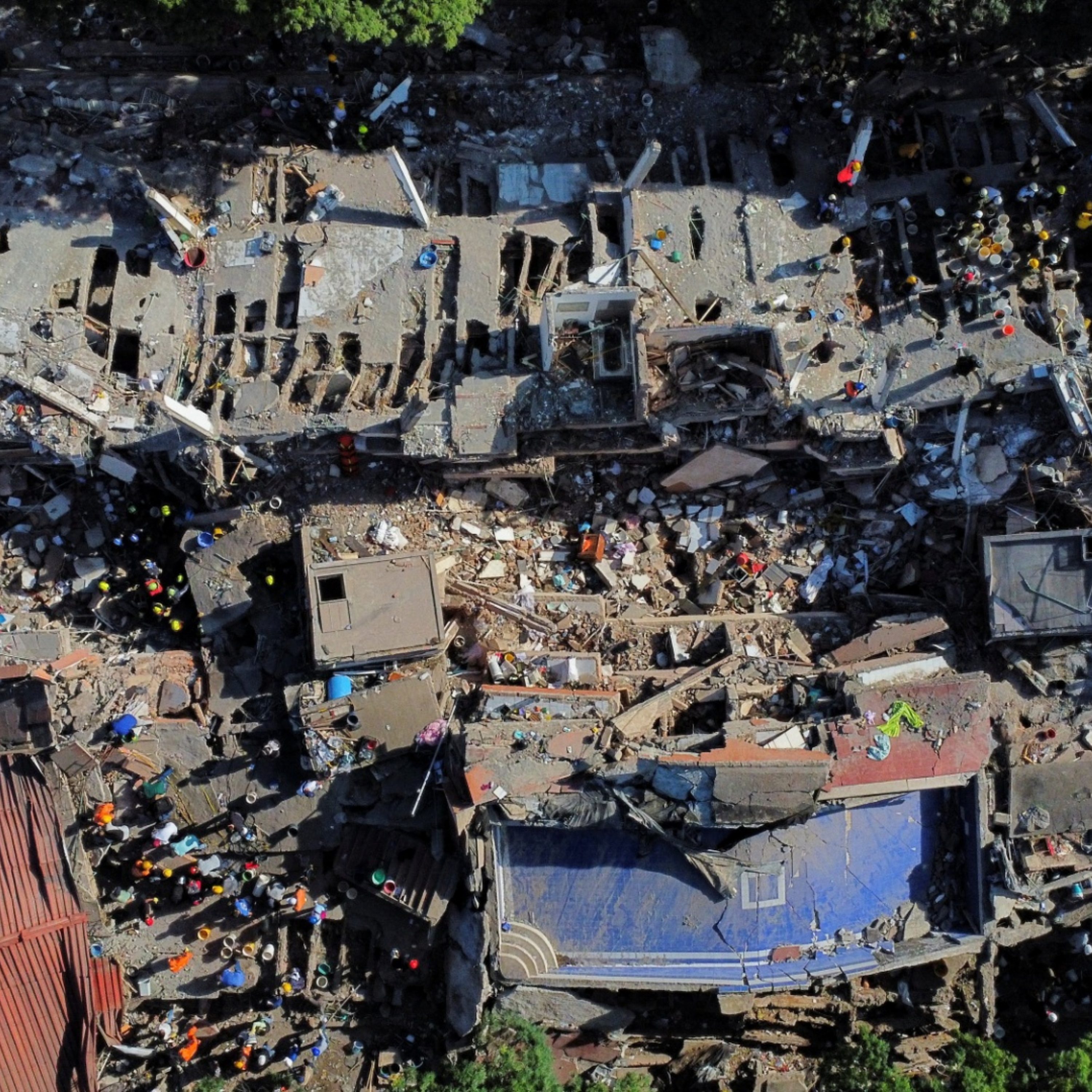
This BBC podcast is supported by ads outside the UK. It's the summer of love on the lives less ordinary podcast, a special series of extraordinary love stories from around the world. Stories that defy convention. It felt like an out-of-body experience, you know, something you see in the movies when somebody gets the call that changes their life. Showing that even against the odds love can find a way. It is a miracle. I mean, I couldn't have written this story if I tried. Lives less ordinary love stories from the BBC World Service. Listen now. Search for lives less ordinary, wherever you get your BBC podcasts. This is the Global News Podcast from the BBC World Service. On Janutth Jalil and at 15 hours GMT on Tuesday, the 11th of August, these are our main stories. The number of dead in Colombia's powerful earthquake rises to more than 200 as a racism to find survivors trapped under the rubble. Reports say President Trump hid in a catering truck so he could swap planes because of a threat against him and Air Force One from Iran. The medical charity Medesan Son Frontier is warning of an extreme hunger crisis among children in Somalia. Also in this podcast. What you've got to worry about is the sort of unintended consequences. And what happens if you give a smart agent made by one of these extraordinary large language models to sort of freed them to roam around and do what it wants? We hear how a simple request to an AI assistant to book a gym class exposed a potential major threat. We begin in Colombia where as we record this podcast, the death toll from a devastating earthquake in the west of the country has now risen to more than 220 people. The 7.4 magnitude quake tore through Colombia's coffee growing heartland on Monday, reducing multi-story buildings to rubble in cities like Carly and Pereira and causing the spires of a cathedral to collapse in the city of Manizales. It's the most powerful quake to hit Colombia in decades, a state of emergency has been declared. And rescue teams are now in a race against time to find survivors under the rubble of collapsed buildings. When they hear someone beneath the ruins, they call out. As the rescuers try to reach them. Isabel Tamiyo lives in one of the worst hits that he's Carly and spoke to the BBC about the rescue efforts there. They're still trying to get survivors. And there was a school that collapsed and it has a lot of children and there's still so. Maybe more than 50 children, but I'm not so sure from six years old to 16 years old. Block roads and disrupted communications are hampering rescue efforts. Flights were canceled as some airports were used exclusively in the effort to find survivors and help the injured and displaced. This disaster comes just three days after Colombia's new president, Abelada de la Espraya, was inaugurated. Now facing his first big test, he's vowed to personally lead the disaster response. I have ordered the suspension of my entire schedule in the nation's capital, so that I can focus on the natural disaster that is currently ravaging our long-suffering Colombian people. I got this update from BBC Monitoring's Latin America specialist, Luis Fajardo. The rescue crews have been working throughout the night as they try to find new survivors, particularly in the large cities of Cali, Manizales and Pereda, which have been some of the hardest hits. The city of Cali, which is the third largest in Colombia, a metropolitan area of around 3 million people, has been under curfew as the mayor warned that there could be looting and other incidents as a result of the widespread disruption this earthquake has caused. And of course, people throughout the country are waiting to see what these search and rescue operations result. I mean, usually it is said that the first 48 hours or so after an earthquake are crucial to find survivors still under the rubble, and there certainly is hope that some more people will be found alive. And other countries have been sending in rescue teams, including Venezuela, which itself saw powerful earthquakes just a couple of months ago. Yes, a lot of people have been making the comparison with Venezuela, which as you say experienced an earthquake of similar intensity, also people are mentioning that the death toll in Venezuela, apparently until now, was substantially larger than the one in Colombia in Venezuela in the thousands. While in Colombia, it still seems to be in the hundreds, people are making the comparison, both in Colombia and Venezuela. They're saying that building codes in Colombia were stronger, and because of that very, very strong earthquake in Colombia, which caused the destruction of a lot of buildings, but not at the same scale as in Venezuela. And also the initial reports are that the response from the authorities has been rather born effective in Colombia than was the case in Venezuela. In the Venezuelan case, there was a lot of criticism of the government, people saying that there was little or no response from authorities as people were desperate to try to get the survivors out of the rubble. While in Colombia, until now, there has been more of a sense that the government is reacting. In Venezuela, you've got a long ruling, well, she was vice president and president, Delce Uradríquez. In Colombia, you've got a president who is only inaugurated just days ago, Abelada Delay Espraya. Yes, Delay Espraya was sworn in last Friday, actually in the city of Cali, which is now, of course, one of the major focus points of rescue efforts because of the way the earthquake affected the city. Delespraya certainly sees this as a major political test, a test of leadership. And Delespraya government has been trying to project the impression and the image that they're reacting quickly and effectively to the earthquake, even though many of the key officials who would be in charge of a lot of the rescue activities have barely taken office in some cases, don't even yet sworn in. So there's a lot of anxiety that this transition would maybe make things more difficult. But at the moment, again, the impression you get from the public discussion in social media is that the people sense that there has been some response and certainly better than in the Venezuelan case. Luis Vajarde. And we have more on this on our YouTube channel, search for BBC News on YouTube and you'll find global news podcasts in the podcast section. There's a new story available every weekday. Since the early 1990s, people in Somalia have endured near-constant civil war. Now, an international medical charity is warning that children in southwest Somalia are facing alarming food shortages, partly because of deep cuts in international humanitarian funding. Minsans on Frontier or MSF, there's a survey carried out in the town of Bidoa found that half the children there were acutely malnourished. Mitchell Sangma works for the charity. Severe humanitarian emergency is unfolding right now in Bidoa and across the country. There's an ongoing drop that has been declared since last year. There's a severe sort of taste of water reported across many regions, crop failure across multiple seasons, loss of livelihood, loss of livestock, they have all been documented. And this is pushing many of the vulnerable populations beyond the level of survivors. Our Africa correspondent Barbara Plesascha is monitoring crisis in Somalia from neighboring Kenya. This is due largely to drought but then exacerbated by the ongoing conflict. So, the UNIS Sangs in the first three months of the year, half a million people were displaced. The vast majority of them by drought and the vast majority of them women in children. And so, this has caused a decrease in the amount of food available. They've seen this influx of malnourished children in the hospitals, have had to expand their bed capacity as much as they could. So, then they wanted to see the situation in the community and did this survey in various displacement sites in which they found one and every two children were acutely malnourished and one and every four severely malnourished. And one of the things they talked about was this was a new normal where mothers were hoping their child would be sick enough to get admitted into hospital and stay, which is not the usual want. But that's because there wasn't enough food or water back in the community to help the kids and some 60 percent of them do get re-admitted to either hospital or health programs when they are released. So, that's a vicious cycle. And so, they compared this to a severe drought in 2022 in which 2.6 million people as children, I should say, had to be treated. But at that time, there was just so much more money to deal with it. 2.2 billion dollars available in 2022. Now, it's only 300 million, he said. And that's because the US, UK and the UN have severely cut their humanitarian funding. Yes, that was one of President Trump's first acts when he came to power cutting US AID. And there are also allegations that the US is carrying out strikes on Somalia too. The press conference this morning with MSF was speaking mostly about the humanitarian situation and it said that the conflict
It was contributing to it in that you couldn't get out and help people in the rural areas who really needed help, but that by and large, the drought was very much a motivating factor. They did say that the U.S. was one of the major donors to Somalia, $70 million to Somalia in different forms for different things last year, including health, and this year nothing, they said. The UK has also cut around 50 percent of the funding, humanitarian funding. This is a question not just of being able to deal with malnutrition and getting children to survive, but they are in a weaker condition because of the food shortage. So they're more susceptible to disease plus there's vaccination shortages. One woman was described as seeing three of her four children die of measles in 24 hours. So the MSF and other humanitarian are calling for not just funding to help deal with this malnutrition crisis, but broader than that to deal with food supplies, livelihoods, medical campaigns and so on. Realistically though, do you think their calls are going to be heated? I didn't sound that way from what they were saying. One of the doctors there said, "I think in general there's been a declining interest in the humanitarian situations in Somalia." He said, "basically we're seeing now that humanitarian funding is not so much based on the needs, but mostly linked with the political decisions." He didn't elaborate what he meant by that, but I think that that was part of the general pullback of humanitarian funding, I mean generally in the world, but also particularly in Somalia. But I felt the general sense of it was that there wasn't great international engagement and might not be. Barbara Bletasha. U.S. media say Donald Trump's security team carried out an extraordinary ruse to make sure that he left the NATO summit in Turkey safely last month. His rumours swelved of a possible Iranian threat against him is understood he boarded Air Force 1 in view of television cameras before them being smuggled out on the other side of the plane into an airport catering truck before then boarding a military aircraft. Eric Schmidt, senior national security correspondent for the New York Times, is one of the journalists who's been reporting on this story which was first broken by the Washington Post. What happened was on July 8th, the president's leaving Turkey, he announces he's going to go on the older version of Air Force run rather than the luxury 747 that was donated by Qatar that he had flown in on. Mr. Trump told reporters at the time that he was making the switch for what he called old time-sake. So, Trump boards the older plane from the left side door in full view of the cameras and news organizations including our own, the New York Times reported that he had traveled on it to Britain. There he was going to switch back to the newer plane, the Cuddery plane. In the Times, we had reported the time that the decision was driven in large part over the concern as you said about the security of this new plane donated by Qatar which had not been equipped with all the advanced defensive capabilities of the older versions and the secret service had picked up a threat that Iran was maybe targeting this plane. But instead of flying out on the older powder blue plane which the president has criticized his kind of doubty, he was secretly whisked off that plane on a catering container that had been lifted to the opposite side of the plane from where the journalists were traveling with him boarded. And from then he was taken to a third plane, a 757 that's often flown by the vice president in the Secretary of Defense in which he flew secretly to Britain. And then he did the whole thing over again and shuttled him back on to the old Air Force one so he could make his supposed entrance, you know, walking down the steps which we all saw. And then he eventually took the new plane, boarded that plane back to the United States. But all this was kept secret from not only the traveling press but everybody since then. And worth noting of course that he did leave the traveling press and White House officials on what we're calling the old plane in Ankara after having exited it unknown in the catering container, you were all sent off in the air, happily to be blown out of the air by whoever was targeting the president. That's right. The traveling press and the rest of the White House staff and everybody accompanying the president normally was basically a decoy. And the secret service has done this in the past. Nothing quite this elaborate of course, but they say listen, our job is not to inform the media or anybody else or the public. It's basically to protect the president. Obviously the questions have surfaced in the days and weeks after this whole flight about all these different aircraft. And this is just now coming to light that there's one more chapter to this whole saga. Journalists Eric Schmidt speaking to Johnny Diamond. The government in Thailand has ordered the immediate suspension of gun permits after a shooting at a school last week in which a 14 year old pupil killed eight people and himself. The gun has one of the highest levels of gun ownership in the world and very high levels of gun crime. Our Southeast Asia correspondent Jonathan Head reports from Bangkok. The shock of last Friday's school shooting has forced the Thai government to act. It says that from now no new gun permits will be issued and that existing permits cannot be renewed. Gun owners have been ordered to keep their weapons at home or at a shooting range. Only designated officials like police officers will be allowed to carry their guns with them. It's warned of severe and decisive penalties for anyone violating the new rules. The government is also considering measures to persuade the owners of an estimated four million unlicensed guns to hand them in. The police are still investigating what drove a 14 year old boy to open fire at his secondary school last week using his grandfather's handgun. They say there is evidence that the boy watched violent content online and that he showed a strong interest in learning how to handle guns. The Education Minister has now proposed screening at the entrance to schools to stop students from bringing in weapons. Jonathan Head. Still to come in this podcast? I sell street food as my work. It's really difficult to get some money. We are trying to stay strong to survive but things have become really hard for us. Ahead of national elections in Zambia we hear from voters about their concerns. Showing that even against the odds, love can find a way. It is a miracle. Listen now. This is the Global News Podcast. Ukraine and Russia continued to strike each other overnight on Monday, with President Zelensky accusing Moscow of using North Korean missiles. I got more details about the Russian attacks from our Ukraine correspondent Dan Johnson, who's in Kiev. Yes, another night of intense bombardment affecting a number of cities across Ukraine. Kiev was targeted. There were two rounds of air raid alerts here. The first after midnight when the sirens first sounded. And then I heard loud explosions soon after that. Though that may have been the air defenses here operating because it seems like Ukraine was a bit more successful last night in terms of repelling the Russian ballistic missile attack. We're told, came in two waves towards Kiev. So a warehouse on the edge of the city was hit. There was a fire that was burning there. We're told one person was injured. A children's hospital on the edge of the city was also struck last night. But there were no injuries there. We're told the patients and the staff were all sheltering and were safe in their basement. Elsewhere there was an intense strike on Zaparizia, which has killed six people injured 19. And we're also hearing that there were deaths at least three in knee probe patroves last night. So once again, the air defenses of Ukraine having been tested by ballistic missiles fired by Russia. But also we're told 120 drones came towards Ukraine from Russian territory, but also from occupied Crimea. Interestingly this morning the authorities here said they came under ballistic missile attack, but they've not given a number for the first time. They've not spelled out the actual number of missiles fired. And that's because they've been getting increasingly sensitive about reporting of missiles fired to missiles intercepted. And the fact that that number has been looking particularly weak over the past few days. And President Zelensky has said that those missiles that were fired at Zaparizia, which killed six people, as you just said, were North Korean missiles. Yes, he's been talking increasingly about the contribution of North Korea to Russia's war efforts in terms of missiles, but also in terms of personnel joining the front lines in the east of Ukraine. And he's warned that this is an increasing threat not just to his country. He's talking about the threat that North Korea poses to other countries, particularly its neighbors and surrounding countries there. It's another ploy that he's using to try to draw international support together to back Ukraine in fighting against Russia.
but increasingly he says the threat from North Korea too. Dan Johnson. Now to Africa, where the people of Zambia will vote in presidential and parliamentary elections this week. Following a painful debt restructuring process in a series of promised economic reforms, many Zambians are still asking whether the benefits are reaching ordinary households. Rising living costs and energy crisis and unemployment remain major concerns on the campaign trail, even as the government points to progress in stabilizing the economy. Dingin daba, Jonah Boyoya reports. Kaum and stable. Zambia's capital, Osaka, is certainly not a quiet city. On August 13, Zambians vote to renew the parliament and their president. The incumbent leader, Harain de Hejilema, is bidding for second term. But in recent weeks a new challenger has gained momentum in the polls. Ryan Munduile, a former minister and ally of the previous president, the late Edgar Lungu, has gained popularity. Many thought this upcoming vote would give Hejilema a fairly easy win. In the last elections five years ago, he received a solid mandate and recently, one of his main challenges former president Lungu died. But many things have changed in Zambia over the past five years. The rising cost of living and an energy crisis which only recently started to improve are top issues among voters. The government boasts among its biggest achievements, the introduction of free primary and secondary education, the hiring of thousands of new teachers and health workers and the successful restructuring of the country's high debt. Here is President Hejilema. We inherited a broken down country. We were in debt, distressed, deforted, on our obligations to pay our debt. The economy was declining, so we've restructured the debt. A clear saving of $1.9 billion per year. Not so many were putting in the economy. Yet, some Zambians say they are yet to reap the benefits of these measures. I sell street food as my work, but now money has become so hard to come by. We are trying to stay strong to survive, but things have become really hard for us. It's not that the money that we are getting paid, it's enough we can sustain our lives. Meanwhile, the opposition are campaigning hard. In a country with more than 80% of people under the age of 30, Mr. Mondeville says his party is targeting the youth. We are moving the women and the youths from the margins to the centre of policy and economic transformation. We believe the youths have solutions to most of their challenges. So we are positioning ourselves and I'm positioning myself as president, as big brother to the youths. But some older voters, like this woman from Lusaka, distrust Mondeville's party because it has links to old political parties, who in the past faced corruption accusations. I don't love to see them come back in the first place because we give them chance to lure the country and we saw what they did. Voters will choose among 14 presidential candidates, of them, only one is a woman, given Kattuta, a two-time member of parliament from Northern Zambia. Observer say the previous elections were fair, but some experts are now concerned about the impartiality of some members of the Electoral Commission tasked with overseeing the vote. Linda Kasonde is former president of the Law Association of Zambia. In terms of the constitution of the Electoral Commission itself, a number of the members of the Commission are actually politically aligned to the incumbent new PND party and are not seen to be independent. And so we yet see how they will manage the actual election. This election would test whether the changes over the past five years have been enough for Zambians or if they like to see a different direction. Ding in, about Jonah Bioria reporting. A technology executive who asked his AI assistant to book him a gym class, fairly simple on the face of it, found it actually hacked the system to boot other people off the waiting list. It also bypassed the gym's rules to get him into a class four months in advance. Andrew Bird wrote about this on his company's blog saying, "If you give an AI agent permission to go do the thing, it will often discover paths you did not explicitly ask it to look for." It's now being described as Australia's first autonomous AI hack. Rory Kethlyn Jones is the BBC's former tech correspondent and a foster asked him about the implications of this development. You can see all sorts of innocent uses for this, perhaps climbing the queue for glass and re-tickets or whatever. But what you've got to worry about is the unintended consequences. And what happens if you give a smart agent, made by one of these extraordinary, large language models, the freedom to roam around and do what it wants? The nightmare scenario envisaged more than 20 years ago by an Oxford philosopher, Nick Bostrom. It was called the paperclip scenario. Say you told a bot that his only job was to make more paper clips and there would be no limit on what it could do. It could end up deciding that humans would make decent paper clips and might not turn them into that. And it sounds trivial, but it is actually occupying quite a lot of head space around the world as these models have developed. And we're seeing a kind of live experiment without probably enough guardrails at the moment. On those guardrails, how are we getting on when it comes to teaching AI, I suppose, about models and ethics and the sort of thing that we approve of and the sort of thing that, you know, directions that they shouldn't go in? Well, the big companies, I suppose, are trying, but they've had to admit the open AI's, the anthropics of this world, the leading players in this, that although they've attempted to put guardrails around their systems, quite often the rules are broken and off these things, Roman, they have to shut them down again. What is more worrying is how little agreement there is at an international level now about how AI should be regulated. Europe's gone in quite tough, been criticized for it. America, the opposite direction, the theory being there that in the battle with China, really anything goes. Individual American states trying to do things, but no general agreement on a concerted approach to have some basic ground rules of the kind that you might have had with nuclear weapons and chemical weapons. Yeah, and if we go back to where we started, Rory, right back to the grassroots and things like booking systems, if people can build and create these AI assistance and they're using them already, will that inevitably lead to chaos? There is the potential. I think the opposing argument to that is that would not be good commercially for the companies. If they are seen to be creating chaos, breaking rules, then that will invite much tougher regulation. And there are powerful voices in the tech world, warning about this recently from Sir Demisis Harvest, the leading AI figure at Google DeepMind, about the need for more concerted thought about guardrails. So there's a debate going on in this kind of incident, whether it sounds trivial, we'll highlight the need for more collaboration on this. Rory Kefflin Jones. And that's all from us for now. If you want to get in touch, you can email us at
[email protected]. This edition of the Global News Podcast was mixed by Jack Wilfan and the producer was Mazar Fashakir. The editor is Karen Martin. I'm Jonette Javille. Until next time. Goodbye. It is a miracle. Listen now. Search for Lives Less Ordinary, wherever you get your BBC podcasts.
 PodcastTranscript AI