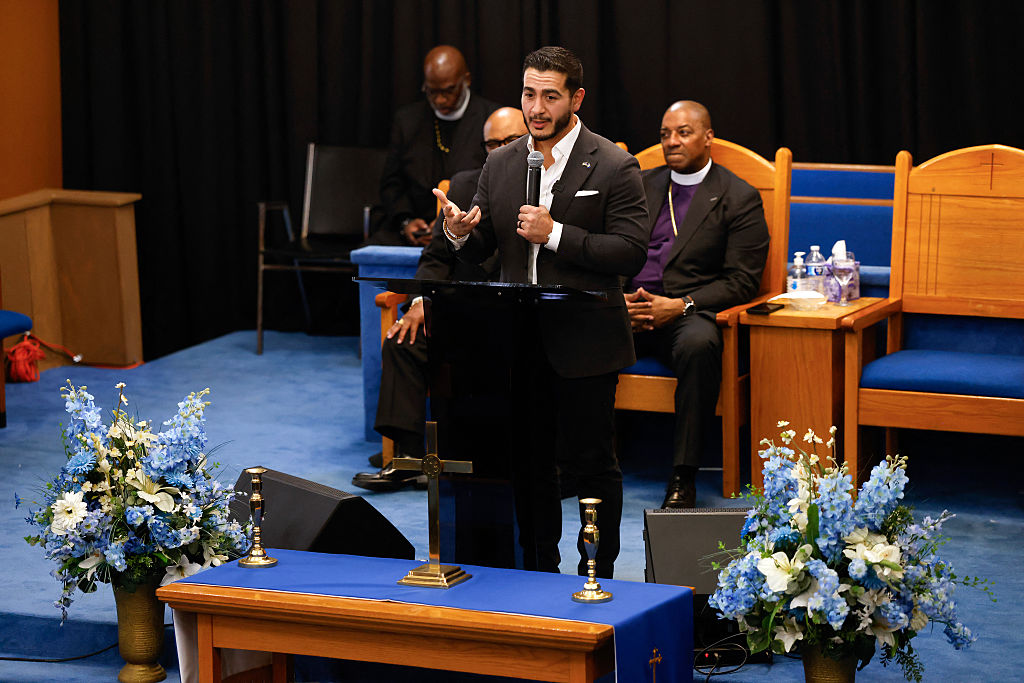
As Election Day approaches, political upheaval is intensifying across key states, exposing deep fractures within the Democratic Party and raising serious concerns about democratic integrity. In Michigan, a dramatic shift unfolds as Hayley Stevens, who narrowly lost the Democratic primary to Abdul Assayed, publicly endorses Republican Mike Rogers—contradicting her earlier criticisms. This sudden pivot signals the rise of radical democratic socialist candidates within the party, whose affiliations with extremist groups and controversial ideologies have triggered widespread alarm. In Alaska, a New York Times investigation reveals that Democratic Senator Mary Peltola’s campaign may have orchestrated the appearance of another Dan Sullivan to manipulate the ranked-choice voting system, potentially undermining the legitimacy of the election. This strategy, which exploits a complex voting formula that can produce unexpected winners, has drawn federal scrutiny and criticism for distorting democratic processes. Meanwhile, California’s proposed wealth tax on billionaires—despite claims of targeting only the ultra-wealthy—raises constitutional and practical concerns, with fears of a slippery slope toward broader taxation affecting middle-class wealth. In Virginia, two constitutional amendments threaten to expand abortion access to the point of birth and redefine marriage without gender or life boundaries, prompting strong opposition from evangelical leaders who view these changes as morally and biblically indefensible. These developments collectively illustrate a fragile political environment where ideological extremism, voting system manipulation, and moral overreach are reshaping the future of American democracy.
it's monday november 2nd 2026 i'm albert moeller and this is the briefing a daily analysis of news
and events from a christian worldview well here it is election day is coming just one day away
and wouldn't you know things are getting even more interesting just when you thought you were
headed into the final hours of the campaign some very unexpected things have not only happened
they basically have exploded and i'm thinking here in particular the senate races in alaska
and in michigan but let's start with michigan because in michigan the huge story is not so
much what has taken place in the campaign itself and of course you've got the democratic candidate
abdul assayed and he's running against the republican candidate mike rogers but the big
story is not really at this point about mike rogers and abdul assayed it is instead about
abdul assayed and the woman he defeated although
just by less than a thousand votes in the democratic primary and that is now representative
hayley stevens and the big story is that going into the weekend stevens and al sayed were expected
to make a joint appearance and so the stevens appearance was going to be a sign of political
unity in the democratic ticket and so it was supposed to be at a church it was supposed to
happen just yesterday it was supposed to come with great fanfare and it was supposed to be
a propulsion into the final hours of the
campaign with democratic party unity and then that unity fell apart and it fell apart fast and
it fell apart explosively and it fell apart in public and so one of the first things we knew
is that stevens had addressed a series of demands to al sayed saying if you don't do these things i
don't want to make the appearance he did not do those things and by the way they were very
common sense things but it just goes to show again the extremism to which he's actually very
much committed and so i'm saying that hayley stevens in this case was
right and yet she then did far more than anyone expected she did what she had told many people
she would not do and she appears on sunday morning so saturday the story was where she wasn't she
wasn't at the appearance with the democratic nominee and then sunday the story was where she
was and that's because yesterday she showed up and she publicly endorsed mike rogers now during
the campaign when she was running for the democratic nomination which she so narrowly lost
she had made very critical statements about mike rogers just what you would expect in terms of
one party speaking about the other party but now it turns out that the one thing that hayley stevens
and mike rogers are absolutely agreed upon is that mike rogers should be the new u.s senator
for the state of michigan and not abdul assayed okay really interesting developments here you
have a war of headlines because you've got democrats trying to say no there's no story
here it's it we're still a unified party and and and al sayed is going to win the election
they're absolutely certain the reality is the polling is within the margin of error
and this would be a huge huge thing the democrats thought they were going to have
basically a winning campaign they really thought that hayley stevens was going to be the nominee
and she's not an exciting candidate but she is very much a democratic candidate
in terms of the normal mode for the democratic party until now but what you have now is the
rise of the democratic socialists the far left in the democratic party and abdul assayed
is one of those candidates he basically is running a democratic socialist-like campaign
even though he says he doesn't identify as a democratic socialist but he is also of course
now even more notorious for the fact that his family has had ties to the muslim brotherhood he
himself has been at least at times publicly in support of the muslim brotherhood and you've got
ties beyond that even to groups that had ties to al-qaeda and others it's a very troublesome
development and of course there are huge issues here and the main problem is that the muslim
media is just absolutely determined to prove in every way possible that they could not be
discriminating in any sense against a muslim candidate but it is also very revealing that
in the closing days and hours of the campaign some in the media are saying well you know that
that is kind of a legitimate issue or at least they seem to believe it might be eliza griswold
wrote a piece at the new yorker entitled the final electric days of abdul assayed's senate
campaign and it turned out that that electricity was at a much higher voltage even than the new
yorker article seemed to indicate i'm going to say there's a lot on the line here just a lot on the
line and one of the things we don't know is exactly what happened between hayley stevens and
i'll say it we just don't know but we do know the public statements that she has made and we do know
the public response against her coming from abdul assayed which was actually quite energetic and so
it is going to be interesting to see how this plays out and one of the things we know at this
point just in terms of how politics
works is that an issue like this arrives with a lot of volatility and so anyone who says i know
how this is going to turn out is basically making either an educated or even an uneducated guess at
this point we're going to have to find out and we want to find out soon exactly how the voters of
michigan are going to respond to this it is hard to believe that the voters of michigan would elect
someone like dr abdul assayed as a united states senator he would be the first muslim
senator by the way the first elected muslim senator in american history but as we know there's a lot
more to it than that you're looking at various radical strands put together in one candidate
which by the way is becoming increasingly common in the democratic party and one of the things we're
going to be looking at this week is the rise of and in some cases the electoral fate of dsa openly
identified candidates running at a number unprecedented in american history and certainly we see the future
of the democratic party very much at stake but along those same lines the other big story was
alaska and the story in alaska is really due largely to one major news report and this was a
news report an investigative report that was published in the new york times so one of the
things i want christians to think about is that when you have something like the new york times
we know that it comes with a very liberal opinion perspective we know that it comes it comes very
left or in some cases even even more clearly leftist directions at the same time we also
understand that a paper like the new york times is able to do investigative reporting and frankly
has the journalistic credibility for people to trust them with information such that it is very
significant that the new york times comes out with this investigative report just a few days ago
saying that there's good evidence the democratic nominee mary peltola that either she or her
campaign was actively involved in
getting someone anyone named dan sullivan on the ballot to confuse voters in terms of running
against incumbent senator republican dan s sullivan so their idea was you put more than
one dan sullivan on the ballot you could siphon off votes and that would lead to a victory but
there's more to it than that and this is something we have to keep in mind how could you have so many
people on on the ticket well that is because alaska has had a very bad experiment with what's
been going on in the last two years and it's been a very bad experiment and it's been a very bad
experiment and it's a formula and i won't go into the details here it simply means that you rank in
terms of your voting a first choice a second choice you can even go further and that is all
put into an algebraic formula in which case if you have a person even if they could win the popular
vote in other words they were ranked one by more people if they were ranked two by a significant
number or if you had other people who were ranked high or if you had other people who were ranked
high at a certain number by this equation you could end up with the candidate who received
fewer first place votes than the other actually being elected to office now one of the things
you have behind this is that the left has been pushing ranked choice voting for a long time
because it's not entirely this but it's at least partly this it would make it very difficult for
republicans to be elected and that's just what they know and that that's why you have
basically pretty liberal states that have done this but this also raises a huge issue and
that is that the voters in alaska are not only going to be electing a united states senator
they're also going to be voting on a ballot measure to end ranked choice voting and return
to the more straightforward electoral system that the rest of us know throughout the united states
in which case you'd have a republican nominee and a democratic nominee and let's just say the
the risk of having two daniel sullivans on the ballot would be largely eliminated the wall
street journal put it this way and cites the new york times saying that that paper reported on
wednesday last week the staffers with peltola's campaign had worked with people to recruit the
other sullivan as a spoiler in the race a strategy that her campaign had long denied that's what
makes the story all the more interesting now by the way as of this morning no one has the smoking
gun that says the candidate herself has initials on this but at the same time even the new york
times piece basically said it's impossible in practical terms to believe she didn't know about
this although she has now looked at a camera and said she didn't know about this and she's
did not know about this we're told that this strategy had long been denied but now they're
having to accept it they're having to admit it because the new york times presented just
overwhelming evidence and furthermore it makes sense it makes sense that's exactly what we're
looking at here the chance that someone who had never been in politics before and by some reports
hadn't even voted in recent elections would decide to run against someone that just by accident had
the same name in this kind of election which could only fulfill the
role of a spoiler that's the only role that that's conceivable here the fact is that it's very
unlikely he came up with this
this. And so what you have is his denial. No, that isn't what happened. But all the dots are
now being connected. And, you know, it's going to take more investigative reports. The governor
of Alaska is now calling for state authorities to investigate. President Trump and the U.S.
Department of Justice have said they want to look at this. It's not exactly clear what role the
federal government can have in this situation. But it is at this point very clear that, again,
you've got a Democratic Party that was up to absolutely no good. Now, that's not to say that
when you have politics that only one party ever pulls this kind of thing. But it is really
interesting. You look at the story right now in Alaska. You look at the story in Michigan. I mean,
these are huge, huge stories. But speaking of the election and with, of course, so many things
coming at us, let's just remind ourselves of some of the other issues, some of the other
questions that are at stake. You've got voting and campaign finance laws in several places. And I
mentioned the voting and campaign finance laws in several places. And I mentioned the voting and
Alaska when it comes to the ranked choice voting or just the more straightforward normal election
math system. And so I do hope that the majority of voters there in Alaska choose common sense over
the complexity of that ranked choice voting. And by the way, one of the proofs of just how volatile
and unhelpful that way of voting is, is that the average person on the street can't even tell you
how it works. President Trump was made fun of by some in the media for saying that no one really
understands it. But it turns out that the majority of voters in Alaska vote for the ranked choice
vote. And that's pretty undeniable, as a matter of fact. And even some of the people in the media
who talk about it get it wrong. It's a mess. And it's a way that really distorts our political
system. And by the way, when you have a two-party system and you have a face-off between two
candidates, you could have third parties, but they have to be identified as third parties.
The reality is that our system increasingly works within that pattern. And you break it
out of that pattern, it's very hard to tell how our politics can go forward. I mean,
you look at the United States Senate right now, you've got a party that has a majority and a
party that has a minority. You have a minority leader's office and a majority leader's office,
but they don't even call them that anymore. Now you have a Republican leader's office and you
have a Democratic leader's office. And that's because they don't move now when the parties
switch which one has the majority. Instead, it just tells you basically it's a two-party system.
And in the United States Senate, it's even just made clear in the furniture. Now,
that's not to say there aren't some independent senators in time.
It is to say the basic structure is still the two-party system. Now, there are some such as
George Will, who has been a fairly conservative columnist throughout time. I think he's less
conservative as he grows older, but he is writing over the weekend about the possibility of a new
third party emerging. But the fact is that about every 10 years, someone sees a third party
emerging, but it's never emerged very far. And it's going to be very difficult to see how it
a two-party system. Now, when Abraham Lincoln was elected and Abraham Lincoln was the first
Republican elected president, that meant that another party basically went into the sunset.
And that can happen with either the Democrats or the Republicans in theory. It's just hard to
imagine in the modern context how either one of these parties can simply at this point disappear.
Well, all right, there are other big issues that are on the ballot. So that means in addition to
electing the entire House of Representatives, in addition to electing about a third of the Senate,
many governors in the respective states, there are other huge issues. And there's some big
questions. I mentioned already, of course, in Alaska, the vote on rank choice voting and whether
that's going to continue or not. But you have other issues in other states. For instance, when it comes
to personal wealth and taxation, you have at least three states that are looking at pretty radical
action that basically comes down to tax the rich. Now, I'm not saying it's wrong to tax the rich.
I'm just saying good luck.
And the reason I say that is because money can move. And so when you're talking about the rich,
you've got to decide who you're really talking about. Now, in California, they're talking about
billionaires. That's the word they're using, billionaires. They're saying to everybody else,
just mere millionaires. Don't worry about this. California, by the way, has lots and lots and lots
and lots of millionaires. And so the way the New York Times puts it is this, quote,
the first of its kind measure would impose a one-time 5% tax on wealth for Californians with
a net worth over $1 billion, with nearly all the revenue going to the United States.
Well, taxes are imposed on the value of personal assets, even if they are not sold rather than on
income or the sale of assets like stocks and bonds and property, end quote. Now, by the way,
there are basic questions here about the constitutionality of that text. And so we'll
see if this passes some kind of constitutional muster. We're also going to see whether or not
the voters of California go for it. Now, it's a very interesting picture because what you have
are some labor unions that are for it. And then you've got some others, even in the Democratic
side, who aren't really for it at all. And so we're going to see if this passes some kind of
governor Gavin Newsom, who, of course, is coming to the end of his term and clearly has his eyes
on the White House. He also understands that billionaires, by definition, can move. And so
you've already had several of them move out of the state of California. You've had others accelerate
their moving because of the threat of this legislation. And so if you are a billionaire
in California, it just might turn out that living in California is too expensive.
Now, the other thing, and this is where a lot of people in the middle are getting,
rather concerned. The problem is that if you can tax wealth this way, and you can do it saying it's
just one time and only against billionaires because of a pressing need in health care,
if you can do it, then I guarantee you legislatures are going to do it and do it and do it. This is
the same way so many other taxes have simply exploded. This is the entire logic. When
legislators find out here's a new untapped vein, they don't ever stop with just this or just that.
And so pretty soon they're going to be saying, well, anyone who has, let's say, it was a billion,
so let's just say 500 million. And you say, well, that's very, very wealthy people. Well,
what if they say then 200 million, 100 million, 50 million? Pretty soon they're down to 1 million.
And there you're looking at a lot of people, even who are retiring on pensions, who have at least
a net worth of a million dollars. And you can just see how this is going to work. And by the way,
there are a lot of people in California who are not currently billionaires or centimillionaires,
but there are people who are nonetheless working. And this includes a lot of people
who've been running, say, food trucks, and then they have a second food truck and a third
food truck. And then they move up the economic ladder. Pretty soon, at least in terms of assets,
they've got a million dollars. Now, it's probably set off by all kinds of other bills and all the
rest. But here's the thing. If you have legislators who say, hey, don't worry,
we're just going after billionaires, I can assure you, and I think a lot of people in
California are very aware of this, it won't stop there. Now, as I said, there's
some just huge questions about constitutionality and all of this. A tax on wealth is very different
than a tax on income. And so the United States Constitution had to be amended in order to have
a national income tax. And you're looking at all the rest of this. It's going to be very
interesting to see where this goes. Now, Governor Gavin Newsom, who is not a conservative, let's
just make that very clear, the two-term Democratic governor is a man of, let's just say,
he wants to position himself as the center left. You know, he wants to be less threat
than other people on the left. Of course, it comes to moral issues. He's about as threatening
as it gets. But when it comes to fiscal issues, he is against this proposal in California because
he understands that rich people will just move. They'll move to a state which doesn't have this.
That's why he has said, no, this kind of wealth tax shouldn't be state by state,
starting with California. It should be a national agenda item. Okay. Now, that means you can't move
from state to state to your advantage. The problem is, and this is what everyone's
in the global economy knows, that even if you say, okay, all 50 states are going to have this
because it's going to be a federal policy. Well, this is one of the reasons why the extremely rich
have options offshore. So I'm trying to make a distinction here. I think there's an argument
that could be made about proportional taxation. And by the way, the rich do pay the majority of
taxes, certainly in terms of the margins. But the reality is that we are in a global economy,
like it or not. And by the way, even before there was anything like a global economy,
you still had offshore investing. And so that goes back even to the medieval world,
where people with a lot of wealth, they would hedge their bets. They would own property here
and there, even if it was blind and hidden. They knew they had to hedge their bets, especially in
an age of political volatility. Now, as I mentioned, there's some huge agenda items state by
state, especially with the transgender issue, and especially as related to teenagers and children
coming up, at least five states. And so, as I mentioned, there's some huge agenda items state
states will be voting on this, and it has never been on the ballot this way before.
And then there are abortion issues as well. And in state by state, there are certain states
that have, you could argue, almost both of them. And that's because this is now the wave
of social change coming in a progressivist direction. And I just mentioned you have all
these candidates now on the Democratic side associated with the DSA and pretty far to the
velocity on so many of these huge social moral issues to increase significantly. And that's almost
how every of the elections turn out. Because even if these DSA candidates on the Democratic side
lose, there's no indication the DSA is anything but a growth market in the Democratic party.
So we're going to watch all of this together. And if it were not sufficiently interesting,
it has just gotten a great deal more interesting. I want to mention one other big issue.
especially for Christians. And so I'm
going to focus here particularly on the state of Virginia. And Virginia has not been, let's just
say, infamous for controversy in the 2026 election cycle. And I think that's a mistake. I think we
should be focusing on Virginia in a way that many people at the national level have not.
There are a couple of big ballot questions, and I'm particularly interested in ballot question
one and ballot question two. So let's just face what they are. Ballot question one. Okay, so I'm
going to read to you the exact question. Quote, should the Constitution of Virginia be amended to
one, protect the freedom to make personal decisions about prenatal care, childbirth, postpartum care,
birth control, abortion, miscarriage management, and fertility care. Two, protect doctors, nurses,
and patients from being punished for these decisions. And three, allow for restrictions on access to abortion
during the third trimester of pregnancy, except when the patient's health is at risk or the pregnancy
cannot survive. Okay, so that's how it's being presented. Just notice how radically pro-abortion
this is. You look at it, and then you even look at the language that's supposed to be restrictive.
So let me get back to that last phrase, allow for restrictions on access to abortion during the
third trimester. Well, at least they allow for restrictions on abortion in the third trimester,
but then they don't. Quote, except when a patient's health is at risk or the pregnancy cannot survive.
And when you consider the fact that mental health is often
cited as a health reason, you understand that a woman in significant distress
is in a position to claim she has a right to abort a baby all the way up until the moment of birth.
So this is all the way through the term. And the people who are behind this understand that's
exactly what it is. And this means an amendment to the Constitution of Virginia. And just notice
again, the first phrase, the first clause, protect the freedom to make personal decisions about
prenatal care, childbirth, postpartum care, birth control, abortion, miscarriage management,
and fertility care. You'll notice it.
That this is to preserve the freedom to make personal decisions. So that means there's no
external authority whatsoever. And just understand just how radical this is. And then the second
phrase, protect doctors, nurses, and patients from being punished for these decisions. So this would
relieve medical professionals of all moral responsibility and legal responsibility when
it comes to this issue. And this includes abortion and so, so much more. Okay, that's ballot question
number one.
Question number two is a constitutional amendment as well. Here's the question.
Quote, should the Constitution of Virginia be amended to, one, remove the ban on same-sex
marriage, two, affirm that two adults may marry regardless of sex, gender, or race, and three,
require all legally valid marriages to be treated equally under the law?
Okay, so that's the measure. It's called ballot question two. I want us to note something,
and that is that same-sex marriage is legal in the state of Virginia. It's legal right now. It's
been legal since 2015 and the Obergefell decision by the U.S. Supreme Court. So then you ask the
question, why would this be put into the Constitution? Why would this be necessary, or why
would the left be pushing for this? And it is because they want to get even the language restricting
same-sex marriage. They want to, and by the way, there is no such language in the Virginia
Constitution. It's just that the Virginia Constitution says that marriage is a unit of a man and a woman. In
the same way, everyone in the United States defined marriage consistent with human history
defining marriage, and that just tells you how revolutionary and how much of a moral revolt is
going on in our time. And this is so sinister because it turns it around as if the Constitution
has a ban on same-sex marriage. It has no such thing, the current Virginia Constitution. What it
has is a very clear statement that this is marriage, and that's what they want to be rid of.
And then you'll notice something else.
I want to draw attention to the second clause, number two, affirm that two adults may marry
regardless of sex, gender, or race. Well, let me ask a question. If you get rid of the distinction
between male and female, if you get rid of the complementary structure of marriage as the union
of one man and one woman for one lifetime, if you just deny that and move on to a new, radically
revised definition of marriage, how in the world do you just, let's just say, destabilize sex and
gender and claim you have stability in number? Number has been a very much earlier issue of
volatility. You just think of polygamy, even all kinds of examples throughout human history.
And so how in the world do you draw the line saying that the Constitution should say that
marriage can only be of two adults? How can you say that? If you can't say man and woman,
then on what basis can you even say two? And I guess what we would say is that
in this point is what's politically plausible. My guess is that those who are trying to destabilize
marriage, they understand they can't go all the way with polygamy or polyamory, that they can't
get rid of the number two. But you know what? If you get rid of male and female, it's just extremely
unlikely, implausible that the number two can last for long. And by the way, you've already
redefined marriage in the most basic way. So if two gives you some kind of comfort,
you're fooling yourself. Okay. I very much appreciate the fact,
a number of Baptist pastors in Virginia have been on this, and they released an open letter
from Virginia pastors to the Commonwealth. And I think it's just incredibly well done.
And they give a biblical reason for these things. When it comes to Amendment 1, they say that
Christians should oppose it because it will bring about more destruction of human life in the womb.
When it comes to the second, they say that Christians should be against it because it
discards the truth of marriage and gender. And of course, that's exactly what these two
amendments would do.
I think it's also very interesting that you take those pastors, evangelical pastors,
a good many of them Baptist, who signed that letter. There is another statement about this
that comes at the journal First Things, and it is by Paul D. Scalia. That would be Father Paul D.
Scalia, a Roman Catholic priest, who would happen also to be the son of the late Supreme Court
Justice Antonine Scalia. He wrote a piece at First Things and taught a Virginia's ballot,
put Caesar over God. And he describes them just, I think, extremely
well. Listen to this. Proposed Amendment 1, I'm reading from his statement here,
quote, seeks to embed unrestricted abortion in the Virginia Constitution. Predictably,
this initiative is presented as simply codifying Roe v. Wade, going back to the good old days
before Dobbs. That would be bad enough, he writes, but the proposed amendment goes much further.
It would open the door to practices that would shock many who favor legal abortion.
By the usual tactics of murky, elastic language, the amendment creates conditions that would
permit abortion up to the point of birth, remove all parental rights, and eliminate
accountability for the abortion industry. Yep, that's all. And then he says about Proposition 2,
the proposed amendment number 2, quote, is promoted as removing the ban on gay marriage
from the Virginia Constitution. Of course, there is no ban. Gay marriage isn't mentioned because
it's not a thing. The state constitution bans gay marriage about as much as zoology bans unicorns.
Rather, it simply defines marriage as what it is. Not surprisingly, the proposed amendment's language
removes not only the imagined ban, but in effect, any definition of marriage whatsoever. It's
under the institution itself. This has always been the end game. End quote.
I wanted to read those two sections from Father Scalia's article because it's just,
in the midst of all this, and in the midst of so much confusion, you've got these evangelical
Virginia Baptists who show up with clarity, and you've got this Roman Catholic priest who does
the same thing. And it also sounds, in this case, like he's basically very much the son of his
father, the late Supreme Court Justice Antonin Scalia. The language is clear,
and crisp, and in the most appropriate way, biting. Thanks for listening to The Briefing.
For more information, go to my website at albertmohler.com. You can follow me on X or
Twitter by going to x.com forward slash albertmohler. For information on the Southern
Baptist Theological Seminary, go to sbts.edu. For information on Boyce College, just go to
boycecollege.com. I'll meet you again tomorrow for The Briefing.
you
Podcast Summary
Key Points:
In Michigan, Democratic nominee Abdul Assayed and former primary rival Hayley Stevens have erupted in public conflict, with Stevens unexpectedly endorsing Republican Mike Rogers despite previously criticizing him, undermining Democratic unity.
The Stevens-Assayed rift reveals a deeper trend of rising democratic socialist influence within the Democratic Party, with Assayed’s ties to the Muslim Brotherhood and extremist groups raising serious concerns about ideological purity and voter trust.
An investigative New York Times report alleges that Mary Peltola’s Alaska campaign intentionally recruited Dan Sullivan to run as a spoiler, exploiting ranked-choice voting to siphon votes from incumbent Republican Dan Sullivan, sparking a major political scandal.
The Alaska ranked-choice voting system is criticized as distorting democracy, as voters struggle to understand its mechanics and it disproportionately disadvantages Republicans, despite widespread public confusion and opposition.
Several states, including California, are advancing radical wealth taxes targeting billionaires, raising constitutional questions and prompting fears of a slippery slope toward broader, income-neutral wealth taxation that would affect millions.
Virginia is facing two controversial ballot initiatives
Evangelical leaders, including Baptist pastors and Roman Catholic priest Paul D. Scalia, have strongly opposed Virginia’s ballot measures, citing biblical and moral grounds for preserving human life and traditional marriage.
These developments signal a broader crisis in American politics, where ideological extremism, systemic voting reforms, and moral agenda items are reshaping party dynamics and threatening the stability of the two-party system.
Summary:
As Election Day approaches, political upheaval is intensifying across key states, exposing deep fractures within the Democratic Party and raising serious concerns about democratic integrity. In Michigan, a dramatic shift unfolds as Hayley Stevens, who narrowly lost the Democratic primary to Abdul Assayed, publicly endorses Republican Mike Rogers—contradicting her earlier criticisms. This sudden pivot signals the rise of radical democratic socialist candidates within the party, whose affiliations with extremist groups and controversial ideologies have triggered widespread alarm.
In Alaska, a New York Times investigation reveals that Democratic Senator Mary Peltola’s campaign may have orchestrated the appearance of another Dan Sullivan to manipulate the ranked-choice voting system, potentially undermining the legitimacy of the election. This strategy, which exploits a complex voting formula that can produce unexpected winners, has drawn federal scrutiny and criticism for distorting democratic processes. Meanwhile, California’s proposed wealth tax on billionaires—despite claims of targeting only the ultra-wealthy—raises constitutional and practical concerns, with fears of a slippery slope toward broader taxation affecting middle-class wealth.
In Virginia, two constitutional amendments threaten to expand abortion access to the point of birth and redefine marriage without gender or life boundaries, prompting strong opposition from evangelical leaders who view these changes as morally and biblically indefensible. These developments collectively illustrate a fragile political environment where ideological extremism, voting system manipulation, and moral overreach are reshaping the future of American democracy.
FAQs
Hayley Stevens, who narrowly lost the Democratic primary to Abdul Assayed, publicly endorsed Mike Rogers, contradicting her earlier critical statements about him. This shift has sparked a political rift, revealing a split within the Democratic party between traditional Democrats and far-left, democratic socialist candidates.
It signals a major ideological shift, as Stevens and Rogers agree that Mike Rogers should be the U.S. Senator, despite Stevens previously criticizing him. This undermines the image of Democratic party unity and highlights growing influence of progressive, left-wing factions within the party.
Assayed has had public ties to the Muslim Brotherhood and is linked to groups with ties to al-Qaida, raising concerns about his political platform. These associations have drawn criticism and increased scrutiny, especially as he is the first elected Muslim U.S. senator.
An investigation by the New York Times found evidence that Peltola's campaign worked to place a second 'Dan Sullivan' on the ballot to confuse voters and siphon votes, a strategy that could have altered the outcome of the race.
While Peltola has publicly denied knowing about the strategy, the New York Times report presents overwhelming evidence that she either knew or failed to deny it. State authorities and federal officials are now investigating the matter.
The system can distort election outcomes by using complex rankings, leading to a candidate winning without a majority of first-choice votes. Many voters struggle to understand how it works, and voters are also voting on whether to end it and return to a simple two-candidate system.
Chat with AI
Loading...
Pro features
Go deeper with this episode
Unlock creator-grade tools that turn any transcript into show notes and subtitle files.
 PodcastTranscript AI