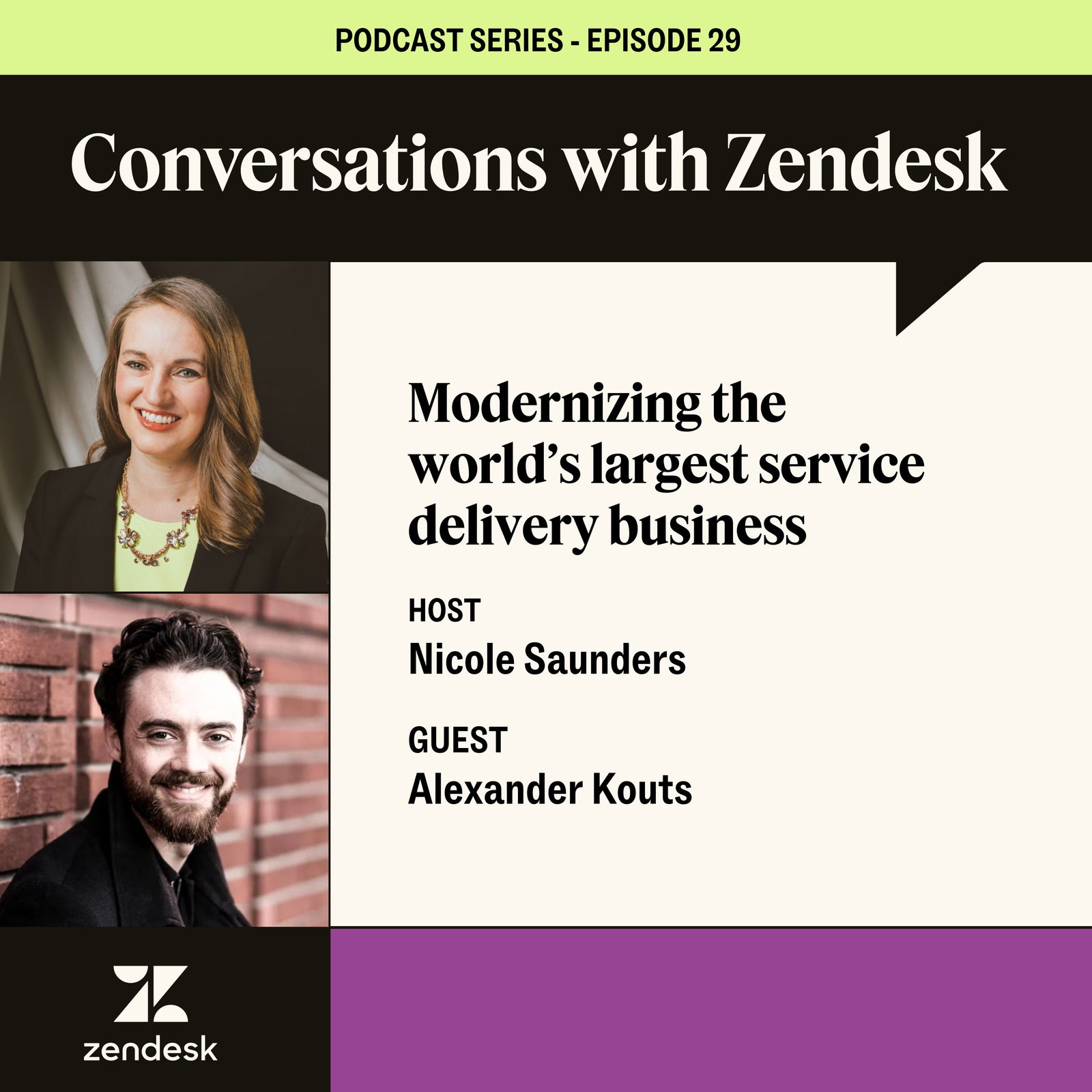
Modernizing the world’s largest service delivery business with Indigov’s Alexander Kouts
28m 8s
Alex Coots, CEO of Indigo, discusses his mission to improve customer service in the public sector by leveraging private-sector technology, particularly Zendesk, to enhance engagement between elected officials and constituents. Initially, congressional offices took an average of 83.8 days to respond to constituents, with only a third responding at all. Indigo reduced this to minutes by using Zendesk's macros, triggers, and automations, alongside custom-built applications like batch processing for repetitive messages and a response approval queue to ensure official language. The work is crucial because constituents often seek help with sensitive issues like veteran benefits, and filtering out advocacy spam allows staff to focus on genuine needs. Challenges include navigating government security standards, regulatory approvals, and data privacy concerns, especially with AI. Coots divides AI into two buckets: democratic interactions, where abstracting human connection is problematic, and agency-side service delivery, where AI can accelerate processes like VA claims. He emphasizes that empathy, speed, and accuracy define service quality, and while AI improves speed and accuracy, maintaining empathetic human connection remains essential. He also notes the need for transparency and cultural adaptation as AI evolves. Coots shares a personal positive customer service experience at REI, highlighting how going beyond expectations creates memorable interactions, and stresses the importance of understanding core service expectations to exceed them.
Empathy is an absolute key ingredient in resolving a customer service dispute. And so I think it remains to be seen as some of these models get better and better. How do we make sure that we're capturing the empathy side? Because nobody wants to feel as though they're talking to a bot, even if they are. Hello and welcome to Conversations The Zen Desk. I'm your host Nicole Saunders. Today we're looking at customer service through different lens, public sector. For anyone that has ever tried to reach out to a government agency or an elected official, the process can be challenging. Sometimes you're lucky if you even get a response. Well, we've got somebody who is working to solve those issues. Joining us today is Alex Coots, CEO of Indigo. He is on a mission to bring the efficiency of the private sector to government context, using technology to drive better engagement between elected officials and their constituents. And he's seeing some pretty incredible results. Response times have dropped from an average of 80 days to less than eight hours. And with a better understanding of the kinds of issues coming into each office, officials can do a better job of proactively addressing them. We'll hear from Alex on what Cajurney has been so far, how Indigo has risen to the challenge of working with a highly regulated space, and where AI fits into the future state of all of this work. Before we dive into that conversation, just a quick note for our listeners, applications are now open to attend our inaugural Zendesk AI Summit, happening in New York City on October 9th. More information on that is available at zendesk.com/AISummit. We'll also include a link to that in our show notes. All right, without further ado, Alex Coots, welcome to Conversations with Zendesk. How are you today? You're cool. I'm doing pretty great. How are you? I'm doing well. We are in the thick of summer here, and it's a good time of year. Yeah, I'm in the thick of summer, the right way to say it in DC. I think that 800% of you already did that. So I'm sure. Yeah. Well, Alex, I'm a huge fan of Indigo and your work, but I'm not sure that all of our listeners are familiar. So I would love it if you could start off by telling us a little bit about what Indigo does and what customer service looks like in your context. Sure. Yeah. Happy to give some background. So maybe let's start a hundred years ago when I was a child. I mean, I started. So my background is as a product manager and user experience designer. And about 15 years ago, I became obsessed with this question of if the government had product managers, if the government had user experience designers, and they were trying to design experiences that would get the average constituent to engage with them on things that really matter, like legislation and government services that they could make available to folks that really need it. What would that actually look like? How would you build that experience from the ground up? And what I realized first was that what government really was when I framed the problem correctly, it was the biggest service delivery business in the entire world. The US government process is something like over 53 billion service requests a year across every level of government. And very rarely did they have single purpose bill tools designed to help people understand that those services exist and be able to access them. And so Indigo was part of a larger mission to redesign the user experience of democracy, leveraging very powerful customer service software like Zendesk and other things that we've built to make constituents lives easier and to make them be able to access their government and avail themselves of services when and where they need them. That's amazing. So in the induction, I talked a little bit about some of the impacts you've had with the work that you've done. But I'd love for you to expand on that a little bit. Maybe you can start by telling us why these efficiencies are so important. And then some of the results that you've had. Sure. Yeah. Happy to. So I had been advising members of Congress on tech policies for some time and walked in their offices and saw the technology that they were using to communicate back and forth with constituents. And what I found is that it was an ecosystem of technology partners that were really hardworking and smart people, but that they hadn't had any new entrance in a very long time. I think we were the first new vendor in the house and well over a decade. And so we looked in and we said, all right, well, what could we leverage from the private market that would dramatically change the way that these offices operate? And why does that matter? And starting with the why first is always a great reason. And so the average congressional office receives anywhere from three to five thousand messages from constituents every single week. What a lot of people don't know is that almost 90% of the incoming mail to their member of Congress's offices are not actually from constituents. They're from advocacy organizations looking to affect legislative outcomes by sending thousands often of identical messages to an office. Now that seems like it should be an easy problem to solve, right? Identify messages that look the same and automate the responding to them. But those tools didn't exist inside the ecosystem. So often constituents will reach out to a member of Congress to help them mediate an issue with the government agency, say, I'm a veteran that's come back from an active conflict zone, active military service. And I need access to psychotropic medication with the VA. And I'm not getting the response that I need from folks that I'm trying to work with there. Sometimes those people will reach out to the member of Congress to lobby that agency on their behalf. And so it's no exaggeration to say that the members of Congress and their staff are helping people survive. They're helping people thrive. They're getting them access to the benefits that they need. And so when their staff has to wait through all that noise of all those advocacy messages that are real constituents, it takes them a long time to be the people that genuinely need the help. And so what we wanted to do was help them sift through the noise, get to the real people so they could spend all their resources and time and focus on the constituents that really needed them. I mean, it seems like incredibly important, incredibly valuable work. Are there any stories that stand out to you as a time that you had a really strong impact or something where you can really see the results of all of this being implemented? Sure. So first off, I'd say it took three years for us to get Indica approved in the US House of Representatives before we get actually start solving problems for people. So it was a very, very long road to get there. And so while we were waiting for the approval to come through and fighting that battle on and of itself, we learned a lot about how these offices were operating. And we ran tests where we sent in messages to every elected representative in the house engaged their average response time. And as you referenced earlier, the average response time from the testing that we did showed that the average time it took for an office to get back to a constituent for any request that came in was 83.8 days. And only a third of Congress was responding at all. And so we showed this data to the house. And that was one of the reasons that we got into the process because they wanted to do better. They genuinely knew they could do better. And it was shocking to a lot of folks. And so when we launched in a house after that three year kind of long, you know, hacking our way through the general process of kind of red tape and security reviews and all those things, all of which are necessary to be clear. You don't want government to take big chances on new technology. You want them to be very risk averse. But once we got in, very, very quickly with the application of private market technology, you're taking the lead from Zendesk and a lot of the amazing triggers and macros and automations available in the platform. We were able to reduce the average constituent response time to a matter of minutes down from 80 some odd days. Now the crazy thing that was kind of comedic and tragic at the time is that members of Congress and their staff wanted their responses to seem contemplative. And in many cases, they very much are. And so we actually had to figure out how to build in a delay to outbound responses inside of the tool. And so I would like to challenge anyone who's ever used Zendesk to try and figure out how to slow down a response. So we now bound take a comment inside the platform. We used a extremely elegant and confusing mix of automations in order to figure out how to do that. And then third party services that we built, it was a really weird challenge. But the bow on that presence, so to speak, is that we were able to reduce the response time so much that it required something like that. And so that meant better faster responses for constituents, better outcomes for people in America. And we took that as a gigantic first check off of our mission that we were accomplishing what we set out to do. That's that's amazing. And as someone who does interact with my government officials on occasion, I want to say thank you. It sounds like you really had to do some work to kind of customize things. You mentioned that you use Zendesk along with some of your own tools. Tell me a little bit more about that, that on the technical side and how you've kind of had to stretch some software. It sounds like kind of pushing it to its limits and figure out how to make it work for your use case. I think that is the most polite way to Zendesk engineering team would probably put it, but they've been using partners for us, helping us figure out how to do some stuff that the platform is not originally designed to do. So what we found when we were kind of starting this process, I looked at every CRM vendor in the market and I've used probably 20 or 30 CRMs in my life. Any of that was not my first company. I've used everything from the sales forces, the Microsoft, everything. And what I found was that Zendesk was the perfect mixture of platform stability, flexible series of API endpoints and structures for us to build really weird and interesting custom functionality into the tool. And so it was a kind of perfect platform as a basis on palmwish for us to build some really creative stuff. And so a couple of examples of some weird things. So we ended up building about probably 50 or 60 custom applications inside of Zendesk, some of which are super beefy. I immediately changed the way the application operates. So the first one that we built probably was batch processing. And so in the private market with companies, if you're reaching out to Toyota, what could say I have a Toyota Tercelle. I don't know, it's the first car that came in my mind, but I have a Toyota Tercelle and I reached out. And I need some customer service. Toyota typically has an account for that particular person. They want to give one-to-one service highly personalized for the individual government because they operate on that risk mitigation paradigm, the structure of their communications is much more comprehensive than what it is in private market companies where customer service reps may have a lot more latitude to have conversations. However, they want. And so in government, they may want to use only approved official communication and language because the issues they deal with are extremely sensitive. And he gets screenshot and put on Twitter and end a political career.
or call for a lot of problems for the government. And so they don't want their reps, so to speak, or their agents just saying whatever they want inside the tool. So that's to go through a series of approval levels. And so we built a project management workflow into Zendes that allowed people to draft and then collaboratively approve in a con-bond style visualization. Every official message before it actually pops up in a macro library where an agent can use it to respond to a constituent. So that was one of the first things we built. We called out the response approval queue, the RAKU, really beefy application. The other thing that we realized as part of that is that most of the responses that members of Congress were doing were done in batches. And so you don't have just one person, actually during COVID, this is an interesting example. A very, very, very, very, very large percentage you've been coming mail to Congress was all about Tiger King during COVID. I don't know if you ever saw that documentary, but everybody-- - I did. - Everybody upset about Carol Baskin, and they thought that she should be in jail, and they wanted to protect the kiddies. And so they were reaching out to the members of Congress, thousands and thousands and thousands a day, in some cases per office. And so often the questions and responses are identical. And so the average member of Congress has roughly eight to 900,000 constituents in their district. And so you may get a couple hundred almost identical messages every day, same opinion. And so what they do is they put those into batches. So we created a batch management interface inside of Indigo. So we basically assigned a tag to a ticket that would then put that ticket in a folder. And then we have a visualization for those folders. You could then assign a macro to that folder and then an automation. So that when a message came in, we were automatically assigning it to a batch. It was receiving this macro, that response closing it out, moving on to the next one. And so it was creating these basically buckets that had automations tied it into staffers with put stuff in, and then the buckets would kind of empty themselves out. And so it's a very non-traditional workflow. I don't think most customer service organizations would operate that way. But leveraging the base infrastructure of Zendesk and tickets and ticket fields and end users or constituent profiles and fields, macros, triggers and automations, we were able to create this self-operating loop in some cases, which saved 60% to 70% of the workload for these offices managing some of these responses. And so really what it was is just product managers and design folks sitting down with people, leveraging a powerful technology platform and customizing it in ways, other than which it was originally intended for their highly specific use case. I love hearing those stories because I know that, you mentioned working with our engineering team and things like that, those are the things that help improve our platform too. We learn how people are using things, we see what those new customizations are. And it helps us to continue to build those things out. Maybe sometimes bring them into product, develop them in a stronger way. - Yeah, I think we had probably a new Christmas wish list every other week for your engineering team. And they were very receptive and very friendly. And all the way from the product managers working on specific features, we were asking for changes with all the way to the CTO to company. It's been an amazing partnership. - Well, that's so wonderful to hear. I'm sure that there was a lot of lessons learned on both sides from all of those efforts. And I'm sure it's an ongoing thing. You know, as the technology continues to evolve, I'm sure you're finding new needs in your communications and ways to do those pieces. So you mentioned earlier, some of the challenges around the slow pace of change with government and the approvals that you have to go through. Like you said, it's a good thing, but it's a little bit tricky. What other challenges have you had in implementing these systems or any new technologies with a government agency? - Ooh, let me open up my dream journal once a second. There are many governments and pushing change, disruptive change in government is often very difficult. Part of it is cultural, part of it is regulatory and a lot of it is security. And so obviously, it has very different security standards than private market companies do. I've been buying mid-market kind of SaaS platforms, basically my entire career at every company that we've been at. And you know, we'll do a cursory security review, but we're looking at badges and emblems on the website. And if it looks good enough, we're probably good to go within reason unless we're storing something really sensitive in it. And government operates very differently. And so Zendes went through its federal and authorization a couple of years ago. We were involved in that process every step of the way, which made it possible for government to use the platform and store data in it. Again, gave government that level of security and understanding what's actually going into the platform and how secure it is. I think in the private market security may be one of the last things that happened in the conversation. In government, it's one of the first things that happen. They have to be assured that there are data that is being stored in the platform. It's not going to be exported and repurposed for other things. This is one of the situations where things like open AI and a lot of the large scale LLMs or a gigantic problem for government. There is a lot of issues with data ownership whenever it comes to constituents offering data to a government agency. And so if I'm reaching out to a member of Congress, to use the example before, and I'm asking for help with the VA or HHS or some other sensitive topic that may require me to submit personally identifiable information to a public office, I need to have confidence that that data is not going to be repurposed and turn into a dancing gift 85 years in the future for open AI to monetize in some way. And so it's not just how secure the platform is, but it's giving our customers assurances that that data is not going to be exported for any purpose. The way in which Zendesk is experimented with AI and has kind of slowly integrated into the product is a very risk-controlled way. And so our customers have been able to, in many cases, opt out because they are not ready for something like that. They may be several years down the road when the technology metabolizes through the ecosystem a lot more than it currently has, but they're not ready now. - So in addition to some of those regulatory or security related concerns, how are you thinking about AI? I suspect you probably aren't implementing a ton of it yet because there are some of those things that you have to get worked out, but how are you looking at it for the future or what would you like to see? - I put AI into two separate buckets. The first bucket is AI applied to democratic interactions. So if I'm reaching out to an elected representative, the other bucket is if I am managing an issue with an agency, thinking like a service delivery or kind of a service completion, like managing tickets effectively. So let's start with a democratic representation side of first. Any situation where you are abstracting the way the elected representative and their staff from the actual constituent who is expressing a view that is very important to them, which is the key stone of democracy, the dialect of the expression of opinion, the conversation. Any time where I am abstracting those people further away from each other with you, so complicated AI models, that is extremely problematic. I want, as a citizen, my elected representative to listen to exactly what I'm saying, not some AI generated summary of what I'm saying. And so AI has a lot of capability and capacity to lighten the load, so to speak, and increase human utility in some really interesting ways. But we have to be really strategic about where we apply it. And we have to think about, for a first order reasoning perspective, what is the purpose of democracy? What is it here to do? Why did these positions exist? We can't just apply AI because we think we could show it or it's cool or other people are doing it. We have to really understand it. And again, the downstream externalities of that application, really, really important point. All right, so that's one bucket. The other bucket is on the agency side. So my family is all military. And we have a lot of folks in the family who have served in combat zones. And I've served in many ways throughout the course of their lives in one of multiple branches of the armed services. So one of the things that was very near and dear to my heart was the VA. I think the VA has made enormous strides over the years that recognize that they've made huge investments of technology. It's gotten enormously better. But that's one area where processing through cues, which is something that humans typically do. AI can certainly help with, in many cases, help identify what type of treatment people are looking for, help them to the right people, and help accelerate that process, which can actually save lives. Yeah. I love what you called out as far as sort of run-in, back-end, different applications of AI. And I think that that applies to the private sectors. Well, right? We're looking at, on the one hand, how AI can help manage customer service conversations. You know, a lot of organizations are looking at, like, using bots to do some of the basic support. Well, at the same time, you don't want to remove the humans from it. You do want to bring humans in when it's important. You don't want to lose that conversation, that fidelity. But on the flip side, there are sometimes internal efficiencies that you can help drive and where timeliness is critical and the direct human-to-human contact isn't as important. That can be a great place to apply the AI. I just want to give a shout out to the VA. My dad used to work at the VA. I'm sure he would love to have some of these tools to make his job a little bit easier and a little bit more meaningful. Oh, yeah. Love those of you getting it. They're doing the laundry. Oh, absolutely. You know, to your point, these are things that can really free up people to do the more meaningful things. And, gosh, we all know that there's a lot of really meaningful things that people don't have time to get done. And especially in government, that could be incredibly valuable. So in customer service interactions, I think there is a triumvirate, so to speak, of variables that affect the perception of quality and service. This is my own personal opinion. There's three. One is how fast does my response come out, right? If I send a message to someone, how quickly does it take? How quickly did it get a response? The other is, do they answer my question? I ask for information on why my seat belts and my Toyota are locking up. And so do I get a response? I need a response. It's very important. And the third is, do I feel like I empathetically connected with the people that I reached out to? Are they really-- do they really care about me? And so I think AI can be amazing at increasing the time-lunus of responses and getting accurate responses to people. The area we really have to concentrate on is do we feel that we're getting an empathetic connection with a human? Humans like other humans. They like to talk to other humans. They want to feel like they're talking to someone who can empathize with them. Because. Nobody wants to feel as though they're talking to a bot, even if they are. Right? And so that's a tough problem that I think we're beginning to fix, but I don't think we've completely passed the Turing test when it comes to customer service interactions, but I think we're getting closer every day. Do that end. I think that transparency is a key element as well. People want to know when they are talking to a bot or when they're having an interaction where that data might go into an LLM. And so that strikes me as another area of AI where there's still some things getting sorted out. We need to make sure there's some regulations and things in place around those kinds of pieces. I agree. I mean, you know, humans, I was having a long conversation with someone other day about this. It was actually a really good conversation, but humans regulate friction in social interactions to help control human behavior, whether it goes from dating or communicating with people, sending people messages. You know, when my grandmother was a kid, if she wanted to communicate with someone across the country, maybe she could pick up a phone and call that person, but she may be writing them a letter. That's a lot of friction. It took a lot of love and time to write a letter to somebody you care about across the country. And now we've reduced so much friction and communication. Our culture needs to regulate friction back in in some ways. It needs to regulate things like privacy controls and what we understand back in so that we can, we can again, reestablish that empathetic connection. A lot of our communication. That's a whole topic for another time, but to the point of AI, like you said, I do think responsible disclosures, so that people understand what and who they are communicating with is absolutely going to be key. But we don't know what people are going to need as they start interacting with bots on a day-to-day basis. Their taste may change. Our culture may form around these new types of interactions, the ways that we don't fully expect. Do you think that there's an element to, you know, you mentioned earlier having to slow down the system so that people felt that empathy and had that sense of like, yeah, people are taking time with this. I also think a lot about how quickly humans can actually intake and process information, right? And it's one thing for it to be really efficient, but it's another thing to have the time to sit with something. What are your thoughts on that, especially when it comes to these governmental interactions? I get a lot of crap from my book club because I read, I listen to audible books at 3x speed and they think that's insane. But the weird thing is it didn't happen right away, right? I didn't start off at like 3x speed. I started like kind of inching up over time and then eventually like, it just, it seemed like a, you know, a natural extension just go faster and faster until you kind of hit the limit of what you can listen to or what the narrator can clearly announce anything. And so, you know, I think part of it is like, we just have to have this a little bit longer for us to figure out what speed and like how we can consume information and how that works in an effective way. But again, technology is changing so rapidly. There are just so many different interaction types and points where we don't really understand what the norms are going to be. And so for instance, like back to members of Congress, like you were saying before, a quick response may not be exactly what you want because it may seem transparently errobotic, even when it isn't. It may seem like it's not as important and considered and, you know, really ingested and digested as much as it should be. And so, you know, I think we have to think about what the end user experience looks like, what people's expectations are, what makes them feel valued, and what makes them feel listened to, and what makes them actually listen to and valued. And so, there's all these Venn diagrams just have to line up on top of each other that I think people are just beginning to learn. And so, I'm really excited for the next generation of user experience designers because, you know, when I was doing user experience design, I designed one of the first 10 iPhone and Android applications. That was like groundbreaking stuff at the time. And nobody knew what to expect. We didn't know how to use push notifications and geolocation access and things like that as they became available. We didn't know how the form factor on a phone was going to be meaningfully different from what was happening on a website. And that went through so many iterations over the years until people actually got a handle on what mobile was really good for. And the use case that made sense for particular applications. And so, you know, I'm really interested in voice input as a UX convention. I'm really interested in AI and kind of conversational UX. But again, I think we're just at the beginning of that and people are grappling with this new technology. I don't think we've gotten good at designing around it yet. You know, you're clearly deeply technical even thinking a lot about technological problems and innovation, but with a very strong eye towards that human experience and what it needs to look like. We try. So one of our favorite things to do on this podcast Alex is celebrate great customer service experiences. And we love to ask each of our guests to share some great customer experience that you've had, whether it was returning a pair of shoes or something related to an, you know, vacation or anything like that. Do you have any great customer experiences that you'd like to share and companies you'd like to shout out for offering some excellent service to you? So I love camping and hiking and being outdoors. I just love being outside in nature and it's tough in DC because you have to evolve gills to survive outside too long in like humidity. But I used to go camping all the time and I would love to buy gear. I was like my favorite in a buy. I don't really like buying clothes for myself or stuff like that, but I love like gear. And so I remember going into RBI and I was taking this hike in Hawaii, Belinda Poly Coast, which was incredible experience. And I was very poorly outfitted. It was the last minute trip. I didn't really have all the stuff I needed. I ended up being stuck there because there happened to be a double hurricane or tropical storm that was bearing down on Hawaii when I happened to do this, which by the way, I didn't know when I booked the ticket and I didn't know when I started the hike, but I quickly found out that it was coming. And so I couldn't get access to clean water and I was on the trail longer than I intended to be. And so I was using iodine tablets to purify the water in my back. So I know I got back from Hawaii and I was talking to the person RBI and I completely just nuked my camel pack because I've been dropping all these iodine tablets and it just stained the whole thing and it looked like a nuclear waste spillage. It was like pretty bad looking. And the salesperson at RBI was such a wonderful person. She just said, oh, well, you don't bring it back in, well, it's changing. No big deal. That kind of thing happens. And what's interesting is I didn't expect it. That was what made it such a wonderful thing. I wasn't asking for a return. She was just being incredibly gracious. And I was talking about that with someone and they told me this story that I'll leave you with that I really liked that I was meeting with this guy years ago when I was talking about this who managed all retail consulting for very large one of the big three consultant firms. And I asked him, I was like, well, how do you know you have like a good customer service experience in like a retail environment? And he said, when someone walks into a store, there are 10 things that they expect to see. When they see those things, they don't even notice like they expect her to be lighting and stuff to buy and person to talk to and somewhere to pay and maybe a changing room to try stuff on. Nobody walks into a store and go, they have lighting in here like, wow, this is super nice. Like I'm really jacked up about this later. And so, you know, when they see the 10 things, don't even notice it. But if you can, if one of those things is missing, like lighting or a cashier or a changing room, people can get kind of angry or quite, quite miffed. And so I think there's a lot of models for figuring out like what a good experience looks like or what those 10 things are for your business. But it's a really good idea to know exactly what they are and figure out the one to two to three things you can do beyond that. They turn it from an adequate customer service experience to an incredible one that I will never forget. And that you'll be talking about on podcasts for years to come. Amazing. Well, thank you for sharing that shout out to R.A.I. Thanks for offering great customer service. And Alex, thank you so much for joining us today. It's been a real pleasure talking with you. My pleasure. Thank you so much. And Zennis has been an incredible partner for us. We love to talk to you all anytime we can. Thanks for listening today. I hope you all enjoy that conversation as much as I did. Don't forget to check the show notes for the links to the Zendesk AI Summit and other things that we mentioned during the podcast. Please be sure to subscribe, see it on this feature episodes. And you can keep up with Zendesk on LinkedIn at zendesk.com/li. As always, if you like what you hear, please consider giving us a five-star rating, sharing with a friend or colleague or writing a review. We really appreciate your support. Until next time, I'm Nicole Saunders for Zendesk, the Intelligent Heart of Customer Experience.
Podcast Summary
Key Points:
Indigo aims to redesign the user experience of democracy by applying private-sector customer service tools to government contexts.
The average congressional response time dropped from 83.8 days to minutes after implementing Zendesk-based solutions.
Indigo built custom applications like batch processing and response approval workflows to handle high volumes and sensitive communications.
Government adoption faces challenges from strict security standards, regulatory approvals, and data ownership concerns with AI.
AI is seen as useful for back-end efficiencies but risky for democratic interactions where human empathy and direct connection are vital.
Empathy, response speed, and accuracy are key to customer service quality, with AI needing to balance efficiency without feeling robotic.
Summary:
Alex Coots, CEO of Indigo, discusses his mission to improve customer service in the public sector by leveraging private-sector technology, particularly Zendesk, to enhance engagement between elected officials and constituents. 8 days to respond to constituents, with only a third responding at all. Indigo reduced this to minutes by using Zendesk's macros, triggers, and automations, alongside custom-built applications like batch processing for repetitive messages and a response approval queue to ensure official language.
The work is crucial because constituents often seek help with sensitive issues like veteran benefits, and filtering out advocacy spam allows staff to focus on genuine needs. Challenges include navigating government security standards, regulatory approvals, and data privacy concerns, especially with AI. Coots divides AI into two buckets: democratic interactions, where abstracting human connection is problematic, and agency-side service delivery, where AI can accelerate processes like VA claims.
He emphasizes that empathy, speed, and accuracy define service quality, and while AI improves speed and accuracy, maintaining empathetic human connection remains essential. He also notes the need for transparency and cultural adaptation as AI evolves. Coots shares a personal positive customer service experience at REI, highlighting how going beyond expectations creates memorable interactions, and stresses the importance of understanding core service expectations to exceed them.
FAQs
It took Indigo three years to get approved, involving extensive security reviews, red tape, and risk-averse assessments. The government requires assurances that data is secure and won't be repurposed, and new vendors are rare, with Indigo being the first in over a decade.
Indigo built a batch management interface that tags tickets, groups identical messages into folders, and applies macros and automations to respond automatically. This creates self-operating loops that save 60-70% of staff workload.
After reducing response times from 83.8 days to minutes, offices wanted responses to seem more contemplative, not robotic. Indigo used a mix of automations and third-party services to build in delays, which was a complex and unusual challenge.
Government requires federal authorization and assurances that constituent data won't be exported or used for AI training. There are concerns about data ownership, especially with LLMs, and customers can opt out of AI features until they're ready.
For democratic representation, AI that abstracts constituents from elected officials is problematic because direct expression is key. For agency services like VA claims, AI can accelerate processes and save lives by routing and identifying needs.
The three variables are speed of response, accuracy of the answer, and empathetic connection. AI excels at speed and accuracy, but struggles to replicate human empathy, which is crucial for making customers feel valued.
Chat with AI
Loading...
Pro features
Go deeper with this episode
Unlock creator-grade tools that turn any transcript into show notes and subtitle files.
 PodcastTranscript AI