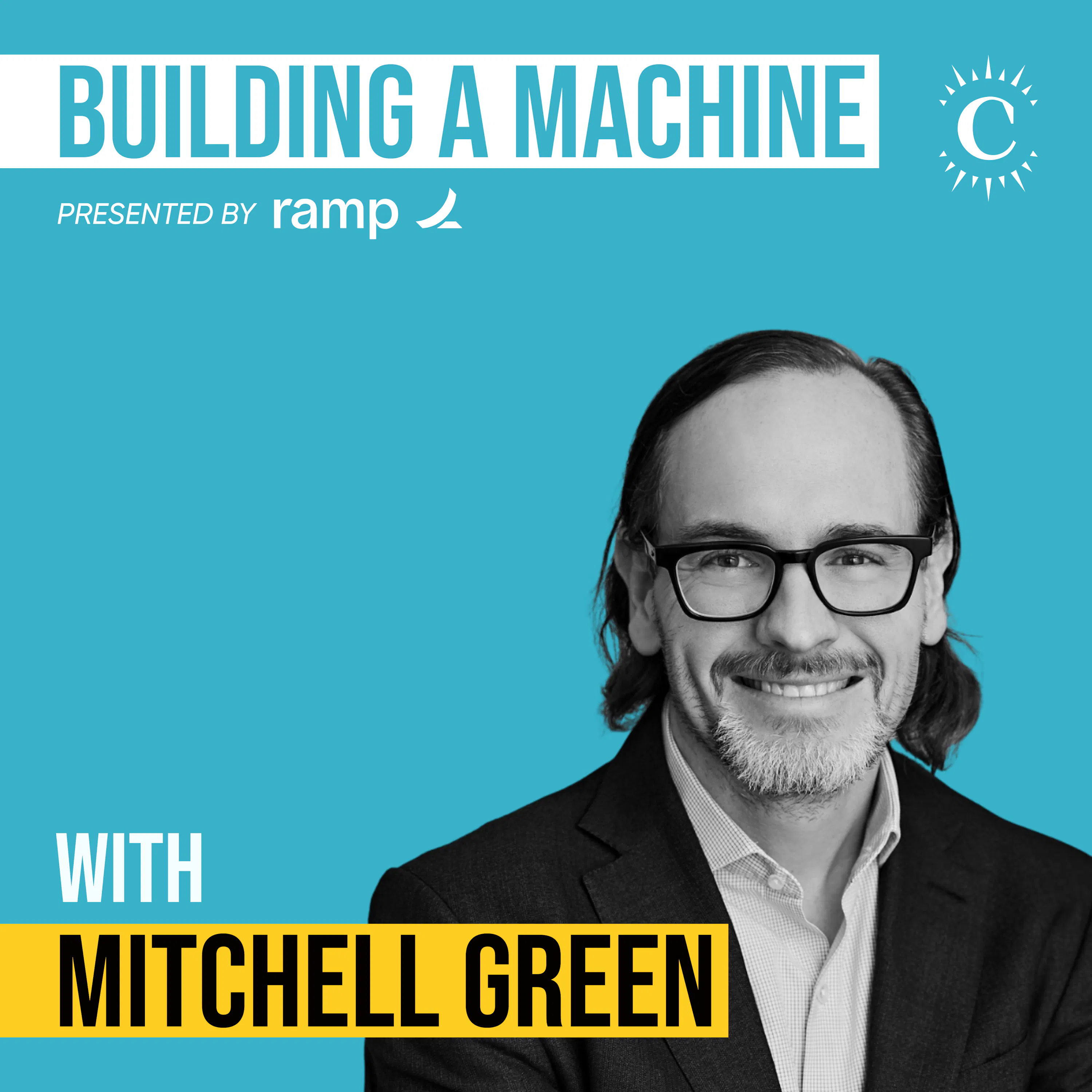
Mitchell Green - Lessons from Cold Calling 10,000 Companies
from Invest Like the Best with Patrick O'Shaughnessy
54m 22s
The transcription features promotional segments for business tools and an investment podcast interview. Ramp is highlighted as an AI-driven expense management platform that automates reviews to save time and reduce costs for companies. Work OS is presented as a solution offering essential enterprise capabilities through APIs, aiding AI firms in rapid scaling. Rogo AI is described as a finance-specific platform that integrates with internal data and workflows to generate professional-grade outputs like memos and spreadsheets.
The core of the transcription is an interview with Mitchell Greene, founder of Lead Edge Capital. He explains the firm's systematic approach to investing, which involves making thousands of cold calls to identify quality software companies using an eight-point criteria framework. A key differentiator is their limited partner (LP) base, composed largely of executives who assist with deal sourcing, due diligence, and post-investment support. The firm aims for consistent returns by focusing on "singles and doubles"—avoiding large losses and frequently taking liquidity through secondaries or IPOs—rather than chasing grand slams. This disciplined process, including active portfolio management and timely selling, is designed to achieve high LP retention and reliable fund performance.
Most software companies try to maximize your time on their app to juice engagement. Ramp does the exact opposite. Ramp understands that no one wants to spend hours chasing receipts, reviewing expense reports, and checking for policy violations. So they built their tools to give that time back, using AI to automate 85% of expense reviews with 99% accuracy. And since Ramp saves companies 5%, it's no wonder that Shopify runs on Ramp, Stripe runs on Ramp, and my business does too. To see what happens when you eliminate the busy work, check out ramp.com/invest. Open AI, cursor, andthropic perplexity and versel all have something in common. They all use work OS. And here's why. To achieve enterprise adoption at scale, you have to deliver on core capabilities like SSO, skim, RBAC, and audit logs. That's where Work OS comes in. Instead of spending months building these mission critical capabilities yourself, you can just use Work OS APIs to gain all of them on day zero. That's why so many of the top AI teams you hear about already run on Work OS. Work OS is the fastest way to become enterprise ready and stay focused on what matters most, your product. Visit Work OS.com to get started. Every investor should know about rogo, because rogo AI's platform is not just another generic chatbot. Instead, it was designed to support how Wall Street bankers and investors actually work from sourcing diligence and modeling to turning analysis into deliverables. For me, three key things differentiate rogo. First, it connects directly to your system, so it can work with your actual data. Second, it understands your workflows. How work really happens across a deal or an investment. And third, it runs end to end and produces real outputs the way the best people do. Auditable spreadsheets, investment memos, diligence materials, and slide decks that match your standards. This all comes from the fact that rogo is built by finance professionals for finance professionals. And it's already being adopted by some of the most demanding institutions in the world. To learn more, visit rogo.ai/invest. [MUSIC] Hello and welcome everyone. I'm Patrick Ochanasi, and this is Invest Like The Best. This show is an open-ended exploration of markets, ideas, stories, and strategies that will help you better invest both your time and your money. If you enjoy these conversations and want to go deeper, check out Colossus, our quarterly publication with in-depth profiles of the people shaping business and investing. You can find Colossus along with all of our podcasts at Colossus.com. [MUSIC] Patrick Ochanasi is the CEO of POSTIF-SUM. All opinions expressed by Patrick and podcast guests are solely their own opinions and do not reflect the opinion of POSTIF-SUM. This podcast is for informational purposes only and should not be relied upon as a basis for investment decisions. Clients of POSTIF-SUM may maintain positions in the securities discussed in this podcast. To learn more, visit psum.fc. [MUSIC] My guest today is Mitchell Greene, the founder of Lead Edge Capital. When I think about Lead Edge, I sort of think about this giant money machine that Mitchell and his two partners have designed over the last 15 plus years to make remarkably consistent investment returns for their clients. They have all sorts of unique aspects to the machine that they built, whether that's their collection of LPs, their eight-point criteria for how they select companies, the way they do cold calls, the way they construct their portfolio. This is just a totally different way of approaching markets. They're trying to hit singles and doubles and deliver very consistent returns. Mitchell says it's really important in life to be memorable. That's just a great simple thing that you can do. I think you'll find, listening to Mitchell today and him talk about his entire machine and the firm that he's built that he himself is extremely memorable. I hope you enjoy learning about his business. [MUSIC] So the first time that I heard about Lead Edge Capital was the very famous list of what companies report, starting with cash profits. And then if they don't have cash profits and you go down this very funny list. Hi, Arkiable Shit. And the bottom one is the place that's voted the best place to work in the city or something. Absolutely. Where did that list come from? Why did you put that together? We've always found that the best way to communicate with our audiences, which is entrepreneurs and also our LPs are clients of it actively. It's to write a quarter letter about a different topic. And I started my career cold calling companies and that's the way we store steals. But when you start your career talking to Brian and I probably spoke to like 10,000 companies. [LAUGH] And if you want to know it's a good company, just call 10,000. >> Call 10,000 of them? You'll figure out really quick, it's pretty good pattern recognition. Until our head up VR comms came in a few years ago, we had actually never posted any of these things online. We joked that we sent this letter to some people in the VC community. One of which is our buddy, the Intracean Horror Whits. And they posted a lot of for us. We just thought, I think it's a very simple way. Like in a world where people spout off total bullshit all the time. And you see everything in decks. This is just a good way to distill it. >> Talk to me about the 10,000 calls. What did you learn calling them in companies? >> You learn to be very disciplined actually. And you learn that most things are actually just noise. And to figure out what makes a lead edge company. And then try to ignore everything else. And you learn a lot about like responsiveness of people and more responsive CEOs, tend to be better CEOs. I think another thing you learn that's really important for young people. If you tell an entrepreneur that you're gonna actually do something, then actually do it. Well, I think that's actually true of like the life. There are so many people that say they'll do things that just never do them. And so if you're known as a firm and a person that actually does what you say you're gonna do, it goes a long way. So if you tell an entrepreneur, hey, I know somebody at Adobe, do you want an intro? It looks like it'll be helpful for your business. And then here she said I'd love to. Well then guess what, follow up with that. Do what you say you're gonna do. >> Can you describe what seems to me like I would call it a machine that is lead edge. Much more than most investment firms where a lot of great investors will tell you there's a lot of art. Everything's different. Lead edge feels to me like unbelievably well-constructive as a machine to produce returns. Before we go into all the component aspects of the machine, describe the machine itself at a high level before I got off on tangent. >> We run this place that gets a software company. My background was at Bessamor. I worked for somebody that was extremely disciplined. It was building the code client program. Part of Brian worked at Bessamor. We were the first two codecars and my partner in New May worked at Insight. And I think Insight, Jeff Warren, was on recently, was one of the best software investment or technology investment machines on the planet. So we've modeled ourselves on that to build a good investment firm that stands the test of time. If you want to go build the next TA associates or general lannic or Bessamor or Sequoia, you just have to be extremely rigorous. So our number one KPI that we run this place by is what is our gross dollar retention for LPs? We want 95% gross dollar retention because the only way you can get that is one, have good investment returns and great client services. So how do you, through long periods of time across people that will come and go, generate world-class returns? Did you need to have a process? And the process for us starts with 18, 22 to 24 year olds that talk to about 9,000 companies a year. You get those 9,000 companies. How do you figure out which ones to work on? So then you need this framework to guide these 18 people to like, well, it's going to be an interesting company because in the investment business, we have one asset. It's time and it's precious. And so how do you guide people to say no quick? And so we built this framework that we really took from coming out of Bessamor. And so they helped build the Bessamor 5. We took the Bessamor 5, turning it into the lead at J8. And it's like drives everything we do. Now, when we find the company, we're then super creative. We'll buy 10%, 80%, LPs out of a 20 year old fund by employees, secondary fund somebody, CV. We don't care. We'll do anything. If I think about the two sides being LPs and the companies that you invest in, I'll come back to the A criteria. The LPs story that you have is also quite distinct and different. Can you describe that in a lot of detail? Our LP-based is our world-class execs and entrepreneurs. But now we do have some big institutions, but 95% of our capital is all these world-class execs and entrepreneurs. And we use these LPs throughout the entire investment life cycle. It literally starts with it, for sources. If a company won't call us back, we'll email all the LPs too. But say it's like an automotive software company. We'll have Rick Wagner, the former CEO of GM, prove a long-term investor. We will send them to CEO and note. If you're like an automotive software CEO and the former CEO and General Motors college, they're way more likely to take an email than my, I mean, not go ahead email. And I'm a 22 year old email and I'm then for diligence. We'll say, hey, you're a healthcare software company. 25 million of revenue. Maybe you say, like biotech, pharmaceutical software. I say, oh, I see Pfizer's a customer. I'll pay you two million bucks. Could we be bigger? I'll be 10 million. I'll meet the former CEO. And then I'll call a BNR. He didn't be like, he ain't. Can you really talk to this company? They'd love to talk to you. But can you tell us what you think? And then if it's super interesting, can you call Pfizer and back channel it? And then you'll be able to say down to me, I don't see biogen the customer. Or you want to meet the former CEO, so you call them towards like, hey, I fund this company. I mean, it's a step in a very criteria. Then post investment. We literally send emails to our opus. They're like, hey, toast is looking for intros to these restaurants. Do you know anybody? And it turns out all these people invest in funds and never get asked around. That's how we do it and how we leverage it. But it's not actually why we did it. It would be a lot easier to go have 20 giant institutions, right? You have 50 to 300 million to our checks versus me spending a huge amount of my time running around the world all the time. It's pretty time with these people. Because if you want 95% retention, that's what you need to do. Because of your clients. The reason we did it is because I knew.
that the returns in this sector and the tech investing sector flow to the top 10% of funds. They just do. It probably is the same in real estate. It probably is the same as industrial buyouts, but like I knew in the venture world that it definitely flowed to that. And I had the pleasure of working from one of these firms, best for venture partners. So when I was starting Lee Edge, I was like, why in God's name is anybody going to take my money? I could teach him on a ski, but that didn't get any very helpful. But I said, you know what? Had I been the global head of HR at Proctering Amble and my partner been the global head of HR. Microsoft and the other one been the head of HR at Nike. When I called the work day 80 times at Bessamer and they just feel about the end was like, I'll hire you as a salesperson. I'm not taking your guys money. If I had been like a woke up HR exec, he would have engaged with me. He could have known that I could have entered these to those companies. Like I have tons of other HR execs. I know these people. In a world that's super crowded and undifferentiated. And I think it's exponentially the case more today, even than what it was 15 years ago. It just had like different chase us. And we do what we say we're going to do. How many LPs do you have? Probably like 800? 95% by number are these executives? Yeah. If you think about the level of returns versus the consistency of returns, how much does one matter versus the other for this 95% gross retention? I think consistency is more important. On a per deal basis, we're trying to make a two to five X and three to seven years. That's like a 25 net IRR. If you just actually map it on a curve. Put it into a fund. We want to generate it to two and a quarter X nets with 20 net IRRs. Some of those deals aren't got the five X's. Some of them might be 0.7 X's. Our downside has been very low. I think we've only lost all our money in one deal ever. And that's because of the kind of criteria we look for in a company. What our average company looks like. And the fact that for a few of our companies have any debt on them. Now, I'm trying to make it two to two and a quarter X net, which is more like a two and a half X gross. However, if something is a really big investment in the fund, and we do not run funds with like 100, 300 companies in them, we run funds with 20 investments in them. So if we've made something that's 7, 10, 12, 15% reposition, and that goes 8, 10, 12 X, that's how you can 3X net a fund. Yeah. And so because you really lose money, does that mean you also almost never hit some like giant grand slam? Correct. We're like Cal Reptif, those are troubles. We're not Sammy Sosa, Marlowe Glar. It's all about hitting doubles and troubles. And if you do that with very little leverage in the portfolio, 90% of our companies or 80% of our companies are like we're current revenue. So if you invest today and know what revenues are in July, I think a pretty good way to invest. 56% of our companies are like profitable businesses. You may get it wrong. You may back the wrong team. You may overestimate the size of the market. But I think 70% of the family on the preff, you're down to the 1X. Now, sometimes you need to be cut to deal with the entrepreneur or the managing team so you're making slightly less than that. But if you can avoid zeros in turn to zeros in like 0.8 X's or 0.1 X's, it massively helps return. We'll sell. Probably a third of our X's have been secondary. We will buy secondaries. We will also sell. We constantly underwrite. We've been referred to as traders for hedge fund guys. And we're like, no, no, we're just trying to actually make money because this company is about to be a living dead and you're going to be in this thing for the next decade. Maybe spend a minute before you go through the buy criteria. We're talking about selling more. What is the process that you run to be able to sell well? We have a divasper company. There's three of us. By self-finity, Ben here also. It's fun one. Yeah, but disposition. We think a lot of firms do a really, really good job on the buy. Very, very few firms do a very good job on the sell. Knowing when to sell, pressuring to sell. I would tell you that the private equity fund tend to do a much better job on the sell than most venture girls. The hedge funds that you do most public activities are long only funds. You constantly can buy in self. The three of us need one to 20 or months and just walk through the portfolio and just talk about it. Like, hey, this is a round going down in this company. Should we sell? How can we try to position this company for a sale over the next 12 months? The fastest way to get fired at lead edge is have a company and not tell us when there's a liquidity opportunity or just something's about to happen before it happens. What is the holding career end of being on average then? I bet our average holds are three and a half to four years probably. Everybody gets all excited by these 2015, 2016, 2017, 2018, 2018 returns. Like, our 15 and 18 returns look very good. But it's just multiple expansion. We sold. That's it. If you think you're going to make a two acts in four years and you make a four acts in two years, it's amazing. It does that I are. People forget the reverse happened in 2021. Nobody's 20 and 21 funds. I think the venture grows ecosystem gets a bad rap, but it's going to be every alternative asset. Their 20 and 21 funds are going to be awful relative to earlier funds because people thought they are going to make a four acts in two years and are instead making a 1.6 acts in eight years. And so that's going to drive that's going to have a huge impact on industry. What is the most interesting thing about the skill of selling and making the transaction happen? Like, presumably it's easiest to sell in private markets when a lot of other people are really excited about buying. You can't just hit sell like in public markets. Maybe in like a bad medium good, there's different kinds of outcomes that you'd be selling into. Or most of your sales into everyone else is excited and you're less excited. It can be everything in between. Like, if a company goes public, it's just eight or two to five acts in three to seven years. And then sell. So you're like the company goes public. You're at like a 3.3 acts in 18 months or 24 months. They're like that annihilate a 12% or 20% that RR. It's a great company. But we constantly are underwriting like what's a forward net return from here. We made like a 3X in 18 months. That's like an IPO. In a secondary sale, it's about underwriting the 4R in toast, which is one of our biggest investments, which we put like 12% of our fund 3N2. And we'd always get crab. Our fund 3 was like a 290 million, our fund. And we put like 36 million bucks into it. And before the IPO, we had sold 180 million bucks. We make 3.5 to 400 in a total. People like, "Why are you selling? You don't believe in us?" We're like, "No, no. All these other knuckleheads that invested alongside us, no, no, them for 12% of our fund in it." And by the way, somebody is paying us a price in the secondary markets that we think is just lunacy. We sold like in the secondary markets at like 40 or 50 bucks in toast. The stock today is 30 bucks. We think it's cheap, but it's just finally, we sold like six years ago. And so it's constantly underwriting forward. As your business scales up, everything gets more complex, especially your compliance and security needs. With so many tools offering band-aids and patches, it's unfortunately far too easy for something to slip through the cracks. Fortunately, Vanta is a powerful tool designed to simplify and automate your security work and deliver a single source of truth for compliance and risk. There's a reason that ramp, cursor, and snowflake all use Vanta. It frees them to focus on building amazing differentiated products. Knowing that compliance and security are under control. Learn more at vanta.com/invest. I know firsthand how complex the tech stack is for asset management firms. And seemingly every new tool and data source makes the problem even worse, adding more complexity, more headcount, and more risk. Ridgeline offers a better way forward. One unified platform that automates away the complexity across portfolio accounting, reconciliation, reporting, trading, compliance, and more all at scale. Ridgeline is revolutionizing investment management, helping ambitious firm scale faster, operates smarter, and stay ahead of the curve. See what Ridgeline can unlock for your firm. Schedule a demo at ridgeline.ai. Okay, now I get to talk about the eight buying criteria. I don't know if you want to take them off or give us some highlights or some highlights. So there's eight criteria. 10 million plus in revenue. Why do you have like product market fit? Are you growing? Because we don't have some startups. I grew on like 25% a year. Returns to gross. We don't use leverage. We have 70% plus gross margins. Why? Because at the end of the day, you trade on multiples runings. Revenue multiples are just short-hand math for what it will be even that multiples or earnings multiples when you don't grow that fast. There's a reason that Facebook gives away electronics and the vendee machines and Dell charges for coax. It's like one has 80% gross margins and one has 15% gross margins. And we think that just drives the benefit of the earnings. Are you occurring? It's like a lot easier to invest knowing what revenues will be in July than they are today. Are you capital efficient? This metric is probably kept us out of the most trouble. It's like our version of return on equity. I think it's more about the within gradients, but are your revenues today greater than your historical cash burn? So what under that? There's 20 revenue. Have you burned to 80? Like every other company? Curatively. Yeah. Have you burned 80 since inception? Or have you burned 10 since inception? We're looking for like this one-to-one ratio. In a world where capital is a commodity and capital is everywhere. If you can build a business that's growing nicely while burning less than your revenues, you've got a pretty good business. That we don't have startups. If investment startups are 2 million revenue companies, then obviously it's harder. Are you profitable at the bottom line? Do you have any customer concentration? I just don't want to wake up and find out 40% of my revenues disappeared because some customer decided they don't want to work with you. I want to talk about the price you're willing to pay for companies and how you would plot yourself on the so much of this sounds like a private equity strategy, but you mentioned toast and it's not like the high growth rate. Toast was 25 million.
of revenue going 150% a year and it was paid like five in a row. It was like 20 times revenue. People were like, that's crazy. Not when it went from 10 to 25. So we just tried to build a forward model and you're like, look, you can pay as high as prices you want. You just got to be right on your excess. You got to be right on your multiple. How people got a bunch of trouble in 2020 and 21. I think how they're going to get in trouble today and all this AI stuff is they just assume the exit multiple is 20 to 25 times. That's insanity. Building your maximum multiple collapses. Now, so you can pay 20 to 25 times revenues. And if you're right, like some of our companies have been, then it's fantastic. But you can also be wrong. Like some of our companies have been and you look like an idiot. I think investing in opening our billions a little insane personally. But like, I don't know if it goes on to do a trillion dollars of earnings, yeah, I was going to be very wrong. I actually invested just almost like shorthand or if you're like, if this company grows and doesn't decel much for 18 months, am I in the money and can I make a decent return for what I'm paying? And if the answer is all might even in the money in 18 months or 24 months, yeah, you're paying my due address. So right now there's this seismic thing. You can look at the constellation and the constellation software stock price or something as the perfect visual indicator of what's been going on, which is it's like a ski slope. This intense skepticism of the market that boring traditional high-grace margin software businesses are worth like much at all. But I'm curious how you process this moment where I'm sure a lot of the companies you're looking at are software companies that have a lot of the components that make people fearful of the simple kinds of companies in public markets. Our belief for right or wrong is that the competitive advantage of software company has never been about R&D. We're not built in semiconductor chips. We're not building biotech in pharma companies. This isn't that it's to build like Chamber of Commerce software. You too could build this. My mother couldn't but my brother could. No problem. It was an engineer. My future Microsoft. Any of our companies in our portfolio, if Microsoft took 500 people and gave them a month, each of our companies could be out of business. But they just don't care a lot about the Chamber of Commerce market. They don't care about the price optimization market for manufacturing companies. They don't care about the tax, the tax software market for a very specific niche product. So for software companies, I really about like distribution sales and marketing. Customer success, client services. We believe that it is the incumbent game to lose in software today. I'll give you a couple of examples. Workday has like 98 or 99% gross dollar attention. It grows 10, 15% here. Oh, it only goes 10% here. I'm sorry. It's like 10 billion of revenue. It only took like 20 years to get there and it does like 3 billion of cash flow. Exxon or your hospital system or Warroof Pincas or KKR or Procter & Gamble. Probably spent three to five years implementing the software. If you think they're going to like start building their own HR software, you're on your mind. Now, the GUI and how you access it is going to be far different. But actually, they already have the customer relationships. And the only reason they built it is because they built a field and they knew it was 20 years ago. That Oracle and SAP had really crappy products. They have thousands of engineers that are trying to build the product much better. And they're going to use Workday versus Mitchell Green's cousin vibe coding his way to build the Workday. The flip side, why did Cooper get built? And the reason that it was able to be built is SAP bought a Reba. They just left it for debt. So they built this big business. They took it all work. And now it's been sold to Tomoravo. So what I actually worry about, Tomoravo or any of these big product funds, is they're putting a bunch of debt on it. It's not growing that fast anymore. If they're putting a bunch of debt on it and then what they do is they buy. They're like, oh, yeah, we drive all our companies to like rule of 50 businesses. Now, do they end up cutting a bunch of people in R&D and sales and marketing and product that if you were being run by an entrepreneur with no leverage, you would have capped. And now I worry that a bunch of these private equity owned assets that are over levered are right for disruption versus independent software companies that are focused on growth that are trying to innovate. And I like to remind people that if you look at e-commerce at 99 and 2000, everybody thought every big box retail was going out of business. But if you look at the top 50 largest e-commerce companies in the United States, Amazon is number one. Two through ten are Walmart, Home Depot, Bloes, Macy's, Target, I mean, Sacks is a crappy company. Their online business is actually pretty good. And even Marcus, same thing. A lot of the incremental win. Now again, Montgomery Ward came our shares with us for either like over levered, didn't innovate. So for us, that's what we're constantly thinking about. Does that mean that right now feels like an especially opportune time for your style because entry multiples are I think the best grist suggested returns right now are in public software names. Byway, Warren Buffett's that's by when everybody is free of all the streets. Yeah, in cell when everybody super excited, people hate software. When we bought a bunch of our bite dance stock two years ago when everybody hated China, when Ali Baba's doubled off its lows and doesn't grow and trades it 15 times earnings. If you think about the CV, the very specialist type buys that you'll do, can you explain an example of one of those? We like to use the house analogy. You walk down the street, go into apartment building. My apartment needs to have these six things. You can go in the front door and you can lead the primary round and put money in the balance sheet where you can buy the whole business. You can go in the side door and buy an early investor, our early employee, but maybe that's not available. So we'll go through the basement window with a pickaxe and buy the cage derivative. Because if you run a business and this can't have Pepsi on to 30% of your business, and I go to the glass that is an investor and the can of Pepsi's fun. And that is really half the LPs and I literally buy that out and you own 30% and I buy half the fund. I just bought 15% of your company. It's the same thing. It's just the derivative. Do you have as much control? No. Do you have as much insight? No, but you trade off price for access. We made a big investment in Zoom. So we couldn't go into the front door. The company didn't have money. We sure as heck weren't buying the entire business. You couldn't buy secondary. They were seconded to buy. You couldn't buy it because Sequoia would roll for you. They're smart. They're not dumb. They're like, why would we have to use knuckleheads and we'll fake the stock and make two or three times our money. And the company was one that took a long time to get funded and wasn't backed by Sequoia. They wanted the stock for rent from Chinese people and Chinese funds. It was actually seconded to buy. But you couldn't because they're over. So we're like, huh. Why don't we go to this fund that has stock? Their LPs have been in this thing for 10 years. Maybe their LPs want to sell. And we can do it one of two ways. We'll just buy your position on the fund and we'll know exactly how much we'll know exactly how much Zoom we have to do it. Or, why don't you create like a new vehicle? Any LPs that wants to sell will stop into their shoes. Well, if you own two percent of Zoom and half the LPs want to sell and I then's kept in those shoes, I'd have only one percent of Zoom. And if I say to you, listen, we get to vote them like we own them. Be used to hold it. The company gets an M&A offer and you get to vote. You have to call us. They won 81 of the IPO after lock up. You got to give us the stock. We just bought the position in a world where LPs and GPs are desperate for liquidity. That part of our business is absolutely booming. And that part of our business is headed by Tim Pima with Smell of Partners, who was actually a Notre Dame alum as well. If I think about the dollars deployed last year over the next year, how much of it is direct capital on a balance sheet, secondaries, something creative like what you just described. 70% creative on the balance sheet. 70% is special sets or like segment. We will evaluate in an IC a public position, a control buyout, a minority deal or a special set. You can get four different things in one week and literally we underrate the same return. But today the opportunity is in we are a market drawdown away from an exploding and plan value. I like exploding. It's up to you. The hard part it seems like is finding a company that has six of the eight criteria that you can also buy it a multiple that you're excited about for the forward return. What percent of companies of the 9000 or whatever meet all eight criteria? Well, no correlation, how informed Cedar, if we do like an eight criteria deal, first like a five criteria deal, there's actually no correlation to like it was a better deal. What about like four or three? We've never looked at what we try to do is if you say it must meet eight criteria, 9000 companies becomes 90. Okay. To do five or seven deals a year, it just doesn't work. And so for us what we say is it just like must meet five that's about a 10% yield. We're trying to get to a set of companies that we can then actually do work on. So you have nine hundred companies that meet five or more criteria. These are diligence on about 150 to 175 to do five to seven deals a year and you're like, well, not more. I'd love to, but like we're calling entrepreneurs. They're like, oh, I'm sorry. I want to sell my business tomorrow. You just happen to call me on this day. No, the sales cycle is going to be a decade. And it's about staying in touches entrepreneur because we're not dealing with it's calling them. There's great firms like Summit or TA or Insider, you know, Bessimer or Battery and they're great firms. And so it's like, well, ask the entrepreneur how do they need help? Title keys information out of them. All you sell into like the consumer space. When I meet the former CEO, Collie Pomalov, and you're doing that to tell you build a relationship with somebody. If five criteria companies don't outperform eight criteria companies, it doesn't imply the criteria are predictive. So then why have your criteria? Because you need to set a framework for what to focus on and what not to focus on. So they're not predictive. It's not predictive, but it's getting us to a small enough pool. It's like knowing your strike zone by partner with a big baseball fan that uses a baseball analogy. Like 10 Williams knew in the hitting zone exactly where to swing and what his probability is for it. Swinging the ball like, yes, you can hit a ball two inches above home plate. And it could be a grand slam and it's hit the ball the far as you've ever hit it. But if you do that over an entire career, your entire career won't be very long. And so it just enables us to know like what pitches to swing at. Our biggest mistakes have honestly been not swinging at the pitches when they were
in our strike zone. And I think that's what we've learned over the last 15 years to get more comfortable and like when it's in our strike zone, swing at it. How do you train these young people to be able to get all this information to know whether or not it's an eight point score or whatever out of an entrepreneur? What is the art of getting someone on the phone and then actually getting them to tell you the information that you need? It is incredible what people will tell you on the phone. People are like listen, you just like call people and they talk, people love to talk. It's investigative journalism with sales. We tend to hire people that are former athletes. But like getting a C or a D on a test is not your biggest failure. Dropping the ball at the rose ball or not making the Olympic team, that's failure. And so you're looking for people that are insanely persistent. People are really inquisitive. And then it's just hey, Patrick, pretend you're toast. We're doing work on the restaurant point of sale system space. I read a bunch of articles. Sounds like you kick them by. Oh, by the way, I just talk to like square and clover and set a couple that we love to talk to you on the phone. And oh, by the way, I'm sure you're getting bombarded by other people, but we're different than a lot of firms. A lot of our capital comes from world class execs. Oh, by the way, one of our LPs, the former CEO Wendy's, we'd be happy to let talk to them if you don't make these people. Huh, sure, love to chat. By the way, we used to get the cold call people. I'm Brian and I and you never doing this literally cold call people and you feel like you feel like the person you call to get 6 p.m. 20 years ago that you're like slam the phone down on. Today, it's like, look, I think you guys get to send emails to people. We get a break. We actually try to now encourage some of the analysts to start calling people. The biggest issue is it's hard to get people cell phone numbers versus four phones. And it's just once you get the person on the phone, you just have to show knowledge. That's where, by the way, AI is incredible. It's like you give every analyst and associate. You give them the power of knowledge and you can sound super smart and you won't get everything. It's like, Hey, just on the game, you have like 80 employees. So what do you like 10 million revenue, 15 million revenue? Oh, I see like your employee cross go on like 80% a year. What do you grow on like 150% and not that fast. Oh, what like 100% yeah, around there. So it's trying to get numbers. If you think about this machine. So we've got this very unique LP base. We do 9,000 calls, five to seven investments per year. We just raised our seven. It's fine. It was three and a half. Okay. So three and a half billion are fun. Two to two and a half percent net moicies to your investors. So that's the machine. Where do you feel the most tempted to go tinker on the machine for the next decade? How do you hope the machine improves? As the firm gets bigger, how do you build a culture of pinching people to still be creative, this crappy hustler. But it's the most important thing. How do we get creative and do CVs? We were doing CVs. We nobody wanted to do CVs. We didn't really recall CVs. We just thought it was paying somebody a profit share. It's continuing to innovate on that. What's really interesting is the secondary market now for some of these names are so liquid. So actually, almost don't you have to underwrite to this thing going public. It's like, can it just get big enough with an office capability where I can then sell out? If you think about all the investments you made the last five years or something, how often are you personally excited about the company and its product? Frankly, this is what drives me nuts about a lot of people in the venture capital ecosystem is they think they're actually changing the world, the which they are. But they should tell everybody about it and they're like doing God's greatest gift to mankind. We don't think that. We love helping entrepreneurs. That is actually what gets me excited and gets us up in the morning. Helping an entrepreneur try to bend the curve and make that customer intro and help find that great CFO, the audit share or whatever. We love making customer intro. That's what gets us the most excited and I think we are still actually just scratching the surface on how we can leverage our obvious. How often do you control the business? We are in a control position about a third of the time. When that's the case, how different is that? It hopefully should be no different at all. But there's less knockout throughout the table. There's less people around the table and what's really interesting is when you have a lot of different people on the table, you can have a lot of different competing interests and so it's about building consensus and you care people that are in one cost. That's right, there's all these 20 and 20 and 21 companies have it so there's these late stage guys that are like, "Oh, just get me out. I'll make a one-axe today or I'll make a one-axe at a decade." But we don't go into companies and say we're replacing the international. This is not what we do. When we invest in a business and when we exit, it's something like 75% of the time, the person who was running the business when we invest is still involved in the company. It may not be running it, but it's like back people who just want to build awesome businesses and great companies and it gets like us. If I'm not the right CEO, well, make me the chairman of the board or make me the chief customer officer or make me a chief product officer or whatever, that's what's really important. I want to go back to the culture thing, the lead edge culture I mean. What have you learned about culture in the many years now that you've been doing this, especially given this is the thing that you want to keep nurturing? I didn't think I appreciated how much culture comes from the top. Follow-ups. Send handwritten thank you notes. I've sent handwritten thank you guys to everybody. Almost everybody. Every entrepreneur, every company. Guests who also does now, to 22-year-old analyst. Have I let we track it and report on it. If you just treat people the way you want to be treated, that just flows. We've built a culture of treat LPs like you yourself want to be treated. People appreciate that and it comes from the top. The intellectual honesty comes from my partner Neemay. A lot of the creativity comes from my partner Brian. Now of course, as you get to be in the 85-90 people at a firm, we've built like a real training program, which is a result of a lot of work Neemay and Brian and our COO, Susie's done and that team and the recruiting team. We didn't have weekly IC meetings before three or four years ago. Why? Because IC was the real us. We talk every day. And so it's just like building processes in place. Can you talk about this crazy one-on-one thing you do with every employee? I got the idea from Tom Barnes at ExcelkaCare. He's built a true machine. ExcelkaCare. I asked him, what do you think something you do that really helps the firm? He's like interview everybody once a year. So we start with like a survey and then he sit down with every employee. You personally do. I personally do. Sit down with every other partner, every VP, every associate, the accounting person on the back end, every receptionist and Bill, I, but what do you like about your job? First, give me everything you do. Green, red, yellow. Green you love, red you hate. Let's figure out what you hate and why. And if there's things you hate, well then let's figure out other people that may be able to do it. Or how can we make your job easier? Okay, that's the first bucket. Second bucket. If you were me running lead edge, what would you change? Three, what's something we can do to make your job easier? What you learn is in class. You get a bunch of really good ideas every year. They actually drive my two partners nuts because sometimes I'm like, that's amazing. Do it. And then they're like, come on, we need to have Bill consensus. I'm like, no, we don't need to build consensus on some of these things. Is there anything else that you do in the culture that you feel carries that much freight? Being good person is not that hard, frankly, in a world that's insanely competitive. If being the nice guy gets you the call back and being the helpful person, then do it all day long. And then it's another really important thing about running this place is I can't be the bottle. I can't know every LP. And so like if you're a 25 year old or 23 year old associate here, and you have to go to Seattle next weekend for a wedding, I'll pay your trip. If you stay on Monday and go meet a bunch of LPs, but you're 23 years old, 99% of firms in this plant wouldn't put 23 rows in front of LPs. I'm like, if you're smart enough to work here, you're smart enough to meet this LP. I don't care. And people love that. The 23 year old associate's love it, which helps us get great people, but then also the LP loves it too. Because no, my son is your age. He was you might talking to him or a, you went to Notre Dame. Oh, my son plays the cross. There's like thinking of going there. Would you talk to him? And be like, Oh, actually, I'll talk to my partner, Tim because he played Notre Dame across. You just build real relationships with people. If you think about the average month for you and the major slices of the pie are time with LPs, time with companies, I'm so curious. It's actually kind of hard to guess. Maybe there's different buckets than those three LPs companies in the best, most internal. What does yours look like? And mine's by the way, very different than Brian and EMS. This is by design. That was a little bit was fundraising, obviously. I probably spend 60% of my time with LPs. Wow. And now again, that could be getting somebody to help accompany, though, too. Or coordinating with the team of people with us like, a, let's figure out a way to get into X on. And then I would say 25, 30% of my time is investing related, which could be reading memos, helping people win deals. That's frankly how I want to help. I'm like, we lose a deal because I didn't meet the company. I might say I can help as when, but we got to least put our best switch forward. And then probably 15, 20% of the operational operations steps come down because one of our partners, Susie, who lives in Greenwich, used to be an investment partner a few years ago, she became RCOL. So that's like my time. Neemay probably spends 90% of his time investing 10% of his time and everything else, which was pretty sure do I'm running the IC. Our partner Brian probably spends 60% of his time investing and probably 2020 on LPs and operations. It's very clear to people that spend time with Brian Neemay that we like play to our strengths and weaknesses. You mentioned Tom Barnes as someone that you've learned from. If you had to like create a rush more of other investment machines that you most respect, who is the rush more insight TA and probably Excel. Okay, yeah. I think Devon, Jeff, Tripway, the guy, Alieberman, I didn't say I have just built like a factory. You know how you know what this offer company is? First look at 30,000 companies a year. It's an absolute factory. It's a process. And so I think they're like amazing at it.
TAs when the pioneer cold calling insights obviously saved to do itself. I would guess insights growth rate and their profile within 2001 and today is actually pretty similar. TAs has definitely come down. They're more private equity life, discipline and process. I could get the sense that TAs where I get it selling to. And then it's up to secure has built like an incredible value creation here. And I think actually as a lot of I think there's a lot to talk about. I talk about value creation. I don't do much, but I get the sense that these guys are like very good at actually helping companies and trying to bend the needle. What if we missed about what makes the machine tick that you think is really important? I would have said that the three of us who run the machine are all very very different and we play to our strengths. And I don't think that should be underestimated. And I think that's what makes the machine like we literally negotiate carry economics. For the three of us in 10 minutes. Either firms you hear about getting the month long fight to over carry. We all highly respect each other and know what we're each really good at. Just a focus on intellectual honesty that I think a lot of firms just don't have like if you go to our investment. Our investment committee is the three of us. Everybody that's basically be paid off gets to come. But if you're sitting the room and listen to Brian and you may I talk about it deal. You would think the three of us hate each other or you might think we're really because it's just a joke and talk about it. If you listen to like Israeli board meeting from the outside, you're like these people are hate each other. Like how do they like that? No, that's how they talk. So it's like no, it's like let's debate the merits of this deal. Your finance team isn't losing money on big mistakes. It's leaking through a thousand tiny decisions nobody's watching. Ramp puts guard rails on spending before it happens. Real-time limits automatic rules zero firefighting. Try it at ramp.com/invest. As your business grows, Vanta scales with you automating compliance and giving you a single source of truth for security and risk. Every investment firm is unique and generic AI doesn't understand your process. Rogo does. It's an AI platform built specifically for Wall Street connected to your data, understanding your process and producing real outputs. Check them out at rogo.ai/invest. The best AI and software companies from open AI to cursor to perplexity use work OS to become enterprise ready overnight, not in months. Visit workOS.com to skip the unglamorous infrastructure work and focus on your product. Rigline is redefining asset management technology as a true partner, not just a software vendor. They've helped firms 5x in scale enabling faster growth, smarter operations and a competitive edge. Visit ridgelineapps.com to see what they can unlock for your firm. We riff a little bit more on just all the ways that you're excited and fearful about AI both in the investment process, at lead edge for running lead edge the business and for the companies that you invest in. I'm the most fearful for what I don't know. AI is going to change the world and it's going to do it in ways that nobody can think about just like the internet did. In 2009-1990-1990 we guess that here we would have mentioned social media today it's three trillion dollars of value now I'm the most fearful whether it comes to companies and processes for that is like what don't we know what are we missing what am I the most excited about for us. AI in the long term will create the biggest productivity game of the last 75 hundred years. It's going to be like electricity but like pretty damn close that's really excited. People get too excited about we're going to go like build the next season work day or we're going to build better calls for their software. You're going to see industries that we're not even thinking about if they're thinking about what's going to be possible is going to happen that's really exciting. It's going to be the age of entrepreneurism people are going to build awesome businesses. Whether it's internally a lead edge or at our portfolio companies is do we have the right people in place so that we don't get disrupted because you constantly want to I joke you want to hire a bunch of young people. The people we're up with young people I get all the fine jobs is like really young people are the ones going to figure out AI more than the 60 year old or 55 year old and so it's actually rank we take all over for a couple of companies and we're saying what's your AI readiness score. And then it's okay this company's like really high this company is pretty low on we should connect those entrepreneurs together to figure out what they're doing what goes into that score. What's your data look like is it structured in a way that you're going to build a leverage AI are you iterating how many AI products have you come out with what's your AI revenues on new products how much more product releases are you able to release. It's not did your engineering comp stay flat or go down I for one strongly believe that if you think in 2020 if your budget in 2024 for 20 to 26 what's have 150 software engineers you should still have 150 software engineers because those software engineers can be exponentially more productive and they can then create more products that your sales team can then go so. Who do you compete with we would be against insight ftv jm i battery best emers when they do like bootstrapped is stripe stuff sometimes we compete against merit tech and IP and rock and chip companies and still come back freaking awesome I've just not paid 100 times for this for. The problem right now there's like too much money maccola set it best it's like they back these giant internet companies when distribution was loose and capital is tight it's like the first happened so capitals everywhere for like four companies control distribution so good luck going to build a giant internet company and right now there's just too much money chasing at least and so I got value do feel great things so decomposing expand on that a little bit so I guess the question is your view on the state of markets and technology markets in general. Overhyped overfraught and I believe this AI cap X bubble went badly it's like the telecom bubble all over again it will be very interesting if apple may look like the really smart one at all this a day we've seen it but I think people are just going to over spend I'm convinced that people invest in all these AI come on you always do see it's like has to portray the view that software is going to be dead because they have to justify how much money they're going to spend if you start to run these assumptions on like how much money is going into these companies and what that is. How much power you need to generate it just doesn't work where the nuclear power plants come up and it like just doesn't work that presents the opportunity that's when you're going to buy it that's when you're going to buy these companies the counter argument would be in telecom those all dark fiber in AI it's all burning GPUs and yes the cap is just crazy but everything still feels mega under supplied I'm just curious how you think about when the opportunities will present itself for an industrial. Yeah my fundamental belief is that the models will commoditize and that companies like Google and Facebook and Amazon and Apple have a competitive cost advantage comes like Amazon and Microsoft and Google have more data to train a model then to these new model companies will ever have and then all by the way if you are all these Chinese models or European models a bunch of these things cost a fraction of the cost to run and you can run them locally especially companies outside the US like why would you pay. That amount for open AI tokens or fan topic developments when you can just run deep seek or one of these other 10 models I think we were the most about realization I have no clue when this will stop it will probably go longer than people think in 99 and 2000 people also thought we were in a bubble people in bubble now and it will just stop is it one of these monster IPO is happening and it just doesn't go like people think it does I think the anthropocryl was kind of like an IPO we're trying to hit doubles and triples a lot of these companies we struggle with you they're going to be 200 access or 100 access or zero that's the sort of force. What kind of company in the AI center of the heat map I know you're probably not investing in any of them because the multiples or whatever. What kinds of companies and most interesting to you just as a enthusiast I think it's fascinating some of the stuff that's being done in infrastructure software and actually agents appear to consume more resources and actually people some of these consumption based models the growth of companies like dumb luck we were very early investors and click house which is database company we were early investors and graphonal apps infrastructure company that completes the like data I think data docs were like high 20s 30% a year at scale it's those types of companies that we fancy very interesting I find them fascinating I really struggle with the violations but the growth rates are like we've never seen it with very good economics you see how much money a company like click house has raised what they've burned is very little compared to what you might otherwise right. What do you think is the most surprising thing about you the good sense of you how you operate persistence enthusiasm energy process what do you think if I spent 10 hours with you I would be most surprised about. Probably I'll driven I am and how much I truly love what I do and like I just put my heart and soul and everything I do whether it's like racing cars which I race cars competitively of the national ranks eraser or all I want to eat it's like I would probably see five or just like four or something it's because I love what I do. I'm insanely competitive if you spent an hour to be like oh my god this guy is the most persistent competitive person I've ever met or you born that way yeah I think it was born that way was enhanced through formative early experience ski racing skiing growing up as a kid 100%. You make that tangible for us like what was it like process do these things and you'll get better do these things on video energy as course and constantly analyze video and do these things the next run and change this and you fell get up and go do it 10 more times I grew up on a ski hill with 500 feet I mean Lindsay Vaughn the best skiers in the world she grew up skiing on 500 feet Buck Hill in Minnesota and doing laps from 4 p.m. to 10 p.m. at night just repetitive. I'm a Kayla Schifrin is one of the best female skiers in the world use it as her time on snow is like limited when you get off the chairlift everything is a drill constantly be trying to improve I think that's it. I think that's what you would find in me is constantly trying to prove what surprised me the most actually if you had to say like huh.
You started the firm 15, 20 years ago. I think I've been able to recruit and maintain, motivate, and build a really good team. I mean, very good to pick really good partners that treat other people really well, and that feeds on itself. Is there anything else from skiing? I'm not a skier. That you find this role and helpful as an analogy for how to do things elsewhere other than reps and practice. Scott Booth, who ran Eastern. I asked him why he hired me, and this was early '08. He said to me, "Because when things get scary, you're going to want to buy." And I didn't know what he meant. Because he's like, "You're going to hold 80 miles an hour." This isn't scary. It's like nothing. You're like, "You can make a decision to go in down the hill and 80 miles an hour and what to do and what not to do and not to fall." Then the fall of the way to happen. Look, this isn't scary. Let's find. It's eventually going to go up. Skierace and helped me really understand a very fine line and risk adjusted and risk return. I just think being an athlete, whether you play basketball, whether you play hockey, whether you play golf, I think athletes just have a work ethic. If you're trying to find it in young people and have a drive, there are athletes that have incredible athleticism, but also have incredible work ethic like Michael Jordan. Those are the best of the best. Then you have people like Steve Kerr, who are not very good athletically, but had a work ethic of Michael Jordan. They could be good. But then you have a wasted talent, which is like Zana Schradman's the world. They were amazing athletes, but they didn't have a drive. I think the same can apply to investing. Why did you choose to start the firm because you were quite young when you did it? How did you translate that experience into advice for someone listening that is thinking about starting a fun to decide whether or not they should do it? Do you want to be an entrepreneur? Do my boarder Brian's like, "You need to start a firm, because nobody was not like, "How are you, ask?" and because you couldn't work for anybody. I've always wanted to be an entrepreneur. I wanted to make a lot of money and be really, really successful. It's always stripping me. I always wanted to be solely focused on it. If you want to generate generation of wealth or build something, you need to be an entrepreneur. Yes, if we build Blackstone, everybody who is here will make an insane amount of money, because it was 90 people. One of my partners, Zach, is very young. I mean, he's 30 years old. He's a partner. He joined here and he took a bet when the firm was tiny. I just encourage people, if you want to do it your own way, there's no better time than now. What are you waiting for? I actually think it's easier to leave when you're 27, 25, than when you're 45 and have three kids. I had nothing to lose. If it failed, I was going to just go work, I guess I guess it works, right? Once you made lots of money, do you still care? 100%. Why? Keep scoring every day. Because it's score? It's a score because I want to win. People like Ken Griffin and Steve Cohen are like mentors to help ease the bars. It's incredible how hard those people work. Now, we've got maybe these are NF2 people, or if you look at somebody's tech entrepreneurs, like An Elon Musk or Alex Carr from Palantir or Matt Prince from Clubflare or George Kurtz from Grudstrike, these people are incredibly driven, hardworking people that live in breeze what they do. I mean, people keep score. It's not work for me. This is fun. I travel constantly to meet companies, to meet LPs, to meet entrepreneurs, to meet bankers, and it's not work. It's fun. It's helped people my schedule and they cry. Oh my god, it's not work. It's fun. It's pretty amazing what you've built, a very unique model, incredibly fun. Well, you are to just walk us through it all. That's so much fun doing this. But now I do these interviews as everyone the same closing question. What's the kindest thing that anyone's ever done for you? Pete Wilmot, he's passed away. Was the former CEO of FedEx and he was a Williams alum. I started a company in college and he was the first person that ever believed me. I was 19 years old and he became an investor with us. And the company completely failed. When I was trying to get my first jobs, when he got my job at Best of Merit, he was my reference and he basically told the person they were insane if they did that early because I was the most persistent person he never met. So that's probably the kindest thing I was ever done. I learned so much today about building something unique. Thanks so much for your time. Cool. Thanks so much, Emile. If you enjoyed this episode, visit Colossus.com. You'll find every episode of this podcast complete with hand out of the transcripts. You can also subscribe to Colossus, our quarterly print, digital and private audio publication, featuring in-depth profiles of the founders, investors and companies that we admire most. Learn more at Colossus.com/subscribe. [Music] Your finance team isn't losing money on big mistakes. Real-time limits, automatic rules, zero firefighting. As your business grows, Vanta scales with you. Automating compliance and giving you a single source of truth for security and risk. Ridgeline is redefining asset management technology as a true partner, not just a software vendor. They've helped firms 5X in scale, enabling faster growth, smarter operations and a competitive edge. Visit Ridgelineafs.com to see what they can unlock for your firm. Rogo does. The best AI and software companies from open AI to cursor to perplexity use WorkOS to become enterprise-ready overnight, not in months. Visit workOS.com to skip the unglamorous infrastructure work and focus on your product.
Podcast Summary
Key Points:
Ramp uses AI to automate expense reviews, saving companies time and money, with clients like Shopify and Stripe.
Work OS provides enterprise-ready capabilities (SSO, RBAC, etc.) via APIs, enabling AI companies like OpenAI to scale quickly.
Rogo AI is a specialized platform for finance professionals, integrating with internal systems to produce auditable outputs like spreadsheets and investment memos.
Lead Edge Capital employs a disciplined, process-driven investment "machine" focusing on consistent returns, leveraging a unique LP network of executives for sourcing and diligence, and prioritizing timely exits.
Summary:
The transcription features promotional segments for business tools and an investment podcast interview. Ramp is highlighted as an AI-driven expense management platform that automates reviews to save time and reduce costs for companies. Work OS is presented as a solution offering essential enterprise capabilities through APIs, aiding AI firms in rapid scaling. Rogo AI is described as a finance-specific platform that integrates with internal data and workflows to generate professional-grade outputs like memos and spreadsheets.
The core of the transcription is an interview with Mitchell Greene, founder of Lead Edge Capital. He explains the firm's systematic approach to investing, which involves making thousands of cold calls to identify quality software companies using an eight-point criteria framework. A key differentiator is their limited partner (LP) base, composed largely of executives who assist with deal sourcing, due diligence, and post-investment support. The firm aims for consistent returns by focusing on "singles and doubles"—avoiding large losses and frequently taking liquidity through secondaries or IPOs—rather than chasing grand slams. This disciplined process, including active portfolio management and timely selling, is designed to achieve high LP retention and reliable fund performance.
FAQs
Ramp focuses on saving time by automating expense reviews with AI, aiming to reduce the hours spent on manual tasks like chasing receipts and checking policy violations.
Work OS provides core enterprise capabilities like SSO, SCIM, RBAC, and audit logs through APIs, allowing companies to become enterprise-ready quickly without building these features themselves.
Rogo AI is designed specifically for Wall Street workflows, connecting directly to systems, understanding deal processes, and producing auditable outputs like spreadsheets and investment memos tailored to finance standards.
Lead Edge Capital prioritizes gross dollar retention for LPs, targeting 95% retention as an indicator of strong investment returns and excellent client service over time.
The firm leverages its network of world-class executives and entrepreneurs for sourcing deals, conducting diligence through back-channel references, and providing post-investment support like introductions and operational advice.
They aim for consistent returns by targeting investments that yield 2-5x in 3-7 years, avoiding high-risk bets and focusing on companies with proven revenue and profitability to minimize losses.
Chat with AI
Loading...
Pro features
Go deeper with this episode
Unlock creator-grade tools that turn any transcript into show notes and subtitle files.
 PodcastTranscript AI